Non -Verbal CommunicationSUSHIL SHAKYADMS –PONDICHERRY UNIVERSITYMBA 1ST YEAR
Non -Verbal Communication : AN OVERVIEW•INTRODUCTION•TYPES OF NON -VERBAL MESSAGES•BODY LANGUAGE•ARTIFACTUAL COMMUNICATION ANDCOLOR•SPACE AND DISTANCE / PROXEMICS•GENDER , DIVERSITY AND TECHNOLOGY•TIPS TO IMPROVE N-V COMMUNICATION
NON-VERBAL COMMUNICATION : INTRODUCTION♦Non -Verbal Communication is the message or response not expressed or sent in words -hints , suggestions , indications.♦Actions speak louder than words.♦“What you are speaks so loudly that I cannot hear what you say” -Ralph Waldo Emerson♦There is a distinction between the meanings we ‘give’ in words and the meanings we ‘give –off ’ in NV signals.
CONTINUE♦Non -Verbal signals are unconscious parts of our behavior which is a deeply rooted part in our entire makeup.♦In fact, it is the most basic part of our personality.♦Behavior has no opposite, i.e. there is no such thing as non-behavior.
TYPES OF NON-VERBAL MESSAGESA. Body Language or KinesicsB. Clothing or Art factual CommunicationC. Voice or Paralanguage D. Space and Distance, or Proxemic factorsE. ColorF. Time, or Chronemics; andG. Touch, or Hepatics
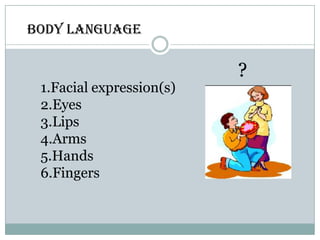
Body Language 1.Facial expression(s)2.Eyes3.Lips4.Arms 5.Hands6.Fingers?
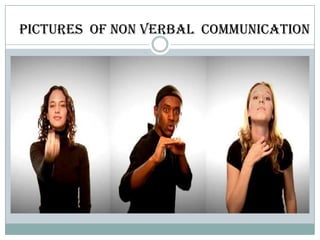
Pictures  of non verbal  communication
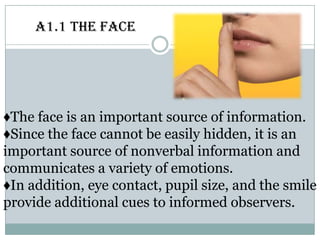
A1.1 The Face ♦The face is an important source of information.♦Since the face cannot be easily hidden, it is an     important source of nonverbal information and communicates a variety of emotions.♦In addition, eye contact, pupil size, and the smile provide additional cues to informed observers.
Tips to improve Non-Verbal Communication♦Positive NV behavior improves your non-verbal communication effectiveness.♦You can improve your effectiveness as a non-verbal communicator by observing and analyzing both the physical environment of interactions and the body language, appearance, gestures, vocal cues, eye contact, and touching behavior of the participants.♦Inculcate positive Body Sport.
Non Verbalcomm

Non Verbalcomm

  • 1.
    Non -Verbal CommunicationSUSHIL SHAKYADMS –PONDICHERRY UNIVERSITYMBA 1ST YEAR
  • 2.
    Non -Verbal Communication: AN OVERVIEW•INTRODUCTION•TYPES OF NON -VERBAL MESSAGES•BODY LANGUAGE•ARTIFACTUAL COMMUNICATION ANDCOLOR•SPACE AND DISTANCE / PROXEMICS•GENDER , DIVERSITY AND TECHNOLOGY•TIPS TO IMPROVE N-V COMMUNICATION
  • 3.
    NON-VERBAL COMMUNICATION :INTRODUCTION♦Non -Verbal Communication is the message or response not expressed or sent in words -hints , suggestions , indications.♦Actions speak louder than words.♦“What you are speaks so loudly that I cannot hear what you say” -Ralph Waldo Emerson♦There is a distinction between the meanings we ‘give’ in words and the meanings we ‘give –off ’ in NV signals.
  • 4.
    CONTINUE♦Non -Verbal signalsare unconscious parts of our behavior which is a deeply rooted part in our entire makeup.♦In fact, it is the most basic part of our personality.♦Behavior has no opposite, i.e. there is no such thing as non-behavior.
  • 5.
    TYPES OF NON-VERBALMESSAGESA. Body Language or KinesicsB. Clothing or Art factual CommunicationC. Voice or Paralanguage D. Space and Distance, or Proxemic factorsE. ColorF. Time, or Chronemics; andG. Touch, or Hepatics
  • 6.
    Body Language 1.Facialexpression(s)2.Eyes3.Lips4.Arms 5.Hands6.Fingers?
  • 7.
    Pictures ofnon verbal communication
  • 9.
    A1.1 The Face♦The face is an important source of information.♦Since the face cannot be easily hidden, it is an important source of nonverbal information and communicates a variety of emotions.♦In addition, eye contact, pupil size, and the smile provide additional cues to informed observers.
  • 10.
    Tips to improveNon-Verbal Communication♦Positive NV behavior improves your non-verbal communication effectiveness.♦You can improve your effectiveness as a non-verbal communicator by observing and analyzing both the physical environment of interactions and the body language, appearance, gestures, vocal cues, eye contact, and touching behavior of the participants.♦Inculcate positive Body Sport.