Nonfiction
 Creative Writing
     ENG 211
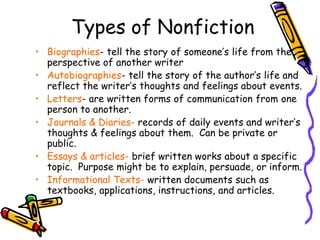
Types of Nonfiction
• Biographies- tell the story of someone’s life from the
  perspective of another writer
• Autobiographies- tell the story of the author’s life and
  reflect the writer’s thoughts and feelings about events.
• Letters- are written forms of communication from one
  person to another.
• Journals & Diaries- records of daily events and writer’s
  thoughts & feelings about them. Can be private or
  public.
• Essays & articles- brief written works about a specific
  topic. Purpose might be to explain, persuade, or inform.
• Informational Texts- written documents such as
  textbooks, applications, instructions, and articles.
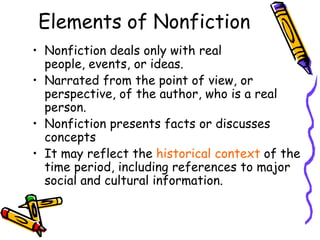
Elements of Nonfiction
• Nonfiction deals only with real
  people, events, or ideas.
• Narrated from the point of view, or
  perspective, of the author, who is a real
  person.
• Nonfiction presents facts or discusses
  concepts
• It may reflect the historical context of the
  time period, including references to major
  social and cultural information.
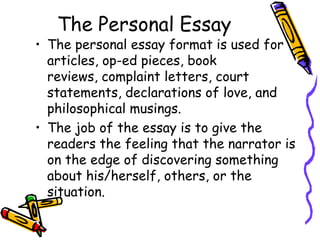
The Personal Essay
• The personal essay format is used for
  articles, op-ed pieces, book
  reviews, complaint letters, court
  statements, declarations of love, and
  philosophical musings.
• The job of the essay is to give the
  readers the feeling that the narrator is
  on the edge of discovering something
  about his/herself, others, or the
  situation.
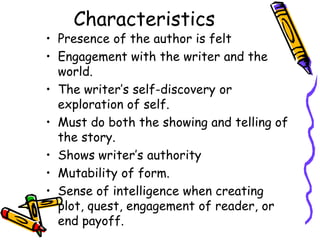
Characteristics
• Presence of the author is felt
• Engagement with the writer and the
  world.
• The writer’s self-discovery or
  exploration of self.
• Must do both the showing and telling of
  the story.
• Shows writer’s authority
• Mutability of form.
• Sense of intelligence when creating
  plot, quest, engagement of reader, or
  end payoff.
Personal Narrative Tips
• The place to look for the voice of
  your narrative is within yourself.
• To create a real world essay, you
  don’t have to be sensitive, rational, or
  reasonable.
• The writer will be considered an
  explorer—charting new territory and
  writing from the heart.
Tips Continued
• If using an anecdote, make sure to
  provide context.
• Don’t make up what didn’t happen but
  recreate what did happen in a way
  that is faithful to what you think
  happened.
• Commit all ideas to paper to create a
  rough guide to follow—draft by draft
  the story will emerge.
Tips Continued
• Understand that the story will
  change and morph as it develops
  though is may not reach any great
  conclusions or profound insights as
  long as the writer sees something
  fresher in the story.
General Information
• The strength of an essay comes from
  the connection the reader feels with
  the writer.
• Writers discover who they are by who
  they were, who they are, and who they
  are becoming.
• In nonfiction you must construct a
  realistic realm with storytelling, but
  there will also be
  interpretation, commentary, analysis, r
  eflection, opinions, and viewpoints.
Information Continued
• Must be fail to memories of
  events, characters actions, and what
  might have been said.
• The narrator for nonfiction is
  essentially the writer.
• Slight distortions and minor
  exaggerations are allowed.
• Make sure the writer’s presence or
  persona is felt in the story.
Information Continued
• Diversions can help the paper move
  forward and be stronger.
• A nonfiction story strives for a
  deeper understanding of something
  that the writer had in the
  beginning—it doesn’t have to reach
  a solution though.
• If the story about understanding
  something, there are questions that
  need to be answered along the way.
Information Continued
• Personal stories draw more toward
  themes and meanings because they
  are about someone’s real world that
  many see as recognizable.
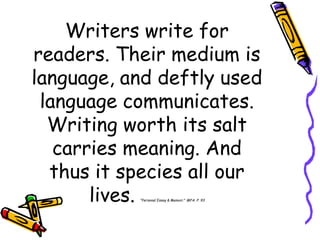
Writers write for
readers. Their medium is
language, and deftly used
 language communicates.
  Writing worth its salt
   carries meaning. And
  thus it species all our
       lives.
           ―Personal Essay & Memoir.‖ MFA. P. 93
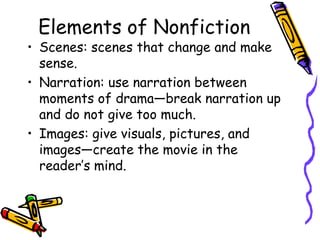
Elements of Nonfiction
• Scenes: scenes that change and make
  sense.
• Narration: use narration between
  moments of drama—break narration up
  and do not give too much.
• Images: give visuals, pictures, and
  images—create the movie in the
  reader’s mind.
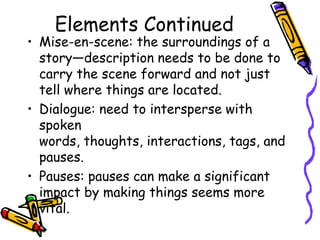
Elements Continued
• Mise-en-scene: the surroundings of a
  story—description needs to be done to
  carry the scene forward and not just
  tell where things are located.
• Dialogue: need to intersperse with
  spoken
  words, thoughts, interactions, tags, and
  pauses.
• Pauses: pauses can make a significant
  impact by making things seems more
  vital.
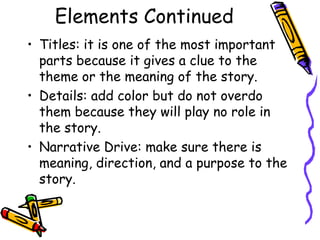
Elements Continued
• Titles: it is one of the most important
  parts because it gives a clue to the
  theme or the meaning of the story.
• Details: add color but do not overdo
  them because they will play no role in
  the story.
• Narrative Drive: make sure there is
  meaning, direction, and a purpose to the
  story.
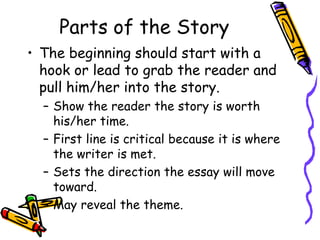
Parts of the Story
• The beginning should start with a
  hook or lead to grab the reader and
  pull him/her into the story.
  – Show the reader the story is worth
    his/her time.
  – First line is critical because it is where
    the writer is met.
  – Sets the direction the essay will move
    toward.
  – May reveal the theme.
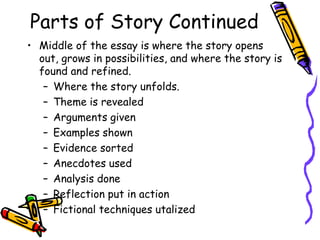
Parts of Story Continued
• Middle of the essay is where the story opens
  out, grows in possibilities, and where the story is
  found and refined.
   – Where the story unfolds.
   – Theme is revealed
   – Arguments given
   – Examples shown
   – Evidence sorted
   – Anecdotes used
   – Analysis done
   – Reflection put in action
   – Fictional techniques utalized
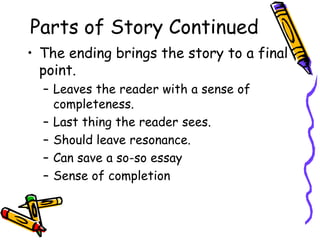
Parts of Story Continued
• The ending brings the story to a final
  point.
  – Leaves the reader with a sense of
    completeness.
  – Last thing the reader sees.
  – Should leave resonance.
  – Can save a so-so essay
  – Sense of completion
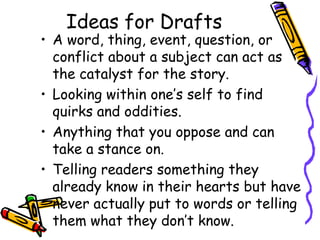
Ideas for Drafts
• A word, thing, event, question, or
  conflict about a subject can act as
  the catalyst for the story.
• Looking within one’s self to find
  quirks and oddities.
• Anything that you oppose and can
  take a stance on.
• Telling readers something they
  already know in their hearts but have
  never actually put to words or telling
  them what they don’t know.

Nonfiction

  • 1.
  • 2.
    Types of Nonfiction •Biographies- tell the story of someone’s life from the perspective of another writer • Autobiographies- tell the story of the author’s life and reflect the writer’s thoughts and feelings about events. • Letters- are written forms of communication from one person to another. • Journals & Diaries- records of daily events and writer’s thoughts & feelings about them. Can be private or public. • Essays & articles- brief written works about a specific topic. Purpose might be to explain, persuade, or inform. • Informational Texts- written documents such as textbooks, applications, instructions, and articles.
  • 3.
    Elements of Nonfiction •Nonfiction deals only with real people, events, or ideas. • Narrated from the point of view, or perspective, of the author, who is a real person. • Nonfiction presents facts or discusses concepts • It may reflect the historical context of the time period, including references to major social and cultural information.
  • 4.
    The Personal Essay •The personal essay format is used for articles, op-ed pieces, book reviews, complaint letters, court statements, declarations of love, and philosophical musings. • The job of the essay is to give the readers the feeling that the narrator is on the edge of discovering something about his/herself, others, or the situation.
  • 5.
    Characteristics • Presence ofthe author is felt • Engagement with the writer and the world. • The writer’s self-discovery or exploration of self. • Must do both the showing and telling of the story. • Shows writer’s authority • Mutability of form. • Sense of intelligence when creating plot, quest, engagement of reader, or end payoff.
  • 6.
    Personal Narrative Tips •The place to look for the voice of your narrative is within yourself. • To create a real world essay, you don’t have to be sensitive, rational, or reasonable. • The writer will be considered an explorer—charting new territory and writing from the heart.
  • 7.
    Tips Continued • Ifusing an anecdote, make sure to provide context. • Don’t make up what didn’t happen but recreate what did happen in a way that is faithful to what you think happened. • Commit all ideas to paper to create a rough guide to follow—draft by draft the story will emerge.
  • 8.
    Tips Continued • Understandthat the story will change and morph as it develops though is may not reach any great conclusions or profound insights as long as the writer sees something fresher in the story.
  • 9.
    General Information • Thestrength of an essay comes from the connection the reader feels with the writer. • Writers discover who they are by who they were, who they are, and who they are becoming. • In nonfiction you must construct a realistic realm with storytelling, but there will also be interpretation, commentary, analysis, r eflection, opinions, and viewpoints.
  • 10.
    Information Continued • Mustbe fail to memories of events, characters actions, and what might have been said. • The narrator for nonfiction is essentially the writer. • Slight distortions and minor exaggerations are allowed. • Make sure the writer’s presence or persona is felt in the story.
  • 11.
    Information Continued • Diversionscan help the paper move forward and be stronger. • A nonfiction story strives for a deeper understanding of something that the writer had in the beginning—it doesn’t have to reach a solution though. • If the story about understanding something, there are questions that need to be answered along the way.
  • 12.
    Information Continued • Personalstories draw more toward themes and meanings because they are about someone’s real world that many see as recognizable.
  • 13.
    Writers write for readers.Their medium is language, and deftly used language communicates. Writing worth its salt carries meaning. And thus it species all our lives. ―Personal Essay & Memoir.‖ MFA. P. 93
  • 14.
    Elements of Nonfiction •Scenes: scenes that change and make sense. • Narration: use narration between moments of drama—break narration up and do not give too much. • Images: give visuals, pictures, and images—create the movie in the reader’s mind.
  • 15.
    Elements Continued • Mise-en-scene:the surroundings of a story—description needs to be done to carry the scene forward and not just tell where things are located. • Dialogue: need to intersperse with spoken words, thoughts, interactions, tags, and pauses. • Pauses: pauses can make a significant impact by making things seems more vital.
  • 16.
    Elements Continued • Titles:it is one of the most important parts because it gives a clue to the theme or the meaning of the story. • Details: add color but do not overdo them because they will play no role in the story. • Narrative Drive: make sure there is meaning, direction, and a purpose to the story.
  • 17.
    Parts of theStory • The beginning should start with a hook or lead to grab the reader and pull him/her into the story. – Show the reader the story is worth his/her time. – First line is critical because it is where the writer is met. – Sets the direction the essay will move toward. – May reveal the theme.
  • 18.
    Parts of StoryContinued • Middle of the essay is where the story opens out, grows in possibilities, and where the story is found and refined. – Where the story unfolds. – Theme is revealed – Arguments given – Examples shown – Evidence sorted – Anecdotes used – Analysis done – Reflection put in action – Fictional techniques utalized
  • 19.
    Parts of StoryContinued • The ending brings the story to a final point. – Leaves the reader with a sense of completeness. – Last thing the reader sees. – Should leave resonance. – Can save a so-so essay – Sense of completion
  • 20.
    Ideas for Drafts •A word, thing, event, question, or conflict about a subject can act as the catalyst for the story. • Looking within one’s self to find quirks and oddities. • Anything that you oppose and can take a stance on. • Telling readers something they already know in their hearts but have never actually put to words or telling them what they don’t know.