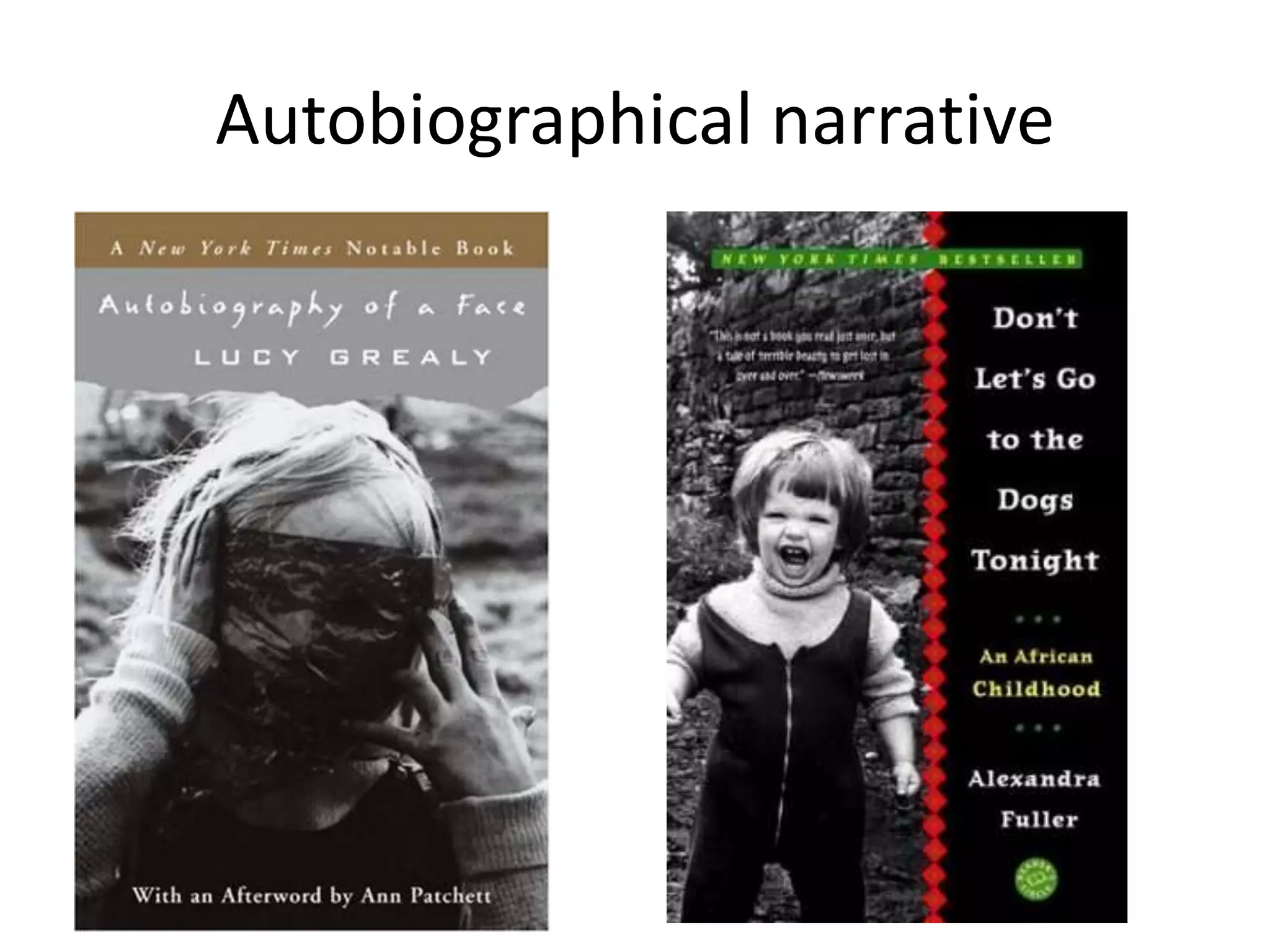
Autobiographical narrative
Open-form: Write it slant!

Sensory details

Figurative language

Emotions

Characters

Scenes
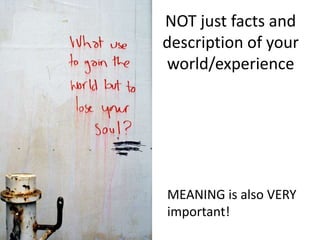
NOT just facts and
description of your
world/experience


MEANING is also VERY
important!
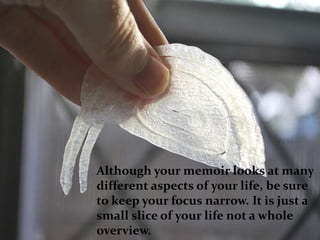
Although your memoir looks at many
different aspects of your life, be sure
to keep your focus narrow. It is just a
small slice of your life not a whole
overview.
The more specificity of detailed description
 and meaningful connections , the better.

                                    Truth is in
                                    the details.
                                    Show me
                                    and I’ll
                                    believe. Tell
                                    me and I
                                    won’t
                                    imagine.
Use plot development
to give the patchwork
quilt of your life’s
story more meaning
and depth
Old vs. new SELF


Transformation/breakthrough


                 Intervention?
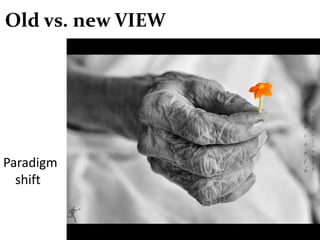
Old vs. new VIEW


Paradigm
  shift
Old vs. new VALUES


Crisis that creates conflict in values, with or
  without resolution
In-Class Activity

Write about/Discuss an event or
   person that changed you.
Four Elements of Memoir
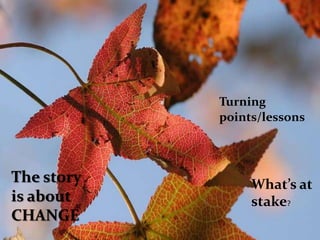
Turning
            points/lessons


The story        What’s at
is about         stake?
CHANGE
The
story is
 about
  YOU
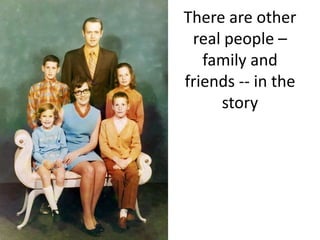
There are other
 real people –
   family and
friends -- in the
     story
Show them
realistically


                How?
Don’t let fear
of what your
family and
friends might
think do THIS
to you!
The story should not be blurted
out but instead, organized and
          structured.
LINGER IN DETAIL
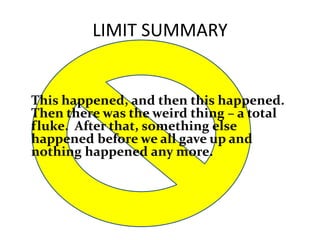
LIMIT SUMMARY


This happened, and then this happened.

Then there was the weird thing – a total
fluke. After that, something else
happened before we all gave up and
nothing happened any more.
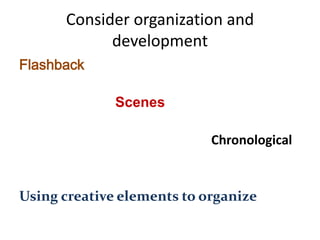
Consider organization and
            development
Flashback

              Scenes

                            Chronological


Using creative elements to organize
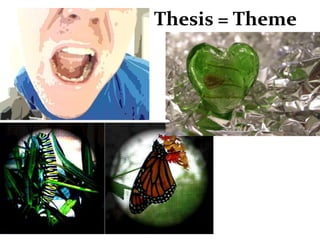
Thesis = Theme
CONFLICT CREATES PLOT


Description + conflict = meaning
Conflict occurs between…

two characters

a person and a place

a character and a feeling
Conflict can be explored but not solved
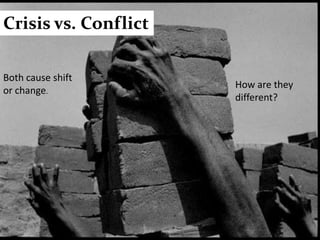
Crisis vs. Conflict

Both cause shift
                      How are they
or change.
                      different?
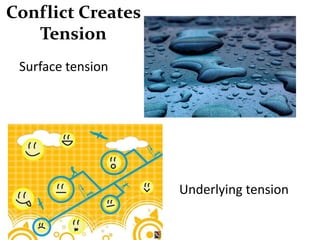
Conflict Creates
   Tension
 Surface tension


                   Underlying tension
Structural
Elements of
  Memoir
Character


      Develop on all
      levels, internal and
      external
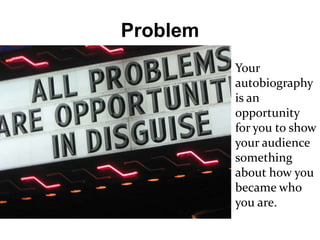
Problem
          Your
          autobiography
          is an
          opportunity
          for you to show
          your audience
          something
          about how you
          became who
          you are.
Struggle: What you go
through to get where
you are now
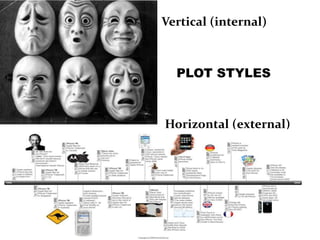
Vertical (internal)


  PLOT STYLES


Horizontal (external)
Epiphany
Resolution
SHOW!


 Reinforce what is being said about
 character’s growth by showing it in scene,
 description, dialogue…
Observational
 Writing and
  Sensory
 Description
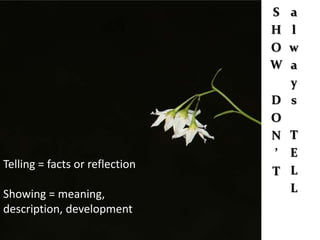
S a
                                H l
                                O w
                                W a
                                  y
                                D s
                                O
                                N T
                                ’ E
Telling = facts or reflection
                                T L
Showing = meaning,                L
description, development
How do you “show” your audience an
              essay?
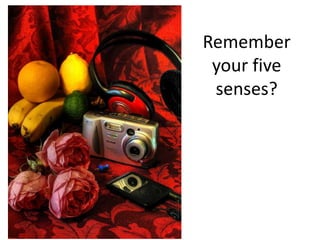
Remember
 your five
 senses?
ACTIVE, VIBRANT word choice

E
n
e
r
g
i
z
e
d
Figurative language
Similes…
“…Like a patient etherized upon a table.”


Metaphor…
 Sylvia Plath uses a cut on her finger to
 represent soldiers going to war.
Using Sensory Language to Create
Positive & Negative Images/Feelings
In-Class Activity
Create a POSITIVE start to Keith’s day. First, he
  eats breakfast. Then, he goes to the store,
  where he runs into a woman he knows; they
  talk and then he returns home

Flesh out the details of Keith’s
  adventure/misadventure using sensory detail,
  description
In-Class Activity…again…
Take Keith’s good day and ruin it, using
  description that evokes negative feelings or
  images.
Description creates
mood, or atmosphere, in
an essay
How do you expand the atmosphere of your essay?
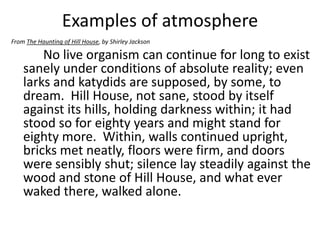
Examples of atmosphere
From The Haunting of Hill House, by Shirley Jackson

        No live organism can continue for long to exist
    sanely under conditions of absolute reality; even
    larks and katydids are supposed, by some, to
    dream. Hill House, not sane, stood by itself
    against its hills, holding darkness within; it had
    stood so for eighty years and might stand for
    eighty more. Within, walls continued upright,
    bricks met neatly, floors were firm, and doors
    were sensibly shut; silence lay steadily against the
    wood and stone of Hill House, and what ever
    waked there, walked alone.
In-Class Activity
Your main character arrives at a party, but
finds the atmosphere in the room so
horrendous that he/she decides to leave.
What is said? Why is he/she uncomfortable?
What is going on in the room? Create the
atmosphere for this party.
DIALOGUE
Dialogue MUST…

Move plot along

Develop characters

Set atmosphere or mood

Be concise and efficient
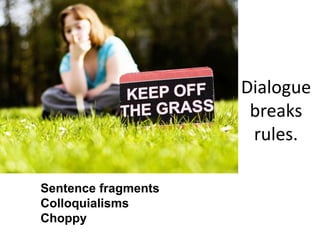
Dialogue
                      breaks
                      rules.

Sentence fragments
Colloquialisms
Choppy
Strong dialogue must have
            tension


Every word should count and have meaning
In-class Activity
Write dialogue between you and the person
who taught you to drive during your first
driving lesson behind the wheel.
Subtext
http://www.youtube.com/watch?v=W4fvYCFaa9
  I (Jurassic Park example)
In-Class Activity
Write dialogue between a couple who is
fighting over one of the partner’s never doing
the dishes. The subtext is one partner
suspects the other of cheating.
Writing Reflection


 Writing about
 what you are
 writing, about
 the story
Reflection acts as a narrative
  voice to guide your audience…


…an interpreter that tells not only what
happened, but why it happened and what it
means.
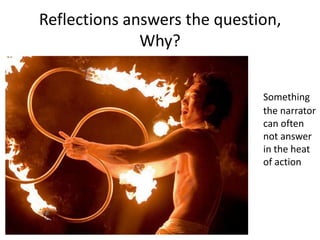
Reflections answers the question,
              Why?


                              Something
                              the narrator
                              can often
                              not answer
                              in the heat
                              of action
Metaphors as reflection
“not the sharpest knife in the block…”


                     Others?
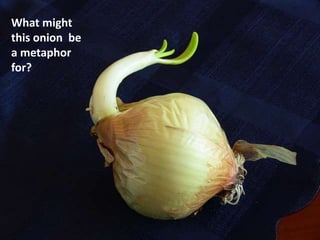
What might
this onion be
a metaphor
for?
In-Class Activity
 Think of three episodes in your life. What
 recurs in those three stages? It could be a hair
 style, a song, a person, a piece of jewelry, a
 car anything. Write just a few sentences about
 why this item was present in your life during
 those three stages and what role it played.

This is how metaphors are found.

English 100: Autobiographical Essay