Evaluation
ENG 111, College Composition I
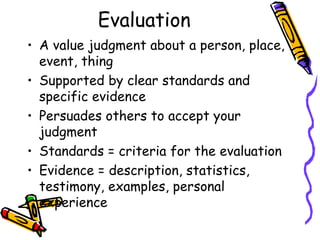
Evaluation
• A value judgment about a person, place,
  event, thing
• Supported by clear standards and
  specific evidence
• Persuades others to accept your
  judgment
• Standards = criteria for the evaluation
• Evidence = description, statistics,
  testimony, examples, personal
  experience
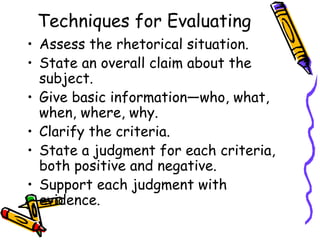
Techniques for Evaluating
• Assess the rhetorical situation.
• State an overall claim about the
  subject.
• Give basic information—who, what,
  when, where, why.
• Clarify the criteria.
• State a judgment for each criteria,
  both positive and negative.
• Support each judgment with
  evidence.
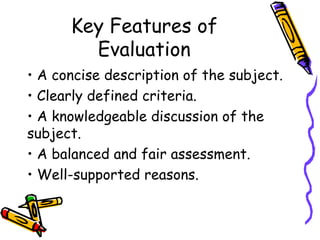
Key Features of
        Evaluation
• A concise description of the subject.
• Clearly defined criteria.
• A knowledgeable discussion of the
subject.
• A balanced and fair assessment.
• Well-supported reasons.
Types of Evaluations
• Evaluating Commercial Products or
  Services Toyota Prius – Shakespeare
  Ugly Stick – Verizon Wireless
• Evaluating Works of Art- The Flower
  Carrier by Diego Rivera
•
  Evaluating Performances – The Lord
  of the Rings trilogy• Compare and
  Contrast two topics – Toyota Prius vs.
  Honda Civic Hybrid
Guidelines for Writing an
        Evaluation
• Choose something to evaluate.
• Consider the rhetorical situation. –
  Purpose – Audience – Stance – Media/
  Design
Guidelines Continued
• Generate ideas and text.
• – Explore what you already know.
• – Find at least three sources that evaluate your
  topic (See External Links).
• – Identify criteria.
• – Use evidence, such as description, statistics,
  expert opinion, testimony, examples, and personal
  experience to evaluate the criteria.
• – Make judgments about the criteria and about
  the topic overall.
• – Anticipate other opinions.
• – Identify and support your reasons.
Shaping Your Evaluation
• Pick a genre:
  – Analysis by Criteria

  Introduction
  Criterion #1/Judgment + Evidence
  Criterion #2/Judgment +Evidence
  Criterion #3/Judgment + Evidence
  Conclusion
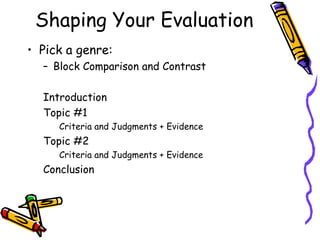
Shaping Your Evaluation
• Pick a genre:
  – Block Comparison and Contrast

  Introduction
  Topic #1
     Criteria and Judgments + Evidence
  Topic #2
     Criteria and Judgments + Evidence
  Conclusion
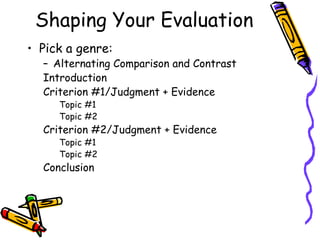
Shaping Your Evaluation
• Pick a genre:
  – Alternating Comparison and Contrast
  Introduction
  Criterion #1/Judgment + Evidence
     Topic #1
     Topic #2
  Criterion #2/Judgment + Evidence
     Topic #1
     Topic #2
  Conclusion
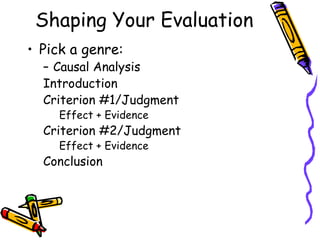
Shaping Your Evaluation
• Pick a genre:
  – Causal Analysis
  Introduction
  Criterion #1/Judgment
     Effect + Evidence
  Criterion #2/Judgment
     Effect + Evidence
  Conclusion
Shaping the Evaluation
• Catchy Title
• Introduction—provides background
  information, description, overall claim
  or thesis.
• Conclusion—reviews the strengths
  and weaknesses of the topic, makes
  the overall claim, or advises the
  reader.
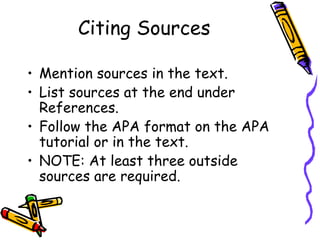
Citing Sources

• Mention sources in the text.
• List sources at the end under
  References.
• Follow the APA format on the APA
  tutorial or in the text.
• NOTE: At least three outside
  sources are required.
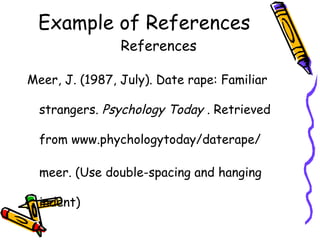
Example of References
                References

Meer, J. (1987, July). Date rape: Familiar

  strangers. Psychology Today . Retrieved

  from www.phychologytoday/daterape/

  meer. (Use double-spacing and hanging

  indent)
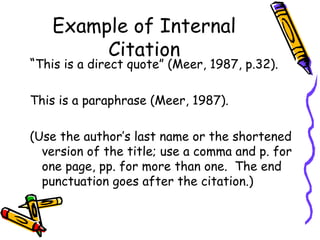
Example of Internal
         Citation
“This is a direct quote” (Meer, 1987, p.32).

This is a paraphrase (Meer, 1987).

(Use the author’s last name or the shortened
  version of the title; use a comma and p. for
  one page, pp. for more than one. The end
  punctuation goes after the citation.)
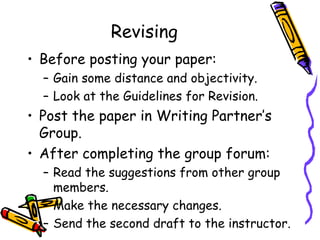
Revising
• Before posting your paper:
  – Gain some distance and objectivity.
  – Look at the Guidelines for Revision.
• Post the paper in Writing Partner’s
  Group.
• After completing the group forum:
  – Read the suggestions from other group
    members.
  – Make the necessary changes.
  – Send the second draft to the instructor.

Evaluation

  • 1.
  • 2.
    Evaluation • A valuejudgment about a person, place, event, thing • Supported by clear standards and specific evidence • Persuades others to accept your judgment • Standards = criteria for the evaluation • Evidence = description, statistics, testimony, examples, personal experience
  • 3.
    Techniques for Evaluating •Assess the rhetorical situation. • State an overall claim about the subject. • Give basic information—who, what, when, where, why. • Clarify the criteria. • State a judgment for each criteria, both positive and negative. • Support each judgment with evidence.
  • 4.
    Key Features of Evaluation • A concise description of the subject. • Clearly defined criteria. • A knowledgeable discussion of the subject. • A balanced and fair assessment. • Well-supported reasons.
  • 5.
    Types of Evaluations •Evaluating Commercial Products or Services Toyota Prius – Shakespeare Ugly Stick – Verizon Wireless • Evaluating Works of Art- The Flower Carrier by Diego Rivera • Evaluating Performances – The Lord of the Rings trilogy• Compare and Contrast two topics – Toyota Prius vs. Honda Civic Hybrid
  • 6.
    Guidelines for Writingan Evaluation • Choose something to evaluate. • Consider the rhetorical situation. – Purpose – Audience – Stance – Media/ Design
  • 7.
    Guidelines Continued • Generateideas and text. • – Explore what you already know. • – Find at least three sources that evaluate your topic (See External Links). • – Identify criteria. • – Use evidence, such as description, statistics, expert opinion, testimony, examples, and personal experience to evaluate the criteria. • – Make judgments about the criteria and about the topic overall. • – Anticipate other opinions. • – Identify and support your reasons.
  • 8.
    Shaping Your Evaluation •Pick a genre: – Analysis by Criteria Introduction Criterion #1/Judgment + Evidence Criterion #2/Judgment +Evidence Criterion #3/Judgment + Evidence Conclusion
  • 9.
    Shaping Your Evaluation •Pick a genre: – Block Comparison and Contrast Introduction Topic #1 Criteria and Judgments + Evidence Topic #2 Criteria and Judgments + Evidence Conclusion
  • 10.
    Shaping Your Evaluation •Pick a genre: – Alternating Comparison and Contrast Introduction Criterion #1/Judgment + Evidence Topic #1 Topic #2 Criterion #2/Judgment + Evidence Topic #1 Topic #2 Conclusion
  • 11.
    Shaping Your Evaluation •Pick a genre: – Causal Analysis Introduction Criterion #1/Judgment Effect + Evidence Criterion #2/Judgment Effect + Evidence Conclusion
  • 12.
    Shaping the Evaluation •Catchy Title • Introduction—provides background information, description, overall claim or thesis. • Conclusion—reviews the strengths and weaknesses of the topic, makes the overall claim, or advises the reader.
  • 13.
    Citing Sources • Mentionsources in the text. • List sources at the end under References. • Follow the APA format on the APA tutorial or in the text. • NOTE: At least three outside sources are required.
  • 14.
    Example of References References Meer, J. (1987, July). Date rape: Familiar strangers. Psychology Today . Retrieved from www.phychologytoday/daterape/ meer. (Use double-spacing and hanging indent)
  • 15.
    Example of Internal Citation “This is a direct quote” (Meer, 1987, p.32). This is a paraphrase (Meer, 1987). (Use the author’s last name or the shortened version of the title; use a comma and p. for one page, pp. for more than one. The end punctuation goes after the citation.)
  • 16.
    Revising • Before postingyour paper: – Gain some distance and objectivity. – Look at the Guidelines for Revision. • Post the paper in Writing Partner’s Group. • After completing the group forum: – Read the suggestions from other group members. – Make the necessary changes. – Send the second draft to the instructor.