Proposal/
  Problem Solving
ENG 111, College Composition I
Proposal/Problem Solving
• A problem is a situation, condition,
  attitude, person, place, or thing that is
  a “source of perplexity, distress, or
  vexation.”
• A problem can be global or local.

• *a proposal paper and a problem solving
  paper are the same thing.
Key Features
• A well-defined problem
• A recommended solution
• Convincing argument for proposed
  solution
• Anticipate questions
• A call to action
• An appropriate tone
Techniques for Problem Solving
• Analyze the political, social, cultural
  context.
• Identify and understand the audience.
• Demonstrate that a problem exists.
• Propose a solution or solutions.
• Persuade the audience that the proposal
  will work; address objections.
• Support the problem and solutions with
  evidence.
Demonstrate that a
          Problem Exists
•   Identify the problem.
•   Define it.
•   Indicate whom it affects.
•   Provide evidence that it exists.
    –   Expert opinion
    –   Examples
    –   Statistics
    –   Personal Experience
Proposing a Solution and
 Convincing the Audience
• Make specific recommendations.
• Provide reasons.
• Provide evidence: statistics,
  examples, expert opinion, personal
  experience.
• Examine feasibility and drawbacks.
Problem Solving: Choosing a
         Subject
• Narrow the topic.
• Identify your audience.
Collecting
• Identify and Focus on the Specific
  Problem:
  –   Who?
  –   What?
  –   When?
  –   Where?
  –   Why?
• Prove that the Problem Exists.
Collecting
• Demonstrate That the Problem
  Needs a Solution.
  – Discuss the effects of the problem,
    both short-term and long-term.
Collecting
• Discover Possible Solutions.
  – Explain what caused the problem
  – Ask “What if?” to explore solutions.
Collecting
• Evaluate Possible Solutions.
  – Apply the “If . . . then” test.
  – Does the proposal:
     • Solve the problem?
     • Meet certain criteria, such as cost-
       effectiveness, practicality, ethicality,
       legality?
     • Avoid creating new problems?
Collecting
• Convince the Audience.
  – Provide reasons.
  – Provide evidence: statistics, expert
    opinion, examples, personal experience.
Collecting
• Answer Possible Objections to the
  Proposal.
  – List drawbacks.
  – List responses.
Collecting
• List Possible Steps for
  Implementation.
• Call for Action.
Collecting
• Provide Evidence by Reading and
  Investigating.
  – Interview participants or authorities.
  – Use a questionnaire or survey.
  – Find articles or web sites addressing
    the problem.
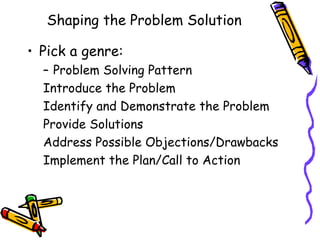
Shaping the Problem Solution

• Pick a genre:
  – Problem Solving Pattern
  Introduce the Problem
  Identify and Demonstrate the Problem
  Provide Solutions
  Address Possible Objections/Drawbacks
  Implement the Plan/Call to Action
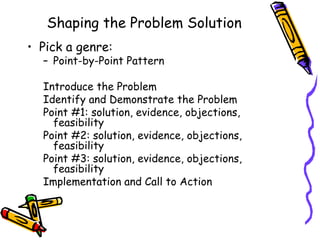
Shaping the Problem Solution
• Pick a genre:
  – Point-by-Point Pattern

  Introduce the Problem
  Identify and Demonstrate the Problem
  Point #1: solution, evidence, objections,
    feasibility
  Point #2: solution, evidence, objections,
    feasibility
  Point #3: solution, evidence, objections,
    feasibility
  Implementation and Call to Action
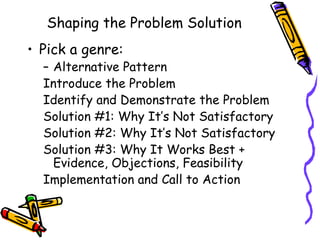
Shaping the Problem Solution
• Pick a genre:
  – Alternative Pattern
  Introduce the Problem
  Identify and Demonstrate the Problem
  Solution #1: Why It’s Not Satisfactory
  Solution #2: Why It’s Not Satisfactory
  Solution #3: Why It Works Best +
    Evidence, Objections, Feasibility
  Implementation and Call to Action
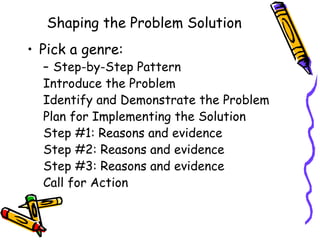
Shaping the Problem Solution
• Pick a genre:
  – Step-by-Step Pattern
  Introduce the Problem
  Identify and Demonstrate the Problem
  Plan for Implementing the Solution
  Step #1: Reasons and evidence
  Step #2: Reasons and evidence
  Step #3: Reasons and evidence
  Call for Action
Citing Sources

• Mention sources in the text.
• List sources at the end under
  References.
• Follow the APA format on the
  tutorial or in the text.
• NOTE: At least three outside
  sources are required.
APA Format
• In-text citation gets the author’s last
  name (if none, the title) and the copyright
  year. (Jones, 2005). However, if it is a
  direct quote, the page number is added
  with p. or pp. (Jones, 2005, p. 1).
• If using the author’s name in the sentence,
  the copyright date comes behind his name:
According to Jones (2005), APA style is a difficult citation
  format for first-time learners. (paraphrase)
According to Jones (2005), “APA style is a difficult citation
  format for first-time learners” (p. 1).
APA Continued
• The website address is included
  behind the phrase: Retrieved from
  http://www.etc. (do not use the web
  address in the in-text)
• Quotations are not used for minor
  titles in the Reference list, but are
  used in the in-text citation. (Still do
  not use all of the title if it is long,
  just the beginning.)
APA Continued
• In the WC is now called References
  and the copyright switches to be
  behind the initial of the author’s
  name. Titles only get the first words
  capitalized unless there is a colon or
  it is a professional journal.
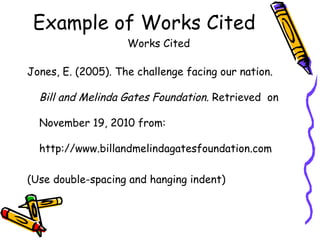
Example of Works Cited
                    Works Cited

Jones, E. (2005). The challenge facing our nation.

  Bill and Melinda Gates Foundation. Retrieved on

  November 19, 2010 from:

  http://www.billandmelindagatesfoundation.com

(Use double-spacing and hanging indent)
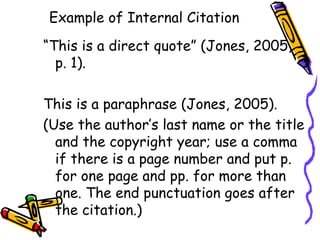
Example of Internal Citation
“This is a direct quote” (Jones, 2005,
  p. 1).

This is a paraphrase (Jones, 2005).
(Use the author’s last name or the title
  and the copyright year; use a comma
  if there is a page number and put p.
  for one page and pp. for more than
  one. The end punctuation goes after
  the citation.)
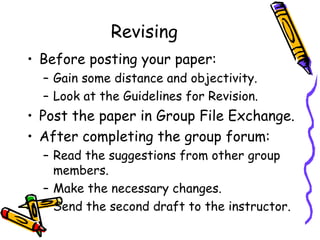
Revising
• Before posting your paper:
  – Gain some distance and objectivity.
  – Look at the Guidelines for Revision.
• Post the paper in Group File Exchange.
• After completing the group forum:
  – Read the suggestions from other group
    members.
  – Make the necessary changes.
  – Send the second draft to the instructor.

Problem solving

  • 1.
    Proposal/ ProblemSolving ENG 111, College Composition I
  • 2.
    Proposal/Problem Solving • Aproblem is a situation, condition, attitude, person, place, or thing that is a “source of perplexity, distress, or vexation.” • A problem can be global or local. • *a proposal paper and a problem solving paper are the same thing.
  • 3.
    Key Features • Awell-defined problem • A recommended solution • Convincing argument for proposed solution • Anticipate questions • A call to action • An appropriate tone
  • 4.
    Techniques for ProblemSolving • Analyze the political, social, cultural context. • Identify and understand the audience. • Demonstrate that a problem exists. • Propose a solution or solutions. • Persuade the audience that the proposal will work; address objections. • Support the problem and solutions with evidence.
  • 5.
    Demonstrate that a Problem Exists • Identify the problem. • Define it. • Indicate whom it affects. • Provide evidence that it exists. – Expert opinion – Examples – Statistics – Personal Experience
  • 6.
    Proposing a Solutionand Convincing the Audience • Make specific recommendations. • Provide reasons. • Provide evidence: statistics, examples, expert opinion, personal experience. • Examine feasibility and drawbacks.
  • 7.
    Problem Solving: Choosinga Subject • Narrow the topic. • Identify your audience.
  • 8.
    Collecting • Identify andFocus on the Specific Problem: – Who? – What? – When? – Where? – Why? • Prove that the Problem Exists.
  • 9.
    Collecting • Demonstrate Thatthe Problem Needs a Solution. – Discuss the effects of the problem, both short-term and long-term.
  • 10.
    Collecting • Discover PossibleSolutions. – Explain what caused the problem – Ask “What if?” to explore solutions.
  • 11.
    Collecting • Evaluate PossibleSolutions. – Apply the “If . . . then” test. – Does the proposal: • Solve the problem? • Meet certain criteria, such as cost- effectiveness, practicality, ethicality, legality? • Avoid creating new problems?
  • 12.
    Collecting • Convince theAudience. – Provide reasons. – Provide evidence: statistics, expert opinion, examples, personal experience.
  • 13.
    Collecting • Answer PossibleObjections to the Proposal. – List drawbacks. – List responses.
  • 14.
    Collecting • List PossibleSteps for Implementation. • Call for Action.
  • 15.
    Collecting • Provide Evidenceby Reading and Investigating. – Interview participants or authorities. – Use a questionnaire or survey. – Find articles or web sites addressing the problem.
  • 16.
    Shaping the ProblemSolution • Pick a genre: – Problem Solving Pattern Introduce the Problem Identify and Demonstrate the Problem Provide Solutions Address Possible Objections/Drawbacks Implement the Plan/Call to Action
  • 17.
    Shaping the ProblemSolution • Pick a genre: – Point-by-Point Pattern Introduce the Problem Identify and Demonstrate the Problem Point #1: solution, evidence, objections, feasibility Point #2: solution, evidence, objections, feasibility Point #3: solution, evidence, objections, feasibility Implementation and Call to Action
  • 18.
    Shaping the ProblemSolution • Pick a genre: – Alternative Pattern Introduce the Problem Identify and Demonstrate the Problem Solution #1: Why It’s Not Satisfactory Solution #2: Why It’s Not Satisfactory Solution #3: Why It Works Best + Evidence, Objections, Feasibility Implementation and Call to Action
  • 19.
    Shaping the ProblemSolution • Pick a genre: – Step-by-Step Pattern Introduce the Problem Identify and Demonstrate the Problem Plan for Implementing the Solution Step #1: Reasons and evidence Step #2: Reasons and evidence Step #3: Reasons and evidence Call for Action
  • 20.
    Citing Sources • Mentionsources in the text. • List sources at the end under References. • Follow the APA format on the tutorial or in the text. • NOTE: At least three outside sources are required.
  • 21.
    APA Format • In-textcitation gets the author’s last name (if none, the title) and the copyright year. (Jones, 2005). However, if it is a direct quote, the page number is added with p. or pp. (Jones, 2005, p. 1). • If using the author’s name in the sentence, the copyright date comes behind his name: According to Jones (2005), APA style is a difficult citation format for first-time learners. (paraphrase) According to Jones (2005), “APA style is a difficult citation format for first-time learners” (p. 1).
  • 22.
    APA Continued • Thewebsite address is included behind the phrase: Retrieved from http://www.etc. (do not use the web address in the in-text) • Quotations are not used for minor titles in the Reference list, but are used in the in-text citation. (Still do not use all of the title if it is long, just the beginning.)
  • 23.
    APA Continued • Inthe WC is now called References and the copyright switches to be behind the initial of the author’s name. Titles only get the first words capitalized unless there is a colon or it is a professional journal.
  • 24.
    Example of WorksCited Works Cited Jones, E. (2005). The challenge facing our nation. Bill and Melinda Gates Foundation. Retrieved on November 19, 2010 from: http://www.billandmelindagatesfoundation.com (Use double-spacing and hanging indent)
  • 25.
    Example of InternalCitation “This is a direct quote” (Jones, 2005, p. 1). This is a paraphrase (Jones, 2005). (Use the author’s last name or the title and the copyright year; use a comma if there is a page number and put p. for one page and pp. for more than one. The end punctuation goes after the citation.)
  • 26.
    Revising • Before postingyour paper: – Gain some distance and objectivity. – Look at the Guidelines for Revision. • Post the paper in Group File Exchange. • After completing the group forum: – Read the suggestions from other group members. – Make the necessary changes. – Send the second draft to the instructor.