Inventing Arguments Chapter 8 College Comp II
Arguing Values When arguing values, one is not just expressing personal opinion, but he/she is trying to shape others’ responses to something by making them see the same qualities or dimensions as the writer does. Job:  Understand the topic itself Detect what readers value in relation to the topic Change what readers value so they see the topic differently To address resistance to change.
Arguing Values Cont. The writer has to  Research the topic Understand the rhetorical situation Assert and support a way of seeing Counterargue Argument is a public affair, not a private complaint.
Arguing Values Cont. Starting Places Ask “How is this thing valuable or perilous?  On the college campus  An organization or corporation In popular culture In the media Sporting events Popular or consumer culture politics
Arguing Values Cont.  Analyzing the situation Questions: Who or what does the topic harm? Who or what does it benefit or help? Does the topic promote a particular kind of behavior, thought process or attitude? What is its purpose or intent? Despite its intent, what are its hidden effects?  What are its hidden effects?
Arguing Values Cont.  Entering Argument Conducting Surveys—short questionnaires Secondary Research Use electronic databases as well as key Internet researches Start with what others claim first and then look at what you claim.
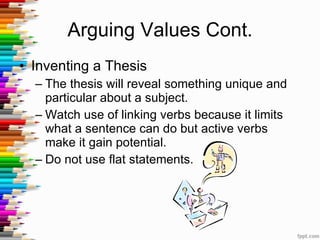
Arguing Values Cont. Inventing a Thesis The thesis will reveal something unique and particular about a subject. Watch use of linking verbs because it limits what a sentence can do but active verbs make it gain potential. Do not use flat statements.
Arguing Values Cont. Inventing Support Criteria: standards by which something is judged Analogies: showing similarities to other subjects or situations can add powerful layers to the argument Personal testimony: personal experiences to support claims Appeal to logic Appeal to value
Arguing Values Cont. Arrangement The thesis is usually the last sentence in the introduction  Add details early in the argument can create a foundation for the readers Counterarguments can go nearly anywhere and may be used in developing paragraphs Dismissing opposing positions too easily can shortchange one’s argument—good arguers carefully examine others’ positions, and even try to imagine contrary points. This helps them draw clear boundaries between their positions and others’.
Arguing Values Cont.  Evaluations can be used for arguments on values. Can be formal such as movie reviews, music reviews, book reviews, restaurant reviews, employee evaluations, teacher evaluations, etc.  What is the criteria on which something is being judged? How well does subject fulfill those criteria?
Arguing Values Cont.  Audience and voice Inclusion of we Concessions/qualifiers Asides (parenthetical comments)
Arguing Values Cont.  Revision Self Peer Instructor

Inventing arguments chap 8

  • 1.
    Inventing Arguments Chapter8 College Comp II
  • 2.
    Arguing Values Whenarguing values, one is not just expressing personal opinion, but he/she is trying to shape others’ responses to something by making them see the same qualities or dimensions as the writer does. Job: Understand the topic itself Detect what readers value in relation to the topic Change what readers value so they see the topic differently To address resistance to change.
  • 3.
    Arguing Values Cont.The writer has to Research the topic Understand the rhetorical situation Assert and support a way of seeing Counterargue Argument is a public affair, not a private complaint.
  • 4.
    Arguing Values Cont.Starting Places Ask “How is this thing valuable or perilous? On the college campus An organization or corporation In popular culture In the media Sporting events Popular or consumer culture politics
  • 5.
    Arguing Values Cont. Analyzing the situation Questions: Who or what does the topic harm? Who or what does it benefit or help? Does the topic promote a particular kind of behavior, thought process or attitude? What is its purpose or intent? Despite its intent, what are its hidden effects? What are its hidden effects?
  • 6.
    Arguing Values Cont. Entering Argument Conducting Surveys—short questionnaires Secondary Research Use electronic databases as well as key Internet researches Start with what others claim first and then look at what you claim.
  • 7.
    Arguing Values Cont.Inventing a Thesis The thesis will reveal something unique and particular about a subject. Watch use of linking verbs because it limits what a sentence can do but active verbs make it gain potential. Do not use flat statements.
  • 8.
    Arguing Values Cont.Inventing Support Criteria: standards by which something is judged Analogies: showing similarities to other subjects or situations can add powerful layers to the argument Personal testimony: personal experiences to support claims Appeal to logic Appeal to value
  • 9.
    Arguing Values Cont.Arrangement The thesis is usually the last sentence in the introduction Add details early in the argument can create a foundation for the readers Counterarguments can go nearly anywhere and may be used in developing paragraphs Dismissing opposing positions too easily can shortchange one’s argument—good arguers carefully examine others’ positions, and even try to imagine contrary points. This helps them draw clear boundaries between their positions and others’.
  • 10.
    Arguing Values Cont. Evaluations can be used for arguments on values. Can be formal such as movie reviews, music reviews, book reviews, restaurant reviews, employee evaluations, teacher evaluations, etc. What is the criteria on which something is being judged? How well does subject fulfill those criteria?
  • 11.
    Arguing Values Cont. Audience and voice Inclusion of we Concessions/qualifiers Asides (parenthetical comments)
  • 12.
    Arguing Values Cont. Revision Self Peer Instructor