Inventing Arguments Chapter 6 & 7 College Comp II
Arguing Definitions When arguing definitions, the writer is asking “What is it?”  It requires defining something in a way that brings out its profound significance for how one might live and think.  They allow people to make other arguments.
Arguing Definitions Cont.  There needs to be a common understanding of certain concepts; otherwise, decisions about public affairs are nearly impossible.  Each discipline defines things differently; each has its own definitions of its own work; each creates its own new knowledge.
Writing About Definitions Starting Places: Focus on a specific situation or thing—and ask whether it falls within or outside of a definition.  Popular culture Politics School Work A reading from the chapter
Writing About Definitions Cont.  Focus on a term—and argue for a specific definition. What term do people misunderstand or misapply? What is the most important debate currently being waged in your community? What is the definition at the root of the debate? What is the most important cultural or national debate? What is the underlying misunderstood aspect?
Writing Definitions Cont.  Focus on an unstated definitional argument that lurks in a common practice. Focus on the visual. How does the appearance and design of a course textbook define college?  How does a particular fashion trend define gender or sexual orientation? Look for visual arguments about definitions where you work.
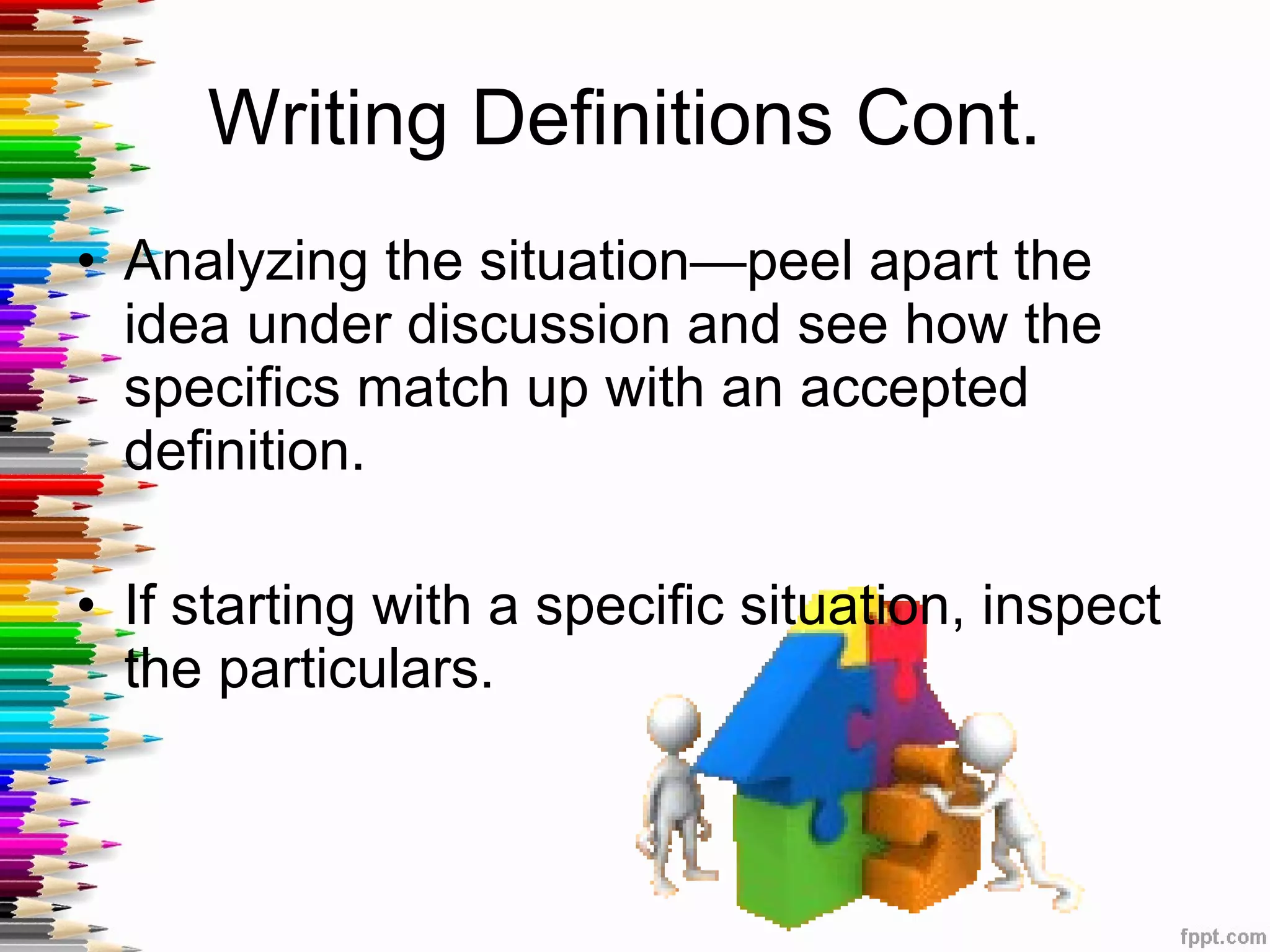
Writing Definitions Cont.  Analyzing the situation—peel apart the idea under discussion and see how the specifics match up with an accepted definition. If starting with a specific situation, inspect the particulars.
Writing Definitions Cont.  If your starting place is a specific situation or think, consider the following questions: What are the particular qualities of the situation or thing? How do those particular qualifiers match up with an agreed-upon definition?
Writing Definitions Cont.  If your starting place is a general term, consider the following questions: What specific behaviors, attitudes, values, policies, or qualities does the term involve? What specific qualities differentiate it from other like thinks? What is its opposite? Under what conditions does it thrive? Under what conditions does it suffer?
Writing Definitions Cont.  Entering argument—bridge an understanding between common conceptions of the topic and their own unique ideas. Conducting Surveys Researching Sources Periodical databases Newspaper databases Internet
Writing Definitions Cont.  Inventing a Thesis Argue that the particular situation, event, show, etc., does or does not match a definition Argue that a common term is often misapplied or entirely misunderstood.
Writing Definitions Cont.  Inventing Support—find support for your opinions Examples Scenarios Allusions Testimony Lines of reasoning Analogical reasoning Appeals to value
Writing Definitions Cont. Arrangement Where should I give my definition? How should I counter opposing definitions? Does a concession or qualifier have to go in every argument?  How many other definitions should I include? With all these different support strategies, how do I know where they should go?
Writing Definitions Cont.  Audience and Voice Formality Informality Informality/formality
Writing Definitions Cont.  Revision Peer Review Instructor comment
Arguing Causes When arguing causes, the writer is asking “Why did this happen?” and understanding the sophisticated causal arguments that go along with the answer. It is looking for assertions about causes, and different perspectives will generate different answers to this question.
Arguing Causes Cont.  It is looking beyond the obvious causes to those lurking on the fringes or that might be overlooked.
Writing About Causes Starting Places: local event or situation particular behavior or trend in college life particular political phenomenon social phenomenon popular culture phenomenon situation in your academic discipline or career field
Writing About Causes Cont. Analyzing the Situation Personal Social Cultural Political Need to lay some intellectual groundwork before diving into the topic.
Writing About Causes Cont.  Questions What are the most direct causes? What economic or business conditions may have figured in? What attitudes, fears, or values may have initiated it or indirectly supported it? What people, organizations, or institution were directly or indirectly involved? Might some basic human need or fundamental physical principle have played a part?
Writing About Causes Cont.  Entering Argument Look in periodical databases such as EBSCOhost Look on Internet search engines such as Google.  If there is no clear debate, you are responsible for making it.  If there are two sides, need to address the supposed causes.  Don’t pick something that has been over-analyzed.
Writing About Causes Cont.  Inventing a Thesis Asserting a single cause—some have preconditions, so clear them and find a single cause Asserting multiple causes—point to several causes instead of one when there are too many influencing factors. Transcending common wisdom—some things people will hold as widely held views but writer can open up new logic about the topic.
Writing About Causes Cont.  Inventing Support: Local authorities Hidden layers Questions: What line of reasoning must I establish and how do I support? What historical or current events or figures illustrate something about the topic? What local authority might help reveal something about the topic? What are the logical causes of the topic on the community—or broader society? What hidden, or indirect, factors can I describe?
Writing About Causes Cont. Arrangement The thesis can be implied, but usually given as the last sentence in the introduction Figure how to use scientific research, but don’t overwhelm readers. If there are multiple causes, develop each in its own paragraph. Create the reader’s journey through the argument.
Writing About Causes Cont.  Audience and Voice Voice and sentence variety Voice and pronouns (stick to third person) Do not use statements like “I think,” “I feel,” “I believe,” etc. as these are not needed since the reader knows the writer is presenting what he/she thinks, feels, or believes.
Writing About Causes Cont. Revision Review yourself Peer Review Instructor review

Inventing arguments 6 7

  • 1.
    Inventing Arguments Chapter6 & 7 College Comp II
  • 2.
    Arguing Definitions Whenarguing definitions, the writer is asking “What is it?” It requires defining something in a way that brings out its profound significance for how one might live and think. They allow people to make other arguments.
  • 3.
    Arguing Definitions Cont. There needs to be a common understanding of certain concepts; otherwise, decisions about public affairs are nearly impossible. Each discipline defines things differently; each has its own definitions of its own work; each creates its own new knowledge.
  • 4.
    Writing About DefinitionsStarting Places: Focus on a specific situation or thing—and ask whether it falls within or outside of a definition. Popular culture Politics School Work A reading from the chapter
  • 5.
    Writing About DefinitionsCont. Focus on a term—and argue for a specific definition. What term do people misunderstand or misapply? What is the most important debate currently being waged in your community? What is the definition at the root of the debate? What is the most important cultural or national debate? What is the underlying misunderstood aspect?
  • 6.
    Writing Definitions Cont. Focus on an unstated definitional argument that lurks in a common practice. Focus on the visual. How does the appearance and design of a course textbook define college? How does a particular fashion trend define gender or sexual orientation? Look for visual arguments about definitions where you work.
  • 7.
    Writing Definitions Cont. Analyzing the situation—peel apart the idea under discussion and see how the specifics match up with an accepted definition. If starting with a specific situation, inspect the particulars.
  • 8.
    Writing Definitions Cont. If your starting place is a specific situation or think, consider the following questions: What are the particular qualities of the situation or thing? How do those particular qualifiers match up with an agreed-upon definition?
  • 9.
    Writing Definitions Cont. If your starting place is a general term, consider the following questions: What specific behaviors, attitudes, values, policies, or qualities does the term involve? What specific qualities differentiate it from other like thinks? What is its opposite? Under what conditions does it thrive? Under what conditions does it suffer?
  • 10.
    Writing Definitions Cont. Entering argument—bridge an understanding between common conceptions of the topic and their own unique ideas. Conducting Surveys Researching Sources Periodical databases Newspaper databases Internet
  • 11.
    Writing Definitions Cont. Inventing a Thesis Argue that the particular situation, event, show, etc., does or does not match a definition Argue that a common term is often misapplied or entirely misunderstood.
  • 12.
    Writing Definitions Cont. Inventing Support—find support for your opinions Examples Scenarios Allusions Testimony Lines of reasoning Analogical reasoning Appeals to value
  • 13.
    Writing Definitions Cont.Arrangement Where should I give my definition? How should I counter opposing definitions? Does a concession or qualifier have to go in every argument? How many other definitions should I include? With all these different support strategies, how do I know where they should go?
  • 14.
    Writing Definitions Cont. Audience and Voice Formality Informality Informality/formality
  • 15.
    Writing Definitions Cont. Revision Peer Review Instructor comment
  • 16.
    Arguing Causes Whenarguing causes, the writer is asking “Why did this happen?” and understanding the sophisticated causal arguments that go along with the answer. It is looking for assertions about causes, and different perspectives will generate different answers to this question.
  • 17.
    Arguing Causes Cont. It is looking beyond the obvious causes to those lurking on the fringes or that might be overlooked.
  • 18.
    Writing About CausesStarting Places: local event or situation particular behavior or trend in college life particular political phenomenon social phenomenon popular culture phenomenon situation in your academic discipline or career field
  • 19.
    Writing About CausesCont. Analyzing the Situation Personal Social Cultural Political Need to lay some intellectual groundwork before diving into the topic.
  • 20.
    Writing About CausesCont. Questions What are the most direct causes? What economic or business conditions may have figured in? What attitudes, fears, or values may have initiated it or indirectly supported it? What people, organizations, or institution were directly or indirectly involved? Might some basic human need or fundamental physical principle have played a part?
  • 21.
    Writing About CausesCont. Entering Argument Look in periodical databases such as EBSCOhost Look on Internet search engines such as Google. If there is no clear debate, you are responsible for making it. If there are two sides, need to address the supposed causes. Don’t pick something that has been over-analyzed.
  • 22.
    Writing About CausesCont. Inventing a Thesis Asserting a single cause—some have preconditions, so clear them and find a single cause Asserting multiple causes—point to several causes instead of one when there are too many influencing factors. Transcending common wisdom—some things people will hold as widely held views but writer can open up new logic about the topic.
  • 23.
    Writing About CausesCont. Inventing Support: Local authorities Hidden layers Questions: What line of reasoning must I establish and how do I support? What historical or current events or figures illustrate something about the topic? What local authority might help reveal something about the topic? What are the logical causes of the topic on the community—or broader society? What hidden, or indirect, factors can I describe?
  • 24.
    Writing About CausesCont. Arrangement The thesis can be implied, but usually given as the last sentence in the introduction Figure how to use scientific research, but don’t overwhelm readers. If there are multiple causes, develop each in its own paragraph. Create the reader’s journey through the argument.
  • 25.
    Writing About CausesCont. Audience and Voice Voice and sentence variety Voice and pronouns (stick to third person) Do not use statements like “I think,” “I feel,” “I believe,” etc. as these are not needed since the reader knows the writer is presenting what he/she thinks, feels, or believes.
  • 26.
    Writing About CausesCont. Revision Review yourself Peer Review Instructor review