FICTION
AND
PROSE
Elijah Marvin Santos Guangco
Instructor
Fiction
- it is literature in the form of prose.
- it is considered as the type of style used for
writing SHORT STORIES and NOVELS.
- it uses imaginary events and characters.
- in the 21st century, it is adapted into movies.
Prose
- it is a type of language.
- it is written and is used in literature.
- it is oridnary in form.
- it follows no metrical structure.
Examples:
Novels
Title: The Perks if Being a Wallflower
Author: Stephen Chbosky
This is a story about a
typical teenager from school who
experiences a coming-of-age upon
meeting a schoolmate.
Title: Everything, Everything
Author: Nicola Yoon
This is a novel about a sick
teenager who finds meaning in life
through love and the appreciation of
everything around her.
Examples:
Short Stories
Title: A Rose for Emily
Author: William Faulkner
It is a story about Emily,
an aristocrat who has a hard time
accepting new trends and still
chooses to live in the old ways of
aristocratic life. She alienates herself
from other people, which also
affects even demography. She is
soon found dead and after a few
days, a locked door is forced open.
There they found a decaying body
of a man who is believed to be the
love of her life, but there is more.
They found an indentation of a
head on the pillow and a long
strand of hair that they believe
belonged to emily.
Title: Rashomon
Author: Ryunosuke Akutagawa
This is a story about a
samurai who had just gave up
his title and is having a hard
time getting over it. He then
meets an olf woman who tests
his valiance and chivalry.
Examples:
Movies
Title: Moana
Directors: Ron Celements and Don
Hall
The film concentrates on
an excellent girl who decides to
have an adventure to prove herself
a master wayfinder and completes
her ancestors’ quest. On the
journey, Moana confronts Maui
who is the once mighty demigod
and they explore the big world
together.
Title: Split
Director: M. Night Shyamalan
Three girls are
kidnapped by "Dennis", one of
the 23 split personalities
inhabiting the body of Kevin
Wendell Crumb. As they are
held captive, a final personality,
"The Beast", begins to
materialize.
THE
ELEMENTS
OF
FICTION
CHARACTERS
CHARACTERS
- are the people whom with whom the story revolves
around.
- are usually the recipients or the causes of different
conflicts.
- they can be good or bad.
- some stay and some go away during any part of the
story.
- are unique from one another.
- they can be humans, animals, objects, supernatural being,
or anything that you can give human attributes to.
Examples:
Why are characters important?
Characters are important, because as readers need the
following:
1. Someone to invest in- “I like Goblin compared to the
Grim Reaper”
2. Someone to care about- “Bakit wala parin yung mga
pulis?!”
3. Someone to root for- “Gana ya ba se dimiyo idol. Muri
ya se dikaw!”
CHARACTERIZATION
CHARACTERIZATION
- it is the creation or the construction of a
fictional character.
- it is how a character is described.
- it is the description of the characters' features.
- it is the description of the characters'
attitudes.
- it is the description of the characters as a
whole.
Examples:
From the outside, Elsa looks poised, regal and reserved, but in reality, she lives in fear as
she wrestles with a mighty secret—she was born with the power to create ice and snow.
It’s a beautiful ability, but also extremely dangerous. Haunted by the moment her magic
nearly killed her younger sister Anna, Elsa has isolated herself, spending every waking
minute trying to suppress her growing powers. Her mounting emotions trigger the magic,
accidentally setting off an eternal winter that she can’t stop. She fears she’s becoming a
monster and that no one, not even her sister, can help her.
PHYSICAL APPEARANCE• about 30 years old• large, green ogre• 193cm tall• round face•
two ears that look like antennae• wears dirty, white shirt with crocodile skinvest; cloth
shoes; brown belt
PERSONALITY• Peaceful (when he gets to live alone)• Cranky (when he is bothered by
others)• Careful (he doesn’t want to hurt anyone)• Loner (he likes to live alone)•
Kindhearted(he doesn’t mean tohurt others
SKILLS• Good at:– scaring off villagers by roaring at them– fighting and protecting himself–
cooking “Weed Rat Stew”• Bad at:– making friends– using his manners
RELATIONSHIPS• Donkey– sidekick and best friend• Princess Fiona– he meets her when he
was rescuing her from acastle– he falls in love with her– he marries her
LIKES AND DISLIKES• Likes– taking mud showers in his swamp– snacking on slugs and
bugs• Dislikes– people coming into his swamp– Donkey’s annoying sounds– Lord
Farquaad
THE TWO MAJOR TYPES OF CHARACTERS
Protagonist
Antagonist
Protagonist
- is one of the major characters in a story.
- is the one who receives the blow from
the antagonist.
- is the one who comes out with a loss or
victorious at the end of a story.
Examples:
Title:
The Stoning of Soraya M.
Protagonist:
Soraya M.
Title:
The Boy in Striped Pyjamas
Protagonists:
Bruno and Shmuel
Title:
The Fault in Out Stars.
Protagonists:
Augustus Waters
Hazel Grace Lancaster
a
Examples:
Title:
The Grave of the Fireflies
Protagonist:
Title:
The Twilight Saga
Protagonist:
Edward Cullen
Antagonist
- is the one in conflict with the protagonist.
- is the one who terrorizes the protagonist,
but gives the protagonist a sense of
realization.
- it can be a single person or as many as a
tribe.
Examples:
Title:
The Stoning of Soraya M.
Antagonist:
Ali
Title:
The Grave of the Fireflies
Antagonists:
America
Title:
The Boy in Striped Pyjamas
Antagonists:
The Members of the Nazi
Examples:
Title:
The Twilight Saga
Antagonists:
Victoria
Laurent
James
THE FOUR ASPECTS CHARACTERIZATION
Static Character Dynamic Character
Flat Character Round Character
STATIC versus Dynamic
This character does not exhibit any change in terms of
his or her role from the beginning towards the end of the
story.
This character is often easier to build.
This character needs careful scrutiny, so as not to be
mistaken as a flat character, because a static character is
hard to spot.
This character experiences major transitions.
This character does not exhibit any change in terms of
attitude.
This character exhibits change in terms of attitude.
This character does not exhibit any change in terms of
purpose.
This character is usually molded by trials and tribulations.
This character does not exhibit change in behaviour. Experiences maturity through having a change of heart or
through developing likeable qualities.
This character does not exhibit redemption; thus, nothing
about this character is highlighted.
A character does not usually exhibit a dynamic attitude.
This character remains unchanged in spite of the changing
world around him or her.
A character is dynamic depending on the qualities that
change through time.
Examples of Static Characters:
Character: Fin
Title: Adventure Time
Character: Scar
Title: The Lion King
Examples of Dynamic Characters:
Character: Harry Potter
Title: Harry Potter
Character: Daenerys Targaryen
Title: The Game of Thrones
FLAT versus ROUND
This character is uncomplicated and remains the
same through out the story.
This character is comple, because he or she
undergoes a significant change.
Unlike a static character, a flat character has two
highlighted traits.
This character may even have contradictory traits.
This character can be summed up in two sentences. This character cannot be summed up in small
sentences.
They have a tendency to be static. They tend to be dynamic characters.
They are easily recognized. They are easily recognized, because the story
usually revolves around them.
Does not surprise readers, because they are very
predictable.
Greatly surprises the readers.
Is affected by the events, but these events are not
strong enough for this character to have a change of
heart.
Is greatly affected by events, because these events
mold this character in to a better or a worse
character.
Examples of Flat Characters:
Character:Olaf
Title: Frozen
Character: Gollum
Title: The Lord of the Rings
Examples of Round Characters:
Character: Beast
Title: Beauty and the Beast
Characters: Marlon, Dory and Nemo
Title: Finding Nemo
Why is characterization important?
- it helps the readers visualize the characters.
- it helps the readers relate to the character.
- it gives the readers and opportunity to examine the
characters; thus, allowing them a healthy bias.
- it helpd the readers understand the actions of the
characters deeply.
- it helps the readers understand the different motivations
and dowsides of a characters.
SETTING
SETTING
- it is where a story takes place
- it is used to give the readers a context, that will help
during the analysis of a text.
- it helps the readers get a hold of the possible
situation wherein the text revolves on; thus,
allowing the readers to relate more or visualize
better.
- it is sometimes equal in signifiance as the characters
themselves.
Examples:
Narnia Hogwarts
A Setting...
- can be large and all encompassing.
- can be very intimate areas.
- can be any time of the day.
- can be any season (natural).
- can be any season (man made celebrations)
- can be any type of climate.
- can be an era.
- can be abstract settings.
Examples:
Large and all Encompassing
Jungle CityHospital
Examples:
Very Intimate Areas
Kitchen Alley WayRoom
Examples:
Any Time of the Day
Dawn TwilightHigh Noon
Examples:
Any Season (Natural)
Winter SummerFall
Examples:
Any Season (Man Made Celebrations)
Christmas HanukkahRamadhan
Examples:
Any Type of Climate
Cold HumidHot
Examples:
An Era or Dynasties
Joseon Era Silla EraGoryeo Era
Examples:
Abstract Settings
Joyous SadEerie
Why is the setting important?
It's important because it shapes the mood and
tone of your story, because the time and places
we live in affect our perceptions and actions
and because time and place are the basic
elements of fiction that give readers a vivid
mental picture of the world your characters
move in.
PLOT
PLOT
- is the series of events that happen in a
story.
- is usually referred to as the “flow”
of the story.
- is the arrangement of happenings in a
story.
DIFFERENT PLOT TYPES
Conventional Plot
Episodic Plots
Flashback
In Medias Re
Conventional Plot
- a conventional plot follows a straight
or linear flow of events that has a
start, a middle part, and a finish.
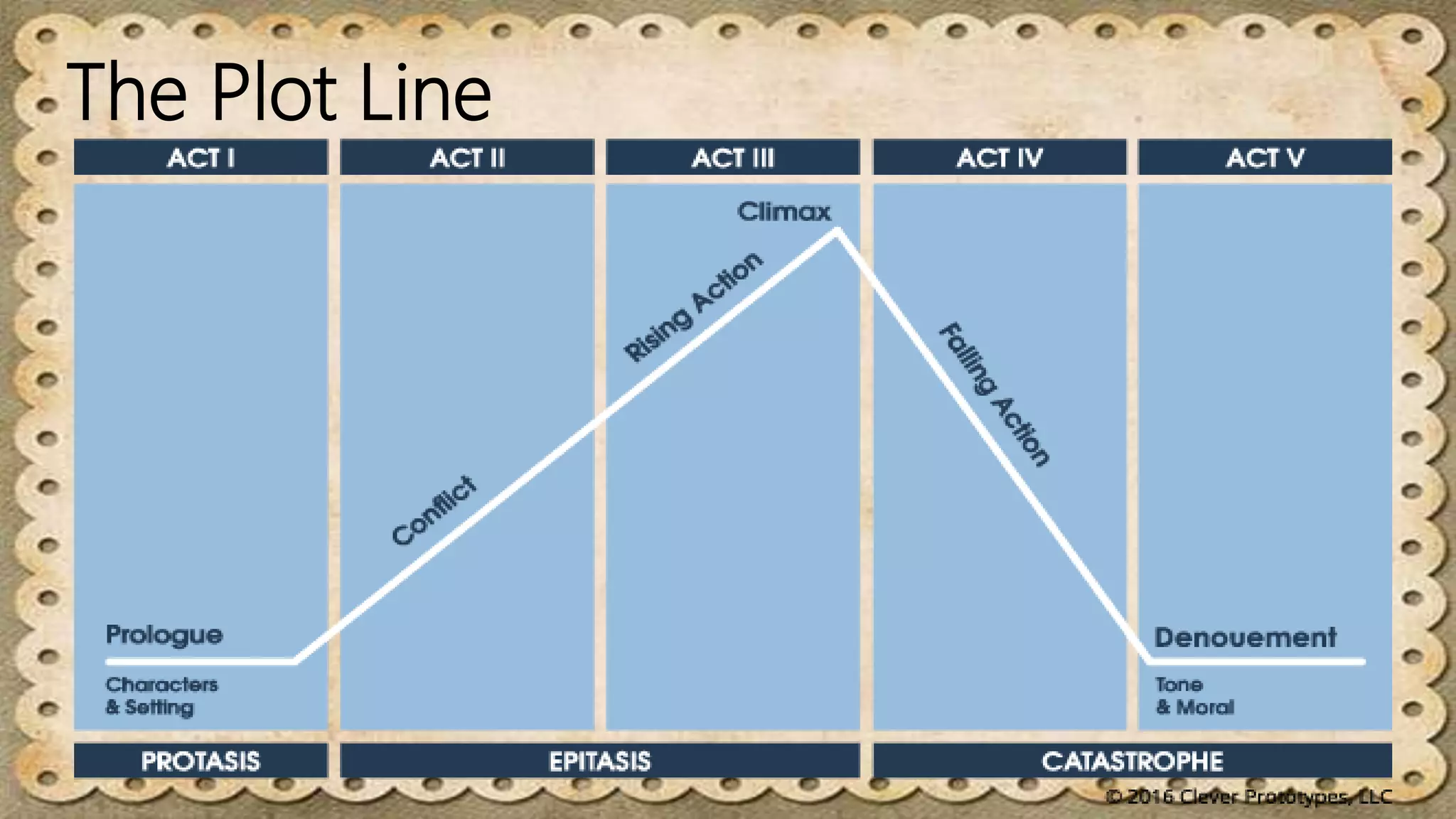
Parts of a Conventional Plot
1. Exposition- it provides background information needed to
make sense of the action, describes the setting, and
introduces the major characters.
2. Conflicts- it is the moment of great tension.
3. Climax- turning point, a moment of greatest tension that
fixes the outcome.
4. Resolution- the fixing or the resolution of the different
conflicts.
5. Dénouement- it is where the action falls off (falling
action) as the plot’s complications are sorted out and
resolved.
The Plot Line
Examples:
Spiderman The Story of Moses
Episodic Plot
- are plots that still function as
conventioanl plots, but they come in
series.
- are a series of conventional plots that
can be found in one story.
Examples:
How to Get Away with Murder
Thirteen Reasons Why
The Walking Dead
Flashback
- the author shares to the reader an event that has
happened in the past. This past event is where the story
focuses on.
- this usually ends up in the present context of the story.
- this is done to explain the current context of the story;
thus, there is a need to go back to the past.
- this is also used to provide background not only about the
person, but the setting and other events as well.
Examples:
Titanic The Notebook
The Life of Pi
In Medias Res
- the author chooses to start the story in the
middle of a situation.
- the current situation of the context is not
explained.
- the beginning of the story is already
established with the conflicts; thus, the
exposition does not exist.
Examples:
Predestination The Notebook
The Hunger Games
Why is having a plot important?
- having a plot is important, because the plot
gives the flow in a story. It organizes thoughts,
ideas, and events; thus, making readers readers
enjoy reading - or watching a movie- without
confusion.
POINT OF VIEW
POINT OF VIEW
- it answers the question “Who is telling the
story?”or “Who is the narrator?”
- it explains the perspective that the story is
coming from; thus, making the readers
consider if it is biased or not.
DIFFERENT POINTS OF VIEW
First Person Point of View
Third Person Point of View:
Omniscient
Limited Omniscient
Objective
First Person Point of View
The narrator presents the point of view of only
one character's consciousness, which limits the
narrative to what the first-person narrator
knows experiences, infers, or can find out by
talking to other characters. This means that the
narrator is a character of the story.
Examples:
1. “I get so weak in the knees I can hardly speak.
I lose all control and something takes over me.
In a daze, your love's so amazing, it's not a phase.
I want you to stay with me, by my side.
I swallow my pride, your love is so sweet.
It knocks me right off of my feet.
I can't explain why your loving makes me weak.”
- I Get So Weak by Jojo
Examples:
2. “Hello from the other side
I must have called a thousand times
To tell you I'm sorry for everything that I've done
But when I call you never seem to be home
Hello from the outside
At least I can say that I've tried
To tell you I'm sorry for breaking your heart
But it don't matter, it clearly doesn't tear you apart
Anymore”
- Hello by Adele
Third Person Point of View
The narrator does not use the word “I”, but
tells it from the view point of other people; thus,
using the words “he”, “she”, or stating the
names, like “Zhed” and “Lour”. It is as if
the narrator is completely seprate from the
charaters adn functions as an observer.
Examples:
1. She took the ring off her finger and
gave it back to him.
2. They partied all night long without
informing their other friends.
3. He wanted to stay, but all that she wanted
to do was to leave.
The Three Types of Third Person
1. Omniscient- The narrator is all-knowing and
takes the reader inside all of the characters’
thoughts, feelings, and motives, as well as
shows what the characters say and do.
Examples:
1. He was sitting there, cold, scared, and
weary. His stomach was spinning from
hunger. His feet were cold to the bone.
2. Maryam held the dagger in her hand, while she
was over Ali. Her sweat was cold and her heart
was skipping beat. She knew right there and
then her soul was burning in hell.
The Three Types of Third Person
2. Limited Omniscient- The narrator takes the
reader inside one (or at most very few
characters), but neither the reader nor the
character(s) has access to the inner lives of any
of the other characters in the story.
Examples:
1. Tesha tried calling Earl that night. She
was anxious about how he would
respond. When he finally pied up, he
said hello, while she almost died inside.
2. She held her hand that day that his heart
skipped a beat.
The Three Types of Third Person
3. Objective- The narrator does not see into the
mind of any character; rather he or she reports
the action and dialogue without telling the
reader directly what the characters feel and
think.
Examples:
1. Belle gave Tuti a red slipper. Tuti held it
tight, looked at it, and placed it under his
chair.
2. They stared at each other for almost five
minutes.
3. He was panting after the long run, while his
companion looked for water.
Why is having a point of view important?
- having a point of view will help the readers
determine the generic views and personal
biases that are offered in the story. It helps limit
knowledge about character, and at the same
time, it helps explain the contribution of each
character and event to as story.
CONFLICT
CONFLICT
- it answers the question “Who is telling the
story?”or “Who is the narrator?”
- it explains the perspective that the story is
coming from; thus, making the readers
consider if it is biased or not.
DIFFERENT CONFLICTS
Man
versus
Man, Self, The Society, Circumstance, Nature,
The Supernatural, and God
Man vs. Man
- the protagonist encounters problems that are
caused by another human being.
- it may be in the form of physical assault.
- it may be in the form of emotional wreckage.
- it may be in the form of any human
disturbance.
Examples:
TakenJason Bourne
Man vs. Self
- the character experiences an internal conflict.
- the character tries to battle his or her own
demons.
- the character wants to change something
within himself or herself, but is finding it hard
to do so.
Examples:
Jennifer
of
Jennifer's Body
Hanna Baker
of
Thirteen Reasons Why
Man vs. The Society
- the character experiences a dilemma with the
people around him or her.
- the character has a problem coping with the norm.
- the character suffers judgment.
- the character battles practices that separate
everything between the character and the
community.
Examples:
The Minister's Black Veil
Easy A
Man vs. Circumstance
- the character struggles with events or
situations that happen to him, like accidents,
loss, death, and many more.
Examples:
127 Hours In Time
The Shallows
Man vs. Nature
- the struggle happens between the character
and the forces of nature, like storms, floods,
landslides, mudslides, and avalanches.
Examples:
San Andreas 2012
Man vs. Supernatural
- the struggle happens between a character
and a paranormal being, a curse, and the like.
Examples:
Legion The Exorcism of Emily Rose
Man vs. God
- is usually the struggle that roots from a sin.
God is blamed by the character who usually
exhibits spiritual frailty and backsliding.
Deux Ex Machina
- means “divine intervention” in
English. God is believed to intervene in
whatever is happening with the
character.
Examples:
The Story of Adam and EveWrath of the Titans
Why is having a conflict important?
- the conflict is important, because it gives a
certain “spice” to the story.
- it gives the readers something to look forward
to and something to worry about.
- it adds to the excitement and helps in the
process of values integration.
END

The Elements of Fiction

  • 1.
  • 2.
    Fiction - it isliterature in the form of prose. - it is considered as the type of style used for writing SHORT STORIES and NOVELS. - it uses imaginary events and characters. - in the 21st century, it is adapted into movies.
  • 3.
    Prose - it isa type of language. - it is written and is used in literature. - it is oridnary in form. - it follows no metrical structure.
  • 4.
    Examples: Novels Title: The Perksif Being a Wallflower Author: Stephen Chbosky This is a story about a typical teenager from school who experiences a coming-of-age upon meeting a schoolmate. Title: Everything, Everything Author: Nicola Yoon This is a novel about a sick teenager who finds meaning in life through love and the appreciation of everything around her.
  • 5.
    Examples: Short Stories Title: ARose for Emily Author: William Faulkner It is a story about Emily, an aristocrat who has a hard time accepting new trends and still chooses to live in the old ways of aristocratic life. She alienates herself from other people, which also affects even demography. She is soon found dead and after a few days, a locked door is forced open. There they found a decaying body of a man who is believed to be the love of her life, but there is more. They found an indentation of a head on the pillow and a long strand of hair that they believe belonged to emily. Title: Rashomon Author: Ryunosuke Akutagawa This is a story about a samurai who had just gave up his title and is having a hard time getting over it. He then meets an olf woman who tests his valiance and chivalry.
  • 6.
    Examples: Movies Title: Moana Directors: RonCelements and Don Hall The film concentrates on an excellent girl who decides to have an adventure to prove herself a master wayfinder and completes her ancestors’ quest. On the journey, Moana confronts Maui who is the once mighty demigod and they explore the big world together. Title: Split Director: M. Night Shyamalan Three girls are kidnapped by "Dennis", one of the 23 split personalities inhabiting the body of Kevin Wendell Crumb. As they are held captive, a final personality, "The Beast", begins to materialize.
  • 7.
  • 8.
  • 9.
    CHARACTERS - are thepeople whom with whom the story revolves around. - are usually the recipients or the causes of different conflicts. - they can be good or bad. - some stay and some go away during any part of the story. - are unique from one another. - they can be humans, animals, objects, supernatural being, or anything that you can give human attributes to.
  • 10.
  • 11.
    Why are charactersimportant? Characters are important, because as readers need the following: 1. Someone to invest in- “I like Goblin compared to the Grim Reaper” 2. Someone to care about- “Bakit wala parin yung mga pulis?!” 3. Someone to root for- “Gana ya ba se dimiyo idol. Muri ya se dikaw!”
  • 12.
  • 13.
    CHARACTERIZATION - it isthe creation or the construction of a fictional character. - it is how a character is described. - it is the description of the characters' features. - it is the description of the characters' attitudes. - it is the description of the characters as a whole.
  • 14.
    Examples: From the outside,Elsa looks poised, regal and reserved, but in reality, she lives in fear as she wrestles with a mighty secret—she was born with the power to create ice and snow. It’s a beautiful ability, but also extremely dangerous. Haunted by the moment her magic nearly killed her younger sister Anna, Elsa has isolated herself, spending every waking minute trying to suppress her growing powers. Her mounting emotions trigger the magic, accidentally setting off an eternal winter that she can’t stop. She fears she’s becoming a monster and that no one, not even her sister, can help her. PHYSICAL APPEARANCE• about 30 years old• large, green ogre• 193cm tall• round face• two ears that look like antennae• wears dirty, white shirt with crocodile skinvest; cloth shoes; brown belt PERSONALITY• Peaceful (when he gets to live alone)• Cranky (when he is bothered by others)• Careful (he doesn’t want to hurt anyone)• Loner (he likes to live alone)• Kindhearted(he doesn’t mean tohurt others SKILLS• Good at:– scaring off villagers by roaring at them– fighting and protecting himself– cooking “Weed Rat Stew”• Bad at:– making friends– using his manners RELATIONSHIPS• Donkey– sidekick and best friend• Princess Fiona– he meets her when he was rescuing her from acastle– he falls in love with her– he marries her LIKES AND DISLIKES• Likes– taking mud showers in his swamp– snacking on slugs and bugs• Dislikes– people coming into his swamp– Donkey’s annoying sounds– Lord Farquaad
  • 15.
    THE TWO MAJORTYPES OF CHARACTERS Protagonist Antagonist
  • 16.
    Protagonist - is oneof the major characters in a story. - is the one who receives the blow from the antagonist. - is the one who comes out with a loss or victorious at the end of a story.
  • 17.
    Examples: Title: The Stoning ofSoraya M. Protagonist: Soraya M. Title: The Boy in Striped Pyjamas Protagonists: Bruno and Shmuel Title: The Fault in Out Stars. Protagonists: Augustus Waters Hazel Grace Lancaster
  • 18.
    a Examples: Title: The Grave ofthe Fireflies Protagonist: Title: The Twilight Saga Protagonist: Edward Cullen
  • 19.
    Antagonist - is theone in conflict with the protagonist. - is the one who terrorizes the protagonist, but gives the protagonist a sense of realization. - it can be a single person or as many as a tribe.
  • 20.
    Examples: Title: The Stoning ofSoraya M. Antagonist: Ali Title: The Grave of the Fireflies Antagonists: America Title: The Boy in Striped Pyjamas Antagonists: The Members of the Nazi
  • 21.
  • 22.
    THE FOUR ASPECTSCHARACTERIZATION Static Character Dynamic Character Flat Character Round Character
  • 23.
    STATIC versus Dynamic Thischaracter does not exhibit any change in terms of his or her role from the beginning towards the end of the story. This character is often easier to build. This character needs careful scrutiny, so as not to be mistaken as a flat character, because a static character is hard to spot. This character experiences major transitions. This character does not exhibit any change in terms of attitude. This character exhibits change in terms of attitude. This character does not exhibit any change in terms of purpose. This character is usually molded by trials and tribulations. This character does not exhibit change in behaviour. Experiences maturity through having a change of heart or through developing likeable qualities. This character does not exhibit redemption; thus, nothing about this character is highlighted. A character does not usually exhibit a dynamic attitude. This character remains unchanged in spite of the changing world around him or her. A character is dynamic depending on the qualities that change through time.
  • 24.
    Examples of StaticCharacters: Character: Fin Title: Adventure Time Character: Scar Title: The Lion King
  • 25.
    Examples of DynamicCharacters: Character: Harry Potter Title: Harry Potter Character: Daenerys Targaryen Title: The Game of Thrones
  • 26.
    FLAT versus ROUND Thischaracter is uncomplicated and remains the same through out the story. This character is comple, because he or she undergoes a significant change. Unlike a static character, a flat character has two highlighted traits. This character may even have contradictory traits. This character can be summed up in two sentences. This character cannot be summed up in small sentences. They have a tendency to be static. They tend to be dynamic characters. They are easily recognized. They are easily recognized, because the story usually revolves around them. Does not surprise readers, because they are very predictable. Greatly surprises the readers. Is affected by the events, but these events are not strong enough for this character to have a change of heart. Is greatly affected by events, because these events mold this character in to a better or a worse character.
  • 27.
    Examples of FlatCharacters: Character:Olaf Title: Frozen Character: Gollum Title: The Lord of the Rings
  • 28.
    Examples of RoundCharacters: Character: Beast Title: Beauty and the Beast Characters: Marlon, Dory and Nemo Title: Finding Nemo
  • 29.
    Why is characterizationimportant? - it helps the readers visualize the characters. - it helps the readers relate to the character. - it gives the readers and opportunity to examine the characters; thus, allowing them a healthy bias. - it helpd the readers understand the actions of the characters deeply. - it helps the readers understand the different motivations and dowsides of a characters.
  • 30.
  • 31.
    SETTING - it iswhere a story takes place - it is used to give the readers a context, that will help during the analysis of a text. - it helps the readers get a hold of the possible situation wherein the text revolves on; thus, allowing the readers to relate more or visualize better. - it is sometimes equal in signifiance as the characters themselves.
  • 32.
  • 33.
    A Setting... - canbe large and all encompassing. - can be very intimate areas. - can be any time of the day. - can be any season (natural). - can be any season (man made celebrations) - can be any type of climate. - can be an era. - can be abstract settings.
  • 34.
    Examples: Large and allEncompassing Jungle CityHospital
  • 35.
  • 36.
    Examples: Any Time ofthe Day Dawn TwilightHigh Noon
  • 37.
  • 38.
    Examples: Any Season (ManMade Celebrations) Christmas HanukkahRamadhan
  • 39.
    Examples: Any Type ofClimate Cold HumidHot
  • 40.
    Examples: An Era orDynasties Joseon Era Silla EraGoryeo Era
  • 41.
  • 42.
    Why is thesetting important? It's important because it shapes the mood and tone of your story, because the time and places we live in affect our perceptions and actions and because time and place are the basic elements of fiction that give readers a vivid mental picture of the world your characters move in.
  • 43.
  • 44.
    PLOT - is theseries of events that happen in a story. - is usually referred to as the “flow” of the story. - is the arrangement of happenings in a story.
  • 45.
    DIFFERENT PLOT TYPES ConventionalPlot Episodic Plots Flashback In Medias Re
  • 46.
    Conventional Plot - aconventional plot follows a straight or linear flow of events that has a start, a middle part, and a finish.
  • 47.
    Parts of aConventional Plot 1. Exposition- it provides background information needed to make sense of the action, describes the setting, and introduces the major characters. 2. Conflicts- it is the moment of great tension. 3. Climax- turning point, a moment of greatest tension that fixes the outcome. 4. Resolution- the fixing or the resolution of the different conflicts. 5. Dénouement- it is where the action falls off (falling action) as the plot’s complications are sorted out and resolved.
  • 48.
  • 49.
  • 50.
    Episodic Plot - areplots that still function as conventioanl plots, but they come in series. - are a series of conventional plots that can be found in one story.
  • 51.
    Examples: How to GetAway with Murder Thirteen Reasons Why The Walking Dead
  • 52.
    Flashback - the authorshares to the reader an event that has happened in the past. This past event is where the story focuses on. - this usually ends up in the present context of the story. - this is done to explain the current context of the story; thus, there is a need to go back to the past. - this is also used to provide background not only about the person, but the setting and other events as well.
  • 53.
  • 54.
    In Medias Res -the author chooses to start the story in the middle of a situation. - the current situation of the context is not explained. - the beginning of the story is already established with the conflicts; thus, the exposition does not exist.
  • 55.
  • 56.
    Why is havinga plot important? - having a plot is important, because the plot gives the flow in a story. It organizes thoughts, ideas, and events; thus, making readers readers enjoy reading - or watching a movie- without confusion.
  • 57.
  • 58.
    POINT OF VIEW -it answers the question “Who is telling the story?”or “Who is the narrator?” - it explains the perspective that the story is coming from; thus, making the readers consider if it is biased or not.
  • 59.
    DIFFERENT POINTS OFVIEW First Person Point of View Third Person Point of View: Omniscient Limited Omniscient Objective
  • 60.
    First Person Pointof View The narrator presents the point of view of only one character's consciousness, which limits the narrative to what the first-person narrator knows experiences, infers, or can find out by talking to other characters. This means that the narrator is a character of the story.
  • 61.
    Examples: 1. “I getso weak in the knees I can hardly speak. I lose all control and something takes over me. In a daze, your love's so amazing, it's not a phase. I want you to stay with me, by my side. I swallow my pride, your love is so sweet. It knocks me right off of my feet. I can't explain why your loving makes me weak.” - I Get So Weak by Jojo
  • 62.
    Examples: 2. “Hello fromthe other side I must have called a thousand times To tell you I'm sorry for everything that I've done But when I call you never seem to be home Hello from the outside At least I can say that I've tried To tell you I'm sorry for breaking your heart But it don't matter, it clearly doesn't tear you apart Anymore” - Hello by Adele
  • 63.
    Third Person Pointof View The narrator does not use the word “I”, but tells it from the view point of other people; thus, using the words “he”, “she”, or stating the names, like “Zhed” and “Lour”. It is as if the narrator is completely seprate from the charaters adn functions as an observer.
  • 64.
    Examples: 1. She tookthe ring off her finger and gave it back to him. 2. They partied all night long without informing their other friends. 3. He wanted to stay, but all that she wanted to do was to leave.
  • 65.
    The Three Typesof Third Person 1. Omniscient- The narrator is all-knowing and takes the reader inside all of the characters’ thoughts, feelings, and motives, as well as shows what the characters say and do.
  • 66.
    Examples: 1. He wassitting there, cold, scared, and weary. His stomach was spinning from hunger. His feet were cold to the bone. 2. Maryam held the dagger in her hand, while she was over Ali. Her sweat was cold and her heart was skipping beat. She knew right there and then her soul was burning in hell.
  • 67.
    The Three Typesof Third Person 2. Limited Omniscient- The narrator takes the reader inside one (or at most very few characters), but neither the reader nor the character(s) has access to the inner lives of any of the other characters in the story.
  • 68.
    Examples: 1. Tesha triedcalling Earl that night. She was anxious about how he would respond. When he finally pied up, he said hello, while she almost died inside. 2. She held her hand that day that his heart skipped a beat.
  • 69.
    The Three Typesof Third Person 3. Objective- The narrator does not see into the mind of any character; rather he or she reports the action and dialogue without telling the reader directly what the characters feel and think.
  • 70.
    Examples: 1. Belle gaveTuti a red slipper. Tuti held it tight, looked at it, and placed it under his chair. 2. They stared at each other for almost five minutes. 3. He was panting after the long run, while his companion looked for water.
  • 71.
    Why is havinga point of view important? - having a point of view will help the readers determine the generic views and personal biases that are offered in the story. It helps limit knowledge about character, and at the same time, it helps explain the contribution of each character and event to as story.
  • 72.
  • 73.
    CONFLICT - it answersthe question “Who is telling the story?”or “Who is the narrator?” - it explains the perspective that the story is coming from; thus, making the readers consider if it is biased or not.
  • 74.
    DIFFERENT CONFLICTS Man versus Man, Self,The Society, Circumstance, Nature, The Supernatural, and God
  • 75.
    Man vs. Man -the protagonist encounters problems that are caused by another human being. - it may be in the form of physical assault. - it may be in the form of emotional wreckage. - it may be in the form of any human disturbance.
  • 76.
  • 77.
    Man vs. Self -the character experiences an internal conflict. - the character tries to battle his or her own demons. - the character wants to change something within himself or herself, but is finding it hard to do so.
  • 78.
  • 79.
    Man vs. TheSociety - the character experiences a dilemma with the people around him or her. - the character has a problem coping with the norm. - the character suffers judgment. - the character battles practices that separate everything between the character and the community.
  • 80.
  • 81.
    Man vs. Circumstance -the character struggles with events or situations that happen to him, like accidents, loss, death, and many more.
  • 82.
    Examples: 127 Hours InTime The Shallows
  • 83.
    Man vs. Nature -the struggle happens between the character and the forces of nature, like storms, floods, landslides, mudslides, and avalanches.
  • 84.
  • 85.
    Man vs. Supernatural -the struggle happens between a character and a paranormal being, a curse, and the like.
  • 86.
  • 87.
    Man vs. God -is usually the struggle that roots from a sin. God is blamed by the character who usually exhibits spiritual frailty and backsliding.
  • 88.
    Deux Ex Machina -means “divine intervention” in English. God is believed to intervene in whatever is happening with the character.
  • 89.
    Examples: The Story ofAdam and EveWrath of the Titans
  • 90.
    Why is havinga conflict important? - the conflict is important, because it gives a certain “spice” to the story. - it gives the readers something to look forward to and something to worry about. - it adds to the excitement and helps in the process of values integration.
  • 91.