Creative Nonfiction
Nonfiction
• Nonfiction is a wide kind of compositions that
incorporates all books that are not established
in an anecdotal account.
• Creative nonfiction can be classified in history
and biography; it might be instructional; it can
offer publication and humor; and it can mull
over philosophical requests.
• The core of nonfiction is FACT.
• Writing about personal experiences, real
people, or events focusing on facts instead
of inventive substance, nonfiction can be a
wellspring of instructive and real readings.
• Much the same as creative writing and
other composing sorts, creative nonfiction
drives you to find and get subjects and
points being conveyed by writers utilizing
their methods and styles recorded as hard
copy.
• Try to activate your prior knowledge
about the elements and techniques
of creative nonfiction.
• Are they just the same with the
elements and techniques that you
have learned in your Creative
Writing class?
• When you are reading or encountering stories
that are based on reality or sources came from
the truth, you can simply tell that it is creative
nonfiction.
◦Fact. The core of nonfiction is fact. Factual
information shall be included in the piece and
not a made-up information.
 ◦Extensive research. Conducting and gathering
information through research provide accurate
and reliable information that you may use in
writing your nonfiction write-up.
◦Reportage/reporting. Documenting the
gathered information like interview and
reports helps you keep records and files
for future usages.
◦Personal experience and personal
opinion. Since the main source of
contents are based from the personal
experiences and personal insights of the
writer, it makes an easy way to write a
piece.
◦Explanation/Exposition. Explaining the
story to the reader is expected to attain
the objectives of the piece.
◦Essay format. The outputs in creative
nonfiction are often in essay format.
Examples: Procedural Essay, Personal
Essay, Literary essays, descriptive essay.
o Creative nonfiction is the literature of fact. Yet,
creative nonfiction writer utilizes many of the
literary devices of fiction writing. The following
is a list of the most common literary devices
that writers incorporate into their nonfiction
writing:
 Storytelling/narration. The goal, challenges and
obstacles, a turning point, and resolution of
the story shall be delivered spontaneously to
help the readers understand the flow of the
story.
Character/Characterization. In a nonfiction
story, characters are also important. The main
character serves as the core or central idea of
the storyline. The story revolves to the
experiences of the main character with the
help of the other characters.
Setting, atmosphere and scene. The writer
creates scenes that are action -oriented;
include dialogue; and contain vivid
descriptions.
Plot and plot structure. These are the
main events that make up the story. In a
personal essay, there might be only one
event. In a memoir, there are often
several significant events.
Figurative language. The use of figurative
languages helps the writer to provide
aesthetics to the piece. It gives vibrant
effect to the story.
Imagery. The use of different sensory images
helps also to add color in writing a nonfiction
piece.
Angle/Point of view. Most of the time
nonfiction adheres with the use of First Person
Point of View since the experiences are being
told.
Dialogue. This can help to make the story run
within the characters.
Theme. It is the central idea or universal truth
presented in the work.
The 5 R’s of
Creative Nonfiction
• Lee Gutkind, who is a writer, professor, and
expert on creative nonfiction, wrote an essay
called “The Five R’s of Creative Nonfiction.” In
this essay, he identified five essential elements
of creative nonfiction.
1.Real life 2. Reflection
3. Research 4. Reading
5. Writing.
The 5 R’s of
Creative Nonfiction
1. Creative nonfiction uses real life
elements.
The writer creates concepts of a
story using the vital and real
information about the subject which
can be associated on close attributes
of the real experiences.
The 5 R’s of
Creative Nonfiction
2. Creative nonfiction lets the writer to
engage on his personal reflection about the
subject.
After gathering information, the writer needs
to scrutinize and analyze the gathered
information. Assessing and considering his
ideologies and beliefs. Through this, it will
help the writer to be more factual based.
The 5 R’s of
Creative Nonfiction
3. Creative nonfiction instructs the author to
do a complete research.
The author needs to find out relevant and vital
information about the subject. The writer needs to finish
investigating and weighing information that will be
included in the story. Finishing auxiliary examination will
lead to create a complete and substantial contents. For an
instance, looking into an individual diary, or meeting a
companion or relative, to guarantee that the data is
honest and genuine.
The 5 R’s of
Creative Nonfiction
4. The fourth aspect of creative
nonfiction is reading.
Reading while conducting research is
not enough. The writer must recall
the components through reading to
improve and make some
modifications.
The 5 R’s of
Creative Nonfiction
5. The final element of creative
nonfiction is writing.
Writing imaginative true to life is both a
workmanship and specialty. The craft of
inventive true to life necessitates that the
essayist utilizes his gifts, senses, innovative
capacities, and creative mind to compose
paramount imaginative true to life.
What are the types of creative
nonfiction?
Types of
Creative Nonfiction
• Creative nonfiction always deals on
reality. Reality can be about using the
topics like the use of individual
encounter, occasion, or issue in the
open eye. There are different classes
or categories to consider in creative
nonfiction such as the individual
article, journal, and life account.
Types of
Creative Nonfiction
1. Personal Essay
The writer uses information that is based on
personal experience or a single event, which
leads in significant personal meaning, or a
lesson learned that he encountered.
The writer uses the first person “I.”
Types of
Creative Nonfiction
2. Memoir
The writer creates a real story within a time
or period of life, one that contributed a
significant personal meaning and truth.
The writer uses the first person “I” in the
story.
Types of
Creative Nonfiction
3. Literary Journalism Essay
The writer creates an output on an issue or
topic using the understood literary devices,
such as the elements of fiction and figurative
languages.
Types of
Creative Nonfiction
4. Autobiography. The writer writes his/her own life
story, from birth to the present, using the first person
“I.”
5. Travel Writing. The writer creates article narration
about travel using literary devices and figurative
languages.
6. Food writing. The writer crafts stories about food
and cuisine using literary techniques that mat lead to a
review and recommendation.
7. Profiles. The writer constructs life stories of people
Creative Essay
Any short, non-fiction text written with
specific attention to its aesthetic qualities
and presentation that is written from the
point of view of the author. It focuses on a
personal experience that is a turning point,
a change in direction, an event that has
significant meaning, and also shares a
universal truth with readers.
What is a Personal Narrative Essay?
• based on memory of an event or experience or
moment in time that had significant meaning to
you
• tell a true story about a turning point in your life
• the event or experience actually happened to
you
• look back into your memory, to an earlier time
in your life, and unearth true stories that had
significant meaning to you
Inspiration
• Memory. Mining your memory for turning points in your life. Turning
points, such as a job loss, illness, disease, death, first encounters.
• Family life. Reflecting on family-What family events had significant
meaning? What do you remember about family life?
• Spiritual journey. Write about your spiritual journey.
• Place. Write about home. What is home? Travel experiences. The
natural world, such as hiking, biking, camping, exploring the
wilderness.
• Popular culture. Write about film, music, fiction, poetry,
photography, art—and how it has impacted you. What memories do
you have?
• The global village. Write about the world in which you live, such as
the environment.
Other Ideas
• Journey, quest, pilgrimage
• Mysteries and investigations
• Rituals, games, performances, events
Dig up memories about a myriad of topics–from
toys to technology, to milestones to
accomplishments, things that have significantly
affected you.
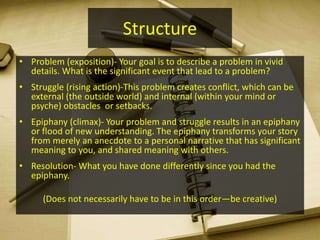
Structure
• Problem (exposition)- Your goal is to describe a problem in vivid
details. What is the significant event that lead to a problem?
• Struggle (rising action)-This problem creates conflict, which can be
external (the outside world) and internal (within your mind or
psyche) obstacles or setbacks.
• Epiphany (climax)- Your problem and struggle results in an epiphany
or flood of new understanding. The epiphany transforms your story
from merely an anecdote to a personal narrative that has significant
meaning to you, and shared meaning with others.
• Resolution- What you have done differently since you had the
epiphany.
(Does not necessarily have to be in this order—be creative)
• Creative essays are written to express, render, and
entertain
• frequently do not follow a standard structure
• designed to move the emotions
• should be rich with imagery, modifiers, and fresh
language, and should vary their syntax
• Usually told from the first-person voice
• make sure that it tells a story
• the writer should structure and present his essay in
the way that best reflects the emotional timbre of
the essay
• should attempt to accurately and honestly relate
these personal ideas
Readers Expect You to Share
• Your thoughts
• Your feelings
• Your opinions
• Personal Reflections
Keep in mind that a creative essay does
not strive to provide answers to questions or
even to necessarily explain a particular concept.
Rather, a creative essay is meant to help create
sense of the world and to raise questions that
the reader may wish to explore further.
Descriptions found at:
essaytown.com
http://www.essaytown.com/writing/creative-essay
http://www.essaytown.com/writing/write-creative-essay
davehood59.wordpress.com
http://davehood59.wordpress.com/2012/04/30/creative-nonfiction-writing-the-
personal-narrative-essay/

Introduction-to-Creative-Nonfiction-1.pptx

  • 1.
  • 2.
    Nonfiction • Nonfiction isa wide kind of compositions that incorporates all books that are not established in an anecdotal account. • Creative nonfiction can be classified in history and biography; it might be instructional; it can offer publication and humor; and it can mull over philosophical requests. • The core of nonfiction is FACT.
  • 3.
    • Writing aboutpersonal experiences, real people, or events focusing on facts instead of inventive substance, nonfiction can be a wellspring of instructive and real readings. • Much the same as creative writing and other composing sorts, creative nonfiction drives you to find and get subjects and points being conveyed by writers utilizing their methods and styles recorded as hard copy.
  • 4.
    • Try toactivate your prior knowledge about the elements and techniques of creative nonfiction. • Are they just the same with the elements and techniques that you have learned in your Creative Writing class?
  • 5.
    • When youare reading or encountering stories that are based on reality or sources came from the truth, you can simply tell that it is creative nonfiction. ◦Fact. The core of nonfiction is fact. Factual information shall be included in the piece and not a made-up information.  ◦Extensive research. Conducting and gathering information through research provide accurate and reliable information that you may use in writing your nonfiction write-up.
  • 6.
    ◦Reportage/reporting. Documenting the gatheredinformation like interview and reports helps you keep records and files for future usages. ◦Personal experience and personal opinion. Since the main source of contents are based from the personal experiences and personal insights of the writer, it makes an easy way to write a piece.
  • 7.
    ◦Explanation/Exposition. Explaining the storyto the reader is expected to attain the objectives of the piece. ◦Essay format. The outputs in creative nonfiction are often in essay format. Examples: Procedural Essay, Personal Essay, Literary essays, descriptive essay.
  • 8.
    o Creative nonfictionis the literature of fact. Yet, creative nonfiction writer utilizes many of the literary devices of fiction writing. The following is a list of the most common literary devices that writers incorporate into their nonfiction writing:  Storytelling/narration. The goal, challenges and obstacles, a turning point, and resolution of the story shall be delivered spontaneously to help the readers understand the flow of the story.
  • 9.
    Character/Characterization. In anonfiction story, characters are also important. The main character serves as the core or central idea of the storyline. The story revolves to the experiences of the main character with the help of the other characters. Setting, atmosphere and scene. The writer creates scenes that are action -oriented; include dialogue; and contain vivid descriptions.
  • 10.
    Plot and plotstructure. These are the main events that make up the story. In a personal essay, there might be only one event. In a memoir, there are often several significant events. Figurative language. The use of figurative languages helps the writer to provide aesthetics to the piece. It gives vibrant effect to the story.
  • 11.
    Imagery. The useof different sensory images helps also to add color in writing a nonfiction piece. Angle/Point of view. Most of the time nonfiction adheres with the use of First Person Point of View since the experiences are being told. Dialogue. This can help to make the story run within the characters. Theme. It is the central idea or universal truth presented in the work.
  • 12.
    The 5 R’sof Creative Nonfiction • Lee Gutkind, who is a writer, professor, and expert on creative nonfiction, wrote an essay called “The Five R’s of Creative Nonfiction.” In this essay, he identified five essential elements of creative nonfiction. 1.Real life 2. Reflection 3. Research 4. Reading 5. Writing.
  • 13.
    The 5 R’sof Creative Nonfiction 1. Creative nonfiction uses real life elements. The writer creates concepts of a story using the vital and real information about the subject which can be associated on close attributes of the real experiences.
  • 14.
    The 5 R’sof Creative Nonfiction 2. Creative nonfiction lets the writer to engage on his personal reflection about the subject. After gathering information, the writer needs to scrutinize and analyze the gathered information. Assessing and considering his ideologies and beliefs. Through this, it will help the writer to be more factual based.
  • 15.
    The 5 R’sof Creative Nonfiction 3. Creative nonfiction instructs the author to do a complete research. The author needs to find out relevant and vital information about the subject. The writer needs to finish investigating and weighing information that will be included in the story. Finishing auxiliary examination will lead to create a complete and substantial contents. For an instance, looking into an individual diary, or meeting a companion or relative, to guarantee that the data is honest and genuine.
  • 16.
    The 5 R’sof Creative Nonfiction 4. The fourth aspect of creative nonfiction is reading. Reading while conducting research is not enough. The writer must recall the components through reading to improve and make some modifications.
  • 17.
    The 5 R’sof Creative Nonfiction 5. The final element of creative nonfiction is writing. Writing imaginative true to life is both a workmanship and specialty. The craft of inventive true to life necessitates that the essayist utilizes his gifts, senses, innovative capacities, and creative mind to compose paramount imaginative true to life.
  • 18.
    What are thetypes of creative nonfiction?
  • 19.
    Types of Creative Nonfiction •Creative nonfiction always deals on reality. Reality can be about using the topics like the use of individual encounter, occasion, or issue in the open eye. There are different classes or categories to consider in creative nonfiction such as the individual article, journal, and life account.
  • 20.
    Types of Creative Nonfiction 1.Personal Essay The writer uses information that is based on personal experience or a single event, which leads in significant personal meaning, or a lesson learned that he encountered. The writer uses the first person “I.”
  • 21.
    Types of Creative Nonfiction 2.Memoir The writer creates a real story within a time or period of life, one that contributed a significant personal meaning and truth. The writer uses the first person “I” in the story.
  • 22.
    Types of Creative Nonfiction 3.Literary Journalism Essay The writer creates an output on an issue or topic using the understood literary devices, such as the elements of fiction and figurative languages.
  • 23.
    Types of Creative Nonfiction 4.Autobiography. The writer writes his/her own life story, from birth to the present, using the first person “I.” 5. Travel Writing. The writer creates article narration about travel using literary devices and figurative languages. 6. Food writing. The writer crafts stories about food and cuisine using literary techniques that mat lead to a review and recommendation. 7. Profiles. The writer constructs life stories of people
  • 24.
    Creative Essay Any short,non-fiction text written with specific attention to its aesthetic qualities and presentation that is written from the point of view of the author. It focuses on a personal experience that is a turning point, a change in direction, an event that has significant meaning, and also shares a universal truth with readers.
  • 25.
    What is aPersonal Narrative Essay? • based on memory of an event or experience or moment in time that had significant meaning to you • tell a true story about a turning point in your life • the event or experience actually happened to you • look back into your memory, to an earlier time in your life, and unearth true stories that had significant meaning to you
  • 26.
    Inspiration • Memory. Miningyour memory for turning points in your life. Turning points, such as a job loss, illness, disease, death, first encounters. • Family life. Reflecting on family-What family events had significant meaning? What do you remember about family life? • Spiritual journey. Write about your spiritual journey. • Place. Write about home. What is home? Travel experiences. The natural world, such as hiking, biking, camping, exploring the wilderness. • Popular culture. Write about film, music, fiction, poetry, photography, art—and how it has impacted you. What memories do you have? • The global village. Write about the world in which you live, such as the environment.
  • 27.
    Other Ideas • Journey,quest, pilgrimage • Mysteries and investigations • Rituals, games, performances, events Dig up memories about a myriad of topics–from toys to technology, to milestones to accomplishments, things that have significantly affected you.
  • 28.
    Structure • Problem (exposition)-Your goal is to describe a problem in vivid details. What is the significant event that lead to a problem? • Struggle (rising action)-This problem creates conflict, which can be external (the outside world) and internal (within your mind or psyche) obstacles or setbacks. • Epiphany (climax)- Your problem and struggle results in an epiphany or flood of new understanding. The epiphany transforms your story from merely an anecdote to a personal narrative that has significant meaning to you, and shared meaning with others. • Resolution- What you have done differently since you had the epiphany. (Does not necessarily have to be in this order—be creative)
  • 29.
    • Creative essaysare written to express, render, and entertain • frequently do not follow a standard structure • designed to move the emotions • should be rich with imagery, modifiers, and fresh language, and should vary their syntax • Usually told from the first-person voice • make sure that it tells a story • the writer should structure and present his essay in the way that best reflects the emotional timbre of the essay • should attempt to accurately and honestly relate these personal ideas
  • 30.
    Readers Expect Youto Share • Your thoughts • Your feelings • Your opinions • Personal Reflections
  • 31.
    Keep in mindthat a creative essay does not strive to provide answers to questions or even to necessarily explain a particular concept. Rather, a creative essay is meant to help create sense of the world and to raise questions that the reader may wish to explore further. Descriptions found at: essaytown.com http://www.essaytown.com/writing/creative-essay http://www.essaytown.com/writing/write-creative-essay davehood59.wordpress.com http://davehood59.wordpress.com/2012/04/30/creative-nonfiction-writing-the- personal-narrative-essay/