Gene therapies
Presented to: Dr. Javed Ali
SPER, JAMIA HAMDARD
Presented by: Dipak Kumar Gupta
M.Pharm 1st yr.(II sem)
Pharmaceutics
What is gene therapy
• Gene therapy is the introduction of genes into existing cells to prevent or cure a
wide range of disease
• An experimental technique for correcting defective genes that are responsible for
disease development.
• The most common form of gene therapy involves inserting a normal gene to
replace an abnormal gene.
• Other approaches used:
 Replacing a mutated gene that causes disease with a healthy copy of the gene .
 Inactivating or “knocking out” a mutated gene that is functioning improperly.
 Introducing a new gene into the body to help fight a disease.
How it works
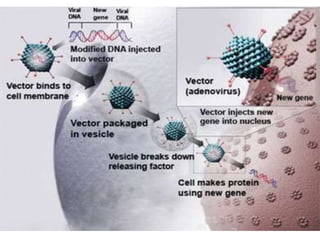
• A vector delivers the therapeutic gene into a patients target cell
• The target cells become infected with the viral vector
• The vectors genetic material is inserted into the target cell
• Functional proteins are created from the therapeutic gene causing the cell
to return to a normal state.
Types of gene therapy
• Somatic gene therapy
• Germ line gene therapy
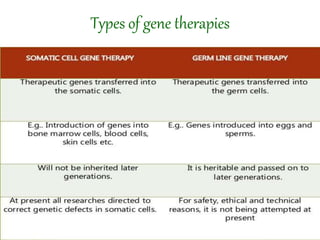
Types of gene therapies
Somatic gene therapy
• Affects only the targeted cells in the patient, and is not pass to future
generations.
• Short –lived because the cells of most tissues ultimately die and are replaced
by new cells
• Transporting the gene to the target cells or tissue is also problematic.
• Appropriate and acceptable for many disorders including cystic fibrosis,
muscular dystrophy, cancer,and certain infectious diseases.
Germ line gene therapy
• Result in permanent changes.
• Potential for offering a permanent therapeutic effect for all who inherit
the target gene.
• Possibility of eliminating some diseases from a particular family.
• Also raises controversy:
• Some people view this type of therapy as unnatural, and like it to
“playing god”.
• Others have concerns about the technical aspects.
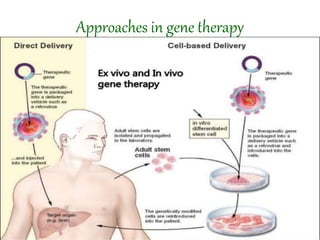
Approaches in gene therapy
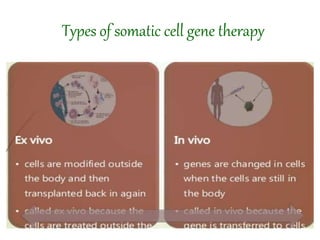
Types of somatic cell gene therapy
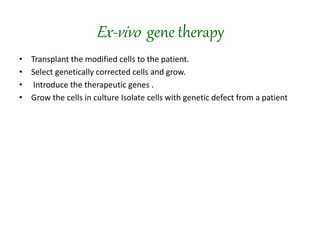
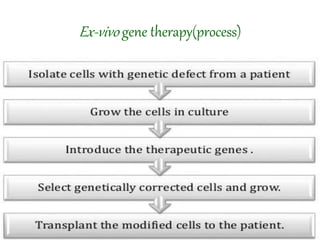
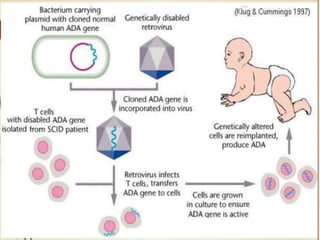
Ex-vivo gene therapy
• Transplant the modified cells to the patient.
• Select genetically corrected cells and grow.
• Introduce the therapeutic genes .
• Grow the cells in culture Isolate cells with genetic defect from a patient
Ex-vivo gene therapy(process)
Example of ex-vivo gene therapy
• 1st gene therapy – to correct deficiency of enzyme, Adenosine deaminase
(ADA).
• Performed on a 4yr old girl Ashanthi DeSilva.
• Was suffering from SCID- Severe Combined Immunodeficiency.
• Caused due to defect in gene coding for ADA
• Deoxyadenosine accumulate and destroys T lymphocytes.
• Disrupts immunity , suffer from infectious diseases and die at young age.
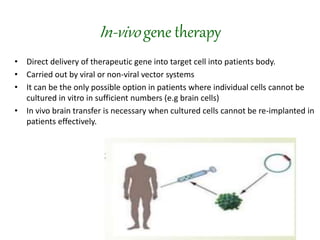
In-vivo gene therapy
• Direct delivery of therapeutic gene into target cell into patients body.
• Carried out by viral or non-viral vector systems
• It can be the only possible option in patients where individual cells cannot be
cultured in vitro in sufficient numbers (e.g brain cells)
• In vivo brain transfer is necessary when cultured cells cannot be re-implanted in
patients effectively.
Examples of in-vivo gene therapy
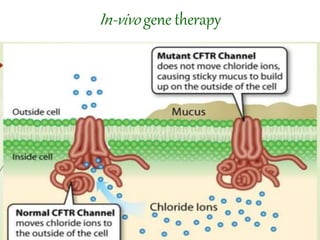
• In patients with cystic fibrosis, a protein called cystic fibrosis trans-
membrane regulator (CFTR) is absent due to a gene defect.
• In the absence of CFTR chloride ions concentrate within the cells and it
draws water from surrounding.
• This leads to the accumulation of sticky mucous in respiratory tract and
lungs.
• Treated by in vivo replacement of defective gene by adenovirus vector
In-vivo gene therapy
METHODS OF GENE DELIVERY
PHYSICAL METHODS
 Gene Gun
• Employs a high-pressure delivery system to shoot tissue with gold or
tungsten particles that are coated with DNA
 Microinjection
• Process of using a glass micropipette to insert microscopic substances
into a single living cell.
• Normally performed under a specialized optical microscope setup called a
micromanipulator.
CHEMICAL METHODS
 USING DETERGENT MIXTURES
• Certain charged chemical compounds like Calcium phosphates are mixed
with functional cDNA of desired function.
• The mixture is introduced near the vicinity of recipient cells.
• The chemicals disturbs the cell membrane, widens the pore size and
allows cDNA to pass through the cell.
 LIPOFECTION
• It is a technique used to inject genetic materials into a cell by means of
liposomes.
• Liposomes are artificial phospholipid vesicles used to deliver a variety of
molecules including DNA into the cells.
GENE THERAPY
GENE AUGMENTATION THERAPY
• Most common form of gene therapy
• Foreign gene replaces missing or defective gene.
• Eg. Replacement of defective p53 gene by a normal one in liver cancer.
 GENE INHIBITION THERAPY
• Done to block the overproduction of some proteins.
• 2 types – Antigene and antisense therapy.
• Antigene – blocks transcription using antigene oligonucleotide
• Antisense – blocks transalation using antisense oligonucleotide
Contnd.....
• Long lasting therapy is not achieved by gene therapy; Due to rapid dividing
of cells benefits of gene therapy is short lived.
• Immune response to the transferred gene stimulates a potential risk to
gene therapy.
• Viruses used as vectors for gene transfer may cause toxicity, immune
responses, and inflammatory reactions in the host.
• Disorders caused by defects in multiple genes cannot be treated
effectively using gene therapy.
• Gene therapy has the potential to eliminate and prevent hereditary
diseases such as cystic fibrosis, ADA- SCID etc.
• It is a possible cure for heart disease, AIDS and cancer.
• It gives someone born with a genetic disease a chance to life.
• It can be used to eradicate diseases from the future generations.
ADVANTAGES
• Gene therapy has the potential to eliminate and prevent hereditary
diseases such as cystic fibrosis, ADA- SCID etc.
• It is a possible cure for heart disease, AIDS and cancer.
• It gives someone born with a genetic disease a chance to life.
• It can be used to eradicate diseases from the future generations.
DISADVATAGES
• Long lasting therapy is not achieved by gene therapy; Due to rapid dividing
of cells benefits of gene therapy is short lived.
• Immune response to the transferred gene stimulates a potential risk to
gene therapy.
• Disorders caused by defects in multiple genes cannot be treated
effectively using gene therapy.
• Viruses used as vectors for gene transfer may cause toxicity, immune
responses, and inflammatory reactions in the host.
references
• Dubey R.C, A textbook of biotechnology, 1st edition (2004), S Chand and
company, New Delhi
• Gupta P.K, Elements of Biotechnology, 1st edition(2001), Rastogi
Publications, Meerut.
• http://www.medindia.net/articles/genetherapy treatment.htm

Gene therapy

  • 1.
    Gene therapies Presented to:Dr. Javed Ali SPER, JAMIA HAMDARD Presented by: Dipak Kumar Gupta M.Pharm 1st yr.(II sem) Pharmaceutics
  • 2.
    What is genetherapy • Gene therapy is the introduction of genes into existing cells to prevent or cure a wide range of disease • An experimental technique for correcting defective genes that are responsible for disease development. • The most common form of gene therapy involves inserting a normal gene to replace an abnormal gene. • Other approaches used:  Replacing a mutated gene that causes disease with a healthy copy of the gene .  Inactivating or “knocking out” a mutated gene that is functioning improperly.  Introducing a new gene into the body to help fight a disease.
  • 4.
    How it works •A vector delivers the therapeutic gene into a patients target cell • The target cells become infected with the viral vector • The vectors genetic material is inserted into the target cell • Functional proteins are created from the therapeutic gene causing the cell to return to a normal state.
  • 5.
    Types of genetherapy • Somatic gene therapy • Germ line gene therapy
  • 6.
    Types of genetherapies
  • 7.
    Somatic gene therapy •Affects only the targeted cells in the patient, and is not pass to future generations. • Short –lived because the cells of most tissues ultimately die and are replaced by new cells • Transporting the gene to the target cells or tissue is also problematic. • Appropriate and acceptable for many disorders including cystic fibrosis, muscular dystrophy, cancer,and certain infectious diseases.
  • 8.
    Germ line genetherapy • Result in permanent changes. • Potential for offering a permanent therapeutic effect for all who inherit the target gene. • Possibility of eliminating some diseases from a particular family. • Also raises controversy: • Some people view this type of therapy as unnatural, and like it to “playing god”. • Others have concerns about the technical aspects.
  • 9.
  • 10.
    Types of somaticcell gene therapy
  • 11.
    Ex-vivo gene therapy •Transplant the modified cells to the patient. • Select genetically corrected cells and grow. • Introduce the therapeutic genes . • Grow the cells in culture Isolate cells with genetic defect from a patient
  • 12.
  • 14.
    Example of ex-vivogene therapy • 1st gene therapy – to correct deficiency of enzyme, Adenosine deaminase (ADA). • Performed on a 4yr old girl Ashanthi DeSilva. • Was suffering from SCID- Severe Combined Immunodeficiency. • Caused due to defect in gene coding for ADA • Deoxyadenosine accumulate and destroys T lymphocytes. • Disrupts immunity , suffer from infectious diseases and die at young age.
  • 15.
    In-vivo gene therapy •Direct delivery of therapeutic gene into target cell into patients body. • Carried out by viral or non-viral vector systems • It can be the only possible option in patients where individual cells cannot be cultured in vitro in sufficient numbers (e.g brain cells) • In vivo brain transfer is necessary when cultured cells cannot be re-implanted in patients effectively.
  • 16.
    Examples of in-vivogene therapy • In patients with cystic fibrosis, a protein called cystic fibrosis trans- membrane regulator (CFTR) is absent due to a gene defect. • In the absence of CFTR chloride ions concentrate within the cells and it draws water from surrounding. • This leads to the accumulation of sticky mucous in respiratory tract and lungs. • Treated by in vivo replacement of defective gene by adenovirus vector
  • 17.
  • 18.
    METHODS OF GENEDELIVERY PHYSICAL METHODS  Gene Gun • Employs a high-pressure delivery system to shoot tissue with gold or tungsten particles that are coated with DNA  Microinjection • Process of using a glass micropipette to insert microscopic substances into a single living cell. • Normally performed under a specialized optical microscope setup called a micromanipulator.
  • 19.
    CHEMICAL METHODS  USINGDETERGENT MIXTURES • Certain charged chemical compounds like Calcium phosphates are mixed with functional cDNA of desired function. • The mixture is introduced near the vicinity of recipient cells. • The chemicals disturbs the cell membrane, widens the pore size and allows cDNA to pass through the cell.  LIPOFECTION • It is a technique used to inject genetic materials into a cell by means of liposomes. • Liposomes are artificial phospholipid vesicles used to deliver a variety of molecules including DNA into the cells.
  • 20.
    GENE THERAPY GENE AUGMENTATIONTHERAPY • Most common form of gene therapy • Foreign gene replaces missing or defective gene. • Eg. Replacement of defective p53 gene by a normal one in liver cancer.  GENE INHIBITION THERAPY • Done to block the overproduction of some proteins. • 2 types – Antigene and antisense therapy. • Antigene – blocks transcription using antigene oligonucleotide • Antisense – blocks transalation using antisense oligonucleotide
  • 21.
    Contnd..... • Long lastingtherapy is not achieved by gene therapy; Due to rapid dividing of cells benefits of gene therapy is short lived. • Immune response to the transferred gene stimulates a potential risk to gene therapy. • Viruses used as vectors for gene transfer may cause toxicity, immune responses, and inflammatory reactions in the host. • Disorders caused by defects in multiple genes cannot be treated effectively using gene therapy. • Gene therapy has the potential to eliminate and prevent hereditary diseases such as cystic fibrosis, ADA- SCID etc. • It is a possible cure for heart disease, AIDS and cancer. • It gives someone born with a genetic disease a chance to life. • It can be used to eradicate diseases from the future generations.
  • 22.
    ADVANTAGES • Gene therapyhas the potential to eliminate and prevent hereditary diseases such as cystic fibrosis, ADA- SCID etc. • It is a possible cure for heart disease, AIDS and cancer. • It gives someone born with a genetic disease a chance to life. • It can be used to eradicate diseases from the future generations.
  • 23.
    DISADVATAGES • Long lastingtherapy is not achieved by gene therapy; Due to rapid dividing of cells benefits of gene therapy is short lived. • Immune response to the transferred gene stimulates a potential risk to gene therapy. • Disorders caused by defects in multiple genes cannot be treated effectively using gene therapy. • Viruses used as vectors for gene transfer may cause toxicity, immune responses, and inflammatory reactions in the host.
  • 24.
    references • Dubey R.C,A textbook of biotechnology, 1st edition (2004), S Chand and company, New Delhi • Gupta P.K, Elements of Biotechnology, 1st edition(2001), Rastogi Publications, Meerut. • http://www.medindia.net/articles/genetherapy treatment.htm