BACHELOR OF ENGINEERINGBACHELOR OF ENGINEERING
MANUFACTURING TECHNOLOGIESMANUFACTURING TECHNOLOGIES
NON-TRADITIONALNON-TRADITIONAL
TECHNOLOGIESTECHNOLOGIES
by Endika Gandarias
2by Endika Gandarias
Dr. ENDIKA GANDARIAS MINTEGI
Mechanical and Manufacturing department
Mondragon Unibertsitatea - www.mondragon.edu
(Basque Country)
www.linkedin.com/in/endika-gandarias-mintegi-91174653
Further presentations: www.symbaloo.com/mix/manufacturingtechnology
3
CONTENTS
BIBLIOGRAPHY
INTRODUCTION
NON-TRADITIONAL TECHNOLOGIES:
 Ultrasonic Machining (USM)
 Jet Machining (AJM / WJM / AWJM)
 Chemical Machining (CM)
 Electro-Chemical Machining (ECM)
 Plasma Arc Machining (PAM)
 Laser Beam Machining (LBM)
 Electro Discharge Machining (EDM)
 Ion Beam Machining (IBM)
 Electron Beam Machining (EBM)
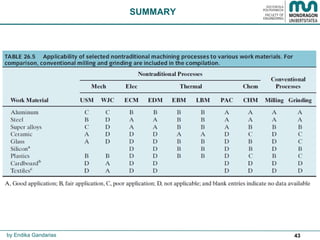
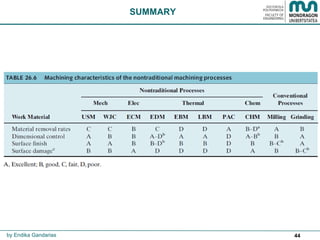
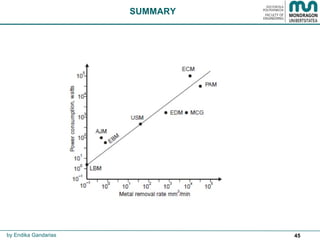
SUMMARY
GLOSSARY
by Endika Gandarias
4
BIBLIOGRAPHY
BIBLIOGRAPHY
by Endika Gandarias
5
The author would like to thank all the bibliographic references and videos that
have contributed to the elaboration of these presentations.
For bibliographic references, please refer to:
• http://www.slideshare.net/endika55/bibliography-71763364 (PDF file)
• http://www.slideshare.net/endika55/bibliography-71763366 (PPT file)
For videos, please refer to:
• www.symbaloo.com/mix/manufacturingtechnology
BIBLIOGRAPHY
by Endika Gandarias
6
INTRODUCTION
INTRODUCTION
by Endika Gandarias
7
INTRODUCTION
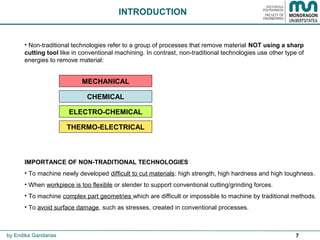
• Non-traditional technologies refer to a group of processes that remove material NOT using a sharp
cutting tool like in conventional machining. In contrast, non-traditional technologies use other type of
energies to remove material:
IMPORTANCE OF NON-TRADITIONAL TECHNOLOGIES
• To machine newly developed difficult to cut materials: high strength, high hardness and high toughness.
• When workpiece is too flexible or slender to support conventional cutting/grinding forces.
• To machine complex part geometries which are difficult or impossible to machine by traditional methods.
• To avoid surface damage, such as stresses, created in conventional processes.
MECHANICAL
ELECTRO-CHEMICAL
THERMO-ELECTRICAL
CHEMICAL
by Endika Gandarias
8
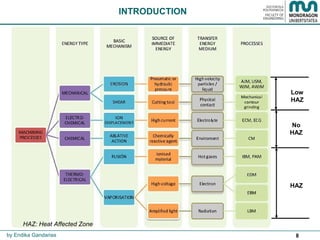
INTRODUCTION
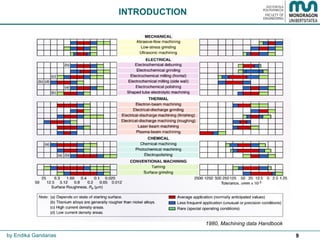
by Endika Gandarias
Low
HAZ
No
HAZ
HAZ
HAZ: Heat Affected Zone
9by Endika Gandarias
1980, Machining data Handbook
INTRODUCTION
10
NON-TRADITIONAL
TECHNOLOGIES
NON-TRADITIONAL TECHNOLOGIES
by Endika Gandarias
11
ULTRASONIC MACHINING (USM)
Dimensional tolerance: ± 0,0025mm
Surface finish: Ra ~ 0,1-0,8µm
by Endika Gandarias
THERMO-ELECTRICALMECHANICAL CHEMICAL ELECTRO-CHEMICAL
ULTRASONIC MACHINING (USM)
12
ULTRASONIC MACHINING (USM)
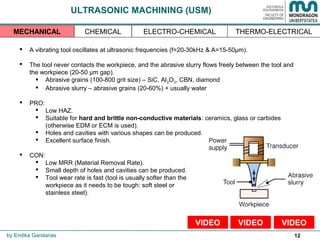
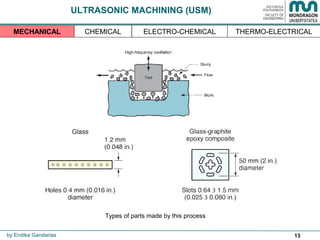
 A vibrating tool oscillates at ultrasonic frequencies (f=20-30kHz & A=15-50µm).
 The tool never contacts the workpiece, and the abrasive slurry flows freely between the tool and
the workpiece (20-50 µm gap).
 Abrasive grains (100-800 grit size) – SiC, Al2O3, CBN, diamond
 Abrasive slurry – abrasive grains (20-60%) + usually water
 PRO:
 Low HAZ.
 Suitable for hard and brittle non-conductive materials: ceramics, glass or carbides
(otherwise EDM or ECM is used).
 Holes and cavities with various shapes can be produced.
 Excellent surface finish.
 CON:
 Low MRR (Material Removal Rate).
 Small depth of holes and cavities can be produced.
 Tool wear rate is fast (tool is usually softer than the
workpiece as it needs to be tough: soft steel or
stainless steel).
by Endika Gandarias
THERMO-ELECTRICALMECHANICAL CHEMICAL ELECTRO-CHEMICAL
VIDEOVIDEOVIDEO
13
ULTRASONIC MACHINING (USM)
Types of parts made by this process
by Endika Gandarias
THERMO-ELECTRICALMECHANICAL CHEMICAL ELECTRO-CHEMICAL
14
JET MACHINING
(AJM / WJM / AWJM)
THERMO-ELECTRICALMECHANICAL CHEMICAL ELECTRO-CHEMICAL
AJM:
Dimensional tolerance: ± 0,05mm
Surface finish: Ra ~ 0,15-1,5 µm
WJM / AWJM:
Dimensional tolerance: ± 0,025mm
Surface finish: Ra ~ 1,6-6.3 µm
by Endika Gandarias
JET MACHINING (AJM / WJM / AWJM)
15
JET MACHINING (AJM / WJM / AWJM)
Abrasive Jet Machining (AJM)
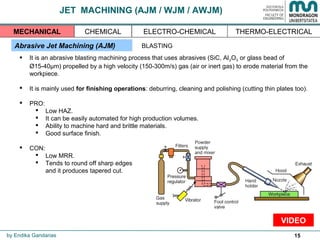
 It is an abrasive blasting machining process that uses abrasives (SiC, Al2O3 or glass bead of
Ø15-40µm) propelled by a high velocity (150-300m/s) gas (air or inert gas) to erode material from the
workpiece.
 It is mainly used for finishing operations: deburring, cleaning and polishing (cutting thin plates too).
 PRO:
 Low HAZ.
 It can be easily automated for high production volumes.
 Ability to machine hard and brittle materials.
 Good surface finish.
 CON:
 Low MRR.
 Tends to round off sharp edges
and it produces tapered cut.
by Endika Gandarias
THERMO-ELECTRICALMECHANICAL CHEMICAL ELECTRO-CHEMICAL
BLASTING
VIDEO
16
JET MACHINING (AJM / WJM / AWJM)
Water Jet Machining (WJM)
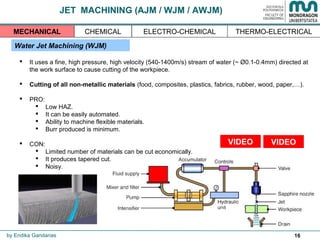
 It uses a fine, high pressure, high velocity (540-1400m/s) stream of water (~ Ø0.1-0.4mm) directed at
the work surface to cause cutting of the workpiece.
 Cutting of all non-metallic materials (food, composites, plastics, fabrics, rubber, wood, paper,…).
 PRO:
 Low HAZ.
 It can be easily automated.
 Ability to machine flexible materials.
 Burr produced is minimum.
 CON:
 Limited number of materials can be cut economically.
 It produces tapered cut.
 Noisy.
by Endika Gandarias
THERMO-ELECTRICALMECHANICAL CHEMICAL ELECTRO-CHEMICAL
VIDEOVIDEO
17
JET MACHINING (AJM / WJM / AWJM)
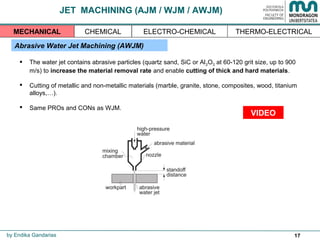
Abrasive Water Jet Machining (AWJM)
 The water jet contains abrasive particles (quartz sand, SiC or Al2O3 at 60-120 grit size, up to 900
m/s) to increase the material removal rate and enable cutting of thick and hard materials.
 Cutting of metallic and non-metallic materials (marble, granite, stone, composites, wood, titanium
alloys,…).
 Same PROs and CONs as WJM.
by Endika Gandarias
THERMO-ELECTRICALMECHANICAL CHEMICAL ELECTRO-CHEMICAL
VIDEO
18
JET MACHINING (AJM / WJM / AWJM)
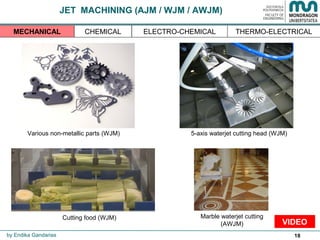
Various non-metallic parts (WJM) 5-axis waterjet cutting head (WJM)
Cutting food (WJM) Marble waterjet cutting
(AWJM)
by Endika Gandarias
THERMO-ELECTRICALMECHANICAL CHEMICAL ELECTRO-CHEMICAL
VIDEO
19
CHEMICAL MACHINING (CM)
CHEMICAL
Dimensional tolerance: ± 0,08mm
Surface finish: Ra ~ 0,1-6,3 µm
by Endika Gandarias
THERMO-ELECTRICALMECHANICAL ELECTRO-CHEMICAL
CHEMICAL MACHINING (CM)
20
CHEMICAL MACHINING (CM)
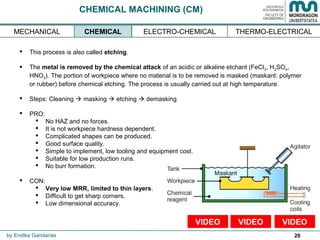
 This process is also called etching.
 The metal is removed by the chemical attack of an acidic or alkaline etchant (FeCl3, H2SO4,
HNO3). The portion of workpiece where no material is to be removed is masked (maskant: polymer
or rubber) before chemical etching. The process is usually carried out at high temperature.
 Steps: Cleaning  masking  etching  demasking
 PRO:
 No HAZ and no forces.
 It is not workpiece hardness dependent.
 Complicated shapes can be produced.
 Good surface quality.
 Simple to implement, low tooling and equipment cost.
 Suitable for low production runs.
 No burr formation.
 CON:
 Very low MRR, limited to thin layers.
 Difficult to get sharp corners.
 Low dimensional accuracy.
by Endika Gandarias
CHEMICAL THERMO-ELECTRICALMECHANICAL ELECTRO-CHEMICAL
VIDEOVIDEOVIDEO
21
CHEMICAL MACHINING (CM)
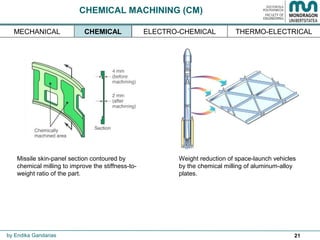
Missile skin-panel section contoured by
chemical milling to improve the stiffness-to-
weight ratio of the part.
Weight reduction of space-launch vehicles
by the chemical milling of aluminum-alloy
plates.
by Endika Gandarias
CHEMICAL THERMO-ELECTRICALMECHANICAL ELECTRO-CHEMICAL
22
ELECTRO-CHEMICAL
MACHINING
(ECM)
ELECTRO-CHEMICAL
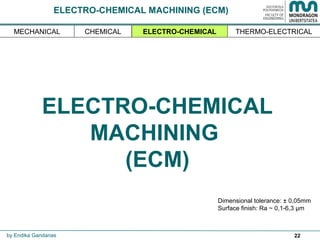
Dimensional tolerance: ± 0,05mm
Surface finish: Ra ~ 0,1-6,3 µm
by Endika Gandarias
THERMO-ELECTRICALCHEMICALMECHANICAL
ELECTRO-CHEMICAL MACHINING (ECM)
23
ELECTRO-CHEMICAL MACHINING (ECM)
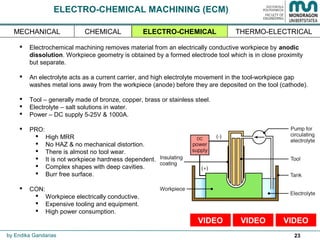
 Electrochemical machining removes material from an electrically conductive workpiece by anodic
dissolution. Workpiece geometry is obtained by a formed electrode tool which is in close proximity
but separate.
 An electrolyte acts as a current carrier, and high electrolyte movement in the tool-workpiece gap
washes metal ions away from the workpiece (anode) before they are deposited on the tool (cathode).
 Tool – generally made of bronze, copper, brass or stainless steel.
 Electrolyte – salt solutions in water.
 Power – DC supply 5-25V & 1000A.
 PRO:
 High MRR
 No HAZ & no mechanical distortion.
 There is almost no tool wear.
 It is not workpiece hardness dependent.
 Complex shapes with deep cavities.
 Burr free surface.
 CON:
 Workpiece electrically conductive.
 Expensive tooling and equipment.
 High power consumption.
by Endika Gandarias
ELECTRO-CHEMICAL THERMO-ELECTRICALCHEMICALMECHANICAL
VIDEOVIDEOVIDEO
24
ELECTRO-CHEMICAL MACHINING (ECM)
by Endika Gandarias
ELECTRO-CHEMICAL THERMO-ELECTRICALCHEMICALMECHANICAL
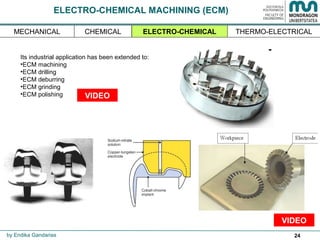
Its industrial application has been extended to:
•ECM machining
•ECM drilling
•ECM deburring
•ECM grinding
•ECM polishing
VIDEO
VIDEO
25
PLASMA ARC MACHINING (PAM)
Dimensional tolerance: ± 1.3mm
Surface finish: Ra ~ 0,8-6,3 µm
by Endika Gandarias
THERMO-ELECTRICALMECHANICAL ELECTRO-CHEMICALCHEMICAL
PLASMA ARC MACHINING (PAM)
26
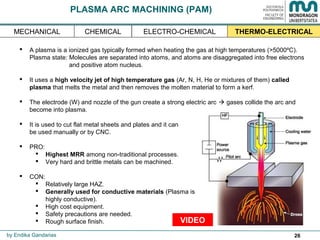
 A plasma is a ionized gas typically formed when heating the gas at high temperatures (>5000ºC).
Plasma state: Molecules are separated into atoms, and atoms are disaggregated into free electrons
and positive atom nucleus.
 It uses a high velocity jet of high temperature gas (Ar, N, H, He or mixtures of them) called
plasma that melts the metal and then removes the molten material to form a kerf.
 The electrode (W) and nozzle of the gun create a strong electric arc  gases collide the arc and
become into plasma.
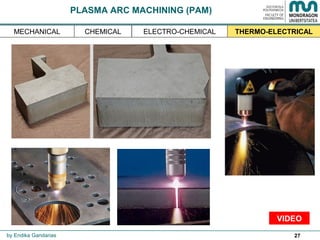
 It is used to cut flat metal sheets and plates and it can
be used manually or by CNC.
 PRO:
 Highest MRR among non-traditional processes.
 Very hard and brittle metals can be machined.
 CON:
 Relatively large HAZ.
 Generally used for conductive materials (Plasma is
highly conductive).
 High cost equipment.
 Safety precautions are needed.
 Rough surface finish.
PLASMA ARC MACHINING (PAM)
by Endika Gandarias
THERMO-ELECTRICALMECHANICAL ELECTRO-CHEMICALCHEMICAL
VIDEO
27
PLASMA ARC MACHINING (PAM)
by Endika Gandarias
THERMO-ELECTRICALMECHANICAL ELECTRO-CHEMICALCHEMICAL
VIDEO
28
LASER BEAM MACHINING (LBM)
Dimensional tolerance: ± 0,08mm
Surface finish: Ra ~ 0,2-6,3 µm
by Endika Gandarias
THERMO-ELECTRICALMECHANICAL ELECTRO-CHEMICALCHEMICAL
LASER BEAM MACHINING (LBM)
29
LASER BEAM MACHINING (LBM)
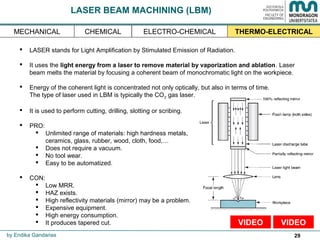
 LASER stands for Light Amplification by Stimulated Emission of Radiation.
 It uses the light energy from a laser to remove material by vaporization and ablation. Laser
beam melts the material by focusing a coherent beam of monochromatic light on the workpiece.
 Energy of the coherent light is concentrated not only optically, but also in terms of time.
The type of laser used in LBM is typically the CO2 gas laser.
 It is used to perform cutting, drilling, slotting or scribing.
 PRO:
 Unlimited range of materials: high hardness metals,
ceramics, glass, rubber, wood, cloth, food,…
 Does not require a vacuum.
 No tool wear.
 Easy to be automatized.
 CON:
 Low MRR.
 HAZ exists.
 High reflectivity materials (mirror) may be a problem.
 Expensive equipment.
 High energy consumption.
 It produces tapered cut.
by Endika Gandarias
THERMO-ELECTRICALMECHANICAL ELECTRO-CHEMICALCHEMICAL
VIDEOVIDEO
30
LASER BEAM MACHINING (LBM)
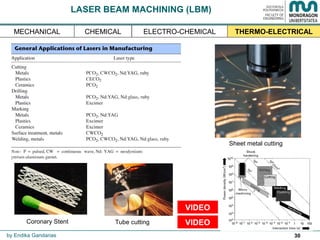
Sheet metal cutting
by Endika Gandarias
PHB stent
Coronary Stent
THERMO-ELECTRICALMECHANICAL ELECTRO-CHEMICALCHEMICAL
Tube cutting VIDEO
VIDEO
31
ELECTRICAL DISCHARGE MACHINING
(EDM)
Dimensional tolerance: ± 0.025mm
Surface finish: Ra ~ 0,05-12,5 µm
by Endika Gandarias
THERMO-ELECTRICALMECHANICAL ELECTRO-CHEMICALCHEMICAL
ELECTRICAL DISCHARGE MACHINING (EDM)
32
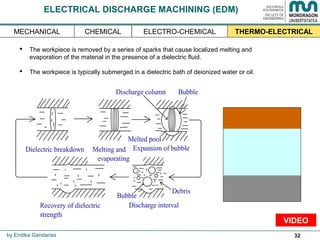
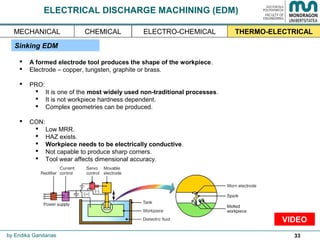
 The workpiece is removed by a series of sparks that cause localized melting and
evaporation of the material in the presence of a dielectric fluid.
 The workpiece is typically submerged in a dielectric bath of deionized water or oil.
ELECTRICAL DISCHARGE MACHINING (EDM)
by Endika Gandarias
THERMO-ELECTRICALMECHANICAL ELECTRO-CHEMICALCHEMICAL
VIDEO
33
ELECTRICAL DISCHARGE MACHINING (EDM)
 A formed electrode tool produces the shape of the workpiece.
 Electrode – copper, tungsten, graphite or brass.
 PRO:
 It is one of the most widely used non-traditional processes.
 It is not workpiece hardness dependent.
 Complex geometries can be produced.
 CON:
 Low MRR.
 HAZ exists.
 Workpiece needs to be electrically conductive.
 Not capable to produce sharp corners.
 Tool wear affects dimensional accuracy.
Sinking EDM
by Endika Gandarias
THERMO-ELECTRICALMECHANICAL ELECTRO-CHEMICALCHEMICAL
VIDEO
34
ELECTRICAL DISCHARGE MACHINING (EDM)
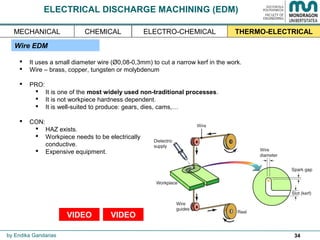
Wire EDM
 It uses a small diameter wire (Ø0,08-0,3mm) to cut a narrow kerf in the work.
 Wire – brass, copper, tungsten or molybdenum
 PRO:
 It is one of the most widely used non-traditional processes.
 It is not workpiece hardness dependent.
 It is well-suited to produce: gears, dies, cams,…
 CON:
 HAZ exists.
 Workpiece needs to be electrically
conductive.
 Expensive equipment.
by Endika Gandarias
THERMO-ELECTRICALMECHANICAL ELECTRO-CHEMICALCHEMICAL
VIDEO VIDEO
35
ELECTRICAL DISCHARGE MACHINING (EDM)
by Endika Gandarias
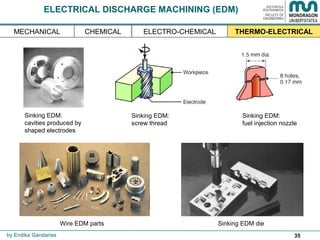
Sinking EDM dieWire EDM parts
Sinking EDM:
screw thread
Sinking EDM:
cavities produced by
shaped electrodes
Sinking EDM:
fuel injection nozzle
THERMO-ELECTRICALMECHANICAL ELECTRO-CHEMICALCHEMICAL
36
ELECTRON BEAM MACHINING
(EBM)
Dimensional tolerance: ± 0,08mm
Surface finish: Ra ~ 0,2-6,3µm
by Endika Gandarias
THERMO-ELECTRICALMECHANICAL ELECTRO-CHEMICALCHEMICAL
ELECTRON BEAM MACHINING (EBM)
37
ELECTRON BEAM MACHINING (EBM)
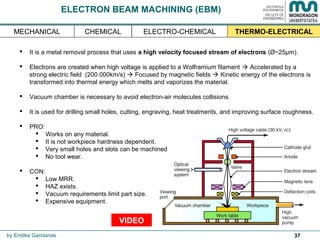
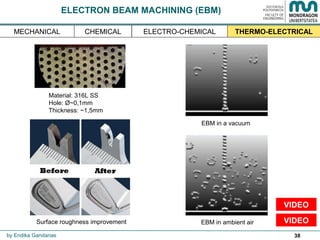
 It is a metal removal process that uses a high velocity focused stream of electrons (Ø~25µm).
 Electrons are created when high voltage is applied to a Wolframium filament  Accelerated by a
strong electric field (200.000km/s)  Focused by magnetic fields  Kinetic energy of the electrons is
transformed into thermal energy which melts and vaporizes the material.
 Vacuum chamber is necessary to avoid electron-air molecules collisions.
 It is used for drilling small holes, cutting, engraving, heat treatments, and improving surface roughness.
 PRO:
 Works on any material.
 It is not workpiece hardness dependent.
 Very small holes and slots can be machined
 No tool wear.
 CON:
 Low MRR.
 HAZ exists.
 Vacuum requirements limit part size.
 Expensive equipment.
by Endika Gandarias
THERMO-ELECTRICALMECHANICAL ELECTRO-CHEMICALCHEMICAL
VIDEO
38
ELECTRON BEAM MACHINING (EBM)
EBM in a vacuum
EBM in ambient air
by Endika Gandarias
Surface roughness improvement
Material: 316L SS
Hole: Ø~0,1mm
Thickness: ~1,5mm
THERMO-ELECTRICALMECHANICAL ELECTRO-CHEMICALCHEMICAL
VIDEO
VIDEO
39
ION BEAM MACHINING (IBM)
THERMO-ELECTRICAL
Dimensional tolerance: ± ??mm
Surface finish: Ra ~ <0.0001 µm
by Endika Gandarias
MECHANICAL ELECTRO-CHEMICALCHEMICAL
ION BEAM MACHINING (IBM)
40
ION BEAM MACHINING (IBM)
 This process is also called Focused Ion Beam (FIB).
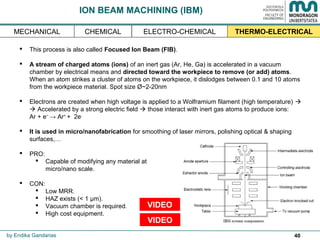
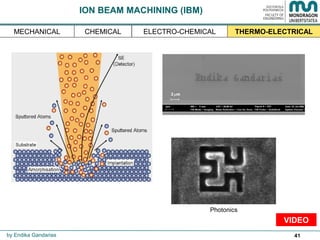
 A stream of charged atoms (ions) of an inert gas (Ar, He, Ga) is accelerated in a vacuum
chamber by electrical means and directed toward the workpiece to remove (or add) atoms.
When an atom strikes a cluster of atoms on the workpiece, it dislodges between 0.1 and 10 atoms
from the workpiece material. Spot size Ø~2-20nm
 Electrons are created when high voltage is applied to a Wolframium filament (high temperature) 
 Accelerated by a strong electric field  those interact with inert gas atoms to produce ions:
Ar + e−
→ Ar+
+ 2e-
 It is used in micro/nanofabrication for smoothing of laser mirrors, polishing optical & shaping
surfaces,…
 PRO:
 Capable of modifying any material at
micro/nano scale.
 CON:
 Low MRR.
 HAZ exists (< 1 μm).
 Vacuum chamber is required.
 High cost equipment.
by Endika Gandarias
THERMO-ELECTRICALMECHANICAL ELECTRO-CHEMICALCHEMICAL
VIDEO
VIDEO
41
ION BEAM MACHINING (IBM)
Photonics
by Endika Gandarias
THERMO-ELECTRICALMECHANICAL ELECTRO-CHEMICALCHEMICAL
VIDEO
42
SUMMARY
SUMMARY
by Endika Gandarias
43
SUMMARY
by Endika Gandarias
44
SUMMARY
by Endika Gandarias
45
SUMMARY
by Endika Gandarias
46
GLOSSARY
GLOSSARY
by Endika Gandarias
47
GLOSSARY
by Endika Gandarias
ENGLISH SPANISH BASQUE
Ablation Ablación Ablazio
Bead Abalorio Beira ale
Beam Haz Sorta
Blasting Chorreado Jariaketa
Brass Latón Letoia
Breakdown Ruptura Haustura
Brittle Frágil Hauskor
Bubble Burbuja Burbuila
Burr Rebaba Bizar
Cam Leva Espeka
Cardboard Cartón Kartoi
Chamber Cámara Ganbera
Cladding Aporte Aportazio
Close Cerca Gertu
Cloth Tela Oihal
Cluster Grupo Multzo
Coating Recubrimiento Estaldura
Coil Bobina Bobina
Collide Chocar Talka egin
Conductive Conductor Eroale
Copper Cobre Kobre
Debri Desecho Hondakin
Deburring Desbarbado Bizar kentze
Die Molde Molde
Dielectric Dieléctrico / No conductor Dielektriko / Ez eroale
Disaggregated Disgregado Sakabanatuta
Dislodge Dislocar Dislokatu
Drain Desagüe Hustubide
48
GLOSSARY
by Endika Gandarias
ENGLISH SPANISH BASQUE
Drilling Taladrado Zulaketa
Electro discharge machining Mecanizado por electroerosión Elektrohigadura bidezko mekanizazio
Electron Beam Machining Mecanizado por haz de electrones Elektroi sorta bidezko mekanizazio
Engraving Grabado Grabazio
Etchant Atacante Erasotzaile
Etching Ataque químico Eraso kimiko
Exhaust Campana de humos Kanpai
Fabric Tela Ohial
Fair Justo Justu
FeCl3 Cloruro de hierro Burdin kloruro
Focal length Longitud / Distancia focal Foku distantzia
Focus Enfocar Enfokatu
Gap Hueco Hutsune
Gear Engrane Engranai
Glass Vidrio Beira
Glazing Vidriado Beiratze
Grain Grano Ale
Grid Rejilla Bursin sare / Sareta
Grit Grano abrasivo Ale urratzaile
Gun Pistola Pistola
H2SO4 Ácido sulfúrico Azido sulfuriko
Hardening Temple Tenple
Hardness Dureza Gogortasuna
Heat Calor Bero
Heating Calentador Berogailu
HNO3 Ácido nítrico Azido nitriko
Insulating Aislante Isolatzaile
Ion beam machining Mecanizado por haz de iones Ioi sorta bidezko mekanizazio
49
GLOSSARY
by Endika Gandarias
ENGLISH SPANISH BASQUE
Jet machining Mecanizado por chorro Zurrusta bidezko mekanizazio
Kerf Canal de corte Mozte bide
Leek Puerro Porru
Len Lente Lente
Machining Mecanizado Mekanizazio
Marble Mármol Marmol
Maskant Enmascarante Estalki / Maskaratzaile
Melt Derretir Urtze
Mirror Espejo Ispilu
Molten Derretido Urturiko
Non traditional technologies Tecnologías no tradicionales Teknologia ez ohikoak
Nozzle Boquilla Aho / Pita
Plasma arc machining Mecanizado por plasma Plasma bidezko mekanizazio
Plate Placa Plaka / Xafla
Polishing Pulido Leunketa
Powder Polvo Hauts
Propel Impulsar Bultzatu
Pump Bomba Bonba
Reel Carrete / Bobina Bobina
Removal rate Tasa de eliminación Ezabapen tasa
Rough Basto Trauskil
Rubber Goma / Caucho Goma / Kautxu
Scribing Trazado a mano Eskuz idatzia
Shaping Dar forma Forma eman
Sharp Afilado Zorrotz
Shear Cizallado Zizailaketa
Sheet Chapa Xafla
Sinking EDM Electroerosión por penetración Sartze elektrohigadura
50
GLOSSARY
by Endika Gandarias
ENGLISH SPANISH BASQUE
Skin Piel Azal
Slender Esbelto Lerden
Slot Ranura Arteka
Slurry Pasta / Lodo Ore / Lokatz
Spark Chispa Txinpart
Spot Punto Puntu
Sputter Escupir Jaurti
Stainless steel Acero inoxidable Altzairu erdoilgaitz
Standoff distance Distancia de alejamiento Urruntze tarte
Stands for Significa Adierazi / Esan nahi
Stiffness Rigidez Zurruntasun
Stone Piedra Harri
Stream Chorro Zurrusta
Strength Resistencia Erresistentzia
Surface roughness Rugosidad superficial Gainazal zimurtasuna
Tapered cut Corte inclinado Mozte inklinatu
Tough Resistente Iraunkor
Toughness Tenacidad Zailtasun
Transducer Transductor Transduktore
Ultrasonic machining Mecanizado ultrasónico Ultrasoinu bidezko mekanizazio
Vacuum Vacío Huts
Wash Limpiar Garbitu
Wear Desgaste Higadura
Welding Soldadura Soldadura
Wire EDM Electroerosión por hilo Harizko elektrohigadura
Workpiece Pieza Pieza

Non traditional technologies

  • 1.
    BACHELOR OF ENGINEERINGBACHELOROF ENGINEERING MANUFACTURING TECHNOLOGIESMANUFACTURING TECHNOLOGIES NON-TRADITIONALNON-TRADITIONAL TECHNOLOGIESTECHNOLOGIES by Endika Gandarias
  • 2.
    2by Endika Gandarias Dr.ENDIKA GANDARIAS MINTEGI Mechanical and Manufacturing department Mondragon Unibertsitatea - www.mondragon.edu (Basque Country) www.linkedin.com/in/endika-gandarias-mintegi-91174653 Further presentations: www.symbaloo.com/mix/manufacturingtechnology
  • 3.
    3 CONTENTS BIBLIOGRAPHY INTRODUCTION NON-TRADITIONAL TECHNOLOGIES:  UltrasonicMachining (USM)  Jet Machining (AJM / WJM / AWJM)  Chemical Machining (CM)  Electro-Chemical Machining (ECM)  Plasma Arc Machining (PAM)  Laser Beam Machining (LBM)  Electro Discharge Machining (EDM)  Ion Beam Machining (IBM)  Electron Beam Machining (EBM) SUMMARY GLOSSARY by Endika Gandarias
  • 4.
  • 5.
    5 The author wouldlike to thank all the bibliographic references and videos that have contributed to the elaboration of these presentations. For bibliographic references, please refer to: • http://www.slideshare.net/endika55/bibliography-71763364 (PDF file) • http://www.slideshare.net/endika55/bibliography-71763366 (PPT file) For videos, please refer to: • www.symbaloo.com/mix/manufacturingtechnology BIBLIOGRAPHY by Endika Gandarias
  • 6.
  • 7.
    7 INTRODUCTION • Non-traditional technologiesrefer to a group of processes that remove material NOT using a sharp cutting tool like in conventional machining. In contrast, non-traditional technologies use other type of energies to remove material: IMPORTANCE OF NON-TRADITIONAL TECHNOLOGIES • To machine newly developed difficult to cut materials: high strength, high hardness and high toughness. • When workpiece is too flexible or slender to support conventional cutting/grinding forces. • To machine complex part geometries which are difficult or impossible to machine by traditional methods. • To avoid surface damage, such as stresses, created in conventional processes. MECHANICAL ELECTRO-CHEMICAL THERMO-ELECTRICAL CHEMICAL by Endika Gandarias
  • 8.
  • 9.
    9by Endika Gandarias 1980,Machining data Handbook INTRODUCTION
  • 10.
  • 11.
    11 ULTRASONIC MACHINING (USM) Dimensionaltolerance: ± 0,0025mm Surface finish: Ra ~ 0,1-0,8µm by Endika Gandarias THERMO-ELECTRICALMECHANICAL CHEMICAL ELECTRO-CHEMICAL ULTRASONIC MACHINING (USM)
  • 12.
    12 ULTRASONIC MACHINING (USM) A vibrating tool oscillates at ultrasonic frequencies (f=20-30kHz & A=15-50µm).  The tool never contacts the workpiece, and the abrasive slurry flows freely between the tool and the workpiece (20-50 µm gap).  Abrasive grains (100-800 grit size) – SiC, Al2O3, CBN, diamond  Abrasive slurry – abrasive grains (20-60%) + usually water  PRO:  Low HAZ.  Suitable for hard and brittle non-conductive materials: ceramics, glass or carbides (otherwise EDM or ECM is used).  Holes and cavities with various shapes can be produced.  Excellent surface finish.  CON:  Low MRR (Material Removal Rate).  Small depth of holes and cavities can be produced.  Tool wear rate is fast (tool is usually softer than the workpiece as it needs to be tough: soft steel or stainless steel). by Endika Gandarias THERMO-ELECTRICALMECHANICAL CHEMICAL ELECTRO-CHEMICAL VIDEOVIDEOVIDEO
  • 13.
    13 ULTRASONIC MACHINING (USM) Typesof parts made by this process by Endika Gandarias THERMO-ELECTRICALMECHANICAL CHEMICAL ELECTRO-CHEMICAL
  • 14.
    14 JET MACHINING (AJM /WJM / AWJM) THERMO-ELECTRICALMECHANICAL CHEMICAL ELECTRO-CHEMICAL AJM: Dimensional tolerance: ± 0,05mm Surface finish: Ra ~ 0,15-1,5 µm WJM / AWJM: Dimensional tolerance: ± 0,025mm Surface finish: Ra ~ 1,6-6.3 µm by Endika Gandarias JET MACHINING (AJM / WJM / AWJM)
  • 15.
    15 JET MACHINING (AJM/ WJM / AWJM) Abrasive Jet Machining (AJM)  It is an abrasive blasting machining process that uses abrasives (SiC, Al2O3 or glass bead of Ø15-40µm) propelled by a high velocity (150-300m/s) gas (air or inert gas) to erode material from the workpiece.  It is mainly used for finishing operations: deburring, cleaning and polishing (cutting thin plates too).  PRO:  Low HAZ.  It can be easily automated for high production volumes.  Ability to machine hard and brittle materials.  Good surface finish.  CON:  Low MRR.  Tends to round off sharp edges and it produces tapered cut. by Endika Gandarias THERMO-ELECTRICALMECHANICAL CHEMICAL ELECTRO-CHEMICAL BLASTING VIDEO
  • 16.
    16 JET MACHINING (AJM/ WJM / AWJM) Water Jet Machining (WJM)  It uses a fine, high pressure, high velocity (540-1400m/s) stream of water (~ Ø0.1-0.4mm) directed at the work surface to cause cutting of the workpiece.  Cutting of all non-metallic materials (food, composites, plastics, fabrics, rubber, wood, paper,…).  PRO:  Low HAZ.  It can be easily automated.  Ability to machine flexible materials.  Burr produced is minimum.  CON:  Limited number of materials can be cut economically.  It produces tapered cut.  Noisy. by Endika Gandarias THERMO-ELECTRICALMECHANICAL CHEMICAL ELECTRO-CHEMICAL VIDEOVIDEO
  • 17.
    17 JET MACHINING (AJM/ WJM / AWJM) Abrasive Water Jet Machining (AWJM)  The water jet contains abrasive particles (quartz sand, SiC or Al2O3 at 60-120 grit size, up to 900 m/s) to increase the material removal rate and enable cutting of thick and hard materials.  Cutting of metallic and non-metallic materials (marble, granite, stone, composites, wood, titanium alloys,…).  Same PROs and CONs as WJM. by Endika Gandarias THERMO-ELECTRICALMECHANICAL CHEMICAL ELECTRO-CHEMICAL VIDEO
  • 18.
    18 JET MACHINING (AJM/ WJM / AWJM) Various non-metallic parts (WJM) 5-axis waterjet cutting head (WJM) Cutting food (WJM) Marble waterjet cutting (AWJM) by Endika Gandarias THERMO-ELECTRICALMECHANICAL CHEMICAL ELECTRO-CHEMICAL VIDEO
  • 19.
    19 CHEMICAL MACHINING (CM) CHEMICAL Dimensionaltolerance: ± 0,08mm Surface finish: Ra ~ 0,1-6,3 µm by Endika Gandarias THERMO-ELECTRICALMECHANICAL ELECTRO-CHEMICAL CHEMICAL MACHINING (CM)
  • 20.
    20 CHEMICAL MACHINING (CM) This process is also called etching.  The metal is removed by the chemical attack of an acidic or alkaline etchant (FeCl3, H2SO4, HNO3). The portion of workpiece where no material is to be removed is masked (maskant: polymer or rubber) before chemical etching. The process is usually carried out at high temperature.  Steps: Cleaning  masking  etching  demasking  PRO:  No HAZ and no forces.  It is not workpiece hardness dependent.  Complicated shapes can be produced.  Good surface quality.  Simple to implement, low tooling and equipment cost.  Suitable for low production runs.  No burr formation.  CON:  Very low MRR, limited to thin layers.  Difficult to get sharp corners.  Low dimensional accuracy. by Endika Gandarias CHEMICAL THERMO-ELECTRICALMECHANICAL ELECTRO-CHEMICAL VIDEOVIDEOVIDEO
  • 21.
    21 CHEMICAL MACHINING (CM) Missileskin-panel section contoured by chemical milling to improve the stiffness-to- weight ratio of the part. Weight reduction of space-launch vehicles by the chemical milling of aluminum-alloy plates. by Endika Gandarias CHEMICAL THERMO-ELECTRICALMECHANICAL ELECTRO-CHEMICAL
  • 22.
    22 ELECTRO-CHEMICAL MACHINING (ECM) ELECTRO-CHEMICAL Dimensional tolerance: ±0,05mm Surface finish: Ra ~ 0,1-6,3 µm by Endika Gandarias THERMO-ELECTRICALCHEMICALMECHANICAL ELECTRO-CHEMICAL MACHINING (ECM)
  • 23.
    23 ELECTRO-CHEMICAL MACHINING (ECM) Electrochemical machining removes material from an electrically conductive workpiece by anodic dissolution. Workpiece geometry is obtained by a formed electrode tool which is in close proximity but separate.  An electrolyte acts as a current carrier, and high electrolyte movement in the tool-workpiece gap washes metal ions away from the workpiece (anode) before they are deposited on the tool (cathode).  Tool – generally made of bronze, copper, brass or stainless steel.  Electrolyte – salt solutions in water.  Power – DC supply 5-25V & 1000A.  PRO:  High MRR  No HAZ & no mechanical distortion.  There is almost no tool wear.  It is not workpiece hardness dependent.  Complex shapes with deep cavities.  Burr free surface.  CON:  Workpiece electrically conductive.  Expensive tooling and equipment.  High power consumption. by Endika Gandarias ELECTRO-CHEMICAL THERMO-ELECTRICALCHEMICALMECHANICAL VIDEOVIDEOVIDEO
  • 24.
    24 ELECTRO-CHEMICAL MACHINING (ECM) byEndika Gandarias ELECTRO-CHEMICAL THERMO-ELECTRICALCHEMICALMECHANICAL Its industrial application has been extended to: •ECM machining •ECM drilling •ECM deburring •ECM grinding •ECM polishing VIDEO VIDEO
  • 25.
    25 PLASMA ARC MACHINING(PAM) Dimensional tolerance: ± 1.3mm Surface finish: Ra ~ 0,8-6,3 µm by Endika Gandarias THERMO-ELECTRICALMECHANICAL ELECTRO-CHEMICALCHEMICAL PLASMA ARC MACHINING (PAM)
  • 26.
    26  A plasmais a ionized gas typically formed when heating the gas at high temperatures (>5000ºC). Plasma state: Molecules are separated into atoms, and atoms are disaggregated into free electrons and positive atom nucleus.  It uses a high velocity jet of high temperature gas (Ar, N, H, He or mixtures of them) called plasma that melts the metal and then removes the molten material to form a kerf.  The electrode (W) and nozzle of the gun create a strong electric arc  gases collide the arc and become into plasma.  It is used to cut flat metal sheets and plates and it can be used manually or by CNC.  PRO:  Highest MRR among non-traditional processes.  Very hard and brittle metals can be machined.  CON:  Relatively large HAZ.  Generally used for conductive materials (Plasma is highly conductive).  High cost equipment.  Safety precautions are needed.  Rough surface finish. PLASMA ARC MACHINING (PAM) by Endika Gandarias THERMO-ELECTRICALMECHANICAL ELECTRO-CHEMICALCHEMICAL VIDEO
  • 27.
    27 PLASMA ARC MACHINING(PAM) by Endika Gandarias THERMO-ELECTRICALMECHANICAL ELECTRO-CHEMICALCHEMICAL VIDEO
  • 28.
    28 LASER BEAM MACHINING(LBM) Dimensional tolerance: ± 0,08mm Surface finish: Ra ~ 0,2-6,3 µm by Endika Gandarias THERMO-ELECTRICALMECHANICAL ELECTRO-CHEMICALCHEMICAL LASER BEAM MACHINING (LBM)
  • 29.
    29 LASER BEAM MACHINING(LBM)  LASER stands for Light Amplification by Stimulated Emission of Radiation.  It uses the light energy from a laser to remove material by vaporization and ablation. Laser beam melts the material by focusing a coherent beam of monochromatic light on the workpiece.  Energy of the coherent light is concentrated not only optically, but also in terms of time. The type of laser used in LBM is typically the CO2 gas laser.  It is used to perform cutting, drilling, slotting or scribing.  PRO:  Unlimited range of materials: high hardness metals, ceramics, glass, rubber, wood, cloth, food,…  Does not require a vacuum.  No tool wear.  Easy to be automatized.  CON:  Low MRR.  HAZ exists.  High reflectivity materials (mirror) may be a problem.  Expensive equipment.  High energy consumption.  It produces tapered cut. by Endika Gandarias THERMO-ELECTRICALMECHANICAL ELECTRO-CHEMICALCHEMICAL VIDEOVIDEO
  • 30.
    30 LASER BEAM MACHINING(LBM) Sheet metal cutting by Endika Gandarias PHB stent Coronary Stent THERMO-ELECTRICALMECHANICAL ELECTRO-CHEMICALCHEMICAL Tube cutting VIDEO VIDEO
  • 31.
    31 ELECTRICAL DISCHARGE MACHINING (EDM) Dimensionaltolerance: ± 0.025mm Surface finish: Ra ~ 0,05-12,5 µm by Endika Gandarias THERMO-ELECTRICALMECHANICAL ELECTRO-CHEMICALCHEMICAL ELECTRICAL DISCHARGE MACHINING (EDM)
  • 32.
    32  The workpieceis removed by a series of sparks that cause localized melting and evaporation of the material in the presence of a dielectric fluid.  The workpiece is typically submerged in a dielectric bath of deionized water or oil. ELECTRICAL DISCHARGE MACHINING (EDM) by Endika Gandarias THERMO-ELECTRICALMECHANICAL ELECTRO-CHEMICALCHEMICAL VIDEO
  • 33.
    33 ELECTRICAL DISCHARGE MACHINING(EDM)  A formed electrode tool produces the shape of the workpiece.  Electrode – copper, tungsten, graphite or brass.  PRO:  It is one of the most widely used non-traditional processes.  It is not workpiece hardness dependent.  Complex geometries can be produced.  CON:  Low MRR.  HAZ exists.  Workpiece needs to be electrically conductive.  Not capable to produce sharp corners.  Tool wear affects dimensional accuracy. Sinking EDM by Endika Gandarias THERMO-ELECTRICALMECHANICAL ELECTRO-CHEMICALCHEMICAL VIDEO
  • 34.
    34 ELECTRICAL DISCHARGE MACHINING(EDM) Wire EDM  It uses a small diameter wire (Ø0,08-0,3mm) to cut a narrow kerf in the work.  Wire – brass, copper, tungsten or molybdenum  PRO:  It is one of the most widely used non-traditional processes.  It is not workpiece hardness dependent.  It is well-suited to produce: gears, dies, cams,…  CON:  HAZ exists.  Workpiece needs to be electrically conductive.  Expensive equipment. by Endika Gandarias THERMO-ELECTRICALMECHANICAL ELECTRO-CHEMICALCHEMICAL VIDEO VIDEO
  • 35.
    35 ELECTRICAL DISCHARGE MACHINING(EDM) by Endika Gandarias Sinking EDM dieWire EDM parts Sinking EDM: screw thread Sinking EDM: cavities produced by shaped electrodes Sinking EDM: fuel injection nozzle THERMO-ELECTRICALMECHANICAL ELECTRO-CHEMICALCHEMICAL
  • 36.
    36 ELECTRON BEAM MACHINING (EBM) Dimensionaltolerance: ± 0,08mm Surface finish: Ra ~ 0,2-6,3µm by Endika Gandarias THERMO-ELECTRICALMECHANICAL ELECTRO-CHEMICALCHEMICAL ELECTRON BEAM MACHINING (EBM)
  • 37.
    37 ELECTRON BEAM MACHINING(EBM)  It is a metal removal process that uses a high velocity focused stream of electrons (Ø~25µm).  Electrons are created when high voltage is applied to a Wolframium filament  Accelerated by a strong electric field (200.000km/s)  Focused by magnetic fields  Kinetic energy of the electrons is transformed into thermal energy which melts and vaporizes the material.  Vacuum chamber is necessary to avoid electron-air molecules collisions.  It is used for drilling small holes, cutting, engraving, heat treatments, and improving surface roughness.  PRO:  Works on any material.  It is not workpiece hardness dependent.  Very small holes and slots can be machined  No tool wear.  CON:  Low MRR.  HAZ exists.  Vacuum requirements limit part size.  Expensive equipment. by Endika Gandarias THERMO-ELECTRICALMECHANICAL ELECTRO-CHEMICALCHEMICAL VIDEO
  • 38.
    38 ELECTRON BEAM MACHINING(EBM) EBM in a vacuum EBM in ambient air by Endika Gandarias Surface roughness improvement Material: 316L SS Hole: Ø~0,1mm Thickness: ~1,5mm THERMO-ELECTRICALMECHANICAL ELECTRO-CHEMICALCHEMICAL VIDEO VIDEO
  • 39.
    39 ION BEAM MACHINING(IBM) THERMO-ELECTRICAL Dimensional tolerance: ± ??mm Surface finish: Ra ~ <0.0001 µm by Endika Gandarias MECHANICAL ELECTRO-CHEMICALCHEMICAL ION BEAM MACHINING (IBM)
  • 40.
    40 ION BEAM MACHINING(IBM)  This process is also called Focused Ion Beam (FIB).  A stream of charged atoms (ions) of an inert gas (Ar, He, Ga) is accelerated in a vacuum chamber by electrical means and directed toward the workpiece to remove (or add) atoms. When an atom strikes a cluster of atoms on the workpiece, it dislodges between 0.1 and 10 atoms from the workpiece material. Spot size Ø~2-20nm  Electrons are created when high voltage is applied to a Wolframium filament (high temperature)   Accelerated by a strong electric field  those interact with inert gas atoms to produce ions: Ar + e− → Ar+ + 2e-  It is used in micro/nanofabrication for smoothing of laser mirrors, polishing optical & shaping surfaces,…  PRO:  Capable of modifying any material at micro/nano scale.  CON:  Low MRR.  HAZ exists (< 1 μm).  Vacuum chamber is required.  High cost equipment. by Endika Gandarias THERMO-ELECTRICALMECHANICAL ELECTRO-CHEMICALCHEMICAL VIDEO VIDEO
  • 41.
    41 ION BEAM MACHINING(IBM) Photonics by Endika Gandarias THERMO-ELECTRICALMECHANICAL ELECTRO-CHEMICALCHEMICAL VIDEO
  • 42.
  • 43.
  • 44.
  • 45.
  • 46.
  • 47.
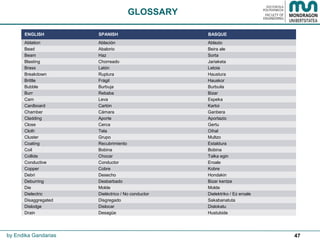
    47 GLOSSARY by Endika Gandarias ENGLISHSPANISH BASQUE Ablation Ablación Ablazio Bead Abalorio Beira ale Beam Haz Sorta Blasting Chorreado Jariaketa Brass Latón Letoia Breakdown Ruptura Haustura Brittle Frágil Hauskor Bubble Burbuja Burbuila Burr Rebaba Bizar Cam Leva Espeka Cardboard Cartón Kartoi Chamber Cámara Ganbera Cladding Aporte Aportazio Close Cerca Gertu Cloth Tela Oihal Cluster Grupo Multzo Coating Recubrimiento Estaldura Coil Bobina Bobina Collide Chocar Talka egin Conductive Conductor Eroale Copper Cobre Kobre Debri Desecho Hondakin Deburring Desbarbado Bizar kentze Die Molde Molde Dielectric Dieléctrico / No conductor Dielektriko / Ez eroale Disaggregated Disgregado Sakabanatuta Dislodge Dislocar Dislokatu Drain Desagüe Hustubide
  • 48.
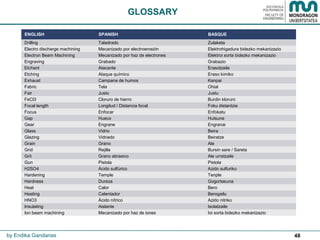
    48 GLOSSARY by Endika Gandarias ENGLISHSPANISH BASQUE Drilling Taladrado Zulaketa Electro discharge machining Mecanizado por electroerosión Elektrohigadura bidezko mekanizazio Electron Beam Machining Mecanizado por haz de electrones Elektroi sorta bidezko mekanizazio Engraving Grabado Grabazio Etchant Atacante Erasotzaile Etching Ataque químico Eraso kimiko Exhaust Campana de humos Kanpai Fabric Tela Ohial Fair Justo Justu FeCl3 Cloruro de hierro Burdin kloruro Focal length Longitud / Distancia focal Foku distantzia Focus Enfocar Enfokatu Gap Hueco Hutsune Gear Engrane Engranai Glass Vidrio Beira Glazing Vidriado Beiratze Grain Grano Ale Grid Rejilla Bursin sare / Sareta Grit Grano abrasivo Ale urratzaile Gun Pistola Pistola H2SO4 Ácido sulfúrico Azido sulfuriko Hardening Temple Tenple Hardness Dureza Gogortasuna Heat Calor Bero Heating Calentador Berogailu HNO3 Ácido nítrico Azido nitriko Insulating Aislante Isolatzaile Ion beam machining Mecanizado por haz de iones Ioi sorta bidezko mekanizazio
  • 49.
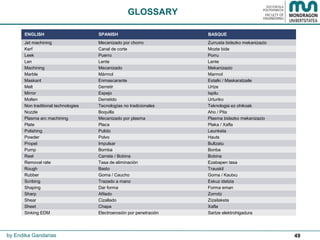
    49 GLOSSARY by Endika Gandarias ENGLISHSPANISH BASQUE Jet machining Mecanizado por chorro Zurrusta bidezko mekanizazio Kerf Canal de corte Mozte bide Leek Puerro Porru Len Lente Lente Machining Mecanizado Mekanizazio Marble Mármol Marmol Maskant Enmascarante Estalki / Maskaratzaile Melt Derretir Urtze Mirror Espejo Ispilu Molten Derretido Urturiko Non traditional technologies Tecnologías no tradicionales Teknologia ez ohikoak Nozzle Boquilla Aho / Pita Plasma arc machining Mecanizado por plasma Plasma bidezko mekanizazio Plate Placa Plaka / Xafla Polishing Pulido Leunketa Powder Polvo Hauts Propel Impulsar Bultzatu Pump Bomba Bonba Reel Carrete / Bobina Bobina Removal rate Tasa de eliminación Ezabapen tasa Rough Basto Trauskil Rubber Goma / Caucho Goma / Kautxu Scribing Trazado a mano Eskuz idatzia Shaping Dar forma Forma eman Sharp Afilado Zorrotz Shear Cizallado Zizailaketa Sheet Chapa Xafla Sinking EDM Electroerosión por penetración Sartze elektrohigadura
  • 50.
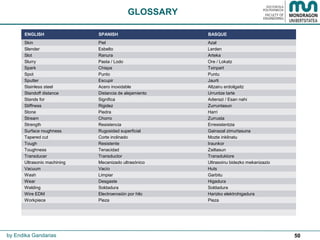
    50 GLOSSARY by Endika Gandarias ENGLISHSPANISH BASQUE Skin Piel Azal Slender Esbelto Lerden Slot Ranura Arteka Slurry Pasta / Lodo Ore / Lokatz Spark Chispa Txinpart Spot Punto Puntu Sputter Escupir Jaurti Stainless steel Acero inoxidable Altzairu erdoilgaitz Standoff distance Distancia de alejamiento Urruntze tarte Stands for Significa Adierazi / Esan nahi Stiffness Rigidez Zurruntasun Stone Piedra Harri Stream Chorro Zurrusta Strength Resistencia Erresistentzia Surface roughness Rugosidad superficial Gainazal zimurtasuna Tapered cut Corte inclinado Mozte inklinatu Tough Resistente Iraunkor Toughness Tenacidad Zailtasun Transducer Transductor Transduktore Ultrasonic machining Mecanizado ultrasónico Ultrasoinu bidezko mekanizazio Vacuum Vacío Huts Wash Limpiar Garbitu Wear Desgaste Higadura Welding Soldadura Soldadura Wire EDM Electroerosión por hilo Harizko elektrohigadura Workpiece Pieza Pieza