Non-Parametric Tests in SPSS
(between subjects)
Fronton I. Oronan
Introduction
• Non-parametric tests are based on ranks rather than raw
scores:
– SPSS converts the raw data into rankings before
comparing groups (ordinal level)
• These tests are advised when
– scores on the DV are ordinal
– when scores are interval, but ANOVA is not robust
enough to deal with the existing deviations from
assumptions for the DV distribution (check
“assumptions of ANOVA”)
Mann-Whitney U
• Design: Non-parametric
– 1 continuous DV (criminal thinking)
– 2 comparison groups (IV) - different participants
in each group (violent and non-violent offenders)
• Purpose: To determine if there is a
significant difference in level of criminal
thinking between violent and non-violent
offenders
SPSS Output
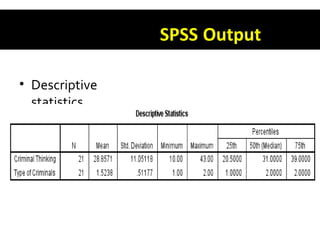
• Descriptive
statistics
SPSS Output
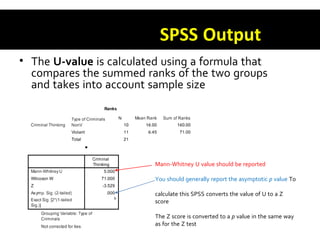
• The U-value is calculated using a formula that
compares the summed ranks of the two groups
and takes into account sample size
Mann-Whitney U value should be reported
You should generally report the asymptotic p value To
calculate this SPSS converts the value of U to a Z
score
The Z score is converted to a p value in the same way
as for the Z test
Reporting Mann-Whitney U
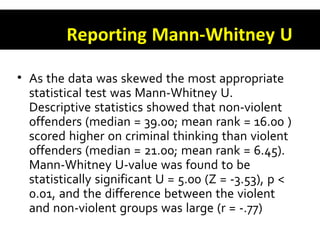
• As the data was skewed the most appropriate
statistical test was Mann-Whitney U.
Descriptive statistics showed that non-violent
offenders (median = 39.00; mean rank = 16.00 )
scored higher on criminal thinking than violent
offenders (median = 21.00; mean rank = 6.45).
Mann-Whitney U-value was found to be
statistically significant U = 5.00 (Z = -3.53), p <
0.01, and the difference between the violent
and non-violent groups was large (r = -.77)
Kruskal-Wallis H
• The Kruskal-Wallis test is the
nonparametric test equivalent to the one-
way ANOVA, and an extension of the
Mann-Whitney U test
– it allows the comparison of more than two
independent groups
Kruskal-Wallis H
• Design: Non-parametric,
– 1 continuous DV (psychoticism)
– 2 or more comparison groups (3 age groups)
different participants in each group
• Purpose: To determine if there is an overall
effect of prisoners’ age on level of psychoticism
(i.e., if at least 2 groups are different from each
other) while controlling for experiment-wise
inflation of Type I error
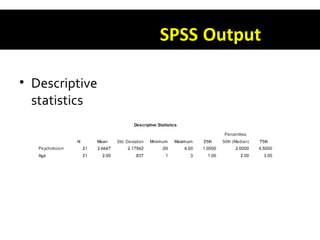
SPSS Output
• Descriptive
statistics
SPSS Output
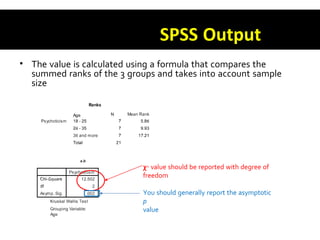
• The value is calculated using a formula that compares the
summed ranks of the 3 groups and takes into account sample
size
χ2 value should be reported with degree of
freedom
You should generally report the asymptotic
p
value
Reporting Kruskal-Wallis
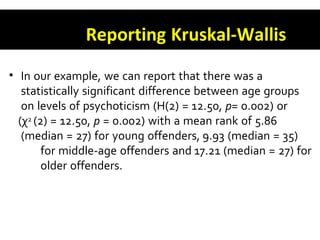
• In our example, we can report that there was a
statistically significant difference between age groups
on levels of psychoticism (H(2) = 12.50, p= 0.002) or
(χ2 (2) = 12.50, p = 0.002) with a mean rank of 5.86
(median = 27) for young offenders, 9.93 (median = 35)
for middle-age offenders and 17.21 (median = 27) for
older offenders.

Non parametric tests

  • 1.
    Non-Parametric Tests inSPSS (between subjects) Fronton I. Oronan
  • 2.
    Introduction • Non-parametric testsare based on ranks rather than raw scores: – SPSS converts the raw data into rankings before comparing groups (ordinal level) • These tests are advised when – scores on the DV are ordinal – when scores are interval, but ANOVA is not robust enough to deal with the existing deviations from assumptions for the DV distribution (check “assumptions of ANOVA”)
  • 3.
    Mann-Whitney U • Design:Non-parametric – 1 continuous DV (criminal thinking) – 2 comparison groups (IV) - different participants in each group (violent and non-violent offenders) • Purpose: To determine if there is a significant difference in level of criminal thinking between violent and non-violent offenders
  • 4.
  • 5.
    SPSS Output • TheU-value is calculated using a formula that compares the summed ranks of the two groups and takes into account sample size Mann-Whitney U value should be reported You should generally report the asymptotic p value To calculate this SPSS converts the value of U to a Z score The Z score is converted to a p value in the same way as for the Z test
  • 6.
    Reporting Mann-Whitney U •As the data was skewed the most appropriate statistical test was Mann-Whitney U. Descriptive statistics showed that non-violent offenders (median = 39.00; mean rank = 16.00 ) scored higher on criminal thinking than violent offenders (median = 21.00; mean rank = 6.45). Mann-Whitney U-value was found to be statistically significant U = 5.00 (Z = -3.53), p < 0.01, and the difference between the violent and non-violent groups was large (r = -.77)
  • 7.
    Kruskal-Wallis H • TheKruskal-Wallis test is the nonparametric test equivalent to the one- way ANOVA, and an extension of the Mann-Whitney U test – it allows the comparison of more than two independent groups
  • 8.
    Kruskal-Wallis H • Design:Non-parametric, – 1 continuous DV (psychoticism) – 2 or more comparison groups (3 age groups) different participants in each group • Purpose: To determine if there is an overall effect of prisoners’ age on level of psychoticism (i.e., if at least 2 groups are different from each other) while controlling for experiment-wise inflation of Type I error
  • 9.
  • 10.
    SPSS Output • Thevalue is calculated using a formula that compares the summed ranks of the 3 groups and takes into account sample size χ2 value should be reported with degree of freedom You should generally report the asymptotic p value
  • 11.
    Reporting Kruskal-Wallis • Inour example, we can report that there was a statistically significant difference between age groups on levels of psychoticism (H(2) = 12.50, p= 0.002) or (χ2 (2) = 12.50, p = 0.002) with a mean rank of 5.86 (median = 27) for young offenders, 9.93 (median = 35) for middle-age offenders and 17.21 (median = 27) for older offenders.