PHILIPPINEELECTRICALCODE
( P E C )
PEC I - Electrical installationinsidebuildings.
PEC II - Electrical installationoutsidebuildings.
* PEC consistsof ruleswhichare intendedtomake use of electricitysafe forpersonandproperty.
* Two(2) categoriesof PECrules *
1. Mandatory Rules - characterizedbythe use of the word “SHALL’’.
2. AdvisoryRules - characterizedbythe use of the word “SHOULD” or are statedas recommendationsof
that whichisadvisedbutnotrequired.
* OBJECTIVES*
a) Safe Use of Electricity
- to establishbasicmaterialsqualityandelectrical workstandardsforthe safe use of electricityforlight,
heat,power,communications,signalingandforotherpurposes.
b) Adequacy - Strict compliance withthe provisionsof this Code willensuresafetyinelectrical
installationandconstruction,butnotnecessarilyefficient,convenient,oradequate forgoodservice or
future expansionof electrical use.
* The use of PEC ismandatedbyR.A.7920 ( formerlyR.A.184 ),alsoknown as the New Electrical
EngineeringLaw.Likewise,referral codesare alsousedwhichare mandatedbytheircorresponding
laws.
1. P.D. 1096 - National BuildingCode
2. P.D. 1185 - Fire Code of the Philippines
3. Structural Code
R.A.7920 - isan act providingfora more responsiveandcomprehensive regulationforthe practice,
licensing,andregistrationof electrical engineersandelectricians.
* GovernmentAuthoritieswhoimplementPEC*
1. Office of the BuildingOfficial
2. Office of the CityElectrician ( CityElectrical SupervisingEngineer)
3. Office of the Municipal Electrician( Municipal Electrical SupervisingEngineer)
4. Regional Office of the DOLE
* SCOPEOF THE PEC*
PEC coversthe electricconductorsincludingoptical fibercable andinstalled withinoron,to or from:
1. Publicandprivate buildings
2. Electrical generatingplants
3. Temporaryand permanentsubstations
4. Industrial plants
5. Transformerstations
6. Railwayswitchyards
7. Yards, carnival,parking,etc.
8. Watercraft
9. Dockyards
10. Airfields
11. Quarriesandmines
12. Mobile homes,travel trailersandrecreational vehicles
13. Offshore facilities
14. Otherpremiseswhichrequireselectrical installationexcepttothose whichare done in;a) Aircraft b)
motor vehicles c) railwayrollingstocks
PERMITS ANDINSPECTION CERTIFICATES
A permitisrequiredbeforeundertakinganyelectrical installation.
An inspection isalsorequiredafterwhichcertificateof electrical inspection(CEI) isissuedbythe
authority.
*EXCEPTIONS*
A permitisnot requiredfor;
1. the installationof electrical portable equipmentratednotmore than1,200 VA.
2. reconnectionof disconnectedservice due tonon-paymentof electricbill orchange of occupantsfor a
periodof one year.
RequirementsforElectrical Permit
a) Anapplicationform(DPWHformNo.77-001-E) shall be accomplished,signedandsubmittedbyaduly
registeredProfessionalElectrical Engineer.However,if the installationdoesnotexceed20lighting
and/orreceptacle outletsor4000 volt-amperes,230 volts,the applicationmaybe prepared,signedand
submittedbyadulyregisteredelectrical engineerormasterelectrician.
b) The applicationshall include additionally,the name andsignature andseal of the electrical
practitionerwho will take charge of the installationsaswell asthe signature of the ownerorhis
authorizedrepresentative.
c) Five (5) setsof plansandspecificationsbearingthe signature andseal of the responsible Professional
Electrical Engineershall be submittedtogetherwiththe application.However,if the installationdoes
not exceed20lightingandor receptacle outletsor4,000 VA,230 V; five (5) setsof sketchesandbill of
materialsmaybe preparedsignedandsubmittedbythe responsibleRegisteredElectrical Engineeror
Master Electrician.
Accordingto P.D.1096, no plansisrequiredforbuildingmade of indigenousmaterialsorwhichcostis
not more than P15,000.00.
ELECTRIC CIRCUITS IN BUILDING
* SERVICES*
No.of Service
A buildingorotherstructure servedshall be suppliedbyonlyone service.
*EXCEPTIONS*
1. For fire pumpwhere a separate service isrequired.
2. For emergencyelectrical systemwhere aseparate service isrequired.
3. Multiple-Occupancybuilding
4. Capacity Requirements.Twoormore servicesshall be permitted:
a) Where the capacityrequirementsare inexcessof 2,000 amperesata supplyvoltage of 600 voltsor
less;or
b) Where the loadrequirementsof asingle-phase installationare greaterthanthe servingagency
normallysupplies throughone service;or
5. Buildingof Large Area ( 10,000 m2 or more Total Area).
6. For differentvoltagecharacteristics,suchasfor differentvoltage,frequencies,orphases,orfor
differentuses,suchasfor differentrate schedules.
THE OVERHEADSERVICE-DROPCONDUCTOR
Thisis the overheadservice conductorfromthe lastpole orotheraerial supporttoand includingthe
splicesif any,connectingthe service entrance conductorsatthe buildingorotherstructure.
SIZE ANDRATING:
a) General. Service dropshall have sufficientampacitytocarry the loadwithouta temperature rise
detrimental tothe coveringorinsulationofthe conductorsandshall have adequatemechanical strength.
b) MinimumSize. The conductorsshall notbe smallerthan8 mm2copper, 14 mm2 aluminumorcopper-
clad aluminum.
CLEARANCES:
a) Above Roofs.Conductorsshall have avertical clearance of notlessthan2,500 mm fromthe roof
surface.
b) Vertical Clearance fromGround.
3,100 mm- at the electricservice entrancetobuildings,oratthe driploopof the buildingelectric
entrance,orabove areas or sidewalks
3,700 mm- for those areaslistedinthe 4,600 mm classificationwhenthe voltage islimitedto600 volts
to ground.
4,600 mm- overresidential propertyanddriveways,andthose commercial areasnotsubjecttotruck
traffic.
5,500 mm- overpublicstreets,alleys,roads,parkingareassubjecttotrucktraffic,drivewaysonother
than residential property,andotherlandtransversedbyvehiclessuchascultivated,grazing,forest,and
orchard.
UNDERGROUND SERVICE-LATERALCONDUCTOR
Thisis the undergroundservice conductorbetweenthe streetmain,includinganyrisersata pole or
otherstructure or from transformers,andthe firstpointof anyconnectiontothe service-entrance
conductorsina terminal box ormeteror otherenclosure withadequatespace,inside oroutside the
buildingwall.
INSULATION. Service-lateral conductorshall withstandexposure toatmosphericandotherconditionsof
use withoutdetrimental leakage of current.
*EXCEPTIONS*
A groundedconductorshall be permittedtobe uninsulatedasfollows:
a) Bare copperusedina raceway.
b) Bare copperfor directburial where bare copperisjudgedtobe suitable forthe soil conditions.
c) Bare copperfordirectburial withoutregardto soil conditionswhere partof cable assemblyidentified
for undergrounduse.
d) Aluminumorcopper-cladaluminumwithoutinsulationorcoveringwhere partof a cable assembly
identifiedforundergrounduse inaracewayor for directburial.
SIZE ANDRATING
a) General. Service lateral conductorsshall have sufficientampacitytocarry the currentfor the load and
shall have adequate mechanicalstrength.
b) MinimumSize. The conductorsshall notbe smallerthan5.5 mm2copperor 8.0 mm2 aluminumor
copper-cladaluminum.
Where twoto six service disconnectingmeansinseparate enclosuressupplyseparateloadsfromone
service dropor lateral,one setof service entrance conductorsshall be permittedtosupplyeachor
several suchservice equipmentenclosures.
EXCEPTION:For installationstosupplyonlylimitedloadsof asingle branchcircuitsuchas small
polyphase power,controlledwaterheatersandthe like,theyshall notbe smallerthan3.5 mm2 copper
or 5.0 mm2aluminumorcopper-cladaluminum.
SERVICEENTRANCE
Service isdefinedasthe portionof the supplywhichextendsfromthe streetmainductor transformer
to the service switchorswitchboardof the buildingsupply.
-itis the conductorand equipmentfordeliveringenergyfromthe electricitysupplysystemtothe wiring
systemof the premisesserved.
TYPES:
1. OverheadService Entrance
The most commontype of service entrance employedbythe powercompaniessupplyingelectricity
whichiseithera 2, 3 or 4-wire connection. Generally,the overheadservice cable betweenthe building
propertyline andthe supplypointissuppliedbyelectriccompanytoa limitof 30 meters.
2. The UndergroundService Entrance
The undergroundservice entrance consistsof aracewayconduitextendingfromthe buildingtothe
propertyline where itistappedtothe main. The type of cable recommendedisthe undergroundservice
entrance cable commonlyreferredtoas USE.
SERVICE- ENTRANCECONDUCTORS
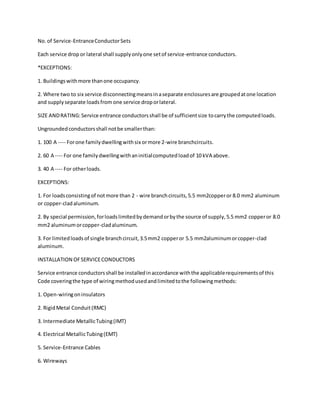
No.of Service-EntranceConductorSets
Each service drop or lateral shall supplyonlyone setof service-entrance conductors.
*EXCEPTIONS:
1. Buildingswithmore thanone occupancy.
2. Where two to six service disconnectingmeansinaseparate enclosuresare groupedatone location
and supplyseparate loadsfrom one service droporlateral.
SIZE ANDRATING:Service entrance conductorsshall be of sufficientsize tocarrythe computedloads.
Ungroundedconductorsshall notbe smallerthan:
1. 100 A ---- Forone familydwellingwithsix ormore 2-wire branchcircuits.
2. 60 A ---- For one familydwellingwithaninitialcomputedloadof 10 kVA above.
3. 40 A ---- For otherloads.
EXCEPTIONS:
1. For loadsconsistingof notmore than 2 - wire branchcircuits,5.5 mm2copperor 8.0 mm2 aluminum
or copper-cladaluminum.
2. By special permission,forloadslimitedbydemandorbythe source of supply,5.5 mm2 copperor 8.0
mm2 aluminumorcopper-cladaluminum.
3. For limitedloadsof single branchcircuit,3.5mm2 copperor 5.5 mm2aluminumorcopper-clad
aluminum.
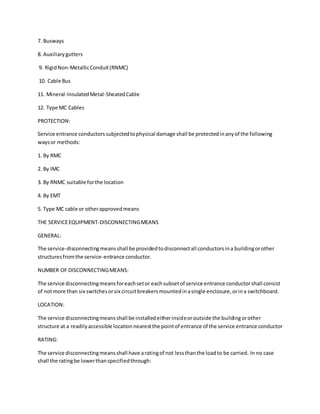
INSTALLATION OFSERVICECONDUCTORS
Service entrance conductorsshall be installedinaccordance withthe applicablerequirementsof this
Code coveringthe type of wiringmethodusedandlimitedtothe followingmethods:
1. Open-wiringoninsulators
2. RigidMetal Conduit(RMC)
3. Intermediate MetallicTubing(IMT)
4. Electrical MetallicTubing(EMT)
5. Service-Entrance Cables
6. Wireways
7. Busways
8. Auxiliarygutters
9. RigidNon-MetallicConduit(RNMC)
10. Cable Bus
11. Mineral-InsulatedMetal-SheatedCable
12. Type MC Cables
PROTECTION:
Service entrance conductorssubjectedtophysical damage shall be protectedinanyof the following
waysor methods:
1. By RMC
2. By IMC
3. By RNMC suitable forthe location
4. By EMT
5. Type MC cable or otherapprovedmeans
THE SERVICEEQUIPMENT-DISCONNECTINGMEANS
GENERAL:
The service-disconnectingmeansshall be providedtodisconnectall conductorsina buildingorother
structuresfromthe service-entrance conductor.
NUMBER OF DISCONNECTINGMEANS:
The service disconnectingmeansforeachsetor eachsubsetof service entrance conductorshall consist
of notmore than six switchesorsix circuitbreakersmountedinasingle enclosure,orina switchboard.
LOCATION:
The service disconnectingmeansshall be installedeitherinsideoroutside the buildingorother
structure at a readilyaccessible locationnearestthe pointof entrance of the service entrance conductor
RATING:
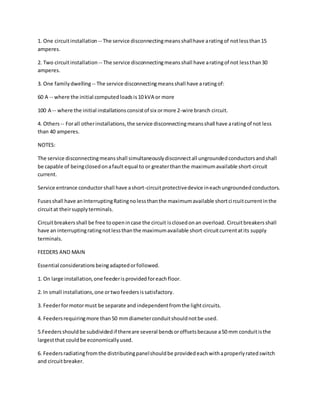
The service disconnectingmeansshall have aratingof not lessthanthe loadto be carried. In no case
shall the ratingbe lowerthanspecifiedthrough:
1. One circuitinstallation -- The service disconnectingmeansshallhave aratingof notlessthan15
amperes.
2. Two circuitinstallation -- The service disconnectingmeansshall have aratingof not lessthan30
amperes.
3. One familydwelling -- The service disconnectingmeansshall have aratingof:
60 A -- where the initial computedloadsis10 kVA or more
100 A -- where the initial installationsconsistof six ormore 2-wire branch circuit.
4. Others-- Forall otherinstallations,the service disconnectingmeansshall have aratingof not less
than 40 amperes.
NOTES:
The service disconnectingmeansshall simultaneouslydisconnectall ungroundedconductorsandshall
be capable of beingclosedonafault equal to or greaterthanthe maximumavailable short-circuit
current.
Service entrance conductorshall have ashort-circuitprotectivedevice ineachungroundedconductors.
Fusesshall have anInterruptingRatingnolessthanthe maximumavailable shortcircuitcurrentinthe
circuitat theirsupplyterminals.
Circuitbreakersshall be free toopenincase the circuit isclosedonan overload. Circuitbreakersshall
have an interruptingratingnotlessthanthe maximumavailable short-circuitcurrentatits supply
terminals.
FEEDERS AND MAIN
Essential considerationsbeingadaptedorfollowed.
1. On large installation,one feederisprovidedforeachfloor.
2. In small installations,one ortwofeedersissatisfactory.
3. Feederformotormust be separate and independentfromthe lightcircuits.
4. Feedersrequiringmore than50 mmdiameterconduitshouldnotbe used.
5.Feedersshouldbe subdividedif thereare several bendsoroffsetsbecause a50 mm conduitisthe
largestthat couldbe economicallyused.
6. Feedersradiatingfromthe distributingpanelshouldbe providedeachwithaproperlyratedswitch
and circuitbreaker.
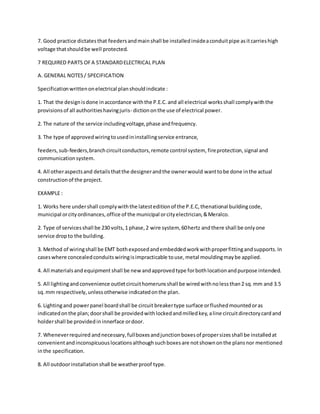
7. Good practice dictatesthat feedersandmainshall be installedinsideaconduitpipe asitcarrieshigh
voltage thatshouldbe well protected.
7 REQUIRED PARTS OFA STANDARDELECTRICAL PLAN
A. GENERAL NOTES/ SPECIFICATION
Specificationwrittenonelectrical planshouldindicate :
1. That the designisdone inaccordance withthe P.E.C.and all electrical worksshall complywiththe
provisionsof all authoritieshavingjuris- dictiononthe use of electrical power.
2. The nature of the service includingvoltage,phase andfrequency.
3. The type of approvedwiringtousedininstallingservice entrance,
feeders,sub-feeders,branchcircuitconductors,remote control system, fireprotection,signal and
communicationsystem.
4. All otheraspectsand detailsthatthe designerandthe ownerwould wanttobe done inthe actual
constructionof the project.
EXAMPLE :
1. Works here undershall complywiththe latesteditionof the P.E.C,thenational buildingcode,
municipal orcityordinances,office of the municipal orcityelectrician,&Meralco.
2. Type of servicesshall be 230 volts,1 phase,2 wire system, 60hertz andthere shall be onlyone
service dropto the building.
3. Method of wiringshall be EMT bothexposedandembeddedworkwithproperfittingandsupports.In
caseswhere concealedconduitswiringisimpracticable touse,metal mouldingmaybe applied.
4. All materialsandequipment shall be new andapprovedtype forbothlocationandpurpose intended.
5. All lightingandconvenience outletcircuithomerunsshall be wiredwithnolessthan2 sq.mm and 3.5
sq.mm respectively, unlessotherwise indicatedonthe plan.
6. Lightingand powerpanel boardshall be circuit breakertype surface orflushedmountedoras
indicatedonthe plan;doorshall be providedwithlockedandmilledkey,aline circuitdirectorycardand
holdershall be providedininnerface ordoor.
7. Wheneverrequired andnecessary,fullboxesandjunctionboxesof propersizesshall be installedat
convenientandinconspicuouslocationsalthoughsuchboxesare notshownonthe plansnor mentioned
inthe specification.
8. All outdoorinstallationshall be weatherproof type.
9. All electrical workshall be done underthe directandimmediate supervisionof aduly
licensedElectrical Engineer.
B. LEGEND ANDSYMBOLS
The legendorsymbolsshall showsymbolsorconfigurationsandfiguresof devicesandequipment
used. StandardElectrical symbolscanbe obtainedfromthe appendix - aof the Philippine Electrical
Code.
C. LOCATION PLAN
Locationor site planwithproposedstructuresandowner’slanddrawntoappropriate metricscale shall
show:
1. Borderingareasshowingpublicorwell knownstreets.
2. Location of service drop,service equipmentandnearestpole of the utilitycompanyfurnishing
electrical energy.
3. Clearance of the path or run of service dropsandservice structure wirestoadjacentexistingor
proposedstructures.
D. RISER DIAGRAM
The riserdiagram consistsof the schematicdiagramof service entrance,feedersandbranch
circuits. Thisindicates:
1. The numberof branch circuits,the size of conductors,size of conduitandprotectionforeachbranch
circuit.
2. The sizesof feeders,itsconduitandfeeder’sprotection.
3. The type of service,size of service entrance conductor,conduitsandmainprotectivedevice.
E. TITLE BLOCK:
Title blockor nameplate of plansanddrawingsshall be astandardstripof 40 mm highat the bottomof
each sheet.
It shall containthe following:
1. Name and locationof proposedinstallation,project,orwatercraft;
2. Name,signature andaddressof owner/manager/operator;
3. Title of sheetandsheetnumber;
4. Scale used;
5. Name,signature anddry seal of professionalelectrical engineertogetherwith registrationnumber,
ProfessionalTax Receipt(PTR) andTax IdentificationNumber (TIN);
6. Initial of draftsman;and
7. Date drawnor revised.
F. ELECTRICAL LIGHTING ANDPOWER LAYOUT
Electrical layoutforeachfloorof the buildingshall indicatethe locationof:
1. Location of lightingoutlets.
2. Location of convenience outlets.
3. Location of switcheswiththeircorrespondingsymbols.
4. Location of outletsforair conditioningunits.
5. Location of telephone,intercomandmasterantennatelevisionoutlets.
6. Location of service equipmentand/ordisconnectingmeans.
7. Location of service kilowatthourmeter.
G. SCHEDULE OF LOADSAND COMPUTATIONS:
Schedule of loadsintabulatedform shall indicate:
A. MOTOR LOADS:
1. Motor as numberedoridentifiedinpowerlayout.
2. Type of motor
3. HP/kW/kVA rating
4. Voltage rating
5. Full loadcurrent rating
6. Frequencyrating
7. Numberof phases
B. LIGHTING ANDPOWER LOADS:
1. Panel as numbered inthe riserdiagram.
2. Circuitdesignationnumber.
3. Numberand lightningoutletsineachcircuits.
4. Numberof switchesineachcircuit.
5. Numberof convinience outlet
6. Voltage circuit
7. Fuse rating or triprating of circuitprotective device.
C. OTHER LOADS
1. Designationnumberonplan
2. Descriptionloads
3. Classificationof service duty
4. Rating inkilovoltampere (KVA)orkilowatt(KW)
5. Phase loadingindicatingfull loadlinecurrent
6. Voltage rating
DESIGN COMPUTATION
Or designanalysiswherenecessarryshall be includedonthe drawingsormaybe submittedonseparate
sheetsof uniformsize paper,shall allow:
1. Illuminationdesigncomputationsandtabulatedlightinglevelsinlux critical areasininstitutional,
Industrial recreational &commercial building.
2. Feedlinesandprotective devicesof motors,electricalequipmentandappliancesindicatingtypesand
ratings.
3. Sizesof branch circuitwires,Feedersandbusbarsincludingprotectivedevices.
4. Size and type of service entrance wires,race waysandequipment.
5. Setting/ ratingsof overcurrentdevices.
GROUNDING PROTECTION
A ground isan electrical connectionwhichmayeitherbe intentional oraccidental betweenanelectric
circuitor equipmentandthe earth,orto some conductingbodythat servesinplace of the earth.The
purpose of groundingacircuit isto fix permanentlyazerovoltage pointinthe system. The grounded
line of a circuitshouldnotbe brokennor fusedtomaintaina solidanduninterruptedconnectiontothe
ground.
Groundingcouldbe accomplishedinthe followingmanner:
1. Connectiontoa buriedcoldwatermain.
2. Connectiontoa rod or group of rods.
3. Connectiontoa buriedgroundplate.
THE PANELBOARD
A panelboard isasingle panel orgroupof panel unitsdesignedforassemblyinthe formof a single
panel.Thisincludesbuses,automaticovercurrentprotective devices,andwithorwithoutswitchesfor
the control of light,heator powercircuit.Itis designedtobe placedinacabinetor cutoutbox placedin
or againsta wall orpartitionandaccessible onlyfromthe front.
Principlesappliedininstallingpanel board
1. The approachshouldbe accessible andconvenient.
2. The panelboardmustbe centrallylocatedtoshortenthe home wiringruns.
3. It must be installednearthe loadcenter.Asinmostcases,panelboardisinstallednearthe kitchen
and the laundrywhere heavyloadsare expected.
MAIN- isthe feederinteriorwiringextendingfromserviceswitch,generatorbus,orconverterbustothe
maindistribution.
BRANCHCIRCUIT- isdefinedasthe circuitconductorsbetweenthe final overcurrentdevice protecting
the circuitand the outlets. Thismeansthatthe branch circuitis onlythe wiringbetweenthe circuit
overcurrentprotectiondevice suchasfusesorcircuitbreakerand the outlets. However,itisa common
knowledge andpractice thatthe branchcircuit comprisesthe entire circuitincludingthe outlet
receptaclesandotherwiringdevices.
PROTECTION OF THE BRANCH CIRCUIT
Anycurrent inexcessof the ratedcurrentcapacity of the equipmentorthe ratedampacityof the
conductoris called overcurrent.
The causesof overcurrentare:
1. Overloadinthe equipmentconductors.
2. Short circuitor ground fault
As perPEC requirement,conductorsshall be protectedagainstovercurrentinaccordance withtheir
ampacities(Art.4.5.1.3)
Ampacity - is the current-carryingcapacityof an electricconductor.
THE CIRCUIT BREAKERAND THE FUSE
A circuitbreakerisan overcurrentprotective device alsodesignedtofunctionasaswitch. It isequipped
withan automatictrippingdevice toprotectthe branchcircuitfrom overloadandgroundfault.
A fuse isalsoan overcurrentprotective device withacircuitopeningfusible elementwhichopenswhen
there isan overcurrentinthe circuit.It isconsideredasthe simplestandthe mostcommoncircuit
protective deviceusedintothe house wiringconnection.
Advantagesof circuitbreakerovera fuse
1. The circuitbreakeracts as a switchaside fromitsbeingan overcurrentdevice.
2. When there isan overcurrent,the circuitbreakertripsautomaticallyandaftercorrectingthe fault,it
isready to be switchedonagain,unlike the fuse whichhastobe discardedandreplacedafterit
isbusted.
Advantagesof fuse overacircuit breaker
1. One of itsmajor advantage isitsreliabilityandstability.Itcanstay onits positionforyearsandact
whencalledonto act as designed,unlikethe circuitbreakerwhichrequirespropermaintenance and
periodictestingtokeepitintoatip-topcondition.
2. The cost of a fuse islessthanthat of a circuitbreaker.
StandardAmpere Ratingsof FusesandInverse time circuitbreakers
15, 20, 25, 30, 40, 45, 60, 70, 80, 90, 100, 110, 125, 150, 200, 225, 250, 300, 350, 400, 450, 500, 600,
700, 800, 1000, 1200, 1600, 2000, 2500, 3000, 4000, 5000 and 6000
Fuses,circuitbreakersorcombinationsshall notbe connectedinparallel.
Exception:Circuitbreakersorfuses,factoryassembledinparallel,and approvedasaunit.
Positionof Knife Switches
a) Single-throwKnife Switches.Single-throwknifeswitchesshall be soplacedthatgravitywill nottend
to close them.Single-throwknifeswitches,approvedforuse inthe invertedposition,shall be provided
witha lockingdevice thatwill ensurethatthe bladesremaininthe openpositionwhensoset.
b) Double-throwKnife Switches. Double-throw knife switchesshall be permittedtobe mountedsothat
the throw will be eithervertical orhorizontal.Where the throw isvertical,alockingdevice shallbe
providedtoholdthe bladesinthe openpositionwhensoset.
RECEPTACLES ANDWIRINGDEVICES
ELECTRICAL CONDUCTORSANDINSULATORS
Electrical Conductors are substancesthatoffera verylow resistance tocurrentflow.
Insulators are substancesthatoffera veryhighresistance tocurrentflow.
List of some goodelectrical conductors
1. Silver6.Zinc
2. Copper7. Platinum
3. Aluminum8. Iron
4. Nickel 9. Tin
5. Brass 10. Lead
List of some insulatingmaterials
1. Rubber8. Asbestos
2. Porcelain 9. Thermoplastics
3. Varnish 10. Paper
4. Slate 11. Oils
5. Glass 12. Wax
6. Mica 13. Dry air
7. Latex
WIRES ANDCABLES
Wiresare those electrical conductorswhichare 8mm2 (AWG no. 8) or smaller,while cablesare those
largerthan the wires.Theyare eithersolidorstranded.
Strandedwire - consistsof a group of wirestwistedtoformmetallicstring.The total circular-milareaof
a strandedwire isfoundbymultiplyingthe circularmil areaof each strandby the total numberof
strand.
Cord isthe term giventoan insulatedstrandedwire.
CIRCULAR MIL. Thisis the unitof crosssectioninthe Americanwire gauge.The term“mil”meansone-
thousandthof an inch(0.001 in.). It isthe area of a circularwire havinga diameterof one mil. Tofind
the numberof circular milsina circle of a givendiameter,we have tosquare the numberof milsinthe
diameter.
Areain circularmil = ( diameterinmils)2
1 inch= 1,000 mils
MCM = 1,000 circularmils
SQUARE MIL. It is the area of a square havingitsside equal to1 mil.
Square mil = ( sides)2= ( 1 mil )2 = ( 0.001 in.)2= 1 x 10⁻⁶ in.2
Square mil = 0.7854 x circular mils
CONDUCTORAREAS:
CONVERSION FACTOR
Square inch = square mil x 0.000001
Square mil = square inch x 1,000,000
Square mil = circularmilsx 0.7854
Circularmil = square milsx 1.273
Millimeter=inchesx 25.4
Square mm = circular milsx 0.0005067
COMMONLY USED PREFIXES
PREFIX UNIT SYMBOL
deci 1 x 10⁻² d milli 1x 10⁻³ m
micro1 x 10-6 m
nano 1 x 10⁻⁹ n
pico1 x 10-12 p
deka1 x 101 da
hecto1 x 102 h
kilo1 x 103 k
Mega 1 x 10⁶ M
Giga 1 x 10⁹ G
COMMONLY USED ENGLISH-METRIC EQUIVALENTS
EnglishtoMetric Metric to English
LENGTH
1 in= 25.4 mm 1 mm= 0.0394 in
1 in= 2.54 cm 1 cm = 0.394 in
1 ft= 304.8 mm 1 cm = 0.033 ft
1 ft= 30.48 cm 1 m = 39.37 in
1 ft= 0.305 m 1 m = 3.28 ft
1 yd= 0.915 m 1 km= 3280.83 ft
1 mi = 1609.34 m 1 km = 0.621 mi
1 mi = 1.609 km
AREA
1 sq in= 645.16 sq mm 1 sq cm =0.155 sq in
1 sq in= 6.45 sq cm 1 sqcm = 0.0011 sq ft
1 sq ft= 929.03 sq cm 1 sq m = 10.764 sq ft
1 sq ft= 0.093 sqm 1 sq m = 1.2 sqyd
DIFFERENTTYPES OFCABLES
1. ArmoredCable. Thistype of cable,the type ACis a fabricatedassemblyof insulatedconductors
enclosedinflexiblemetalsheath.Armoredcable isusedinbothexposedandconcealedwork.
2. Metal CladCable. Cable of the type MC is a factory assembledcable of one ormore conductors,each
individuallyinsulatedandenclosedinametallicsheathof interlockingtape,orasmoothor corrugated
tube.Thistype isusedspecificallyforservices,feeders,branchcircuits,eitherexposedorconcealedand
for indooror outdoorwork.
3. Mineral InsulatedCable. Thistype of cable,type MI,isa factory assemblyof one ormore conductors
insulatedwithahighly compressedrefractorymineral insulationandenclosedinliquid-tightandgas-
tightcontinuouscoppersheath.The type MIis usedindry,wetor continuouslymoistlocationas
service,feedersorbranchcircuit.
4. NonmetallicSheathedCable. TypesNMandNMC are factoryassembledtwoormore insulated
conductorshavinga moisture-resistantoutersheath,flame-retardantandnon-metallicmaterial.These
typesare usedspecificallyforone ortwo dwellingnotexceeding3storeybuildings.
5. ShieldedNonmetallicSheathedCable. Thistype of cable,the type SNM,isa factory assemblyof two
or more insulatedconductorsinanextrudedcore ormoisture-resistantandflame-retardantmaterial,
coveredwithanoverlapping spiral metaltape.Thistype isusedinhazardouslocationsandincable trays
or in raceways.
6. Service Entrance Cable. Thisisa single conductorormulticonductorassemblyprovidedwithor
withoutanover-all covering,primarilyusedforservicesandof the typesSE and USE.
7. UndergroundFeederandBrach CircuitCables. Thistype of cable,the type UF cable isa moisture-
resistantcable usedforunderground,includingdirectburial inthe ground,asfeederorbranchcircuit.
8. Powerand Control Tray Cable. Type TCcable is a factory assemblyof twoormore insulated
conductorswithor withoutassociatedbare orcoveredgroundingunderametallicsheath.Thisisused
for installationincable trays,racewaysorwhere supportedbyamessengerwire.
9. Flat Cable Assemblies. Thisisanassemblyof parallelconductorsformedintegrallywithaninsulating
material webdesignedspecificallyforfieldinstallationinmetal surface raceway.Cablesof thistype are
the typesFC.
10. FlatConductorCable. Thistype of cable,type FCCconsistsof three or more flat conductorsplaced
edge to edge,separatedandenclosedwithinaninsulatingassembly.Thisusedforgeneral purpose,
appliance branchcircuitsandfor individual branchcircuitsspecificallyonhard,smooth,continuousfloor
surfaces,etc.
12.MediumVoltage Cables. MV cable isa single ormulticonductorsoliddielectricinsulatedcable rated
2,001 voltsor higherandisusedfor powersystemsupto35,000 volts.The MV cablesare of different
typesandcharacteristics.
RACEWAYS
Racewaysare channelsdesignedforholdingwires,cablesorbus-bars,whichare eithermade of metal or
insulatingmaterials.The commontypesof racewaysinhouseholdwiringare the a) conduits,b)
connectors,andc) others.
a) Conduits
Conduits,pipesortubingsare the mostcommonelectrical raceway.
Accordingto the type of materialsused,conduitmaybe classifiedaseithermetallic suchassteel pipesor
nonmetallicsuchas PVC,andthe like.
Accordingto itsmake,conduitsmaybe classifiedas:rigidmetal,flexiblemetal,rigidnonmetal and
flexible nonmetal.
b) Connectors
A connectorisa metal sleeveusuallymade of copperthatisslippedoverandsecuredtothe buttedends
of conductorsinmaking joint.A connectorisalsocalleda splicingsleeve.
c) OtherRaceways
Aside fromthe conduitsandconnectorsthere are still numeroustypesandkindsof raceways,among
these are the a) conduitcouplings,elbowsandotherfittings;b) conduitsupports,suchasclamps,
hangers,etc;c) cable trays,cablebus;d) metal raceways;e) nonmetal raceways.
OUTLETS, RECEPTACLES and otherWIRINGDEVICES
OUTLETS. Anoutletisa pointinthe wiringsystem atwhichcurrent istakento supplyutilization
equipment.The kindsof outletsare:convenience outletorattachmentcap,lightingoutlet,and
receptacle outlet.
A convenience outletorattachmentcap isa device whichbyinsertioninareceptacle,establishes
connectionbetweenthe conductorof the flexible cordandthe conductorsconnectedpermanentlyto
the receptacle.
A lightingoutletisanoutletintendedfordirectconnectionof alampholder,alightingfixture,ora
pendantcordterminatingina lampholder.
A receptacle outlet isanoutletwhere one ormore receptaclesare installed.
TYPES OF WIRES
A. TYPES T, TW, THW
The most ordinarytype of plasticinsulatedwireisthe “type T”.It may be usedonlyindry locations.
Some manufacturesnolongermake the ordinaryType T,insteadproduce Type TW,whichis identical in
appearance,butmaybe usedinwetor dry locations.Alsoavailable isType THW,issimilartoType TW
but withstandagreaterdegree of heat,andconsequentlyhasa higherampacityratinginthe larger
sizes.
B. TYPES THHN, THWN
These are comparativelynewtypesof wire,consistingof the basicType THH and THW butwithless
thermoplasticinsulation,andwithafinal extrudedjacketof nylon.Nylonhasexceptionalinsulating
qualitiesandgreatmechanical strength,all of whichresultsinawire whichissmallerindiameterthan
ordinaryTypesT, TW, TW of correspondingsize.
C. TYPE XHHW
In appearance,itresemblesTypesT,TW,THW but because of somewhatthinnerlayerof insulation,the
over-all diameterissmaller.The insulationis“cross-linkedsyntheticpolymer,”whichhasan
extraordinarypropertiesastoinsulatingvalue,heatresistance,andmoistureresistance.Itmaybe used
indry or wetlocations.While atpresent,itisanexpensivewire,itwouldbe nosurprise if indue course
of time,thisone single type willreplace all the manytypesandsubtypesof Type Tor R now recognized
by the Code.
D. RUBBER-COVERED WIRE
It consistsof copperconductor,tinnedtomake it easiertoremove the insulation,andforeasy
soldering.Overthe copperisalayerof rubber,the thicknessof whichdependsonthe size of the wire.
Thenfollowsanouterfabricbraidwhichissaturatedwithmoisture-and-fire-resistantcompounds;if itis
seton fire witha blowtorch,the flame diesoutwhenthe torchisremoved.
E. OTHER TYPES
Othertypessuchas the basicType R, whichissuitable foronlyindrylocations,isnolongerbeingmade.
The most ordinarykindisType RHW, whichmay be usedfordry or wetlocations.TypesRHand RHH
have insulationwhichwithstandsmore heatandtherefore have ahigherampacityinthe largersize.
Theymay be usedonlyindry locations.
KINDSOF LOCATIONS
DAMP LOCATION
Partiallyprotectedlocationsundercanopies,marquees,roofedopenporches,andlike locations,and
interiorlocationssubjectedtomoderate degree of moisture,suchassome basements,some barns,and
some cold-storage warehouses.
DRY LOCATION
A locationnotnormallysubjecttodampnessorwetness.A locationclassifiedasdrymay be temporarily
subjecttodampnessor wetness,asinthe case of a buildingunderconstruction.
WET LOCATION
Installationsundergroundorinconcrete slabsor masonryindirectcontact withthe earth,and location
subjecttosaturationwithwateror otherliquids,suchasvehicle washingareas,andlocationsexposed
to weatherandunprotected.
HAZARDOUS(CLASSIFIED) LOCATIONS
Locationswhere fire orexplosionhazardsmayexistdue toflammablegasesorvapors,flammable
liquids,combustible dust,orignitiblefibersorflyings.
1. ClassI Locations.ClassI locationsare those inwhichflammable gasesorvaporsare or may be present
inthe airin quantitiessufficienttoproduce explosiveorignitible mixtures.
a) ClassI,Division1. A ClassI, Division1locationisa location:I) inwhichigntible concentrationsof
flammable gasesorvaporscan existundernormal operatingconditions;orii) inwhichignitible
concentrationsof suchgas vaporsmay existfrequentlybecause of repairormaintenance operationsor
because of leakage;oriii) inwhichbreakdownorfaultyoperationof equipmentorprocessesmight
release ignitible concentrationsof flammable gasesorvapors,and mightalsocause simultaneousfailure
of electricequipment.
b) ClassI, Division2.A ClassI,Division2locationisa location:I) inwhichvolatile flammable liquidsor
flammable gasesare handled,processes,orused,butinwhichthe liquids,vapors, orgaseswill normally
be confineswithinclosedcontainersorclosedsystemsfromwhichtheycanescape onlyincase of
accidental rupture orbreakdownof suchcontainersor systems,orincase of abnormal operationof
equipment;orii) inwhichignitible concentrationsof gasesorvaporsare normallypreventedbypositive
mechanical ventilation,andwhichmightbecome hazardousthroughfailureorabnormal operationof
the ventilatingequipment;iii)thatisadjacenttoClassI, Division1location,andto whichignitible
concentrationsof gasesorvapors mightoccasionallybe communicatedunlesssuchcommunicationis
preventedbyadequate positive ventilationfromasource of cleanair,and effective safeguardsagainst
ventilationfailure are provided.
ClassII Locations. ClassIIlocationsare those that are hazardousbecause of the presence of combustible
dust.
a) ClassII,Division1.A classII,Division1 locationisa location:I) inwhichcombustibledustisinthe air
normal operatingconditionsin quantitiessufficienttoproduce explosiveorignitible mixtures;orii)
where mechanical failure orabnormal operationof machineryorequipmentmightcause suchexplosive
or ignitible mixturestobe produced,andmightalsoprovide asource of ignitionthroughsimultaneous
failure of electricequipment,operationdevices,orfromothercauses;or iii) inwhichcombustible dusts
of an electricallyconductive nature maybe presentinhazardousquantities.
b) ClassII, Division2. A ClassII, Division2locationisa locationwhere combustibledustisnotnormallyin
the air inquantitiessufficienttoproduce explosive orignitiblemixtures,anddustaccumulationsare
normallyinsufficienttointerfere withthe normal operationof electrical equipmentorotherapparatus,
but combustibledustmaybe insuspensioninthe airas a resultof infrequentmalfunctioningof handling
or processingequipmentandwhere combustible dustaccumulationson,in,orinthe vicinityof the
electrical equipmentmaybe sufficienttointerfere withthe safe dissipationof heatfromelectrical
equipmentormaybe ignitiblebyabnormal operationorfailure of electrical equipment.
3. ClassIII Locations. ClassIIIlocationsare those thatare hazardousbecause of the presence of easily
combustible fibersorflyings,butinwhichsuchfibersorflyingsare notlikelytobe insuspensioninthe
air inquantitiessufficienttoproduce ignitible mixtures.
a) ClassIII,Division1. A ClassIII,Divisions1locationisa locationinwhich easilyignitible fibersor
materialsproducingcombustibleflyingsare handled,manufactured,orused.
b) ClassIII, Division2. A ClassIII,Division2locationisa locationinwhicheasilyignitible fibersare stored
or handled.

228279816 philippine-electrical-code-summary

  • 1.
    PHILIPPINEELECTRICALCODE ( P EC ) PEC I - Electrical installationinsidebuildings. PEC II - Electrical installationoutsidebuildings. * PEC consistsof ruleswhichare intendedtomake use of electricitysafe forpersonandproperty. * Two(2) categoriesof PECrules * 1. Mandatory Rules - characterizedbythe use of the word “SHALL’’. 2. AdvisoryRules - characterizedbythe use of the word “SHOULD” or are statedas recommendationsof that whichisadvisedbutnotrequired. * OBJECTIVES* a) Safe Use of Electricity - to establishbasicmaterialsqualityandelectrical workstandardsforthe safe use of electricityforlight, heat,power,communications,signalingandforotherpurposes. b) Adequacy - Strict compliance withthe provisionsof this Code willensuresafetyinelectrical installationandconstruction,butnotnecessarilyefficient,convenient,oradequate forgoodservice or future expansionof electrical use. * The use of PEC ismandatedbyR.A.7920 ( formerlyR.A.184 ),alsoknown as the New Electrical EngineeringLaw.Likewise,referral codesare alsousedwhichare mandatedbytheircorresponding laws. 1. P.D. 1096 - National BuildingCode 2. P.D. 1185 - Fire Code of the Philippines 3. Structural Code R.A.7920 - isan act providingfora more responsiveandcomprehensive regulationforthe practice, licensing,andregistrationof electrical engineersandelectricians. * GovernmentAuthoritieswhoimplementPEC* 1. Office of the BuildingOfficial 2. Office of the CityElectrician ( CityElectrical SupervisingEngineer) 3. Office of the Municipal Electrician( Municipal Electrical SupervisingEngineer)
  • 2.
    4. Regional Officeof the DOLE * SCOPEOF THE PEC* PEC coversthe electricconductorsincludingoptical fibercable andinstalled withinoron,to or from: 1. Publicandprivate buildings 2. Electrical generatingplants 3. Temporaryand permanentsubstations 4. Industrial plants 5. Transformerstations 6. Railwayswitchyards 7. Yards, carnival,parking,etc. 8. Watercraft 9. Dockyards 10. Airfields 11. Quarriesandmines 12. Mobile homes,travel trailersandrecreational vehicles 13. Offshore facilities 14. Otherpremiseswhichrequireselectrical installationexcepttothose whichare done in;a) Aircraft b) motor vehicles c) railwayrollingstocks PERMITS ANDINSPECTION CERTIFICATES A permitisrequiredbeforeundertakinganyelectrical installation. An inspection isalsorequiredafterwhichcertificateof electrical inspection(CEI) isissuedbythe authority. *EXCEPTIONS* A permitisnot requiredfor; 1. the installationof electrical portable equipmentratednotmore than1,200 VA. 2. reconnectionof disconnectedservice due tonon-paymentof electricbill orchange of occupantsfor a periodof one year.
  • 3.
    RequirementsforElectrical Permit a) Anapplicationform(DPWHformNo.77-001-E)shall be accomplished,signedandsubmittedbyaduly registeredProfessionalElectrical Engineer.However,if the installationdoesnotexceed20lighting and/orreceptacle outletsor4000 volt-amperes,230 volts,the applicationmaybe prepared,signedand submittedbyadulyregisteredelectrical engineerormasterelectrician. b) The applicationshall include additionally,the name andsignature andseal of the electrical practitionerwho will take charge of the installationsaswell asthe signature of the ownerorhis authorizedrepresentative. c) Five (5) setsof plansandspecificationsbearingthe signature andseal of the responsible Professional Electrical Engineershall be submittedtogetherwiththe application.However,if the installationdoes not exceed20lightingandor receptacle outletsor4,000 VA,230 V; five (5) setsof sketchesandbill of materialsmaybe preparedsignedandsubmittedbythe responsibleRegisteredElectrical Engineeror Master Electrician. Accordingto P.D.1096, no plansisrequiredforbuildingmade of indigenousmaterialsorwhichcostis not more than P15,000.00. ELECTRIC CIRCUITS IN BUILDING * SERVICES* No.of Service A buildingorotherstructure servedshall be suppliedbyonlyone service. *EXCEPTIONS* 1. For fire pumpwhere a separate service isrequired. 2. For emergencyelectrical systemwhere aseparate service isrequired. 3. Multiple-Occupancybuilding 4. Capacity Requirements.Twoormore servicesshall be permitted: a) Where the capacityrequirementsare inexcessof 2,000 amperesata supplyvoltage of 600 voltsor less;or b) Where the loadrequirementsof asingle-phase installationare greaterthanthe servingagency normallysupplies throughone service;or 5. Buildingof Large Area ( 10,000 m2 or more Total Area). 6. For differentvoltagecharacteristics,suchasfor differentvoltage,frequencies,orphases,orfor differentuses,suchasfor differentrate schedules.
  • 4.
    THE OVERHEADSERVICE-DROPCONDUCTOR Thisis theoverheadservice conductorfromthe lastpole orotheraerial supporttoand includingthe splicesif any,connectingthe service entrance conductorsatthe buildingorotherstructure. SIZE ANDRATING: a) General. Service dropshall have sufficientampacitytocarry the loadwithouta temperature rise detrimental tothe coveringorinsulationofthe conductorsandshall have adequatemechanical strength. b) MinimumSize. The conductorsshall notbe smallerthan8 mm2copper, 14 mm2 aluminumorcopper- clad aluminum. CLEARANCES: a) Above Roofs.Conductorsshall have avertical clearance of notlessthan2,500 mm fromthe roof surface. b) Vertical Clearance fromGround. 3,100 mm- at the electricservice entrancetobuildings,oratthe driploopof the buildingelectric entrance,orabove areas or sidewalks 3,700 mm- for those areaslistedinthe 4,600 mm classificationwhenthe voltage islimitedto600 volts to ground. 4,600 mm- overresidential propertyanddriveways,andthose commercial areasnotsubjecttotruck traffic. 5,500 mm- overpublicstreets,alleys,roads,parkingareassubjecttotrucktraffic,drivewaysonother than residential property,andotherlandtransversedbyvehiclessuchascultivated,grazing,forest,and orchard. UNDERGROUND SERVICE-LATERALCONDUCTOR Thisis the undergroundservice conductorbetweenthe streetmain,includinganyrisersata pole or otherstructure or from transformers,andthe firstpointof anyconnectiontothe service-entrance conductorsina terminal box ormeteror otherenclosure withadequatespace,inside oroutside the buildingwall. INSULATION. Service-lateral conductorshall withstandexposure toatmosphericandotherconditionsof use withoutdetrimental leakage of current. *EXCEPTIONS* A groundedconductorshall be permittedtobe uninsulatedasfollows: a) Bare copperusedina raceway.
  • 5.
    b) Bare copperfordirectburial where bare copperisjudgedtobe suitable forthe soil conditions. c) Bare copperfordirectburial withoutregardto soil conditionswhere partof cable assemblyidentified for undergrounduse. d) Aluminumorcopper-cladaluminumwithoutinsulationorcoveringwhere partof a cable assembly identifiedforundergrounduse inaracewayor for directburial. SIZE ANDRATING a) General. Service lateral conductorsshall have sufficientampacitytocarry the currentfor the load and shall have adequate mechanicalstrength. b) MinimumSize. The conductorsshall notbe smallerthan5.5 mm2copperor 8.0 mm2 aluminumor copper-cladaluminum. Where twoto six service disconnectingmeansinseparate enclosuressupplyseparateloadsfromone service dropor lateral,one setof service entrance conductorsshall be permittedtosupplyeachor several suchservice equipmentenclosures. EXCEPTION:For installationstosupplyonlylimitedloadsof asingle branchcircuitsuchas small polyphase power,controlledwaterheatersandthe like,theyshall notbe smallerthan3.5 mm2 copper or 5.0 mm2aluminumorcopper-cladaluminum. SERVICEENTRANCE Service isdefinedasthe portionof the supplywhichextendsfromthe streetmainductor transformer to the service switchorswitchboardof the buildingsupply. -itis the conductorand equipmentfordeliveringenergyfromthe electricitysupplysystemtothe wiring systemof the premisesserved. TYPES: 1. OverheadService Entrance The most commontype of service entrance employedbythe powercompaniessupplyingelectricity whichiseithera 2, 3 or 4-wire connection. Generally,the overheadservice cable betweenthe building propertyline andthe supplypointissuppliedbyelectriccompanytoa limitof 30 meters. 2. The UndergroundService Entrance The undergroundservice entrance consistsof aracewayconduitextendingfromthe buildingtothe propertyline where itistappedtothe main. The type of cable recommendedisthe undergroundservice entrance cable commonlyreferredtoas USE. SERVICE- ENTRANCECONDUCTORS
  • 6.
    No.of Service-EntranceConductorSets Each servicedrop or lateral shall supplyonlyone setof service-entrance conductors. *EXCEPTIONS: 1. Buildingswithmore thanone occupancy. 2. Where two to six service disconnectingmeansinaseparate enclosuresare groupedatone location and supplyseparate loadsfrom one service droporlateral. SIZE ANDRATING:Service entrance conductorsshall be of sufficientsize tocarrythe computedloads. Ungroundedconductorsshall notbe smallerthan: 1. 100 A ---- Forone familydwellingwithsix ormore 2-wire branchcircuits. 2. 60 A ---- For one familydwellingwithaninitialcomputedloadof 10 kVA above. 3. 40 A ---- For otherloads. EXCEPTIONS: 1. For loadsconsistingof notmore than 2 - wire branchcircuits,5.5 mm2copperor 8.0 mm2 aluminum or copper-cladaluminum. 2. By special permission,forloadslimitedbydemandorbythe source of supply,5.5 mm2 copperor 8.0 mm2 aluminumorcopper-cladaluminum. 3. For limitedloadsof single branchcircuit,3.5mm2 copperor 5.5 mm2aluminumorcopper-clad aluminum. INSTALLATION OFSERVICECONDUCTORS Service entrance conductorsshall be installedinaccordance withthe applicablerequirementsof this Code coveringthe type of wiringmethodusedandlimitedtothe followingmethods: 1. Open-wiringoninsulators 2. RigidMetal Conduit(RMC) 3. Intermediate MetallicTubing(IMT) 4. Electrical MetallicTubing(EMT) 5. Service-Entrance Cables 6. Wireways
  • 7.
    7. Busways 8. Auxiliarygutters 9.RigidNon-MetallicConduit(RNMC) 10. Cable Bus 11. Mineral-InsulatedMetal-SheatedCable 12. Type MC Cables PROTECTION: Service entrance conductorssubjectedtophysical damage shall be protectedinanyof the following waysor methods: 1. By RMC 2. By IMC 3. By RNMC suitable forthe location 4. By EMT 5. Type MC cable or otherapprovedmeans THE SERVICEEQUIPMENT-DISCONNECTINGMEANS GENERAL: The service-disconnectingmeansshall be providedtodisconnectall conductorsina buildingorother structuresfromthe service-entrance conductor. NUMBER OF DISCONNECTINGMEANS: The service disconnectingmeansforeachsetor eachsubsetof service entrance conductorshall consist of notmore than six switchesorsix circuitbreakersmountedinasingle enclosure,orina switchboard. LOCATION: The service disconnectingmeansshall be installedeitherinsideoroutside the buildingorother structure at a readilyaccessible locationnearestthe pointof entrance of the service entrance conductor RATING: The service disconnectingmeansshall have aratingof not lessthanthe loadto be carried. In no case shall the ratingbe lowerthanspecifiedthrough:
  • 8.
    1. One circuitinstallation-- The service disconnectingmeansshallhave aratingof notlessthan15 amperes. 2. Two circuitinstallation -- The service disconnectingmeansshall have aratingof not lessthan30 amperes. 3. One familydwelling -- The service disconnectingmeansshall have aratingof: 60 A -- where the initial computedloadsis10 kVA or more 100 A -- where the initial installationsconsistof six ormore 2-wire branch circuit. 4. Others-- Forall otherinstallations,the service disconnectingmeansshall have aratingof not less than 40 amperes. NOTES: The service disconnectingmeansshall simultaneouslydisconnectall ungroundedconductorsandshall be capable of beingclosedonafault equal to or greaterthanthe maximumavailable short-circuit current. Service entrance conductorshall have ashort-circuitprotectivedevice ineachungroundedconductors. Fusesshall have anInterruptingRatingnolessthanthe maximumavailable shortcircuitcurrentinthe circuitat theirsupplyterminals. Circuitbreakersshall be free toopenincase the circuit isclosedonan overload. Circuitbreakersshall have an interruptingratingnotlessthanthe maximumavailable short-circuitcurrentatits supply terminals. FEEDERS AND MAIN Essential considerationsbeingadaptedorfollowed. 1. On large installation,one feederisprovidedforeachfloor. 2. In small installations,one ortwofeedersissatisfactory. 3. Feederformotormust be separate and independentfromthe lightcircuits. 4. Feedersrequiringmore than50 mmdiameterconduitshouldnotbe used. 5.Feedersshouldbe subdividedif thereare several bendsoroffsetsbecause a50 mm conduitisthe largestthat couldbe economicallyused. 6. Feedersradiatingfromthe distributingpanelshouldbe providedeachwithaproperlyratedswitch and circuitbreaker.
  • 9.
    7. Good practicedictatesthat feedersandmainshall be installedinsideaconduitpipe asitcarrieshigh voltage thatshouldbe well protected. 7 REQUIRED PARTS OFA STANDARDELECTRICAL PLAN A. GENERAL NOTES/ SPECIFICATION Specificationwrittenonelectrical planshouldindicate : 1. That the designisdone inaccordance withthe P.E.C.and all electrical worksshall complywiththe provisionsof all authoritieshavingjuris- dictiononthe use of electrical power. 2. The nature of the service includingvoltage,phase andfrequency. 3. The type of approvedwiringtousedininstallingservice entrance, feeders,sub-feeders,branchcircuitconductors,remote control system, fireprotection,signal and communicationsystem. 4. All otheraspectsand detailsthatthe designerandthe ownerwould wanttobe done inthe actual constructionof the project. EXAMPLE : 1. Works here undershall complywiththe latesteditionof the P.E.C,thenational buildingcode, municipal orcityordinances,office of the municipal orcityelectrician,&Meralco. 2. Type of servicesshall be 230 volts,1 phase,2 wire system, 60hertz andthere shall be onlyone service dropto the building. 3. Method of wiringshall be EMT bothexposedandembeddedworkwithproperfittingandsupports.In caseswhere concealedconduitswiringisimpracticable touse,metal mouldingmaybe applied. 4. All materialsandequipment shall be new andapprovedtype forbothlocationandpurpose intended. 5. All lightingandconvenience outletcircuithomerunsshall be wiredwithnolessthan2 sq.mm and 3.5 sq.mm respectively, unlessotherwise indicatedonthe plan. 6. Lightingand powerpanel boardshall be circuit breakertype surface orflushedmountedoras indicatedonthe plan;doorshall be providedwithlockedandmilledkey,aline circuitdirectorycardand holdershall be providedininnerface ordoor. 7. Wheneverrequired andnecessary,fullboxesandjunctionboxesof propersizesshall be installedat convenientandinconspicuouslocationsalthoughsuchboxesare notshownonthe plansnor mentioned inthe specification. 8. All outdoorinstallationshall be weatherproof type.
  • 10.
    9. All electricalworkshall be done underthe directandimmediate supervisionof aduly licensedElectrical Engineer. B. LEGEND ANDSYMBOLS The legendorsymbolsshall showsymbolsorconfigurationsandfiguresof devicesandequipment used. StandardElectrical symbolscanbe obtainedfromthe appendix - aof the Philippine Electrical Code. C. LOCATION PLAN Locationor site planwithproposedstructuresandowner’slanddrawntoappropriate metricscale shall show: 1. Borderingareasshowingpublicorwell knownstreets. 2. Location of service drop,service equipmentandnearestpole of the utilitycompanyfurnishing electrical energy. 3. Clearance of the path or run of service dropsandservice structure wirestoadjacentexistingor proposedstructures. D. RISER DIAGRAM The riserdiagram consistsof the schematicdiagramof service entrance,feedersandbranch circuits. Thisindicates: 1. The numberof branch circuits,the size of conductors,size of conduitandprotectionforeachbranch circuit. 2. The sizesof feeders,itsconduitandfeeder’sprotection. 3. The type of service,size of service entrance conductor,conduitsandmainprotectivedevice. E. TITLE BLOCK: Title blockor nameplate of plansanddrawingsshall be astandardstripof 40 mm highat the bottomof each sheet. It shall containthe following: 1. Name and locationof proposedinstallation,project,orwatercraft; 2. Name,signature andaddressof owner/manager/operator; 3. Title of sheetandsheetnumber; 4. Scale used;
  • 11.
    5. Name,signature anddryseal of professionalelectrical engineertogetherwith registrationnumber, ProfessionalTax Receipt(PTR) andTax IdentificationNumber (TIN); 6. Initial of draftsman;and 7. Date drawnor revised. F. ELECTRICAL LIGHTING ANDPOWER LAYOUT Electrical layoutforeachfloorof the buildingshall indicatethe locationof: 1. Location of lightingoutlets. 2. Location of convenience outlets. 3. Location of switcheswiththeircorrespondingsymbols. 4. Location of outletsforair conditioningunits. 5. Location of telephone,intercomandmasterantennatelevisionoutlets. 6. Location of service equipmentand/ordisconnectingmeans. 7. Location of service kilowatthourmeter. G. SCHEDULE OF LOADSAND COMPUTATIONS: Schedule of loadsintabulatedform shall indicate: A. MOTOR LOADS: 1. Motor as numberedoridentifiedinpowerlayout. 2. Type of motor 3. HP/kW/kVA rating 4. Voltage rating 5. Full loadcurrent rating 6. Frequencyrating 7. Numberof phases B. LIGHTING ANDPOWER LOADS: 1. Panel as numbered inthe riserdiagram. 2. Circuitdesignationnumber.
  • 12.
    3. Numberand lightningoutletsineachcircuits. 4.Numberof switchesineachcircuit. 5. Numberof convinience outlet 6. Voltage circuit 7. Fuse rating or triprating of circuitprotective device. C. OTHER LOADS 1. Designationnumberonplan 2. Descriptionloads 3. Classificationof service duty 4. Rating inkilovoltampere (KVA)orkilowatt(KW) 5. Phase loadingindicatingfull loadlinecurrent 6. Voltage rating DESIGN COMPUTATION Or designanalysiswherenecessarryshall be includedonthe drawingsormaybe submittedonseparate sheetsof uniformsize paper,shall allow: 1. Illuminationdesigncomputationsandtabulatedlightinglevelsinlux critical areasininstitutional, Industrial recreational &commercial building. 2. Feedlinesandprotective devicesof motors,electricalequipmentandappliancesindicatingtypesand ratings. 3. Sizesof branch circuitwires,Feedersandbusbarsincludingprotectivedevices. 4. Size and type of service entrance wires,race waysandequipment. 5. Setting/ ratingsof overcurrentdevices. GROUNDING PROTECTION A ground isan electrical connectionwhichmayeitherbe intentional oraccidental betweenanelectric circuitor equipmentandthe earth,orto some conductingbodythat servesinplace of the earth.The purpose of groundingacircuit isto fix permanentlyazerovoltage pointinthe system. The grounded line of a circuitshouldnotbe brokennor fusedtomaintaina solidanduninterruptedconnectiontothe ground.
  • 13.
    Groundingcouldbe accomplishedinthe followingmanner: 1.Connectiontoa buriedcoldwatermain. 2. Connectiontoa rod or group of rods. 3. Connectiontoa buriedgroundplate. THE PANELBOARD A panelboard isasingle panel orgroupof panel unitsdesignedforassemblyinthe formof a single panel.Thisincludesbuses,automaticovercurrentprotective devices,andwithorwithoutswitchesfor the control of light,heator powercircuit.Itis designedtobe placedinacabinetor cutoutbox placedin or againsta wall orpartitionandaccessible onlyfromthe front. Principlesappliedininstallingpanel board 1. The approachshouldbe accessible andconvenient. 2. The panelboardmustbe centrallylocatedtoshortenthe home wiringruns. 3. It must be installednearthe loadcenter.Asinmostcases,panelboardisinstallednearthe kitchen and the laundrywhere heavyloadsare expected. MAIN- isthe feederinteriorwiringextendingfromserviceswitch,generatorbus,orconverterbustothe maindistribution. BRANCHCIRCUIT- isdefinedasthe circuitconductorsbetweenthe final overcurrentdevice protecting the circuitand the outlets. Thismeansthatthe branch circuitis onlythe wiringbetweenthe circuit overcurrentprotectiondevice suchasfusesorcircuitbreakerand the outlets. However,itisa common knowledge andpractice thatthe branchcircuit comprisesthe entire circuitincludingthe outlet receptaclesandotherwiringdevices. PROTECTION OF THE BRANCH CIRCUIT Anycurrent inexcessof the ratedcurrentcapacity of the equipmentorthe ratedampacityof the conductoris called overcurrent. The causesof overcurrentare: 1. Overloadinthe equipmentconductors. 2. Short circuitor ground fault As perPEC requirement,conductorsshall be protectedagainstovercurrentinaccordance withtheir ampacities(Art.4.5.1.3) Ampacity - is the current-carryingcapacityof an electricconductor.
  • 14.
    THE CIRCUIT BREAKERANDTHE FUSE A circuitbreakerisan overcurrentprotective device alsodesignedtofunctionasaswitch. It isequipped withan automatictrippingdevice toprotectthe branchcircuitfrom overloadandgroundfault. A fuse isalsoan overcurrentprotective device withacircuitopeningfusible elementwhichopenswhen there isan overcurrentinthe circuit.It isconsideredasthe simplestandthe mostcommoncircuit protective deviceusedintothe house wiringconnection. Advantagesof circuitbreakerovera fuse 1. The circuitbreakeracts as a switchaside fromitsbeingan overcurrentdevice. 2. When there isan overcurrent,the circuitbreakertripsautomaticallyandaftercorrectingthe fault,it isready to be switchedonagain,unlike the fuse whichhastobe discardedandreplacedafterit isbusted. Advantagesof fuse overacircuit breaker 1. One of itsmajor advantage isitsreliabilityandstability.Itcanstay onits positionforyearsandact whencalledonto act as designed,unlikethe circuitbreakerwhichrequirespropermaintenance and periodictestingtokeepitintoatip-topcondition. 2. The cost of a fuse islessthanthat of a circuitbreaker. StandardAmpere Ratingsof FusesandInverse time circuitbreakers 15, 20, 25, 30, 40, 45, 60, 70, 80, 90, 100, 110, 125, 150, 200, 225, 250, 300, 350, 400, 450, 500, 600, 700, 800, 1000, 1200, 1600, 2000, 2500, 3000, 4000, 5000 and 6000 Fuses,circuitbreakersorcombinationsshall notbe connectedinparallel. Exception:Circuitbreakersorfuses,factoryassembledinparallel,and approvedasaunit. Positionof Knife Switches a) Single-throwKnife Switches.Single-throwknifeswitchesshall be soplacedthatgravitywill nottend to close them.Single-throwknifeswitches,approvedforuse inthe invertedposition,shall be provided witha lockingdevice thatwill ensurethatthe bladesremaininthe openpositionwhensoset. b) Double-throwKnife Switches. Double-throw knife switchesshall be permittedtobe mountedsothat the throw will be eithervertical orhorizontal.Where the throw isvertical,alockingdevice shallbe providedtoholdthe bladesinthe openpositionwhensoset. RECEPTACLES ANDWIRINGDEVICES ELECTRICAL CONDUCTORSANDINSULATORS
  • 15.
    Electrical Conductors aresubstancesthatoffera verylow resistance tocurrentflow. Insulators are substancesthatoffera veryhighresistance tocurrentflow. List of some goodelectrical conductors 1. Silver6.Zinc 2. Copper7. Platinum 3. Aluminum8. Iron 4. Nickel 9. Tin 5. Brass 10. Lead List of some insulatingmaterials 1. Rubber8. Asbestos 2. Porcelain 9. Thermoplastics 3. Varnish 10. Paper 4. Slate 11. Oils 5. Glass 12. Wax 6. Mica 13. Dry air 7. Latex WIRES ANDCABLES Wiresare those electrical conductorswhichare 8mm2 (AWG no. 8) or smaller,while cablesare those largerthan the wires.Theyare eithersolidorstranded. Strandedwire - consistsof a group of wirestwistedtoformmetallicstring.The total circular-milareaof a strandedwire isfoundbymultiplyingthe circularmil areaof each strandby the total numberof strand. Cord isthe term giventoan insulatedstrandedwire. CIRCULAR MIL. Thisis the unitof crosssectioninthe Americanwire gauge.The term“mil”meansone- thousandthof an inch(0.001 in.). It isthe area of a circularwire havinga diameterof one mil. Tofind the numberof circular milsina circle of a givendiameter,we have tosquare the numberof milsinthe diameter. Areain circularmil = ( diameterinmils)2
  • 16.
    1 inch= 1,000mils MCM = 1,000 circularmils SQUARE MIL. It is the area of a square havingitsside equal to1 mil. Square mil = ( sides)2= ( 1 mil )2 = ( 0.001 in.)2= 1 x 10⁻⁶ in.2 Square mil = 0.7854 x circular mils CONDUCTORAREAS: CONVERSION FACTOR Square inch = square mil x 0.000001 Square mil = square inch x 1,000,000 Square mil = circularmilsx 0.7854 Circularmil = square milsx 1.273 Millimeter=inchesx 25.4 Square mm = circular milsx 0.0005067 COMMONLY USED PREFIXES PREFIX UNIT SYMBOL deci 1 x 10⁻² d milli 1x 10⁻³ m micro1 x 10-6 m nano 1 x 10⁻⁹ n pico1 x 10-12 p deka1 x 101 da hecto1 x 102 h kilo1 x 103 k Mega 1 x 10⁶ M Giga 1 x 10⁹ G COMMONLY USED ENGLISH-METRIC EQUIVALENTS
  • 17.
    EnglishtoMetric Metric toEnglish LENGTH 1 in= 25.4 mm 1 mm= 0.0394 in 1 in= 2.54 cm 1 cm = 0.394 in 1 ft= 304.8 mm 1 cm = 0.033 ft 1 ft= 30.48 cm 1 m = 39.37 in 1 ft= 0.305 m 1 m = 3.28 ft 1 yd= 0.915 m 1 km= 3280.83 ft 1 mi = 1609.34 m 1 km = 0.621 mi 1 mi = 1.609 km AREA 1 sq in= 645.16 sq mm 1 sq cm =0.155 sq in 1 sq in= 6.45 sq cm 1 sqcm = 0.0011 sq ft 1 sq ft= 929.03 sq cm 1 sq m = 10.764 sq ft 1 sq ft= 0.093 sqm 1 sq m = 1.2 sqyd DIFFERENTTYPES OFCABLES 1. ArmoredCable. Thistype of cable,the type ACis a fabricatedassemblyof insulatedconductors enclosedinflexiblemetalsheath.Armoredcable isusedinbothexposedandconcealedwork. 2. Metal CladCable. Cable of the type MC is a factory assembledcable of one ormore conductors,each individuallyinsulatedandenclosedinametallicsheathof interlockingtape,orasmoothor corrugated tube.Thistype isusedspecificallyforservices,feeders,branchcircuits,eitherexposedorconcealedand for indooror outdoorwork. 3. Mineral InsulatedCable. Thistype of cable,type MI,isa factory assemblyof one ormore conductors insulatedwithahighly compressedrefractorymineral insulationandenclosedinliquid-tightandgas- tightcontinuouscoppersheath.The type MIis usedindry,wetor continuouslymoistlocationas service,feedersorbranchcircuit. 4. NonmetallicSheathedCable. TypesNMandNMC are factoryassembledtwoormore insulated conductorshavinga moisture-resistantoutersheath,flame-retardantandnon-metallicmaterial.These typesare usedspecificallyforone ortwo dwellingnotexceeding3storeybuildings.
  • 18.
    5. ShieldedNonmetallicSheathedCable. Thistypeof cable,the type SNM,isa factory assemblyof two or more insulatedconductorsinanextrudedcore ormoisture-resistantandflame-retardantmaterial, coveredwithanoverlapping spiral metaltape.Thistype isusedinhazardouslocationsandincable trays or in raceways. 6. Service Entrance Cable. Thisisa single conductorormulticonductorassemblyprovidedwithor withoutanover-all covering,primarilyusedforservicesandof the typesSE and USE. 7. UndergroundFeederandBrach CircuitCables. Thistype of cable,the type UF cable isa moisture- resistantcable usedforunderground,includingdirectburial inthe ground,asfeederorbranchcircuit. 8. Powerand Control Tray Cable. Type TCcable is a factory assemblyof twoormore insulated conductorswithor withoutassociatedbare orcoveredgroundingunderametallicsheath.Thisisused for installationincable trays,racewaysorwhere supportedbyamessengerwire. 9. Flat Cable Assemblies. Thisisanassemblyof parallelconductorsformedintegrallywithaninsulating material webdesignedspecificallyforfieldinstallationinmetal surface raceway.Cablesof thistype are the typesFC. 10. FlatConductorCable. Thistype of cable,type FCCconsistsof three or more flat conductorsplaced edge to edge,separatedandenclosedwithinaninsulatingassembly.Thisusedforgeneral purpose, appliance branchcircuitsandfor individual branchcircuitsspecificallyonhard,smooth,continuousfloor surfaces,etc. 12.MediumVoltage Cables. MV cable isa single ormulticonductorsoliddielectricinsulatedcable rated 2,001 voltsor higherandisusedfor powersystemsupto35,000 volts.The MV cablesare of different typesandcharacteristics. RACEWAYS Racewaysare channelsdesignedforholdingwires,cablesorbus-bars,whichare eithermade of metal or insulatingmaterials.The commontypesof racewaysinhouseholdwiringare the a) conduits,b) connectors,andc) others. a) Conduits Conduits,pipesortubingsare the mostcommonelectrical raceway. Accordingto the type of materialsused,conduitmaybe classifiedaseithermetallic suchassteel pipesor nonmetallicsuchas PVC,andthe like. Accordingto itsmake,conduitsmaybe classifiedas:rigidmetal,flexiblemetal,rigidnonmetal and flexible nonmetal. b) Connectors
  • 19.
    A connectorisa metalsleeveusuallymade of copperthatisslippedoverandsecuredtothe buttedends of conductorsinmaking joint.A connectorisalsocalleda splicingsleeve. c) OtherRaceways Aside fromthe conduitsandconnectorsthere are still numeroustypesandkindsof raceways,among these are the a) conduitcouplings,elbowsandotherfittings;b) conduitsupports,suchasclamps, hangers,etc;c) cable trays,cablebus;d) metal raceways;e) nonmetal raceways. OUTLETS, RECEPTACLES and otherWIRINGDEVICES OUTLETS. Anoutletisa pointinthe wiringsystem atwhichcurrent istakento supplyutilization equipment.The kindsof outletsare:convenience outletorattachmentcap,lightingoutlet,and receptacle outlet. A convenience outletorattachmentcap isa device whichbyinsertioninareceptacle,establishes connectionbetweenthe conductorof the flexible cordandthe conductorsconnectedpermanentlyto the receptacle. A lightingoutletisanoutletintendedfordirectconnectionof alampholder,alightingfixture,ora pendantcordterminatingina lampholder. A receptacle outlet isanoutletwhere one ormore receptaclesare installed. TYPES OF WIRES A. TYPES T, TW, THW The most ordinarytype of plasticinsulatedwireisthe “type T”.It may be usedonlyindry locations. Some manufacturesnolongermake the ordinaryType T,insteadproduce Type TW,whichis identical in appearance,butmaybe usedinwetor dry locations.Alsoavailable isType THW,issimilartoType TW but withstandagreaterdegree of heat,andconsequentlyhasa higherampacityratinginthe larger sizes. B. TYPES THHN, THWN These are comparativelynewtypesof wire,consistingof the basicType THH and THW butwithless thermoplasticinsulation,andwithafinal extrudedjacketof nylon.Nylonhasexceptionalinsulating qualitiesandgreatmechanical strength,all of whichresultsinawire whichissmallerindiameterthan ordinaryTypesT, TW, TW of correspondingsize. C. TYPE XHHW In appearance,itresemblesTypesT,TW,THW but because of somewhatthinnerlayerof insulation,the over-all diameterissmaller.The insulationis“cross-linkedsyntheticpolymer,”whichhasan extraordinarypropertiesastoinsulatingvalue,heatresistance,andmoistureresistance.Itmaybe used indry or wetlocations.While atpresent,itisanexpensivewire,itwouldbe nosurprise if indue course
  • 20.
    of time,thisone singletype willreplace all the manytypesandsubtypesof Type Tor R now recognized by the Code. D. RUBBER-COVERED WIRE It consistsof copperconductor,tinnedtomake it easiertoremove the insulation,andforeasy soldering.Overthe copperisalayerof rubber,the thicknessof whichdependsonthe size of the wire. Thenfollowsanouterfabricbraidwhichissaturatedwithmoisture-and-fire-resistantcompounds;if itis seton fire witha blowtorch,the flame diesoutwhenthe torchisremoved. E. OTHER TYPES Othertypessuchas the basicType R, whichissuitable foronlyindrylocations,isnolongerbeingmade. The most ordinarykindisType RHW, whichmay be usedfordry or wetlocations.TypesRHand RHH have insulationwhichwithstandsmore heatandtherefore have ahigherampacityinthe largersize. Theymay be usedonlyindry locations. KINDSOF LOCATIONS DAMP LOCATION Partiallyprotectedlocationsundercanopies,marquees,roofedopenporches,andlike locations,and interiorlocationssubjectedtomoderate degree of moisture,suchassome basements,some barns,and some cold-storage warehouses. DRY LOCATION A locationnotnormallysubjecttodampnessorwetness.A locationclassifiedasdrymay be temporarily subjecttodampnessor wetness,asinthe case of a buildingunderconstruction. WET LOCATION Installationsundergroundorinconcrete slabsor masonryindirectcontact withthe earth,and location subjecttosaturationwithwateror otherliquids,suchasvehicle washingareas,andlocationsexposed to weatherandunprotected. HAZARDOUS(CLASSIFIED) LOCATIONS Locationswhere fire orexplosionhazardsmayexistdue toflammablegasesorvapors,flammable liquids,combustible dust,orignitiblefibersorflyings. 1. ClassI Locations.ClassI locationsare those inwhichflammable gasesorvaporsare or may be present inthe airin quantitiessufficienttoproduce explosiveorignitible mixtures. a) ClassI,Division1. A ClassI, Division1locationisa location:I) inwhichigntible concentrationsof flammable gasesorvaporscan existundernormal operatingconditions;orii) inwhichignitible concentrationsof suchgas vaporsmay existfrequentlybecause of repairormaintenance operationsor
  • 21.
    because of leakage;oriii)inwhichbreakdownorfaultyoperationof equipmentorprocessesmight release ignitible concentrationsof flammable gasesorvapors,and mightalsocause simultaneousfailure of electricequipment. b) ClassI, Division2.A ClassI,Division2locationisa location:I) inwhichvolatile flammable liquidsor flammable gasesare handled,processes,orused,butinwhichthe liquids,vapors, orgaseswill normally be confineswithinclosedcontainersorclosedsystemsfromwhichtheycanescape onlyincase of accidental rupture orbreakdownof suchcontainersor systems,orincase of abnormal operationof equipment;orii) inwhichignitible concentrationsof gasesorvaporsare normallypreventedbypositive mechanical ventilation,andwhichmightbecome hazardousthroughfailureorabnormal operationof the ventilatingequipment;iii)thatisadjacenttoClassI, Division1location,andto whichignitible concentrationsof gasesorvapors mightoccasionallybe communicatedunlesssuchcommunicationis preventedbyadequate positive ventilationfromasource of cleanair,and effective safeguardsagainst ventilationfailure are provided. ClassII Locations. ClassIIlocationsare those that are hazardousbecause of the presence of combustible dust. a) ClassII,Division1.A classII,Division1 locationisa location:I) inwhichcombustibledustisinthe air normal operatingconditionsin quantitiessufficienttoproduce explosiveorignitible mixtures;orii) where mechanical failure orabnormal operationof machineryorequipmentmightcause suchexplosive or ignitible mixturestobe produced,andmightalsoprovide asource of ignitionthroughsimultaneous failure of electricequipment,operationdevices,orfromothercauses;or iii) inwhichcombustible dusts of an electricallyconductive nature maybe presentinhazardousquantities. b) ClassII, Division2. A ClassII, Division2locationisa locationwhere combustibledustisnotnormallyin the air inquantitiessufficienttoproduce explosive orignitiblemixtures,anddustaccumulationsare normallyinsufficienttointerfere withthe normal operationof electrical equipmentorotherapparatus, but combustibledustmaybe insuspensioninthe airas a resultof infrequentmalfunctioningof handling or processingequipmentandwhere combustible dustaccumulationson,in,orinthe vicinityof the electrical equipmentmaybe sufficienttointerfere withthe safe dissipationof heatfromelectrical equipmentormaybe ignitiblebyabnormal operationorfailure of electrical equipment. 3. ClassIII Locations. ClassIIIlocationsare those thatare hazardousbecause of the presence of easily combustible fibersorflyings,butinwhichsuchfibersorflyingsare notlikelytobe insuspensioninthe air inquantitiessufficienttoproduce ignitible mixtures. a) ClassIII,Division1. A ClassIII,Divisions1locationisa locationinwhich easilyignitible fibersor materialsproducingcombustibleflyingsare handled,manufactured,orused. b) ClassIII, Division2. A ClassIII,Division2locationisa locationinwhicheasilyignitible fibersare stored or handled.