Non-neoplastic
Colonic Polyps
Polyps are most common in the colon but may occur in the
esophagus, stomach, or small intestine.
Lecture 14
By

Dr Mohammad Manzoor Mashwani BKMC Mardan
Definition of Polyp
A polyp is defined as any growth or mass protruding from the mucous membrane
into the lumen.
• Classification:

• Stalked or pedunculated polyp
• Sessile polyp
As sessile polyps enlarge, proliferation of cells adjacent to the polyp and the effects
of traction on the luminal protrusion, may combine to create a stalk.

Non-neoplastic &
Neoplastic Polyps
Non-neoplastic Colonic
Polyps

Non-neoplastic Polyps
Hyperplastic polypsHamartomatous polyps
Juvenile polyps
Peutz-Jeghers polyps
Inflammatory polyps
Lymphoid polyps

90%

most common
Neoplastic Colonic Polyps
• Neoplastic Epithelial Lesions
• Benign polyps
•
Adenomas
• Malignant lesions

Adenocarcinoma
Squamous cell carcinoma of the anus
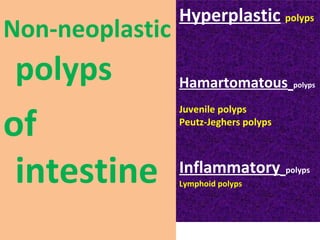
Non-neoplastic

polyps

of
intestine

Hyperplastic polyps
Hamartomatous

polyps

Juvenile polyps
Peutz-Jeghers polyps

Inflammatory
Lymphoid polyps

polyps
Non-neoplastic Polyps
• The overwhelming majority of intestinal
polyps occur sporadically, particularly in the
colon, and increase in infrequency with age.
• Non-neoplastic polyps represent 90% of all
epithelial polyps in the large intestine and are
found in more than half of all persons age 60
years or older.
I. Hyperplastic Polyps (Metaplastic)
• The most common amongst all epithelial polyps.
• Most common in the left colon (rectosigmoid).
• Called hyperplastic because there is epithelial
hyperplasia at the base of crypts, and metaplastic
as there are areas of cystic metaplasia.
• More common in elderly (6th-7th decade).
Pathogenesis
The pathogenesis of hyperplastic polyps is incompletely understood, but they are
thought to result from

decreased epithelial cell turnover and
delayed shedding of surface epithelial cells,
leading to a “pileup” of goblet cells and absorptive
cells.
Morphology
GROSS- Most commonly found in the

•

Small

( <5 mm in diameter), multiple,

left colon (rectosigmoid) and

smooth-surfaced, sessile.

Microscopy - composed of mature goblet

and
absorptive cells, long & cystically dilated glands &
crypts.

• The delayed shedding of these cells leads to crowding that creates
the

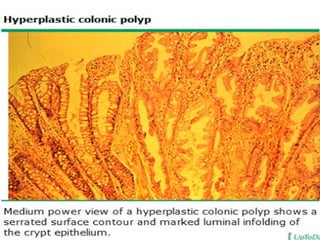
serrated surface

(Saw-toothed) architecture that is the

morphologic hallmark of these lesions.
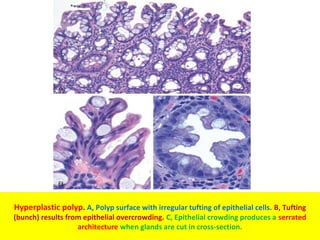
Hyperplastic polyp. A, Polyp surface with irregular tufting of epithelial cells. B, Tufting

(bunch) results from epithelial overcrowding. C, Epithelial crowding produces a serrated
architecture when glands are cut in cross-section.
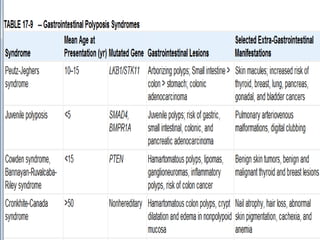
Hamartomatous polyps
Occur sporadically and in the context of various
genetically determined or acquired syndromes .
Recall that hamartomas are tumor-like growths
composed of mature tissues that are normally present at
the site in which they develop.

Although Hamartomatous polyposis syndromes are rare, they are

associated intestinal
and extra-intestinal manifestations and the need
to screen family members.
important to recognize because of
Juvenile Polyps

(Retention polyps)

• Juvenile polyps are the most common type of
hamartomatous polyp.
• Juvenile polyps are focal malformations of the
mucosal epithelium and lamina propria.
• These may be sporadic or syndromic.
• The vast majority of juvenile polyps occur in
children less than 5 years of age.
• When present in adults, polyps with identical morphology are
sometimes confusingly referred to as inflammatory

polyps.
• The majority of juvenile polyps are located in the

rectum and most present with rectal bleeding. In

some cases prolapse occurs and the polyp protrudes
through the anal sphincter.
• Sporadic juvenile polyps are usually solitary lesions
and may be referred to as retention polyps.
• In contrast, individuals with the autosomal dominant syndrome
of juvenile polyposis have from 3 to as many as 100 hamartomatous polyps
and may require colectomy to limit the chronic and sometimes
severe hemorrhage associated with polyp ulceration.
•

stomach and small bowel.
Pulmonary arteriovenous malformations are a
A minority of patients also have polyps in the

recognized extra-intestinal manifestation of the syndrome.

Dysplasia occurs in a small proportion of (mostly syndrome associated)
juvenile polyps, and the juvenile polyposis syndrome
is associated with increased risk for the development of colonic adenocarcinoma.
Morphology

Individual sporadic and syndromic juvenile polyps often are indistinguishable.

Gross-

pedunculated, smooth surfaced,
reddish lesions that are <3 cm in diameter and
display characteristic cystic spaces on cut sections.
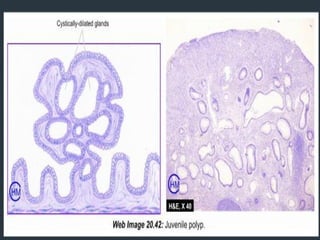
Microscopic examination – cystically dilated glands
filled with mucin and inflammatory debris
Spherical,
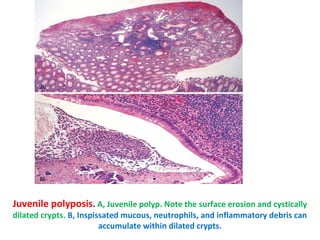
Juvenile polyposis. A, Juvenile polyp. Note the surface erosion and cystically

dilated crypts. B, Inspissated mucous, neutrophils, and inflammatory debris can
accumulate within dilated crypts.
Peutz-Jeghers Syndrome
A rare autosomal dominant disorder
defined by the presence of multiple
gastrointestinal hamartomatous polyps
and mucocutaneous hyperpigmentation

that carries an increased risk of several
malignancies, including cancers of the colon,
pancreas, breast, lung, ovaries, uterus, and testes, as
well as other unusual neoplasms.
• Intestinal polyps are most common in the small
intestine, although they may also occur in the
stomach and colon and, rarely, in the bladder and
lungs.
Morphology
• Gross- More commonly situated in the small
intestine. Often large (variable), multiple &
pedunculated with lobulated contour.
• Microscopy- characteristic arborizing network of

connective tissue, smooth muscle, lamina propria, and glands
lined by normal-appearing intestinal epithelium.
• Tree-like branching of muscularis mucosae. The
gland may show hyperplasia & cystic change.
Peutz-Jeghers polyp. A, Polyp surface (top) overlies stroma composed of smooth

muscle bundles cutting through the lamina propria. B, Complex glandular architecture and the
presence of smooth muscle are features that distinguish Peutz-Jeghers polyps from juveni le
polyps.
Inflammatory Polyps

(Pseudopolyps)

The polyp that forms as part of the solitary rectal
ulcer syndrome is an example of the purely
inflammatory lesion.
Patients present with the clinical triad of rectal
bleeding, mucus discharge, and an inflammatory
lesion of the anterior rectal wall.
• The underlying cause is impaired relaxation of the
anorectal sphincter, creating a sharp angle at the
anterior rectal shelf. This leads to recurrent
abrasion and ulceration of the overlying rectal
mucosa. Chronic cycles of injury and healing
produce a polypoid mass made up of inflamed and
reactive mucosal tissue.
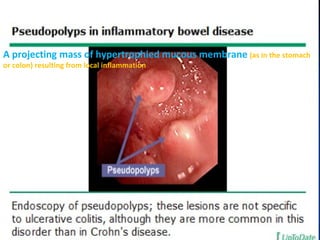
• Inflammatory polyps or pseudopolyps appear due
to reepithelialisation of the undermined ulcer &
overhanging margins in inflammatory bowel
disease, most frequently in ulcerative colitis &
sometimes in Crohn’s disease.
A projecting mass of hypertrophied mucous membrane (as in the stomach
or colon) resulting from local inflammation
Solitary rectal ulcer syndrome. A, The dilated glands, proliferative epithelium,

superficial erosions, and inflammatory infiltrate are typical of an inflamatory polyp. However,
the smooth muscle hyperplasia within the lamina propria suggests that mucosal
prolapse has also occurred. B, Epithelial hyperplasia. C, Granulation tissue-like capillary
proliferation within the lamina propria caused by repeated erosion and re-epithelialization .
Non neoplasticColonic polyps

Non neoplasticColonic polyps

  • 1.
    Non-neoplastic Colonic Polyps Polyps aremost common in the colon but may occur in the esophagus, stomach, or small intestine. Lecture 14 By Dr Mohammad Manzoor Mashwani BKMC Mardan
  • 2.
    Definition of Polyp Apolyp is defined as any growth or mass protruding from the mucous membrane into the lumen. • Classification: • Stalked or pedunculated polyp • Sessile polyp As sessile polyps enlarge, proliferation of cells adjacent to the polyp and the effects of traction on the luminal protrusion, may combine to create a stalk. Non-neoplastic & Neoplastic Polyps
  • 3.
    Non-neoplastic Colonic Polyps Non-neoplastic Polyps HyperplasticpolypsHamartomatous polyps Juvenile polyps Peutz-Jeghers polyps Inflammatory polyps Lymphoid polyps 90% most common
  • 4.
    Neoplastic Colonic Polyps •Neoplastic Epithelial Lesions • Benign polyps • Adenomas • Malignant lesions Adenocarcinoma Squamous cell carcinoma of the anus
  • 5.
  • 6.
    Non-neoplastic Polyps • Theoverwhelming majority of intestinal polyps occur sporadically, particularly in the colon, and increase in infrequency with age. • Non-neoplastic polyps represent 90% of all epithelial polyps in the large intestine and are found in more than half of all persons age 60 years or older.
  • 7.
    I. Hyperplastic Polyps(Metaplastic) • The most common amongst all epithelial polyps. • Most common in the left colon (rectosigmoid). • Called hyperplastic because there is epithelial hyperplasia at the base of crypts, and metaplastic as there are areas of cystic metaplasia. • More common in elderly (6th-7th decade).
  • 8.
    Pathogenesis The pathogenesis ofhyperplastic polyps is incompletely understood, but they are thought to result from decreased epithelial cell turnover and delayed shedding of surface epithelial cells, leading to a “pileup” of goblet cells and absorptive cells.
  • 9.
    Morphology GROSS- Most commonlyfound in the • Small ( <5 mm in diameter), multiple, left colon (rectosigmoid) and smooth-surfaced, sessile. Microscopy - composed of mature goblet and absorptive cells, long & cystically dilated glands & crypts. • The delayed shedding of these cells leads to crowding that creates the serrated surface (Saw-toothed) architecture that is the morphologic hallmark of these lesions.
  • 10.
    Hyperplastic polyp. A,Polyp surface with irregular tufting of epithelial cells. B, Tufting (bunch) results from epithelial overcrowding. C, Epithelial crowding produces a serrated architecture when glands are cut in cross-section.
  • 12.
    Hamartomatous polyps Occur sporadicallyand in the context of various genetically determined or acquired syndromes . Recall that hamartomas are tumor-like growths composed of mature tissues that are normally present at the site in which they develop. Although Hamartomatous polyposis syndromes are rare, they are associated intestinal and extra-intestinal manifestations and the need to screen family members. important to recognize because of
  • 16.
    Juvenile Polyps (Retention polyps) •Juvenile polyps are the most common type of hamartomatous polyp. • Juvenile polyps are focal malformations of the mucosal epithelium and lamina propria. • These may be sporadic or syndromic. • The vast majority of juvenile polyps occur in children less than 5 years of age. • When present in adults, polyps with identical morphology are sometimes confusingly referred to as inflammatory polyps.
  • 17.
    • The majorityof juvenile polyps are located in the rectum and most present with rectal bleeding. In some cases prolapse occurs and the polyp protrudes through the anal sphincter. • Sporadic juvenile polyps are usually solitary lesions and may be referred to as retention polyps. • In contrast, individuals with the autosomal dominant syndrome of juvenile polyposis have from 3 to as many as 100 hamartomatous polyps and may require colectomy to limit the chronic and sometimes severe hemorrhage associated with polyp ulceration.
  • 18.
    • stomach and smallbowel. Pulmonary arteriovenous malformations are a A minority of patients also have polyps in the recognized extra-intestinal manifestation of the syndrome. Dysplasia occurs in a small proportion of (mostly syndrome associated) juvenile polyps, and the juvenile polyposis syndrome is associated with increased risk for the development of colonic adenocarcinoma.
  • 19.
    Morphology Individual sporadic andsyndromic juvenile polyps often are indistinguishable. Gross- pedunculated, smooth surfaced, reddish lesions that are <3 cm in diameter and display characteristic cystic spaces on cut sections. Microscopic examination – cystically dilated glands filled with mucin and inflammatory debris Spherical,
  • 21.
    Juvenile polyposis. A,Juvenile polyp. Note the surface erosion and cystically dilated crypts. B, Inspissated mucous, neutrophils, and inflammatory debris can accumulate within dilated crypts.
  • 22.
    Peutz-Jeghers Syndrome A rareautosomal dominant disorder defined by the presence of multiple gastrointestinal hamartomatous polyps and mucocutaneous hyperpigmentation that carries an increased risk of several malignancies, including cancers of the colon, pancreas, breast, lung, ovaries, uterus, and testes, as well as other unusual neoplasms.
  • 23.
    • Intestinal polypsare most common in the small intestine, although they may also occur in the stomach and colon and, rarely, in the bladder and lungs.
  • 24.
    Morphology • Gross- Morecommonly situated in the small intestine. Often large (variable), multiple & pedunculated with lobulated contour. • Microscopy- characteristic arborizing network of connective tissue, smooth muscle, lamina propria, and glands lined by normal-appearing intestinal epithelium. • Tree-like branching of muscularis mucosae. The gland may show hyperplasia & cystic change.
  • 25.
    Peutz-Jeghers polyp. A,Polyp surface (top) overlies stroma composed of smooth muscle bundles cutting through the lamina propria. B, Complex glandular architecture and the presence of smooth muscle are features that distinguish Peutz-Jeghers polyps from juveni le polyps.
  • 26.
    Inflammatory Polyps (Pseudopolyps) The polypthat forms as part of the solitary rectal ulcer syndrome is an example of the purely inflammatory lesion. Patients present with the clinical triad of rectal bleeding, mucus discharge, and an inflammatory lesion of the anterior rectal wall.
  • 27.
    • The underlyingcause is impaired relaxation of the anorectal sphincter, creating a sharp angle at the anterior rectal shelf. This leads to recurrent abrasion and ulceration of the overlying rectal mucosa. Chronic cycles of injury and healing produce a polypoid mass made up of inflamed and reactive mucosal tissue.
  • 28.
    • Inflammatory polypsor pseudopolyps appear due to reepithelialisation of the undermined ulcer & overhanging margins in inflammatory bowel disease, most frequently in ulcerative colitis & sometimes in Crohn’s disease.
  • 29.
    A projecting massof hypertrophied mucous membrane (as in the stomach or colon) resulting from local inflammation
  • 30.
    Solitary rectal ulcersyndrome. A, The dilated glands, proliferative epithelium, superficial erosions, and inflammatory infiltrate are typical of an inflamatory polyp. However, the smooth muscle hyperplasia within the lamina propria suggests that mucosal prolapse has also occurred. B, Epithelial hyperplasia. C, Granulation tissue-like capillary proliferation within the lamina propria caused by repeated erosion and re-epithelialization .