Neoplastic Colonic Polyps Dr. Saud Al-Subaie Department of Surgery  Amiri Hospital Monday 17/04/2006
Introduction   Polyp :-  any protrusion arising from an epithelial surface. Precursor for carcinoma Adenomatous polyp are premalignant  2/3 of polyps are adenomatous The bigger the size, the higher the risk of Ca < 1 cm :- ~10 yrs for transformation
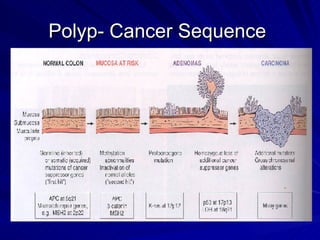
Polyp- Cancer Sequence
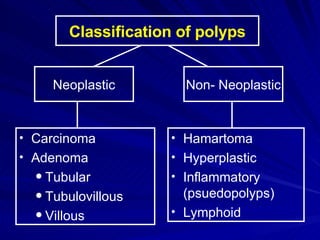
Carcinoma Adenoma Tubular  Tubulovillous Villous Classification of polyps Hamartoma  Hyperplastic Inflammatory (psuedopolyps) Lymphoid Neoplastic Non- Neoplastic
Epidemiology  10.5% (100 %) Weighted chance 40 % 10 % Villous adenoma 22% 15 % Tubulovillous 5% 75% Tubular adenoma % Malignant Prevalence TYPE
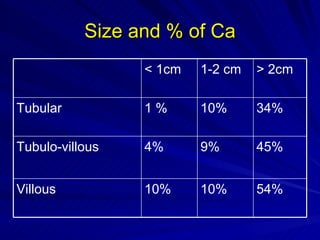
Size and % of Ca                                         54% 10% 10% Villous 45% 9% 4% Tubulo-villous 34% 10% 1 % Tubular  > 2cm 1-2 cm < 1cm
Endoscopic appearance
                                       
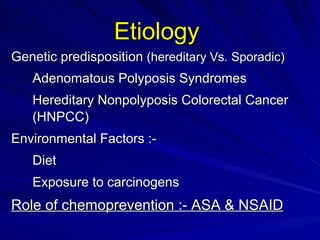
Etiology  Genetic predisposition  (hereditary Vs. Sporadic) Adenomatous Polyposis Syndromes Hereditary Nonpolyposis Colorectal Cancer (HNPCC) Environmental Factors :- Diet Exposure to carcinogens Role of chemoprevention :- ASA & NSAID
Etiology of Ca
Etiology (FAP)
Clinical Presentation Asymptomatic: - incidental finding Symptomatic: - Usually > 1cm - Abdominal pain (intussusception) - Profuse watery diarrhea (large villous adenoma). - Bleeding PR (when ulcerated)
Management
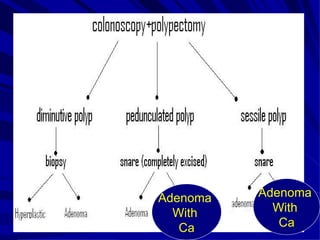
Endoscopic Management Polypectomy is the best treatment. Cautary snare: caution !! Complete removal & retrieval of the polyp Sessile & Semisessile polyp:-  Piecemeal removal. ?? tattoo with India ink
 
 
Adenoma  With  Ca Adenoma  With  Ca
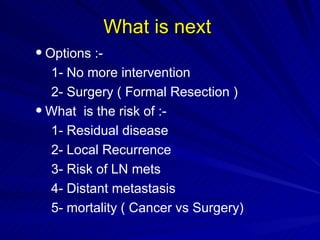
What is next  Options :- 1- No more intervention 2- Surgery ( Formal Resection ) What  is the risk of :- 1- Residual disease  2- Local Recurrence 3- Risk of LN mets 4- Distant metastasis 5- mortality ( Cancer vs Surgery)
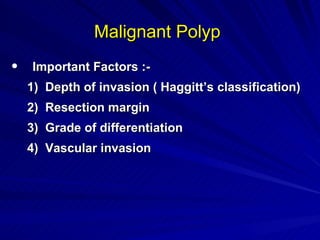
Malignant Polyp   Important Factors :- 1)  Depth of invasion ( Haggitt’s classification) 2)  Resection margin 3)  Grade of differentiation 4)  Vascular invasion
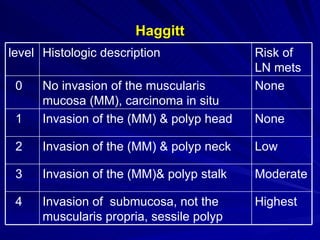
Haggitt Highest  Invasion of  submucosa, not the muscularis propria, sessile polyp 4 Moderate Invasion of the (MM)& polyp stalk 3 Low  Invasion of the (MM) & polyp neck  2  None  Invasion of the (MM) & polyp head  1 None  No invasion of the muscularis mucosa (MM), carcinoma in situ 0  Risk of LN mets  Histologic description level
Histologic assessment  Favorable ( low risk ) :- 1- Differentiation G I G II 2- Resection margin > 2mm 3- Vascular and lymphatic invasion None
Histological assessment  Unfavorable ( high risk ) 1- Differentiation :-  G III 2- Resection margin :-  < 2mm 3- Vascular and lymphatic invasion :-  yes
Cesare Hassan et al Histologic Risk Factors & Clinical Outcome  A pooled- data analysis. Thirty-one studies  1,900 patients with malignant polyp.  Three histologic risk factors  Five unfavorable clinical outcomes Dis Colon Rectum  2005
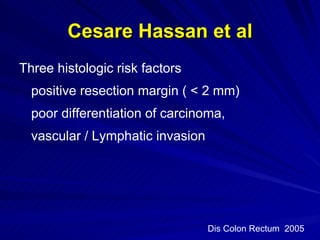
Cesare Hassan et al Three histologic risk factors positive resection margin ( < 2 mm)  poor differentiation of carcinoma,  vascular / Lymphatic invasion  Dis Colon Rectum  2005
Cesare Hassan et al Five unfavorable clinical outcomes  residual disease recurrent disease  lymph node metastasis  hematogenous metastasis  mortality Dis Colon Rectum  2005
Cesare Hassan et al CONCLUSION:  All three histologic risk factors are significantly associated with the clinical outcome.  Classification in low-risk and high-risk patients may be regarded as a meaningful staging procedure.  Dis Colon Rectum  2005
Sitz et al Retrospective ( 1985 – 1996) 114 Pts with endoscopicaly removed polyps Low risk :- Complete resection G1 G 2 grade No Vascular invasion High risk :- others Dis Colon Rectum  2004
Sitz et al 54 low risk :- - 5    surgery    no residual disease - 33 no surgery    no adverse outcome 60 high risk : - 52  surgery    residual disease in 27% - Significantly higher risk of adverse outcome( P < 0.0001) - No surgical complications Dis Colon Rectum  2004
Sitz et al Conclusion:- 1- Low risk :- Endoscopic polypectomy alone is adequate 2- High risk :- The risk of adverse outcome should be weighed  against the risk of surgery Dis Colon Rectum  2004
Volk / Fazio 47 pt 17 had favorable histology:- 16    polypectomy alone    no adverse outcome 30 pt unfavorable  21    surgery 10/30 had adverse outcome Conclusion:-   Endoscopic polypectomy is adequate for polyps with favorable histology Gastroenterology 1995
Operative Management - Transanal excision  Transcoccygeal  Transabdominal Malignant rectal polyps Anatomic resection with removal of adjacent LN Malignant / incompletely excised / Suspicious polyp - Colotomy+ Polypectomy - Segmental Resection Benign polyp(>3cm can’t be managed endoscopically) Surgical options Type of polyp
Summary Formal surgery should be advised  for Malignant polyps with the following :- Poor differentiation Vascular and lymphatic invasion < 2mm resection margins Sessile polyps Haggitts’s level 3/4
“ Colon cancer can only be found if looked for.   And it  can only be cured if found early.”
THANK YOU

Neoplastic Colonic Polyp

  • 1.
    Neoplastic Colonic PolypsDr. Saud Al-Subaie Department of Surgery Amiri Hospital Monday 17/04/2006
  • 2.
    Introduction Polyp :- any protrusion arising from an epithelial surface. Precursor for carcinoma Adenomatous polyp are premalignant 2/3 of polyps are adenomatous The bigger the size, the higher the risk of Ca < 1 cm :- ~10 yrs for transformation
  • 3.
  • 4.
    Carcinoma Adenoma Tubular Tubulovillous Villous Classification of polyps Hamartoma Hyperplastic Inflammatory (psuedopolyps) Lymphoid Neoplastic Non- Neoplastic
  • 5.
    Epidemiology 10.5%(100 %) Weighted chance 40 % 10 % Villous adenoma 22% 15 % Tubulovillous 5% 75% Tubular adenoma % Malignant Prevalence TYPE
  • 6.
    Size and %of Ca                                         54% 10% 10% Villous 45% 9% 4% Tubulo-villous 34% 10% 1 % Tubular > 2cm 1-2 cm < 1cm
  • 7.
  • 8.
  • 9.
    Etiology Geneticpredisposition (hereditary Vs. Sporadic) Adenomatous Polyposis Syndromes Hereditary Nonpolyposis Colorectal Cancer (HNPCC) Environmental Factors :- Diet Exposure to carcinogens Role of chemoprevention :- ASA & NSAID
  • 10.
  • 11.
  • 12.
    Clinical Presentation Asymptomatic:- incidental finding Symptomatic: - Usually > 1cm - Abdominal pain (intussusception) - Profuse watery diarrhea (large villous adenoma). - Bleeding PR (when ulcerated)
  • 13.
  • 14.
    Endoscopic Management Polypectomyis the best treatment. Cautary snare: caution !! Complete removal & retrieval of the polyp Sessile & Semisessile polyp:- Piecemeal removal. ?? tattoo with India ink
  • 15.
  • 16.
  • 17.
    Adenoma With Ca Adenoma With Ca
  • 18.
    What is next Options :- 1- No more intervention 2- Surgery ( Formal Resection ) What is the risk of :- 1- Residual disease 2- Local Recurrence 3- Risk of LN mets 4- Distant metastasis 5- mortality ( Cancer vs Surgery)
  • 19.
    Malignant Polyp Important Factors :- 1) Depth of invasion ( Haggitt’s classification) 2) Resection margin 3) Grade of differentiation 4) Vascular invasion
  • 20.
    Haggitt Highest Invasion of submucosa, not the muscularis propria, sessile polyp 4 Moderate Invasion of the (MM)& polyp stalk 3 Low Invasion of the (MM) & polyp neck 2 None Invasion of the (MM) & polyp head 1 None No invasion of the muscularis mucosa (MM), carcinoma in situ 0 Risk of LN mets Histologic description level
  • 21.
    Histologic assessment Favorable ( low risk ) :- 1- Differentiation G I G II 2- Resection margin > 2mm 3- Vascular and lymphatic invasion None
  • 22.
    Histological assessment Unfavorable ( high risk ) 1- Differentiation :- G III 2- Resection margin :- < 2mm 3- Vascular and lymphatic invasion :- yes
  • 23.
    Cesare Hassan etal Histologic Risk Factors & Clinical Outcome A pooled- data analysis. Thirty-one studies 1,900 patients with malignant polyp. Three histologic risk factors Five unfavorable clinical outcomes Dis Colon Rectum 2005
  • 24.
    Cesare Hassan etal Three histologic risk factors positive resection margin ( < 2 mm) poor differentiation of carcinoma, vascular / Lymphatic invasion Dis Colon Rectum 2005
  • 25.
    Cesare Hassan etal Five unfavorable clinical outcomes residual disease recurrent disease lymph node metastasis hematogenous metastasis mortality Dis Colon Rectum 2005
  • 26.
    Cesare Hassan etal CONCLUSION:  All three histologic risk factors are significantly associated with the clinical outcome. Classification in low-risk and high-risk patients may be regarded as a meaningful staging procedure. Dis Colon Rectum 2005
  • 27.
    Sitz et alRetrospective ( 1985 – 1996) 114 Pts with endoscopicaly removed polyps Low risk :- Complete resection G1 G 2 grade No Vascular invasion High risk :- others Dis Colon Rectum 2004
  • 28.
    Sitz et al54 low risk :- - 5  surgery  no residual disease - 33 no surgery  no adverse outcome 60 high risk : - 52 surgery  residual disease in 27% - Significantly higher risk of adverse outcome( P < 0.0001) - No surgical complications Dis Colon Rectum 2004
  • 29.
    Sitz et alConclusion:- 1- Low risk :- Endoscopic polypectomy alone is adequate 2- High risk :- The risk of adverse outcome should be weighed against the risk of surgery Dis Colon Rectum 2004
  • 30.
    Volk / Fazio47 pt 17 had favorable histology:- 16  polypectomy alone  no adverse outcome 30 pt unfavorable 21  surgery 10/30 had adverse outcome Conclusion:- Endoscopic polypectomy is adequate for polyps with favorable histology Gastroenterology 1995
  • 31.
    Operative Management -Transanal excision Transcoccygeal Transabdominal Malignant rectal polyps Anatomic resection with removal of adjacent LN Malignant / incompletely excised / Suspicious polyp - Colotomy+ Polypectomy - Segmental Resection Benign polyp(>3cm can’t be managed endoscopically) Surgical options Type of polyp
  • 32.
    Summary Formal surgeryshould be advised for Malignant polyps with the following :- Poor differentiation Vascular and lymphatic invasion < 2mm resection margins Sessile polyps Haggitts’s level 3/4
  • 33.
    “ Colon cancercan only be found if looked for. And it can only be cured if found early.”
  • 34.