Neoplastic
Polyps
Lecture 17
Polyp
• A polyp is a mass that
protrudes into the lumen of
the gut.
Tumors of the Small and Large Intestines
Non-neoplastic Polyps 90%
Hyperplastic polyps- most common
Hamartomatous polyps
Juvenile polyps
Peutz-Jeghers polyps
Inflammatory polyps
Lymphoid polyps
• Neoplastic Polyps:
• Benign polyps
• Adenomas
• Malignant lesions (Polyps)
Adenocarcinoma
Squamous cell carcinoma of the anus
Adenomas
• A benign epithelial tumor in which the cells
form recognizable glandular structures or in
which the cells are derived from glandular
epithelium.
Adenomatous Polyps
By definition they are dysplastic and have
malignant potential
Time for development of adenomas to cancer is
about 7 to 10 years.
Adenomas
Epidemiology of Adenoma
Older age is a major risk factor
More common in men
Large adenomas (> 9mm) may be more
common in African Americans
African Americans have a higher risk of right-
sided colonic adenomas and may present with
cancer at a younger age (< 50 years) than
Caucasians.
• There is a well-defined familial predisposition
to sporadic adenomas, accounting for about a
fourfold greater risk for adenomas among first
degree relatives, and also a fourfold greater
risk of colorectal carcinoma in any person with
adenomas.
Types of adenomas on the basis of the epithelial architecture
• 1. Tubular adenomas
• 2. Villous adenomas
• 3. Tubulovillous adenomas
• 4. Sessile Serrated adenomas
Endoscopic Classification
1. Sessile – base is attached to colon wall usually
large
2. Pedunculated – mucosal stalk is interposed
between the polyp and the wall
3. Flat – height less than one-half the diameter of
the lesion.
Depressed lesions appear to be particularly likely
to harbor high-grade dysplasia or be malignant
even if small.
Colonic adenomas. A, Pedunculated adenoma .B, Adenoma with a velvety surface. C, Low-
magnification photomicrograph of a pedunculated tubular adenoma.
Pathologic Classification
I. Low grade dysplasia
II. High grade dysplasia
Tubular Adenoma
The most common -- 80%
Characterized by a complex network of branching
adenomatous glands.
Small and
pedunculated.
Morphology of TA
Rectosigmoid -50 %,
Single -50%
• The smallest adenomas are sessile;
• Larger adenomas are pedunculated
Microscopy
Stalk is covered by normal colonic mucosa
Head is composed of neoplastic epithelium,
forming
branching glands
lined by tall, hyperchromatic, somewhat disorderly
cell,
which may or may not show mucin secretion.
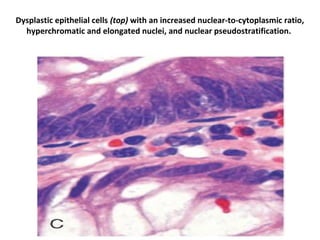
Dysplastic epithelial cells (top) with an increased nuclear-to-cytoplasmic ratio,
hyperchromatic and elongated nuclei, and nuclear pseudostratification.
• In some instances there are small foci of
villous architecture.
• In the clearly benign lesion, the branching
glands are well separated by lamina propria,
and the level of dysplasia or cytologic atypia is
slight.
• However all degrees of dysplasia may be
encountered, ranging up to cancer confined to
the mucosa (intramucosal carcinoma) or
invasive carcinoma extending into the
mucosa of the stalk.
• A frequent finding in any adenoma is
superficial erosion of the epithelium,
• the result of mechanical trauma.
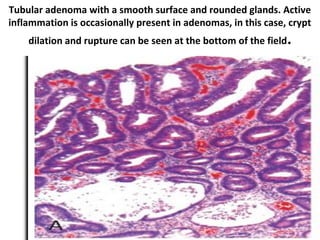
Tubular adenoma with a smooth surface and rounded glands. Active
inflammation is occasionally present in adenomas, in this case, crypt
dilation and rupture can be seen at the bottom of the field.
Villous adenomas
5-15%
Glands- long & straight
, creating finger-like projections.
large and sessile.
Morphology of VA
The larger and more ominous.
occur in older persons,
most commonly in the rectum and rectosigmoid
They generally are sessile,
up to 10 cm in diameter,
velvety or cauliflower-like masses projecting 1
to 3 cm above the surrounding mucosa.
Microscopy
• frondlike villiform extensions of the mucosa
covered by dysplastic, sometimes very
disorderly, sometimes piled-up, columnar
epithelium.
• Invasive carcinoma is found in as many as
40% of these lesions,
• the frequency being correlated with the size
of the polyp.
Villous adenoma with long, slender projections
that are reminiscent of small intestinal villi.
Tubulovillous adenomas
26 to 75 % villous component
5 to 15 %of adenomas;
a broad mix of tubular and villous areas.
They are intermediate between the tubular and the
villous lesions in their frequency of having a stalk or
being sessile, their size, the degree of dysplasia, and
the risk of harboring intramucosal or invasive
carcinoma.
Serrated Polyps
Display features of both hyperplastic P and adenoma
Two types
Sessile serrated adenoma – precursors to large HP in
proximal colon of patients with hyperplastic
polyposis
Traditional serrated adenoma – look and behave as
conventional adenomas; often pedunculated found
more often in distal colon
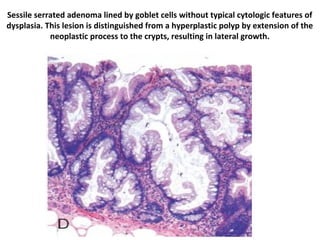
Sessile serrated adenoma lined by goblet cells without typical cytologic features of
dysplasia. This lesion is distinguished from a hyperplastic polyp by extension of the
neoplastic process to the crypts, resulting in lateral growth.
Clinical features of adenomas
• The smaller adenomas are usually
asymptomatic, until such time that occult
bleeding leads to clinically significant anemia.
• Villous adenomas are much more frequently
symptomatic because of overt or occult rectal
bleeding.
• The most distal villous adenomas may
secrete sufficient amounts of mucosal
material rich in protein and potassium to
produce hypoproteinemia or hypokalemia.
• On discovery, all adenomas, regardless of
their location in the alimentary tract, are to be
considered potentially malignant; thus, in
practical terms, prompt and adequate
excision is mandated.
•98%of all cancers in large
intestine almost always arise in
adenomatous polyps, generally
curable by resection
Risk Factors for High grade dysplasia and cancer
Large Size - > 1 cm in diameter are risk factor for
containing CRC
Villous histology – adenomatous polyps with > 25
percent villous histology are a risk factor for
developing CRC
High-grade dysplasia – adenomas with high-grade
dysplasia often coexist with areas of invasive cancer
in the polyp.
Number of polyps: three or more is a risk factor
Adenoma with intramucosal carcinoma. A, Cribriform glands interface directly with
the lamina propria without an intervening basement membrane.
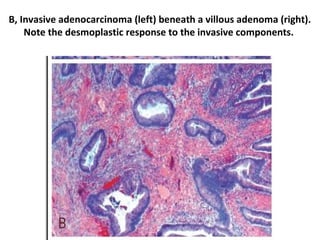
B, Invasive adenocarcinoma (left) beneath a villous adenoma (right).
Note the desmoplastic response to the invasive components.
Plasia
L17 neoplastic polyps

L17 neoplastic polyps

  • 1.
  • 2.
    Polyp • A polypis a mass that protrudes into the lumen of the gut.
  • 3.
    Tumors of theSmall and Large Intestines Non-neoplastic Polyps 90% Hyperplastic polyps- most common Hamartomatous polyps Juvenile polyps Peutz-Jeghers polyps Inflammatory polyps Lymphoid polyps
  • 4.
    • Neoplastic Polyps: •Benign polyps • Adenomas • Malignant lesions (Polyps) Adenocarcinoma Squamous cell carcinoma of the anus
  • 5.
    Adenomas • A benignepithelial tumor in which the cells form recognizable glandular structures or in which the cells are derived from glandular epithelium.
  • 6.
    Adenomatous Polyps By definitionthey are dysplastic and have malignant potential Time for development of adenomas to cancer is about 7 to 10 years. Adenomas
  • 7.
    Epidemiology of Adenoma Olderage is a major risk factor More common in men Large adenomas (> 9mm) may be more common in African Americans African Americans have a higher risk of right- sided colonic adenomas and may present with cancer at a younger age (< 50 years) than Caucasians.
  • 8.
    • There isa well-defined familial predisposition to sporadic adenomas, accounting for about a fourfold greater risk for adenomas among first degree relatives, and also a fourfold greater risk of colorectal carcinoma in any person with adenomas.
  • 9.
    Types of adenomason the basis of the epithelial architecture • 1. Tubular adenomas • 2. Villous adenomas • 3. Tubulovillous adenomas • 4. Sessile Serrated adenomas
  • 10.
    Endoscopic Classification 1. Sessile– base is attached to colon wall usually large 2. Pedunculated – mucosal stalk is interposed between the polyp and the wall 3. Flat – height less than one-half the diameter of the lesion. Depressed lesions appear to be particularly likely to harbor high-grade dysplasia or be malignant even if small.
  • 11.
    Colonic adenomas. A,Pedunculated adenoma .B, Adenoma with a velvety surface. C, Low- magnification photomicrograph of a pedunculated tubular adenoma.
  • 12.
    Pathologic Classification I. Lowgrade dysplasia II. High grade dysplasia
  • 13.
    Tubular Adenoma The mostcommon -- 80% Characterized by a complex network of branching adenomatous glands. Small and pedunculated.
  • 14.
  • 15.
    • The smallestadenomas are sessile; • Larger adenomas are pedunculated
  • 16.
    Microscopy Stalk is coveredby normal colonic mucosa Head is composed of neoplastic epithelium, forming branching glands lined by tall, hyperchromatic, somewhat disorderly cell, which may or may not show mucin secretion.
  • 17.
    Dysplastic epithelial cells(top) with an increased nuclear-to-cytoplasmic ratio, hyperchromatic and elongated nuclei, and nuclear pseudostratification.
  • 18.
    • In someinstances there are small foci of villous architecture. • In the clearly benign lesion, the branching glands are well separated by lamina propria, and the level of dysplasia or cytologic atypia is slight.
  • 19.
    • However alldegrees of dysplasia may be encountered, ranging up to cancer confined to the mucosa (intramucosal carcinoma) or invasive carcinoma extending into the mucosa of the stalk.
  • 20.
    • A frequentfinding in any adenoma is superficial erosion of the epithelium, • the result of mechanical trauma.
  • 21.
    Tubular adenoma witha smooth surface and rounded glands. Active inflammation is occasionally present in adenomas, in this case, crypt dilation and rupture can be seen at the bottom of the field.
  • 22.
    Villous adenomas 5-15% Glands- long& straight , creating finger-like projections. large and sessile.
  • 23.
    Morphology of VA Thelarger and more ominous. occur in older persons, most commonly in the rectum and rectosigmoid They generally are sessile, up to 10 cm in diameter, velvety or cauliflower-like masses projecting 1 to 3 cm above the surrounding mucosa.
  • 24.
    Microscopy • frondlike villiformextensions of the mucosa covered by dysplastic, sometimes very disorderly, sometimes piled-up, columnar epithelium. • Invasive carcinoma is found in as many as 40% of these lesions, • the frequency being correlated with the size of the polyp.
  • 25.
    Villous adenoma withlong, slender projections that are reminiscent of small intestinal villi.
  • 26.
    Tubulovillous adenomas 26 to75 % villous component 5 to 15 %of adenomas; a broad mix of tubular and villous areas. They are intermediate between the tubular and the villous lesions in their frequency of having a stalk or being sessile, their size, the degree of dysplasia, and the risk of harboring intramucosal or invasive carcinoma.
  • 27.
    Serrated Polyps Display featuresof both hyperplastic P and adenoma Two types Sessile serrated adenoma – precursors to large HP in proximal colon of patients with hyperplastic polyposis Traditional serrated adenoma – look and behave as conventional adenomas; often pedunculated found more often in distal colon
  • 28.
    Sessile serrated adenomalined by goblet cells without typical cytologic features of dysplasia. This lesion is distinguished from a hyperplastic polyp by extension of the neoplastic process to the crypts, resulting in lateral growth.
  • 29.
    Clinical features ofadenomas • The smaller adenomas are usually asymptomatic, until such time that occult bleeding leads to clinically significant anemia. • Villous adenomas are much more frequently symptomatic because of overt or occult rectal bleeding. • The most distal villous adenomas may secrete sufficient amounts of mucosal material rich in protein and potassium to produce hypoproteinemia or hypokalemia.
  • 30.
    • On discovery,all adenomas, regardless of their location in the alimentary tract, are to be considered potentially malignant; thus, in practical terms, prompt and adequate excision is mandated.
  • 31.
    •98%of all cancersin large intestine almost always arise in adenomatous polyps, generally curable by resection
  • 32.
    Risk Factors forHigh grade dysplasia and cancer Large Size - > 1 cm in diameter are risk factor for containing CRC Villous histology – adenomatous polyps with > 25 percent villous histology are a risk factor for developing CRC High-grade dysplasia – adenomas with high-grade dysplasia often coexist with areas of invasive cancer in the polyp. Number of polyps: three or more is a risk factor
  • 34.
    Adenoma with intramucosalcarcinoma. A, Cribriform glands interface directly with the lamina propria without an intervening basement membrane.
  • 35.
    B, Invasive adenocarcinoma(left) beneath a villous adenoma (right). Note the desmoplastic response to the invasive components.
  • 36.