GERUNDS, INFINITIVES,
AND PARTICIPLES
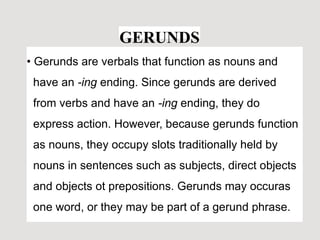
GERUNDS
• Gerunds are verbals that function as nouns and
have an -ing ending. Since gerunds are derived
from verbs and have an -ing ending, they do
express action. However, because gerunds function
as nouns, they occupy slots traditionally held by
nouns in sentences such as subjects, direct objects
and objects ot prepositions. Gerunds may occuras
one word, or they may be part of a gerund phrase.
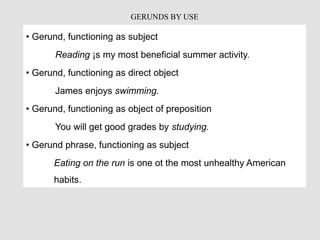
• Gerund, functioning as subject
Reading ¡s my most beneficial summer activity.
• Gerund, functioning as direct object
James enjoys swimming.
• Gerund, functioning as object of preposition
You will get good grades by studying.
• Gerund phrase, functioning as subject
Eating on the run is one ot the most unhealthy American
habits.
GERUNDS BY USE
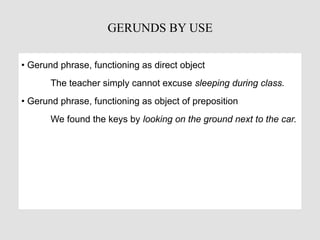
• Gerund phrase, functioning as direct object
The teacher simply cannot excuse sleeping during class.
• Gerund phrase, functioning as object of preposition
We found the keys by looking on the ground next to the car.
GERUNDS BY USE
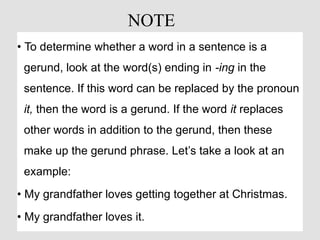
• To determine whether a word in a sentence is a
gerund, look at the word(s) ending in -ing in the
sentence. If this word can be replaced by the pronoun
it, then the word is a gerund. If the word it replaces
other words in addition to the gerund, then these
make up the gerund phrase. Let’s take a look at an
example:
• My grandfather loves getting together at Christmas.
• My grandfather loves it.
NOTE
Identify the gerunds or gerund phrases in each
sentence.
1. Raising the funds proved to be a difficult task.
2. Camping at Colé to Creek was the Smith family's
annual summer vacation.
3. Joseph hoped to obtain a job by learning the
welding trade.
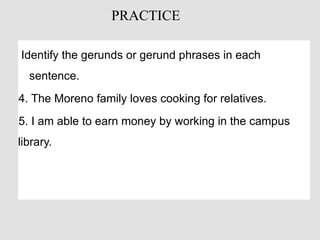
PRACTICE
Identify the gerunds or gerund phrases in each
sentence.
4. The Moreno family loves cooking for relatives.
5. I am able to earn money by working in the campus
library.
PRACTICE
PARTICIPLES
Participles are verbals that usually function as adjectives
and occasionally function as adverbs. Participles generally
end with an -ed or -ing ending. Since participles are
derived from verbs, they do express actions or states of
being. When participles function as adjectives, they are
usually found preceding the nouns and pronouns in a
sentence. When participles function as adverbs, they are
typically found following the verb in a sentence.
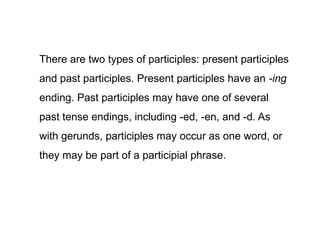
There are two types of participles: present participles
and past participles. Present participles have an -ing
ending. Past participles may have one of several
past tense endings, including -ed, -en, and -d. As
with gerunds, participles may occur as one word, or
they may be part of a participial phrase.
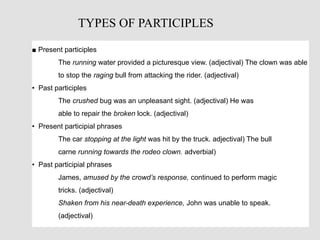
■ Present participles
The running water provided a picturesque view. (adjectival) The clown was able
to stop the raging bull from attacking the rider. (adjectival)
• Past participles
The crushed bug was an unpleasant sight. (adjectival) He was
able to repair the broken lock. (adjectival)
• Present participial phrases
The car stopping at the light was hit by the truck. adjectival) The bull
carne running towards the rodeo clown. adverbial)
• Past participial phrases
James, amused by the crowd’s response, continued to perform magic
tricks. (adjectival)
Shaken from his near-death experience, John was unable to speak.
(adjectival)
TYPES OF PARTICIPLES
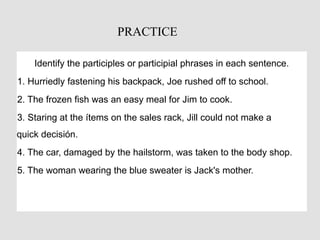
Identify the participles or participial phrases in each sentence.
1. Hurriedly fastening his backpack, Joe rushed off to school.
2. The frozen fish was an easy meal for Jim to cook.
3. Staring at the ítems on the sales rack, Jill could not make a
quick decisión.
4. The car, damaged by the hailstorm, was taken to the body shop.
5. The woman wearing the blue sweater is Jack's mother.
PRACTICE
INFINITIVES
Infinitives are verbals that are made up of the word to and a verb.
Infinitives may function as nouns, adjectives or adverbs. Since
infinitives are derived from verbs, they do express actions o
rstates of being. When infinitives function as adjectives and
adverbs, they are usually found preceding nouns and pronouns in
sentences, and when they function as nouns, they are used as
subjects, direct objects and objects of prepositions. Infinitives (to
+ verb) should not be confused with prepositional phrases (to +
noun or pronoun). Infinitives may occur as to + one verb, or they
may be part of an infinitive phrase.
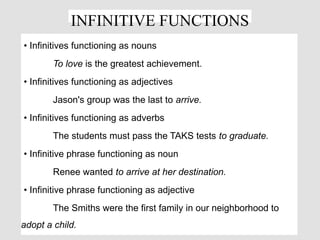
INFINITIVE FUNCTIONS
• Infinitives functioning as nouns
To love is the greatest achievement.
• Infinitives functioning as adjectives
Jason's group was the last to arrive.
• Infinitives functioning as adverbs
The students must pass the TAKS tests to graduate.
• Infinitive phrase functioning as noun
Renee wanted to arrive at her destination.
• Infinitive phrase functioning as adjective
The Smiths were the first family in our neighborhood to
adopt a child.
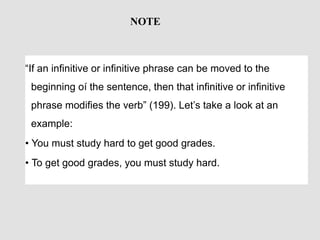
“If an infinitive or infinitive phrase can be moved to the
beginning oí the sentence, then that infinitive or infinitive
phrase modifies the verb” (199). Let’s take a look at an
example:
• You must study hard to get good grades.
• To get good grades, you must study hard.
NOTE
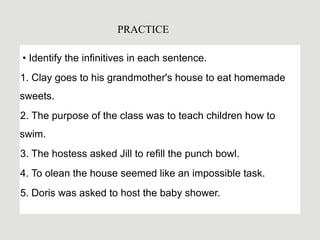
• Identify the infinitives in each sentence.
1. Clay goes to his grandmother's house to eat homemade
sweets.
2. The purpose of the class was to teach children how to
swim.
3. The hostess asked Jill to refill the punch bowl.
4. To olean the house seemed like an impossible task.
5. Doris was asked to host the baby shower.
PRACTICE

Gerunds.pptx This ppt is about gerunds .

  • 1.
  • 2.
    GERUNDS • Gerunds areverbals that function as nouns and have an -ing ending. Since gerunds are derived from verbs and have an -ing ending, they do express action. However, because gerunds function as nouns, they occupy slots traditionally held by nouns in sentences such as subjects, direct objects and objects ot prepositions. Gerunds may occuras one word, or they may be part of a gerund phrase.
  • 3.
    • Gerund, functioningas subject Reading ¡s my most beneficial summer activity. • Gerund, functioning as direct object James enjoys swimming. • Gerund, functioning as object of preposition You will get good grades by studying. • Gerund phrase, functioning as subject Eating on the run is one ot the most unhealthy American habits. GERUNDS BY USE
  • 4.
    • Gerund phrase,functioning as direct object The teacher simply cannot excuse sleeping during class. • Gerund phrase, functioning as object of preposition We found the keys by looking on the ground next to the car. GERUNDS BY USE
  • 5.
    • To determinewhether a word in a sentence is a gerund, look at the word(s) ending in -ing in the sentence. If this word can be replaced by the pronoun it, then the word is a gerund. If the word it replaces other words in addition to the gerund, then these make up the gerund phrase. Let’s take a look at an example: • My grandfather loves getting together at Christmas. • My grandfather loves it. NOTE
  • 6.
    Identify the gerundsor gerund phrases in each sentence. 1. Raising the funds proved to be a difficult task. 2. Camping at Colé to Creek was the Smith family's annual summer vacation. 3. Joseph hoped to obtain a job by learning the welding trade. PRACTICE
  • 7.
    Identify the gerundsor gerund phrases in each sentence. 4. The Moreno family loves cooking for relatives. 5. I am able to earn money by working in the campus library. PRACTICE
  • 8.
    PARTICIPLES Participles are verbalsthat usually function as adjectives and occasionally function as adverbs. Participles generally end with an -ed or -ing ending. Since participles are derived from verbs, they do express actions or states of being. When participles function as adjectives, they are usually found preceding the nouns and pronouns in a sentence. When participles function as adverbs, they are typically found following the verb in a sentence.
  • 9.
    There are twotypes of participles: present participles and past participles. Present participles have an -ing ending. Past participles may have one of several past tense endings, including -ed, -en, and -d. As with gerunds, participles may occur as one word, or they may be part of a participial phrase.
  • 10.
    ■ Present participles Therunning water provided a picturesque view. (adjectival) The clown was able to stop the raging bull from attacking the rider. (adjectival) • Past participles The crushed bug was an unpleasant sight. (adjectival) He was able to repair the broken lock. (adjectival) • Present participial phrases The car stopping at the light was hit by the truck. adjectival) The bull carne running towards the rodeo clown. adverbial) • Past participial phrases James, amused by the crowd’s response, continued to perform magic tricks. (adjectival) Shaken from his near-death experience, John was unable to speak. (adjectival) TYPES OF PARTICIPLES
  • 11.
    Identify the participlesor participial phrases in each sentence. 1. Hurriedly fastening his backpack, Joe rushed off to school. 2. The frozen fish was an easy meal for Jim to cook. 3. Staring at the ítems on the sales rack, Jill could not make a quick decisión. 4. The car, damaged by the hailstorm, was taken to the body shop. 5. The woman wearing the blue sweater is Jack's mother. PRACTICE
  • 12.
    INFINITIVES Infinitives are verbalsthat are made up of the word to and a verb. Infinitives may function as nouns, adjectives or adverbs. Since infinitives are derived from verbs, they do express actions o rstates of being. When infinitives function as adjectives and adverbs, they are usually found preceding nouns and pronouns in sentences, and when they function as nouns, they are used as subjects, direct objects and objects of prepositions. Infinitives (to + verb) should not be confused with prepositional phrases (to + noun or pronoun). Infinitives may occur as to + one verb, or they may be part of an infinitive phrase.
  • 13.
    INFINITIVE FUNCTIONS • Infinitivesfunctioning as nouns To love is the greatest achievement. • Infinitives functioning as adjectives Jason's group was the last to arrive. • Infinitives functioning as adverbs The students must pass the TAKS tests to graduate. • Infinitive phrase functioning as noun Renee wanted to arrive at her destination. • Infinitive phrase functioning as adjective The Smiths were the first family in our neighborhood to adopt a child.
  • 14.
    “If an infinitiveor infinitive phrase can be moved to the beginning oí the sentence, then that infinitive or infinitive phrase modifies the verb” (199). Let’s take a look at an example: • You must study hard to get good grades. • To get good grades, you must study hard. NOTE
  • 15.
    • Identify theinfinitives in each sentence. 1. Clay goes to his grandmother's house to eat homemade sweets. 2. The purpose of the class was to teach children how to swim. 3. The hostess asked Jill to refill the punch bowl. 4. To olean the house seemed like an impossible task. 5. Doris was asked to host the baby shower. PRACTICE