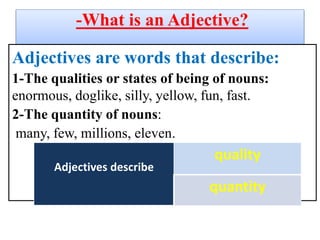
-What is an Adjective?
Adjectives are words that describe:
1-The qualities or states of being of nouns:
enormous, doglike, silly, yellow, fun, fast.
2-The quantity of nouns:
many, few, millions, eleven.
quality
Adjectives describe
quantity
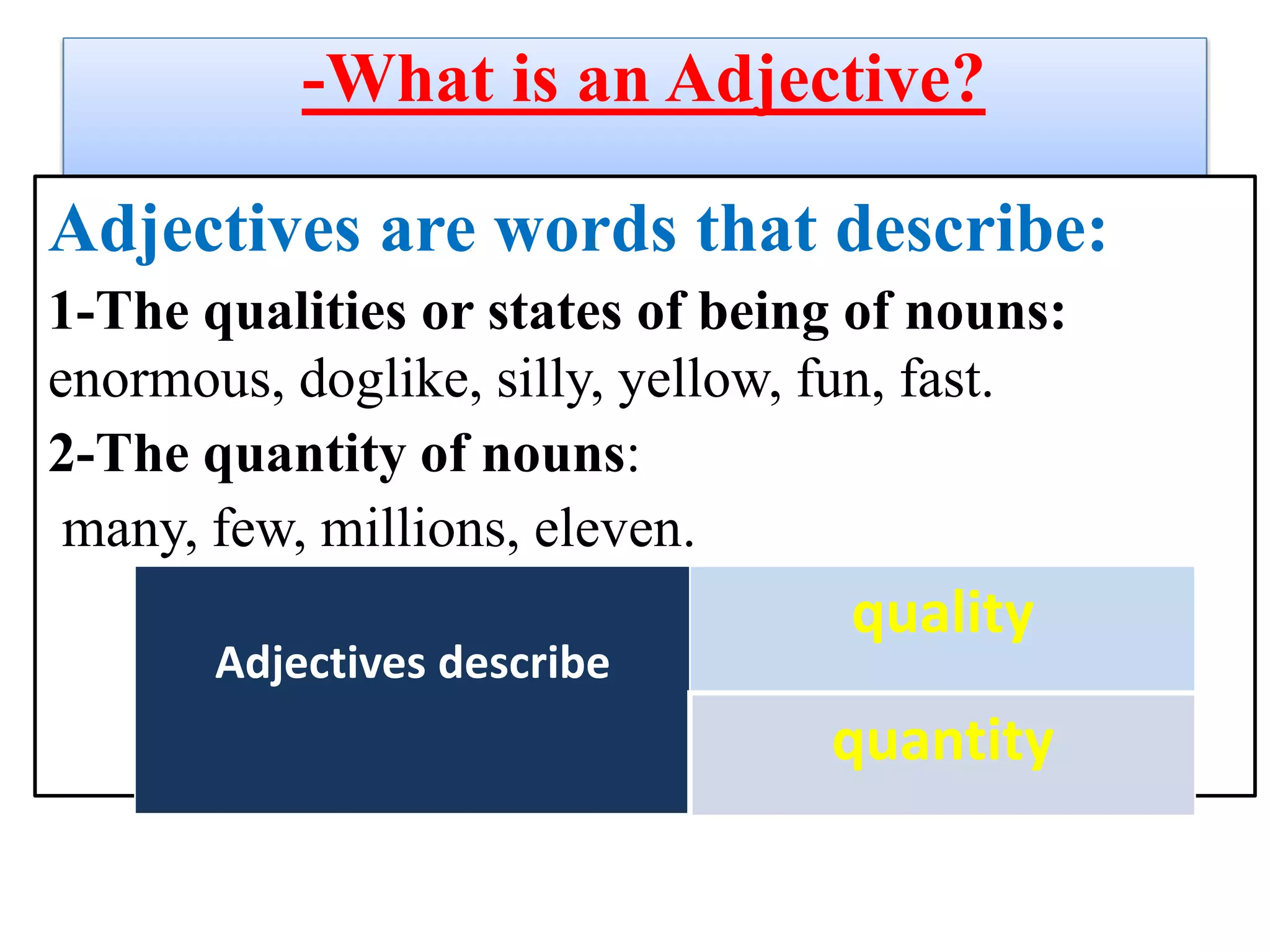
-Uses of Adjectives:
Adjectives tell the reader:
1-how much of something you’re talking about.
2-how many of something you’re talking about.
3-which thing you want passed to you.
4-which kind of something you want.
-Please use three white flowers in the
arrangement.
Three and white are modifying flowers.
Often, when adjectives are used together, you should separate
them with a comma or conjunction.
-I’m looking for a small, good-tempered dog to keep as a pet.
-My new dog is small and good-tempered.
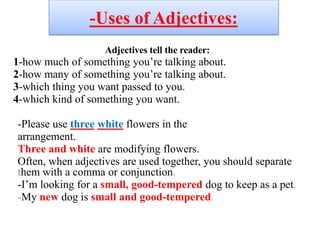
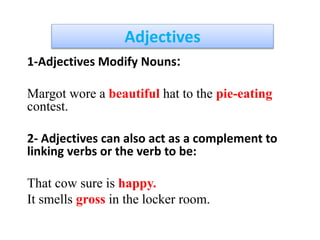
Adjectives
1-Adjectives Modify Nouns:
Margot wore a beautiful hat to the pie-eating
contest.
2- Adjectives can also act as a complement to
linking verbs or the verb to be:
That cow sure is happy.
It smells gross in the locker room.
Adjectives
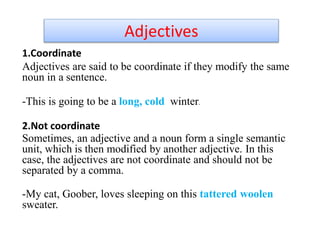
1.Coordinate
Adjectives are said to be coordinate if they modify the same
noun in a sentence.
-This is going to be a long, cold winter.
2.Not coordinate
Sometimes, an adjective and a noun form a single semantic
unit, which is then modified by another adjective. In this
case, the adjectives are not coordinate and should not be
separated by a comma.
-My cat, Goober, loves sleeping on this tattered woolen
sweater.
Adjectives
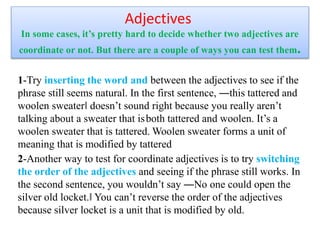
In some cases, it’s pretty hard to decide whether two adjectives are
coordinate or not. But there are a couple of ways you can test them.
1-Try inserting the word and between the adjectives to see if the
phrase still seems natural. In the first sentence, ―this tattered and
woolen sweater‖ doesn’t sound right because you really aren’t
talking about a sweater that isboth tattered and woolen. It’s a
woolen sweater that is tattered. Woolen sweater forms a unit of
meaning that is modified by tattered
2-Another way to test for coordinate adjectives is to try switching
the order of the adjectives and seeing if the phrase still works. In
the second sentence, you wouldn’t say ―No one could open the
silver old locket.‖ You can’t reverse the order of the adjectives
because silver locket is a unit that is modified by old.
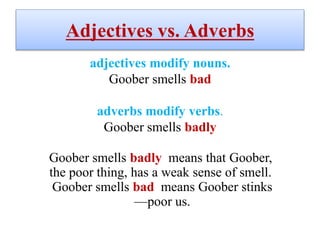
Adjectives vs. Adverbs
adjectives modify nouns.
Goober smells bad
adverbs modify verbs.
Goober smells badly
Goober smells badly means that Goober,
the poor thing, has a weak sense of smell.
Goober smells bad means Goober stinks
—poor us.
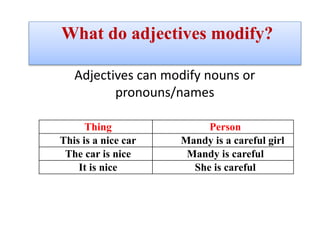
What do adjectives modify?
Adjectives can modify nouns or
pronouns/names
Thing Person
This is a nice car Mandy is a careful girl
The car is nice Mandy is careful
It is nice She is careful
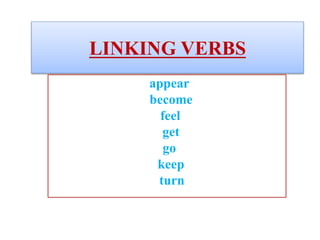
LINKING VERBS
appear
become
feel
get
go
keep
turn
Adjectives Position
1-Adjectives can be put in front of the noun.
-a fat old cat. (ATTRIBUTIVE Adjectives)
2-Adjectives can be put after the verb
(e.g. to be) or linking verbs
-It was cold, wet and windy.
-Children get bored very quickly.
(
PREDICATIVE Adjectives
)
Adjective and Participle
There are many adjectives that have the same
form as participles (used attributively and
predicatively)
e.g.: His views were very surprising.
(his surprising views) (-ing participle)
e.g.: The man seemed very offended.
(-ed participle)
(the offended man)
-Adjectives / Characteristics:
1-Adjectives are one of the major form classes: the verb, the noun,
the adverb, they belong to open-class items.
2-Adjectives can be defined by function as word which describe,
modify, limit, determine or qualify nouns or nouns equivalents.
3-Adjectives are uninflected for number and case and in this respect
they differ from nouns.
4-Adjectives have one form which is invariable for singular and
plural, number, gender, case and person.
E.g.:
-He is a brave man.
-She is a brave woman.
-They are brave men.
-They are brave women.
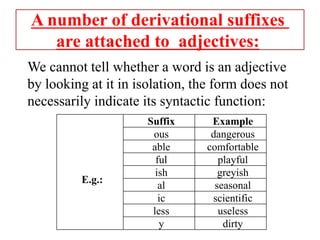
A number of derivational suffixes
are attached to adjectives:
We cannot tell whether a word is an adjective
by looking at it in isolation, the form does not
necessarily indicate its syntactic function:
E.g.:
Suffix Example
ous dangerous
able comfortable
ful playful
ish greyish
al seasonal
ic scientific
less useless
y dirty
Adjectives
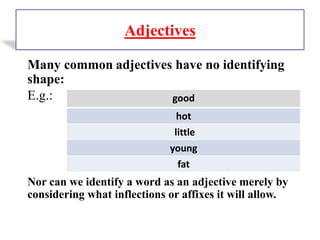
Many common adjectives have no identifying
shape:
E.g.:
Nor can we identify a word as an adjective merely by
considering what inflections or affixes it will allow.
good
hot
little
young
fat
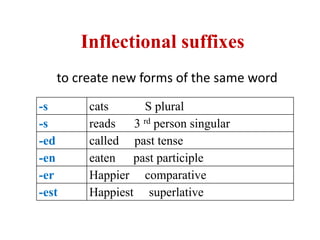
Inflectional suffixes
to create new forms of the same word
S plural
cats
-s
reads 3 rd person singular
-s
called past tense
-ed
eaten past participle
en
-
Happier comparative
er
-
Happiest superlative
est
-
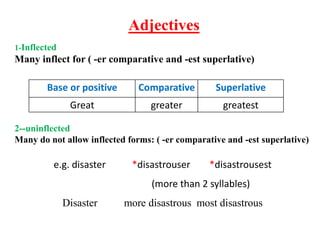
Adjectives
1-Inflected
Many inflect for ( -er comparative and -est superlative)
2--uninflected
Many do not allow inflected forms: ( -er comparative and -est superlative)
e.g. disaster *disastrouser *disastrousest
(more than 2 syllables)
Disaster more disastrous most disastrous
Superlative
Comparative
Base or positive
greatest
greater
Great
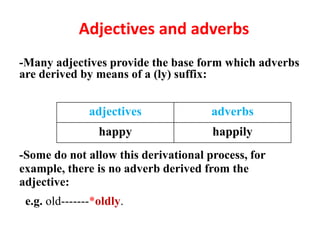
Adjectives and adverbs
-Many adjectives provide the base form which adverbs
are derived by means of a (ly) suffix:
-Some do not allow this derivational process, for
example, there is no adverb derived from the
adjective:
e.g. old-------*oldly.
adverbs
adjectives
happily
happy
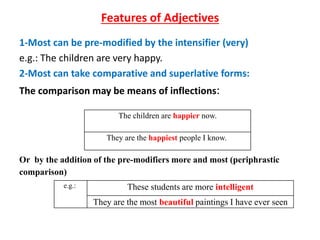
Features of Adjectives
1-Most can be pre-modified by the intensifier (very)
e.g.: The children are very happy.
2-Most can take comparative and superlative forms:
The comparison may be means of inflections:
Or by the addition of the pre-modifiers more and most (periphrastic
comparison)
The children are happier now.
They are the happiest people I know.
These students are more intelligent
e.g.:
They are the most beautiful paintings I have ever seen
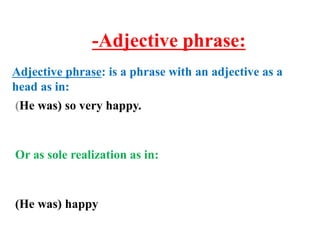
-Adjective phrase:
Adjective phrase: is a phrase with an adjective as a
head as in:
(He was) so very happy.
Or as sole realization as in:
(He was) happy
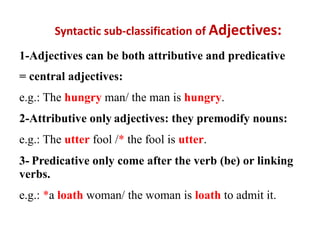
Syntactic sub-classification of Adjectives:
1-Adjectives can be both attributive and predicative
= central adjectives:
e.g.: The hungry man/ the man is hungry.
2-Attributive only adjectives: they premodify nouns:
e.g.: The utter fool /* the fool is utter.
3- Predicative only come after the verb (be) or linking
verbs.
e.g.: *a loath woman/ the woman is loath to admit it.
-Predicative adjectives as
Cs or Co:
a-Subject complement Cs:
e.g.: your daughter is pretty.
b-Object complement Co:
e.g.: he made his wife happy.
c-They can be complement C to S which is:
1-Finite clause e.g.: [Whether he will resign] is uncertain
2-Non-finite clause e.g.: [Driving a bus] isn’t easy.
-Similarly, adjectives can be Co to clauses →
e.g.: I consider [what he did] foolish.
e.g.: I consider [playing so hard] foolish.
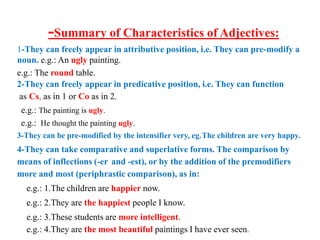
-Summary of Characteristics of Adjectives:
1-They can freely appear in attributive position, i.e. They can pre-modify a
noun. e.g.: An ugly painting.
e.g.: The round table.
2-They can freely appear in predicative position, i.e. They can function
as Cs, as in 1 or Co as in 2.
e.g.: The painting is ugly.
e.g.: He thought the painting ugly.
3-They can be pre-modified by the intensifier very, eg.The children are very happy.
4-They can take comparative and superlative forms. The comparison by
means of inflections (-er and -est), or by the addition of the premodifiers
more and most (periphrastic comparison), as in:
e.g.: 1.The children are happier now.
e.g.: 2.They are the happiest people I know.
e.g.: 3.These students are more intelligent.
e.g.: 4.They are the most beautiful paintings I have ever seen.
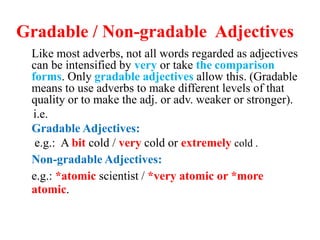
Gradable / Non-gradable Adjectives
Like most adverbs, not all words regarded as adjectives
can be intensified by very or take the comparison
forms. Only gradable adjectives allow this. (Gradable
means to use adverbs to make different levels of that
quality or to make the adj. or adv. weaker or stronger).
i.e.
Gradable Adjectives:
e.g.: A bit cold / very cold or extremely cold .
Non-gradable Adjectives:
e.g.: *atomic scientist / *very atomic or *more
atomic.
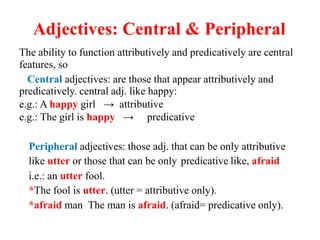
Adjectives: Central & Peripheral
The ability to function attributively and predicatively are central
features, so
Central adjectives: are those that appear attributively and
predicatively. central adj. like happy:
e.g.: A happy girl → attributive
e.g.: The girl is happy → predicative
Peripheral adjectives: those adj. that can be only attributive
like utter or those that can be only predicative like, afraid
i.e.: an utter fool.
*The fool is utter. (utter = attributive only).
*afraid man The man is afraid. (afraid= predicative only).
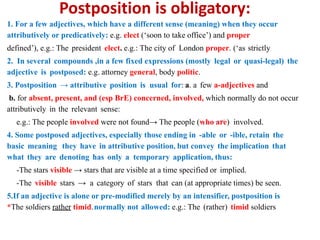
Postposition is obligatory:
1. For a few adjectives, which have a different sense (meaning) when they occur
attributively or predicatively: e.g. elect (‘soon to take office’) and proper
(‘as strictly
defined’), e.g.: The president elect. e.g.: The city of London proper.
2. In several compounds ,in a few fixed expressions (mostly legal or quasi-legal) the
adjective is postposed: e.g. attorney general, body politic.
3. Postposition → attributive position is usual for: a. a few a-adjectives and
b. for absent, present, and (esp BrE) concerned, involved, which normally do not occur
attributively in the relevant sense:
e.g.: The people involved were not found→ The people (who are) involved.
4. Some postposed adjectives, especially those ending in -able or -ible, retain the
basic meaning they have in attributive position, but convey the implication that
what they are denoting has only a temporary application, thus:
-The stars visible → stars that are visible at a time specified or implied.
-The visible stars → a category of stars that can (at appropriate times) be seen.
5.If an adjective is alone or pre-modified merely by an intensifier, postposition is
normally not allowed: e.g.: The (rather) timid soldiers
*The soldiers rather timid.
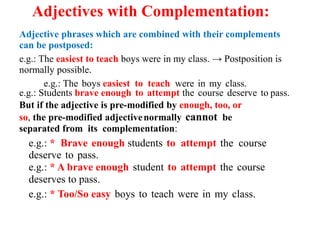
Adjectives with Complementation:
Adjective phrases which are combined with their complements
can be postposed:
e.g.: The easiest to teach boys were in my class. → Postposition is
normally possible.
e.g.: The boys easiest to teach were in my class.
e.g.: Students brave enough to attempt the course deserve to pass.
But if the adjective is pre-modified by enough, too, or
so, the pre-modified adjectivenormally cannot be
separated from its complementation:
e.g.: * Brave enough students to attempt the course
deserve to pass.
e.g.: * A brave enough student to attempt the course
deserves to pass.
e.g.: * Too/So easy boys to teach were in my class.
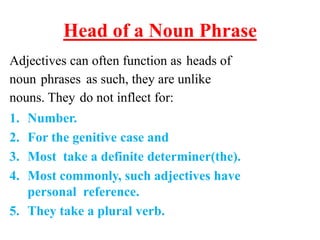
Head of a Noun Phrase
Adjectives can often function as heads of
noun phrases as such, they are unlike
nouns. They do not inflect for:
1. Number.
2. For the genitive case and
3. Most take a definite determiner(the).
4. Most commonly, such adjectives have
personal reference.
5. They take a plural verb.
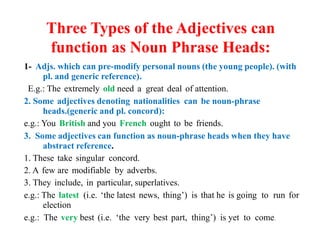
Three Types of the Adjectives can
function as Noun Phrase Heads:
1- Adjs. which can pre-modify personal nouns (the young people). (with
pl. and generic reference).
E.g.: The extremely old need a great deal of attention.
2. Some adjectives denoting nationalities can be noun-phrase
heads.(generic and pl. concord):
e.g.: You British and you French ought to be friends.
3. Some adjectives can function as noun-phrase heads when they have
abstract reference.
1. These take singular concord.
2. A few are modifiable by adverbs.
3. They include, in particular, superlatives.
e.g.: The latest (i.e. ‘the latest news, thing’) is that he is going to run for
election
e.g.: The very best (i.e. ‘the very best part, thing’) is yet to come.
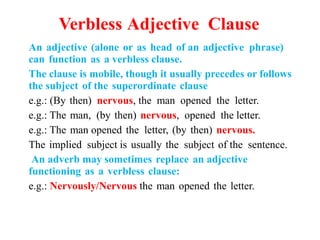
Verbless Adjective Clause
An adjective (alone or as head of an adjective phrase)
can function as a verbless clause.
The clause is mobile, though it usually precedes or follows
the subject of the superordinate clause
e.g.: (By then) nervous, the man opened the letter.
e.g.: The man, (by then) nervous, opened the letter.
e.g.: The man opened the letter, (by then) nervous.
The implied subject is usually the subject of the sentence.
An adverb may sometimes replace an adjective
functioning as a verbless clause:
e.g.: Nervously/Nervous the man opened the letter.
CONTINGENT ADJECTIVE CLAUSE
A contingent adjective clause: is a clause which is often
introduced by a subordinator expresses
the circumstance or condition under which what is said
in the superordinate clause applies.
A subordinator is often present but can be omitted.
e.g.: When ripe, these apples are sweet.
- The implied subject of the contingent adjective
clause is normally the subject of the superordinate
clause, but it can also be the object
e.g.: We can drink it hot.
e.g.: You must eat it when fresh.
Exclamatory Adjective Sentence
An adjective as head of an adjective phrase
or as its sole realization can be an
exclamation:
e.g.: How good of you !
e.g.: How wonderful !
e.g.: Excellent !
Syntactic Subclassification of Adjectives
Adjectives can be sub-classified according to
whether they can function as:
1-both attributive and predicative,
e.g.: a hungry man ^ the man is hungry;
these are the majorityand constitute the central
adjectives:
2-attributive only,
e.g.: an utter fool
* the fool is utter.
3-predicative only,
e.g.: *a loath woman ^ the woman is loath to admit it.
NON-INHERENT
/
INHERENT
Adjectives that characterize the referent of the noun directly
are termed INHERENT, those that do not are termed NON-
INHERENT.
Some non-inherent adjectives occur also
predicatively.
For example: new
a new student / That student is new. →
inherent
a new friend *My friend is new. → non-
inherent
Note
words with strongly emotive value (Only attributive position):
e.g.: You poor man, my dear lady, that wretched woman.
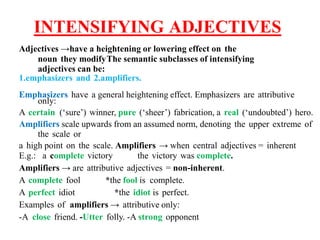
INTENSIFYING ADJECTIVES
Adjectives →have a heightening or lowering effect on the
noun they modifyThe semantic subclasses of intensifying
adjectives can be:
1.emphasizers and 2.amplifiers.
Emphasizers have a general heightening effect. Emphasizers are attributive
only:
A certain (‘sure’) winner, pure (‘sheer’) fabrication, a real (‘undoubted’) hero.
Amplifiers scale upwards from an assumed norm, denoting the upper extreme of
the scale or
a high point on the scale. Amplifiers → when central adjectives = inherent
E.g.: a complete victory the victory was complete.
Amplifiers → are attributive adjectives = non-inherent.
A complete fool *the fool is complete.
A perfect idiot *the idiot is perfect.
Examples of amplifiers → attributive only:
-A close friend. -Utter folly. -A strong opponent
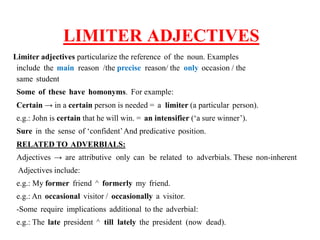
LIMITER ADJECTIVES
Limiter adjectives particularize the reference of the noun. Examples
include the main reason /the precise reason/ the only occasion / the
same student
Some of these have homonyms. For example:
Certain → in a certain person is needed = a limiter (a particular person).
e.g.: John is certain that he will win. = an intensifier (‘a sure winner’).
Sure in the sense of ‘confident’And predicative position.
RELATED TO ADVERBIALS:
Adjectives → are attributive only can be related to adverbials. These non-inherent
Adjectives include:
e.g.: My former friend ^ formerly my friend.
e.g.: An occasional visitor / occasionally a visitor.
-Some require implications additional to the adverbial:
e.g.: The late president ^ till lately the president (now dead).
DENOMINAL ADJECTIVES
Some adjectives derived from nouns are
attributive only:
e.g.: Criminal law (law concerning crime).
e.g.: An atomic scientist (a scientist specializing in atomic science).
e.g.: A medical school (a school for students of medicine).
Note
The same item may also be a central adjective.
For example:
A criminal law can be = a law which seems criminal.
[criminal = a central adjective].
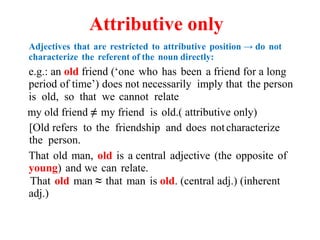
Attributive only
Adjectives that are restricted to attributive position → do not
characterize the referent of the noun directly:
e.g.: an old friend (‘one who has been a friend for a long
period of time’) does not necessarily imply that the person
is old, so that we cannot relate
my old friend ≠ my friend is old.( attributive only)
[Old refers to the friendship and does notcharacterize
the person.
That old man, old is a central adjective (the opposite of
young) and we can relate.
That old man ≈ that man is old. (central adj.) (inherent
adj.)
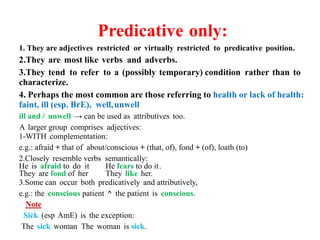
Predicative only:
1. They are adjectives restricted or virtually restricted to predicative position.
2.They are most like verbs and adverbs.
3.They tend to refer to a (possibly temporary) condition rather than to
characterize.
4. Perhaps the most common are those referring to health or lack of health:
faint, ill (esp. BrE), well,unwell
ill and / unwell → can be used as attributives too.
A larger group comprises adjectives:
1-WITH complementation:
e.g.: afraid + that of about/conscious + (that, of), fond + (of), loath (to)
2.Closely resemble verbs semantically:
He is afraid to do it He fears to do it.
They are fond of her They like her.
3.Some can occur both predicatively and attributively,
e.g.: the conscious patient ^ the patient is conscious.
Note
Sick (esp AmE) is the exception:
The sick woman The woman is sick.
Semantic Subclassification of Adjectives
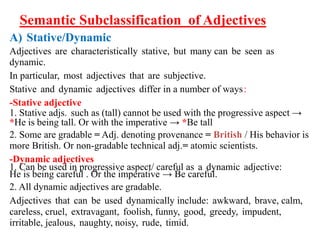
A) Stative/Dynamic
Adjectives are characteristically stative, but many can be seen as
dynamic.
In particular, most adjectives that are subjective.
Stative and dynamic adjectives differ in a number of ways:
-Stative adjective
1. Stative adjs. such as (tall) cannot be used with the progressive aspect →
*He is being tall. Or with the imperative → *Be tall
2. Some are gradable = Adj. denoting provenance = British / His behavior is
more British. Or non-gradable technical adj.= atomic scientists.
-Dynamic adjectives
1. Can be used in progressive aspect/ careful as a dynamic adjective:
He is being careful . Or the imperative → Be careful.
2. All dynamic adjectives are gradable.
Adjectives that can be used dynamically include: awkward, brave, calm,
careless, cruel, extravagant, foolish, funny, good, greedy, impudent,
irritable, jealous, naughty, noisy, rude, timid.
Semantic Subclassification of Adjectives
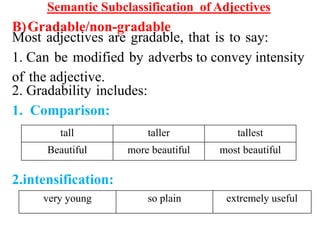
B)Gradable/non-gradable
Most adjectives are gradable, that is to say:
1. Can be modified by adverbs to convey intensity
of the adjective.
2. Gradability includes:
1. Comparison:
2.intensification:
tall taller tallest
Beautiful more beautiful most beautiful
very young so plain extremely useful
Semantic Subclassification of Adjectives
C) Inherent/non-inherent:
Most adjectives are inherent, and it is especially
→ dynamic adjectives to be inherent;
A firm handshake = inherent
a firm friend = non inherent
Exception is wooden in →
The actor is being wooden.
both [dynamic and non-inherent].
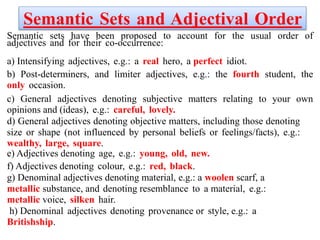
Semantic Sets and Adjectival Order
Semantic sets have been proposed to account for the usual order of
adjectives and for their co-occurrence:
a) Intensifying adjectives, e.g.: a real hero, a perfect idiot.
b) Post-determiners, and limiter adjectives, e.g.: the fourth student, the
only occasion.
c) General adjectives denoting subjective matters relating to your own
opinions and (ideas), e.g.: careful, lovely.
d) General adjectives denoting objective matters, including those denoting
size or shape (not influenced by personal beliefs or feelings/facts), e.g.:
wealthy, large, square.
e) Adjectives denoting age, e.g.: young, old, new.
f) Adjectives denoting colour, e.g.: red, black.
g) Denominal adjectives denoting material, e.g.: a woolen scarf, a
metallic substance, and denoting resemblance to a material, e.g.:
metallic voice, silken hair.
h) Denominal adjectives denoting provenance or style, e.g.: a
Britishship.
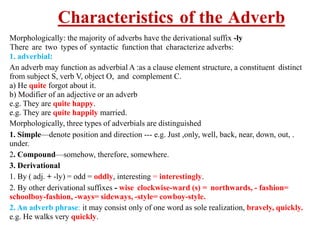
Characteristics of the Adverb
Morphologically: the majority of adverbs have the derivational suffix -ly
There are two types of syntactic function that characterize adverbs:
1. adverbial:
An adverb may function as adverbial A :as a clause element structure, a constituent distinct
from subject S, verb V, object O, and complement C.
a) He quite forgot about it.
b) Modifier of an adjective or an adverb
e.g. They are quite happy.
e.g. They are quite happily married.
Morphologically, three types of adverbials are distinguished
1. Simple—denote position and direction --- e.g. Just ,only, well, back, near, down, out, .
under.
2. Compound—somehow, therefore, somewhere.
3. Derivational
1. By ( adj. + -ly) = odd = oddly, interesting = interestingly.
2. By other derivational suffixes - wise clockwise-ward (s) = northwards, - fashion=
schoolboy-fashion, -ways= sideways, -style= cowboy-style.
2. An adverb phrase: it may consist only of one word as sole realization, bravely, quickly.
e.g. He walks very quickly.
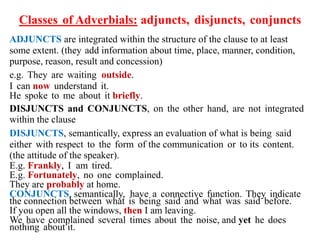
Classes of Adverbials: adjuncts, disjuncts, conjuncts
ADJUNCTS are integrated within the structure of the clause to at least
some extent. (they add information about time, place, manner, condition,
purpose, reason, result and concession)
e.g. They are waiting outside.
I can now understand it.
He spoke to me about it briefly.
DISJUNCTS and CONJUNCTS, on the other hand, are not integrated
within the clause
DISJUNCTS, semantically, express an evaluation of what is being said
either with respect to the form of the communication or to its content.
(the attitude of the speaker).
E.g. Frankly, I am tired.
E.g. Fortunately, no one complained.
They are probably at home.
CONJUNCTS, semantically, have a connective function. They indicate
the connection between what is being said and what was said before.
If you open all the windows, then I am leaving.
We have complained several times about the noise, and yet he does
nothing about it.
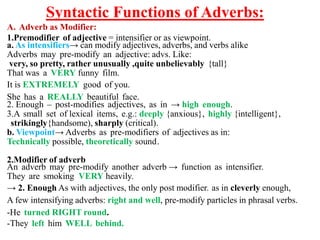
Syntactic Functions of Adverbs:
A. Adverb as Modifier:
1.Premodifier of adjective = intensifier or as viewpoint.
a. As intensifiers→ can modify adjectives, adverbs, and verbs alike
Adverbs may pre-modify an adjective: advs. Like:
very, so pretty, rather unusually ,quite unbelievably {tall}
That was a VERY funny film.
It is EXTREMELY good of you.
She has a REALLY beautiful face.
2. Enough – post-modifies adjectives, as in → high enough.
3.A small set of lexical items, e.g.: deeply {anxious}, highly {intelligent},
strikingly{handsome), sharply (critical).
b. Viewpoint→ Adverbs as pre-modifiers of adjectives as in:
Technically possible, theoretically sound.
2.Modifier of adverb
An adverb may pre-modify another adverb → function as intensifier.
They are smoking VERY heavily.
→ 2. Enough As with adjectives, the only post modifier. as in cleverly enough,
A few intensifying adverbs: right and well, pre-modify particles in phrasal verbs.
-He turned RIGHT round.
-They left him WELL behind.
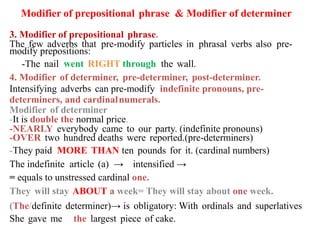
Modifier of prepositional phrase & Modifier of determiner
3. Modifier of prepositional phrase.
The few adverbs that pre-modify particles in phrasal verbs also pre-
modify prepositions:
-The nail went RIGHT through the wall.
4. Modifier of determiner, pre-determiner, post-determiner.
Intensifying adverbs can pre-modify indefinite pronouns, pre-
determiners, and cardinalnumerals.
Modifier of determiner
-It is double the normal price.
-NEARLY everybody came to our party. (indefinite pronouns)
-OVER two hundred deaths were reported.(pre-determiners)
-They paid MORE THAN ten pounds for it. (cardinal numbers)
The indefinite article (a) → intensified →
= equals to unstressed cardinal one.
They will stay ABOUT a week= They will stay about one week.
(The/definite determiner)→ is obligatory: With ordinals and superlatives
She gave me the largest piece of cake.
Modifier of noun phrase
An intensifiers + noun phrases (indefinite): quite, rather + np ( n= sg.. count. n & .(1.) gradable)
pre-determiners + np: such and exclamatory what.
-He told SUCH a funny story. -He told SUCH funny stories.
-I have never heard SUCH wickedness.
-It was RATHER a mess. -WHAT a (big) fool he is !
So & interrogative and exclamatory how + gradable adj. + the indefinite article + np.( n.sg.
&count.), [the noun phrase requires]
1.A gradable adjective.
2.The head of the noun phrase to be a singular countable noun.
3. They cause the adjective to move in front of the article.
-I didn’t realize that he was SO big a fool.
-HOW tall a man is he? -HOW tall a man he is!
Np. + Some adverbs signifying place or time
PLACE: the way ahead, the neighbor upstairs, the sentence below.
TIME: the meeting yesterday, the day before.
adverb can also be used as a pre-modifier:
His home journey, the above photo, the upstairs neighbor.
A few other adverbs are also used as pre-modifiers: (then and above)
The then president.
Adverb as Complement of Preposition
-Some place and time adverbs function as
complement of a preposition
Preposition + Adv. (place or time)
Place adverbs→[of, here and . there] + most
prepositions: along, around, down, from,in, near, on,
out {of }, over, round, through, under, up
the prepositions [at, from, near, toward (s)] + adv.
Home = At home, near home.
-Others are restricted to the preposition.
Time adverbs most commonly functioning as
complement of prepositions
Since/lately/recently/till/until/then/today/yesterday.
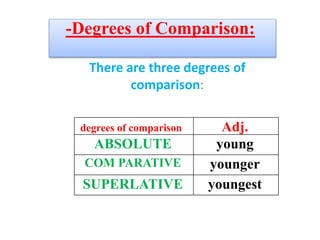
-Degrees of Comparison:
There are three degrees of
comparison:
degrees of comparison Adj.
ABSOLUTE young
COM PARATIVE younger
SUPERLATIVE youngest
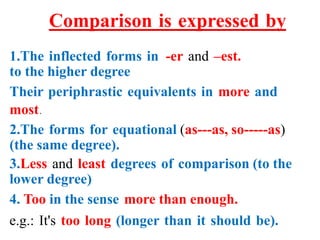
Comparison is expressed by
1.The inflected forms in -er and –est.
to the higher degree
Their periphrastic equivalents in more and
most.
2.The forms for equational (as---as, so-----as)
(the same degree).
3.Less and least degrees of comparison (to the
lower degree)
4. Too in the sense more than enough.
e.g.: It's too long (longer than it should be).
Basis of Comparison:
1. By the correlative constructions introduced by than (correlative to
more, less).
e.g.: John is more/less stupid than Bob (is). (to the higher/lower degrees).
e.g.: John behaves more/less politely than Bob (does).
2. and by as (correlative to as) (The same degree)
e.g.: John is as stupid as Bob (is).
e.g.: John behaves as politely as Bob (does).
3. and prepositional phrases with (of).
e.g.: John is the stupider of the (two) boys.
e.g.: Of the (two) boys, John behaves the more politely.
e.g.: John is the most stupid of the (three) boys.
e.g.: Of the (three) boys, John behaves the most politely.
The basis of comparison can also be shown by: the [adjective + noun]
e.g.: John is the more stupid boy.
→ John is more stupid than the other boy. (More formally).
e.g.: John is the most stupid boy.
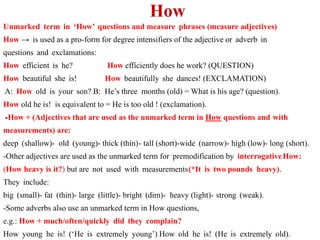
How
Unmarked term in ‘How’ questions and measure phrases (measure adjectives)
How → is used as a pro-form for degree intensifiers of the adjective or adverb in
questions and exclamations:
How efficient is he? How efficiently does he work? (QUESTION)
How beautiful she is! How beautifully she dances! (EXCLAMATION)
A: How old is your son? B: He’s three months (old) = What is his age? (question).
How old he is! is equivalent to = He is too old ! (exclamation).
-How + (Adjectives that are used as the unmarked term in How questions and with
measurements) are:
deep (shallow)- old (young)- thick (thin)- tall (short)-wide (narrow)- high (low)- long (short).
-Other adjectives are used as the unmarked term for premodification by interrogativeHow:
(How heavy is it?) but are not used with measurements(*It is two pounds heavy).
They include:
big (small)- fat (thin)- large (little)- bright (dim)- heavy (light)- strong (weak).
-Some adverbs also use an unmarked term in How questions,
e.g.: How + much/often/quickly did they complain?
How young he is! (‘He is extremely young’) How old he is! (He is extremely old).
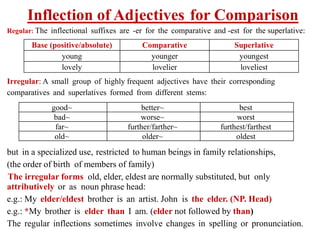
Inflection of Adjectives for Comparison
Regular: The inflectional suffixes are -er for the comparative and -est for the superlative:
Irregular: A small group of highly frequent adjectives have their corresponding
comparatives and superlatives formed from different stems:
but in a specialized use, restricted to human beings in family relationships,
(the order of birth of members of family)
The irregular forms old, elder, eldest are normally substituted, but only
attributively or as noun phrase head:
e.g.: My elder/eldest brother is an artist. John is the elder. (NP. Head)
e.g.: *My brother is elder than I am. (elder not followed by than)
The regular inflections sometimes involve changes in spelling or pronunciation.
Base (positive/absolute) Comparative Superlative
young younger youngest
lovely lovelier loveliest
good~ better~ best
bad~ worse~ worst
far~ further/farther~ furthest/farthest
old~ older~ oldest
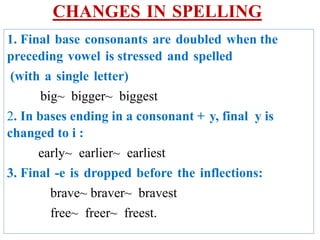
CHANGES IN SPELLING
1. Final base consonants are doubled when the
preceding vowel is stressed and spelled
(with a single letter)
big~ bigger~ biggest
2. In bases ending in a consonant + y, final y is
changed to i :
early~ earlier~ earliest
3. Final -e is dropped before the inflections:
brave~ braver~ bravest
free~ freer~ freest.
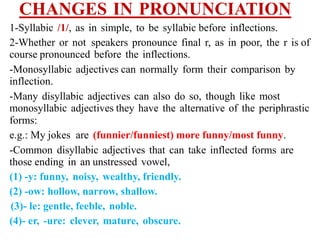
CHANGES IN PRONUNCIATION
1-Syllabic /1/, as in simple, to be syllabic before inflections.
2-Whether or not speakers pronounce final r, as in poor, the r is of
course pronounced before the inflections.
-Monosyllabic adjectives can normally form their comparison by
inflection.
-Many disyllabic adjectives can also do so, though like most
monosyllabic adjectives they have the alternative of the periphrastic
forms:
e.g.: My jokes are (funnier/funniest) more funny/most funny.
-Common disyllabic adjectives that can take inflected forms are
those ending in an unstressed vowel,
(1) -y: funny, noisy, wealthy, friendly.
(2) -ow: hollow, narrow, shallow.
(3)- le: gentle, feeble, noble.
(4)- er, -ure: clever, mature, obscure.
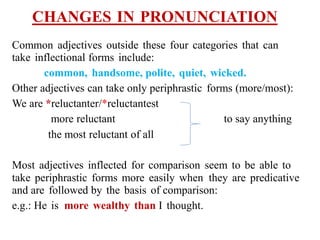
CHANGES IN PRONUNCIATION
Common adjectives outside these four categories that can
take inflectional forms include:
common, handsome, polite, quiet, wicked.
Other adjectives can take only periphrastic forms (more/most):
We are *reluctanter/*reluctantest
more reluctant to say anything
the most reluctant of all
Most adjectives inflected for comparison seem to be able to
take periphrastic forms more easily when they are predicative
and are followed by the basis of comparison:
e.g.: He is more wealthy than I thought.
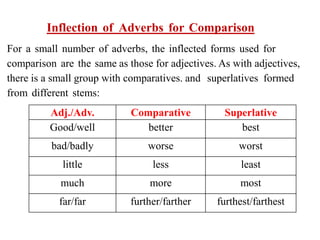
Inflection of Adverbs for Comparison
For a small number of adverbs, the inflected forms used for
comparison are the same as those for adjectives. As with adjectives,
there is a small group with comparatives. and superlatives formed
from different stems:
Adj./Adv. Comparative Superlative
Good/well better best
bad/badly worse worst
little less least
much more most
far/far further/farther furthest/farthest
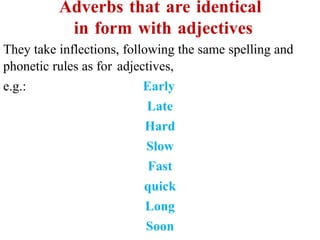
Adverbs that are identical
in form with adjectives
They take inflections, following the same spelling and
phonetic rules as for adjectives,
e.g.: Early
Late
Hard
Slow
Fast
quick
Long
Soon
Modification of Comparatives and Superlatives:
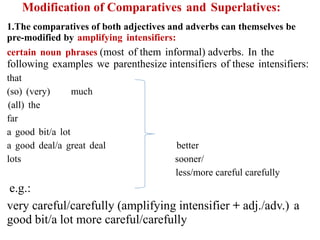
1.The comparatives of both adjectives and adverbs can themselves be
pre-modified by amplifying intensifiers:
certain noun phrases (most of them informal) adverbs. In the
following examples we parenthesize intensifiers of these intensifiers:
that
(so) (very) much
(all) the
far
a good bit/a lot
a good deal/a great deal better
lots sooner/
less/more careful carefully
e.g.:
very careful/carefully (amplifying intensifier + adj./adv.) a
good bit/a lot more careful/carefully
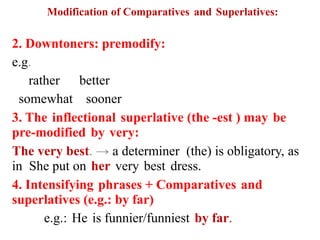
Modification of Comparatives and Superlatives:
2. Downtoners: premodify:
e.g.
rather better
somewhat sooner
3. The inflectional superlative (the -est ) may be
pre-modified by very:
The very best. → a determiner (the) is obligatory, as
in She put on her very best dress.
4. Intensifying phrases + Comparatives and
superlatives (e.g.: by far)
e.g.: He is funnier/funniest by far.
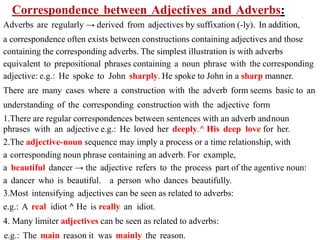
Correspondence between Adjectives and Adverbs:
Adverbs are regularly → derived from adjectives by suffixation (-ly). In addition,
a correspondence often exists between constructions containing adjectives and those
containing the corresponding adverbs. The simplest illustration is with adverbs
equivalent to prepositional phrases containing a noun phrase with the corresponding
adjective: e.g.: He spoke to John sharply. He spoke to John in a sharp manner.
There are many cases where a construction with the adverb form seems basic to an
understanding of the corresponding construction with the adjective form
1.There are regular correspondences between sentences with an adverb andnoun
phrases with an adjective e.g.: He loved her deeply.^ His deep love for her.
2.The adjective-noun sequence may imply a process or a time relationship, with
a corresponding noun phrase containing an adverb. For example,
a beautiful dancer → the adjective refers to the process part of the agentive noun:
a dancer who is beautiful. a person who dances beautifully.
3.Most intensifying adjectives can be seen as related to adverbs:
e.g.: A real idiot ^ He is really an idiot.
4. Many limiter adjectives can be seen as related to adverbs:
e.g.: The main reason it was mainly the reason.
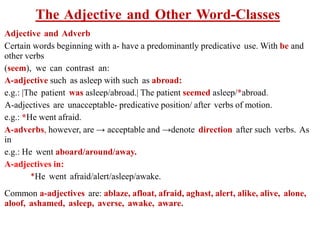
The Adjective and Other Word-Classes
Adjective and Adverb
Certain words beginning with a- have a predominantly predicative use. With be and
other verbs
(seem), we can contrast an:
A-adjective such as asleep with such as abroad:
e.g.: |The patient was asleep/abroad.| The patient seemed asleep/*abroad.
A-adjectives are unacceptable- predicative position/ after verbs of motion.
e.g.: *He went afraid.
A-adverbs, however, are → acceptable and →denote direction after such verbs. As
in
e.g.: He went aboard/around/away.
A-adjectives in:
*He went afraid/alert/asleep/awake.
Common a-adjectives are: ablaze, afloat, afraid, aghast, alert, alike, alive, alone,
aloof, ashamed, asleep, averse, awake, aware.
Adjective and Noun
Relation of Conversion:
Some items can be both adjectives and nouns. For example,
criminal = adjective in that
it can be used both attributively {a criminal attack} and
predicatively {The attack seemed criminal} But criminal
also has all the characteristics of a noun; for example, in
having
number contrast and the capacity to be subject of a clause;
as in:
The criminals pleaded guilty to all charges. (NP. pl. As s)
Criminal is therefore both an adjective and a noun.
Adjective and Noun
Nouns commonly function as premodifiers of other nouns:
A love poem. -August weather. -The city council.
-A stone wall. (stone = n→ functions as an adj.+ wall = n.)
In this function, the attributive nouns resemble adjectives. However, they correspond to
prepositional phrases with the noun as complement
A love poem → a poem about love (pp.)
= C (complement of the noun)
a wall (made) of stone - weather (usual) in August.
Such a correspondence is not available for attributive adjectives:= (no pp)
a long poem - hot weather - a thick wall
a long poem ^ a poem (of considerable length) (pp)
n. (post-modifying the noun)
Though the nouns denote material from which things are made or refer to style.
That concrete floor → that floor is concrete (= is of concrete).
Some nouns can appear in predicative noun phrases after seem. In this,
they resemble adjectives:
-He seems a fool. -His friend seems very much an Englishman.
Adjective and Participle
There are many adjectives that have the same form as participles (used attributively and predicatively)
e.g.: His views were very surprising. (-ing participle)
(his surprising views)
e.g.: The man seemed very offended. (-ed participle)
(the offended man)
The -ed participle of intransitive verbs can also be used attributively:
e.g.: The departed guest (the guest who has departed). (= possible- The guest is departed).
There may be no corresponding verb, and sometimes a corresponding verb has a different
meaning. We can therefore have ambiguous sentences where the ambiguity depends
on whether we have a participle or an adjective:
-They were (very) relieved (to find her at home) -adjective.
-They were relieved (by the next group of sentries) -participle.
Often the difference between the adjective and the participle is not clear-cut, and
lies in the verbal force of the participle. The verbal force is explicit for the -ing form
when a direct object is present. Hence, in
His views were alarming his audience.
S + V-ing participle + O
The -ing form is a participle.
Similarly, the verbal force is explicit for the -ed form when a by agentive phrase with
a personal agent is present, e.g.: The man was offended (by the policeman.)
For both (-ed & - ing) participle forms, modification by the intensifier very is an
explicit indication that the forms have adjective status:
e.g.: The man was very offended.
e.g.: His views were very alarming.
Conjunct and Conjunction:
A few conjuncts, e.g.: so, yet, resemble coordinators both in
being connectives and
the order of the following two clauses (with the conjunct so
in the second clause)
is fixed:
-We paid him a very large sum. So he left quite happy.
(quite here is an adverb)
If we change the order of the clauses, the relationship is
changed and so must now refer to
some preceding clause. However, the conjuncts differ from
coordinators in that they can
be preceded by a coordinator:
-We paid him a very large sum, and so he left quite happy.
Adjectives and Adverbs
Reference
A University Grammar of English
Randolph Quirk-Sidney Greenbaum
Chapter 5
Adjectives and Adverbs
Prepared by: Afrah k. Rashid
University of Mosul / College of Arts /
Department of English / Third Year
/ Second Semester / Evening Class /

Adjectives & adverbs

  • 1.
    -What is anAdjective? Adjectives are words that describe: 1-The qualities or states of being of nouns: enormous, doglike, silly, yellow, fun, fast. 2-The quantity of nouns: many, few, millions, eleven. quality Adjectives describe quantity
  • 2.
    -Uses of Adjectives: Adjectivestell the reader: 1-how much of something you’re talking about. 2-how many of something you’re talking about. 3-which thing you want passed to you. 4-which kind of something you want. -Please use three white flowers in the arrangement. Three and white are modifying flowers. Often, when adjectives are used together, you should separate them with a comma or conjunction. -I’m looking for a small, good-tempered dog to keep as a pet. -My new dog is small and good-tempered.
  • 3.
    Adjectives 1-Adjectives Modify Nouns: Margotwore a beautiful hat to the pie-eating contest. 2- Adjectives can also act as a complement to linking verbs or the verb to be: That cow sure is happy. It smells gross in the locker room.
  • 4.
    Adjectives 1.Coordinate Adjectives are saidto be coordinate if they modify the same noun in a sentence. -This is going to be a long, cold winter. 2.Not coordinate Sometimes, an adjective and a noun form a single semantic unit, which is then modified by another adjective. In this case, the adjectives are not coordinate and should not be separated by a comma. -My cat, Goober, loves sleeping on this tattered woolen sweater.
  • 5.
    Adjectives In some cases,it’s pretty hard to decide whether two adjectives are coordinate or not. But there are a couple of ways you can test them. 1-Try inserting the word and between the adjectives to see if the phrase still seems natural. In the first sentence, ―this tattered and woolen sweater‖ doesn’t sound right because you really aren’t talking about a sweater that isboth tattered and woolen. It’s a woolen sweater that is tattered. Woolen sweater forms a unit of meaning that is modified by tattered 2-Another way to test for coordinate adjectives is to try switching the order of the adjectives and seeing if the phrase still works. In the second sentence, you wouldn’t say ―No one could open the silver old locket.‖ You can’t reverse the order of the adjectives because silver locket is a unit that is modified by old.
  • 6.
    Adjectives vs. Adverbs adjectivesmodify nouns. Goober smells bad adverbs modify verbs. Goober smells badly Goober smells badly means that Goober, the poor thing, has a weak sense of smell. Goober smells bad means Goober stinks —poor us.
  • 7.
    What do adjectivesmodify? Adjectives can modify nouns or pronouns/names Thing Person This is a nice car Mandy is a careful girl The car is nice Mandy is careful It is nice She is careful
  • 8.
  • 9.
    Adjectives Position 1-Adjectives canbe put in front of the noun. -a fat old cat. (ATTRIBUTIVE Adjectives) 2-Adjectives can be put after the verb (e.g. to be) or linking verbs -It was cold, wet and windy. -Children get bored very quickly. ( PREDICATIVE Adjectives )
  • 10.
    Adjective and Participle Thereare many adjectives that have the same form as participles (used attributively and predicatively) e.g.: His views were very surprising. (his surprising views) (-ing participle) e.g.: The man seemed very offended. (-ed participle) (the offended man)
  • 11.
    -Adjectives / Characteristics: 1-Adjectivesare one of the major form classes: the verb, the noun, the adverb, they belong to open-class items. 2-Adjectives can be defined by function as word which describe, modify, limit, determine or qualify nouns or nouns equivalents. 3-Adjectives are uninflected for number and case and in this respect they differ from nouns. 4-Adjectives have one form which is invariable for singular and plural, number, gender, case and person. E.g.: -He is a brave man. -She is a brave woman. -They are brave men. -They are brave women.
  • 12.
    A number ofderivational suffixes are attached to adjectives: We cannot tell whether a word is an adjective by looking at it in isolation, the form does not necessarily indicate its syntactic function: E.g.: Suffix Example ous dangerous able comfortable ful playful ish greyish al seasonal ic scientific less useless y dirty
  • 13.
    Adjectives Many common adjectiveshave no identifying shape: E.g.: Nor can we identify a word as an adjective merely by considering what inflections or affixes it will allow. good hot little young fat
  • 14.
    Inflectional suffixes to createnew forms of the same word S plural cats -s reads 3 rd person singular -s called past tense -ed eaten past participle en - Happier comparative er - Happiest superlative est -
  • 15.
    Adjectives 1-Inflected Many inflect for( -er comparative and -est superlative) 2--uninflected Many do not allow inflected forms: ( -er comparative and -est superlative) e.g. disaster *disastrouser *disastrousest (more than 2 syllables) Disaster more disastrous most disastrous Superlative Comparative Base or positive greatest greater Great
  • 16.
    Adjectives and adverbs -Manyadjectives provide the base form which adverbs are derived by means of a (ly) suffix: -Some do not allow this derivational process, for example, there is no adverb derived from the adjective: e.g. old-------*oldly. adverbs adjectives happily happy
  • 17.
    Features of Adjectives 1-Mostcan be pre-modified by the intensifier (very) e.g.: The children are very happy. 2-Most can take comparative and superlative forms: The comparison may be means of inflections: Or by the addition of the pre-modifiers more and most (periphrastic comparison) The children are happier now. They are the happiest people I know. These students are more intelligent e.g.: They are the most beautiful paintings I have ever seen
  • 18.
    -Adjective phrase: Adjective phrase:is a phrase with an adjective as a head as in: (He was) so very happy. Or as sole realization as in: (He was) happy
  • 19.
    Syntactic sub-classification ofAdjectives: 1-Adjectives can be both attributive and predicative = central adjectives: e.g.: The hungry man/ the man is hungry. 2-Attributive only adjectives: they premodify nouns: e.g.: The utter fool /* the fool is utter. 3- Predicative only come after the verb (be) or linking verbs. e.g.: *a loath woman/ the woman is loath to admit it.
  • 20.
    -Predicative adjectives as Csor Co: a-Subject complement Cs: e.g.: your daughter is pretty. b-Object complement Co: e.g.: he made his wife happy. c-They can be complement C to S which is: 1-Finite clause e.g.: [Whether he will resign] is uncertain 2-Non-finite clause e.g.: [Driving a bus] isn’t easy. -Similarly, adjectives can be Co to clauses → e.g.: I consider [what he did] foolish. e.g.: I consider [playing so hard] foolish.
  • 21.
    -Summary of Characteristicsof Adjectives: 1-They can freely appear in attributive position, i.e. They can pre-modify a noun. e.g.: An ugly painting. e.g.: The round table. 2-They can freely appear in predicative position, i.e. They can function as Cs, as in 1 or Co as in 2. e.g.: The painting is ugly. e.g.: He thought the painting ugly. 3-They can be pre-modified by the intensifier very, eg.The children are very happy. 4-They can take comparative and superlative forms. The comparison by means of inflections (-er and -est), or by the addition of the premodifiers more and most (periphrastic comparison), as in: e.g.: 1.The children are happier now. e.g.: 2.They are the happiest people I know. e.g.: 3.These students are more intelligent. e.g.: 4.They are the most beautiful paintings I have ever seen.
  • 22.
    Gradable / Non-gradableAdjectives Like most adverbs, not all words regarded as adjectives can be intensified by very or take the comparison forms. Only gradable adjectives allow this. (Gradable means to use adverbs to make different levels of that quality or to make the adj. or adv. weaker or stronger). i.e. Gradable Adjectives: e.g.: A bit cold / very cold or extremely cold . Non-gradable Adjectives: e.g.: *atomic scientist / *very atomic or *more atomic.
  • 23.
    Adjectives: Central &Peripheral The ability to function attributively and predicatively are central features, so Central adjectives: are those that appear attributively and predicatively. central adj. like happy: e.g.: A happy girl → attributive e.g.: The girl is happy → predicative Peripheral adjectives: those adj. that can be only attributive like utter or those that can be only predicative like, afraid i.e.: an utter fool. *The fool is utter. (utter = attributive only). *afraid man The man is afraid. (afraid= predicative only).
  • 24.
    Postposition is obligatory: 1.For a few adjectives, which have a different sense (meaning) when they occur attributively or predicatively: e.g. elect (‘soon to take office’) and proper (‘as strictly defined’), e.g.: The president elect. e.g.: The city of London proper. 2. In several compounds ,in a few fixed expressions (mostly legal or quasi-legal) the adjective is postposed: e.g. attorney general, body politic. 3. Postposition → attributive position is usual for: a. a few a-adjectives and b. for absent, present, and (esp BrE) concerned, involved, which normally do not occur attributively in the relevant sense: e.g.: The people involved were not found→ The people (who are) involved. 4. Some postposed adjectives, especially those ending in -able or -ible, retain the basic meaning they have in attributive position, but convey the implication that what they are denoting has only a temporary application, thus: -The stars visible → stars that are visible at a time specified or implied. -The visible stars → a category of stars that can (at appropriate times) be seen. 5.If an adjective is alone or pre-modified merely by an intensifier, postposition is normally not allowed: e.g.: The (rather) timid soldiers *The soldiers rather timid.
  • 25.
    Adjectives with Complementation: Adjectivephrases which are combined with their complements can be postposed: e.g.: The easiest to teach boys were in my class. → Postposition is normally possible. e.g.: The boys easiest to teach were in my class. e.g.: Students brave enough to attempt the course deserve to pass. But if the adjective is pre-modified by enough, too, or so, the pre-modified adjectivenormally cannot be separated from its complementation: e.g.: * Brave enough students to attempt the course deserve to pass. e.g.: * A brave enough student to attempt the course deserves to pass. e.g.: * Too/So easy boys to teach were in my class.
  • 26.
    Head of aNoun Phrase Adjectives can often function as heads of noun phrases as such, they are unlike nouns. They do not inflect for: 1. Number. 2. For the genitive case and 3. Most take a definite determiner(the). 4. Most commonly, such adjectives have personal reference. 5. They take a plural verb.
  • 27.
    Three Types ofthe Adjectives can function as Noun Phrase Heads: 1- Adjs. which can pre-modify personal nouns (the young people). (with pl. and generic reference). E.g.: The extremely old need a great deal of attention. 2. Some adjectives denoting nationalities can be noun-phrase heads.(generic and pl. concord): e.g.: You British and you French ought to be friends. 3. Some adjectives can function as noun-phrase heads when they have abstract reference. 1. These take singular concord. 2. A few are modifiable by adverbs. 3. They include, in particular, superlatives. e.g.: The latest (i.e. ‘the latest news, thing’) is that he is going to run for election e.g.: The very best (i.e. ‘the very best part, thing’) is yet to come.
  • 28.
    Verbless Adjective Clause Anadjective (alone or as head of an adjective phrase) can function as a verbless clause. The clause is mobile, though it usually precedes or follows the subject of the superordinate clause e.g.: (By then) nervous, the man opened the letter. e.g.: The man, (by then) nervous, opened the letter. e.g.: The man opened the letter, (by then) nervous. The implied subject is usually the subject of the sentence. An adverb may sometimes replace an adjective functioning as a verbless clause: e.g.: Nervously/Nervous the man opened the letter.
  • 29.
    CONTINGENT ADJECTIVE CLAUSE Acontingent adjective clause: is a clause which is often introduced by a subordinator expresses the circumstance or condition under which what is said in the superordinate clause applies. A subordinator is often present but can be omitted. e.g.: When ripe, these apples are sweet. - The implied subject of the contingent adjective clause is normally the subject of the superordinate clause, but it can also be the object e.g.: We can drink it hot. e.g.: You must eat it when fresh.
  • 30.
    Exclamatory Adjective Sentence Anadjective as head of an adjective phrase or as its sole realization can be an exclamation: e.g.: How good of you ! e.g.: How wonderful ! e.g.: Excellent !
  • 31.
    Syntactic Subclassification ofAdjectives Adjectives can be sub-classified according to whether they can function as: 1-both attributive and predicative, e.g.: a hungry man ^ the man is hungry; these are the majorityand constitute the central adjectives: 2-attributive only, e.g.: an utter fool * the fool is utter. 3-predicative only, e.g.: *a loath woman ^ the woman is loath to admit it.
  • 32.
    NON-INHERENT / INHERENT Adjectives that characterizethe referent of the noun directly are termed INHERENT, those that do not are termed NON- INHERENT. Some non-inherent adjectives occur also predicatively. For example: new a new student / That student is new. → inherent a new friend *My friend is new. → non- inherent Note words with strongly emotive value (Only attributive position): e.g.: You poor man, my dear lady, that wretched woman.
  • 33.
    INTENSIFYING ADJECTIVES Adjectives →havea heightening or lowering effect on the noun they modifyThe semantic subclasses of intensifying adjectives can be: 1.emphasizers and 2.amplifiers. Emphasizers have a general heightening effect. Emphasizers are attributive only: A certain (‘sure’) winner, pure (‘sheer’) fabrication, a real (‘undoubted’) hero. Amplifiers scale upwards from an assumed norm, denoting the upper extreme of the scale or a high point on the scale. Amplifiers → when central adjectives = inherent E.g.: a complete victory the victory was complete. Amplifiers → are attributive adjectives = non-inherent. A complete fool *the fool is complete. A perfect idiot *the idiot is perfect. Examples of amplifiers → attributive only: -A close friend. -Utter folly. -A strong opponent
  • 34.
    LIMITER ADJECTIVES Limiter adjectivesparticularize the reference of the noun. Examples include the main reason /the precise reason/ the only occasion / the same student Some of these have homonyms. For example: Certain → in a certain person is needed = a limiter (a particular person). e.g.: John is certain that he will win. = an intensifier (‘a sure winner’). Sure in the sense of ‘confident’And predicative position. RELATED TO ADVERBIALS: Adjectives → are attributive only can be related to adverbials. These non-inherent Adjectives include: e.g.: My former friend ^ formerly my friend. e.g.: An occasional visitor / occasionally a visitor. -Some require implications additional to the adverbial: e.g.: The late president ^ till lately the president (now dead).
  • 35.
    DENOMINAL ADJECTIVES Some adjectivesderived from nouns are attributive only: e.g.: Criminal law (law concerning crime). e.g.: An atomic scientist (a scientist specializing in atomic science). e.g.: A medical school (a school for students of medicine). Note The same item may also be a central adjective. For example: A criminal law can be = a law which seems criminal. [criminal = a central adjective].
  • 36.
    Attributive only Adjectives thatare restricted to attributive position → do not characterize the referent of the noun directly: e.g.: an old friend (‘one who has been a friend for a long period of time’) does not necessarily imply that the person is old, so that we cannot relate my old friend ≠ my friend is old.( attributive only) [Old refers to the friendship and does notcharacterize the person. That old man, old is a central adjective (the opposite of young) and we can relate. That old man ≈ that man is old. (central adj.) (inherent adj.)
  • 37.
    Predicative only: 1. Theyare adjectives restricted or virtually restricted to predicative position. 2.They are most like verbs and adverbs. 3.They tend to refer to a (possibly temporary) condition rather than to characterize. 4. Perhaps the most common are those referring to health or lack of health: faint, ill (esp. BrE), well,unwell ill and / unwell → can be used as attributives too. A larger group comprises adjectives: 1-WITH complementation: e.g.: afraid + that of about/conscious + (that, of), fond + (of), loath (to) 2.Closely resemble verbs semantically: He is afraid to do it He fears to do it. They are fond of her They like her. 3.Some can occur both predicatively and attributively, e.g.: the conscious patient ^ the patient is conscious. Note Sick (esp AmE) is the exception: The sick woman The woman is sick.
  • 38.
    Semantic Subclassification ofAdjectives A) Stative/Dynamic Adjectives are characteristically stative, but many can be seen as dynamic. In particular, most adjectives that are subjective. Stative and dynamic adjectives differ in a number of ways: -Stative adjective 1. Stative adjs. such as (tall) cannot be used with the progressive aspect → *He is being tall. Or with the imperative → *Be tall 2. Some are gradable = Adj. denoting provenance = British / His behavior is more British. Or non-gradable technical adj.= atomic scientists. -Dynamic adjectives 1. Can be used in progressive aspect/ careful as a dynamic adjective: He is being careful . Or the imperative → Be careful. 2. All dynamic adjectives are gradable. Adjectives that can be used dynamically include: awkward, brave, calm, careless, cruel, extravagant, foolish, funny, good, greedy, impudent, irritable, jealous, naughty, noisy, rude, timid.
  • 39.
    Semantic Subclassification ofAdjectives B)Gradable/non-gradable Most adjectives are gradable, that is to say: 1. Can be modified by adverbs to convey intensity of the adjective. 2. Gradability includes: 1. Comparison: 2.intensification: tall taller tallest Beautiful more beautiful most beautiful very young so plain extremely useful
  • 40.
    Semantic Subclassification ofAdjectives C) Inherent/non-inherent: Most adjectives are inherent, and it is especially → dynamic adjectives to be inherent; A firm handshake = inherent a firm friend = non inherent Exception is wooden in → The actor is being wooden. both [dynamic and non-inherent].
  • 41.
    Semantic Sets andAdjectival Order Semantic sets have been proposed to account for the usual order of adjectives and for their co-occurrence: a) Intensifying adjectives, e.g.: a real hero, a perfect idiot. b) Post-determiners, and limiter adjectives, e.g.: the fourth student, the only occasion. c) General adjectives denoting subjective matters relating to your own opinions and (ideas), e.g.: careful, lovely. d) General adjectives denoting objective matters, including those denoting size or shape (not influenced by personal beliefs or feelings/facts), e.g.: wealthy, large, square. e) Adjectives denoting age, e.g.: young, old, new. f) Adjectives denoting colour, e.g.: red, black. g) Denominal adjectives denoting material, e.g.: a woolen scarf, a metallic substance, and denoting resemblance to a material, e.g.: metallic voice, silken hair. h) Denominal adjectives denoting provenance or style, e.g.: a Britishship.
  • 42.
    Characteristics of theAdverb Morphologically: the majority of adverbs have the derivational suffix -ly There are two types of syntactic function that characterize adverbs: 1. adverbial: An adverb may function as adverbial A :as a clause element structure, a constituent distinct from subject S, verb V, object O, and complement C. a) He quite forgot about it. b) Modifier of an adjective or an adverb e.g. They are quite happy. e.g. They are quite happily married. Morphologically, three types of adverbials are distinguished 1. Simple—denote position and direction --- e.g. Just ,only, well, back, near, down, out, . under. 2. Compound—somehow, therefore, somewhere. 3. Derivational 1. By ( adj. + -ly) = odd = oddly, interesting = interestingly. 2. By other derivational suffixes - wise clockwise-ward (s) = northwards, - fashion= schoolboy-fashion, -ways= sideways, -style= cowboy-style. 2. An adverb phrase: it may consist only of one word as sole realization, bravely, quickly. e.g. He walks very quickly.
  • 43.
    Classes of Adverbials:adjuncts, disjuncts, conjuncts ADJUNCTS are integrated within the structure of the clause to at least some extent. (they add information about time, place, manner, condition, purpose, reason, result and concession) e.g. They are waiting outside. I can now understand it. He spoke to me about it briefly. DISJUNCTS and CONJUNCTS, on the other hand, are not integrated within the clause DISJUNCTS, semantically, express an evaluation of what is being said either with respect to the form of the communication or to its content. (the attitude of the speaker). E.g. Frankly, I am tired. E.g. Fortunately, no one complained. They are probably at home. CONJUNCTS, semantically, have a connective function. They indicate the connection between what is being said and what was said before. If you open all the windows, then I am leaving. We have complained several times about the noise, and yet he does nothing about it.
  • 44.
    Syntactic Functions ofAdverbs: A. Adverb as Modifier: 1.Premodifier of adjective = intensifier or as viewpoint. a. As intensifiers→ can modify adjectives, adverbs, and verbs alike Adverbs may pre-modify an adjective: advs. Like: very, so pretty, rather unusually ,quite unbelievably {tall} That was a VERY funny film. It is EXTREMELY good of you. She has a REALLY beautiful face. 2. Enough – post-modifies adjectives, as in → high enough. 3.A small set of lexical items, e.g.: deeply {anxious}, highly {intelligent}, strikingly{handsome), sharply (critical). b. Viewpoint→ Adverbs as pre-modifiers of adjectives as in: Technically possible, theoretically sound. 2.Modifier of adverb An adverb may pre-modify another adverb → function as intensifier. They are smoking VERY heavily. → 2. Enough As with adjectives, the only post modifier. as in cleverly enough, A few intensifying adverbs: right and well, pre-modify particles in phrasal verbs. -He turned RIGHT round. -They left him WELL behind.
  • 45.
    Modifier of prepositionalphrase & Modifier of determiner 3. Modifier of prepositional phrase. The few adverbs that pre-modify particles in phrasal verbs also pre- modify prepositions: -The nail went RIGHT through the wall. 4. Modifier of determiner, pre-determiner, post-determiner. Intensifying adverbs can pre-modify indefinite pronouns, pre- determiners, and cardinalnumerals. Modifier of determiner -It is double the normal price. -NEARLY everybody came to our party. (indefinite pronouns) -OVER two hundred deaths were reported.(pre-determiners) -They paid MORE THAN ten pounds for it. (cardinal numbers) The indefinite article (a) → intensified → = equals to unstressed cardinal one. They will stay ABOUT a week= They will stay about one week. (The/definite determiner)→ is obligatory: With ordinals and superlatives She gave me the largest piece of cake.
  • 46.
    Modifier of nounphrase An intensifiers + noun phrases (indefinite): quite, rather + np ( n= sg.. count. n & .(1.) gradable) pre-determiners + np: such and exclamatory what. -He told SUCH a funny story. -He told SUCH funny stories. -I have never heard SUCH wickedness. -It was RATHER a mess. -WHAT a (big) fool he is ! So & interrogative and exclamatory how + gradable adj. + the indefinite article + np.( n.sg. &count.), [the noun phrase requires] 1.A gradable adjective. 2.The head of the noun phrase to be a singular countable noun. 3. They cause the adjective to move in front of the article. -I didn’t realize that he was SO big a fool. -HOW tall a man is he? -HOW tall a man he is! Np. + Some adverbs signifying place or time PLACE: the way ahead, the neighbor upstairs, the sentence below. TIME: the meeting yesterday, the day before. adverb can also be used as a pre-modifier: His home journey, the above photo, the upstairs neighbor. A few other adverbs are also used as pre-modifiers: (then and above) The then president.
  • 47.
    Adverb as Complementof Preposition -Some place and time adverbs function as complement of a preposition Preposition + Adv. (place or time) Place adverbs→[of, here and . there] + most prepositions: along, around, down, from,in, near, on, out {of }, over, round, through, under, up the prepositions [at, from, near, toward (s)] + adv. Home = At home, near home. -Others are restricted to the preposition. Time adverbs most commonly functioning as complement of prepositions Since/lately/recently/till/until/then/today/yesterday.
  • 48.
    -Degrees of Comparison: Thereare three degrees of comparison: degrees of comparison Adj. ABSOLUTE young COM PARATIVE younger SUPERLATIVE youngest
  • 49.
    Comparison is expressedby 1.The inflected forms in -er and –est. to the higher degree Their periphrastic equivalents in more and most. 2.The forms for equational (as---as, so-----as) (the same degree). 3.Less and least degrees of comparison (to the lower degree) 4. Too in the sense more than enough. e.g.: It's too long (longer than it should be).
  • 50.
    Basis of Comparison: 1.By the correlative constructions introduced by than (correlative to more, less). e.g.: John is more/less stupid than Bob (is). (to the higher/lower degrees). e.g.: John behaves more/less politely than Bob (does). 2. and by as (correlative to as) (The same degree) e.g.: John is as stupid as Bob (is). e.g.: John behaves as politely as Bob (does). 3. and prepositional phrases with (of). e.g.: John is the stupider of the (two) boys. e.g.: Of the (two) boys, John behaves the more politely. e.g.: John is the most stupid of the (three) boys. e.g.: Of the (three) boys, John behaves the most politely. The basis of comparison can also be shown by: the [adjective + noun] e.g.: John is the more stupid boy. → John is more stupid than the other boy. (More formally). e.g.: John is the most stupid boy.
  • 51.
    How Unmarked term in‘How’ questions and measure phrases (measure adjectives) How → is used as a pro-form for degree intensifiers of the adjective or adverb in questions and exclamations: How efficient is he? How efficiently does he work? (QUESTION) How beautiful she is! How beautifully she dances! (EXCLAMATION) A: How old is your son? B: He’s three months (old) = What is his age? (question). How old he is! is equivalent to = He is too old ! (exclamation). -How + (Adjectives that are used as the unmarked term in How questions and with measurements) are: deep (shallow)- old (young)- thick (thin)- tall (short)-wide (narrow)- high (low)- long (short). -Other adjectives are used as the unmarked term for premodification by interrogativeHow: (How heavy is it?) but are not used with measurements(*It is two pounds heavy). They include: big (small)- fat (thin)- large (little)- bright (dim)- heavy (light)- strong (weak). -Some adverbs also use an unmarked term in How questions, e.g.: How + much/often/quickly did they complain? How young he is! (‘He is extremely young’) How old he is! (He is extremely old).
  • 52.
    Inflection of Adjectivesfor Comparison Regular: The inflectional suffixes are -er for the comparative and -est for the superlative: Irregular: A small group of highly frequent adjectives have their corresponding comparatives and superlatives formed from different stems: but in a specialized use, restricted to human beings in family relationships, (the order of birth of members of family) The irregular forms old, elder, eldest are normally substituted, but only attributively or as noun phrase head: e.g.: My elder/eldest brother is an artist. John is the elder. (NP. Head) e.g.: *My brother is elder than I am. (elder not followed by than) The regular inflections sometimes involve changes in spelling or pronunciation. Base (positive/absolute) Comparative Superlative young younger youngest lovely lovelier loveliest good~ better~ best bad~ worse~ worst far~ further/farther~ furthest/farthest old~ older~ oldest
  • 53.
    CHANGES IN SPELLING 1.Final base consonants are doubled when the preceding vowel is stressed and spelled (with a single letter) big~ bigger~ biggest 2. In bases ending in a consonant + y, final y is changed to i : early~ earlier~ earliest 3. Final -e is dropped before the inflections: brave~ braver~ bravest free~ freer~ freest.
  • 54.
    CHANGES IN PRONUNCIATION 1-Syllabic/1/, as in simple, to be syllabic before inflections. 2-Whether or not speakers pronounce final r, as in poor, the r is of course pronounced before the inflections. -Monosyllabic adjectives can normally form their comparison by inflection. -Many disyllabic adjectives can also do so, though like most monosyllabic adjectives they have the alternative of the periphrastic forms: e.g.: My jokes are (funnier/funniest) more funny/most funny. -Common disyllabic adjectives that can take inflected forms are those ending in an unstressed vowel, (1) -y: funny, noisy, wealthy, friendly. (2) -ow: hollow, narrow, shallow. (3)- le: gentle, feeble, noble. (4)- er, -ure: clever, mature, obscure.
  • 55.
    CHANGES IN PRONUNCIATION Commonadjectives outside these four categories that can take inflectional forms include: common, handsome, polite, quiet, wicked. Other adjectives can take only periphrastic forms (more/most): We are *reluctanter/*reluctantest more reluctant to say anything the most reluctant of all Most adjectives inflected for comparison seem to be able to take periphrastic forms more easily when they are predicative and are followed by the basis of comparison: e.g.: He is more wealthy than I thought.
  • 56.
    Inflection of Adverbsfor Comparison For a small number of adverbs, the inflected forms used for comparison are the same as those for adjectives. As with adjectives, there is a small group with comparatives. and superlatives formed from different stems: Adj./Adv. Comparative Superlative Good/well better best bad/badly worse worst little less least much more most far/far further/farther furthest/farthest
  • 57.
    Adverbs that areidentical in form with adjectives They take inflections, following the same spelling and phonetic rules as for adjectives, e.g.: Early Late Hard Slow Fast quick Long Soon
  • 58.
    Modification of Comparativesand Superlatives: 1.The comparatives of both adjectives and adverbs can themselves be pre-modified by amplifying intensifiers: certain noun phrases (most of them informal) adverbs. In the following examples we parenthesize intensifiers of these intensifiers: that (so) (very) much (all) the far a good bit/a lot a good deal/a great deal better lots sooner/ less/more careful carefully e.g.: very careful/carefully (amplifying intensifier + adj./adv.) a good bit/a lot more careful/carefully
  • 59.
    Modification of Comparativesand Superlatives: 2. Downtoners: premodify: e.g. rather better somewhat sooner 3. The inflectional superlative (the -est ) may be pre-modified by very: The very best. → a determiner (the) is obligatory, as in She put on her very best dress. 4. Intensifying phrases + Comparatives and superlatives (e.g.: by far) e.g.: He is funnier/funniest by far.
  • 60.
    Correspondence between Adjectivesand Adverbs: Adverbs are regularly → derived from adjectives by suffixation (-ly). In addition, a correspondence often exists between constructions containing adjectives and those containing the corresponding adverbs. The simplest illustration is with adverbs equivalent to prepositional phrases containing a noun phrase with the corresponding adjective: e.g.: He spoke to John sharply. He spoke to John in a sharp manner. There are many cases where a construction with the adverb form seems basic to an understanding of the corresponding construction with the adjective form 1.There are regular correspondences between sentences with an adverb andnoun phrases with an adjective e.g.: He loved her deeply.^ His deep love for her. 2.The adjective-noun sequence may imply a process or a time relationship, with a corresponding noun phrase containing an adverb. For example, a beautiful dancer → the adjective refers to the process part of the agentive noun: a dancer who is beautiful. a person who dances beautifully. 3.Most intensifying adjectives can be seen as related to adverbs: e.g.: A real idiot ^ He is really an idiot. 4. Many limiter adjectives can be seen as related to adverbs: e.g.: The main reason it was mainly the reason.
  • 61.
    The Adjective andOther Word-Classes Adjective and Adverb Certain words beginning with a- have a predominantly predicative use. With be and other verbs (seem), we can contrast an: A-adjective such as asleep with such as abroad: e.g.: |The patient was asleep/abroad.| The patient seemed asleep/*abroad. A-adjectives are unacceptable- predicative position/ after verbs of motion. e.g.: *He went afraid. A-adverbs, however, are → acceptable and →denote direction after such verbs. As in e.g.: He went aboard/around/away. A-adjectives in: *He went afraid/alert/asleep/awake. Common a-adjectives are: ablaze, afloat, afraid, aghast, alert, alike, alive, alone, aloof, ashamed, asleep, averse, awake, aware.
  • 62.
    Adjective and Noun Relationof Conversion: Some items can be both adjectives and nouns. For example, criminal = adjective in that it can be used both attributively {a criminal attack} and predicatively {The attack seemed criminal} But criminal also has all the characteristics of a noun; for example, in having number contrast and the capacity to be subject of a clause; as in: The criminals pleaded guilty to all charges. (NP. pl. As s) Criminal is therefore both an adjective and a noun.
  • 63.
    Adjective and Noun Nounscommonly function as premodifiers of other nouns: A love poem. -August weather. -The city council. -A stone wall. (stone = n→ functions as an adj.+ wall = n.) In this function, the attributive nouns resemble adjectives. However, they correspond to prepositional phrases with the noun as complement A love poem → a poem about love (pp.) = C (complement of the noun) a wall (made) of stone - weather (usual) in August. Such a correspondence is not available for attributive adjectives:= (no pp) a long poem - hot weather - a thick wall a long poem ^ a poem (of considerable length) (pp) n. (post-modifying the noun) Though the nouns denote material from which things are made or refer to style. That concrete floor → that floor is concrete (= is of concrete). Some nouns can appear in predicative noun phrases after seem. In this, they resemble adjectives: -He seems a fool. -His friend seems very much an Englishman.
  • 64.
    Adjective and Participle Thereare many adjectives that have the same form as participles (used attributively and predicatively) e.g.: His views were very surprising. (-ing participle) (his surprising views) e.g.: The man seemed very offended. (-ed participle) (the offended man) The -ed participle of intransitive verbs can also be used attributively: e.g.: The departed guest (the guest who has departed). (= possible- The guest is departed). There may be no corresponding verb, and sometimes a corresponding verb has a different meaning. We can therefore have ambiguous sentences where the ambiguity depends on whether we have a participle or an adjective: -They were (very) relieved (to find her at home) -adjective. -They were relieved (by the next group of sentries) -participle. Often the difference between the adjective and the participle is not clear-cut, and lies in the verbal force of the participle. The verbal force is explicit for the -ing form when a direct object is present. Hence, in His views were alarming his audience. S + V-ing participle + O The -ing form is a participle. Similarly, the verbal force is explicit for the -ed form when a by agentive phrase with a personal agent is present, e.g.: The man was offended (by the policeman.) For both (-ed & - ing) participle forms, modification by the intensifier very is an explicit indication that the forms have adjective status: e.g.: The man was very offended. e.g.: His views were very alarming.
  • 65.
    Conjunct and Conjunction: Afew conjuncts, e.g.: so, yet, resemble coordinators both in being connectives and the order of the following two clauses (with the conjunct so in the second clause) is fixed: -We paid him a very large sum. So he left quite happy. (quite here is an adverb) If we change the order of the clauses, the relationship is changed and so must now refer to some preceding clause. However, the conjuncts differ from coordinators in that they can be preceded by a coordinator: -We paid him a very large sum, and so he left quite happy.
  • 66.
    Adjectives and Adverbs Reference AUniversity Grammar of English Randolph Quirk-Sidney Greenbaum Chapter 5 Adjectives and Adverbs Prepared by: Afrah k. Rashid University of Mosul / College of Arts / Department of English / Third Year / Second Semester / Evening Class /