Dr. Ramesh B T
Assistant Prof, MED
Jain Institute of Technology
Davangere-577003
Mail ID: rameshbt049@gmail.com
Phone No: 9900784915
5/16/2021
1
Energy
The word ‘energy’ itself is derived from the Greek
word which means ‘in-work’ or ‘work content’. The work
output depends on the energy input.
Energy can be defined as the ability to do work.
Energy is measured in the same unit as work: joules (J).
Energy is all around us. we can hear energy as sound. we can
see energy as light and we can feel it as wind.
The five main forms of energy are:
Heat
Chemical
Electromagnetic
Nuclear
Mechanical
5/16/2021
2
All forms of energy can be converted into other forms.
The sun’s energy through solar cells can be converted directly into
electricity.
Green plants convert the sun’s energy (electromagnetic) into
starches and sugars (chemical energy).
In an electric motor, electromagnetic energy is converted to
mechanical energy.
In a battery, chemical energy is converted into electromagnetic
energy.
The mechanical energy of a waterfall is converted to electrical
energy in a generator.
All forms of energy can be in either of two states:
Potential
Kinetic
5/16/2021
3
Kinetic Energy
The energy of motion is called kinetic energy
K.E. = mass x velocity
Potential Energy
Potential Energy is stored energy, Stored chemically in fuel,
the nucleus of atom, and in foods. Or stored because of the
work done on it:
Stretching a rubber band.
Winding a watch.
Pulling back on a bow’s arrow.
Lifting a brick high in the air.
5/16/2021
4
Classification of energy resources:
*Conventional/ Commercial
*Non - Conventional
*Renewable
*Non – renewable
*Primary resources
*Intermediate resources
*Secondary resources
Conventional sources:
Energy sources which are available in less amount and will one day be
exhausted, are known as conventional sources of energy. E.g. fossil fuels
Non - conventional sources:
The energy sources which are renewable and can be regenerated are
known as renewable or non-conventional sources of energy.
As the population is increasing the energy consumption also is increasing.
Hence we need such sources of energy which can be renewed from time
to time and they can meet our needs regularly. 5/16/2021
5
5/16/2021
6
The different sources of energy are:
1. Fossil fuels
2. Biomass
3. Hydro power plant
4. Wind energy
5. Solar energy
6. Geothermal energy
7. Ocean thermal energy
8. Tidal energy
9. Wave energy
10.Nuclear energy
5/16/2021
7
The need for alternatives:
* The average rate of increase of oil production in the world is declining & a peak in
production may be reached around 2015. There after the production will decline
gradually & most of the oil reserves of the world are likely to be consumed by the end of
the present century. The serious nature of this observation is apparent when one notes
that oil provides about 30% of the world‘s need for energy from commercial sources &
that oil is the fuel used in most of the world‘s transportation systems.
* The production of natural gas is continuing to increase at a rate of about 4% every year.
Unlike oil, there has been no significant slowdown in the rate of increase of production.
Present indications are that a peak in gas production will come around 2025, about 10
years after the peak in oil production.
* As oil & natural gas becomes scarcer, a great burden will fall on coal. It is likely that the
production of coal will touch a maximum somewhere around 2050.
* Finally, it should be noted that in addition to supplying energy, fossil fuels are used
extensively as feed stock material for the manufacture of organic chemicals. As
resources deplete, the need for using fossil fuels exclusively for such purposes may
become greater.
5/16/2021
8
need for non-conventional energy sources
• CO2 is at 407ppm (Oct 2018)
increased by 90ppm in the last
70 years
• Global warming ~1.1°C in the
past 200 years
• Ocean acidification
• Rising sea level ~3.2mm each
year
• Decreasing ice sheet mass
• Retreating glaciers
• Decreasing Arctic ice at a rate
of 13% each decade
NASA Youtube video showing planet warming
https://www.youtube.com/watch?time_continue=9&v=s3RWTTtPg8E 5/16/2021
9
5/16/2021
10
5/16/2021
11
5/16/2021
12
5/16/2021
13
Energy Production/consumption Energy Percent
source equivalent( in contribution
1015 J)
Coal 310 Mt 8177 56.16
Oil 103.44 Mt 4331 29.75
Natural 27.860×10⁹ m3 1087 7.47
gas
Water- 74362 GWh 765 5.25
power
Nuclear 16621GWh 199 1.37
power
Total 14559 100.00
5/16/2021
14
Consumption trend of primary energy resources
5/16/2021
15
5/16/2021
16
1. Coal and Lignite:
2. Oil and Gas:
3.Hydroelectric power:
4.Atomic or Nuclear Power:
5. Nuclear Power
5/16/2021
17
SALIENT FEATURES OF NON-CONVENTIONAL ENERGY RESOURCES
Merits:
* NCES are available in nature, free of cost.
* They cause no or very little pollution. Thus, by and large, they are
environmental friendly.
* They are inexhaustible.
* They have low gestation period.
Demerits:
* Though available freely in nature, the cost of harnessing energy from NCES is
high, as in general, these are available in dilute forms of energy.
* Uncertainty of availability: the energy flow depends on various natural
phenomena beyond human control.
* Difficulty in transporting this form of energy.
5/16/2021
18
ADVANTAGES & DISADVANTAGES OF CONVENTIONAL ENERGY RESOURCES:
ADVANTAGES:
• Coal: as present is cheap.
• Security: by storing certain quantity, the energy availability can be ensured for a
certain period.
• Convenience: it is very convenient to use.
DISADVANTAGES:
• Fossil fuels generate pollutants: CO, CO2, NOX, SOX. Particulate matter & heat.
The pollutants degrade the environment, pose health hazards & cause various
other problems.
• Coal: it is also valuable petro-chemical & used as source of raw material for
chemical & paints, industries, etc. From long term point of view, it is desirable
to conserve coal for future needs.
• Safety of nuclear plants: it is a controversial subject.
• Hydro electrical plants are cleanest but large hydro reservoirs
cause the following problems
• As large land area submerges into water, which leads to deforestation
Causes ecological disturbances such as earthquakes
• Causes dislocation of large population & consequently their rehabilitation
problems. 5/16/2021
19
Solar energy is a very large, inexhaustible source of energy.
5/16/2021
20
5/16/2021
21
Merits of solar energy:
Demerits of solar energy:
Solar applications:
5/16/2021
22
5/16/2021
23
5/16/2021
24
https://youtu.be/zvQZtpZnRRE
5/16/2021
25
https://youtu.be/ZYO83TkM0To
5/16/2021
26
5/16/2021
27
5/16/2021
28
https://youtu.be/q8HmRLCgDAI
5/16/2021
29
https://youtu.be/45Xh7FKS9nM
5/16/2021
30
5/16/2021
31
https://youtu.be/BsojDI7tQm0
Biomass energy is energy generated or produced by living or once-living
organisms. ... Biomass is organic, meaning it is made of material that comes
from living organisms, such as plants and animals. The most
common biomass materials used for energy are plants, wood, and waste.
5/16/2021
32
5/16/2021
33
https://youtu.be/IASV8IH-ytE
Ocean thermal energy conversion (OTEC) is a process or technology for
producing energy by harnessing the temperature differences (thermal gradients)
between ocean surface waters and deep ocean waters
he temperature of the ocean also varies from top to bottom, giving a vertical
structure to most of the ocean. There is an upper layer of water, up to 200m
deep, that is warmed by the Sun and has the same temperature from top to
bottom. Below that is a layer called the thermocline, reaching down in places to
1000m, which is colder at the bottom than at the top. The deep ocean below the
thermocline, making up 80% of the ocean, is the same very cold temperature
throughout
Some properties of water change with temperature:
• Cold water is denser than warm water, so it tends to sink.
• Cold water holds more dissolvable gases, such as carbon dioxide
• Water temperature can affect the productivity of organisms living in it.
Water expands when it warms up – heat energy makes its molecules move around
more and take up more space. Because the molecules are more spread out,
the density goes down. When water cools, it contracts and becomes denser.
Temperature and salinity both affect the density of water, resulting in water
moving up or down through the ocean layers and moving as currents around the
ocean.
5/16/2021
34
5/16/2021
35
Applications:
used turbines to produce electricity.
5/16/2021
36
5/16/2021
37
Tidal energy is energy produced by the tides of the ocean. Tides are produced by
the pull of gravity from the Moon as well as the spin of the Earth. There is a lot of
energy in the movement of that much water.
The first wave power plant in the world opened in 2008 at the Farm in Portugal.
Tidal power to turn water wheels and grind grains was used as far back as
Roman times and the Middle Ages. The idea of using tidal power for electricity
is fairly recent, but the costs have been too high to make it a major energy
source. Recent technological advances have shown that it could become a
competitive and viable source.
Oscillating Water Column (OWC)
5/16/2021
38
The Pivoting Flap Device
Tidal Turbines
Tidal Barrages
https://youtu.be/VkTRcTyDSyk https://youtu.be/gcStpg3i5V8
5/16/2021
39
Some advantages of tidal energy are:
• Environment-friendly
• A highly predictable energy source
• High energy density
• Operational and maintenance costs are low
• An inexhaustible source of energy
Some of the disadvantages of tidal energy are:
• High tidal power plant construction costs
• Negative influence on marine life forms
• Location limits
• The variable intensity of sea waves
5/16/2021
40
Geothermal energy is heat within the earth.
https://youtu.be/mCRDf7QxjDk
5/16/2021
41
5/16/2021
42
5/16/2021
43
Oil shale is a fine-grained sedimentary rock containing large amounts of organic
matter (kerogen), which can yield substantial quantities of hydrocarbons.
Tar sands are grains of sand or, in some cases, porous
carbonate rocks that are intimately mixed with a very
heavy, asphalt-like crude oil called bitumen.
5/16/2021
44
oil shale contains about 4% kerogen. When heated to 350-400 °C, it yields about 6
gallons of oil per ton of shale. Rich shale may contain up to 40% kerogen and
typically yields about 50 gallons of oil per ton.
Oil is then recovered from the shale by retorting the shale. Retorting involves
heating the shale in the absence of air to temperatures of 500 °C or more.
Typically, 75-80% of the kerogen is converted to oil.
https://youtu.be/Dx1jOD-V8mc
5/16/2021
45
The bitumen is much too viscous to be recovered by traditional petroleum recovery
techniques. If tar sand is heated to about 80 °C, by injecting steam into the deposit
in a manner analogous to that of enhanced oil recovery, the elevated temperature
causes a decrease in the viscosity of the bitumen just enough to allow its pumping
to the surface. Alternatively, it is sometimes easier to mine the tar sand as a solid
material. When the mined tar sand is mixed with steam and hot water, the bitumen
will float on the water while the sand sinks to the bottom of the container, allowing
for easy separation. Heating the bitumen above 500 °C converts about 70% of it to
a synthetic crude oil. Distilling this oil gives good yields of kerosene and other
liquid products in the middle distillate range. The remainder of the bitumen either
thermally cracks to form gaseous products or reacts to form petroleum coke
5/16/2021
46
5/16/2021
47
Nuclear power is the use of nuclear reactions to produce electricity. Nuclear
power can be obtained from nuclear fission, nuclear decay and nuclear fusion
reactions.
5/16/2021
48
https://youtu.be/_UwexvaCMWA
5/16/2021
49
Dr. Ramesh B T
Assistant Prof, MED
Jain Institute of Technology
Davangere-577003
Mail ID: rameshbt049@gmail.com
Phone No: 9900784915
5/16/2021
50
5/16/2021
51
Solar Radiation
The solar constant, GSC is the energy from the sun, per unit time, received on
a unit area of surface perpendicular to the direction of propagation of the
radiation, at mean earth-sun distance, outside of the atmosphere.
Earth’s elliptic orbit
The elliptical path causes
only small variations in the
amount of solar radiation
reaching the earth.
5/16/2021
52
5/16/2021
53
*3 factors contribute to
the amount of incoming
solar radiation
(insolation):
1) Period of daylight
5/16/2021
54
*
Vernal and autumnal equinox
5/16/2021
55
*
Summer solstice
5/16/2021
56
*
Winter solstice
5/16/2021
57
2) Solar angle
5/16/2021
58
*
5/16/2021
59
3) Beam depletion
5/16/2021
60
5/16/2021
61
The Earth is a planet with an atmosphere and is largely transparent to the incoming
solar radiation. There are constituents in the atmosphere which prevent some kinds of
radiation from reaching the surface, such as ozone which stops the ultraviolet. A fair
proportion of the Earth is covered by clouds which reflect a lot of the Sun's radiation
and thus affecting the surface temperature.
The process of scattering occurs when small particles and gas
molecules diffuse part of the incoming solar radiation in random
directions without any alteration to the  of the electromagnetic
energy. Scattering does, however, reduce the amount of
incoming radiation reaching the Earth's surface. A significant
proportion of scattered shortwave solar radiation is redirected
back to space. The amount of scattering that takes place is
dependent on two factors:  of the incoming radiation and the
size of the scattering particle or gas molecule. In the Earth's
atmosphere, the presence of a large number of particles with a
size of about 0.5 m results in shorter wavelengths being
preferentially scattered. This factor also causes our sky to look
blue because this color corresponds to those wavelengths that
are best diffused. If scattering did not occur in our atmosphere
the daylight sky would be black.
5/16/2021
62
If intercepted, some gases and particles in the atmosphere
have the ability to absorb incoming insolation. Absorption is
defined as a process in which solar radiation is retained by
a substance and converted into heat. The creation of heat
also causes the substance to emit its own radiation. In
general, the absorption of solar radiation by substances in
the Earth's atmosphere results in temperatures that get no
higher than 1800° C. Bodies with temperatures at this level
or lower would emit their radiation in the longwave band.
Further, this emission of radiation is in all directions so a
sizable proportion of this energy is lost to space.
The third process in the atmosphere that modifies
incoming solar radiation is reflection. Reflection is a process
where sunlight is redirect by 180° after it strikes an
atmospheric particle. This redirection causes a 100 % loss
of the insolation. Most of the reflection in our atmosphere
occurs in clouds when light is intercepted by particles of
liquid and frozen water. The reflectivity (albedo) of a cloud
can range from 40 to 90 %.
5/16/2021
63
At the smallest scale the electromagnetic radiation behaves as a particle, like when light is
emitted by a single atom or molecule. When energy is given off there is a change in the
orbital pattern of the electrons that surround the nucleus of an atom. As the orbit
changes, a bundle of energy called a "photon" is released. However, particles of light
differ from particles of matter: they have no mass, occupy no space, and travel at the
speed of light. The amount of energy carried by a photon varies inversely with
wavelength, the shorter the wavelength the more energetic is the photon. Normally, light
is formed from a large number of photons, with the intensity related to the number of
them.
The gasses that comprise our atmosphere absorbs
only particular wavelengths of light. Electrons orbit
the nucleus of an atom at fixed orbital distances
called orbital shells. The orbital shell for each atom
is different and discrete. That is, for a given atom
like hydrogen, its electrons can only orbit at
particular distances and are different than those
for atoms of other gases.
5/16/2021
64
5/16/2021
65
Sun is a sphere of hot gaseous matter with a diameter of 1.39*10^9m. Due to its
temperature, sun emits energy in the form of electromagnetic waves, which is
called radiation energy. The energy from the sun is X-ffered to the earth in the
form of photons (Small packet of energy) moving at the speed of 3*10^8 m/s.
When Photon energy- absorption (metal)- Heat energy .When Photon energy-
absorption (Plant)- (Photon energy combine with O2)Chemical energy. The heat
energy received on the earth through photons is responsible foe earth’s
temperature. The amount of solar radiation reaching different parts of the world is
not the same .
5/16/2021
66
Extraterrestrial Radiation:
The extraterrestrial radiation refers to the amount of radiation falling on
earth, outside its atmosphere. The extraterrestrial solar radiation received by
the earth is essentially constant. The solar constant, a measure of flux, is the
amount of incoming solar electromagnetic radiation per unit area that would
be incident on a plane perpendicular to the rays, at a distance of one
astronomical unit (AU) (roughly the mean distance from the Sun to the Earth).
Solar radiation incident
outside the earth's
atmosphere is called
extraterrestrial radiation.
On average the
extraterrestrial irradiance
is 1367 W/m2. This value
varies by ±3% as the
earth orbits the sun.
5/16/2021
67
5/16/2021
68
Solar Radiation at the Earth's Surface
While the solar radiation incident on the Earth's atmosphere is relatively constant,
the radiation at the Earth's surface varies widely due to:
• atmospheric effects, including absorption and scattering;
• local variations in the atmosphere, such as water vapour, clouds, and pollution;
• latitude of the location; and
• the season of the year and the time of day.
The above effects have several impacts on the solar radiation received at the Earth's
surface. These changes include variations in the overall power received, the
spectral content of the light and the angle from which light is incident on a surface.
In addition, a key change is that the variability of the solar radiation at a particular
location increases dramatically. The variability is due to both local effects such as
clouds and seasonal variations, as well as other effects such as the length of the day
at a particular latitude. Desert regions tend to have lower variations due to local
atmospheric phenomena such as clouds. Equatorial regions have low variability
between seasons.
5/16/2021
69
equator

90o

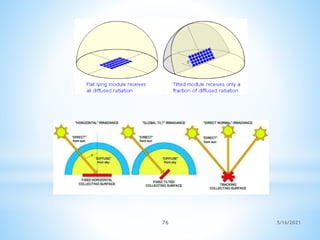
Beam radiation is the solar radiation received from the Sun without having
been scattered by the atmosphere. Diffuse radiation is that received from the
Sun after its direction has been changed by scattering by the atmosphere.
The total solar radiation is the sum of the beam (B) and
diffuse solar (D) radiation on a surface (Eq. 5.1). The
most common measurements of solar radiation are total
radiation on a horizontal surface, often referred to as
global radiation on the surface.
G= B+ D
5/16/2021
70
5/16/2021
71
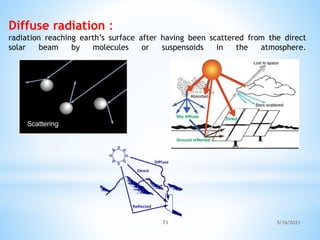
Diffuse radiation :
radiation reaching earth’s surface after having been scattered from the direct
solar beam by molecules or suspensoids in the atmosphere.
Global solar radiation
Ib
Ir
Id
flected
Diffuse
Beam
GlobalRadiation Re



5/16/2021
72
The path length of the solar radiation
through the Earth’s atmosphere in units
of Air Mass (AM) increases with the
angle from the zenith. The AM 1.5
spectrum is the preferred standard
spectrum for solar cell efficiency
measurements.
The easiest way to estimate the air
mass in practice is to measure the
length of the shadow s cast by a
vertical structure of height h using
AM  1 
h

 s2
Air Mass AM : The ratio of the mass of atmosphere through which beam radiation passes to
the mass it would pass through if the sun were at zenith (directly overhead).
At sea level, AM =1 when the sun is at zenith; AM = 2 for a zenith angle z of 60o.
For 0 < z < 70o AM= 1/cos z
5/16/2021
73
5/16/2021
74
5/16/2021
75
5/16/2021
76
Measurement of Solar Radiation
5/16/2021
77
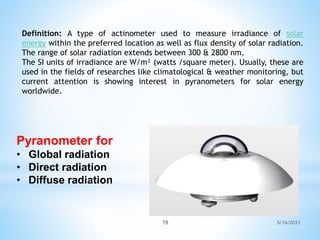
Pyranometer for
• Global radiation
• Direct radiation
• Diffuse radiation
Definition: A type of actinometer used to measure irradiance of solar
energy within the preferred location as well as flux density of solar radiation.
The range of solar radiation extends between 300 & 2800 nm.
The SI units of irradiance are W/m² (watts /square meter). Usually, these are
used in the fields of researches like climatological & weather monitoring, but
current attention is showing interest in pyranometers for solar energy
worldwide.
5/16/2021
78
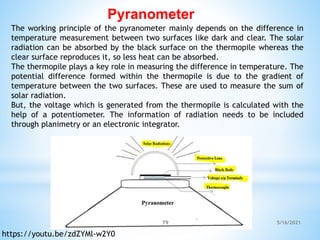
Pyranometer
https://youtu.be/zdZYMl-w2Y0
The working principle of the pyranometer mainly depends on the difference in
temperature measurement between two surfaces like dark and clear. The solar
radiation can be absorbed by the black surface on the thermopile whereas the
clear surface reproduces it, so less heat can be absorbed.
The thermopile plays a key role in measuring the difference in temperature. The
potential difference formed within the thermopile is due to the gradient of
temperature between the two surfaces. These are used to measure the sum of
solar radiation.
But, the voltage which is generated from the thermopile is calculated with the
help of a potentiometer. The information of radiation needs to be included
through planimetry or an electronic integrator.
5/16/2021
79
5/16/2021
80
The pyranometer advantages and disadvantages are
• The temperature coefficient is extremely small
• Standardized to ISO standards
• Measurements of performance ration & performance index are accurate.
• Response time is longer compare to PV cell
The disadvantage of the pyranometer is,
• its spectral sensitivity is imperfect, so it does not observe the complete
spectrum of the sun. So errors in measurements can occur.
The applications are
• The solar intensity data can be measured.
• Climatological & Meteorological studies
• PV systems design
• Locations of the greenhouse can be established.
• Expecting the requirements of insulation for building structures
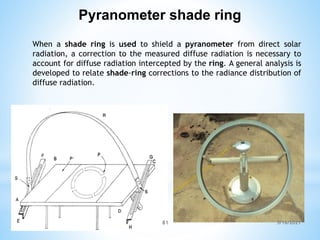
Pyranometer shade ring
When a shade ring is used to shield a pyranometer from direct solar
radiation, a correction to the measured diffuse radiation is necessary to
account for diffuse radiation intercepted by the ring. A general analysis is
developed to relate shade‐ring corrections to the radiance distribution of
diffuse radiation.
5/16/2021
81
Pyrheliometer
A pyrheliometer is an instrument for measurement of direct beam solar
irradiance. Sunlight enters the instrument through a window and is directed onto
a thermopile which converts heat to an electrical signal that can be recorded.
The signal voltage is converted via a formula to measure watts per square metre
5/16/2021
82
5/16/2021
83
5/16/2021
84
https://youtu.be/0ef2EWFR3RQ
5/16/2021
85

Non Conventional Energy Source, Introduction, Solar Radiation, and measurements

  • 1.
    Dr. Ramesh BT Assistant Prof, MED Jain Institute of Technology Davangere-577003 Mail ID: rameshbt049@gmail.com Phone No: 9900784915 5/16/2021 1
  • 2.
    Energy The word ‘energy’itself is derived from the Greek word which means ‘in-work’ or ‘work content’. The work output depends on the energy input. Energy can be defined as the ability to do work. Energy is measured in the same unit as work: joules (J). Energy is all around us. we can hear energy as sound. we can see energy as light and we can feel it as wind. The five main forms of energy are: Heat Chemical Electromagnetic Nuclear Mechanical 5/16/2021 2
  • 3.
    All forms ofenergy can be converted into other forms. The sun’s energy through solar cells can be converted directly into electricity. Green plants convert the sun’s energy (electromagnetic) into starches and sugars (chemical energy). In an electric motor, electromagnetic energy is converted to mechanical energy. In a battery, chemical energy is converted into electromagnetic energy. The mechanical energy of a waterfall is converted to electrical energy in a generator. All forms of energy can be in either of two states: Potential Kinetic 5/16/2021 3
  • 4.
    Kinetic Energy The energyof motion is called kinetic energy K.E. = mass x velocity Potential Energy Potential Energy is stored energy, Stored chemically in fuel, the nucleus of atom, and in foods. Or stored because of the work done on it: Stretching a rubber band. Winding a watch. Pulling back on a bow’s arrow. Lifting a brick high in the air. 5/16/2021 4
  • 5.
    Classification of energyresources: *Conventional/ Commercial *Non - Conventional *Renewable *Non – renewable *Primary resources *Intermediate resources *Secondary resources Conventional sources: Energy sources which are available in less amount and will one day be exhausted, are known as conventional sources of energy. E.g. fossil fuels Non - conventional sources: The energy sources which are renewable and can be regenerated are known as renewable or non-conventional sources of energy. As the population is increasing the energy consumption also is increasing. Hence we need such sources of energy which can be renewed from time to time and they can meet our needs regularly. 5/16/2021 5
  • 6.
  • 7.
    The different sourcesof energy are: 1. Fossil fuels 2. Biomass 3. Hydro power plant 4. Wind energy 5. Solar energy 6. Geothermal energy 7. Ocean thermal energy 8. Tidal energy 9. Wave energy 10.Nuclear energy 5/16/2021 7
  • 8.
    The need foralternatives: * The average rate of increase of oil production in the world is declining & a peak in production may be reached around 2015. There after the production will decline gradually & most of the oil reserves of the world are likely to be consumed by the end of the present century. The serious nature of this observation is apparent when one notes that oil provides about 30% of the world‘s need for energy from commercial sources & that oil is the fuel used in most of the world‘s transportation systems. * The production of natural gas is continuing to increase at a rate of about 4% every year. Unlike oil, there has been no significant slowdown in the rate of increase of production. Present indications are that a peak in gas production will come around 2025, about 10 years after the peak in oil production. * As oil & natural gas becomes scarcer, a great burden will fall on coal. It is likely that the production of coal will touch a maximum somewhere around 2050. * Finally, it should be noted that in addition to supplying energy, fossil fuels are used extensively as feed stock material for the manufacture of organic chemicals. As resources deplete, the need for using fossil fuels exclusively for such purposes may become greater. 5/16/2021 8
  • 9.
    need for non-conventionalenergy sources • CO2 is at 407ppm (Oct 2018) increased by 90ppm in the last 70 years • Global warming ~1.1°C in the past 200 years • Ocean acidification • Rising sea level ~3.2mm each year • Decreasing ice sheet mass • Retreating glaciers • Decreasing Arctic ice at a rate of 13% each decade NASA Youtube video showing planet warming https://www.youtube.com/watch?time_continue=9&v=s3RWTTtPg8E 5/16/2021 9
  • 10.
  • 11.
  • 12.
  • 13.
  • 14.
    Energy Production/consumption EnergyPercent source equivalent( in contribution 1015 J) Coal 310 Mt 8177 56.16 Oil 103.44 Mt 4331 29.75 Natural 27.860×10⁹ m3 1087 7.47 gas Water- 74362 GWh 765 5.25 power Nuclear 16621GWh 199 1.37 power Total 14559 100.00 5/16/2021 14
  • 15.
    Consumption trend ofprimary energy resources 5/16/2021 15
  • 16.
  • 17.
    1. Coal andLignite: 2. Oil and Gas: 3.Hydroelectric power: 4.Atomic or Nuclear Power: 5. Nuclear Power 5/16/2021 17
  • 18.
    SALIENT FEATURES OFNON-CONVENTIONAL ENERGY RESOURCES Merits: * NCES are available in nature, free of cost. * They cause no or very little pollution. Thus, by and large, they are environmental friendly. * They are inexhaustible. * They have low gestation period. Demerits: * Though available freely in nature, the cost of harnessing energy from NCES is high, as in general, these are available in dilute forms of energy. * Uncertainty of availability: the energy flow depends on various natural phenomena beyond human control. * Difficulty in transporting this form of energy. 5/16/2021 18
  • 19.
    ADVANTAGES & DISADVANTAGESOF CONVENTIONAL ENERGY RESOURCES: ADVANTAGES: • Coal: as present is cheap. • Security: by storing certain quantity, the energy availability can be ensured for a certain period. • Convenience: it is very convenient to use. DISADVANTAGES: • Fossil fuels generate pollutants: CO, CO2, NOX, SOX. Particulate matter & heat. The pollutants degrade the environment, pose health hazards & cause various other problems. • Coal: it is also valuable petro-chemical & used as source of raw material for chemical & paints, industries, etc. From long term point of view, it is desirable to conserve coal for future needs. • Safety of nuclear plants: it is a controversial subject. • Hydro electrical plants are cleanest but large hydro reservoirs cause the following problems • As large land area submerges into water, which leads to deforestation Causes ecological disturbances such as earthquakes • Causes dislocation of large population & consequently their rehabilitation problems. 5/16/2021 19
  • 20.
    Solar energy isa very large, inexhaustible source of energy. 5/16/2021 20
  • 21.
  • 22.
    Merits of solarenergy: Demerits of solar energy: Solar applications: 5/16/2021 22
  • 23.
  • 24.
  • 25.
  • 26.
  • 27.
  • 28.
  • 29.
  • 30.
  • 31.
    5/16/2021 31 https://youtu.be/BsojDI7tQm0 Biomass energy isenergy generated or produced by living or once-living organisms. ... Biomass is organic, meaning it is made of material that comes from living organisms, such as plants and animals. The most common biomass materials used for energy are plants, wood, and waste.
  • 32.
  • 33.
    5/16/2021 33 https://youtu.be/IASV8IH-ytE Ocean thermal energyconversion (OTEC) is a process or technology for producing energy by harnessing the temperature differences (thermal gradients) between ocean surface waters and deep ocean waters
  • 34.
    he temperature ofthe ocean also varies from top to bottom, giving a vertical structure to most of the ocean. There is an upper layer of water, up to 200m deep, that is warmed by the Sun and has the same temperature from top to bottom. Below that is a layer called the thermocline, reaching down in places to 1000m, which is colder at the bottom than at the top. The deep ocean below the thermocline, making up 80% of the ocean, is the same very cold temperature throughout Some properties of water change with temperature: • Cold water is denser than warm water, so it tends to sink. • Cold water holds more dissolvable gases, such as carbon dioxide • Water temperature can affect the productivity of organisms living in it. Water expands when it warms up – heat energy makes its molecules move around more and take up more space. Because the molecules are more spread out, the density goes down. When water cools, it contracts and becomes denser. Temperature and salinity both affect the density of water, resulting in water moving up or down through the ocean layers and moving as currents around the ocean. 5/16/2021 34
  • 35.
  • 36.
    Applications: used turbines toproduce electricity. 5/16/2021 36
  • 37.
    5/16/2021 37 Tidal energy isenergy produced by the tides of the ocean. Tides are produced by the pull of gravity from the Moon as well as the spin of the Earth. There is a lot of energy in the movement of that much water. The first wave power plant in the world opened in 2008 at the Farm in Portugal. Tidal power to turn water wheels and grind grains was used as far back as Roman times and the Middle Ages. The idea of using tidal power for electricity is fairly recent, but the costs have been too high to make it a major energy source. Recent technological advances have shown that it could become a competitive and viable source. Oscillating Water Column (OWC)
  • 38.
    5/16/2021 38 The Pivoting FlapDevice Tidal Turbines Tidal Barrages https://youtu.be/VkTRcTyDSyk https://youtu.be/gcStpg3i5V8
  • 39.
    5/16/2021 39 Some advantages oftidal energy are: • Environment-friendly • A highly predictable energy source • High energy density • Operational and maintenance costs are low • An inexhaustible source of energy Some of the disadvantages of tidal energy are: • High tidal power plant construction costs • Negative influence on marine life forms • Location limits • The variable intensity of sea waves
  • 40.
    5/16/2021 40 Geothermal energy isheat within the earth. https://youtu.be/mCRDf7QxjDk
  • 41.
  • 42.
  • 43.
    5/16/2021 43 Oil shale isa fine-grained sedimentary rock containing large amounts of organic matter (kerogen), which can yield substantial quantities of hydrocarbons. Tar sands are grains of sand or, in some cases, porous carbonate rocks that are intimately mixed with a very heavy, asphalt-like crude oil called bitumen.
  • 44.
    5/16/2021 44 oil shale containsabout 4% kerogen. When heated to 350-400 °C, it yields about 6 gallons of oil per ton of shale. Rich shale may contain up to 40% kerogen and typically yields about 50 gallons of oil per ton. Oil is then recovered from the shale by retorting the shale. Retorting involves heating the shale in the absence of air to temperatures of 500 °C or more. Typically, 75-80% of the kerogen is converted to oil. https://youtu.be/Dx1jOD-V8mc
  • 45.
    5/16/2021 45 The bitumen ismuch too viscous to be recovered by traditional petroleum recovery techniques. If tar sand is heated to about 80 °C, by injecting steam into the deposit in a manner analogous to that of enhanced oil recovery, the elevated temperature causes a decrease in the viscosity of the bitumen just enough to allow its pumping to the surface. Alternatively, it is sometimes easier to mine the tar sand as a solid material. When the mined tar sand is mixed with steam and hot water, the bitumen will float on the water while the sand sinks to the bottom of the container, allowing for easy separation. Heating the bitumen above 500 °C converts about 70% of it to a synthetic crude oil. Distilling this oil gives good yields of kerosene and other liquid products in the middle distillate range. The remainder of the bitumen either thermally cracks to form gaseous products or reacts to form petroleum coke
  • 46.
  • 47.
    5/16/2021 47 Nuclear power isthe use of nuclear reactions to produce electricity. Nuclear power can be obtained from nuclear fission, nuclear decay and nuclear fusion reactions.
  • 48.
  • 49.
  • 50.
    Dr. Ramesh BT Assistant Prof, MED Jain Institute of Technology Davangere-577003 Mail ID: rameshbt049@gmail.com Phone No: 9900784915 5/16/2021 50
  • 51.
  • 52.
    The solar constant,GSC is the energy from the sun, per unit time, received on a unit area of surface perpendicular to the direction of propagation of the radiation, at mean earth-sun distance, outside of the atmosphere. Earth’s elliptic orbit The elliptical path causes only small variations in the amount of solar radiation reaching the earth. 5/16/2021 52
  • 53.
  • 54.
    *3 factors contributeto the amount of incoming solar radiation (insolation): 1) Period of daylight 5/16/2021 54
  • 55.
    * Vernal and autumnalequinox 5/16/2021 55
  • 56.
  • 57.
  • 58.
  • 59.
  • 60.
  • 61.
  • 62.
    The Earth isa planet with an atmosphere and is largely transparent to the incoming solar radiation. There are constituents in the atmosphere which prevent some kinds of radiation from reaching the surface, such as ozone which stops the ultraviolet. A fair proportion of the Earth is covered by clouds which reflect a lot of the Sun's radiation and thus affecting the surface temperature. The process of scattering occurs when small particles and gas molecules diffuse part of the incoming solar radiation in random directions without any alteration to the  of the electromagnetic energy. Scattering does, however, reduce the amount of incoming radiation reaching the Earth's surface. A significant proportion of scattered shortwave solar radiation is redirected back to space. The amount of scattering that takes place is dependent on two factors:  of the incoming radiation and the size of the scattering particle or gas molecule. In the Earth's atmosphere, the presence of a large number of particles with a size of about 0.5 m results in shorter wavelengths being preferentially scattered. This factor also causes our sky to look blue because this color corresponds to those wavelengths that are best diffused. If scattering did not occur in our atmosphere the daylight sky would be black. 5/16/2021 62
  • 63.
    If intercepted, somegases and particles in the atmosphere have the ability to absorb incoming insolation. Absorption is defined as a process in which solar radiation is retained by a substance and converted into heat. The creation of heat also causes the substance to emit its own radiation. In general, the absorption of solar radiation by substances in the Earth's atmosphere results in temperatures that get no higher than 1800° C. Bodies with temperatures at this level or lower would emit their radiation in the longwave band. Further, this emission of radiation is in all directions so a sizable proportion of this energy is lost to space. The third process in the atmosphere that modifies incoming solar radiation is reflection. Reflection is a process where sunlight is redirect by 180° after it strikes an atmospheric particle. This redirection causes a 100 % loss of the insolation. Most of the reflection in our atmosphere occurs in clouds when light is intercepted by particles of liquid and frozen water. The reflectivity (albedo) of a cloud can range from 40 to 90 %. 5/16/2021 63
  • 64.
    At the smallestscale the electromagnetic radiation behaves as a particle, like when light is emitted by a single atom or molecule. When energy is given off there is a change in the orbital pattern of the electrons that surround the nucleus of an atom. As the orbit changes, a bundle of energy called a "photon" is released. However, particles of light differ from particles of matter: they have no mass, occupy no space, and travel at the speed of light. The amount of energy carried by a photon varies inversely with wavelength, the shorter the wavelength the more energetic is the photon. Normally, light is formed from a large number of photons, with the intensity related to the number of them. The gasses that comprise our atmosphere absorbs only particular wavelengths of light. Electrons orbit the nucleus of an atom at fixed orbital distances called orbital shells. The orbital shell for each atom is different and discrete. That is, for a given atom like hydrogen, its electrons can only orbit at particular distances and are different than those for atoms of other gases. 5/16/2021 64
  • 65.
    5/16/2021 65 Sun is asphere of hot gaseous matter with a diameter of 1.39*10^9m. Due to its temperature, sun emits energy in the form of electromagnetic waves, which is called radiation energy. The energy from the sun is X-ffered to the earth in the form of photons (Small packet of energy) moving at the speed of 3*10^8 m/s. When Photon energy- absorption (metal)- Heat energy .When Photon energy- absorption (Plant)- (Photon energy combine with O2)Chemical energy. The heat energy received on the earth through photons is responsible foe earth’s temperature. The amount of solar radiation reaching different parts of the world is not the same .
  • 66.
    5/16/2021 66 Extraterrestrial Radiation: The extraterrestrialradiation refers to the amount of radiation falling on earth, outside its atmosphere. The extraterrestrial solar radiation received by the earth is essentially constant. The solar constant, a measure of flux, is the amount of incoming solar electromagnetic radiation per unit area that would be incident on a plane perpendicular to the rays, at a distance of one astronomical unit (AU) (roughly the mean distance from the Sun to the Earth). Solar radiation incident outside the earth's atmosphere is called extraterrestrial radiation. On average the extraterrestrial irradiance is 1367 W/m2. This value varies by ±3% as the earth orbits the sun.
  • 67.
  • 68.
    5/16/2021 68 Solar Radiation atthe Earth's Surface While the solar radiation incident on the Earth's atmosphere is relatively constant, the radiation at the Earth's surface varies widely due to: • atmospheric effects, including absorption and scattering; • local variations in the atmosphere, such as water vapour, clouds, and pollution; • latitude of the location; and • the season of the year and the time of day. The above effects have several impacts on the solar radiation received at the Earth's surface. These changes include variations in the overall power received, the spectral content of the light and the angle from which light is incident on a surface. In addition, a key change is that the variability of the solar radiation at a particular location increases dramatically. The variability is due to both local effects such as clouds and seasonal variations, as well as other effects such as the length of the day at a particular latitude. Desert regions tend to have lower variations due to local atmospheric phenomena such as clouds. Equatorial regions have low variability between seasons.
  • 69.
  • 70.
    equator  90o  Beam radiation isthe solar radiation received from the Sun without having been scattered by the atmosphere. Diffuse radiation is that received from the Sun after its direction has been changed by scattering by the atmosphere. The total solar radiation is the sum of the beam (B) and diffuse solar (D) radiation on a surface (Eq. 5.1). The most common measurements of solar radiation are total radiation on a horizontal surface, often referred to as global radiation on the surface. G= B+ D 5/16/2021 70
  • 71.
    5/16/2021 71 Diffuse radiation : radiationreaching earth’s surface after having been scattered from the direct solar beam by molecules or suspensoids in the atmosphere.
  • 72.
  • 73.
    The path lengthof the solar radiation through the Earth’s atmosphere in units of Air Mass (AM) increases with the angle from the zenith. The AM 1.5 spectrum is the preferred standard spectrum for solar cell efficiency measurements. The easiest way to estimate the air mass in practice is to measure the length of the shadow s cast by a vertical structure of height h using AM  1  h   s2 Air Mass AM : The ratio of the mass of atmosphere through which beam radiation passes to the mass it would pass through if the sun were at zenith (directly overhead). At sea level, AM =1 when the sun is at zenith; AM = 2 for a zenith angle z of 60o. For 0 < z < 70o AM= 1/cos z 5/16/2021 73
  • 74.
  • 75.
  • 76.
  • 77.
    Measurement of SolarRadiation 5/16/2021 77
  • 78.
    Pyranometer for • Globalradiation • Direct radiation • Diffuse radiation Definition: A type of actinometer used to measure irradiance of solar energy within the preferred location as well as flux density of solar radiation. The range of solar radiation extends between 300 & 2800 nm. The SI units of irradiance are W/m² (watts /square meter). Usually, these are used in the fields of researches like climatological & weather monitoring, but current attention is showing interest in pyranometers for solar energy worldwide. 5/16/2021 78
  • 79.
    Pyranometer https://youtu.be/zdZYMl-w2Y0 The working principleof the pyranometer mainly depends on the difference in temperature measurement between two surfaces like dark and clear. The solar radiation can be absorbed by the black surface on the thermopile whereas the clear surface reproduces it, so less heat can be absorbed. The thermopile plays a key role in measuring the difference in temperature. The potential difference formed within the thermopile is due to the gradient of temperature between the two surfaces. These are used to measure the sum of solar radiation. But, the voltage which is generated from the thermopile is calculated with the help of a potentiometer. The information of radiation needs to be included through planimetry or an electronic integrator. 5/16/2021 79
  • 80.
    5/16/2021 80 The pyranometer advantagesand disadvantages are • The temperature coefficient is extremely small • Standardized to ISO standards • Measurements of performance ration & performance index are accurate. • Response time is longer compare to PV cell The disadvantage of the pyranometer is, • its spectral sensitivity is imperfect, so it does not observe the complete spectrum of the sun. So errors in measurements can occur. The applications are • The solar intensity data can be measured. • Climatological & Meteorological studies • PV systems design • Locations of the greenhouse can be established. • Expecting the requirements of insulation for building structures
  • 81.
    Pyranometer shade ring Whena shade ring is used to shield a pyranometer from direct solar radiation, a correction to the measured diffuse radiation is necessary to account for diffuse radiation intercepted by the ring. A general analysis is developed to relate shade‐ring corrections to the radiance distribution of diffuse radiation. 5/16/2021 81
  • 82.
    Pyrheliometer A pyrheliometer isan instrument for measurement of direct beam solar irradiance. Sunlight enters the instrument through a window and is directed onto a thermopile which converts heat to an electrical signal that can be recorded. The signal voltage is converted via a formula to measure watts per square metre 5/16/2021 82
  • 83.
  • 84.
  • 85.