PREPARED BY: DIVYA DEVADAS (BAMS 2nd YEAR)
Leaf Study
LEAF DEFENITION
Leaves are thin and flat lateral
outgrowths from stem nodes
They are the vegetative organs of a plant
body
Produced from a superficial
Meristematic tissue called leaf primordia
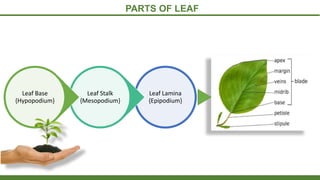
PARTS OF LEAF
Leaf Lamina
{Epipodium}
Leaf Stalk
{Mesopodium}
Leaf Base
{Hypopodium}
LEAF BASE
.
• The Initial Part of Leaf, that attaches to the Stem
.
• AXIL: The Upper Angle between the leaf base & Stem
.
• PULVINUS: Leaf base is Swollen (Sometimes)
.
• Such Leaves with Pulvinus is Pulvinate Leaves
LEAF STALK
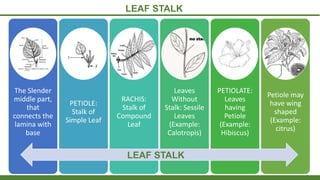
The Slender
middle part,
that
connects the
lamina with
base
PETIOLE:
Stalk of
Simple Leaf
RACHIS:
Stalk of
Compound
Leaf
Leaves
Without
Stalk: Sessile
Leaves
(Example:
Calotropis)
PETIOLATE:
Leaves
having
Petiole
(Example:
Hibiscus)
Petiole may
have wing
shaped
(Example:
citrus)
LEAF STALK
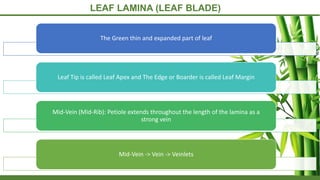
LEAF LAMINA (LEAF BLADE)
The Green thin and expanded part of leaf
Leaf Tip is called Leaf Apex and The Edge or Boarder is called Leaf Margin
Mid-Vein (Mid-Rib): Petiole extends throughout the length of the lamina as a
strong vein
Mid-Vein -> Vein -> Veinlets
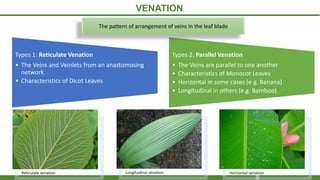
VENATION
Types 1: Reticulate Venation
• The Veins and Veinlets from an anastomosing
network
• Characteristics of Dicot Leaves
Types 2: Parallel Venation
• The Veins are parallel to one another
• Characteristics of Monocot Leaves
• Horizontal in some cases (e.g. Banana)
• Longitudinal in others (e.g. Bamboo)
The pattern of arrangement of veins in the leaf blade
Longitudinal venation Horizontal venationReticulate venation
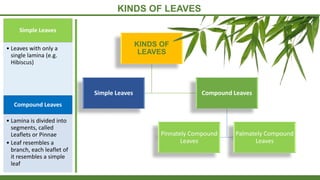
KINDS OF LEAVES
Simple Leaves
• Leaves with only a
single lamina (e.g.
Hibiscus)
Compound Leaves
• Lamina is divided into
segments, called
Leaflets or Pinnae
• Leaf resembles a
branch, each leaflet of
it resembles a simple
leaf
KINDS OF
LEAVES
Simple Leaves Compound Leaves
Pinnately Compound
Leaves
Palmately Compound
Leaves
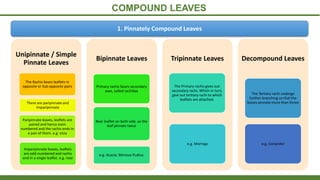
COMPOUND LEAVES
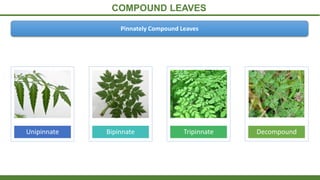
1. Pinnately Compound Leaves
Unipinnate / Simple
Pinnate Leaves
The Rachis bears leaflets in
opposite or Sub opposite pairs
There are paripinnate and
Imparipinnate
Paripinnate leaves, leaflets are
paired and hence even
numbered and the rachis ends in
a pair of them. e.g. vicia
Imparipinnate leaves, leaflets
are odd-numbered and rachis
end in a single leaflet. e.g. rose
Bipinnate Leaves
Primary rachis bears secondary
axes, called rachillae
Bear leaflet on both side, so the
leaf pinnate twice
e.g. Acacia, Mimosa Pudica.
Tripinnate Leaves
The Primary rachis gives out
secondary rachi, Which in turn,
give out tertiary rachi to which
leaflets are attached.
e.g. Moringa
Decompound Leaves
The Tertiary rachi undergo
further branching so that the
leaves pinnate more than thrice
e.g. Coriander
COMPOUND LEAVES
Pinnately Compound Leaves
Unipinnate Bipinnate Tripinnate Decompound
COMPOUND LEAVES
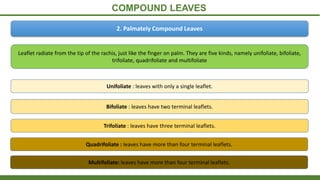
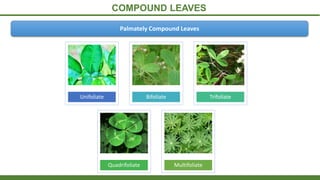
2. Palmately Compound Leaves
Leaflet radiate from the tip of the rachis, just like the finger on palm. They are five kinds, namely unifoliate, bifoliate,
trifoliate, quadrifoliate and multifoliate
Unifoliate : leaves with only a single leaflet.
Bifoliate : leaves have two terminal leaflets.
Trifoliate : leaves have three terminal leaflets.
Quadrifoliate : leaves have more than four terminal leaflets.
Multifoliate: leaves have more than four terminal leaflets.
COMPOUND LEAVES
Palmately Compound Leaves
Unifoliate Bifoliate Trifoliate
Quadrifoliate Multifoliate
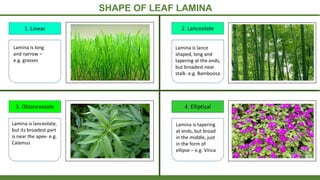
SHAPE OF LEAF LAMINA
1. Linear 2. Lanceolate
3. Oblanceolate 4. Elliptical
Lamina
Lamina is long
and narrow –
e.g. grasses
Lamina is lance
shaped, long and
tapering at the ends,
but broadest near
stalk- e.g. Bamboosa
Lamina is lanceolate,
but its broadest part
is near the apex- e.g.
Calamus
Lamina is tapering
at ends, but broad
in the middle, just
in the form of
ellipse – e.g. Vinca
SHAPE OF LEAF LAMINA
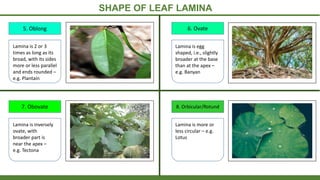
5. Oblong 6. Ovate
7. Obovate 8. Orbicular/Rotund
Lamina is 2 or 3
times as long as its
broad, with its sides
more or less parallel
and ends rounded –
e.g. Plantain
Lamina is egg
shaped, i.e., slightly
broader at the base
than at the apex –
e.g. Banyan
Lamina is inversely
ovate, with
broader part is
near the apex –
e.g. Tectona
Lamina is more or
less circular – e.g.
Lotus
SHAPE OF LEAF LAMINA
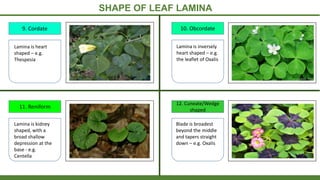
9. Cordate 10. Obcordate
11. Reniform
12. Cuneate/Wedge
shaped
Lamina is heart
shaped – e.g.
Thespesia
Lamina is inversely
heart shaped – e.g.
the leaflet of Oxalis
Lamina is kidney
shaped, with a
broad shallow
depression at the
base - e.g.
Centella
Blade is broadest
beyond the middle
and tapers straight
down – e.g. Oxalis
SHAPE OF LEAF LAMINA
13. Deltoid 14. Sagittate
15. Falcate or Sickle
Shaped
16. Oblique
Lamina is broadly
cuneate – e.g.
Abutilon
Lamina is shaped
like a arrow head,
with two sharp and
straight lobes at the
base- e.g. Sagittaria
and Arum
Lamina is curved
sideways – e.g. adult
leaves of Eucalyptus
Right and the left
halves of the blade
are not symmetrical
– e.g. Begonia and
Guazuma
SHAPE OF LEAF LAMINA
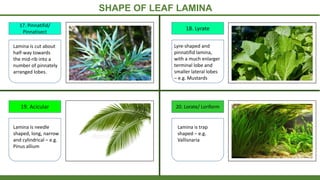
17. Pinnatifid/
Pinnatisect
18. Lyrate
19. Acicular 20. Lorate/ Loriform
Lamina is cut about
half-way towards
the mid-rib into a
number of pinnately
arranged lobes.
Lyre-shaped and
pinnatifid lamina,
with a much enlarger
terminal lobe and
smaller lateral lobes
– e.g. Mustards
Lamina is needle
shaped, long, narrow
and cylindrical – e.g.
Pinus allium
Lamina is trap
shaped – e.g.
Vallisnaria
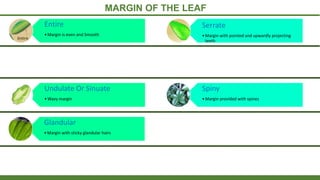
MARGIN OF THE LEAF
Entire
•Margin is even and Smooth
Serrate
•Margin with pointed and upwardly projecting
teeth
Glandular
•Margin with sticky glandular hairs
Undulate Or Sinuate
•Wavy margin
Spiny
•Margin provided with spines
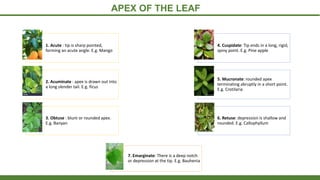
APEX OF THE LEAF
1. Acute : tip is sharp pointed,
forming an acute angle. E.g. Mango
2. Acuminate : apex is drawn out into
a long slender tail. E.g. ficus
3. Obtuse : blunt or rounded apex.
E.g. Banyan
4. Cuspidate: Tip ends in a long, rigid,
spiny point. E.g. Pine apple
5. Mucronate: rounded apex
terminating abruptly in a short point.
E.g. Crotilaria
6. Retuse: depression is shallow and
rounded. E.g. Callophyllum
7. Emarginate: There is a deep notch
or depression at the tip. E.g. Bauhenia
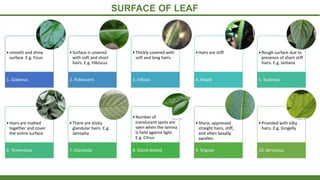
SURFACE OF LEAF
•smooth and shiny
surface. E.g. Ficus
1. Glabrous
•Surface is covered
with soft and short
hairs. E.g. Hibiscus
2. Pubescent
•Thickly covered with
soft and long hairs.
3. Villous
•Hairs are stiff.
4. Hispid
•Rough surface due to
presence of short stiff
hairs. E.g. lantana
5. Scabrous
•Hairs are matted
together and cover
the entire surface.
6. Tomentosa
•There are sticky
glandular hairs. E.g.
Jatropha
7. Glandular
•Number of
translucent spots are
seen when the lamina
is held against light.
E.g. Citrus
8. Gland dotted
•Sharp, appressed
straight hairs, stiff,
and often basally
swollen.
9. Srigose
•Provided with silky
hairs. E.g. Gingelly
10. Sericeous
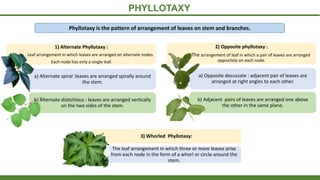
PHYLLOTAXY
3) Whorled Phyllotaxy:
The leaf arrangement in which three or more leaves arise
from each node in the form of a whorl or circle around the
stem.
2) Opposite phyllotaxy :
The arrangement of leaf in which a pair of leaves are arranged
oppositely on each node.
a) Opposite decussate : adjacent pair of leaves are
arranged at right angles to each other.
b) Adjacent pairs of leaves are arranged one above
the other in the same plane.
1) Alternate Phyllotaxy :
Leaf arrangement in which leaves are arranged on alternate nodes.
Each node has only a single leaf.
a) Alternate spiral :leaves are arranged spirally around
the stem.
b) Alternate distichious : leaves are arranged vertically
on the two sides of the stem.
Phyllotaxy is the pattern of arrangement of leaves on stem and branches.
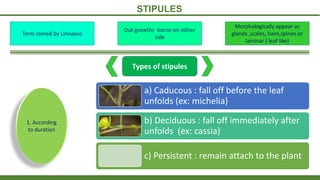
STIPULES
Term coined by Linnaeus
Out growths borne on either
side
Morphologically appear as
glands ,scales, hairs,spines or
laminar ( leaf like)
Types of stipules
a) Caducous : fall off before the leaf
unfolds (ex: michelia)
b) Deciduous : fall off immediately after
unfolds (ex: cassia)
c) Persistent : remain attach to the plant
1. According
to duration
STIPULES
2. According
to shape,
size &
position
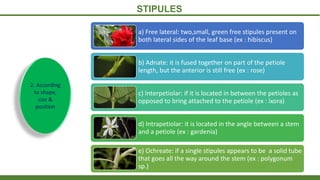
a) Free lateral: two,small, green free stipules present on
both lateral sides of the leaf base (ex : hibiscus)
b) Adnate: it is fused together on part of the petiole
length, but the anterior is still free (ex : rose)
c) Interpetiolar: if it is located in between the petioles as
opposed to bring attached to the petiole (ex : ixora)
d) Intrapetiolar: it is located in the angle between a stem
and a petiole (ex : gardenia)
e) Ochreate: if a single stipules appears to be a solid tube
that goes all the way around the stem (ex : polygonum
sp.)
STIPULES
2. According
to shape,
size &
position
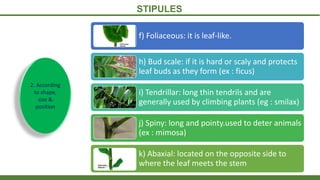
f) Foliaceous: it is leaf-like.
h) Bud scale: if it is hard or scaly and protects
leaf buds as they form (ex : ficus)
i) Tendrillar: long thin tendrils and are
generally used by climbing plants (eg : smilax)
j) Spiny: long and pointy.used to deter animals
(ex : mimosa)
k) Abaxial: located on the opposite side to
where the leaf meets the stem
T H A N K Y O U

Leaf presentation - Botony

  • 1.
    PREPARED BY: DIVYADEVADAS (BAMS 2nd YEAR) Leaf Study
  • 2.
    LEAF DEFENITION Leaves arethin and flat lateral outgrowths from stem nodes They are the vegetative organs of a plant body Produced from a superficial Meristematic tissue called leaf primordia
  • 3.
    PARTS OF LEAF LeafLamina {Epipodium} Leaf Stalk {Mesopodium} Leaf Base {Hypopodium}
  • 4.
    LEAF BASE . • TheInitial Part of Leaf, that attaches to the Stem . • AXIL: The Upper Angle between the leaf base & Stem . • PULVINUS: Leaf base is Swollen (Sometimes) . • Such Leaves with Pulvinus is Pulvinate Leaves
  • 5.
    LEAF STALK The Slender middlepart, that connects the lamina with base PETIOLE: Stalk of Simple Leaf RACHIS: Stalk of Compound Leaf Leaves Without Stalk: Sessile Leaves (Example: Calotropis) PETIOLATE: Leaves having Petiole (Example: Hibiscus) Petiole may have wing shaped (Example: citrus) LEAF STALK
  • 6.
    LEAF LAMINA (LEAFBLADE) The Green thin and expanded part of leaf Leaf Tip is called Leaf Apex and The Edge or Boarder is called Leaf Margin Mid-Vein (Mid-Rib): Petiole extends throughout the length of the lamina as a strong vein Mid-Vein -> Vein -> Veinlets
  • 7.
    VENATION Types 1: ReticulateVenation • The Veins and Veinlets from an anastomosing network • Characteristics of Dicot Leaves Types 2: Parallel Venation • The Veins are parallel to one another • Characteristics of Monocot Leaves • Horizontal in some cases (e.g. Banana) • Longitudinal in others (e.g. Bamboo) The pattern of arrangement of veins in the leaf blade Longitudinal venation Horizontal venationReticulate venation
  • 8.
    KINDS OF LEAVES SimpleLeaves • Leaves with only a single lamina (e.g. Hibiscus) Compound Leaves • Lamina is divided into segments, called Leaflets or Pinnae • Leaf resembles a branch, each leaflet of it resembles a simple leaf KINDS OF LEAVES Simple Leaves Compound Leaves Pinnately Compound Leaves Palmately Compound Leaves
  • 9.
    COMPOUND LEAVES 1. PinnatelyCompound Leaves Unipinnate / Simple Pinnate Leaves The Rachis bears leaflets in opposite or Sub opposite pairs There are paripinnate and Imparipinnate Paripinnate leaves, leaflets are paired and hence even numbered and the rachis ends in a pair of them. e.g. vicia Imparipinnate leaves, leaflets are odd-numbered and rachis end in a single leaflet. e.g. rose Bipinnate Leaves Primary rachis bears secondary axes, called rachillae Bear leaflet on both side, so the leaf pinnate twice e.g. Acacia, Mimosa Pudica. Tripinnate Leaves The Primary rachis gives out secondary rachi, Which in turn, give out tertiary rachi to which leaflets are attached. e.g. Moringa Decompound Leaves The Tertiary rachi undergo further branching so that the leaves pinnate more than thrice e.g. Coriander
  • 10.
    COMPOUND LEAVES Pinnately CompoundLeaves Unipinnate Bipinnate Tripinnate Decompound
  • 11.
    COMPOUND LEAVES 2. PalmatelyCompound Leaves Leaflet radiate from the tip of the rachis, just like the finger on palm. They are five kinds, namely unifoliate, bifoliate, trifoliate, quadrifoliate and multifoliate Unifoliate : leaves with only a single leaflet. Bifoliate : leaves have two terminal leaflets. Trifoliate : leaves have three terminal leaflets. Quadrifoliate : leaves have more than four terminal leaflets. Multifoliate: leaves have more than four terminal leaflets.
  • 12.
    COMPOUND LEAVES Palmately CompoundLeaves Unifoliate Bifoliate Trifoliate Quadrifoliate Multifoliate
  • 13.
    SHAPE OF LEAFLAMINA 1. Linear 2. Lanceolate 3. Oblanceolate 4. Elliptical Lamina Lamina is long and narrow – e.g. grasses Lamina is lance shaped, long and tapering at the ends, but broadest near stalk- e.g. Bamboosa Lamina is lanceolate, but its broadest part is near the apex- e.g. Calamus Lamina is tapering at ends, but broad in the middle, just in the form of ellipse – e.g. Vinca
  • 14.
    SHAPE OF LEAFLAMINA 5. Oblong 6. Ovate 7. Obovate 8. Orbicular/Rotund Lamina is 2 or 3 times as long as its broad, with its sides more or less parallel and ends rounded – e.g. Plantain Lamina is egg shaped, i.e., slightly broader at the base than at the apex – e.g. Banyan Lamina is inversely ovate, with broader part is near the apex – e.g. Tectona Lamina is more or less circular – e.g. Lotus
  • 15.
    SHAPE OF LEAFLAMINA 9. Cordate 10. Obcordate 11. Reniform 12. Cuneate/Wedge shaped Lamina is heart shaped – e.g. Thespesia Lamina is inversely heart shaped – e.g. the leaflet of Oxalis Lamina is kidney shaped, with a broad shallow depression at the base - e.g. Centella Blade is broadest beyond the middle and tapers straight down – e.g. Oxalis
  • 16.
    SHAPE OF LEAFLAMINA 13. Deltoid 14. Sagittate 15. Falcate or Sickle Shaped 16. Oblique Lamina is broadly cuneate – e.g. Abutilon Lamina is shaped like a arrow head, with two sharp and straight lobes at the base- e.g. Sagittaria and Arum Lamina is curved sideways – e.g. adult leaves of Eucalyptus Right and the left halves of the blade are not symmetrical – e.g. Begonia and Guazuma
  • 17.
    SHAPE OF LEAFLAMINA 17. Pinnatifid/ Pinnatisect 18. Lyrate 19. Acicular 20. Lorate/ Loriform Lamina is cut about half-way towards the mid-rib into a number of pinnately arranged lobes. Lyre-shaped and pinnatifid lamina, with a much enlarger terminal lobe and smaller lateral lobes – e.g. Mustards Lamina is needle shaped, long, narrow and cylindrical – e.g. Pinus allium Lamina is trap shaped – e.g. Vallisnaria
  • 18.
    MARGIN OF THELEAF Entire •Margin is even and Smooth Serrate •Margin with pointed and upwardly projecting teeth Glandular •Margin with sticky glandular hairs Undulate Or Sinuate •Wavy margin Spiny •Margin provided with spines
  • 19.
    APEX OF THELEAF 1. Acute : tip is sharp pointed, forming an acute angle. E.g. Mango 2. Acuminate : apex is drawn out into a long slender tail. E.g. ficus 3. Obtuse : blunt or rounded apex. E.g. Banyan 4. Cuspidate: Tip ends in a long, rigid, spiny point. E.g. Pine apple 5. Mucronate: rounded apex terminating abruptly in a short point. E.g. Crotilaria 6. Retuse: depression is shallow and rounded. E.g. Callophyllum 7. Emarginate: There is a deep notch or depression at the tip. E.g. Bauhenia
  • 20.
    SURFACE OF LEAF •smoothand shiny surface. E.g. Ficus 1. Glabrous •Surface is covered with soft and short hairs. E.g. Hibiscus 2. Pubescent •Thickly covered with soft and long hairs. 3. Villous •Hairs are stiff. 4. Hispid •Rough surface due to presence of short stiff hairs. E.g. lantana 5. Scabrous •Hairs are matted together and cover the entire surface. 6. Tomentosa •There are sticky glandular hairs. E.g. Jatropha 7. Glandular •Number of translucent spots are seen when the lamina is held against light. E.g. Citrus 8. Gland dotted •Sharp, appressed straight hairs, stiff, and often basally swollen. 9. Srigose •Provided with silky hairs. E.g. Gingelly 10. Sericeous
  • 21.
    PHYLLOTAXY 3) Whorled Phyllotaxy: Theleaf arrangement in which three or more leaves arise from each node in the form of a whorl or circle around the stem. 2) Opposite phyllotaxy : The arrangement of leaf in which a pair of leaves are arranged oppositely on each node. a) Opposite decussate : adjacent pair of leaves are arranged at right angles to each other. b) Adjacent pairs of leaves are arranged one above the other in the same plane. 1) Alternate Phyllotaxy : Leaf arrangement in which leaves are arranged on alternate nodes. Each node has only a single leaf. a) Alternate spiral :leaves are arranged spirally around the stem. b) Alternate distichious : leaves are arranged vertically on the two sides of the stem. Phyllotaxy is the pattern of arrangement of leaves on stem and branches.
  • 22.
    STIPULES Term coined byLinnaeus Out growths borne on either side Morphologically appear as glands ,scales, hairs,spines or laminar ( leaf like) Types of stipules a) Caducous : fall off before the leaf unfolds (ex: michelia) b) Deciduous : fall off immediately after unfolds (ex: cassia) c) Persistent : remain attach to the plant 1. According to duration
  • 23.
    STIPULES 2. According to shape, size& position a) Free lateral: two,small, green free stipules present on both lateral sides of the leaf base (ex : hibiscus) b) Adnate: it is fused together on part of the petiole length, but the anterior is still free (ex : rose) c) Interpetiolar: if it is located in between the petioles as opposed to bring attached to the petiole (ex : ixora) d) Intrapetiolar: it is located in the angle between a stem and a petiole (ex : gardenia) e) Ochreate: if a single stipules appears to be a solid tube that goes all the way around the stem (ex : polygonum sp.)
  • 24.
    STIPULES 2. According to shape, size& position f) Foliaceous: it is leaf-like. h) Bud scale: if it is hard or scaly and protects leaf buds as they form (ex : ficus) i) Tendrillar: long thin tendrils and are generally used by climbing plants (eg : smilax) j) Spiny: long and pointy.used to deter animals (ex : mimosa) k) Abaxial: located on the opposite side to where the leaf meets the stem
  • 25.
    T H AN K Y O U