Principle of NMR Shielding and deshielding Effect
with examples
GAVIN PEREIRA
NU24PHPY06
DEPT. OF PHARMACOLOGY
INTRODUCTION
• Nuclear Magnetic Resonance is a branch of spectroscopy in which radio
frequency waves induce transitions between magnetic energy levels of
nuclei of a molecule.
• The magnetic energy levels are created by keeping the nuclei in
a magnetic field.
• In analytical chemistry, NMR is a technique that enables us to study the
shape and structure of molecules.
PRINCIPLE:
NMR is based on the interaction between atomic nuclei and an
external magnetic field. Certain nuclei (e.g., 1H, 13C, 15N) have a
property called spin, which generates a magnetic moment. When
these nuclei are placed in a strong magnetic field, they align either
parallel or antiparallel to the field.
SHIELDING AND DESHIELDING EFFECT:
• Nucleus is surrounded by the electron and hence protons can be present
within or outside the circulating magnetic field caused by the circulation of
electrons in double bond, triple bond, aromatic or other ring systems etc.
• The principles of NMR shielding and deshielding are based on the
interaction between the nucleus, the surrounding electron cloud, and the
external magnetic field applied during an NMR experiment. These
interactions determine the chemical shift observed in an NMR spectrum,
providing insight into the electronic environment around the nucleus.
SHIELDING EFFECT
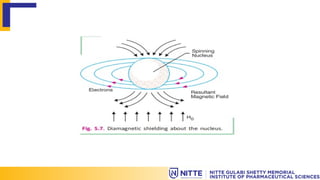
• When a proton is present inside such magnetic field or closer to an electropositive
atom, more applied magnetic field is required to cause excitation. Such protons
are called as shielded protons. This effect is called as Shielding effect.
• Nucleus generates a small magnetic field that opposes the external magnetic field
applied during NMR
• This reduces the magnetic field of nucleus.
• Causes: Shielding is usually caused by the presence of electron-donating groups
or the overall electron density around the nucleus. For example, in a molecule,
hydrogen atoms attached to carbon atoms with high electron density (like in
alkanes) are typically more shielded.
DESHIELDING EFFECT
• When a proton is present outside the circulating magnetic field or when
it is attached to an electronegative atom, less applied magnetic field is
sufficient for excitation. Such protons are called as deshielded protons
• The electrons arround the nucleus reduces the ability to oppose the
external magnetic field.
• Causes: Deshielding occurs when electron-withdrawing groups are near
the nucleus, pulling electron density away from it. For instance,
hydrogen atoms attached to carbon atoms near electronegative atoms
(like oxygen or fluorine) are typically deshielded.
BASIC PRINCIPLE:
• External Magnetic Field: In an NMR experiment, a strong external
magnetic field is applied to the sample. This field influences the
magnetic moments of atomic nuclei, causing them to align either with
or against the field.
• Electron Clouds and Local Fields: The electrons surrounding a
nucleus generate their own small magnetic fields. These fields can
either oppose or enhance the external magnetic field at the nucleus.
• Shielding Effect:
○ When the local electron-generated magnetic field opposes the external
magnetic field, it reduces the effective magnetic field experienced by
the nucleus. This is known as shielding.
○ If the local magnetic field aligns with the external field, the nucleus
experiences a stronger effective magnetic field, which is referred to as
deshielding.
• Chemical Shift: The difference in resonance frequency due to shielding
or deshielding is measured as the chemical shift, typically in parts per
million (ppm). The chemical shift provides information about the
chemical environment of the nucleus, helping in the identification of
molecular structures.
• Resonance Frequency: The ability of a molecule to absorb the radio
frequency of a NMR. This is directly related to magnetic field
experienced by the molecule.
• Shielded nuclei will posses less magnetic field and posses high
resonating frequency this is Upfield.
• If the shielded nuclei will posses higher magnetic field and posses lesser
resonating frequency this it is known as Downfield.
FACTORS INFLUENCING SHIELDING AND
DESHIELDING :
● Electron Density: High density → shielding- upfield chemical shift
low density → deshielding- downfield shift
● Electronegative Atoms: Withdraw electron density → deshielding.
● Aromatic Rings and Conjugated Systems: Create magnetic fields →
deshielding.
● Hybridization: sp²- more deshielding than sp³ effects.
EXAMPLES
1. SHIELDING:
● Alkane Protons (e.g., Methane, CH )
₄
○ Description: In methane, the carbon atom is sp³ hybridized, and the
surrounding hydrogen atoms are attached to this carbon.
○ Effect: The hydrogen nuclei in methane are shielded because the carbon-
hydrogen bonds are surrounded by a relatively high electron density, providing
significant electron shielding.
○ Chemical Shift: The protons in alkanes like methane typically resonate at
lower chemical shifts, around 0.5 to 2.0 ppm in ¹H NMR.
● TMS (Tetramethylsilane, (CH ) Si)
₃ ₄
○ Description: Tetramethylsilane is commonly used as the reference
compound in NMR because it is highly shielded.
○ Effect: The silicon atom donates electron density to the surrounding
methyl groups, shielding the protons.
○ Chemical Shift: The protons in TMS resonate at 0 ppm in ¹H NMR,
which is why it is used as a reference standard.
2. DESHIELDING
● Alcohols (e.g., Ethanol, CH CH OH)
₃ ₂
○ Description: In ethanol, the hydroxyl (-OH) group is highly
electronegative, pulling electron density away from the
adjacent carbon and hydrogen atoms.
○ Effect: The hydrogen atoms attached to the carbon bonded
to the -OH group are deshielded due to the electron-
withdrawing effect of oxygen.
○ Chemical Shift: The protons on the carbon adjacent to the
-OH group typically resonate downfield, around 3.5 to 4.5
ppm in ¹H NMR.
● Aldehydes (e.g., Acetaldehyde, CH CHO)
₃
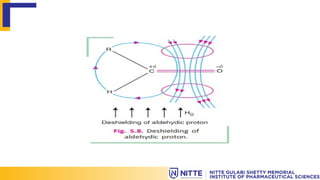
○ Description: In aldehydes, the carbonyl group (C=O) is strongly
electron-withdrawing, pulling electron density away from the adjacent
carbon and hydrogen atoms.
○ Effect: The proton attached to the carbonyl carbon is highly
deshielded due to the significant electron withdrawal by the carbonyl
group.
○ Chemical Shift: The proton on the carbonyl carbon in aldehydes
typically resonates further downfield, around 9.0 to 10.0 ppm in ¹H
NMR.
● Aromatic Protons (e.g., Benzene, C H )
₆ ₆
○ Description: In aromatic compounds like benzene, the delocalized π-
electrons create a ring current when exposed to an external magnetic
field. This current generates a magnetic field that deshields the
hydrogen atoms attached to the ring.
○ Effect: The protons on the benzene ring are deshielded by the ring
current effect.
○ Chemical Shift: Aromatic protons typically resonate downfield,
around 6.0 to 8.0 ppm in ¹H NMR.
● Carboxylic Acids (e.g., Acetic Acid, CH COOH)
₃
○ Description: The carboxyl group (-COOH) is highly electronegative
and pulls electron density away from the attached protons.
○ Effect: The proton in the -OH group of the carboxylic acid is highly
deshielded due to the electron-withdrawing effects of both the
carbonyl and hydroxyl groups.
○ Chemical Shift: The proton in the carboxyl group typically resonates
very far downfield, around 10.0 to 12.0 ppm in ¹H NMR.
CONCLUSION
In summary, the principle of NMR shielding and deshielding
revolves around how the electron cloud surrounding a nucleus
affects the local magnetic field experienced by the nucleus in an
external magnetic field. This, in turn, alters the resonance frequency
and chemical shift observed in the NMR spectrum, providing
valuable information about the molecular structure and the
electronic environment of the nucleus.
REFERENCE
1. Pharmaceutical Analysis- Instrumental Methods by Dr. F.G.Wadodkar ,
chapter 25, page number 25.8
2. Instrumental method of chemical Analysis by Gurudeep Chatwal,
Chapter 7, page number 2.81-2.23.
3. Elementary Organic Spectroscopy by Y.R. Sharma ,Page number 200-
203

NMR SHIELDING & DESHIELDINGffffffffffffffffffffffffffffffffff.pptx

  • 1.
    Principle of NMRShielding and deshielding Effect with examples GAVIN PEREIRA NU24PHPY06 DEPT. OF PHARMACOLOGY
  • 2.
    INTRODUCTION • Nuclear MagneticResonance is a branch of spectroscopy in which radio frequency waves induce transitions between magnetic energy levels of nuclei of a molecule. • The magnetic energy levels are created by keeping the nuclei in a magnetic field. • In analytical chemistry, NMR is a technique that enables us to study the shape and structure of molecules.
  • 3.
    PRINCIPLE: NMR is basedon the interaction between atomic nuclei and an external magnetic field. Certain nuclei (e.g., 1H, 13C, 15N) have a property called spin, which generates a magnetic moment. When these nuclei are placed in a strong magnetic field, they align either parallel or antiparallel to the field.
  • 4.
    SHIELDING AND DESHIELDINGEFFECT: • Nucleus is surrounded by the electron and hence protons can be present within or outside the circulating magnetic field caused by the circulation of electrons in double bond, triple bond, aromatic or other ring systems etc. • The principles of NMR shielding and deshielding are based on the interaction between the nucleus, the surrounding electron cloud, and the external magnetic field applied during an NMR experiment. These interactions determine the chemical shift observed in an NMR spectrum, providing insight into the electronic environment around the nucleus.
  • 5.
    SHIELDING EFFECT • Whena proton is present inside such magnetic field or closer to an electropositive atom, more applied magnetic field is required to cause excitation. Such protons are called as shielded protons. This effect is called as Shielding effect. • Nucleus generates a small magnetic field that opposes the external magnetic field applied during NMR • This reduces the magnetic field of nucleus. • Causes: Shielding is usually caused by the presence of electron-donating groups or the overall electron density around the nucleus. For example, in a molecule, hydrogen atoms attached to carbon atoms with high electron density (like in alkanes) are typically more shielded.
  • 7.
    DESHIELDING EFFECT • Whena proton is present outside the circulating magnetic field or when it is attached to an electronegative atom, less applied magnetic field is sufficient for excitation. Such protons are called as deshielded protons • The electrons arround the nucleus reduces the ability to oppose the external magnetic field. • Causes: Deshielding occurs when electron-withdrawing groups are near the nucleus, pulling electron density away from it. For instance, hydrogen atoms attached to carbon atoms near electronegative atoms (like oxygen or fluorine) are typically deshielded.
  • 9.
    BASIC PRINCIPLE: • ExternalMagnetic Field: In an NMR experiment, a strong external magnetic field is applied to the sample. This field influences the magnetic moments of atomic nuclei, causing them to align either with or against the field. • Electron Clouds and Local Fields: The electrons surrounding a nucleus generate their own small magnetic fields. These fields can either oppose or enhance the external magnetic field at the nucleus.
  • 10.
    • Shielding Effect: ○When the local electron-generated magnetic field opposes the external magnetic field, it reduces the effective magnetic field experienced by the nucleus. This is known as shielding. ○ If the local magnetic field aligns with the external field, the nucleus experiences a stronger effective magnetic field, which is referred to as deshielding.
  • 11.
    • Chemical Shift:The difference in resonance frequency due to shielding or deshielding is measured as the chemical shift, typically in parts per million (ppm). The chemical shift provides information about the chemical environment of the nucleus, helping in the identification of molecular structures.
  • 12.
    • Resonance Frequency:The ability of a molecule to absorb the radio frequency of a NMR. This is directly related to magnetic field experienced by the molecule. • Shielded nuclei will posses less magnetic field and posses high resonating frequency this is Upfield. • If the shielded nuclei will posses higher magnetic field and posses lesser resonating frequency this it is known as Downfield.
  • 13.
    FACTORS INFLUENCING SHIELDINGAND DESHIELDING : ● Electron Density: High density → shielding- upfield chemical shift low density → deshielding- downfield shift ● Electronegative Atoms: Withdraw electron density → deshielding. ● Aromatic Rings and Conjugated Systems: Create magnetic fields → deshielding. ● Hybridization: sp²- more deshielding than sp³ effects.
  • 14.
    EXAMPLES 1. SHIELDING: ● AlkaneProtons (e.g., Methane, CH ) ₄ ○ Description: In methane, the carbon atom is sp³ hybridized, and the surrounding hydrogen atoms are attached to this carbon. ○ Effect: The hydrogen nuclei in methane are shielded because the carbon- hydrogen bonds are surrounded by a relatively high electron density, providing significant electron shielding. ○ Chemical Shift: The protons in alkanes like methane typically resonate at lower chemical shifts, around 0.5 to 2.0 ppm in ¹H NMR.
  • 15.
    ● TMS (Tetramethylsilane,(CH ) Si) ₃ ₄ ○ Description: Tetramethylsilane is commonly used as the reference compound in NMR because it is highly shielded. ○ Effect: The silicon atom donates electron density to the surrounding methyl groups, shielding the protons. ○ Chemical Shift: The protons in TMS resonate at 0 ppm in ¹H NMR, which is why it is used as a reference standard.
  • 16.
    2. DESHIELDING ● Alcohols(e.g., Ethanol, CH CH OH) ₃ ₂ ○ Description: In ethanol, the hydroxyl (-OH) group is highly electronegative, pulling electron density away from the adjacent carbon and hydrogen atoms. ○ Effect: The hydrogen atoms attached to the carbon bonded to the -OH group are deshielded due to the electron- withdrawing effect of oxygen. ○ Chemical Shift: The protons on the carbon adjacent to the -OH group typically resonate downfield, around 3.5 to 4.5 ppm in ¹H NMR.
  • 17.
    ● Aldehydes (e.g.,Acetaldehyde, CH CHO) ₃ ○ Description: In aldehydes, the carbonyl group (C=O) is strongly electron-withdrawing, pulling electron density away from the adjacent carbon and hydrogen atoms. ○ Effect: The proton attached to the carbonyl carbon is highly deshielded due to the significant electron withdrawal by the carbonyl group. ○ Chemical Shift: The proton on the carbonyl carbon in aldehydes typically resonates further downfield, around 9.0 to 10.0 ppm in ¹H NMR.
  • 18.
    ● Aromatic Protons(e.g., Benzene, C H ) ₆ ₆ ○ Description: In aromatic compounds like benzene, the delocalized π- electrons create a ring current when exposed to an external magnetic field. This current generates a magnetic field that deshields the hydrogen atoms attached to the ring. ○ Effect: The protons on the benzene ring are deshielded by the ring current effect. ○ Chemical Shift: Aromatic protons typically resonate downfield, around 6.0 to 8.0 ppm in ¹H NMR.
  • 19.
    ● Carboxylic Acids(e.g., Acetic Acid, CH COOH) ₃ ○ Description: The carboxyl group (-COOH) is highly electronegative and pulls electron density away from the attached protons. ○ Effect: The proton in the -OH group of the carboxylic acid is highly deshielded due to the electron-withdrawing effects of both the carbonyl and hydroxyl groups. ○ Chemical Shift: The proton in the carboxyl group typically resonates very far downfield, around 10.0 to 12.0 ppm in ¹H NMR.
  • 20.
    CONCLUSION In summary, theprinciple of NMR shielding and deshielding revolves around how the electron cloud surrounding a nucleus affects the local magnetic field experienced by the nucleus in an external magnetic field. This, in turn, alters the resonance frequency and chemical shift observed in the NMR spectrum, providing valuable information about the molecular structure and the electronic environment of the nucleus.
  • 21.
    REFERENCE 1. Pharmaceutical Analysis-Instrumental Methods by Dr. F.G.Wadodkar , chapter 25, page number 25.8 2. Instrumental method of chemical Analysis by Gurudeep Chatwal, Chapter 7, page number 2.81-2.23. 3. Elementary Organic Spectroscopy by Y.R. Sharma ,Page number 200- 203

Editor's Notes

  • #2 The principle behind NMR is that many nuclei have spin and all nuclei are electrically charged. If an external magnetic field is applied, an energy transfer is possible between the base energy to a higher energy level (generally a single energy gap). The energy transfer takes place at a wavelength that corresponds to radio frequencies and when the spin returns to its base level, energy is emitted at the same frequency. The signal that matches this transfer is measured in many ways and processed in order to yield an NMR spectrum for the nucleus concerned.
  • #4 Definition: Shielding refers to the phenomenon where the electron cloud around a nucleus generates a small magnetic field that opposes the external magnetic field applied during NMR. This reduces the effective magnetic field experienced by the nucleus.
  • #13 Electron Density: High electron density around a nucleus increases shielding, leading to an upfield chemical shift. Low electron density, due to the presence of electronegative atoms or groups, causes deshielding and results in a downfield shift. Electronegative Substituents: Electronegative atoms (like oxygen, nitrogen, or halogens) withdraw electron density from nearby nuclei, leading to deshielding. Aromatic and Conjugated Systems: Aromatic rings and conjugated double bonds create magnetic fields due to electron circulation (ring currents), which can cause significant deshielding of nuclei within or near these systems. Hybridization and Bonding: The type of hybridization (sp³, sp², sp) and the bonding environment also affect shielding and deshielding. For instance, sp² hybridized carbons in alkenes are typically deshielded compared to sp³ hybridized carbons in alkanes.
  • #14 Alkanes: Upfield shifts due to high electron density. TMS: Highly shielded protons used as a reference (0 ppm).
  • #16 Alcohols: Downfield shifts due to electronegative oxygen. Aromatic Compounds: Downfield shifts due to ring current effects. Aldehydes: Strong deshielding by the carbonyl group.