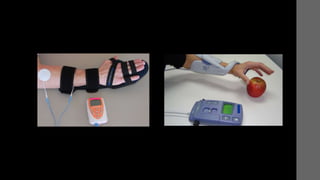
Aditya Johan Romadhon, M.Fis
NEUROMUSCULAR ELECTRICAL
STIMULATION
(NMES)
INTRODUCTION
• Lack of neural innervation due to neurological damage renders muscle
unable to produce force
• Use of electrical stimulation is a medium in a way to restore movement
and the ability to perform activities of daily living
• Different methods of applying electrical current to modify neuromuscular
activity are electrical stimulation (ES)
• Neuromuscular Electrical Stimulation (NMES), Transcutaneous Electrical
Nerve Stimulation (TENS), and Functional Electrical Stimulation (FES)
NEUROMUSCULAR ELECTRICAL STIMULATION
• Electrical stimulation is currently used in many forms to facilitate
changes in muscle action and performance
• In clinical settings, electrical stimulation can be used for improving
muscle strength, increasing range of motion, reducing edema,
decreasing atrophy, healing tissue, and decreasing pain
• Neuromuscular electrical stimulation (NMES), used interchangeably
with electrical stimulation (ES)
• Typically provided at higher frequencies (30-50-100 Hz)
Frequency
• In a study comparing several different frequencies and stimulation
patterns, frequencies under 16Hz were not sufficient to elicit a strong
enough contraction to allow the quadriceps to extend to a target of 40º
• Higher frequencies of stimulation (50 Hz and 80 Hz) administered to
hand muscles resulted in a rapid decline in force after approximately
20s
• Lower frequencies (30Hz) had the potential to produce lower forces, a
condition that lasted for 24 hours or longer
• Stimulation frequency rates closely aligned with physiological rates of
motor unit discharge were studied in the hand that showed a consistent
frequency of 30 Hz preserved force better
Ramp up & down
• Frequently, a gradation of stimulation up to the desired frequency and
intensity is used for patient comfort
• Ramp time refers to the period of time from when the stimulation is
turned on until the actual onset of the desired frequency
• Ramp times of 1 to 3 seconds are common in rehabilitation regimens
with longer ramp times sometimes used for hypertonic or spastic
musculature or for the patient with an increased sensitivity to
stimulation
Pulse width /duration
• The time span of a single pulse is known as the pulse width or pulse
duration
• In biphasic (a positive phase combined with a negative) pulses
• Typically, dynamic quadriceps extensions similar to those used in
FES cycling tests exhibit pulse widths between 300μs-600μs
• Longer pulse durations will typically penetrate more deeply into
subcutaneous tissues, so these widths should be used when trying to
impact secondary tissue layers
Amplitude/Intensity
• The higher the intensity, the stronger the depolarizing effect in the
structures underlying the electrodes
• Recent work examining the optimal parameters for stimulation has
suggested that lower intensities can induce more central nervous
system input than higher intensities
• when both frequency and amplitude were varied during a
stimulation regimen of knee extension in healthy adults, more
contractions were performed as compared to when a constant
frequency and amplitude program was used
THANKS

Nmes

  • 1.
    Aditya Johan Romadhon,M.Fis NEUROMUSCULAR ELECTRICAL STIMULATION (NMES)
  • 2.
    INTRODUCTION • Lack ofneural innervation due to neurological damage renders muscle unable to produce force • Use of electrical stimulation is a medium in a way to restore movement and the ability to perform activities of daily living • Different methods of applying electrical current to modify neuromuscular activity are electrical stimulation (ES) • Neuromuscular Electrical Stimulation (NMES), Transcutaneous Electrical Nerve Stimulation (TENS), and Functional Electrical Stimulation (FES)
  • 3.
    NEUROMUSCULAR ELECTRICAL STIMULATION •Electrical stimulation is currently used in many forms to facilitate changes in muscle action and performance • In clinical settings, electrical stimulation can be used for improving muscle strength, increasing range of motion, reducing edema, decreasing atrophy, healing tissue, and decreasing pain • Neuromuscular electrical stimulation (NMES), used interchangeably with electrical stimulation (ES) • Typically provided at higher frequencies (30-50-100 Hz)
  • 4.
    Frequency • In astudy comparing several different frequencies and stimulation patterns, frequencies under 16Hz were not sufficient to elicit a strong enough contraction to allow the quadriceps to extend to a target of 40º • Higher frequencies of stimulation (50 Hz and 80 Hz) administered to hand muscles resulted in a rapid decline in force after approximately 20s • Lower frequencies (30Hz) had the potential to produce lower forces, a condition that lasted for 24 hours or longer • Stimulation frequency rates closely aligned with physiological rates of motor unit discharge were studied in the hand that showed a consistent frequency of 30 Hz preserved force better
  • 5.
    Ramp up &down • Frequently, a gradation of stimulation up to the desired frequency and intensity is used for patient comfort • Ramp time refers to the period of time from when the stimulation is turned on until the actual onset of the desired frequency • Ramp times of 1 to 3 seconds are common in rehabilitation regimens with longer ramp times sometimes used for hypertonic or spastic musculature or for the patient with an increased sensitivity to stimulation
  • 6.
    Pulse width /duration •The time span of a single pulse is known as the pulse width or pulse duration • In biphasic (a positive phase combined with a negative) pulses • Typically, dynamic quadriceps extensions similar to those used in FES cycling tests exhibit pulse widths between 300μs-600μs • Longer pulse durations will typically penetrate more deeply into subcutaneous tissues, so these widths should be used when trying to impact secondary tissue layers
  • 7.
    Amplitude/Intensity • The higherthe intensity, the stronger the depolarizing effect in the structures underlying the electrodes • Recent work examining the optimal parameters for stimulation has suggested that lower intensities can induce more central nervous system input than higher intensities • when both frequency and amplitude were varied during a stimulation regimen of knee extension in healthy adults, more contractions were performed as compared to when a constant frequency and amplitude program was used
  • 10.