GALVANIC CURRENT
Dr. Mansi Ray
MPT (Orthopaedics)
Assistant professor
 It is also known as a DIRECT CURRENT OR
CONSTANT CURRENT.
 In most of therapeutic references, it is known as a
galvanic current.
 This is direct electric current (DC) .its
direction of polarity is constant and passes
continuously in the one direction only .
 Modification in direct current is done with
interruption in the direct current with the
flow of current commencing and ceasing at
regular intervals named, INTERRUPTED
GALVANIC CURRENT.
 THERAPEUTIC DIRECT CURRENT or
GALVANIC CURRENT-
 impulses with a duration of more than 10ms
may be classed having a long duration and are
used for the stimulation of denerveted
muscles.
 An Italian scientist named “Wigi Galvany” found that
when electrical charges is introduced in the muscles of
frogs leg through a copper wire ,muscles get contracted.
 So the name of DC is given as galvanic current.
 During treatment ,our purpose is to get the muscle contracted
and relaxed, which is possible only when we apply the current
for a shorter duration and there should be a silent period during
two pulses.
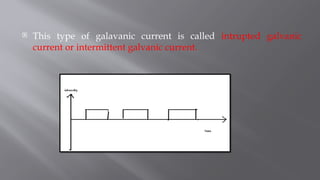
 This type of galavanic current is called intrupted galvanic
current or intermittent galvanic current.
Types of intermittent galvanic current
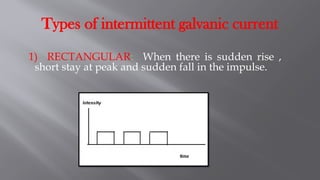
1) RECTANGULAR: When there is sudden rise ,
short stay at peak and sudden fall in the impulse.
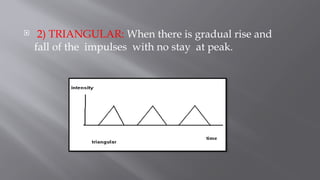
 2) TRIANGULAR: When there is gradual rise and
fall of the impulses with no stay at peak.
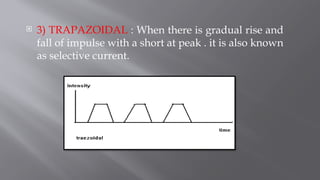
 3) TRAPAZOIDAL : When there is gradual rise and
fall of impulse with a short at peak . it is also known
as selective current.
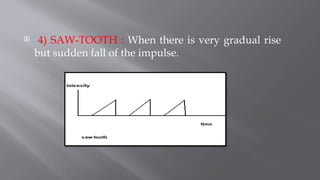
 4) SAW-TOOTH : When there is very gradual rise
but sudden fall of the impulse.
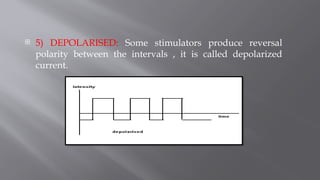
 5) DEPOLARISED: Some stimulators produce reversal
polarity between the intervals , it is called depolarized
current.
 The duration and frequency of impulse is adjusted
within the range of 10 ml sec to 300 ml sec.
 A duration of 100 ml sec is commonly used.
 When the impulse of 100ml sec is used , the average
frequency will be 30 cycles per minute. But if
duration increases, the frequency consequently
reduces.
 However ,the duration and frequency of the current
can be selected by the therapist as desired.
 The passage of a direct current through an
electrolyte causes chemical changes to take place at
the electrodes.
INDICATIONS
 The main indication for interrupted direct or galvanic
current is to produce contractions of Denervated
muscles.
 When nerve supply of a muscle deprives, the structure
and properties of the muscle change.
 It leads to wasting of the muscle
 If the denervation is of long standing, it can cause
fibrosis and loss of the muscle properties like,
irritability, contractibility, extensibility and
elasticity .
 Electrical stimulation with galvanic current can
slow down these changes.
 If electrical stimulations used ,it must be strong enough
to produce a muscle contraction, and an adequate
number of contraction s must be produced.
 Ninety contractions are usually regarded as the
minimum number of contractions for treatment to be
effective, though if fatigue occurs before this number is
reached the treatment time should be shorted.
 In the early stages of re-innervation, electrical stimulation may
be useful to re-educate the patient , if he cannot get the feel of the
recovering muscle.
SELECTION OF TYPE OF IMPULSE
 The difference between the various types of impulse lies
in the time taken for the intensity of current to rise to
maximum.
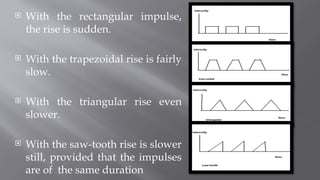
 With the rectangular impulse,
the rise is sudden.
 With the trapezoidal rise is fairly
slow.
 With the triangular rise even
slower.
 With the saw-tooth rise is slower
still, provided that the impulses
are of the same duration
 A slow rise in the intensity of current has the
advantages that a contraction of Denervated muscle
is often obtained with less sensory stimulation than
when rectangular impulses are used.
 Denervated muscle often responds to lower
intensity of current than that required to stimulate
motor nerves , so that unwanted contractions of
normally innervated muscles in the region are
eliminated.
 When various types of impulse are available ,it is
advisable to attempt stimulation with each in order
to ascertain which produces the most satisfactory
contraction.
 It is often found that the more long-standing the
denervation, the slower the rise in intensity of
current that is required.
DURATION OF IMPULSE
 An impulse of at least 100 ms is necessary in order
to ensure that all the denerveted muscle fibers are
stimulated.
 If shorter impulses are used, some of the muscle
fibers may fail to contract.
 When attempting to eliminate contraction of
normally innervated muscles or to stimulate a
muscle which has been denerveted for some time ,
it is necessary to increase the duration of the
impulses to 300 or 600ms.
AIM
 The treatment must be arranged so that with
stimulation, the current passes through all the
fibers of the muscle and contraction is achieved in
whole the muscle.
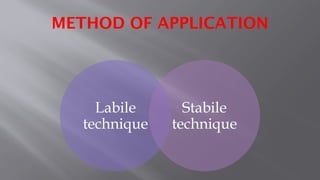
METHOD OF APPLICATION
Labile
technique
Stabile
technique
LABILE METHODS
 One muscle is stimulated at a time .
 Inactive electrode is placed on the origin of the
muscle groups or the nerve trunk .
 Active electrode is placed on the muscle belly or
on the motor point of the individual muscle. This
method is widely used.
 Advantage: Current can be regulated to produce
the optimum contraction of each muscle, and that
each muscle is rested while other muscles of the
group are being stimulated.
 Disadvantage: Large numbers of the muscle or the
muscle groups are not stimulated simultaneously at
one time.
STABILE METHOD
 Inactive electrode is kept at origin
 Active electrode is kept at near the end of muscle and
pressed firmly.
 Advantage: Large number of muscles or muscle groups are
stimulated and contractions can be elicited.
 This method is useful for the deeply placed muscles which are
difficult to isolate ,such as the extensor pollicis longus.
Physiological effects
 Stimulation of sensory nerves:
 The impulses of interrupted direct current are of long
duration, it can cause marked sensory stimulation of
sensory nerves giving rise to stabbing sensation.
 There is reflex dilatation of the superficial blood vessels
resulting in the erythma of the skin.
 Stimulation of motor nerves:
 Stimulation of motor nerves causes contraction
of all the muscle fibers supplied by it.
 The quality of the contraction of each muscle
is ‘brisk muscle twitch’ followed by complete
relaxation.
 Stimulation of denervated muscle:
 If the impulses of sufficiently long duration, it can
produce muscle contractions in denervated
muscles, and the contractions will be sluggish in
nature.
 As denervated muscle does not have any property
of accommodation, current that rises very slow is
more effective than sudden rise in the intensity.
 Effects on muscle contractions:
 Muscle contractions produced are of not the voluntary
contractions .
 The current is used to maintain the muscle tone.
 If sufficient contractions are given, it will increase
metabolism, removal of waste products, increase demand for
food stuffs and increase the venous and lymphatic drainages.
 Chemical effects:
 Modified direct current has a danger of
chemical burns.
 When stimulation is applied with the
galvanic current, chemical changes takes
place at the electrodes.
Therapeutic effects
 Facilitation of muscle contraction
 Reeducation of the muscle action
 Contractions of the paralyzed muscles
 Increase blood supply and nourishment through
pumping effects
 Improve venous and lymphatic drainage.
 The amount of voluntary contraction is increased
gradually and electrical stimulation is reduced until
the muscles produce full voluntary contraction.
Facilitation or initiation of the muscle action
 When patient is unable to produce muscle contraction or
finds it difficult to do.
 So, electrical stimulation may be required in assisting to
produce voluntary contraction.
Re-education of muscle action
 According to behaviours theory the brain appreciate
movements and not individual muscle action .
 In some situations where muscle is not under voluntary
control re-education or re-learning of muscle action is
required. these situation could be
1)prolonged disuse
2)in correct use
Training a new muscle action
 After tendon transplantation or other reconstruction
operations a muscle may required to perform a different
action from that which it previously carried out.
 A muscle is stimulated with this current ,so that it is
new action is performed.
Neuraprexia of a motor nerve
 In this case impulses from the brain are unable to
pass the site of the lesion to reach the muscles
supplied by the affected nerve.
 So the voluntary power is reduced or lost.
Severed motor nerve
 When a nerve has been severed, degenration of the
axons takes place and there is no longer a satisfactory
response to stimuli of short duration.
 Degeneration takes several days, and for a few days
after the injury a muscle contraction may be obtained by
this current.
Contraindications
 Local
 Open wounds
 Very recent fracture
 Skin grafts
 Severe edema
 Hairy surface
 Acute inflammation
 Metal in the part
 Malignant growth
 Hyper sensitive skin
 Loss of sensation
•General
 Hyperpyrexia /fever
 Hypertension
 Patients with cardiac
pacemaker.
 Anemia
 Severe renal and cardiac
failure
 Epileptic patients
 Non co-operative patients
 Mentally retarded patients
 Over abdomen of the
pregnant women
Precautions
1) Skin abrasions
2) Remove the patients rings
3)Warn the patient to remain still during
treatment.
4) Ensure correct thickness of pads.
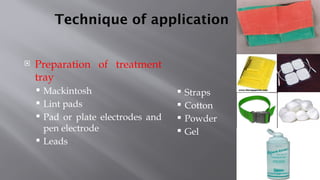
Technique of application
 Preparation of treatment
tray
 Mackintosh
 Lint pads
 Pad or plate electrodes and
pen electrode
 Leads
 Straps
 Cotton
 Powder
 Gel
 Skin resistance lowering tray
 Saline water
 Soap
 Cotton
 Vaseline
 Towels, etc.
 Preparation of apparatus
 Check whether all the knobs are at zero intensity.
 Checking the pins of plug and check weather the
switch is off
 Check the insulation of wire
 Check whether the switch in the stimulator is
working or not.
 Check whether fuse is present in the apparatus
 If plate electrodes (metal) are used , lint pads are
used which consists of 8 layers of folds to avoid
direct contact with skin.
 The pad should be without any creases to avoid
uneven distribution of current.
 Correct positioning of the patient:
 Patient should be in the comfortable position.
 Part to be treated must be supported, exposed and
should be at adequate distance from the modality.
 Correct positioning of
physiotherapist:
 Position of physiotherapist should also be
comfortable so that he/she may not get tired after
treatment if he is giving stimulation to the
individual muscles.
 Position should be such that it provides
maximum accessibility to the treatment part and
to the modality.
 Testing of apparatus :
 Apparatus must be checked once In front of the
patient.
 SELF TEST to be done.
 Switch on the apparatus and gradually increase the
current.
 Explain the patient the feel of the current.
 This will increase the confidence of the patient.
 Application of electrodes : (placing of
electrodes):
 Before applying the electrodes, the skin
resistance is reduced by washing the area with
soap and water or saline to remove the natural
oils.
 If metal plate electrodes are used, the cotton
lint pad is wraped on it and it is soaked into
the water.
 If rubber electrodes are used , a petroleum jelly is applied on it
which acts as a coupling medium.
 The indifferent or inactive electrode is applied on the nerve
trunk or the origin of the muscle groups.
 Active electrode is placed on the muscle belly or the motor
points of the muscles to be stimulated.
 Electrodes are fixed with straps or tapes.
Instruction to the patient before treatment:
 I am going to start the treatment
 Be in relaxed position.
 Don’t touch anything around you.
 Don’t pull the leads.
 Don’t touch the walls and ground.
 Don’t touch the knobs of the machine.
 If you feel uneasy switch off from the patients
switch.
Regulating the current:
 Selection of pulse, frequency, duration and treatment
time.
 Gradually Increase the current.
 Keep talking with the patient about the feel of the
current.
 Tell him to inform you immediately about any
inconvenience ,discomfort or burning.
 Palpating tendon: feel the contraction by palpating the
tendon.
 Termination of treatment:
As the treatment gets over ,
 Reduce the intensity to 0
 Remove the electrodes from the part
 Clean the skin again with cotton.
Explanation to the patient :
Explain the patient:
The advantage of the treatment
The course or duration of the treatment.
The do’s and don’t in home and other advices
Thank you… 

galvanic currentwiwbdvfhrhrhrhherhh.pptx

  • 1.
    GALVANIC CURRENT Dr. MansiRay MPT (Orthopaedics) Assistant professor
  • 2.
     It isalso known as a DIRECT CURRENT OR CONSTANT CURRENT.  In most of therapeutic references, it is known as a galvanic current.
  • 3.
     This isdirect electric current (DC) .its direction of polarity is constant and passes continuously in the one direction only .  Modification in direct current is done with interruption in the direct current with the flow of current commencing and ceasing at regular intervals named, INTERRUPTED GALVANIC CURRENT.
  • 4.
     THERAPEUTIC DIRECTCURRENT or GALVANIC CURRENT-  impulses with a duration of more than 10ms may be classed having a long duration and are used for the stimulation of denerveted muscles.
  • 5.
     An Italianscientist named “Wigi Galvany” found that when electrical charges is introduced in the muscles of frogs leg through a copper wire ,muscles get contracted.  So the name of DC is given as galvanic current.  During treatment ,our purpose is to get the muscle contracted and relaxed, which is possible only when we apply the current for a shorter duration and there should be a silent period during two pulses.
  • 6.
     This typeof galavanic current is called intrupted galvanic current or intermittent galvanic current.
  • 7.
    Types of intermittentgalvanic current 1) RECTANGULAR: When there is sudden rise , short stay at peak and sudden fall in the impulse.
  • 8.
     2) TRIANGULAR:When there is gradual rise and fall of the impulses with no stay at peak.
  • 9.
     3) TRAPAZOIDAL: When there is gradual rise and fall of impulse with a short at peak . it is also known as selective current.
  • 10.
     4) SAW-TOOTH: When there is very gradual rise but sudden fall of the impulse.
  • 11.
     5) DEPOLARISED:Some stimulators produce reversal polarity between the intervals , it is called depolarized current.
  • 12.
     The durationand frequency of impulse is adjusted within the range of 10 ml sec to 300 ml sec.  A duration of 100 ml sec is commonly used.  When the impulse of 100ml sec is used , the average frequency will be 30 cycles per minute. But if duration increases, the frequency consequently reduces.
  • 13.
     However ,theduration and frequency of the current can be selected by the therapist as desired.  The passage of a direct current through an electrolyte causes chemical changes to take place at the electrodes.
  • 14.
    INDICATIONS  The mainindication for interrupted direct or galvanic current is to produce contractions of Denervated muscles.  When nerve supply of a muscle deprives, the structure and properties of the muscle change.  It leads to wasting of the muscle
  • 15.
     If thedenervation is of long standing, it can cause fibrosis and loss of the muscle properties like, irritability, contractibility, extensibility and elasticity .  Electrical stimulation with galvanic current can slow down these changes.
  • 16.
     If electricalstimulations used ,it must be strong enough to produce a muscle contraction, and an adequate number of contraction s must be produced.  Ninety contractions are usually regarded as the minimum number of contractions for treatment to be effective, though if fatigue occurs before this number is reached the treatment time should be shorted.  In the early stages of re-innervation, electrical stimulation may be useful to re-educate the patient , if he cannot get the feel of the recovering muscle.
  • 17.
    SELECTION OF TYPEOF IMPULSE  The difference between the various types of impulse lies in the time taken for the intensity of current to rise to maximum.
  • 18.
     With therectangular impulse, the rise is sudden.  With the trapezoidal rise is fairly slow.  With the triangular rise even slower.  With the saw-tooth rise is slower still, provided that the impulses are of the same duration
  • 19.
     A slowrise in the intensity of current has the advantages that a contraction of Denervated muscle is often obtained with less sensory stimulation than when rectangular impulses are used.  Denervated muscle often responds to lower intensity of current than that required to stimulate motor nerves , so that unwanted contractions of normally innervated muscles in the region are eliminated.
  • 20.
     When varioustypes of impulse are available ,it is advisable to attempt stimulation with each in order to ascertain which produces the most satisfactory contraction.  It is often found that the more long-standing the denervation, the slower the rise in intensity of current that is required.
  • 21.
    DURATION OF IMPULSE An impulse of at least 100 ms is necessary in order to ensure that all the denerveted muscle fibers are stimulated.  If shorter impulses are used, some of the muscle fibers may fail to contract.
  • 22.
     When attemptingto eliminate contraction of normally innervated muscles or to stimulate a muscle which has been denerveted for some time , it is necessary to increase the duration of the impulses to 300 or 600ms.
  • 23.
    AIM  The treatmentmust be arranged so that with stimulation, the current passes through all the fibers of the muscle and contraction is achieved in whole the muscle.
  • 24.
  • 25.
    LABILE METHODS  Onemuscle is stimulated at a time .  Inactive electrode is placed on the origin of the muscle groups or the nerve trunk .  Active electrode is placed on the muscle belly or on the motor point of the individual muscle. This method is widely used.
  • 26.
     Advantage: Currentcan be regulated to produce the optimum contraction of each muscle, and that each muscle is rested while other muscles of the group are being stimulated.  Disadvantage: Large numbers of the muscle or the muscle groups are not stimulated simultaneously at one time.
  • 27.
    STABILE METHOD  Inactiveelectrode is kept at origin  Active electrode is kept at near the end of muscle and pressed firmly.  Advantage: Large number of muscles or muscle groups are stimulated and contractions can be elicited.  This method is useful for the deeply placed muscles which are difficult to isolate ,such as the extensor pollicis longus.
  • 28.
    Physiological effects  Stimulationof sensory nerves:  The impulses of interrupted direct current are of long duration, it can cause marked sensory stimulation of sensory nerves giving rise to stabbing sensation.  There is reflex dilatation of the superficial blood vessels resulting in the erythma of the skin.
  • 29.
     Stimulation ofmotor nerves:  Stimulation of motor nerves causes contraction of all the muscle fibers supplied by it.  The quality of the contraction of each muscle is ‘brisk muscle twitch’ followed by complete relaxation.
  • 30.
     Stimulation ofdenervated muscle:  If the impulses of sufficiently long duration, it can produce muscle contractions in denervated muscles, and the contractions will be sluggish in nature.  As denervated muscle does not have any property of accommodation, current that rises very slow is more effective than sudden rise in the intensity.
  • 31.
     Effects onmuscle contractions:  Muscle contractions produced are of not the voluntary contractions .  The current is used to maintain the muscle tone.  If sufficient contractions are given, it will increase metabolism, removal of waste products, increase demand for food stuffs and increase the venous and lymphatic drainages.
  • 32.
     Chemical effects: Modified direct current has a danger of chemical burns.  When stimulation is applied with the galvanic current, chemical changes takes place at the electrodes.
  • 33.
  • 34.
     Facilitation ofmuscle contraction  Reeducation of the muscle action  Contractions of the paralyzed muscles  Increase blood supply and nourishment through pumping effects  Improve venous and lymphatic drainage.  The amount of voluntary contraction is increased gradually and electrical stimulation is reduced until the muscles produce full voluntary contraction.
  • 35.
    Facilitation or initiationof the muscle action  When patient is unable to produce muscle contraction or finds it difficult to do.  So, electrical stimulation may be required in assisting to produce voluntary contraction.
  • 36.
    Re-education of muscleaction  According to behaviours theory the brain appreciate movements and not individual muscle action .  In some situations where muscle is not under voluntary control re-education or re-learning of muscle action is required. these situation could be 1)prolonged disuse 2)in correct use
  • 37.
    Training a newmuscle action  After tendon transplantation or other reconstruction operations a muscle may required to perform a different action from that which it previously carried out.  A muscle is stimulated with this current ,so that it is new action is performed.
  • 38.
    Neuraprexia of amotor nerve  In this case impulses from the brain are unable to pass the site of the lesion to reach the muscles supplied by the affected nerve.  So the voluntary power is reduced or lost.
  • 39.
    Severed motor nerve When a nerve has been severed, degenration of the axons takes place and there is no longer a satisfactory response to stimuli of short duration.  Degeneration takes several days, and for a few days after the injury a muscle contraction may be obtained by this current.
  • 40.
    Contraindications  Local  Openwounds  Very recent fracture  Skin grafts  Severe edema  Hairy surface  Acute inflammation  Metal in the part  Malignant growth  Hyper sensitive skin  Loss of sensation
  • 41.
    •General  Hyperpyrexia /fever Hypertension  Patients with cardiac pacemaker.  Anemia  Severe renal and cardiac failure  Epileptic patients  Non co-operative patients  Mentally retarded patients  Over abdomen of the pregnant women
  • 42.
    Precautions 1) Skin abrasions 2)Remove the patients rings 3)Warn the patient to remain still during treatment. 4) Ensure correct thickness of pads.
  • 43.
    Technique of application Preparation of treatment tray  Mackintosh  Lint pads  Pad or plate electrodes and pen electrode  Leads  Straps  Cotton  Powder  Gel
  • 44.
     Skin resistancelowering tray  Saline water  Soap  Cotton  Vaseline  Towels, etc.
  • 45.
     Preparation ofapparatus  Check whether all the knobs are at zero intensity.  Checking the pins of plug and check weather the switch is off  Check the insulation of wire  Check whether the switch in the stimulator is working or not.  Check whether fuse is present in the apparatus
  • 46.
     If plateelectrodes (metal) are used , lint pads are used which consists of 8 layers of folds to avoid direct contact with skin.  The pad should be without any creases to avoid uneven distribution of current.
  • 47.
     Correct positioningof the patient:  Patient should be in the comfortable position.  Part to be treated must be supported, exposed and should be at adequate distance from the modality.
  • 48.
     Correct positioningof physiotherapist:  Position of physiotherapist should also be comfortable so that he/she may not get tired after treatment if he is giving stimulation to the individual muscles.  Position should be such that it provides maximum accessibility to the treatment part and to the modality.
  • 49.
     Testing ofapparatus :  Apparatus must be checked once In front of the patient.  SELF TEST to be done.  Switch on the apparatus and gradually increase the current.  Explain the patient the feel of the current.  This will increase the confidence of the patient.
  • 50.
     Application ofelectrodes : (placing of electrodes):  Before applying the electrodes, the skin resistance is reduced by washing the area with soap and water or saline to remove the natural oils.  If metal plate electrodes are used, the cotton lint pad is wraped on it and it is soaked into the water.
  • 51.
     If rubberelectrodes are used , a petroleum jelly is applied on it which acts as a coupling medium.  The indifferent or inactive electrode is applied on the nerve trunk or the origin of the muscle groups.  Active electrode is placed on the muscle belly or the motor points of the muscles to be stimulated.  Electrodes are fixed with straps or tapes.
  • 52.
    Instruction to thepatient before treatment:  I am going to start the treatment  Be in relaxed position.  Don’t touch anything around you.  Don’t pull the leads.  Don’t touch the walls and ground.  Don’t touch the knobs of the machine.  If you feel uneasy switch off from the patients switch.
  • 53.
    Regulating the current: Selection of pulse, frequency, duration and treatment time.  Gradually Increase the current.  Keep talking with the patient about the feel of the current.  Tell him to inform you immediately about any inconvenience ,discomfort or burning.  Palpating tendon: feel the contraction by palpating the tendon.
  • 54.
     Termination oftreatment: As the treatment gets over ,  Reduce the intensity to 0  Remove the electrodes from the part  Clean the skin again with cotton.
  • 55.
    Explanation to thepatient : Explain the patient: The advantage of the treatment The course or duration of the treatment. The do’s and don’t in home and other advices
  • 56.