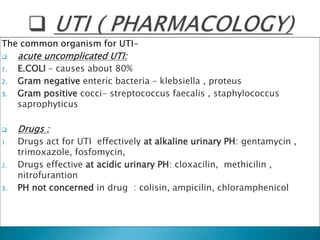
The common organism for UTI-
 acute uncomplicated UTI:
1. E.COLI – causes about 80%
2. Gram negative enteric bacteria – klebsiella , proteus
3. Gram positive cocci- streptococcus faecalis , staphylococcus
saprophyticus
 Drugs :
1. Drugs act for UTI effectively at alkaline urinary PH: gentamycin ,
trimoxazole, fosfomycin,
2. Drugs effective at acidic urinary PH: cloxacilin, methicilin ,
nitrofurantion
3. PH not concerned in drug : colisin, ampicilin, chloramphenicol
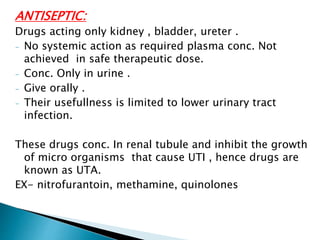
ANTISEPTIC:
Drugs acting only kidney , bladder, ureter .
- No systemic action as required plasma conc. Not
achieved in safe therapeutic dose.
- Conc. Only in urine .
- Give orally .
- Their usefullness is limited to lower urinary tract
infection.
These drugs conc. In renal tubule and inhibit the growth
of micro organisms that cause UTI , hence drugs are
known as UTA.
EX- nitrofurantoin, methamine, quinolones
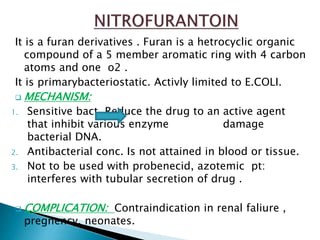
It is a furan derivatives . Furan is a hetrocyclic organic
compound of a 5 member aromatic ring with 4 carbon
atoms and one o2 .
It is primarybacteriostatic. Activly limited to E.COLI.
 MECHANISM:
1. Sensitive bact. Reduce the drug to an active agent
that inhibit various enzyme damage
bacterial DNA.
2. Antibacterial conc. Is not attained in blood or tissue.
3. Not to be used with probenecid, azotemic pt:
interferes with tubular secretion of drug .
 COMPLICATION: Contraindication in renal faliure ,
pregnency, neonates.
 USE:
1. Treatment for uncomplicated lower urinary tract infection
2. Supportive long term theory
3. Long term prophylaxis
4. Prevent bacteriuria after prostatectomy and chronic nephritis.
 DOSE:
1. 100 mg TDS for 10 day with milk/ food
2. 100 mg single dose daily / 50 mg BD for long term to prevent
UTI.
 ADVERSE EFFECT:
1. human cells take long time to degrade nitrofurantoin to toxic
intermediate hence toxicity in man is rare.
2. Urine becomes dark brown on exposure to air due to its
metabolite.
3. Gastrointestinal tolerance: nausea , epigastric pain, diarrhoea
4. Hypersensitivity: fever, chill
5. Hematologic disorder: leukopenia, hemolytic anemia in G6PD
deficient pt.
6. Liver damage, pulmonary reaction with fibrosis on chronic use.
7. Peripheral neuritis and neurological effect with long term use .
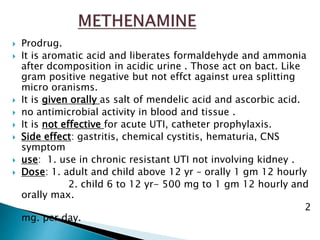
 Prodrug.
 It is aromatic acid and liberates formaldehyde and ammonia
after dcomposition in acidic urine . Those act on bact. Like
gram positive negative but not effct against urea splitting
micro oranisms.
 It is given orally as salt of mendelic acid and ascorbic acid.
 no antimicrobial activity in blood and tissue .
 It is not effective for acute UTI, catheter prophylaxis.
 Side effect: gastritis, chemical cystitis, hematuria, CNS
symptom
 use: 1. use in chronic resistant UTI not involving kidney .
 Dose: 1. adult and child above 12 yr – orally 1 gm 12 hourly
2. child 6 to 12 yr- 500 mg to 1 gm 12 hourly and
orally max.
2
mg. per day.
 urinary analgesic
 Use: a) relive burn
b) dysuria
c) other inflammation of UTI
 Adverse effect: nausea , vomiting, epigastric pain
 Trade name – tab. Pyridium
 Dose: a) adult: 100 mg to 400 mg 8 hourly orally after
meals orally
 Nonfluorinated quinolone.
 Bactericidal.
 Mechanism: a) inhibit the replication of bact. By
interfering with the action of DNA gyrase during
bacterial bacterial growth and development.
b) resistance developes rather rapidly.
 Use: 1. use in second line drugs for UTI.
2. use on basis of sensitivity reports.
3. seizures in children.
4. nausea, vomiting, abdominal pain
 Contraindicted in infants.
 Why it is not used now???
- Low potency only effective for gram ve- even not
for pseudomonas.
- Only locally. Active as urinary antiseptics.
- Not effective for systemic bcz 98.5% bound hence
blood and tissue level conc. Not up to effective
value.
- Also too rapidly excreted.
- Bacterial resistance frequent occur.
 IT is synthetic antimicrobials.
 Its effects against gram ve- but not pseudomonal.
 High bacterial resistance.
 USE:
1. in diarrhoea cases.
2. effective for ampicillin resistance.
 Unwanted effect:1) nausea, vomiting, abdominal pain,
diarrhoea
2) CNS effect- dizziness, headache,
tremor
3) rashes
4) pain and inflammation in
tendons
 ACTION:
IT inhibit replication of bact. DNA . They block the activity of
bacterial DNA gyrase and DNA topoisomerase, the enzymes
that form DNA supercoils and are essential for DNA
replication and repair. The effect is bactericidal.

Uti ( pharmacology)

  • 1.
    The common organismfor UTI-  acute uncomplicated UTI: 1. E.COLI – causes about 80% 2. Gram negative enteric bacteria – klebsiella , proteus 3. Gram positive cocci- streptococcus faecalis , staphylococcus saprophyticus  Drugs : 1. Drugs act for UTI effectively at alkaline urinary PH: gentamycin , trimoxazole, fosfomycin, 2. Drugs effective at acidic urinary PH: cloxacilin, methicilin , nitrofurantion 3. PH not concerned in drug : colisin, ampicilin, chloramphenicol
  • 2.
    ANTISEPTIC: Drugs acting onlykidney , bladder, ureter . - No systemic action as required plasma conc. Not achieved in safe therapeutic dose. - Conc. Only in urine . - Give orally . - Their usefullness is limited to lower urinary tract infection. These drugs conc. In renal tubule and inhibit the growth of micro organisms that cause UTI , hence drugs are known as UTA. EX- nitrofurantoin, methamine, quinolones
  • 3.
    It is afuran derivatives . Furan is a hetrocyclic organic compound of a 5 member aromatic ring with 4 carbon atoms and one o2 . It is primarybacteriostatic. Activly limited to E.COLI.  MECHANISM: 1. Sensitive bact. Reduce the drug to an active agent that inhibit various enzyme damage bacterial DNA. 2. Antibacterial conc. Is not attained in blood or tissue. 3. Not to be used with probenecid, azotemic pt: interferes with tubular secretion of drug .  COMPLICATION: Contraindication in renal faliure , pregnency, neonates.
  • 4.
     USE: 1. Treatmentfor uncomplicated lower urinary tract infection 2. Supportive long term theory 3. Long term prophylaxis 4. Prevent bacteriuria after prostatectomy and chronic nephritis.  DOSE: 1. 100 mg TDS for 10 day with milk/ food 2. 100 mg single dose daily / 50 mg BD for long term to prevent UTI.  ADVERSE EFFECT: 1. human cells take long time to degrade nitrofurantoin to toxic intermediate hence toxicity in man is rare. 2. Urine becomes dark brown on exposure to air due to its metabolite. 3. Gastrointestinal tolerance: nausea , epigastric pain, diarrhoea 4. Hypersensitivity: fever, chill 5. Hematologic disorder: leukopenia, hemolytic anemia in G6PD deficient pt. 6. Liver damage, pulmonary reaction with fibrosis on chronic use. 7. Peripheral neuritis and neurological effect with long term use .
  • 5.
     Prodrug.  Itis aromatic acid and liberates formaldehyde and ammonia after dcomposition in acidic urine . Those act on bact. Like gram positive negative but not effct against urea splitting micro oranisms.  It is given orally as salt of mendelic acid and ascorbic acid.  no antimicrobial activity in blood and tissue .  It is not effective for acute UTI, catheter prophylaxis.  Side effect: gastritis, chemical cystitis, hematuria, CNS symptom  use: 1. use in chronic resistant UTI not involving kidney .  Dose: 1. adult and child above 12 yr – orally 1 gm 12 hourly 2. child 6 to 12 yr- 500 mg to 1 gm 12 hourly and orally max. 2 mg. per day.
  • 6.
     urinary analgesic Use: a) relive burn b) dysuria c) other inflammation of UTI  Adverse effect: nausea , vomiting, epigastric pain  Trade name – tab. Pyridium  Dose: a) adult: 100 mg to 400 mg 8 hourly orally after meals orally
  • 7.
     Nonfluorinated quinolone. Bactericidal.  Mechanism: a) inhibit the replication of bact. By interfering with the action of DNA gyrase during bacterial bacterial growth and development. b) resistance developes rather rapidly.  Use: 1. use in second line drugs for UTI. 2. use on basis of sensitivity reports. 3. seizures in children. 4. nausea, vomiting, abdominal pain  Contraindicted in infants.
  • 8.
     Why itis not used now??? - Low potency only effective for gram ve- even not for pseudomonas. - Only locally. Active as urinary antiseptics. - Not effective for systemic bcz 98.5% bound hence blood and tissue level conc. Not up to effective value. - Also too rapidly excreted. - Bacterial resistance frequent occur.
  • 9.
     IT issynthetic antimicrobials.  Its effects against gram ve- but not pseudomonal.  High bacterial resistance.  USE: 1. in diarrhoea cases. 2. effective for ampicillin resistance.  Unwanted effect:1) nausea, vomiting, abdominal pain, diarrhoea 2) CNS effect- dizziness, headache, tremor 3) rashes 4) pain and inflammation in tendons  ACTION: IT inhibit replication of bact. DNA . They block the activity of bacterial DNA gyrase and DNA topoisomerase, the enzymes that form DNA supercoils and are essential for DNA replication and repair. The effect is bactericidal.