SULPHURIC  ACID
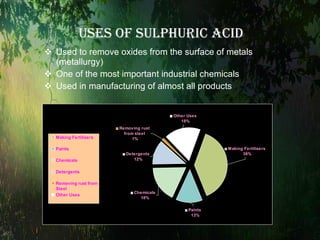
USES OF SULPHURIC ACID Used to remove oxides from the surface of metals (metallurgy) One of the most important industrial chemicals Used in manufacturing of almost all products
Mainly used in producing fertilisers Superphosphate fertilisers: Sulphuric acid + Calcium phosphate 2H 2 SO 4  + Ca 3 (PO 4 ) 2  -> Ca(H 2 PO 4 ) 2 Ammonia sulphate fertilisers: Sulphuric acid + Ammonia 2NH 3  + H 2 SO 4  -> (NH 4 )2SO 4 Sulphonic acid reacts with sodium hydroxide to form sodium alkyl sulphonate, which is a detergent.
MANUFACTURE OF SULPHURIC ACID Sulphuric acid is made from sulphur dioxide, SO 2 , by the  Contact Process . The raw materials used are sulphur, air and water and it consist of 3 stages
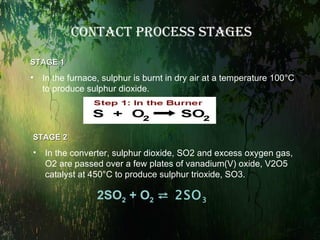
STAGE 1 In the furnace, sulphur is burnt in dry air at a temperature 100°C to produce sulphur dioxide. CONTACT PROCESS STAGES STAGE 2 In the converter, sulphur dioxide, SO2 and excess oxygen gas, O2 are passed over a few plates of vanadium(V) oxide, V2O5 catalyst at 450°C to produce sulphur trioxide, SO3.  2SO 2  + O 2   ⇄ 2SO 3
STAGE 3 In the absorber, the sulphur trioxide, SO 3  is first reacted with concentration sulphuric acid, H 2 SO 4  to form a product called oleum. The oleum, H2S2O7 is the dilute with water to produce concentrated sulphuric acid, H2SO4 in large quantities. The two reactions in the 3 rd  stage are equivalent to adding sulphur trioxide, SO3 directly to water. SO 3  + H 2 O -> H 2 SO 4 This reaction not carried out in industry because it is too vigorous. It produces a large cloud of sulphuric acid mist. This mist is corrosive and pollutes the air.
SULPHUR DIOXIDE AND ENVIRONMENTAL POLLUTION Effects in the human: Coughing Chest pain Shortness of breath Bronchitis Lung diseases Can cause acid rain Due to the reaction of SO 2  with rainwater 2SO 2  + O 2  + 2H 2 O  ->  2H 2 SO 4
BAD EFFECTS OF ACID RAIN Cause respiratory problems in human Corrodes the building and metal structures especially with carbonate and active metal Lakes and rivers become acidic A threat to aquatic life because the decrease of the pH value of the water  pH of the soil decreases Salts are leached out of the top soil Roots of trees are destroyed Plants die of malnutrition and diseases AIR POLLUTIONS WATER POLLUTIONS SOIL POLLUTIONS
REDUCING ACID RAIN Most acids causing acids rain are from: Sulphuric acid SO 3  + H 2 O  ->  H 2 SO 4 Sulphurous acid SO 2  + H 2 O  ->  H 2 SO 3 Carbonic acid CO 2  + H 2 O  ->  H 2 CO 3 But, it can be reduced by reacting the gas with:- Calcium carbonate   CaCO 3  + SO 2   ->  CaSO 3  + CO 2 Calcium oxide CaO + SO 2     CaSO 3 4CaO + 4SO 2  + 2O 2  ->  4CaSO 4 Calcium sulphate 2CaSO 3  + O 2   ->  2CaSO 4
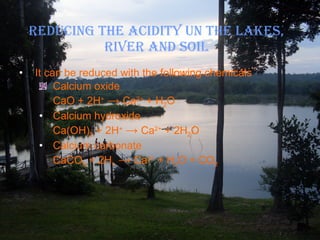
REDUCING THE ACIDITY UN THE LAKES, RIVER AND SOIL It can be reduced with the following chemicals Calcium oxide CaO + 2H +   ->  Ca 2+  + H 2 O Calcium hydroxide Ca(OH) 2  + 2H +   ->  Ca 2+  + 2H 2 O Calcium carbonate CaCO 3  + 2H +   ->  Ca 2+  + H 2 O + CO 2

Sulphuric Acid

  • 1.
  • 2.
    USES OF SULPHURICACID Used to remove oxides from the surface of metals (metallurgy) One of the most important industrial chemicals Used in manufacturing of almost all products
  • 3.
    Mainly used inproducing fertilisers Superphosphate fertilisers: Sulphuric acid + Calcium phosphate 2H 2 SO 4 + Ca 3 (PO 4 ) 2 -> Ca(H 2 PO 4 ) 2 Ammonia sulphate fertilisers: Sulphuric acid + Ammonia 2NH 3 + H 2 SO 4 -> (NH 4 )2SO 4 Sulphonic acid reacts with sodium hydroxide to form sodium alkyl sulphonate, which is a detergent.
  • 4.
    MANUFACTURE OF SULPHURICACID Sulphuric acid is made from sulphur dioxide, SO 2 , by the Contact Process . The raw materials used are sulphur, air and water and it consist of 3 stages
  • 5.
    STAGE 1 Inthe furnace, sulphur is burnt in dry air at a temperature 100°C to produce sulphur dioxide. CONTACT PROCESS STAGES STAGE 2 In the converter, sulphur dioxide, SO2 and excess oxygen gas, O2 are passed over a few plates of vanadium(V) oxide, V2O5 catalyst at 450°C to produce sulphur trioxide, SO3. 2SO 2 + O 2 ⇄ 2SO 3
  • 6.
    STAGE 3 Inthe absorber, the sulphur trioxide, SO 3 is first reacted with concentration sulphuric acid, H 2 SO 4 to form a product called oleum. The oleum, H2S2O7 is the dilute with water to produce concentrated sulphuric acid, H2SO4 in large quantities. The two reactions in the 3 rd stage are equivalent to adding sulphur trioxide, SO3 directly to water. SO 3 + H 2 O -> H 2 SO 4 This reaction not carried out in industry because it is too vigorous. It produces a large cloud of sulphuric acid mist. This mist is corrosive and pollutes the air.
  • 7.
    SULPHUR DIOXIDE ANDENVIRONMENTAL POLLUTION Effects in the human: Coughing Chest pain Shortness of breath Bronchitis Lung diseases Can cause acid rain Due to the reaction of SO 2 with rainwater 2SO 2 + O 2 + 2H 2 O -> 2H 2 SO 4
  • 8.
    BAD EFFECTS OFACID RAIN Cause respiratory problems in human Corrodes the building and metal structures especially with carbonate and active metal Lakes and rivers become acidic A threat to aquatic life because the decrease of the pH value of the water pH of the soil decreases Salts are leached out of the top soil Roots of trees are destroyed Plants die of malnutrition and diseases AIR POLLUTIONS WATER POLLUTIONS SOIL POLLUTIONS
  • 9.
    REDUCING ACID RAINMost acids causing acids rain are from: Sulphuric acid SO 3 + H 2 O -> H 2 SO 4 Sulphurous acid SO 2 + H 2 O -> H 2 SO 3 Carbonic acid CO 2 + H 2 O -> H 2 CO 3 But, it can be reduced by reacting the gas with:- Calcium carbonate CaCO 3 + SO 2 -> CaSO 3 + CO 2 Calcium oxide CaO + SO 2  CaSO 3 4CaO + 4SO 2 + 2O 2 -> 4CaSO 4 Calcium sulphate 2CaSO 3 + O 2 -> 2CaSO 4
  • 10.
    REDUCING THE ACIDITYUN THE LAKES, RIVER AND SOIL It can be reduced with the following chemicals Calcium oxide CaO + 2H + -> Ca 2+ + H 2 O Calcium hydroxide Ca(OH) 2 + 2H + -> Ca 2+ + 2H 2 O Calcium carbonate CaCO 3 + 2H + -> Ca 2+ + H 2 O + CO 2