DEPARTMENT OF ELECTRICAL ENGINEERING
Submitted to
Mr. Hemant Amahiya Sir,
Lecturer
DEPTT.OF ELECTRICAL
ENGINEERING
JEC,JABALPUR
Submitted By
SUBHASH DHAKAR
(0201EE071056)
V th SEM, EE
YEAR:2009
• “ Can you see in dark?”
• The answer is most definitely yes. with the proper
night -vision equipment,you can see a person
standing over 200 yards (183 m) away on a
moonless, cloudy night.
• Ability to see in dark night.
 The first night vision devices (NVD) were
created duringWWII.
• Pre 1940’s: Flares and spot lights were used for
operations at night.
• Functioned by placing an infrared filter over a
searchlight.
 A tank fromWorld
War II equipped
with a search light
used for night
combat.
• Thermal imaging
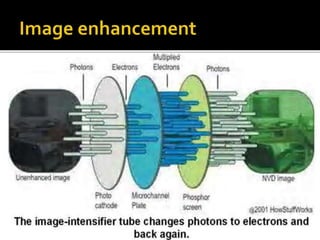
• Image enhancement
 The screen was
purposefully colored
green due to the
scientific fact that the
human eye can
differentiate more
shades of green that
any other color
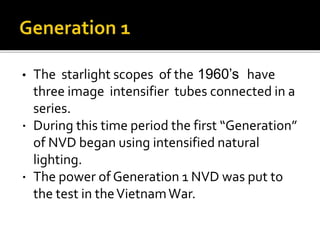
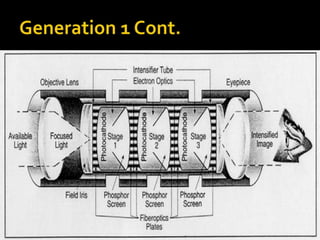
• The starlight scopes of the 1960’s have
three image intensifier tubes connected in a
series.
 During this time period the first “Generation”
of NVD began using intensified natural
lighting.
 The power of Generation 1 NVD was put to
the test in theVietnamWar.
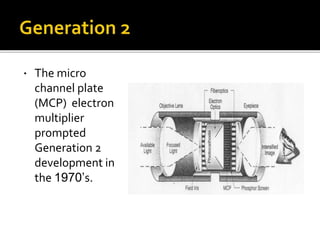
 The micro
channel plate
(MCP) electron
multiplier
prompted
Generation 2
development in
the 1970’s.
 These thermal imagers were expensive, so in
1973 scientists created a common module
that made it less expensive, and more ideal
for military use.
 The generation 2 NVD were first put to the
test by US forces in the early 1990’s during
Operation Desert Storm in Kuwait.
 The currently generations of NVS are
generations 3 and 4.
 Generation 3 is much like generation 2
except for it has a substantially longer life, as
well as more defined images.
 Generation 4 has less noise than generation
3, however it has shorter life.
 Here is a chart comparing the life in hours of
the intensification tube for generations 1-3
Generation 1 Generation 2 Generation 3
2,000 hours 2,500- 4,000
hours
10,000 hours
 Development of NVD up until the 1980’s was
completely focused around military purposes.
• In the 80’s, companies in the US and Europe
took NVT and found ways to improve
everyday civilian life.
 There are many practical everyday uses for NVD,
some of which are:
 Law Enforcement
 Hunting
 Wildlife observation
 Security
 Navigation
 Hidden-Object detection
 Entertainment
 In conclusion I believe that is wonderful how
something originally designed for
destruction, can now help people on an
every-day basis.
 This is truly amazing technology.
night vision

night vision

  • 1.
    DEPARTMENT OF ELECTRICALENGINEERING Submitted to Mr. Hemant Amahiya Sir, Lecturer DEPTT.OF ELECTRICAL ENGINEERING JEC,JABALPUR Submitted By SUBHASH DHAKAR (0201EE071056) V th SEM, EE YEAR:2009
  • 2.
    • “ Canyou see in dark?” • The answer is most definitely yes. with the proper night -vision equipment,you can see a person standing over 200 yards (183 m) away on a moonless, cloudy night. • Ability to see in dark night.
  • 4.
     The firstnight vision devices (NVD) were created duringWWII. • Pre 1940’s: Flares and spot lights were used for operations at night. • Functioned by placing an infrared filter over a searchlight.
  • 5.
     A tankfromWorld War II equipped with a search light used for night combat.
  • 6.
    • Thermal imaging •Image enhancement
  • 9.
     The screenwas purposefully colored green due to the scientific fact that the human eye can differentiate more shades of green that any other color
  • 10.
    • The starlightscopes of the 1960’s have three image intensifier tubes connected in a series.  During this time period the first “Generation” of NVD began using intensified natural lighting.  The power of Generation 1 NVD was put to the test in theVietnamWar.
  • 12.
     The micro channelplate (MCP) electron multiplier prompted Generation 2 development in the 1970’s.
  • 13.
     These thermalimagers were expensive, so in 1973 scientists created a common module that made it less expensive, and more ideal for military use.  The generation 2 NVD were first put to the test by US forces in the early 1990’s during Operation Desert Storm in Kuwait.
  • 14.
     The currentlygenerations of NVS are generations 3 and 4.  Generation 3 is much like generation 2 except for it has a substantially longer life, as well as more defined images.  Generation 4 has less noise than generation 3, however it has shorter life.
  • 15.
     Here isa chart comparing the life in hours of the intensification tube for generations 1-3 Generation 1 Generation 2 Generation 3 2,000 hours 2,500- 4,000 hours 10,000 hours
  • 16.
     Development ofNVD up until the 1980’s was completely focused around military purposes. • In the 80’s, companies in the US and Europe took NVT and found ways to improve everyday civilian life.
  • 17.
     There aremany practical everyday uses for NVD, some of which are:  Law Enforcement  Hunting  Wildlife observation
  • 18.
     Security  Navigation Hidden-Object detection  Entertainment
  • 19.
     In conclusionI believe that is wonderful how something originally designed for destruction, can now help people on an every-day basis.  This is truly amazing technology.