“To be, or not to be?” is
not a thesis statement
“To be, or not to be?” is a question
!
(“Why don’t I just kill myself already?!”
—Hamlet, the original emo kid)
Thesis statements are (less
melodramatic) statements
Thesis statements are, in
fact, arguable statements
Therefore, a strong thesis
statement will (like any good
arguable statement) do four things.
1. Take a stand.
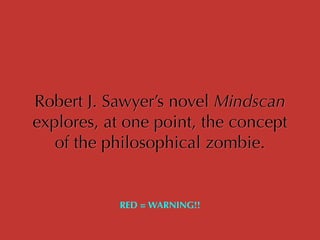
Robert J. Sawyer’s novel Mindscan
explores, at one point, the concept
of the philosophical zombie.
RED = WARNING!!
Yes. It does.
!
I’m glad we had this talk!!!
A strong thesis statement takes a stand by risking
an argument that the reader could sensibly reject.
!
If you disagreed with me about how RJS’s novel
discusses “the philosophical zombie,” then you
were wrong. I just need to turn to page 194 to
prove you wrong. What’s the fun in that?
Robert J. Sawyer uses literary
devices to refute the idea that the
machine characters in his novel
are philosophical zombies.
“No he doesn’t! Did you get
your degree from a cereal box?”
!
Now, we’re getting somewhere.
2. Justify the discussion.
Robert J. Sawyer uses literary
devices to refute the idea that the
machine characters in his novel
are philosophical zombies.
Okay. But, like,
who cares?
Well, who cares?
Who cares about using
literature to refute arguments?
!
Authors might care.
Literary critics might care.
What about, specifically, refuting the
philosophical zombie?
!
(This is a philosophical argument with
scientific applications.)
Philosophers might care.
Scientists might care.
Authors, literary critics, philosophers,
scientists…
!
Science Fiction authors might care.
Robert J. Sawyer uses literary devices to
refute the idea that the machine
characters in his novel are philosophical
zombies, thereby suggesting that science
fiction authors have a role to play in the
process of scientific exploration.
3. Express one main idea.
Robert J. Sawyer uses literary devices…
!
Which ones?
A good question, but…
Robert J. Sawyer uses narrative voice and
metaphors and space travel and a cool font
and lots themes and the afterword and beer
and a dog and stuff to refute the idea that the
machine characters in his novel are
philosophical zombies, thereby suggesting that
science fiction authors have a role to play in
the process of scientific exploration.
Pick one.
Robert J. Sawyer uses narrative voice to
refute the idea that the machine
characters in his novel are philosophical
zombies, thereby suggesting that science
fiction authors have a role to play in the
process of scientific exploration.
4. Be specific.
Be Specific
If you aren’t Being Specific,
then you are just writing B.S.
Robert J. Sawyer uses narrative voice
[what kind?] to refute [suggests an essay;
isn’t this literature?] the idea [idea, or
argument?] that the machine characters
[aren’t they really human “copies”?] in his
novel [what novel?] are philosophical
zombies [are what?], thereby suggesting
that science fiction authors have a role
[what role?] to play in the process of
scientific exploration.
Robert J. Sawyer’s novel Mindscan uses
first-person, character-based narration to
present a literary refutation of the
argument that human “copies” like his
characters would be “philosophical
zombies” and not conscious, thereby
suggesting that science fiction authors
experiment with ideas in literary
laboratories and thus participate in the
process of scientific exploration.
Thesis Statements summarize arguments.
!
They take a stand.
They justify discussion.
They express one main idea.
They are specific.
Hamlet skipped his classes in
order to hang out with ghosts.
!
He was only good at two things:
sulking and dying.
!
He wasn’t much for writing essays.

To be or not to be is not a thesis statement

  • 1.
    “To be, ornot to be?” is not a thesis statement
  • 2.
    “To be, ornot to be?” is a question ! (“Why don’t I just kill myself already?!” —Hamlet, the original emo kid)
  • 3.
    Thesis statements are(less melodramatic) statements
  • 4.
    Thesis statements are,in fact, arguable statements
  • 5.
    Therefore, a strongthesis statement will (like any good arguable statement) do four things.
  • 6.
    1. Take astand.
  • 7.
    Robert J. Sawyer’snovel Mindscan explores, at one point, the concept of the philosophical zombie. RED = WARNING!!
  • 8.
    Yes. It does. ! I’mglad we had this talk!!!
  • 9.
    A strong thesisstatement takes a stand by risking an argument that the reader could sensibly reject. ! If you disagreed with me about how RJS’s novel discusses “the philosophical zombie,” then you were wrong. I just need to turn to page 194 to prove you wrong. What’s the fun in that?
  • 10.
    Robert J. Sawyeruses literary devices to refute the idea that the machine characters in his novel are philosophical zombies.
  • 11.
    “No he doesn’t!Did you get your degree from a cereal box?” ! Now, we’re getting somewhere.
  • 12.
    2. Justify thediscussion.
  • 13.
    Robert J. Sawyeruses literary devices to refute the idea that the machine characters in his novel are philosophical zombies.
  • 14.
  • 15.
  • 16.
    Who cares aboutusing literature to refute arguments? ! Authors might care. Literary critics might care.
  • 17.
    What about, specifically,refuting the philosophical zombie? ! (This is a philosophical argument with scientific applications.)
  • 18.
  • 19.
    Authors, literary critics,philosophers, scientists… ! Science Fiction authors might care.
  • 20.
    Robert J. Sawyeruses literary devices to refute the idea that the machine characters in his novel are philosophical zombies, thereby suggesting that science fiction authors have a role to play in the process of scientific exploration.
  • 21.
    3. Express onemain idea.
  • 22.
    Robert J. Sawyeruses literary devices… ! Which ones?
  • 23.
  • 24.
    Robert J. Sawyeruses narrative voice and metaphors and space travel and a cool font and lots themes and the afterword and beer and a dog and stuff to refute the idea that the machine characters in his novel are philosophical zombies, thereby suggesting that science fiction authors have a role to play in the process of scientific exploration.
  • 25.
  • 26.
    Robert J. Sawyeruses narrative voice to refute the idea that the machine characters in his novel are philosophical zombies, thereby suggesting that science fiction authors have a role to play in the process of scientific exploration.
  • 27.
  • 28.
  • 29.
    If you aren’tBeing Specific, then you are just writing B.S.
  • 30.
    Robert J. Sawyeruses narrative voice [what kind?] to refute [suggests an essay; isn’t this literature?] the idea [idea, or argument?] that the machine characters [aren’t they really human “copies”?] in his novel [what novel?] are philosophical zombies [are what?], thereby suggesting that science fiction authors have a role [what role?] to play in the process of scientific exploration.
  • 31.
    Robert J. Sawyer’snovel Mindscan uses first-person, character-based narration to present a literary refutation of the argument that human “copies” like his characters would be “philosophical zombies” and not conscious, thereby suggesting that science fiction authors experiment with ideas in literary laboratories and thus participate in the process of scientific exploration.
  • 32.
    Thesis Statements summarizearguments. ! They take a stand. They justify discussion. They express one main idea. They are specific.
  • 33.
    Hamlet skipped hisclasses in order to hang out with ghosts. ! He was only good at two things: sulking and dying. ! He wasn’t much for writing essays.