NIGHT VISION TECHNOLOGY
(A MIRACLE !)
BY –
SACHIN
2315639
THE BULLETS DON’T CARE HOW DARK IT IS
CONTENTS
Introduction to Night Vision
History
Biological Night Vision
Technical Night Vision categories
Night Vision Devices
Applications of Night Vision technology
Night Vision system in cars
Conclusion
INTRODUCTION
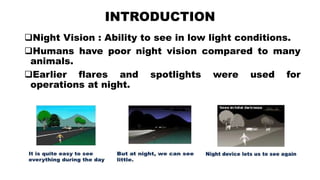
Night Vision : Ability to see in low light conditions.
Humans have poor night vision compared to many
animals.
Earlier flares and spotlights were used for
operations at night.
HISTORY
Originally developed for military use.
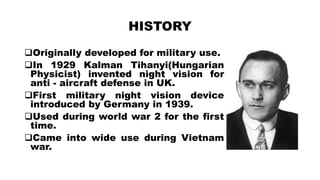
In 1929 Kalman Tihanyi(Hungarian
Physicist) invented night vision for
anti - aircraft defense in UK.
First military night vision device
introduced by Germany in 1939.
Used during world war 2 for the first
time.
Came into wide use during Vietnam
war.
HOW FAR CAN WE SEE?
 Recognition Range : Approx. 200m.
o On a moonless cloudy night we can tell the
difference between a male and a female or a dog
and a deer standing at about 200m.
 Detection Range : Depends on two variables
o Size of the object
o Lighting conditions
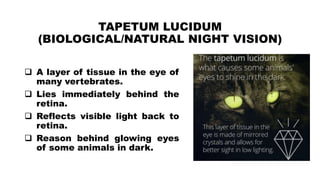
TAPETUM LUCIDUM
(BIOLOGICAL/NATURAL NIGHT VISION)
 A layer of tissue in the eye of
many vertebrates.
 Lies immediately behind the
retina.
 Reflects visible light back to
retina.
 Reason behind glowing eyes
of some animals in dark.
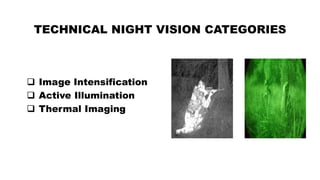
TECHNICAL NIGHT VISION CATEGORIES
 Image Intensification
 Active Illumination
 Thermal Imaging
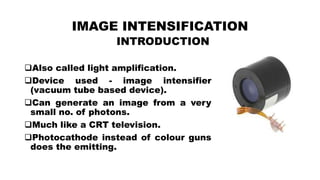
IMAGE INTENSIFICATION
INTRODUCTION
Also called light amplification.
Device used - image intensifier
(vacuum tube based device).
Can generate an image from a very
small no. of photons.
Much like a CRT television.
Photocathode instead of colour guns
does the emitting.
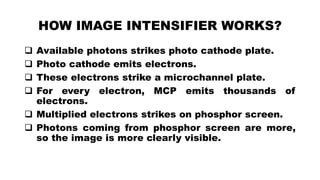
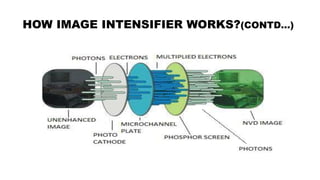
HOW IMAGE INTENSIFIER WORKS?
 Available photons strikes photo cathode plate.
 Photo cathode emits electrons.
 These electrons strike a microchannel plate.
 For every electron, MCP emits thousands of
electrons.
 Multiplied electrons strikes on phosphor screen.
 Photons coming from phosphor screen are more,
so the image is more clearly visible.
HOW IMAGE INTENSIFIER WORKS?(CONTD…)
PHOTO CATHODE
 Negatively charged electrode.
 Coated with photosensitive compound(mainly
alkali metals).
 Emits electron when struck by photons due to
photoelectric effect.
 Some photo cathode materials are :
o GaAs (Gallium Arsenide)
o InGaAs (Indium Gallium Arsenide)
o Cs-Te (Caesium-Telluride)
o Cs-I (Caesium-Iodide)
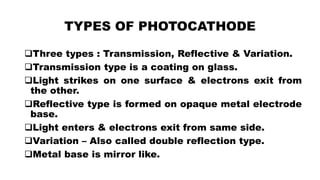
TYPES OF PHOTOCATHODE
Three types : Transmission, Reflective & Variation.
Transmission type is a coating on glass.
Light strikes on one surface & electrons exit from
the other.
Reflective type is formed on opaque metal electrode
base.
Light enters & electrons exit from same side.
Variation – Also called double reflection type.
Metal base is mirror like.
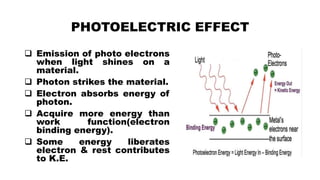
PHOTOELECTRIC EFFECT
 Emission of photo electrons
when light shines on a
material.
 Photon strikes the material.
 Electron absorbs energy of
photon.
 Acquire more energy than
work function(electron
binding energy).
 Some energy liberates
electron & rest contributes
to K.E.
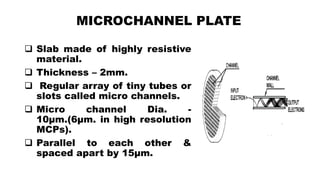
MICROCHANNEL PLATE
 Slab made of highly resistive
material.
 Thickness – 2mm.
 Regular array of tiny tubes or
slots called micro channels.
 Micro channel Dia. -
10µm.(6µm. in high resolution
MCPs).
 Parallel to each other &
spaced apart by 15µm.
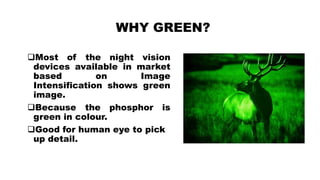
WHY GREEN?
Most of the night vision
devices available in market
based on Image
Intensification shows green
image.
Because the phosphor is
green in colour.
Good for human eye to pick
up detail.
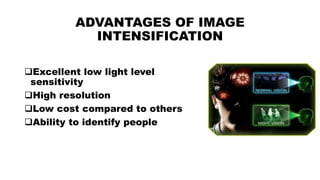
ADVANTAGES OF IMAGE
INTENSIFICATION
Excellent low light level
sensitivity
High resolution
Low cost compared to others
Ability to identify people
DISADVANTAGES OF IMAGE
INTENSIFICATION
Possibility of damage when
observing bright sources
under low light conditions.
Not useful when there is
essentially no light.
Lack of colour discrimination.
ACTIVE ILLUMINATION
 Lighting whose direction, intensity, and pattern
are controlled by commands or signals.
 Couples Image Intensification technology with an
active source of illumination.
 Risk of getting detected in military operations.
 High range of vision even in fog & smoky areas.
 Used in high speed video capturing of the vehicle
movement.
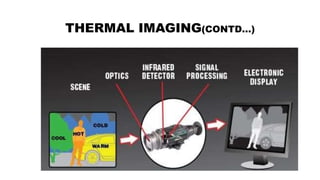
THERMAL IMAGING
 Works on IR radiations.
 Higher the temp., more are
the radiations.
 Detects the temp. difference
& create detailed temp.
pattern called Thermogram.
 Thermogram translated into
electric impulses.
 Processor translates these
impulses into data(diff.
colour for diff. temp.) to
display.
THERMAL IMAGING(CONTD…)
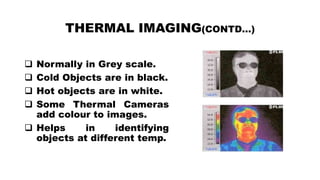
 Normally in Grey scale.
 Cold Objects are in black.
 Hot objects are in white.
 Some Thermal Cameras
add colour to images.
 Helps in identifying
objects at different temp.
THERMAL IMAGING(CONTD…)
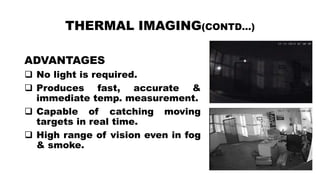
ADVANTAGES
 No light is required.
 Produces fast, accurate &
immediate temp. measurement.
 Capable of catching moving
targets in real time.
 High range of vision even in fog
& smoke.
THERMAL IMAGING(CONTD…)
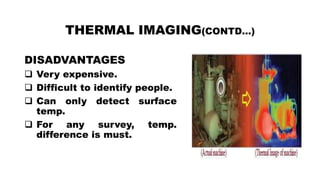
DISADVANTAGES
 Very expensive.
 Difficult to identify people.
 Can only detect surface
temp.
 For any survey, temp.
difference is must.
NIGHT VISION DEVICES
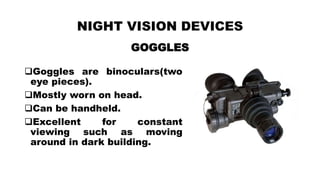
GOGGLES
Goggles are binoculars(two
eye pieces).
Mostly worn on head.
Can be handheld.
Excellent for constant
viewing such as moving
around in dark building.
NIGHT VISION DEVICES(CONTD…)
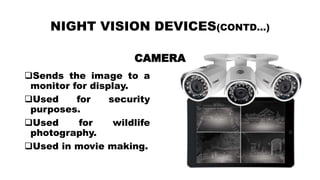
CAMERA
Sends the image to a
monitor for display.
Used for security
purposes.
Used for wildlife
photography.
Used in movie making.
NIGHT VISION DEVICES(CONTD…)
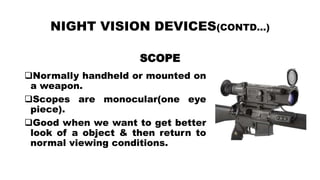
SCOPE
Normally handheld or mounted on
a weapon.
Scopes are monocular(one eye
piece).
Good when we want to get better
look of a object & then return to
normal viewing conditions.
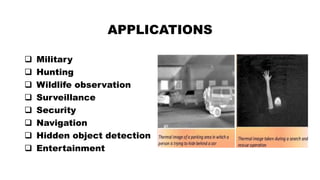
APPLICATIONS
 Military
 Hunting
 Wildlife observation
 Surveillance
 Security
 Navigation
 Hidden object detection
 Entertainment
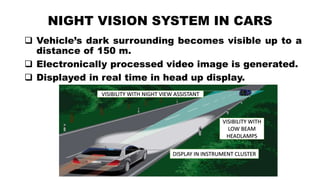
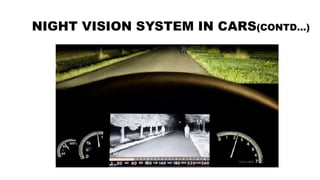
NIGHT VISION SYSTEM IN CARS
 Vehicle’s dark surrounding becomes visible up to a
distance of 150 m.
 Electronically processed video image is generated.
 Displayed in real time in head up display.
DISPLAY IN INSTRUMENT CLUSTER
VISIBILITY WITH NIGHT VIEW ASSISTANT
VISIBILITY WITH
LOW BEAM
HEADLAMPS
NIGHT VISION SYSTEM IN CARS(CONTD…)
CONCLUSION
It’s a critical study.
Plays vital role in modern world.
Involved with advance use of science & technology.
Advances in technology have created tremendous
opportunities for vision system.
Applicable in various fields.
THANK YOU

PPT on night vision technology

  • 1.
    NIGHT VISION TECHNOLOGY (AMIRACLE !) BY – SACHIN 2315639 THE BULLETS DON’T CARE HOW DARK IT IS
  • 2.
    CONTENTS Introduction to NightVision History Biological Night Vision Technical Night Vision categories Night Vision Devices Applications of Night Vision technology Night Vision system in cars Conclusion
  • 3.
    INTRODUCTION Night Vision :Ability to see in low light conditions. Humans have poor night vision compared to many animals. Earlier flares and spotlights were used for operations at night.
  • 4.
    HISTORY Originally developed formilitary use. In 1929 Kalman Tihanyi(Hungarian Physicist) invented night vision for anti - aircraft defense in UK. First military night vision device introduced by Germany in 1939. Used during world war 2 for the first time. Came into wide use during Vietnam war.
  • 5.
    HOW FAR CANWE SEE?  Recognition Range : Approx. 200m. o On a moonless cloudy night we can tell the difference between a male and a female or a dog and a deer standing at about 200m.  Detection Range : Depends on two variables o Size of the object o Lighting conditions
  • 6.
    TAPETUM LUCIDUM (BIOLOGICAL/NATURAL NIGHTVISION)  A layer of tissue in the eye of many vertebrates.  Lies immediately behind the retina.  Reflects visible light back to retina.  Reason behind glowing eyes of some animals in dark.
  • 7.
    TECHNICAL NIGHT VISIONCATEGORIES  Image Intensification  Active Illumination  Thermal Imaging
  • 8.
    IMAGE INTENSIFICATION INTRODUCTION Also calledlight amplification. Device used - image intensifier (vacuum tube based device). Can generate an image from a very small no. of photons. Much like a CRT television. Photocathode instead of colour guns does the emitting.
  • 9.
    HOW IMAGE INTENSIFIERWORKS?  Available photons strikes photo cathode plate.  Photo cathode emits electrons.  These electrons strike a microchannel plate.  For every electron, MCP emits thousands of electrons.  Multiplied electrons strikes on phosphor screen.  Photons coming from phosphor screen are more, so the image is more clearly visible.
  • 10.
    HOW IMAGE INTENSIFIERWORKS?(CONTD…)
  • 12.
    PHOTO CATHODE  Negativelycharged electrode.  Coated with photosensitive compound(mainly alkali metals).  Emits electron when struck by photons due to photoelectric effect.  Some photo cathode materials are : o GaAs (Gallium Arsenide) o InGaAs (Indium Gallium Arsenide) o Cs-Te (Caesium-Telluride) o Cs-I (Caesium-Iodide)
  • 13.
    TYPES OF PHOTOCATHODE Threetypes : Transmission, Reflective & Variation. Transmission type is a coating on glass. Light strikes on one surface & electrons exit from the other. Reflective type is formed on opaque metal electrode base. Light enters & electrons exit from same side. Variation – Also called double reflection type. Metal base is mirror like.
  • 14.
    PHOTOELECTRIC EFFECT  Emissionof photo electrons when light shines on a material.  Photon strikes the material.  Electron absorbs energy of photon.  Acquire more energy than work function(electron binding energy).  Some energy liberates electron & rest contributes to K.E.
  • 15.
    MICROCHANNEL PLATE  Slabmade of highly resistive material.  Thickness – 2mm.  Regular array of tiny tubes or slots called micro channels.  Micro channel Dia. - 10µm.(6µm. in high resolution MCPs).  Parallel to each other & spaced apart by 15µm.
  • 16.
    WHY GREEN? Most ofthe night vision devices available in market based on Image Intensification shows green image. Because the phosphor is green in colour. Good for human eye to pick up detail.
  • 17.
    ADVANTAGES OF IMAGE INTENSIFICATION Excellentlow light level sensitivity High resolution Low cost compared to others Ability to identify people
  • 18.
    DISADVANTAGES OF IMAGE INTENSIFICATION Possibilityof damage when observing bright sources under low light conditions. Not useful when there is essentially no light. Lack of colour discrimination.
  • 19.
    ACTIVE ILLUMINATION  Lightingwhose direction, intensity, and pattern are controlled by commands or signals.  Couples Image Intensification technology with an active source of illumination.  Risk of getting detected in military operations.  High range of vision even in fog & smoky areas.  Used in high speed video capturing of the vehicle movement.
  • 20.
    THERMAL IMAGING  Workson IR radiations.  Higher the temp., more are the radiations.  Detects the temp. difference & create detailed temp. pattern called Thermogram.  Thermogram translated into electric impulses.  Processor translates these impulses into data(diff. colour for diff. temp.) to display.
  • 21.
    THERMAL IMAGING(CONTD…)  Normallyin Grey scale.  Cold Objects are in black.  Hot objects are in white.  Some Thermal Cameras add colour to images.  Helps in identifying objects at different temp.
  • 22.
  • 23.
    THERMAL IMAGING(CONTD…) ADVANTAGES  Nolight is required.  Produces fast, accurate & immediate temp. measurement.  Capable of catching moving targets in real time.  High range of vision even in fog & smoke.
  • 24.
    THERMAL IMAGING(CONTD…) DISADVANTAGES  Veryexpensive.  Difficult to identify people.  Can only detect surface temp.  For any survey, temp. difference is must.
  • 25.
    NIGHT VISION DEVICES GOGGLES Gogglesare binoculars(two eye pieces). Mostly worn on head. Can be handheld. Excellent for constant viewing such as moving around in dark building.
  • 26.
    NIGHT VISION DEVICES(CONTD…) CAMERA Sendsthe image to a monitor for display. Used for security purposes. Used for wildlife photography. Used in movie making.
  • 27.
    NIGHT VISION DEVICES(CONTD…) SCOPE Normallyhandheld or mounted on a weapon. Scopes are monocular(one eye piece). Good when we want to get better look of a object & then return to normal viewing conditions.
  • 28.
    APPLICATIONS  Military  Hunting Wildlife observation  Surveillance  Security  Navigation  Hidden object detection  Entertainment
  • 29.
    NIGHT VISION SYSTEMIN CARS  Vehicle’s dark surrounding becomes visible up to a distance of 150 m.  Electronically processed video image is generated.  Displayed in real time in head up display. DISPLAY IN INSTRUMENT CLUSTER VISIBILITY WITH NIGHT VIEW ASSISTANT VISIBILITY WITH LOW BEAM HEADLAMPS
  • 30.
    NIGHT VISION SYSTEMIN CARS(CONTD…)
  • 31.
    CONCLUSION It’s a criticalstudy. Plays vital role in modern world. Involved with advance use of science & technology. Advances in technology have created tremendous opportunities for vision system. Applicable in various fields.
  • 32.