Night vision technology allows one to see in low-light or no-light conditions through either thermal imaging or image enhancement. Thermal imaging detects infrared light emitted as heat from objects, while image enhancement collects available light including infrared and amplifies it using an image intensifier tube. Night vision has military and civilian applications and has advanced from Generation 1 to Generation 3 technology, improving light amplification, resolution, and operational lifespan. Key factors that impact night vision usage include textures, light levels, and reduced color detection compared to normal vision.


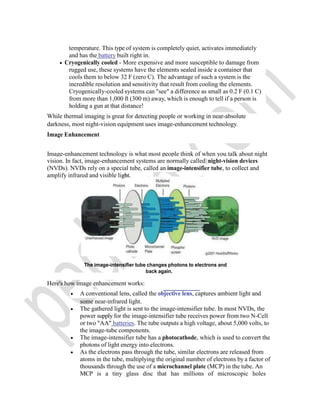

![Generations
Generation 0 - The earliest (1950's) night vision products were based on image
conversion, rather than intensification. They required a source of invisible infrared (IR)
light mounted on or near the device to illuminate the target area.
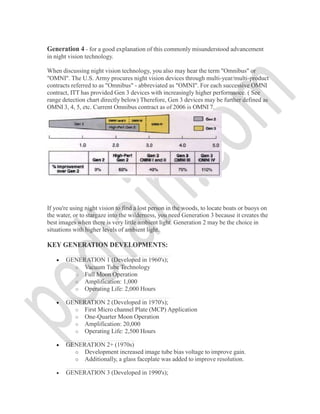
Generation 1 - The "starlight scopes" of the 1960's (Vietnam Era) have three image
intensifier tubes connected in a series. These systems are larger and heavier than Gen 2
and Gen 3. The Gen 1 image is clear at the center but may be distorted around the edges.
(Low-cost Gen 1 imports are often mislabeled as a higher generation.
Figure 1 illustrates first-generation night vision. [Not a great topic sentence but it does
has the advantage of calling attention to the figure.] Incoming light is collimated by fiber
optic plates before impacting a photocathode t which releases electrons, which in turn
impact a phosphor screen. The excited screen emits green light into a second fiber optic
plate, and the process is repeated. The complete process is repeated three times providing
an overall gain of 10,000.
Generation 2 - The micro channel plate (MCP) electron multiplier prompted Gen 2
development in the 1970s. The "gain" provided by the MCP eliminated the need for
back-to-back tubes - thereby improving size and image quality. The MCP enabled
development of hand held and helmet mounted goggles.](https://image.slidesharecdn.com/night-vision-technology-seminar-report-pdf-130805071844-phpapp01/85/Night-vision-technology-seminar-report-pdf-7-320.jpg)
![Second-generation image intensification significantly increased gain and resolution by
employing a microchannel plate. Figure 2 depicts the basic configuration. [These two
sentences could have been combined: "Figure2 depicts how second-generation image ...
plate."] The microchannel plate is composed of several million microscopic hollow glass
channels fused into a disk. Each channel, approximately 0.0125 mm in diameter, is
coated with a special semiconductor which easily liberates electrons. A single electron
entering a channel initiates an avalanche process of secondary emission, under influence
of an applied voltage, freeing hundreds of electrons. These electrons, effectively
collimated by the channel, increase the resolution of the device. With additional electron
optics, details as fine as 0.025 mm can be realized (half the diameter of a human hair).
Current image intensifiers incorporate their predecessor's resolution with additional light
amplification. The multialkali photocathode is replaced with a gallium arsenide
photocathode; this extends the wavelength sensitivity of the detector into the near
infrared. The moon and stars provide light in these wavelengths, which boosts the
effectively available light by approximately 30%, bringing the total gain of the system to
around 30,000.
[No topic sentence. Indeed one might have moved this material to the front in a more
dramatic way, perhaps by calling attention to the movie `Silence of the Lambs.'] slight
green tint similar to some sunglasses. The apparent lighting of the landscape on a dark
night is comparable to what the unaided eye would see on a clear winter night with fresh
snow on the ground and a full moon.
Generation 3 - Two major advancements characterized development of Gen 3 in the
late 1970s and early 1980s: the gallium arsenide (GaAs) photocathode and the ion-barrier
film on the MCP. The GaAs photocathode enabled detection of objects at greater
distances under much darker conditions. The ion-barrier film increased the operational
life of the tube from 2000 hours (Gen 2) to 10,000 (Gen 3), as demonstrated by actual
testing and not extrapolation.](https://image.slidesharecdn.com/night-vision-technology-seminar-report-pdf-130805071844-phpapp01/85/Night-vision-technology-seminar-report-pdf-8-320.jpg)