Variational Inference
Natan Katz
Raanana AI
06/01/2020
What is Bayesian Inference?
Sampling
When NICE met VI
Rigorous Foundation
Two words on Numeric
WHAT IS
BAYESIAN
INFERENCE?
Bayesian Inference -Notations
4
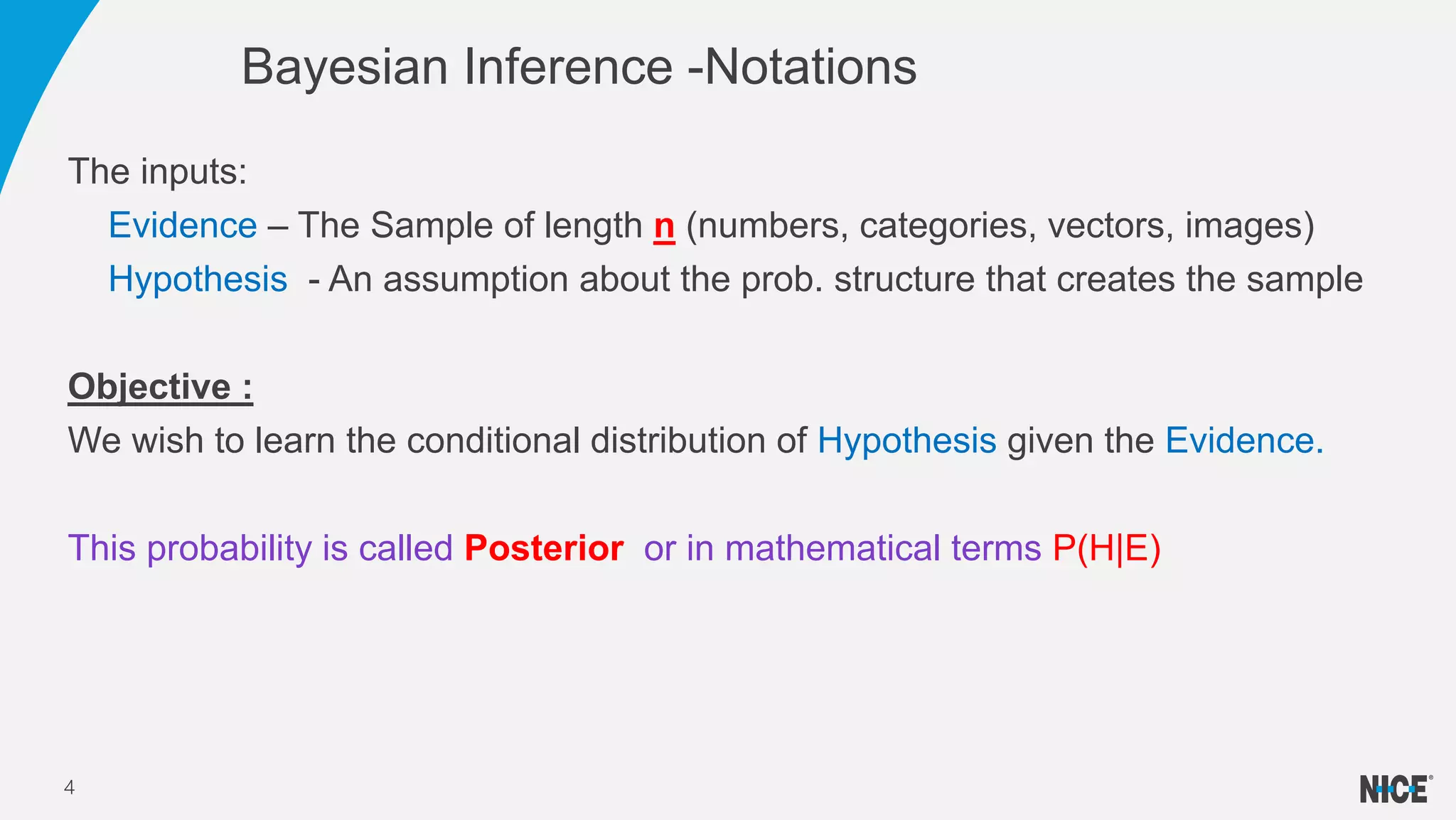
The inputs:
Evidence – The Sample of length n (numbers, categories, vectors, images)
Hypothesis - An assumption about the prob. structure that creates the sample
Objective :
We wish to learn the conditional distribution of Hypothesis given the Evidence.
This probability is called Posterior or in mathematical terms P(H|E)
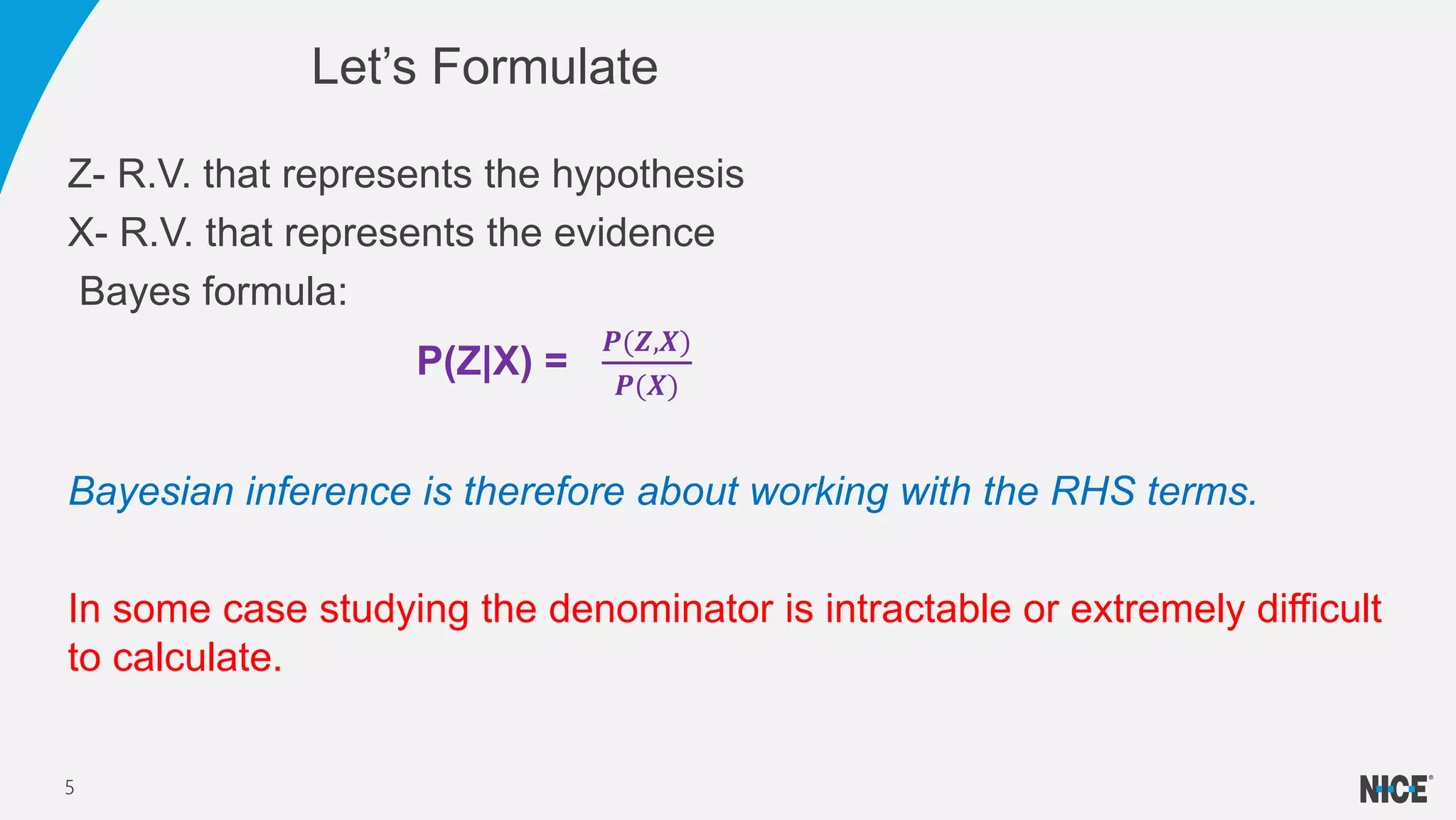
Z- R.V. that represents the hypothesis
X- R.V. that represents the evidence
Bayes formula:
P(Z|X) =
𝑷(𝒁,𝑿)
𝑷(𝑿)
Bayesian inference is therefore about working with the RHS terms.
In some case studying the denominator is intractable or extremely difficult
to calculate.
Let’s Formulate
5
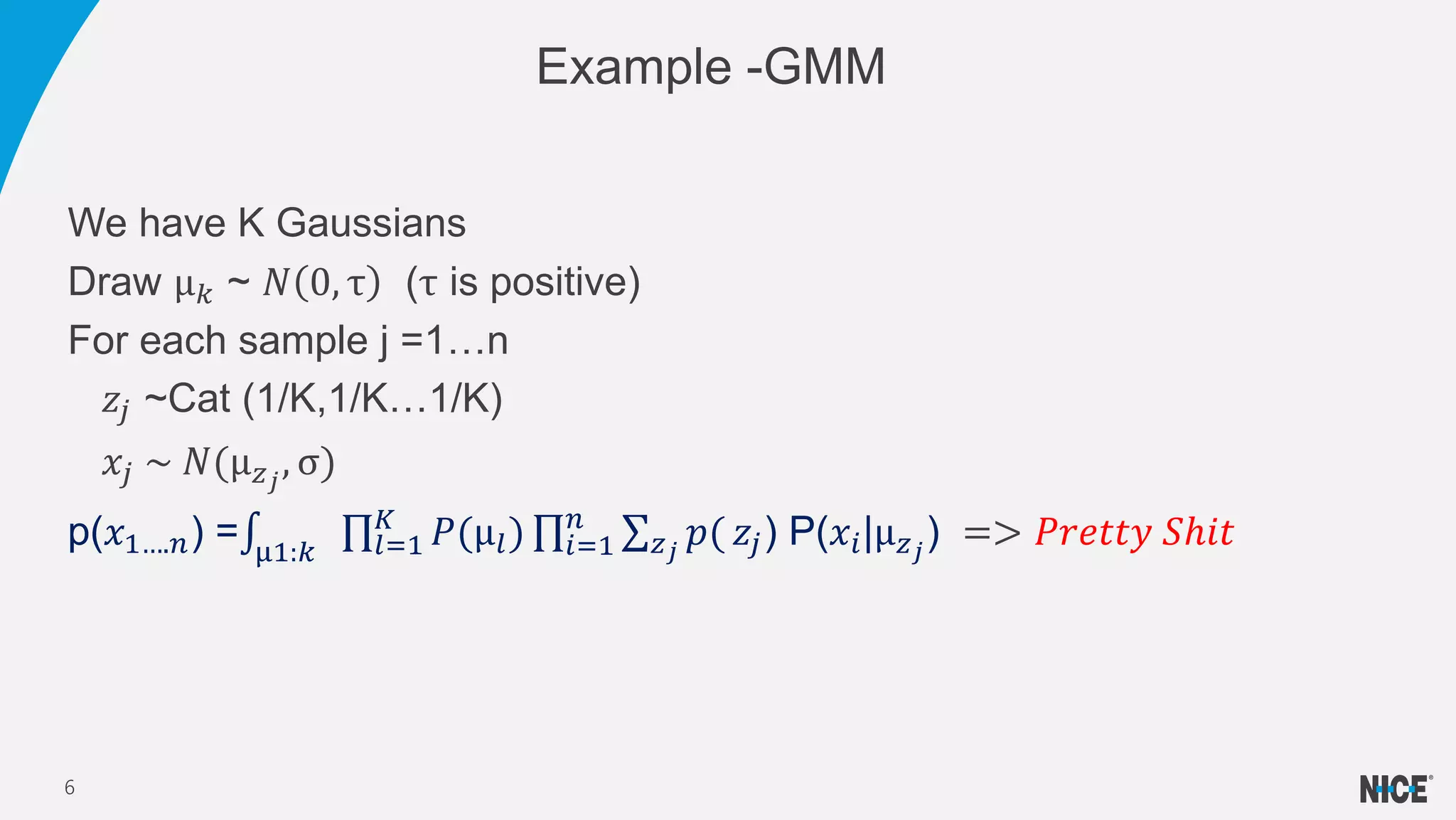
We have K Gaussians
Draw μ 𝑘 ~ 𝑁 0, τ (τ is positive)
For each sample j =1…n
𝑧𝑗 ~Cat (1/K,1/K…1/K)
𝑥𝑗 ~ 𝑁(μ 𝑧 𝑗
, σ)
p(𝑥1….𝑛) = μ1:𝑘 𝑙=1
𝐾
𝑃(μ𝑙) 𝑖=1
𝑛
𝑧 𝑗
𝑝( 𝑧𝑗) P(𝑥𝑖|μ 𝑧 𝑗
) => 𝑃𝑟𝑒𝑡𝑡𝑦 𝑆ℎ𝑖𝑡
Example -GMM
6
SAMPLING
Traditionally posterior is learned using Markov Chain Monte Carlo
(MCMC) methods :
• Metropolis-Hastings
• Gibbs
• Hybrid Monte Carlo
Today we will talk about none of these methods!
Sampling
8
“AN INTRODUCTION TO VARIATIONAL METHODS FOR GRAPHICAL MODELS”
9
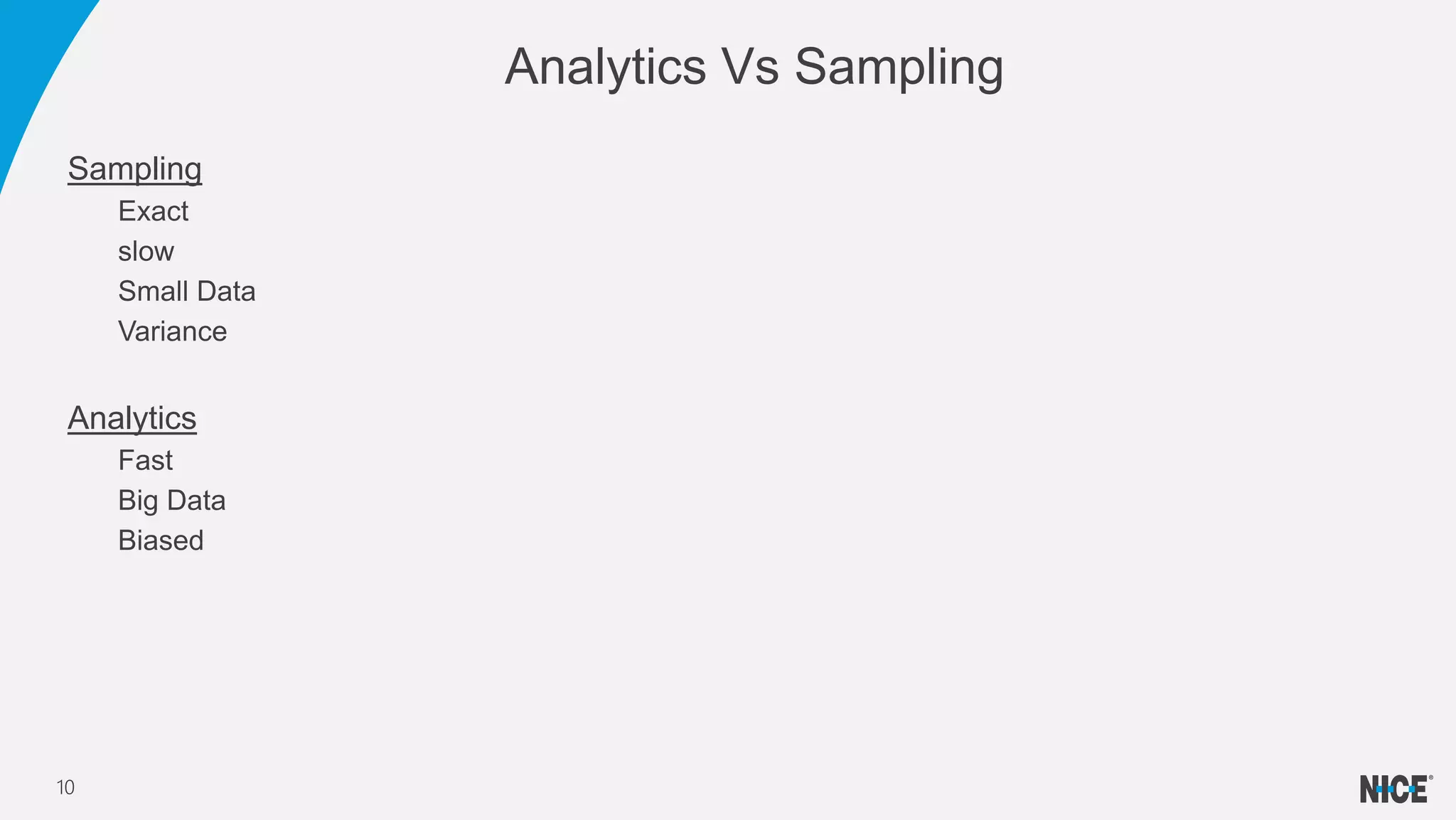
Sampling
Exact
slow
Small Data
Variance
Analytics
Fast
Big Data
Biased
Analytics Vs Sampling
10
WHEN
NICE
MET
VI
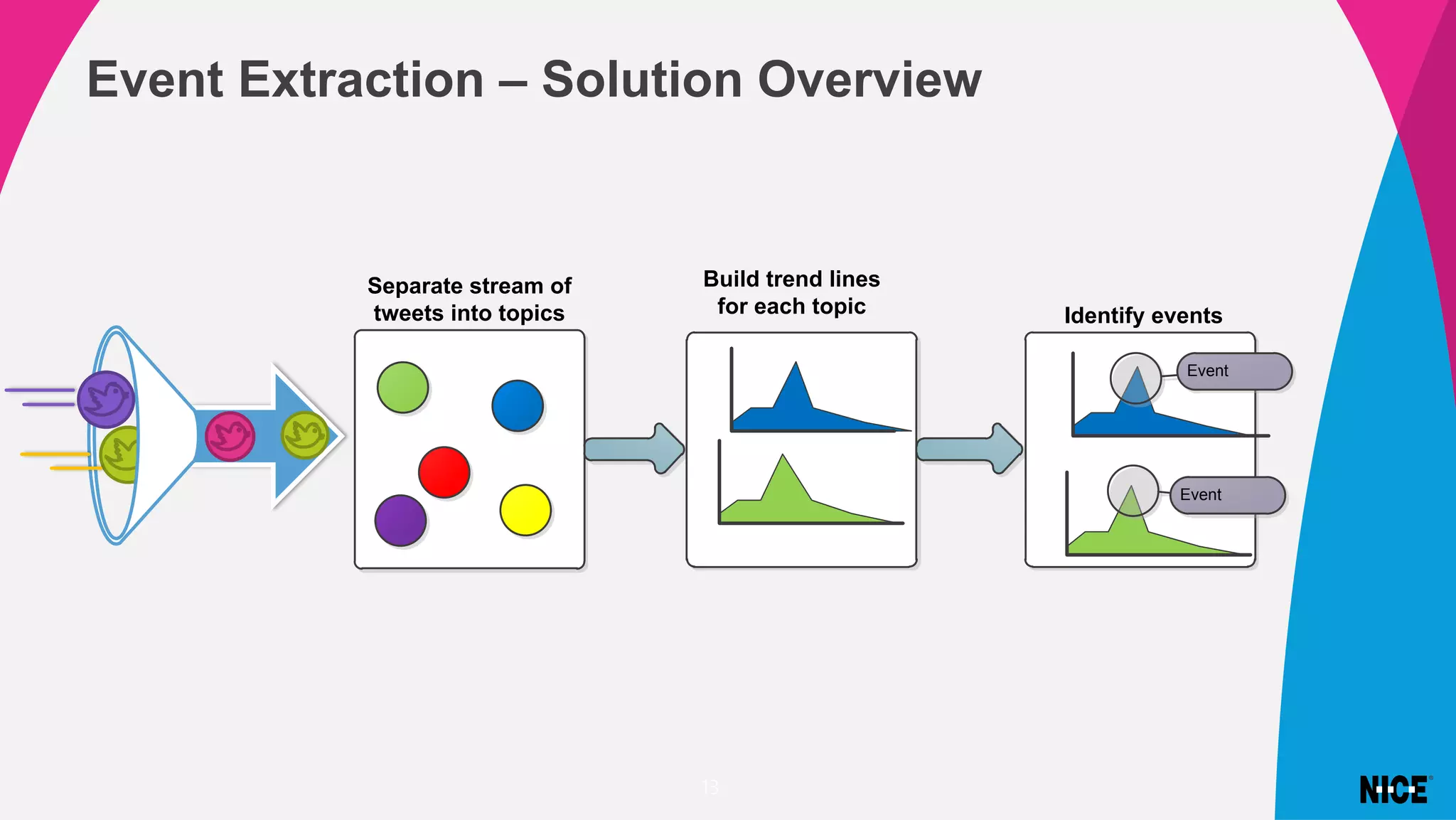
• 2017- Innovation authority project on a content traffic in networks
• Their objective was identifying global events by observing twits and
classifying them according to calculated topics.
Infomedia - Global Events
12
Event Extraction – Solution Overview
13
Separate stream of
tweets into topics
Build trend lines
for each topic Identify events
Event
Event
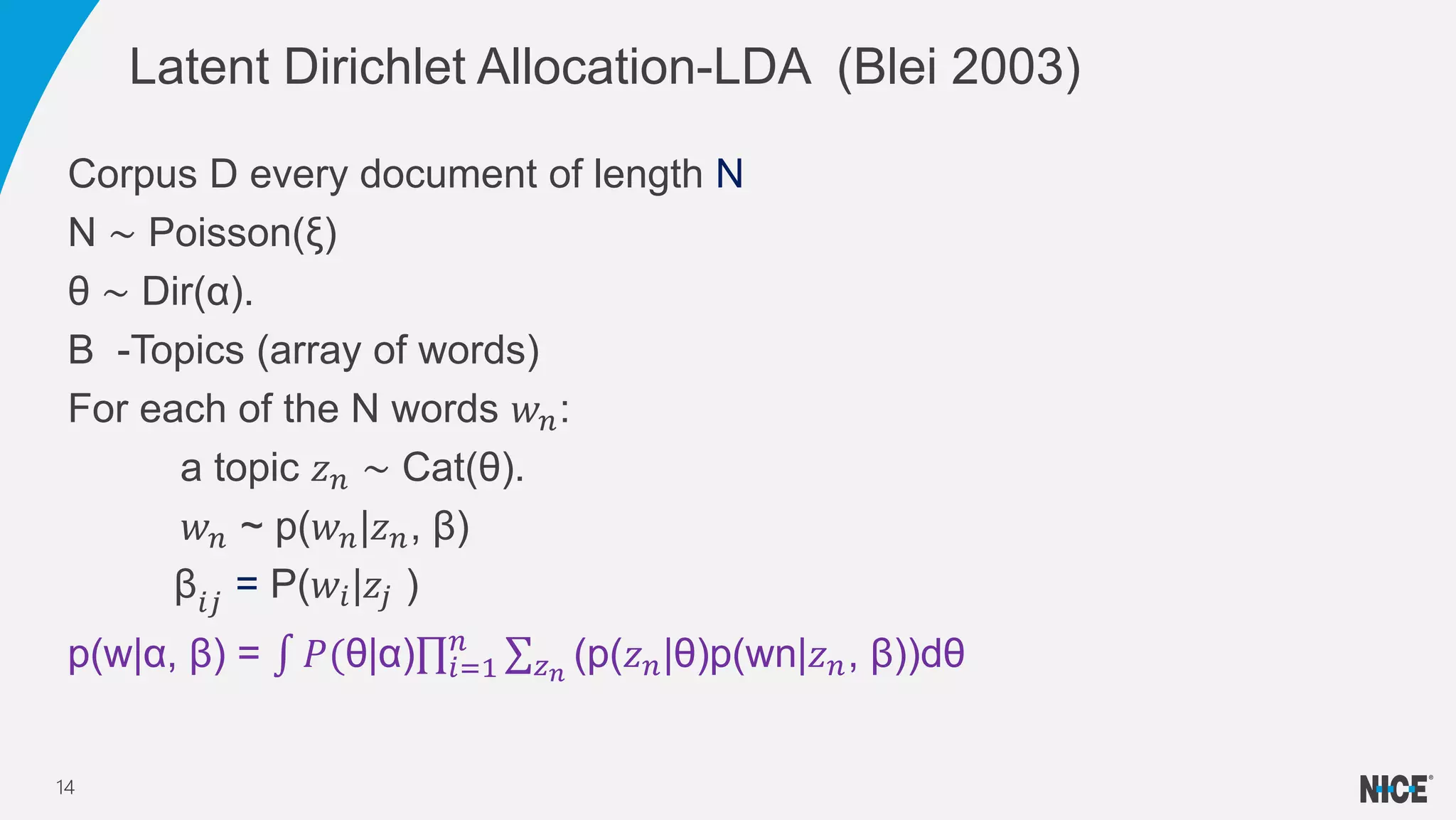
Corpus D every document of length N
N ∼ Poisson(ξ)
θ ∼ Dir(α).
Β -Topics (array of words)
For each of the N words 𝑤 𝑛:
a topic 𝑧 𝑛 ∼ Cat(θ).
𝑤 𝑛 ~ p(𝑤 𝑛|𝑧 𝑛, β)
β𝑖𝑗 = P(𝑤𝑖|𝑧𝑗 )
p(w|α, β) = 𝑃(θ|α) 𝑖=1
𝑛
𝑧 𝑛
(p(𝑧 𝑛|θ)p(wn|𝑧 𝑛, β))dθ
Latent Dirichlet Allocation-LDA (Blei 2003)
14
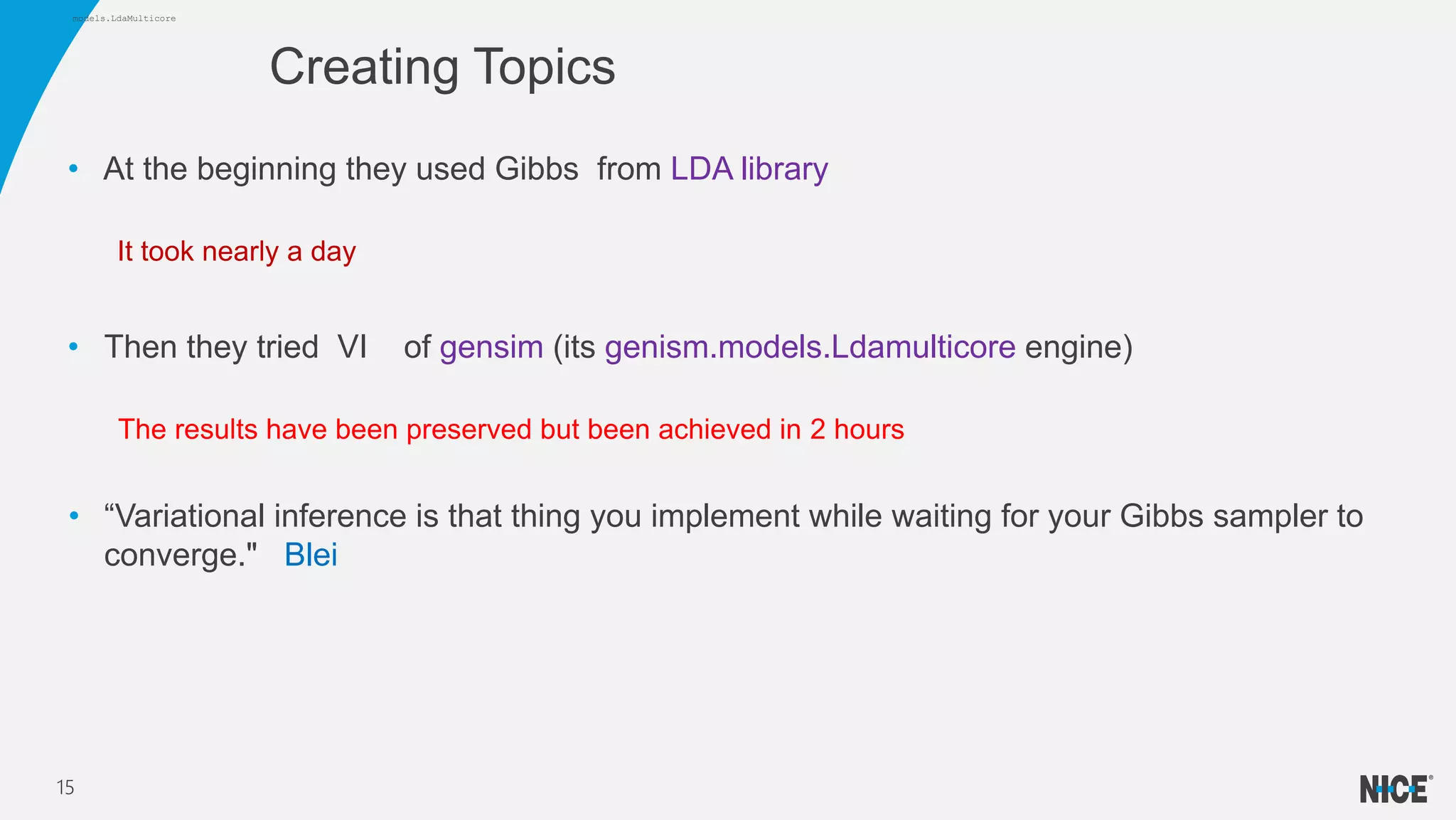
• At the beginning they used Gibbs from LDA library
It took nearly a day
• Then they tried VI of gensim (its genism.models.Ldamulticore engine)
The results have been preserved but been achieved in 2 hours
• “Variational inference is that thing you implement while waiting for your Gibbs sampler to
converge." Blei
Creating Topics
15
models.LdaMulticore
VARIATIONAL-INFERENCE
NERDS’ TIME
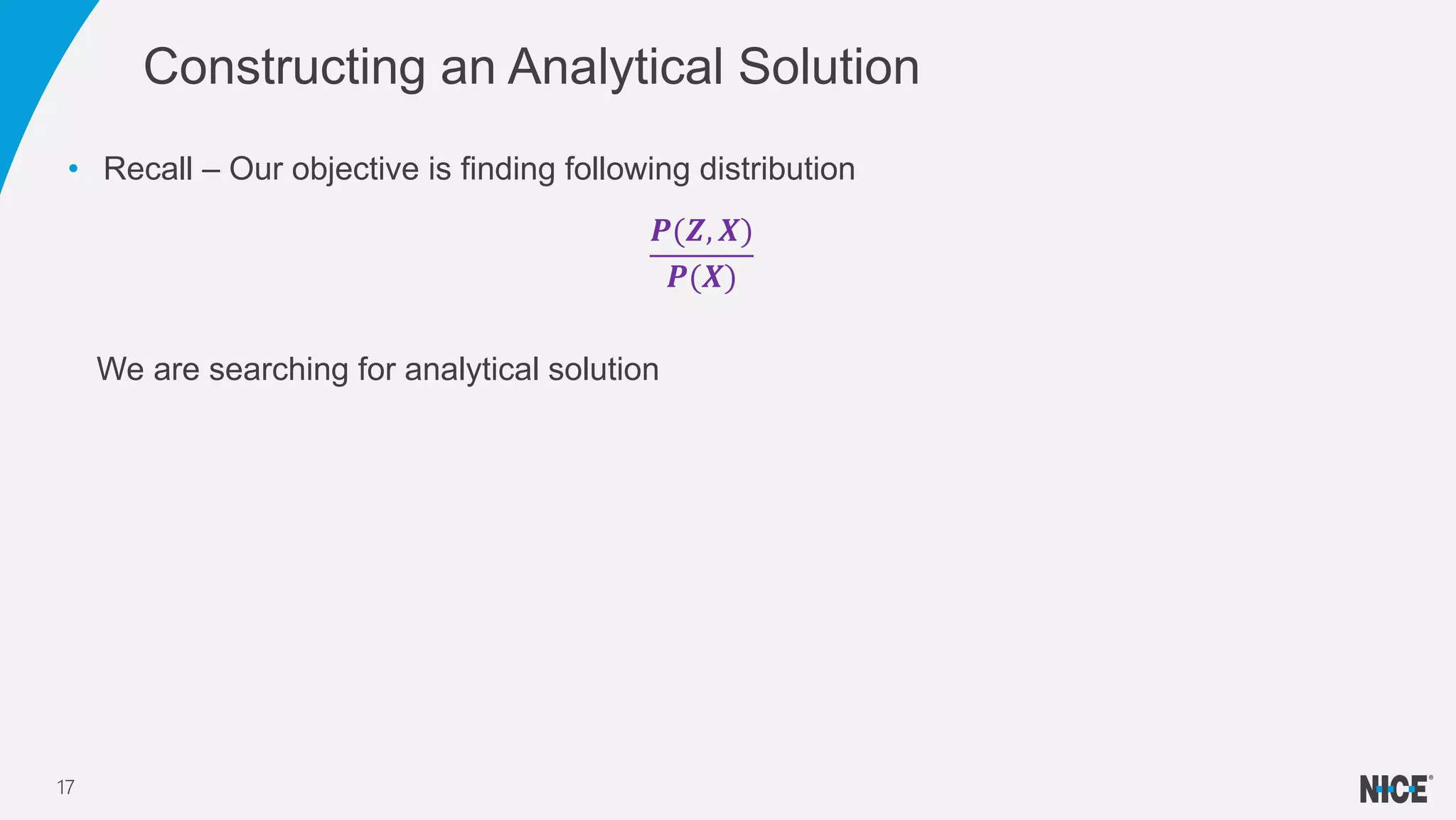
• Recall – Our objective is finding following distribution
𝑷(𝒁, 𝑿)
𝑷(𝑿)
We are searching for analytical solution
Constructing an Analytical Solution
17
What is needed in order to construct such a solution?
1.Being familiar with the frame work
2. Having a metric function over this space
3.Having an optimization methodology
Clause 1 is obvious : we are interested in distribution functions space
Constructing an Analytical Solution (cont)
18
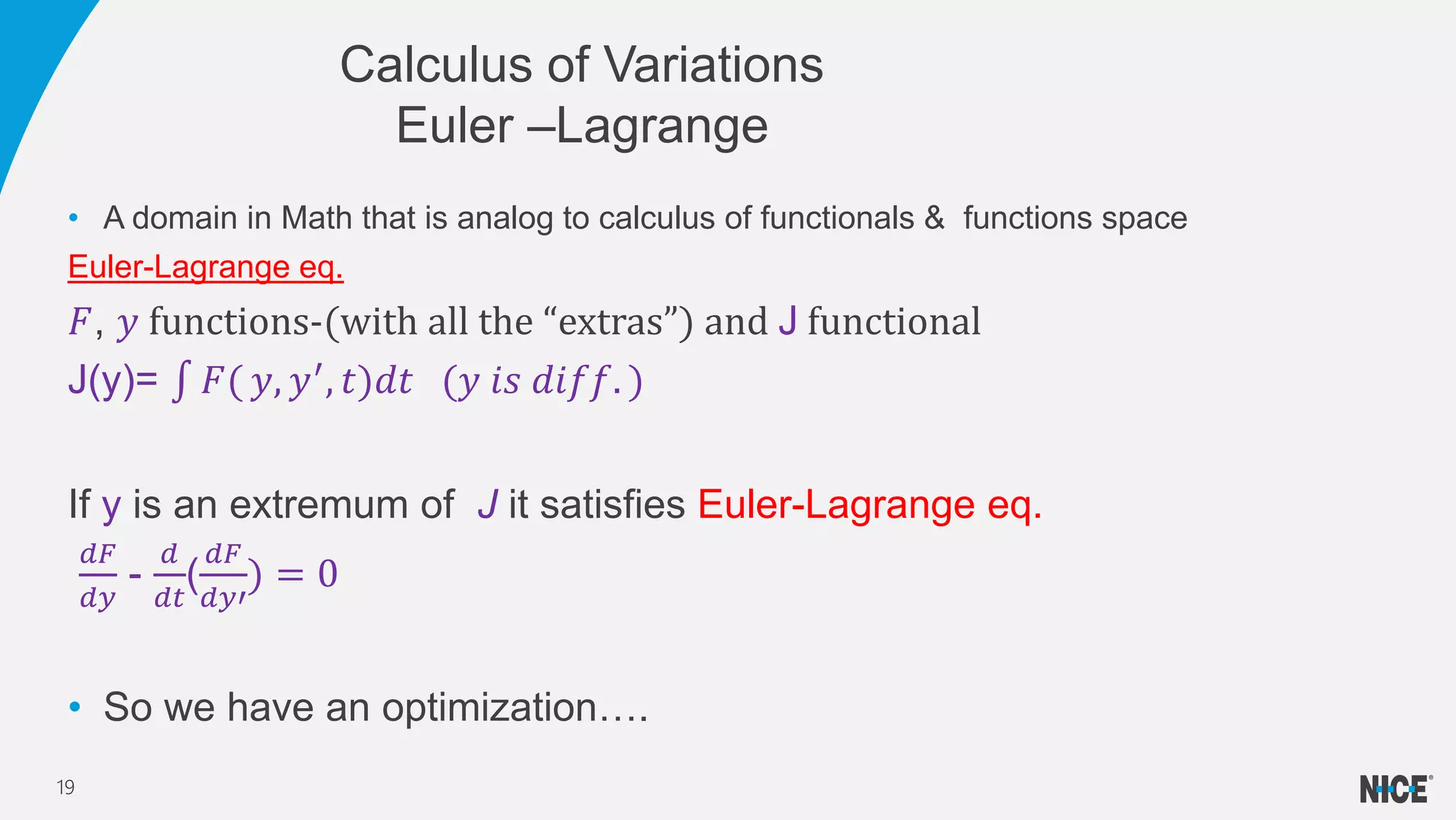
• A domain in Math that is analog to calculus of functionals & functions space
Euler-Lagrange eq.
𝐹, 𝑦 functions-(with all the “extras”) and J functional
J(y)= 𝐹( 𝑦, 𝑦′
, 𝑡)𝑑𝑡 (𝑦 𝑖𝑠 𝑑𝑖𝑓𝑓. )
If y is an extremum of J it satisfies Euler-Lagrange eq.
𝑑𝐹
𝑑𝑦
-
𝑑
𝑑𝑡
(
𝑑𝐹
𝑑𝑦′
) = 0
• So we have an optimization….
Calculus of Variations
Euler –Lagrange
19
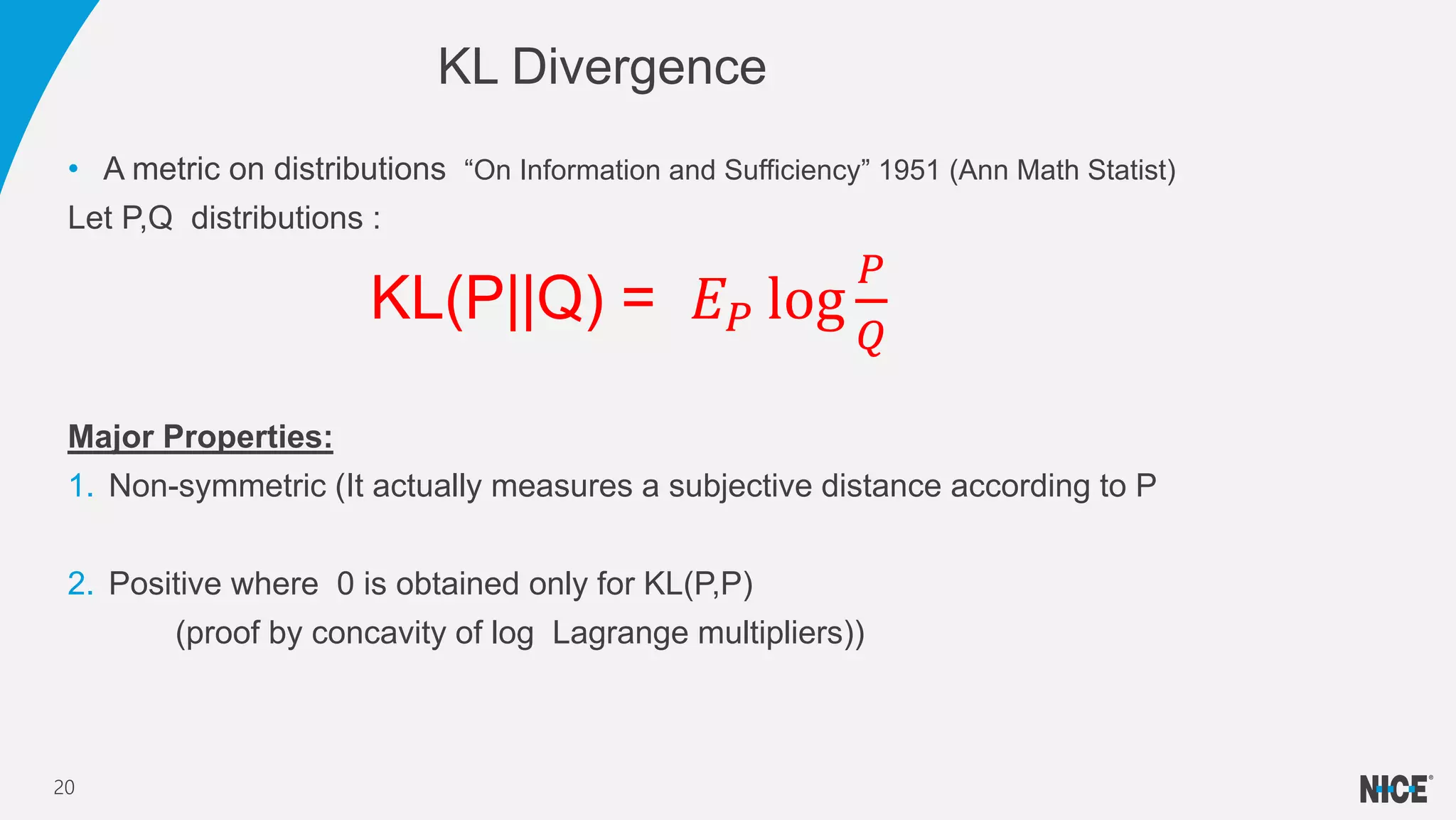
• A metric on distributions “On Information and Sufficiency” 1951 (Ann Math Statist)
Let P,Q distributions :
KL(P||Q) = 𝐸 𝑃 log
𝑃
𝑄
Major Properties:
1. Non-symmetric (It actually measures a subjective distance according to P
2. Positive where 0 is obtained only for KL(P,P)
(proof by concavity of log Lagrange multipliers))
KL Divergence
20
Cross Entropy
(P,Q)= H(P)+ KL(P||Q)
PMI Pointwise mutual information
• Let X,Y random variables
• PMI(X,Y)=Log[
𝑃(𝑋=𝑎,𝑌=𝑏)
𝑃 𝑋=𝑎 𝑃(𝑌=𝑏)
]
• KL(P(X/Y=a)||Q(x)) = 𝑥 𝑃(𝑋 = 𝑥|𝑌 = 𝑎)PMI(X=x, Y=a)
KL- Applications
21
Can we approximate P(Z|X)?
min KL(Q(z)|| P(Z|X))
We have:
log(P(X)) = 𝐸 𝑄 [log P(x, Z)] − 𝐸 𝑄 [log Q(Z)] + KL(Q(Z)||P(Z|X))
ELBO-Evidence Lower Bound
Remarks
1. LHS is indecent on Z
2. log(P(X)) ≥ ELBO (log concavity)
Hence: Maximizing ELBO =>minimizing KL
VI -Let’s Develop
22
𝐸𝐿𝐵𝑂 = 𝐸 𝑄[log P(X, Z)] − 𝐸 𝑄 [log Q(Z)] = 𝑄𝐿𝑜𝑔(
𝑃(𝑋,𝑍)
𝑄(𝑍)
)= J(Q)
Q may have enormous number of variables, can we do more?
VI Development
23
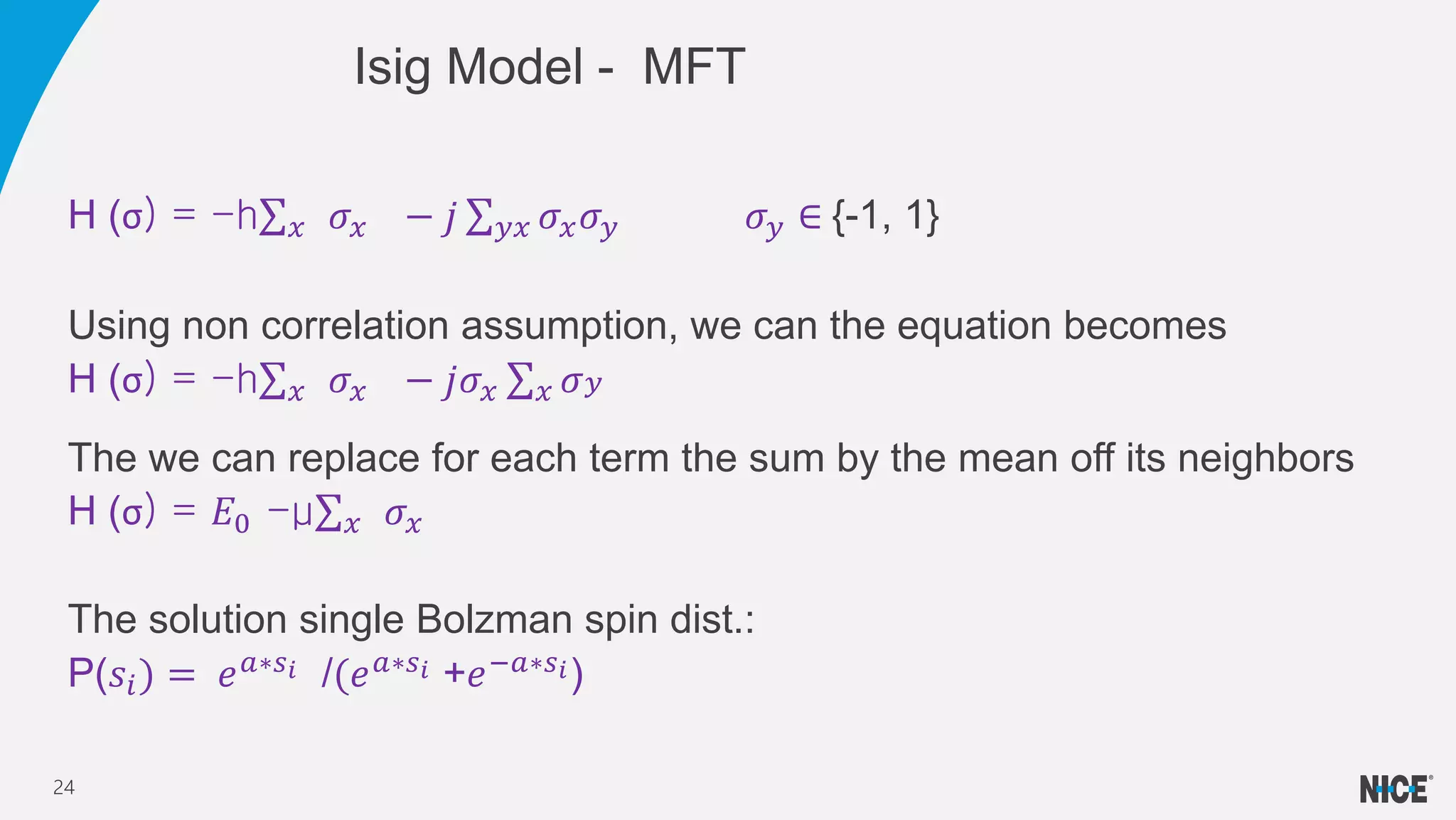
H (σ) = -h 𝑥 𝜎𝑥 − 𝑗 𝑦𝑥 𝜎𝑥 𝜎 𝑦 𝜎 𝑦 ∈ {-1, 1}
Using non correlation assumption, we can the equation becomes
H (σ) = -h 𝑥 𝜎𝑥 − 𝑗𝜎𝑥 𝑥 𝜎 𝑦
The we can replace for each term the sum by the mean off its neighbors
H (σ) = 𝐸0 -μ 𝑥 𝜎𝑥
The solution single Bolzman spin dist.:
P(𝑠𝑖) = 𝑒 𝑎∗𝑠 𝑖 /(𝑒 𝑎∗𝑠 𝑖 +𝑒−𝑎∗𝑠 𝑖)
Isig Model - MFT
24
• If if Ising & Lenz can do it .why don’t we?
• We assume independency rather non-correlation
𝐸𝐿𝐵𝑂 = 𝐸 𝑄[log P(X, Z)] − 𝐸 𝑄 [log Q(Z)]
Q becomes Q(z) = 𝑖=1
𝑛
𝑞𝑖(𝑧𝑖) (Obviously not true)
• We can use now Euler –Lagrange with the constrain
𝑞𝑖(z) =1
L𝑜𝑔(𝑞𝑖) = 𝑐𝑜𝑛𝑠𝑡 + 𝐸−𝑖[𝑝 𝑥, 𝑧 ] Bolzman Dist.! (as said . We are as good as Ising)
Back to VI
25
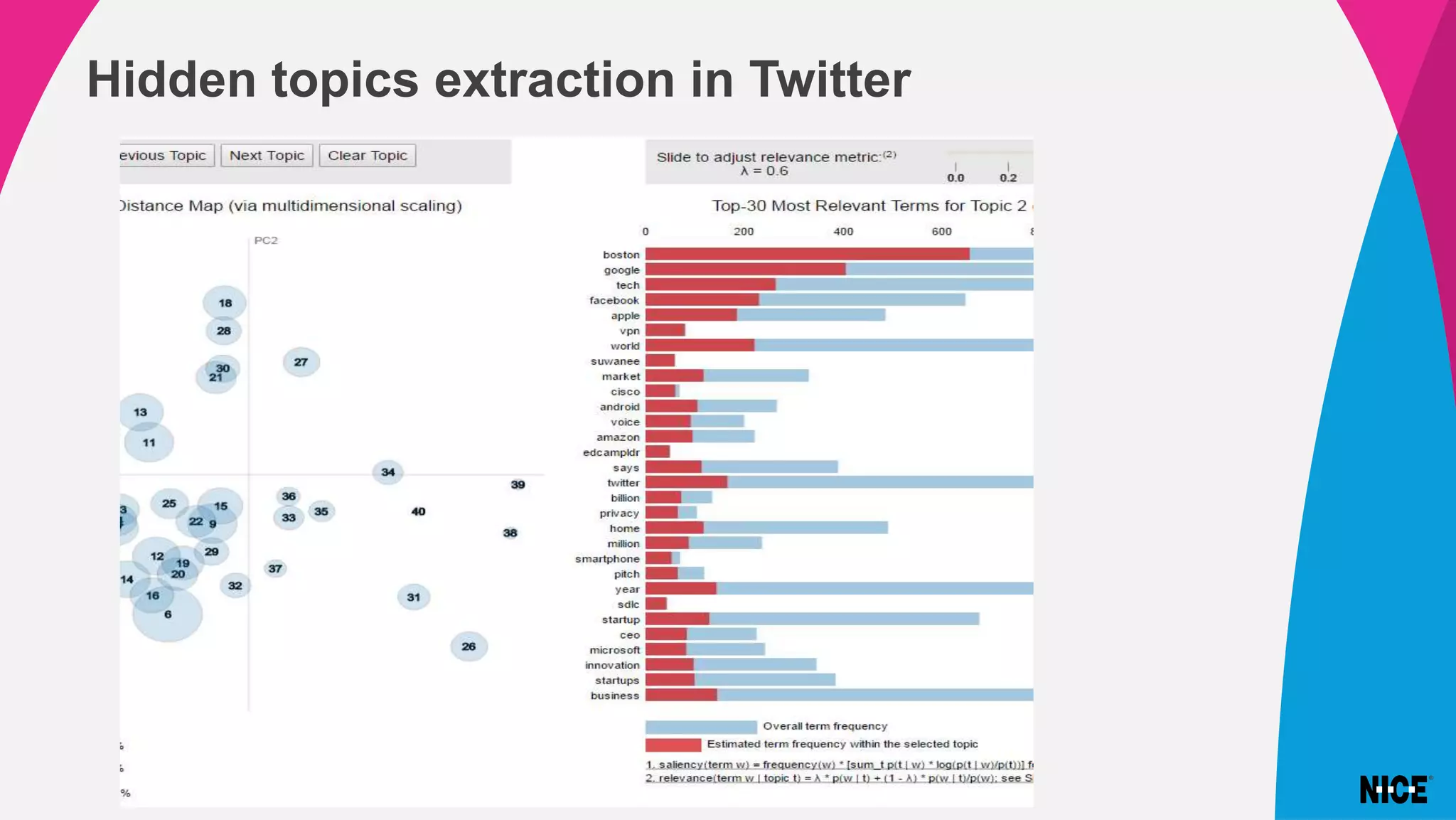
Hidden topics extraction in Twitter
26
NUMERIC
• Blei 2018 VI- A review for statistics
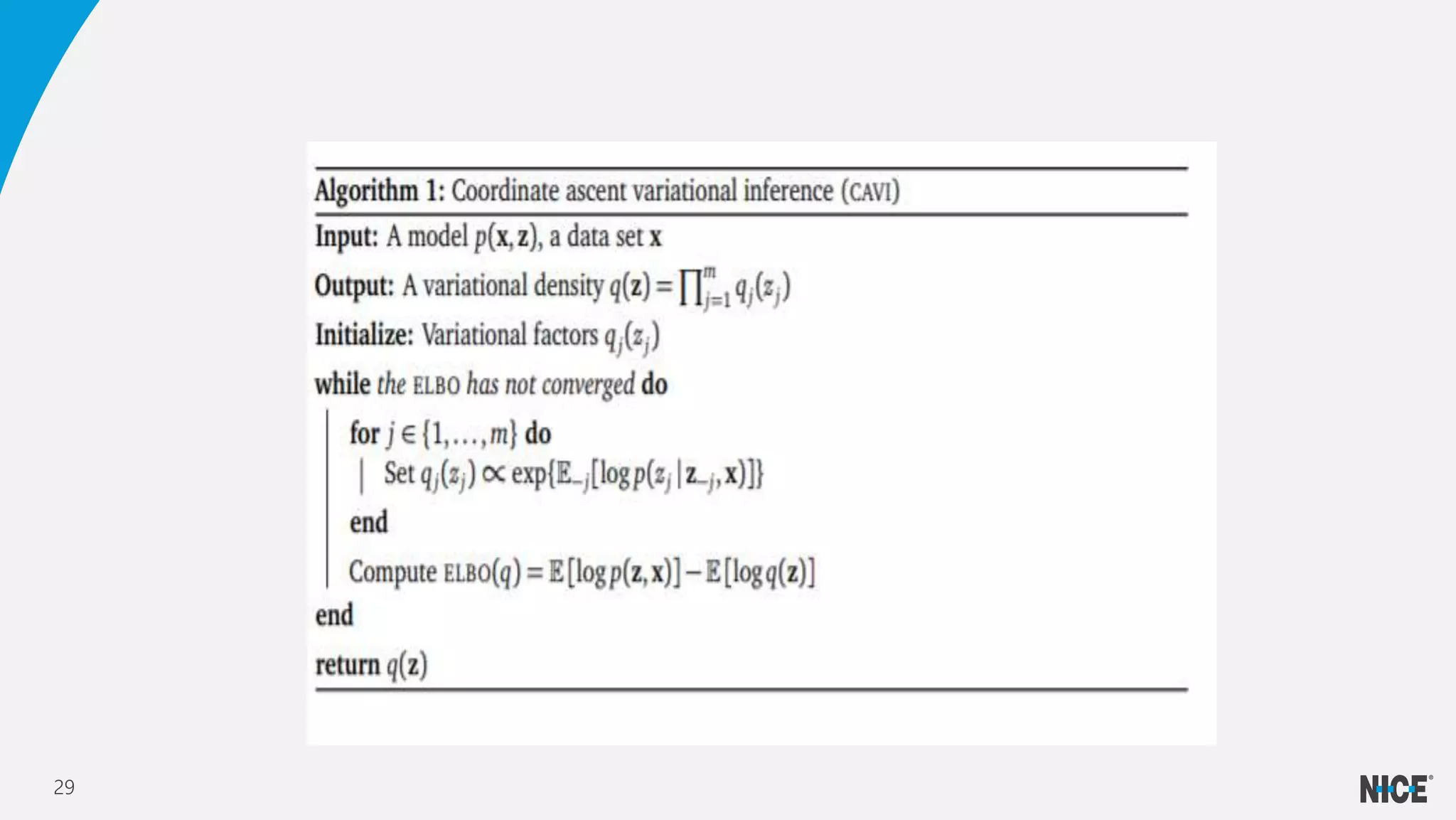
The basic step is set sequentially each 𝑞𝑖 to 𝐸−𝑖[𝑝 𝑥, 𝑧 ] +constant
No 𝑖 𝑡ℎ
coordinate in the RHS (Independency)
Simply update each q until a convergence of ELBO
Coordinate Ascent Variational Inference
CAVI
28
29
• CAVI does not work well for big data (update for every item)
• Stochastic VI- rather updating the q’s, we calculate the gradient of the ELBO, and
optimize its parameters (similar to EM)
• Used in LDA applications (David Blei et al)
• http://www.columbia.edu/~jwp2128/Papers/HoffmanBleiWangPaisley2013.pdf
• https://www.cs.princeton.edu/courses/archive/fall11/cos597C/reading/Blei2011.pdf
Stochastic VI
30
31

NICE Research -Variational inference project

  • 1.
  • 2.
    What is BayesianInference? Sampling When NICE met VI Rigorous Foundation Two words on Numeric
  • 3.
  • 4.
    Bayesian Inference -Notations 4 Theinputs: Evidence – The Sample of length n (numbers, categories, vectors, images) Hypothesis - An assumption about the prob. structure that creates the sample Objective : We wish to learn the conditional distribution of Hypothesis given the Evidence. This probability is called Posterior or in mathematical terms P(H|E)
  • 5.
    Z- R.V. thatrepresents the hypothesis X- R.V. that represents the evidence Bayes formula: P(Z|X) = 𝑷(𝒁,𝑿) 𝑷(𝑿) Bayesian inference is therefore about working with the RHS terms. In some case studying the denominator is intractable or extremely difficult to calculate. Let’s Formulate 5
  • 6.
    We have KGaussians Draw μ 𝑘 ~ 𝑁 0, τ (τ is positive) For each sample j =1…n 𝑧𝑗 ~Cat (1/K,1/K…1/K) 𝑥𝑗 ~ 𝑁(μ 𝑧 𝑗 , σ) p(𝑥1….𝑛) = μ1:𝑘 𝑙=1 𝐾 𝑃(μ𝑙) 𝑖=1 𝑛 𝑧 𝑗 𝑝( 𝑧𝑗) P(𝑥𝑖|μ 𝑧 𝑗 ) => 𝑃𝑟𝑒𝑡𝑡𝑦 𝑆ℎ𝑖𝑡 Example -GMM 6
  • 7.
  • 8.
    Traditionally posterior islearned using Markov Chain Monte Carlo (MCMC) methods : • Metropolis-Hastings • Gibbs • Hybrid Monte Carlo Today we will talk about none of these methods! Sampling 8
  • 9.
    “AN INTRODUCTION TOVARIATIONAL METHODS FOR GRAPHICAL MODELS” 9
  • 10.
  • 11.
  • 12.
    • 2017- Innovationauthority project on a content traffic in networks • Their objective was identifying global events by observing twits and classifying them according to calculated topics. Infomedia - Global Events 12
  • 13.
    Event Extraction –Solution Overview 13 Separate stream of tweets into topics Build trend lines for each topic Identify events Event Event
  • 14.
    Corpus D everydocument of length N N ∼ Poisson(ξ) θ ∼ Dir(α). Β -Topics (array of words) For each of the N words 𝑤 𝑛: a topic 𝑧 𝑛 ∼ Cat(θ). 𝑤 𝑛 ~ p(𝑤 𝑛|𝑧 𝑛, β) β𝑖𝑗 = P(𝑤𝑖|𝑧𝑗 ) p(w|α, β) = 𝑃(θ|α) 𝑖=1 𝑛 𝑧 𝑛 (p(𝑧 𝑛|θ)p(wn|𝑧 𝑛, β))dθ Latent Dirichlet Allocation-LDA (Blei 2003) 14
  • 15.
    • At thebeginning they used Gibbs from LDA library It took nearly a day • Then they tried VI of gensim (its genism.models.Ldamulticore engine) The results have been preserved but been achieved in 2 hours • “Variational inference is that thing you implement while waiting for your Gibbs sampler to converge." Blei Creating Topics 15 models.LdaMulticore
  • 16.
  • 17.
    • Recall –Our objective is finding following distribution 𝑷(𝒁, 𝑿) 𝑷(𝑿) We are searching for analytical solution Constructing an Analytical Solution 17
  • 18.
    What is neededin order to construct such a solution? 1.Being familiar with the frame work 2. Having a metric function over this space 3.Having an optimization methodology Clause 1 is obvious : we are interested in distribution functions space Constructing an Analytical Solution (cont) 18
  • 19.
    • A domainin Math that is analog to calculus of functionals & functions space Euler-Lagrange eq. 𝐹, 𝑦 functions-(with all the “extras”) and J functional J(y)= 𝐹( 𝑦, 𝑦′ , 𝑡)𝑑𝑡 (𝑦 𝑖𝑠 𝑑𝑖𝑓𝑓. ) If y is an extremum of J it satisfies Euler-Lagrange eq. 𝑑𝐹 𝑑𝑦 - 𝑑 𝑑𝑡 ( 𝑑𝐹 𝑑𝑦′ ) = 0 • So we have an optimization…. Calculus of Variations Euler –Lagrange 19
  • 20.
    • A metricon distributions “On Information and Sufficiency” 1951 (Ann Math Statist) Let P,Q distributions : KL(P||Q) = 𝐸 𝑃 log 𝑃 𝑄 Major Properties: 1. Non-symmetric (It actually measures a subjective distance according to P 2. Positive where 0 is obtained only for KL(P,P) (proof by concavity of log Lagrange multipliers)) KL Divergence 20
  • 21.
    Cross Entropy (P,Q)= H(P)+KL(P||Q) PMI Pointwise mutual information • Let X,Y random variables • PMI(X,Y)=Log[ 𝑃(𝑋=𝑎,𝑌=𝑏) 𝑃 𝑋=𝑎 𝑃(𝑌=𝑏) ] • KL(P(X/Y=a)||Q(x)) = 𝑥 𝑃(𝑋 = 𝑥|𝑌 = 𝑎)PMI(X=x, Y=a) KL- Applications 21
  • 22.
    Can we approximateP(Z|X)? min KL(Q(z)|| P(Z|X)) We have: log(P(X)) = 𝐸 𝑄 [log P(x, Z)] − 𝐸 𝑄 [log Q(Z)] + KL(Q(Z)||P(Z|X)) ELBO-Evidence Lower Bound Remarks 1. LHS is indecent on Z 2. log(P(X)) ≥ ELBO (log concavity) Hence: Maximizing ELBO =>minimizing KL VI -Let’s Develop 22
  • 23.
    𝐸𝐿𝐵𝑂 = 𝐸𝑄[log P(X, Z)] − 𝐸 𝑄 [log Q(Z)] = 𝑄𝐿𝑜𝑔( 𝑃(𝑋,𝑍) 𝑄(𝑍) )= J(Q) Q may have enormous number of variables, can we do more? VI Development 23
  • 24.
    H (σ) =-h 𝑥 𝜎𝑥 − 𝑗 𝑦𝑥 𝜎𝑥 𝜎 𝑦 𝜎 𝑦 ∈ {-1, 1} Using non correlation assumption, we can the equation becomes H (σ) = -h 𝑥 𝜎𝑥 − 𝑗𝜎𝑥 𝑥 𝜎 𝑦 The we can replace for each term the sum by the mean off its neighbors H (σ) = 𝐸0 -μ 𝑥 𝜎𝑥 The solution single Bolzman spin dist.: P(𝑠𝑖) = 𝑒 𝑎∗𝑠 𝑖 /(𝑒 𝑎∗𝑠 𝑖 +𝑒−𝑎∗𝑠 𝑖) Isig Model - MFT 24
  • 25.
    • If ifIsing & Lenz can do it .why don’t we? • We assume independency rather non-correlation 𝐸𝐿𝐵𝑂 = 𝐸 𝑄[log P(X, Z)] − 𝐸 𝑄 [log Q(Z)] Q becomes Q(z) = 𝑖=1 𝑛 𝑞𝑖(𝑧𝑖) (Obviously not true) • We can use now Euler –Lagrange with the constrain 𝑞𝑖(z) =1 L𝑜𝑔(𝑞𝑖) = 𝑐𝑜𝑛𝑠𝑡 + 𝐸−𝑖[𝑝 𝑥, 𝑧 ] Bolzman Dist.! (as said . We are as good as Ising) Back to VI 25
  • 26.
  • 27.
  • 28.
    • Blei 2018VI- A review for statistics The basic step is set sequentially each 𝑞𝑖 to 𝐸−𝑖[𝑝 𝑥, 𝑧 ] +constant No 𝑖 𝑡ℎ coordinate in the RHS (Independency) Simply update each q until a convergence of ELBO Coordinate Ascent Variational Inference CAVI 28
  • 29.
  • 30.
    • CAVI doesnot work well for big data (update for every item) • Stochastic VI- rather updating the q’s, we calculate the gradient of the ELBO, and optimize its parameters (similar to EM) • Used in LDA applications (David Blei et al) • http://www.columbia.edu/~jwp2128/Papers/HoffmanBleiWangPaisley2013.pdf • https://www.cs.princeton.edu/courses/archive/fall11/cos597C/reading/Blei2011.pdf Stochastic VI 30
  • 31.

Editor's Notes

  • #5 Use case A: The problem with this use case: