Neural ODE
Natan Katz
Natan.katz@gmail.com
Lecture’s Summary
• Why do we care about ODE?
• What is ODE?
• Neural ODE –History
• Neural ODE –NeurIPS paper
Why do we care?
• NeurIPS 2018 research papers competition
• 4500 papers have been submitted
• One of the best 4 :
Neural ODE (Qi Chen ,Rubanova, Bettencourt ,Duvenaud)
An new usage of both mathematical tool an approach in DL
1. Observing a network as a continuous entity
2. Observing hidden layer as a time function rather a set of
discrete entities
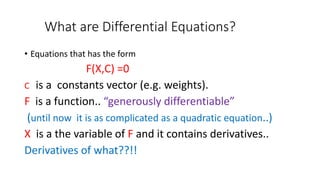
What are Differential Equations?
• Equations that has the form
F(X,C) =0
C is a constants vector (e.g. weights).
F is a function.. “generously differentiable”
(until now it is as complicated as a quadratic equation..)
X is a the variable of F and it contains derivatives..
Derivatives of what??!!
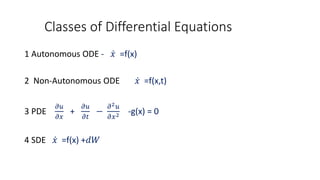
Classes of Differential Equations
1 Autonomous ODE - 𝑥 =f(x)
2 Non-Autonomous ODE 𝑥 =f(x,t)
3 PDE
𝜕𝑢
𝜕𝑥
+
𝜕𝑢
𝜕𝑡
−
𝜕2 𝑢
𝜕𝑥2 -g(x) = 0
4 SDE 𝑥 =f(x) +𝑑𝑊
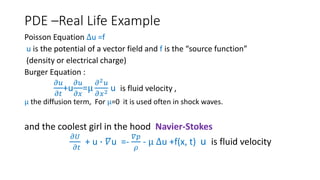
PDE –Real Life Example
Poisson Equation ∆u =f
u is the potential of a vector field and f is the “source function”
(density or electrical charge)
Burger Equation :
𝜕𝑢
𝜕𝑡
+u
𝜕𝑢
𝜕𝑥
=μ
𝜕2 𝑢
𝜕𝑥2 u is fluid velocity ,
μ the diffusion term, For μ=0 it is used often in shock waves.
and the coolest girl in the hood Navier-Stokes
𝜕𝑈
𝜕𝑡
+ u ∙ 𝛻u =-
𝛻𝑝
𝜌
- μ ∆u +f(x, t) u is fluid velocity
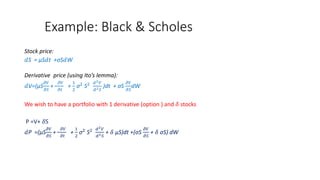
Example: Black & Scholes
Stock price:
𝑑S = μS𝑑t +σS𝑑W
Derivative price (using Ito’s lemma):
𝑑V=(μS
𝜕𝑉
𝜕𝑆
+
𝜕𝑉
𝜕𝑡
+
1
2
σ2
S2 𝑑2 𝑉
𝑑2 𝑆
)dt + σS
𝜕𝑉
𝜕𝑆
dW
We wish to have a portfolio with 1 derivative (option ) and 𝛿 stocks
P =V+ 𝛿S
𝑑P =(μS
𝜕𝑉
𝜕𝑆
+
𝜕𝑉
𝜕𝑡
+
1
2
σ2
S2 𝑑2 𝑉
𝑑2 𝑆
+ 𝛿 μS)dt +(σS
𝜕𝑉
𝜕𝑆
+ 𝛿 σS) dW
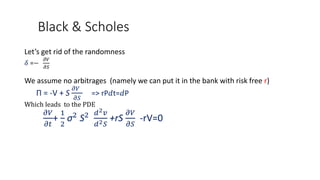
Black & Scholes
Let’s get rid of the randomness
𝛿 =−
𝜕𝑉
𝜕𝑆
We assume no arbitrages (namely we can put it in the bank with risk free r)
Π = -V + S
𝜕𝑉
𝜕𝑆
=> rP𝑑t=𝑑P
Which leads to the PDE
𝜕𝑉
𝜕𝑡
+
1
2
σ2
S2 𝑑2 𝑣
𝑑2 𝑆
+rS
𝜕𝑉
𝜕𝑆
-rV=0
ODE –Basic Terminology
𝑥 =f(x) or 𝑥 =f(x,t)
Initial condition
Let the eq. 𝑥 =f(x) we add the initial condition x[0] =c
Example:
𝑥=x by integrating both sides we get
x[t] =𝑒 𝑡
a . We need the i.c. to determine a
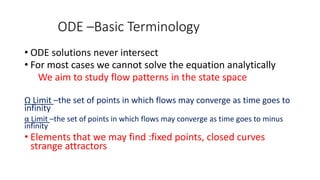
ODE –Basic Terminology
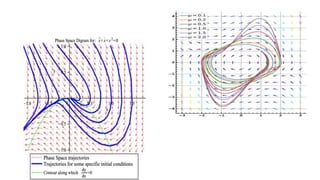
• ODE solutions never intersect
• For most cases we cannot solve the equation analytically
We aim to study flow patterns in the state space
Ω Limit –the set of points in which flows may converge as time goes to
infinity
α Limit –the set of points in which flows may converge as time goes to minus
infinity
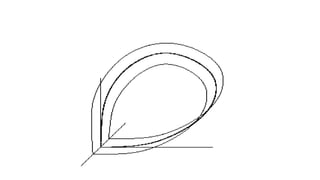
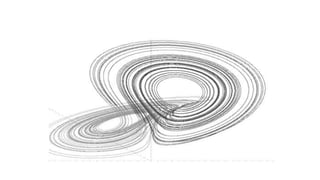
• Elements that we may find :fixed points, closed curves
strange attractors
ODE -Terminology
Attractors
A point or compact set in which attracts every i.c.
Fixed Point
F(x)=0 Namely the point that the flow “rests”
Stability
F.p. is stable if the flow does not leave a ε-neighborhood. (homoclinic)
Determine stability
Autonomous system
If the Jacobian has non -zero real part eigen values
• Lyapunov function
• Dulac Theorem
Non-Autonomous system
Lyapunov exponents
Bifurcations
Further Reading
• Non Autonomous DS, Kloeden & Rasmussen
• ODE - Jack Hale
• Navier Stokes –several books, papers of Edriss Titti
• Theory & applications of SDE –Zeev Schuss
• Books on Heat equation
DE & DL
• Consider Resnet
Every layer t satisfies :
ℎ 𝑡+1 =δt f(ℎ 𝑡 θ) + ℎ 𝑡
Haber & Ruthotto (2017) ,Yiping Lu ,Zhong
For infinitesimal time step (nearly continuity) We obtain:
ℎ = f(h, θ)
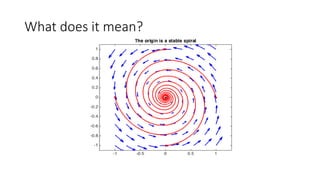
What does it mean?
Neural ODE –Chen Rubanova et al
One of the best research papers in NeurIPS 2018
What does it contain?
• Description of solving neural with ODE solver
• A backpropagation algorithm for ODE solver
• Comparison of this method for supervised learning
• Generative process
• Continuous normalized flow
A backpropagation algorithm for ODE solver
• There are several methods to solve ODEs such as Euler and
Runge-Kutta , their main difficulties is the amount of
gradients needed
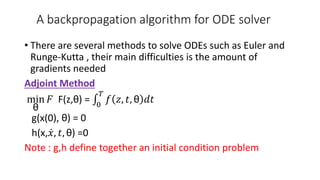
Adjoint Method
min
θ
𝐹 F(z,θ) = 0
𝑇
𝑓 𝑧, 𝑡, θ 𝑑𝑡
g(x(0), θ) = 0
h(x, 𝑥, 𝑡, θ) =0
Note : g,h define together an initial condition problem
Adjoint Method (cont.)
So what do they do in the paper?
𝑧 =f(z,t,θ)
We assume a loss L s.t.
L(z(T) =L[z (0) + 0
𝑇
𝑓 𝑧, 𝑡, θ 𝑑𝑡] -ODE solver friendly 
We define
a(T) =
𝜕𝐿
𝜕𝑧(𝑇)
What is actually z(T)?
Adjoint Method (cont.)
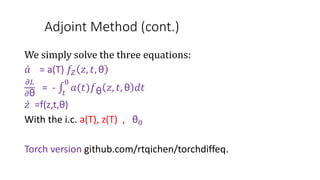
We simply solve the three equations:
𝑎 = a(T) 𝑓𝑍 𝑧, 𝑡, θ
𝜕𝐿
𝜕θ
= - 𝑡
0
𝑎(𝑡)𝑓θ 𝑧, 𝑡, θ 𝑑𝑡
𝑧 =f(z,t,θ)
With the i.c. a(T), z(T) , θ0
Torch version github.com/rtqichen/torchdiffeq.
Comparison of this method for
supervised learning
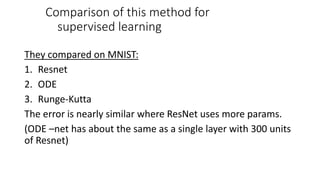
They compared on MNIST:
1. Resnet
2. ODE
3. Runge-Kutta
The error is nearly similar where ResNet uses more params.
(ODE –net has about the same as a single layer with 300 units
of Resnet)
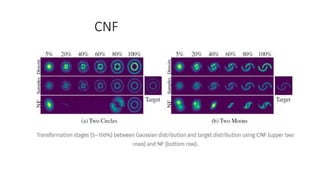
Continuous Normalization Flow- CNF
• A method that maps a generic distribution (Gaussianexponents)
Into a more complicate distributions through a sequence of maps
𝑓1 , 𝑓2 , 𝑓3 .…. 𝑓𝑘
The main difficulties here are:
𝑧1= 𝑓(𝑧0 ) => log 𝑝(𝑧1)=log 𝑝(𝑧0) -log det(𝑓𝑍[𝑧0])
Calculating determinants is “costly”.
CNF
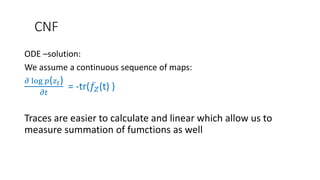
ODE –solution:
We assume a continuous sequence of maps:
𝜕 log 𝑝( 𝑧 𝑡)
𝜕𝑡
= -tr(𝑓𝑍(t) )
Traces are easier to calculate and linear which allow us to
measure summation of fumctions as well
CNF
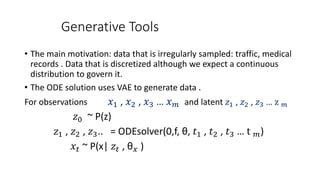
Generative Tools
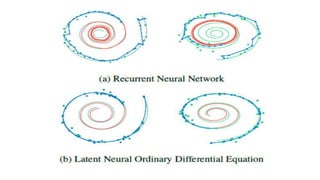
• The main motivation: data that is irregularly sampled: traffic, medical
records . Data that is discretized although we expect a continuous
distribution to govern it.
• The ODE solution uses VAE to generate data .
For observations 𝑥1 , 𝑥2 , 𝑥3 … 𝑥 𝑚 and latent 𝑧1 , 𝑧2 , 𝑧3 … z 𝑚
𝑧0 ~ P(z)
𝑧1 , 𝑧2 , 𝑧3.. = ODEsolver(0,f, θ, 𝑡1 , 𝑡2 , 𝑡3 … t 𝑚)
𝑥𝑡 ~ P(x| 𝑧𝑡 , θ 𝑥 )
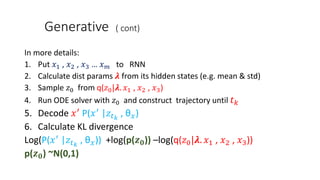
Generative ( cont)
In more details:
1. Put 𝑥1 , 𝑥2 , 𝑥3 … 𝑥 𝑚 to RNN
2. Calculate dist params 𝝀 from its hidden states (e.g. mean & std)
3. Sample 𝑧0 from q(𝑧0|𝝀. 𝑥1 , 𝑥2 , 𝑥3)
4. Run ODE solver with 𝑧0 and construct trajectory until 𝑡 𝑘
5. Decode 𝑥′
P(𝑥′
|𝑧𝑡 𝑘
, θ 𝑥)
6. Calculate KL divergence
Log(P(𝑥′
|𝑧𝑡 𝑘
, θ 𝑥)) +log(p(𝒛 𝟎)) –log(q(𝑧0|𝝀. 𝑥1 , 𝑥2 , 𝑥3))
p(𝒛 𝟎) ~N(0,1)
Thanks!!!

Neural ODE

  • 1.
  • 2.
    Lecture’s Summary • Whydo we care about ODE? • What is ODE? • Neural ODE –History • Neural ODE –NeurIPS paper
  • 3.
    Why do wecare? • NeurIPS 2018 research papers competition • 4500 papers have been submitted • One of the best 4 : Neural ODE (Qi Chen ,Rubanova, Bettencourt ,Duvenaud) An new usage of both mathematical tool an approach in DL 1. Observing a network as a continuous entity 2. Observing hidden layer as a time function rather a set of discrete entities
  • 4.
    What are DifferentialEquations? • Equations that has the form F(X,C) =0 C is a constants vector (e.g. weights). F is a function.. “generously differentiable” (until now it is as complicated as a quadratic equation..) X is a the variable of F and it contains derivatives.. Derivatives of what??!!
  • 5.
    Classes of DifferentialEquations 1 Autonomous ODE - 𝑥 =f(x) 2 Non-Autonomous ODE 𝑥 =f(x,t) 3 PDE 𝜕𝑢 𝜕𝑥 + 𝜕𝑢 𝜕𝑡 − 𝜕2 𝑢 𝜕𝑥2 -g(x) = 0 4 SDE 𝑥 =f(x) +𝑑𝑊
  • 6.
    PDE –Real LifeExample Poisson Equation ∆u =f u is the potential of a vector field and f is the “source function” (density or electrical charge) Burger Equation : 𝜕𝑢 𝜕𝑡 +u 𝜕𝑢 𝜕𝑥 =μ 𝜕2 𝑢 𝜕𝑥2 u is fluid velocity , μ the diffusion term, For μ=0 it is used often in shock waves. and the coolest girl in the hood Navier-Stokes 𝜕𝑈 𝜕𝑡 + u ∙ 𝛻u =- 𝛻𝑝 𝜌 - μ ∆u +f(x, t) u is fluid velocity
  • 7.
    Example: Black &Scholes Stock price: 𝑑S = μS𝑑t +σS𝑑W Derivative price (using Ito’s lemma): 𝑑V=(μS 𝜕𝑉 𝜕𝑆 + 𝜕𝑉 𝜕𝑡 + 1 2 σ2 S2 𝑑2 𝑉 𝑑2 𝑆 )dt + σS 𝜕𝑉 𝜕𝑆 dW We wish to have a portfolio with 1 derivative (option ) and 𝛿 stocks P =V+ 𝛿S 𝑑P =(μS 𝜕𝑉 𝜕𝑆 + 𝜕𝑉 𝜕𝑡 + 1 2 σ2 S2 𝑑2 𝑉 𝑑2 𝑆 + 𝛿 μS)dt +(σS 𝜕𝑉 𝜕𝑆 + 𝛿 σS) dW
  • 8.
    Black & Scholes Let’sget rid of the randomness 𝛿 =− 𝜕𝑉 𝜕𝑆 We assume no arbitrages (namely we can put it in the bank with risk free r) Π = -V + S 𝜕𝑉 𝜕𝑆 => rP𝑑t=𝑑P Which leads to the PDE 𝜕𝑉 𝜕𝑡 + 1 2 σ2 S2 𝑑2 𝑣 𝑑2 𝑆 +rS 𝜕𝑉 𝜕𝑆 -rV=0
  • 9.
    ODE –Basic Terminology 𝑥=f(x) or 𝑥 =f(x,t) Initial condition Let the eq. 𝑥 =f(x) we add the initial condition x[0] =c Example: 𝑥=x by integrating both sides we get x[t] =𝑒 𝑡 a . We need the i.c. to determine a
  • 10.
    ODE –Basic Terminology •ODE solutions never intersect • For most cases we cannot solve the equation analytically We aim to study flow patterns in the state space Ω Limit –the set of points in which flows may converge as time goes to infinity α Limit –the set of points in which flows may converge as time goes to minus infinity • Elements that we may find :fixed points, closed curves strange attractors
  • 11.
    ODE -Terminology Attractors A pointor compact set in which attracts every i.c. Fixed Point F(x)=0 Namely the point that the flow “rests” Stability F.p. is stable if the flow does not leave a ε-neighborhood. (homoclinic)
  • 13.
    Determine stability Autonomous system Ifthe Jacobian has non -zero real part eigen values • Lyapunov function • Dulac Theorem Non-Autonomous system Lyapunov exponents Bifurcations
  • 14.
    Further Reading • NonAutonomous DS, Kloeden & Rasmussen • ODE - Jack Hale • Navier Stokes –several books, papers of Edriss Titti • Theory & applications of SDE –Zeev Schuss • Books on Heat equation
  • 15.
    DE & DL •Consider Resnet Every layer t satisfies : ℎ 𝑡+1 =δt f(ℎ 𝑡 θ) + ℎ 𝑡 Haber & Ruthotto (2017) ,Yiping Lu ,Zhong For infinitesimal time step (nearly continuity) We obtain: ℎ = f(h, θ)
  • 16.
  • 18.
    Neural ODE –ChenRubanova et al One of the best research papers in NeurIPS 2018 What does it contain? • Description of solving neural with ODE solver • A backpropagation algorithm for ODE solver • Comparison of this method for supervised learning • Generative process • Continuous normalized flow
  • 19.
    A backpropagation algorithmfor ODE solver • There are several methods to solve ODEs such as Euler and Runge-Kutta , their main difficulties is the amount of gradients needed Adjoint Method min θ 𝐹 F(z,θ) = 0 𝑇 𝑓 𝑧, 𝑡, θ 𝑑𝑡 g(x(0), θ) = 0 h(x, 𝑥, 𝑡, θ) =0 Note : g,h define together an initial condition problem
  • 20.
    Adjoint Method (cont.) Sowhat do they do in the paper? 𝑧 =f(z,t,θ) We assume a loss L s.t. L(z(T) =L[z (0) + 0 𝑇 𝑓 𝑧, 𝑡, θ 𝑑𝑡] -ODE solver friendly  We define a(T) = 𝜕𝐿 𝜕𝑧(𝑇) What is actually z(T)?
  • 22.
    Adjoint Method (cont.) Wesimply solve the three equations: 𝑎 = a(T) 𝑓𝑍 𝑧, 𝑡, θ 𝜕𝐿 𝜕θ = - 𝑡 0 𝑎(𝑡)𝑓θ 𝑧, 𝑡, θ 𝑑𝑡 𝑧 =f(z,t,θ) With the i.c. a(T), z(T) , θ0 Torch version github.com/rtqichen/torchdiffeq.
  • 23.
    Comparison of thismethod for supervised learning They compared on MNIST: 1. Resnet 2. ODE 3. Runge-Kutta The error is nearly similar where ResNet uses more params. (ODE –net has about the same as a single layer with 300 units of Resnet)
  • 24.
    Continuous Normalization Flow-CNF • A method that maps a generic distribution (Gaussianexponents) Into a more complicate distributions through a sequence of maps 𝑓1 , 𝑓2 , 𝑓3 .…. 𝑓𝑘 The main difficulties here are: 𝑧1= 𝑓(𝑧0 ) => log 𝑝(𝑧1)=log 𝑝(𝑧0) -log det(𝑓𝑍[𝑧0]) Calculating determinants is “costly”.
  • 25.
    CNF ODE –solution: We assumea continuous sequence of maps: 𝜕 log 𝑝( 𝑧 𝑡) 𝜕𝑡 = -tr(𝑓𝑍(t) ) Traces are easier to calculate and linear which allow us to measure summation of fumctions as well
  • 26.
  • 27.
    Generative Tools • Themain motivation: data that is irregularly sampled: traffic, medical records . Data that is discretized although we expect a continuous distribution to govern it. • The ODE solution uses VAE to generate data . For observations 𝑥1 , 𝑥2 , 𝑥3 … 𝑥 𝑚 and latent 𝑧1 , 𝑧2 , 𝑧3 … z 𝑚 𝑧0 ~ P(z) 𝑧1 , 𝑧2 , 𝑧3.. = ODEsolver(0,f, θ, 𝑡1 , 𝑡2 , 𝑡3 … t 𝑚) 𝑥𝑡 ~ P(x| 𝑧𝑡 , θ 𝑥 )
  • 28.
    Generative ( cont) Inmore details: 1. Put 𝑥1 , 𝑥2 , 𝑥3 … 𝑥 𝑚 to RNN 2. Calculate dist params 𝝀 from its hidden states (e.g. mean & std) 3. Sample 𝑧0 from q(𝑧0|𝝀. 𝑥1 , 𝑥2 , 𝑥3) 4. Run ODE solver with 𝑧0 and construct trajectory until 𝑡 𝑘 5. Decode 𝑥′ P(𝑥′ |𝑧𝑡 𝑘 , θ 𝑥) 6. Calculate KL divergence Log(P(𝑥′ |𝑧𝑡 𝑘 , θ 𝑥)) +log(p(𝒛 𝟎)) –log(q(𝑧0|𝝀. 𝑥1 , 𝑥2 , 𝑥3)) p(𝒛 𝟎) ~N(0,1)
  • 30.