Comprehensive Examination
Master’s in Statistics and Analytics
Md Abul Hayat
Graduate Assistant
Electrical Engineering
April 26, 2021
Contents
• An Introduction to Locally Linear Embedding
– Objective
– Idea
– Algorithm
– Results
• Explaining Variational Approximations
– Idea
– Algorithm
– Examples
• Q&A
An Introduction to Locally Linear Embedding
Lawrence K. Saul, Sam T. Roweis
Unpublished (2000)
Available at https://cs.nyu.edu/~roweis/lle/publications.html
Locally Linear Embedding (LLE)
• Unsupervised dimension reduction technique
• Eigenvector method for nonlinear dimensionality reduction
– Both PCA and MDS are eigenvector methods
– designed to model linear variabilities in high dimensional data
– optimizations do not involve local minima
• LLE maps high dimensional data into a system of lower dimensionality
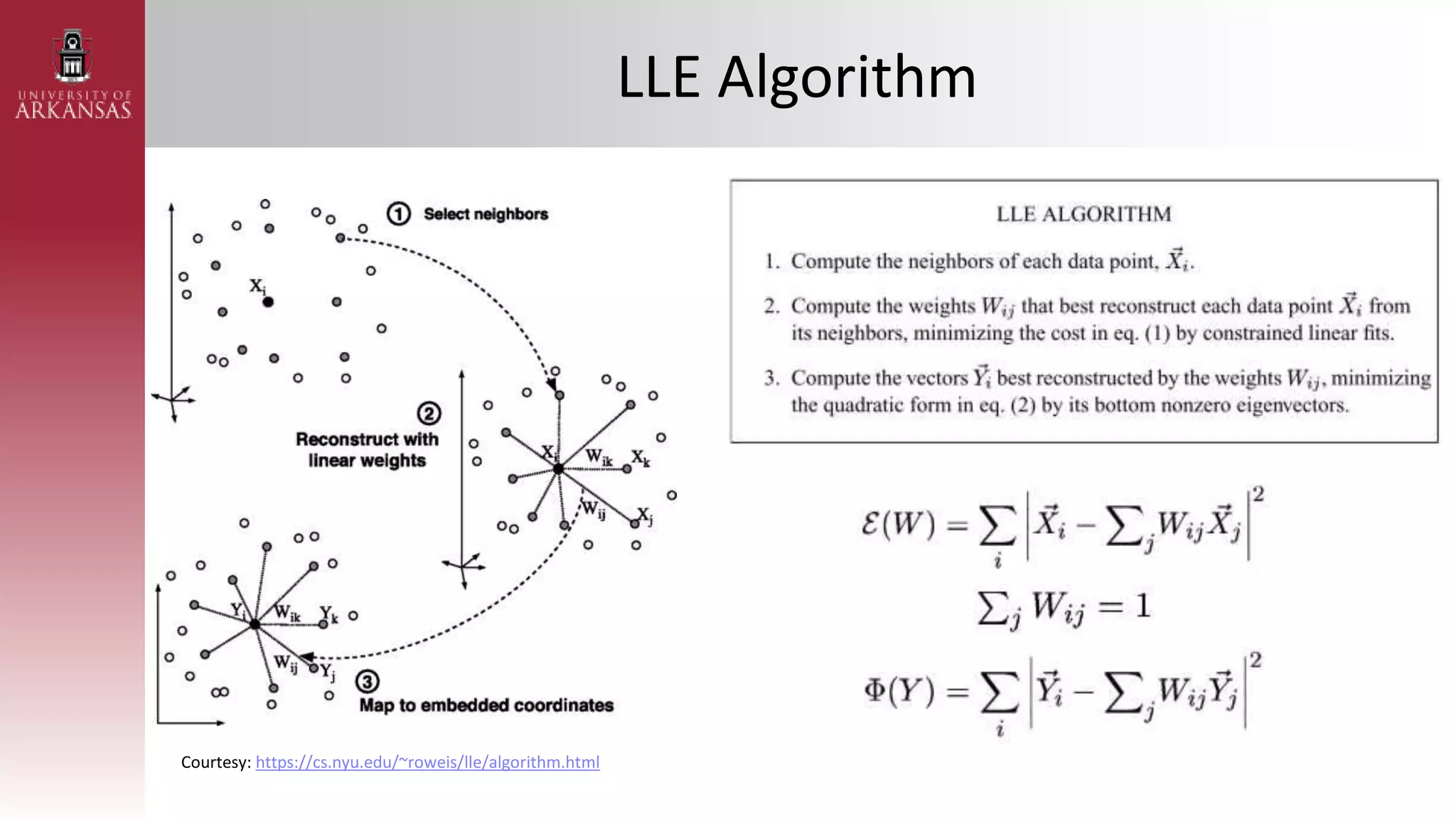
LLE Algorithm
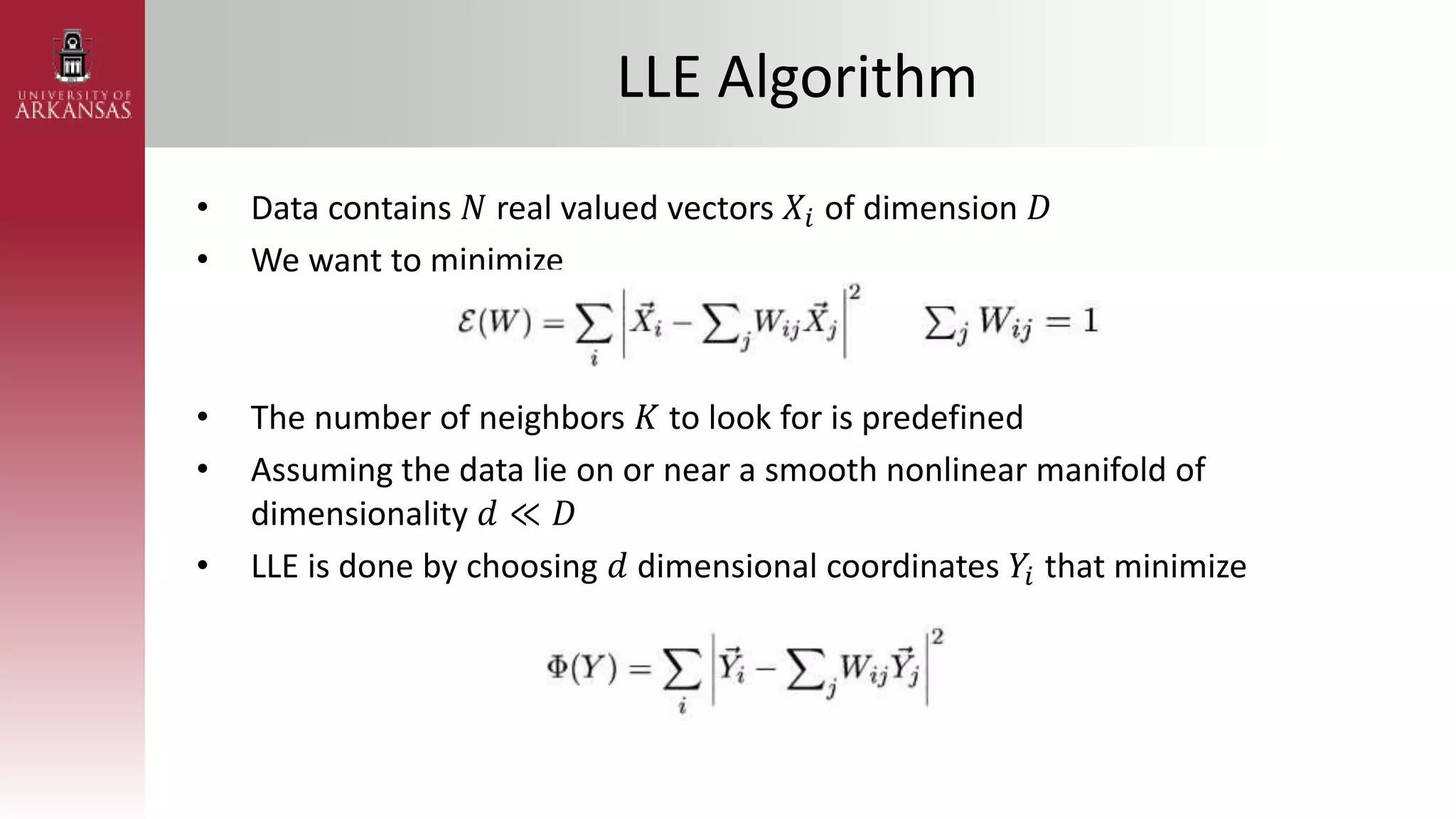
• Data contains 𝑁 real valued vectors 𝑋𝑖 of dimension 𝐷
• We want to minimize
• The number of neighbors 𝐾 to look for is predefined
• Assuming the data lie on or near a smooth nonlinear manifold of
dimensionality 𝑑 ≪ 𝐷
• LLE is done by choosing 𝑑 dimensional coordinates 𝑌𝑖 that minimize
LLE Algorithm
Courtesy: https://cs.nyu.edu/~roweis/lle/algorithm.html
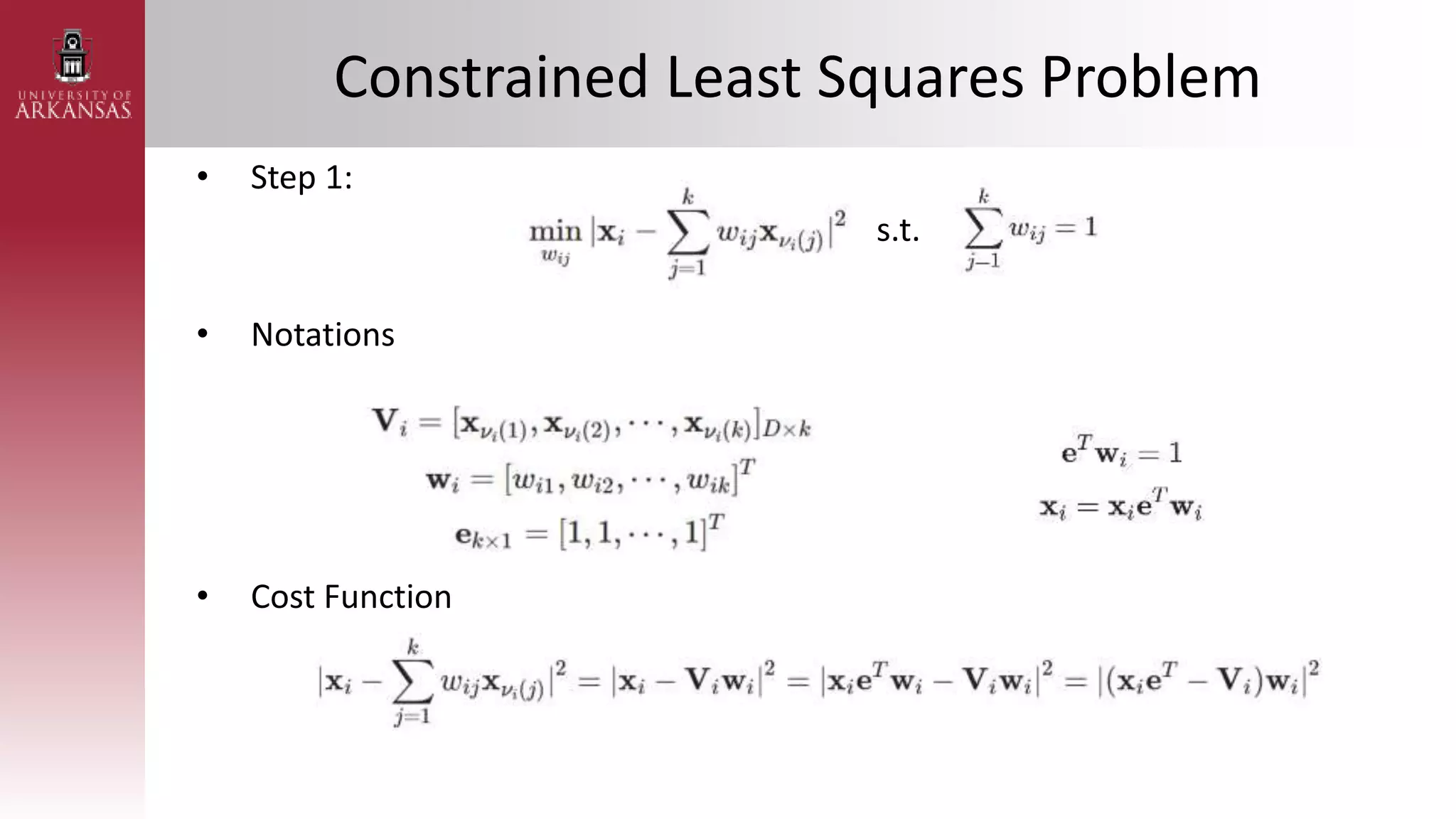
Constrained Least Squares Problem
• Step 1:
s.t.
• Notations
• Cost Function
Constrained Least Squares Problem
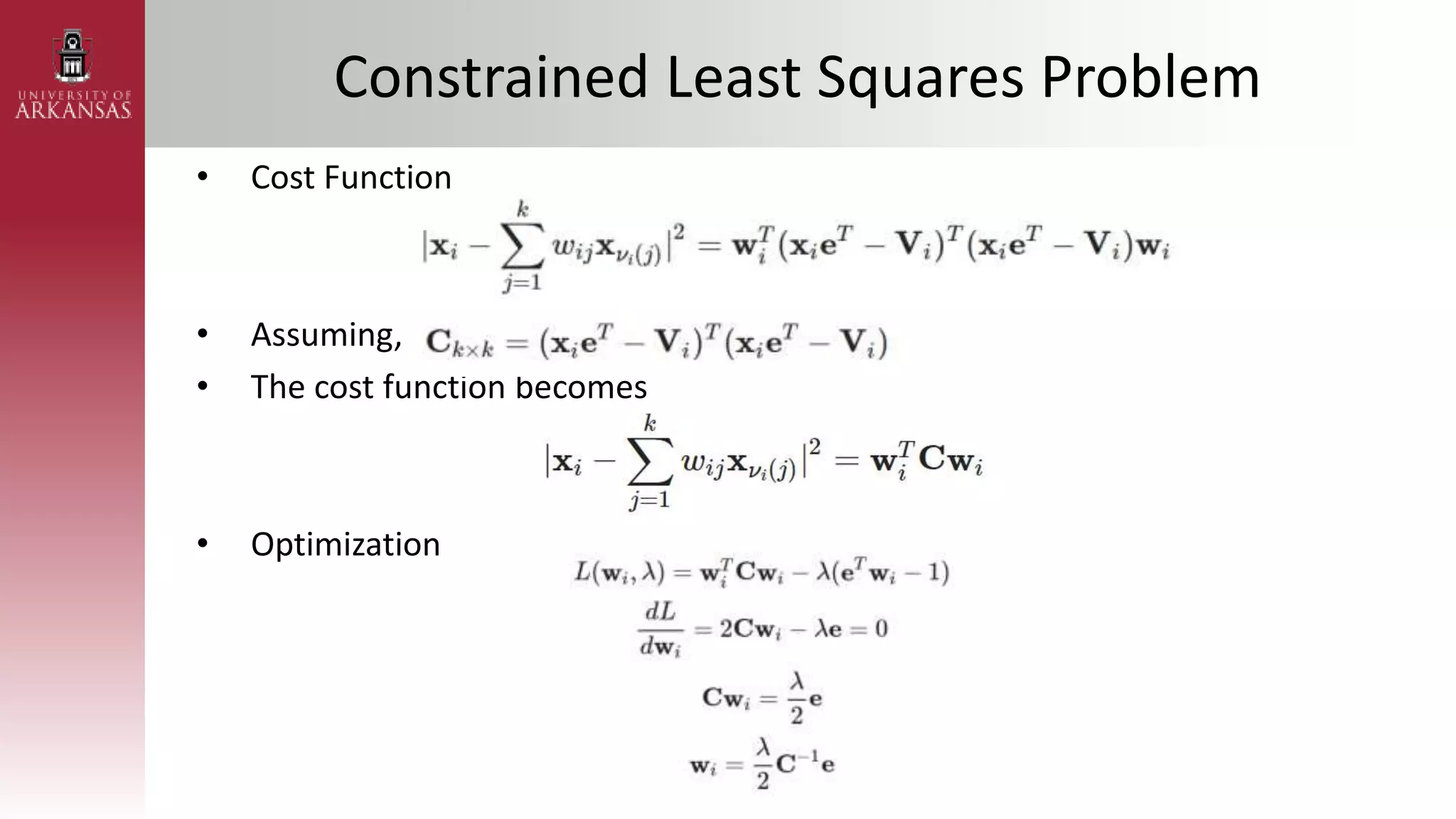
• Cost Function
• Assuming,
• The cost function becomes
• Optimization
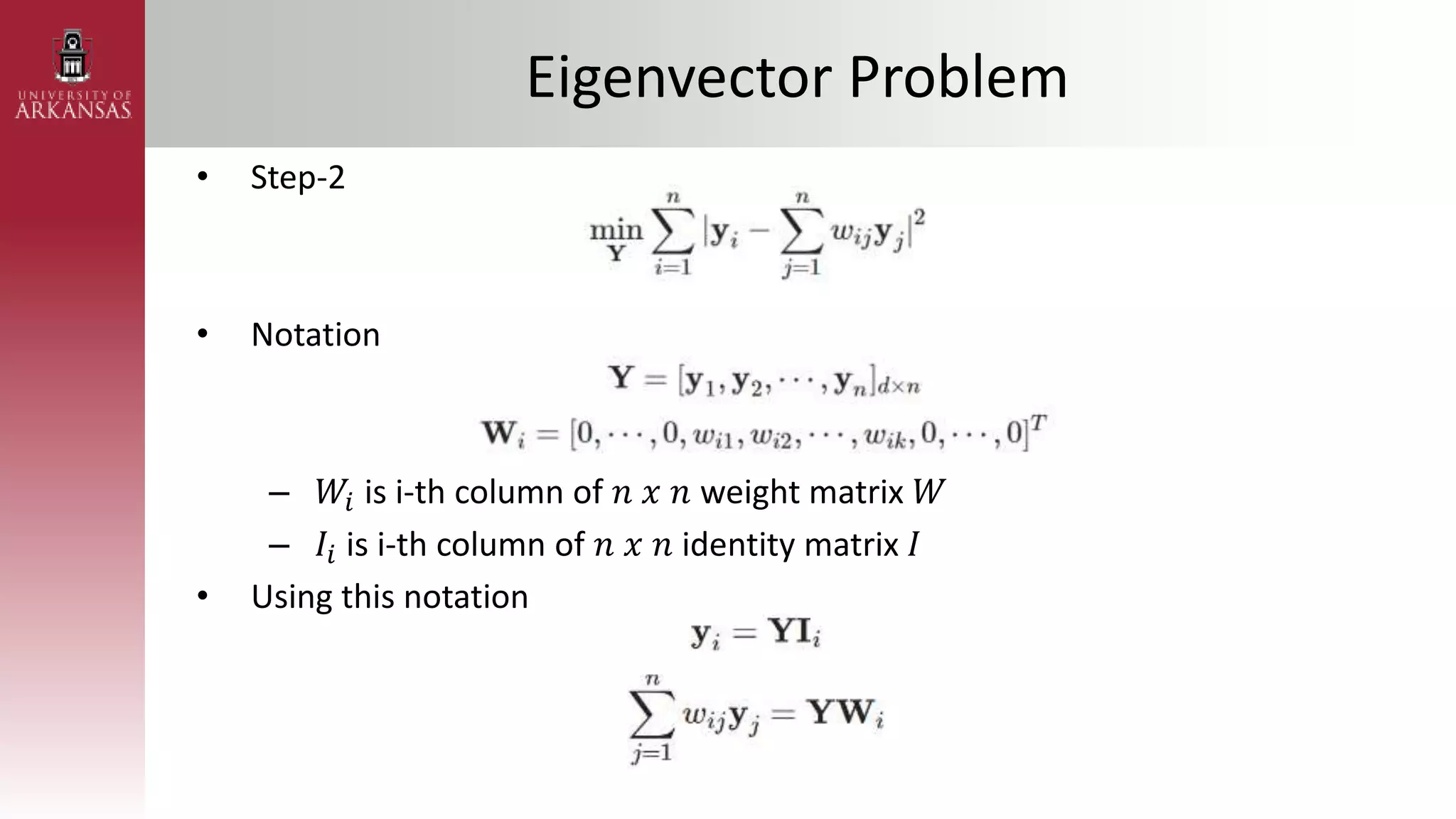
Eigenvector Problem
• Step-2
• Notation
– 𝑊𝑖 is i-th column of 𝑛 𝑥 𝑛 weight matrix 𝑊
– 𝐼𝑖 is i-th column of 𝑛 𝑥 𝑛 identity matrix 𝐼
• Using this notation
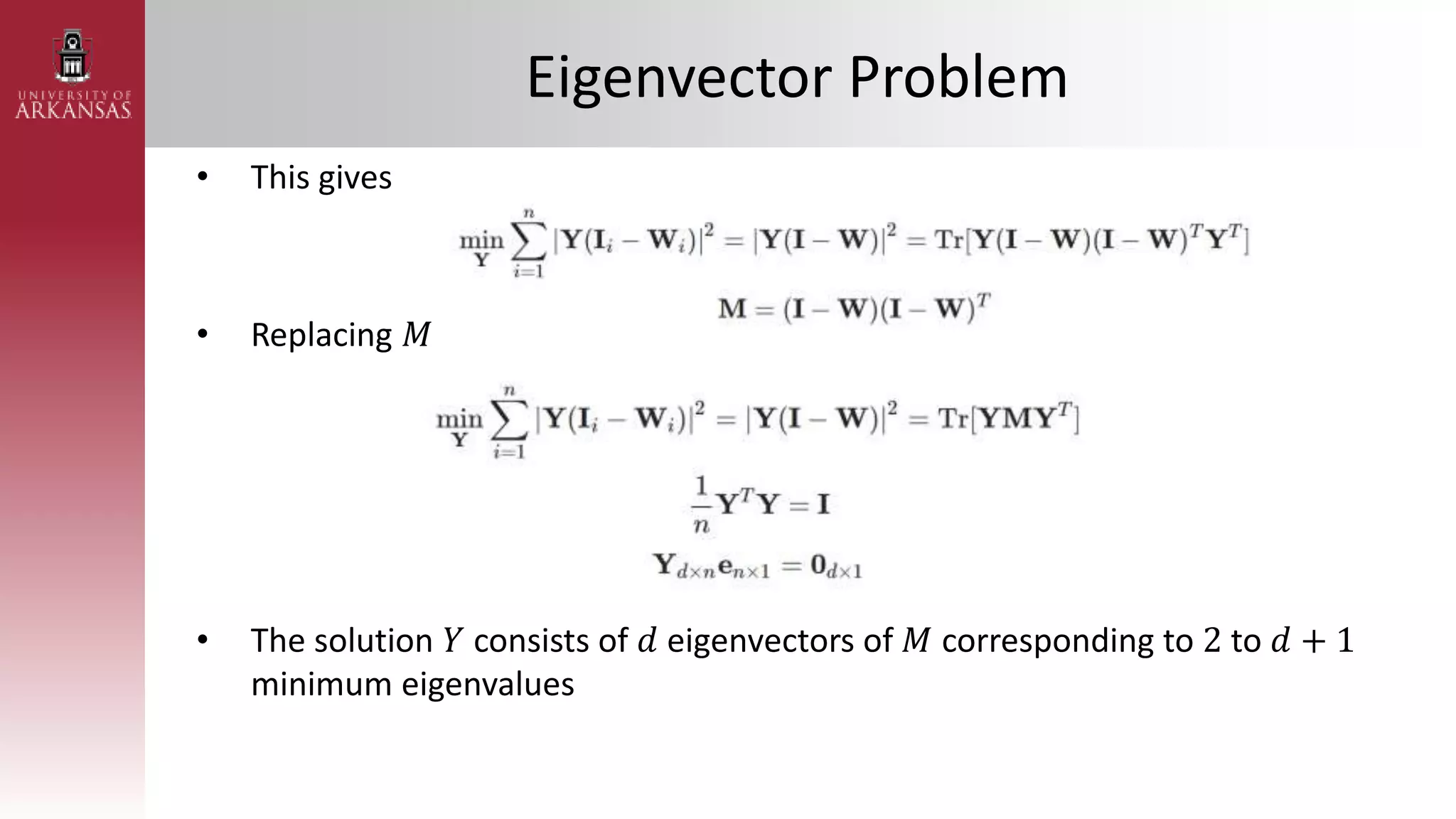
Eigenvector Problem
• This gives
• Replacing 𝑀
• The solution 𝑌 consists of 𝑑 eigenvectors of 𝑀 corresponding to 2 to 𝑑 + 1
minimum eigenvalues
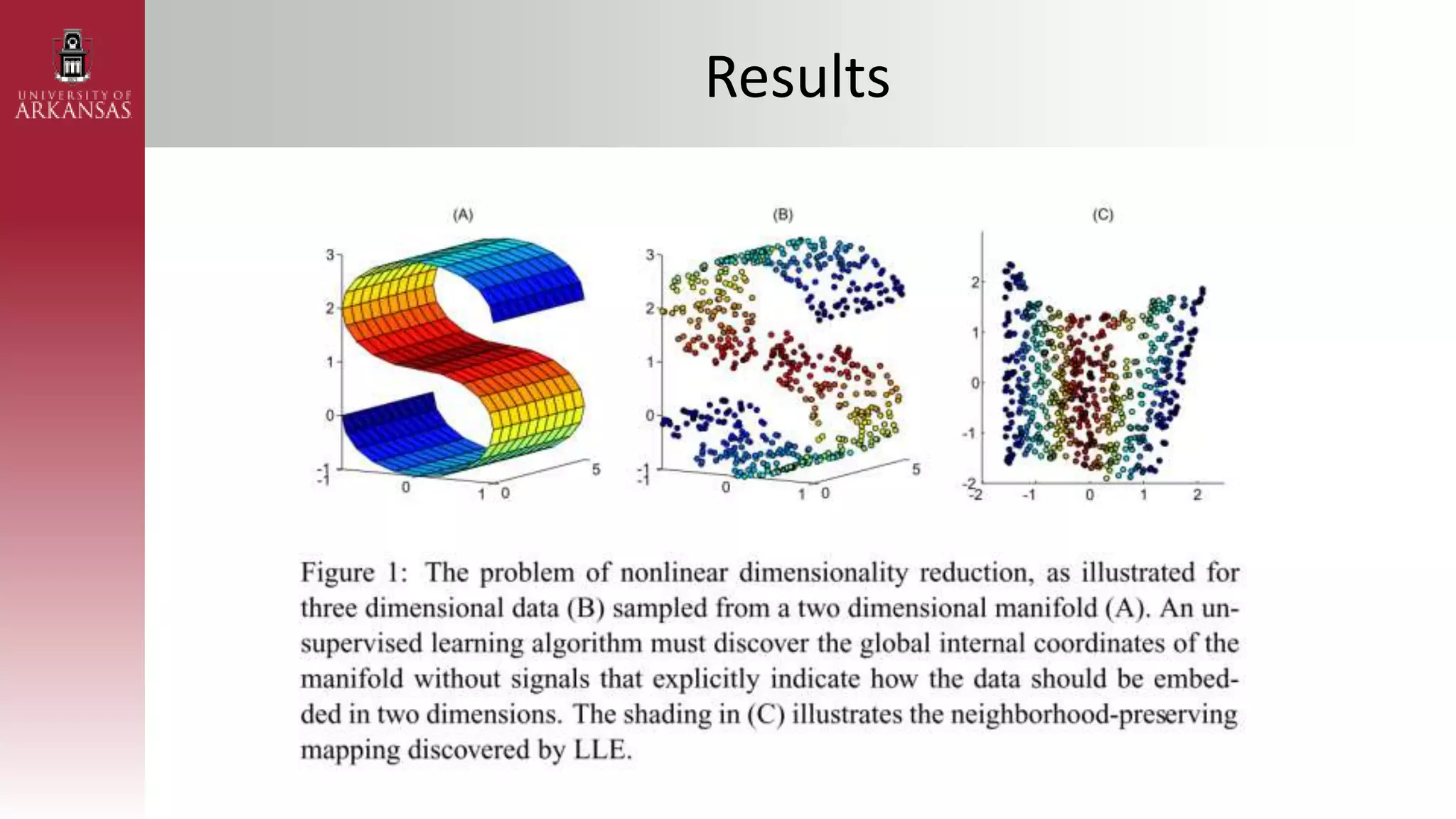
Results
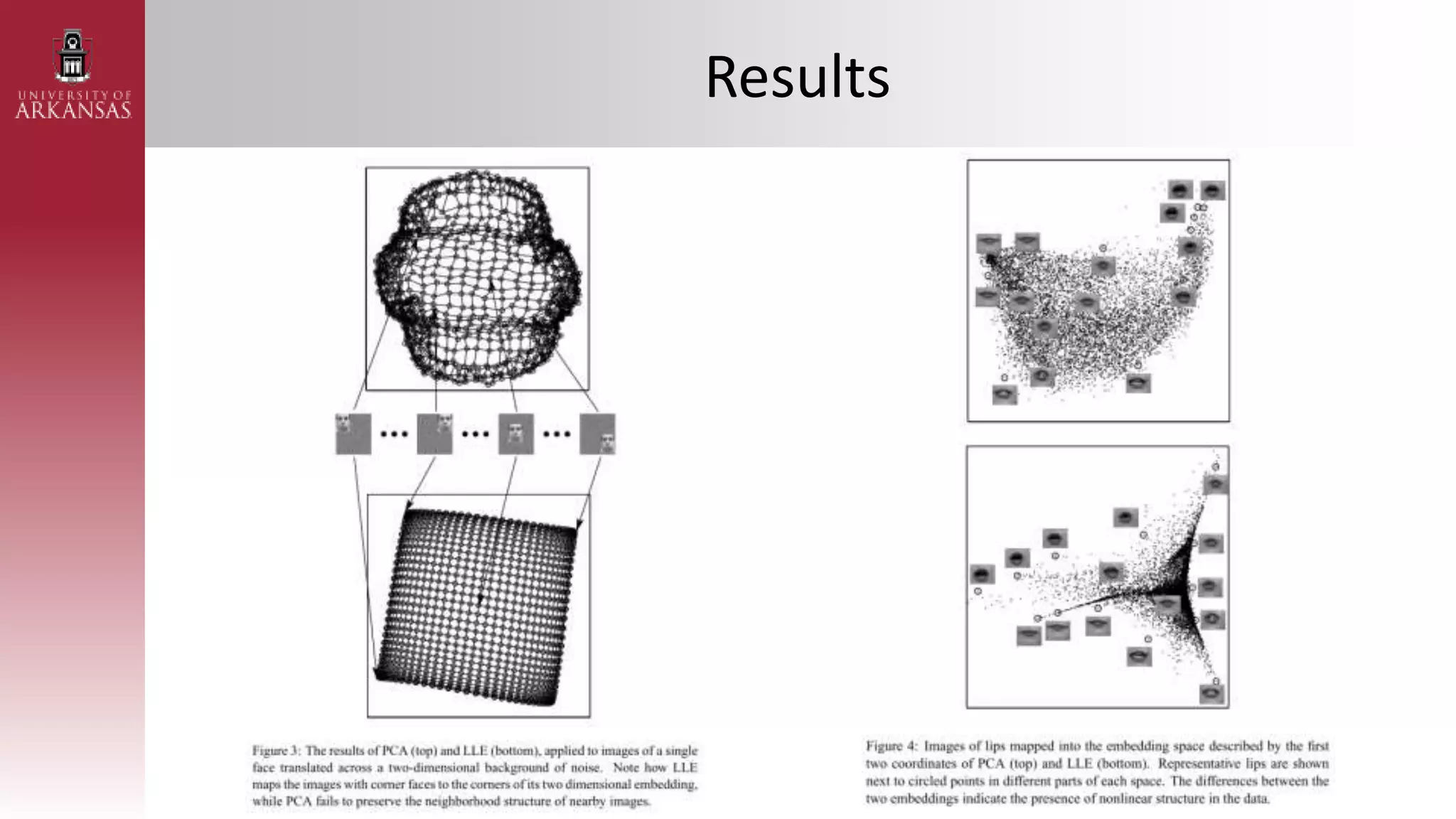
Results
Explaining Variational Approximations
John T. Ormerod, Matt P. Wand
The American Statistician (2010)
Introduction
• Variational approximations facilitate approximate inference for the
parameters in complex statistical models and provide fast, deterministic
alternatives to Monte Carlo methods
• Variational approximations are limited in their approximation accuracy
– opposed to MCMC that can be very accurate
• This paper does not discuss the quality of variational approximations
• Variational approximations can be useful for both likelihood-based and
Bayesian inference
• Topics
– Section 2: Density transform approach
– Section 3: Tangent transform approach
– Section 4: Same idea on frequentist context
Density Transform Approach
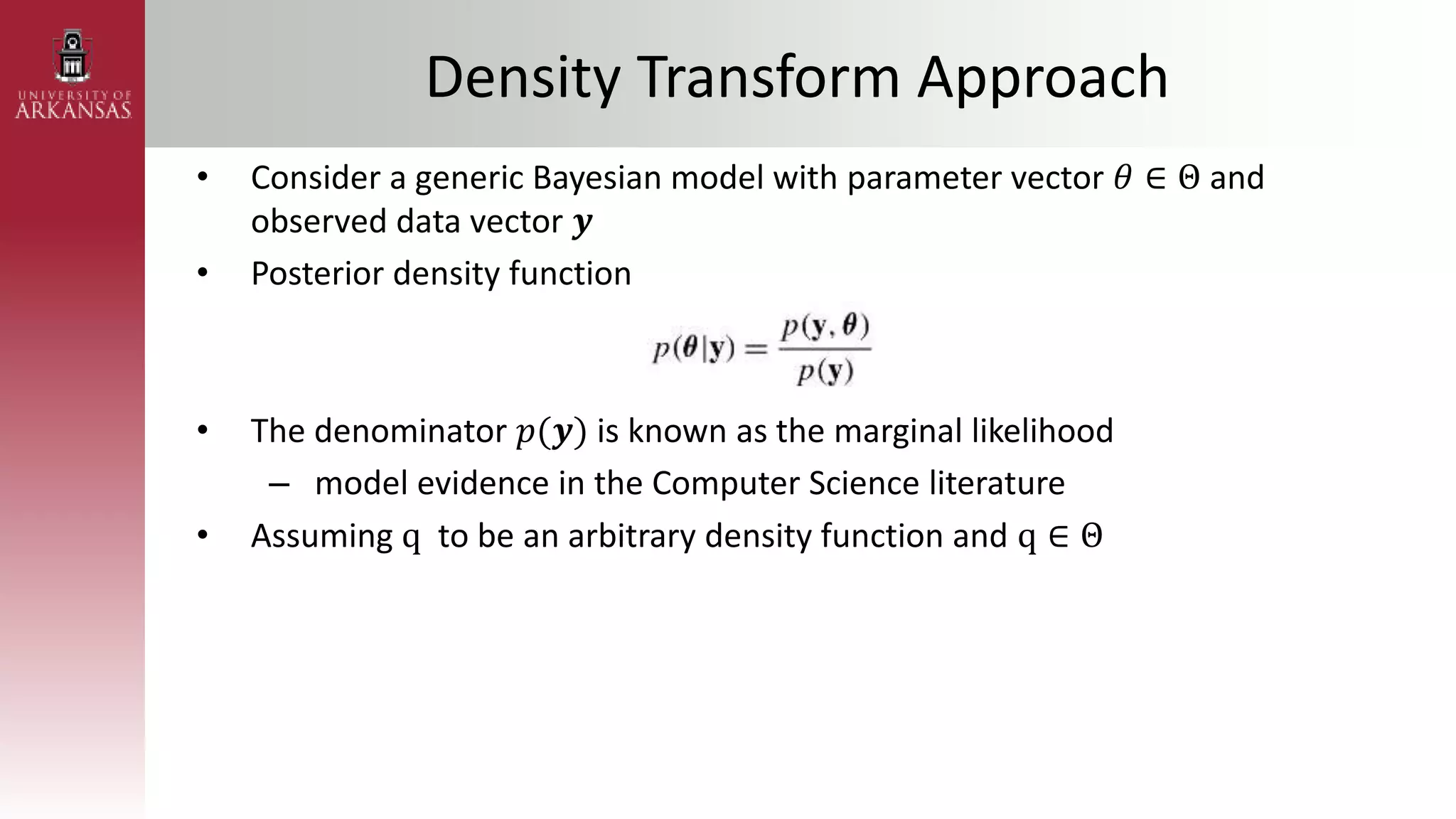
• Consider a generic Bayesian model with parameter vector 𝜃 ∈ Θ and
observed data vector 𝒚
• Posterior density function
• The denominator 𝑝(𝒚) is known as the marginal likelihood
– model evidence in the Computer Science literature
• Assuming q to be an arbitrary density function and q ∈ Θ
Density Transform Approach
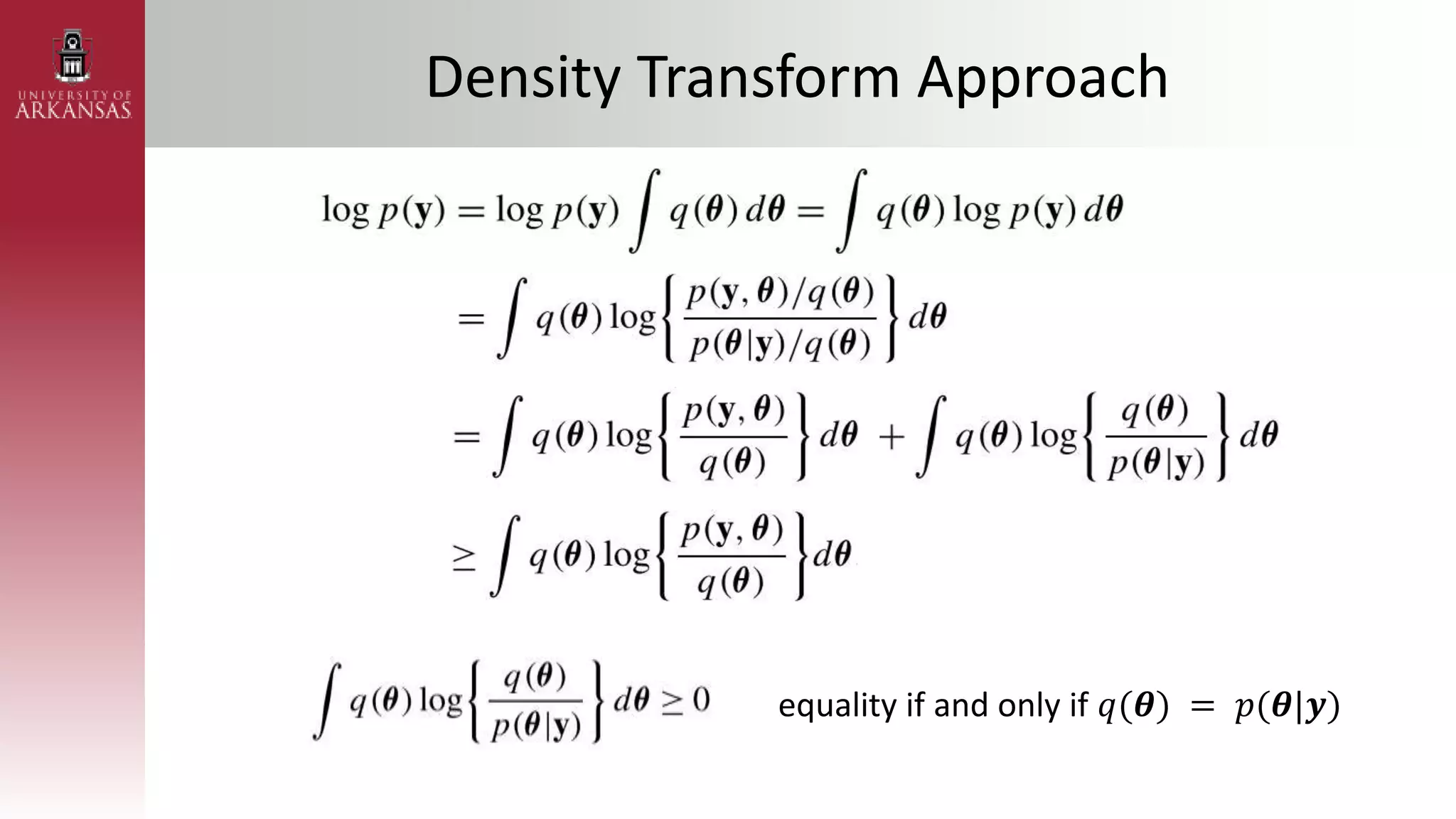
equality if and only if 𝑞(𝜽) = 𝑝(𝜽|𝒚)
Density Transform Approach
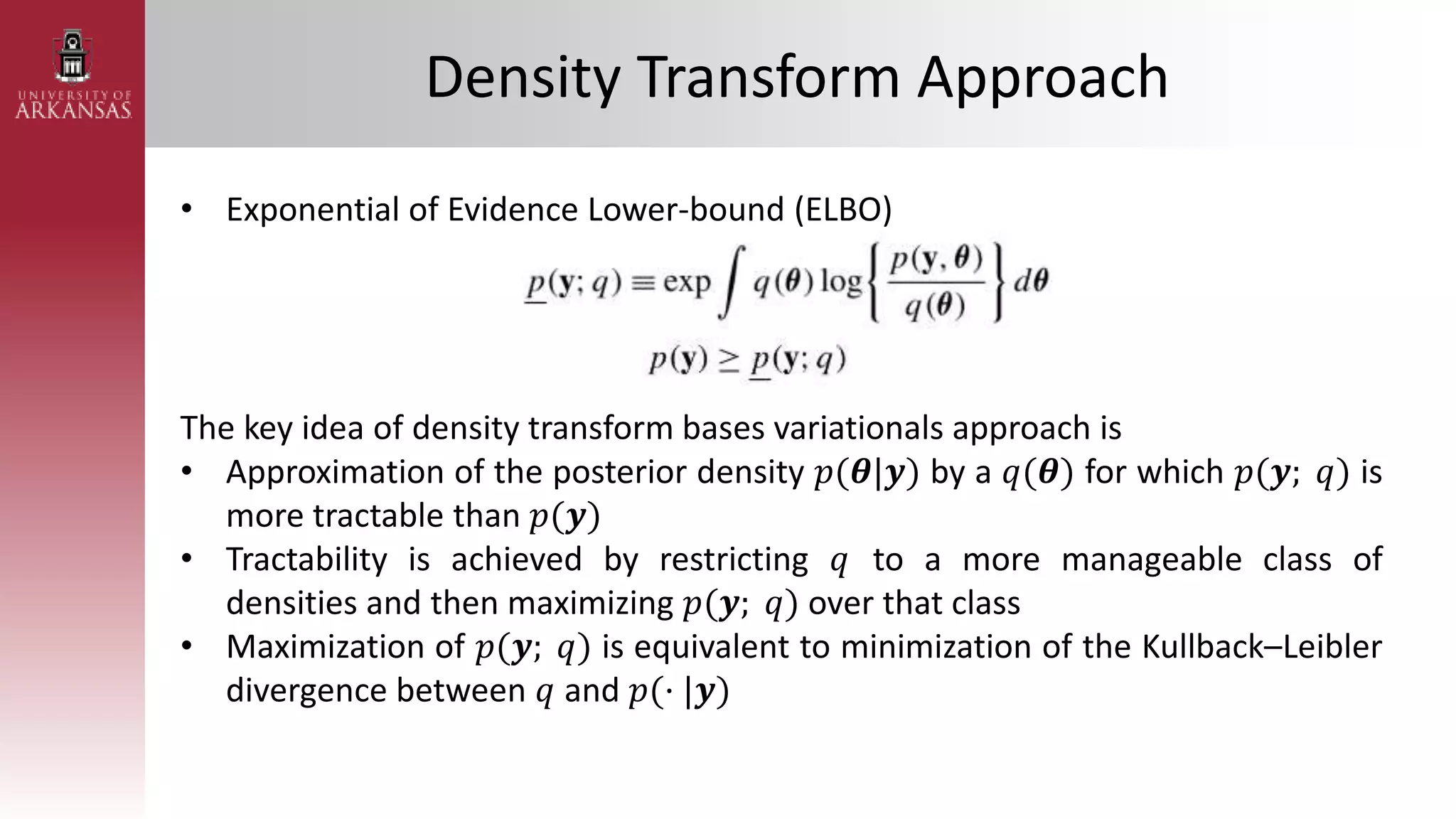
• Exponential of Evidence Lower-bound (ELBO)
The key idea of density transform bases variationals approach is
• Approximation of the posterior density 𝑝(𝜽|𝒚) by a 𝑞(𝜽) for which 𝑝(𝒚; 𝑞) is
more tractable than 𝑝(𝒚)
• Tractability is achieved by restricting 𝑞 to a more manageable class of
densities and then maximizing 𝑝(𝒚; 𝑞) over that class
• Maximization of 𝑝(𝒚; 𝑞) is equivalent to minimization of the Kullback–Leibler
divergence between 𝑞 and 𝑝(· |𝒚)
Density Transform Approach
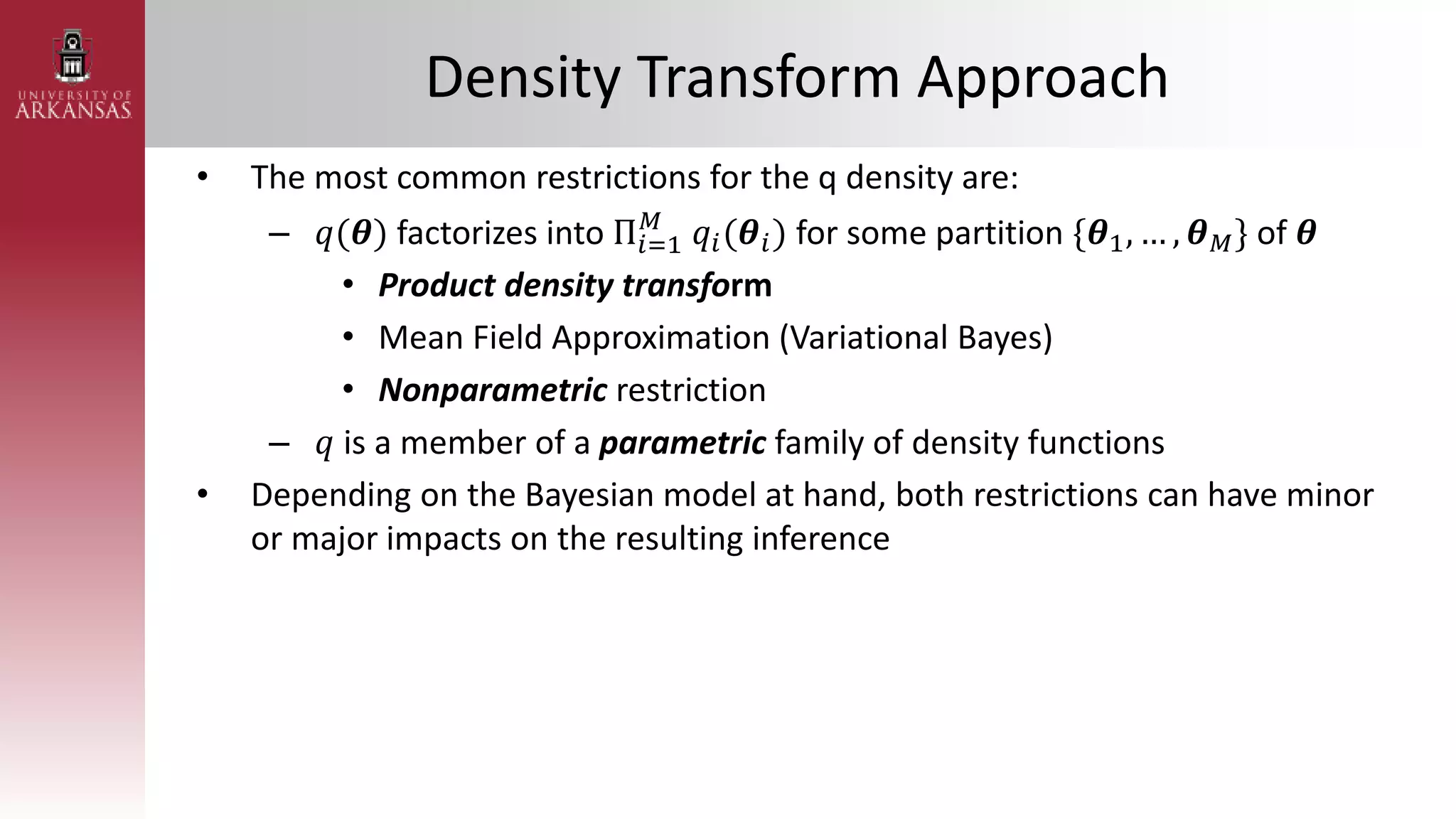
• The most common restrictions for the q density are:
– 𝑞(𝜽) factorizes into Π𝑖=1
𝑀
𝑞𝑖(𝜽𝑖) for some partition {𝜽1, … , 𝜽𝑀} of 𝜽
• Product density transform
• Mean Field Approximation (Variational Bayes)
• Nonparametric restriction
– 𝑞 is a member of a parametric family of density functions
• Depending on the Bayesian model at hand, both restrictions can have minor
or major impacts on the resulting inference
Product Density Transforms
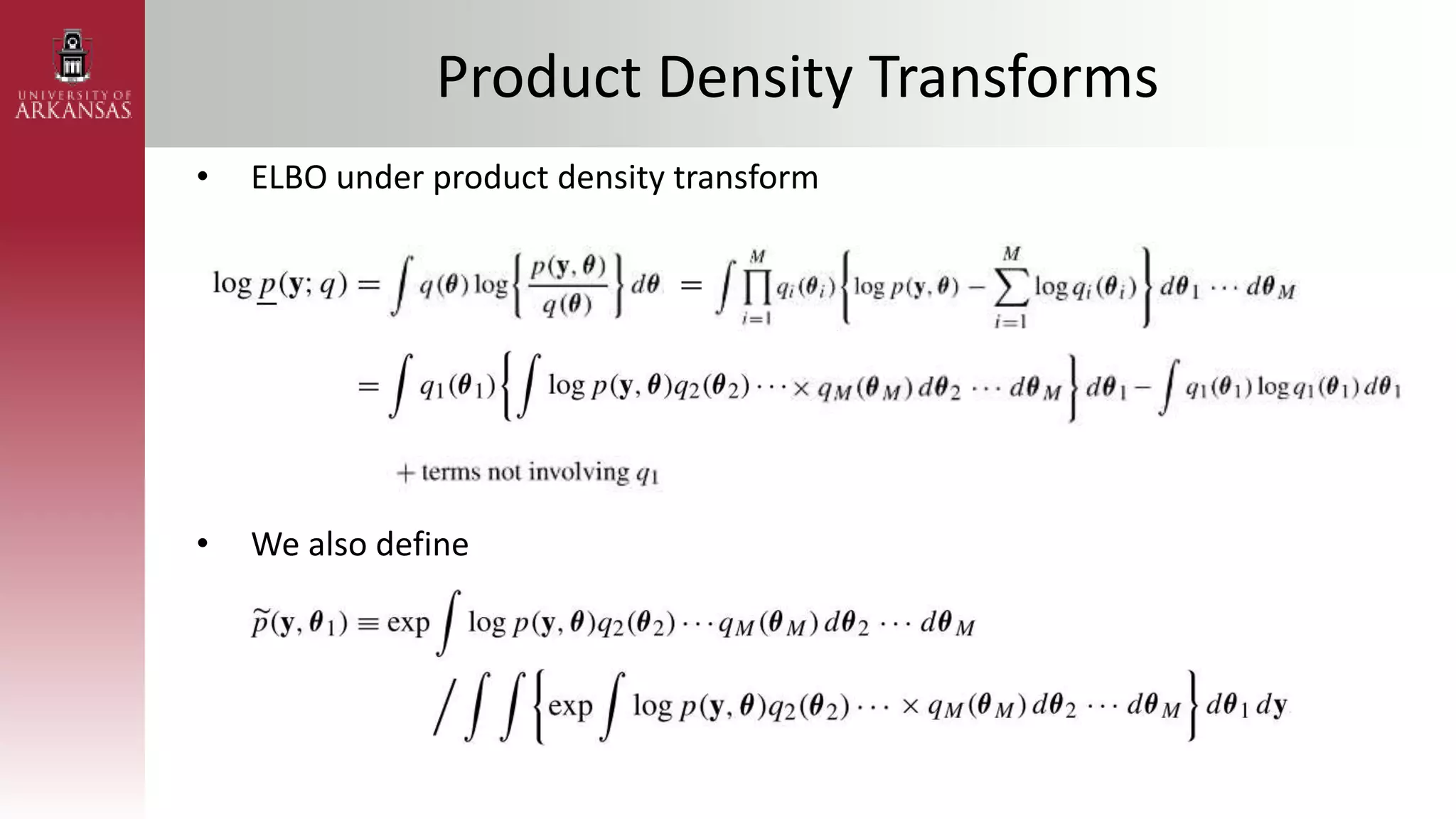
• ELBO under product density transform
• We also define
Product Density Transforms
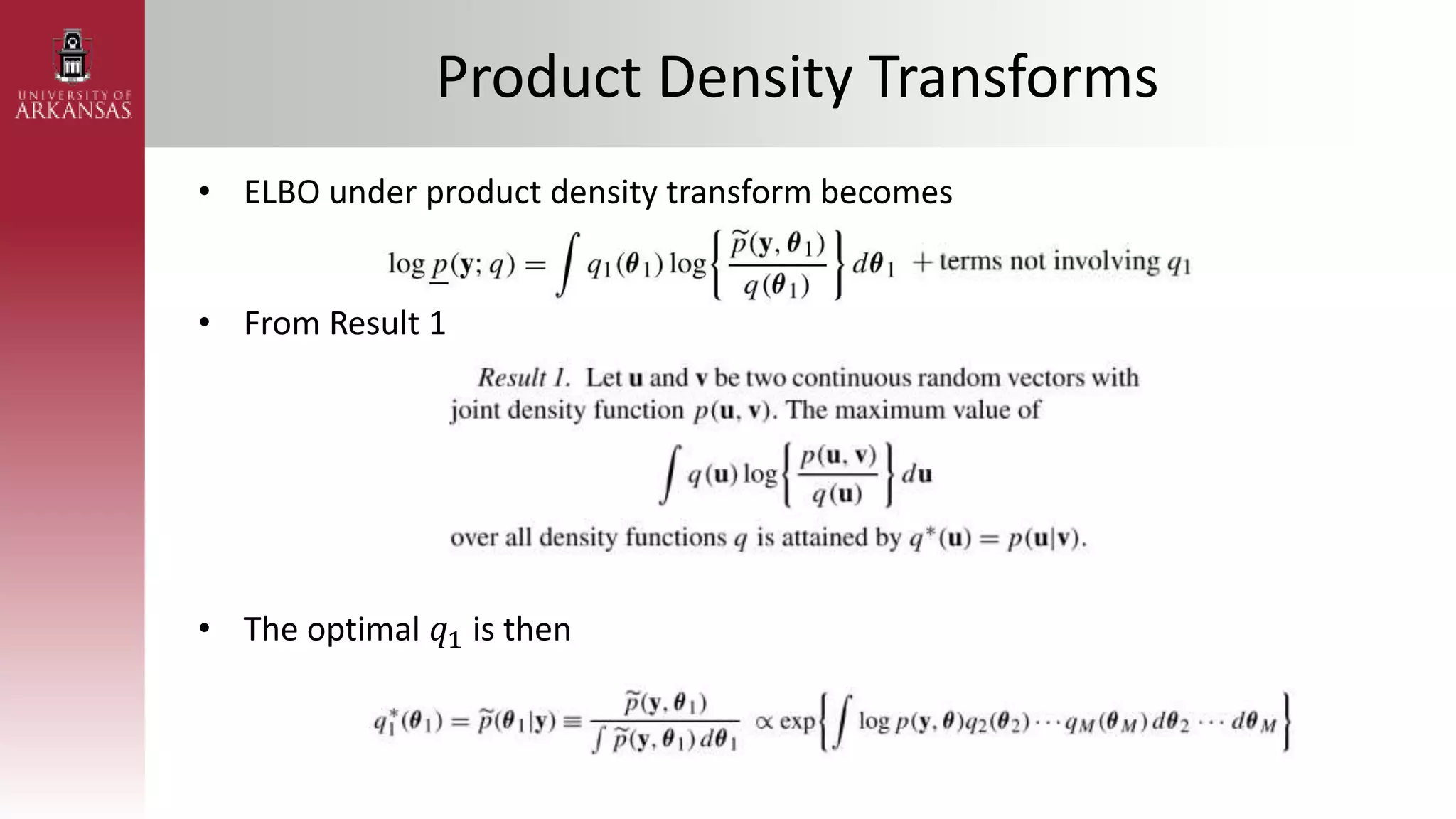
• ELBO under product density transform becomes
• From Result 1
• The optimal 𝑞1 is then
Product Density Transforms
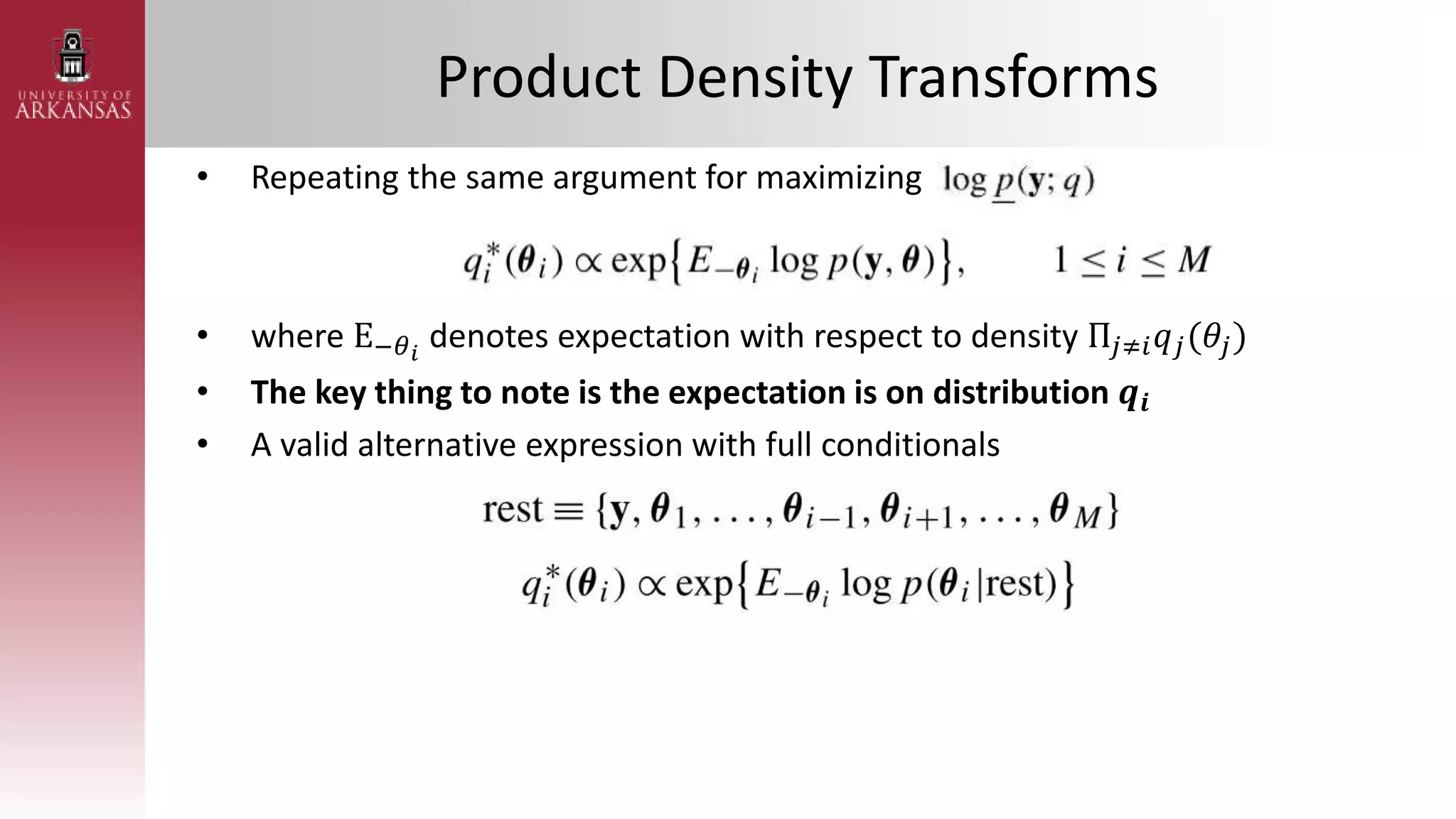
• Repeating the same argument for maximizing
• where E−𝜃𝑖
denotes expectation with respect to density Π𝑗≠𝑖𝑞𝑗(𝜃𝑗)
• The key thing to note is the expectation is on distribution 𝒒𝒊
• A valid alternative expression with full conditionals
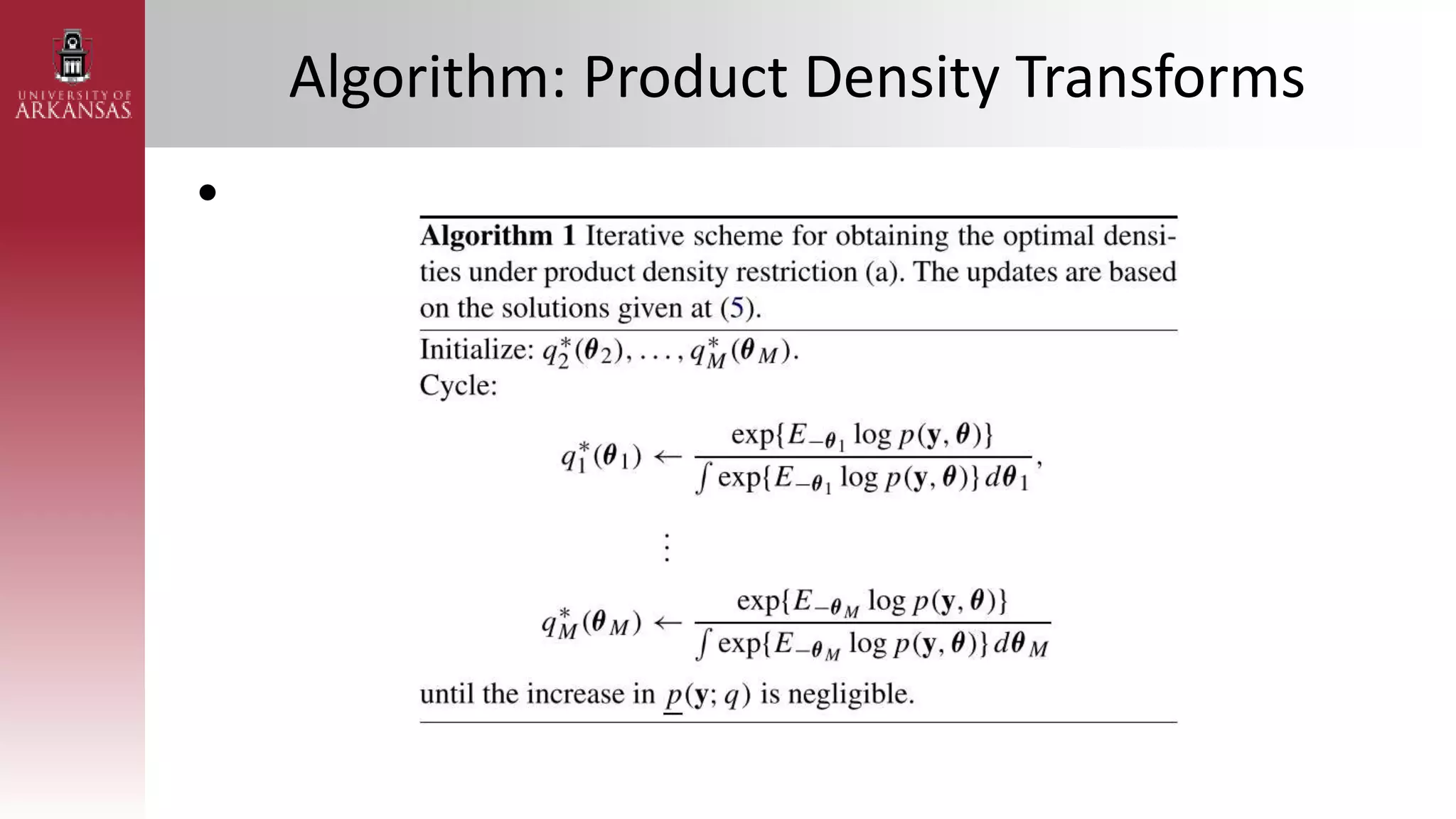
Algorithm: Product Density Transforms
•
Example 1: Normal Random Sample
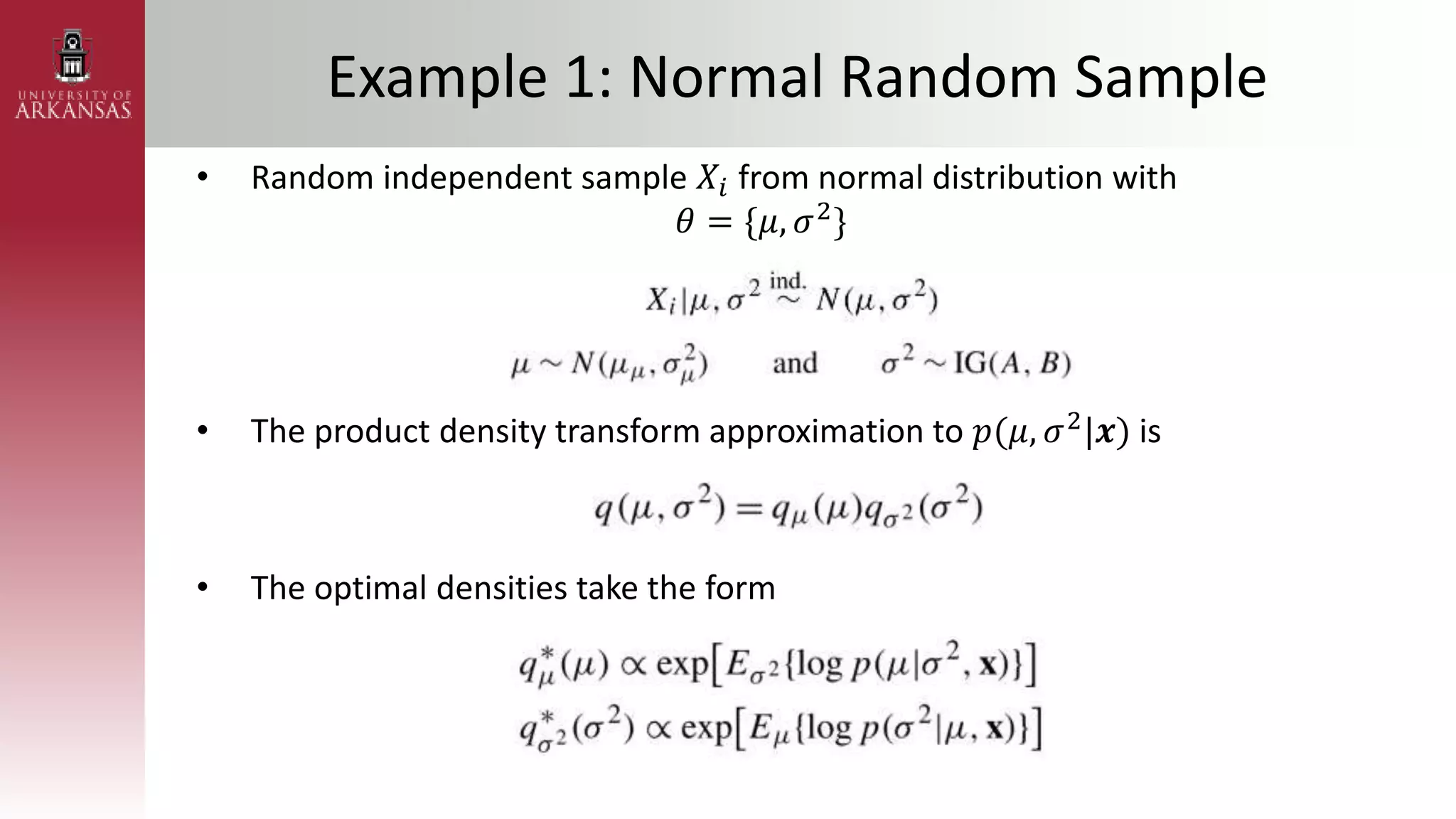
• Random independent sample 𝑋𝑖 from normal distribution with
𝜃 = {𝜇, 𝜎2
}
• The product density transform approximation to 𝑝(𝜇, 𝜎2
|𝒙) is
• The optimal densities take the form
Example 1: Normal Random Sample
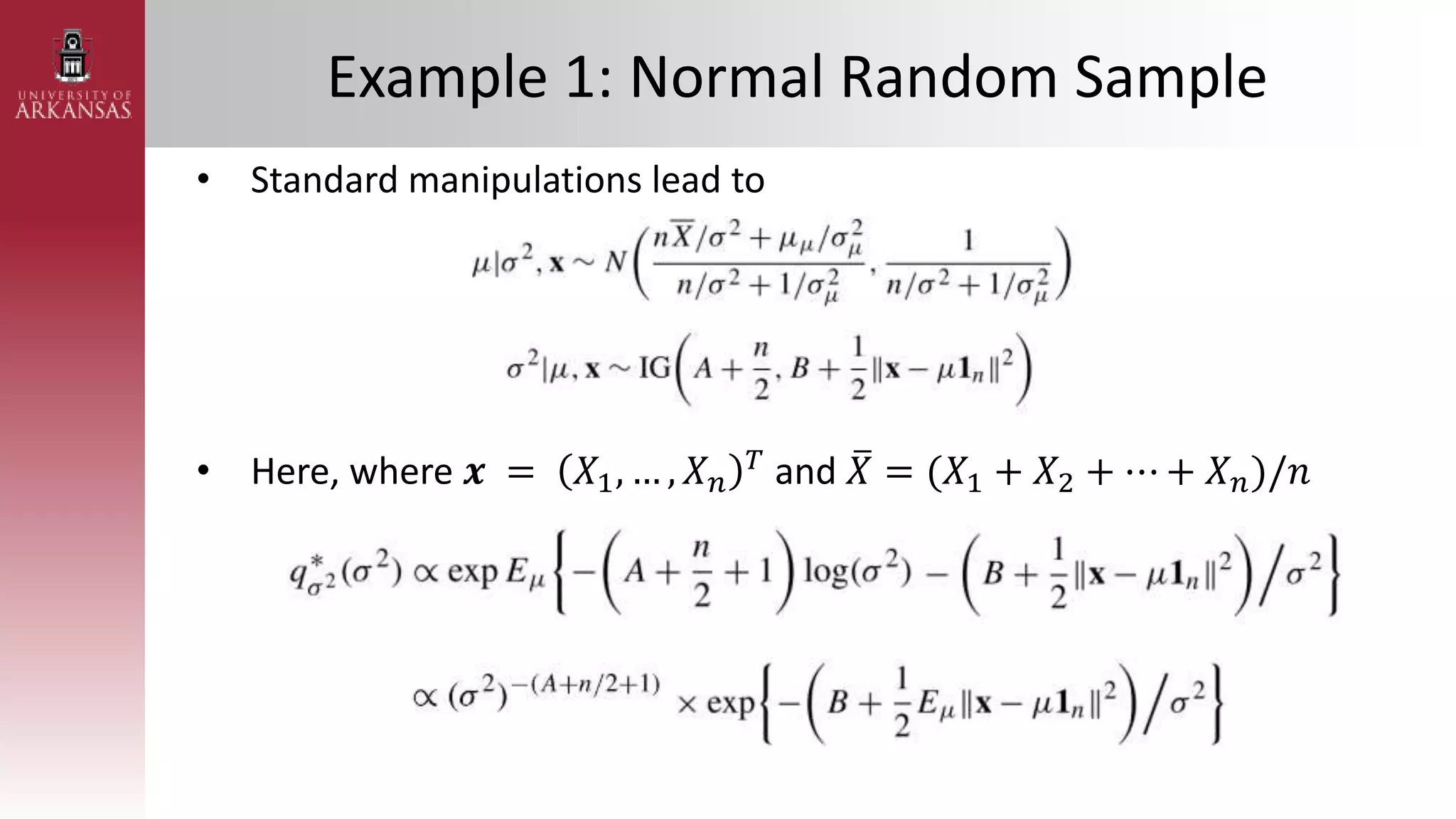
• Standard manipulations lead to
• Here, where 𝒙 = 𝑋1, … , 𝑋𝑛
𝑇
and 𝑋 = (𝑋1 + 𝑋2 + ⋯ + 𝑋𝑛)/𝑛
Example 1: Normal Random Sample
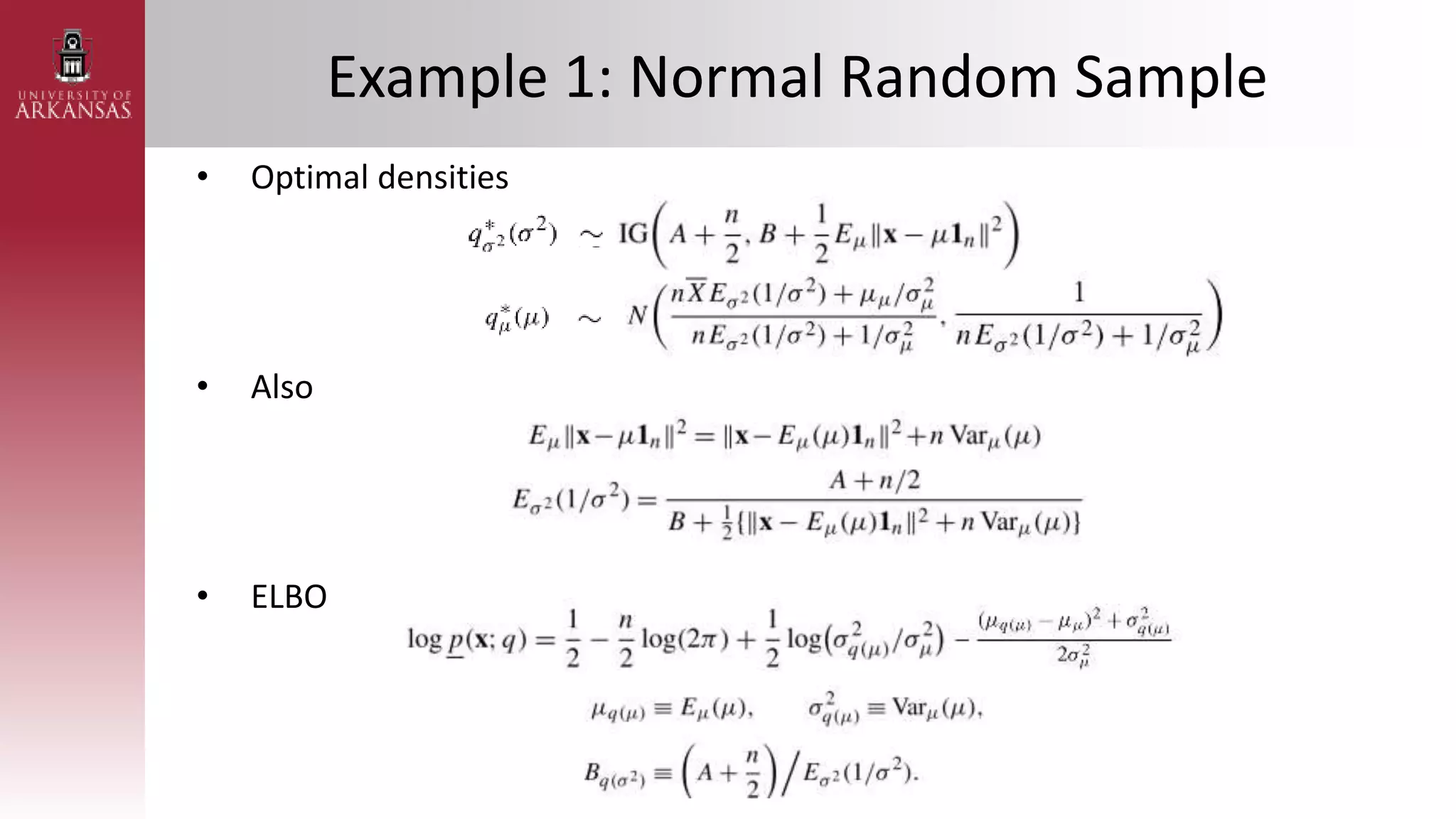
• Optimal densities
• Also
• ELBO
Example 1: Normal Random Sample
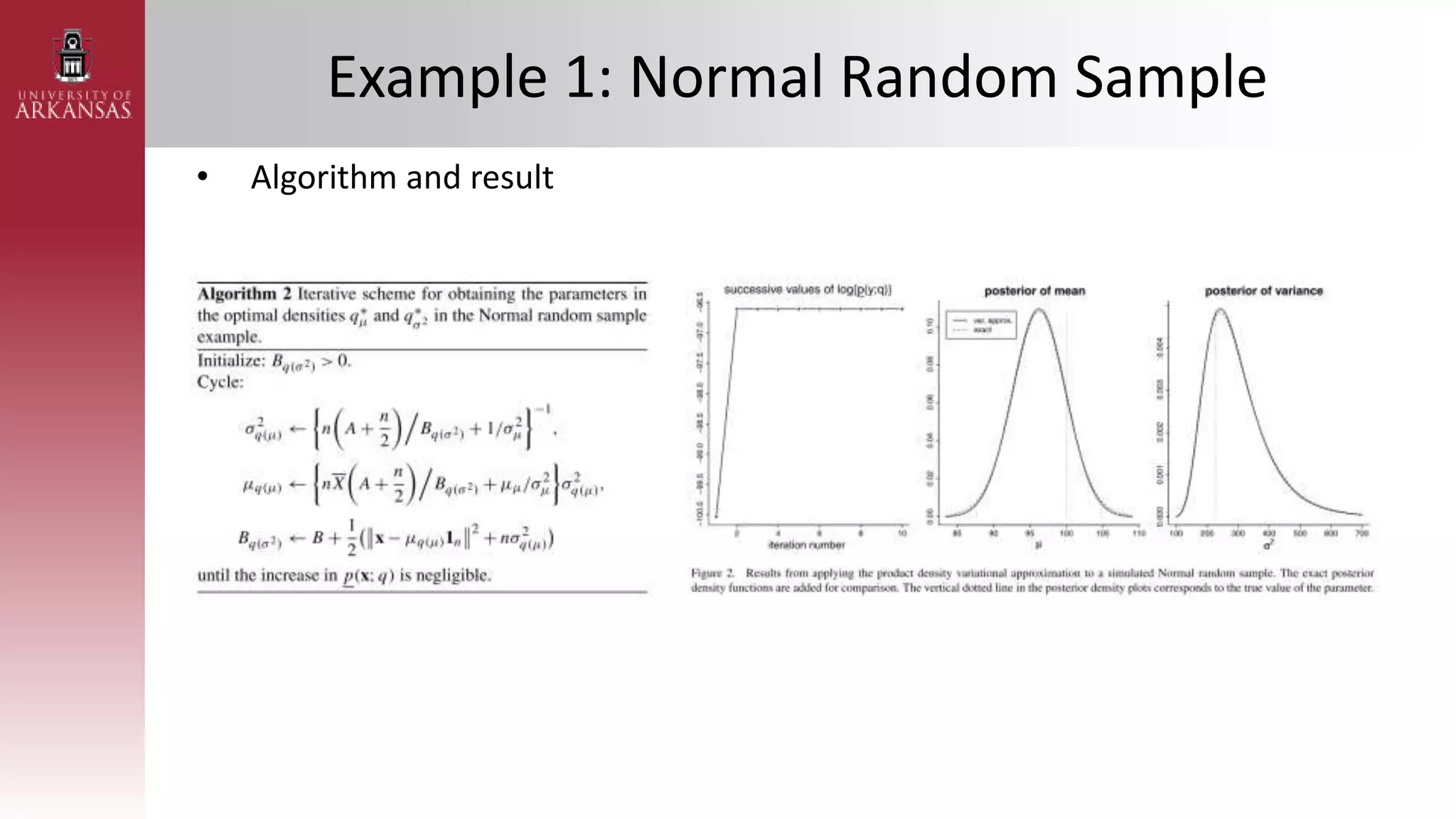
• Algorithm and result
Example 2: Linear Mixed Model
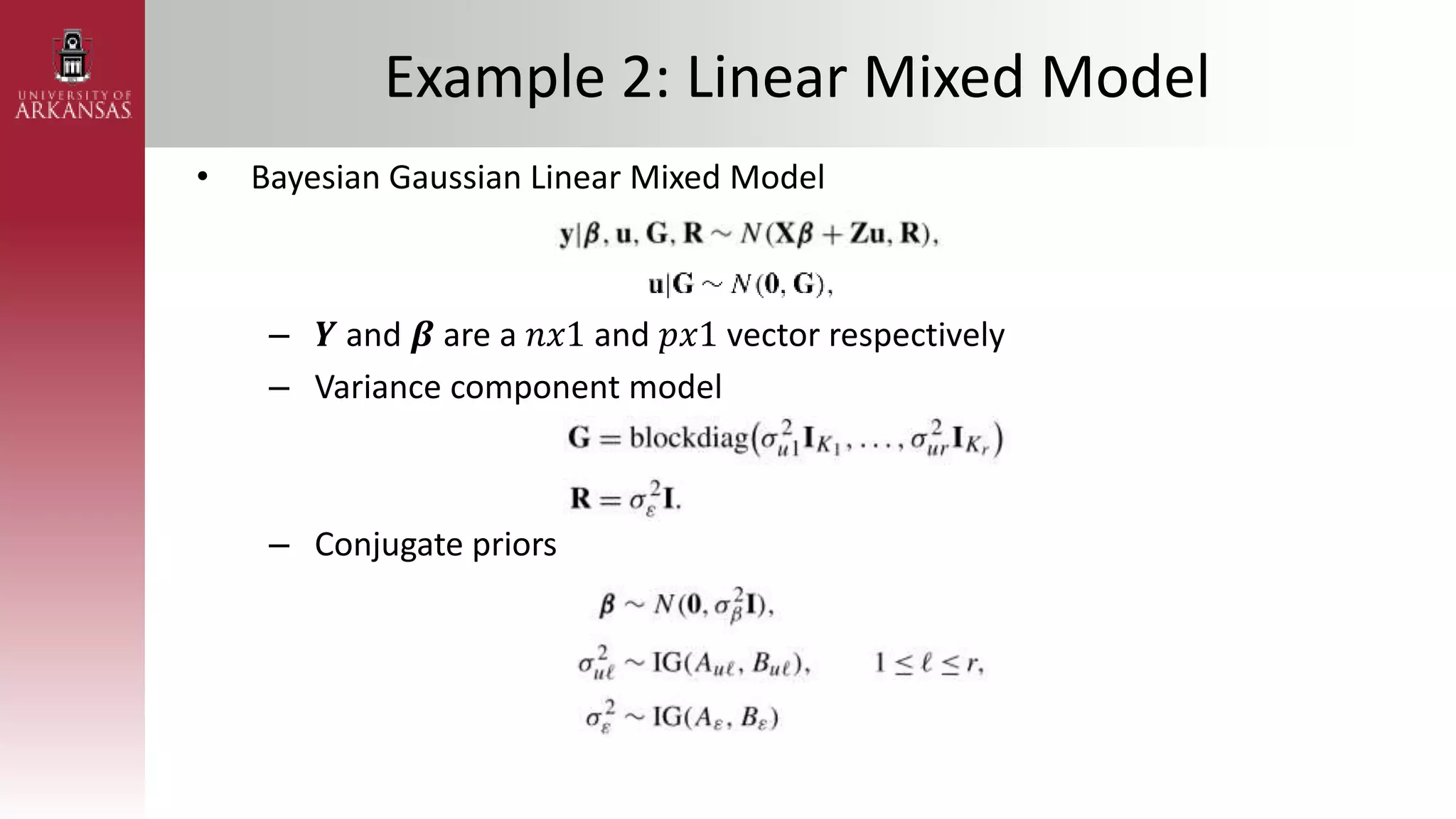
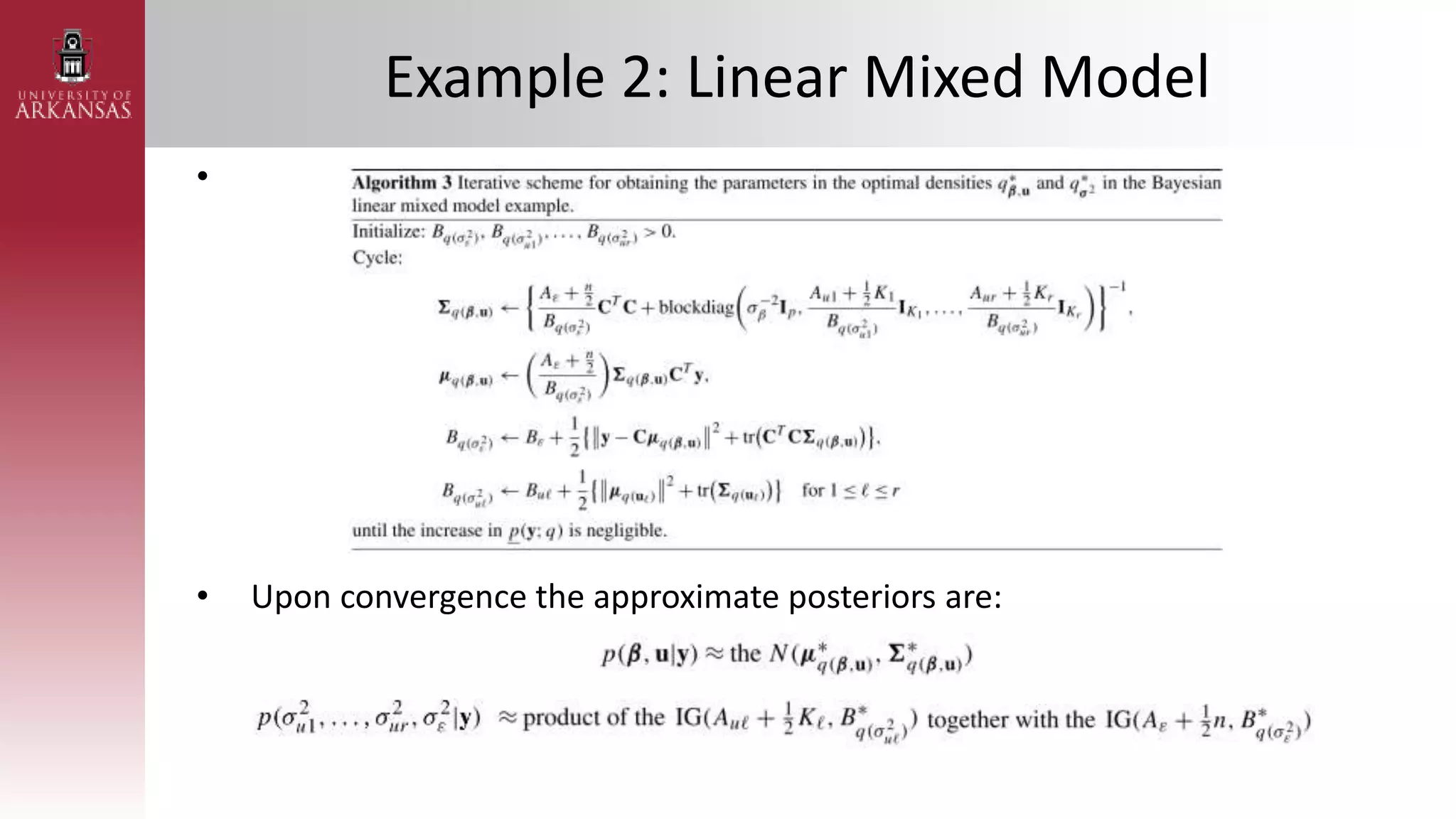
• Bayesian Gaussian Linear Mixed Model
– 𝒀 and 𝜷 are a 𝑛𝑥1 and 𝑝𝑥1 vector respectively
– Variance component model
– Conjugate priors
Example 2: Linear Mixed Model
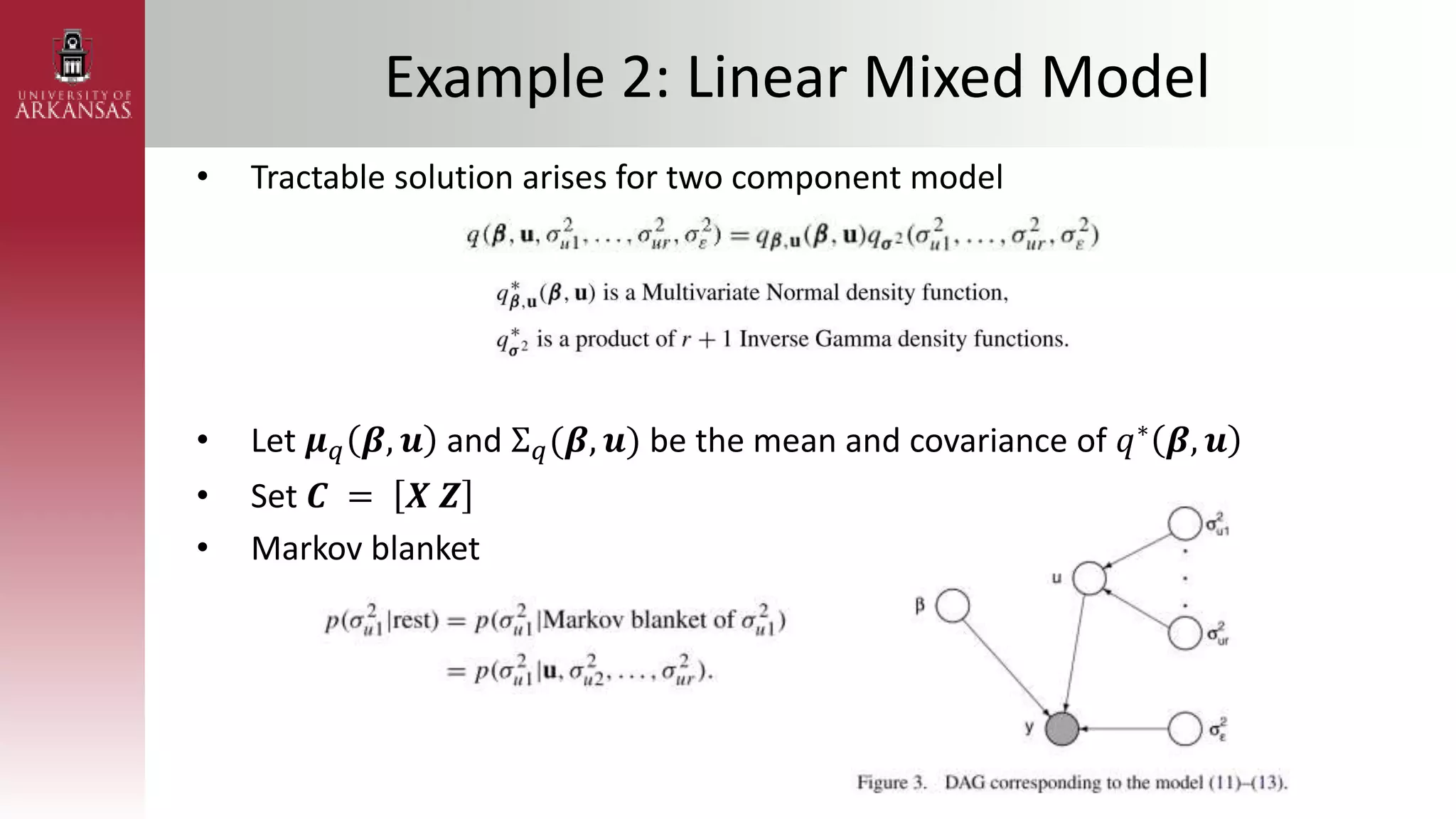
• Tractable solution arises for two component model
• Let 𝝁𝑞 𝜷, 𝒖 and Σ𝑞(𝜷, 𝒖) be the mean and covariance of 𝑞∗ 𝜷, 𝒖
• Set 𝑪 = 𝑿 𝒁
• Markov blanket
Example 2: Linear Mixed Model
•
• Upon convergence the approximate posteriors are:
Example 2: Linear Mixed Model
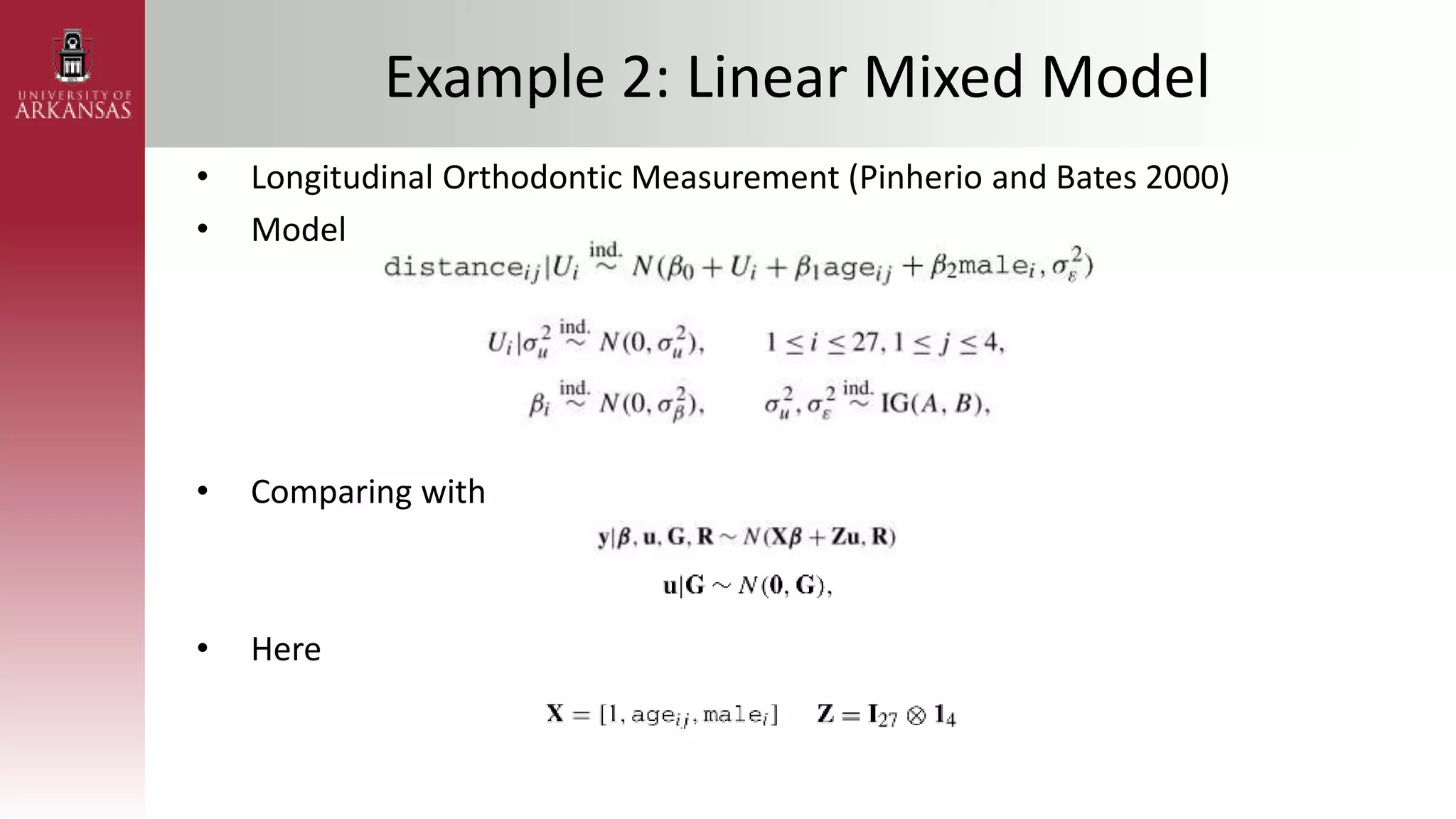
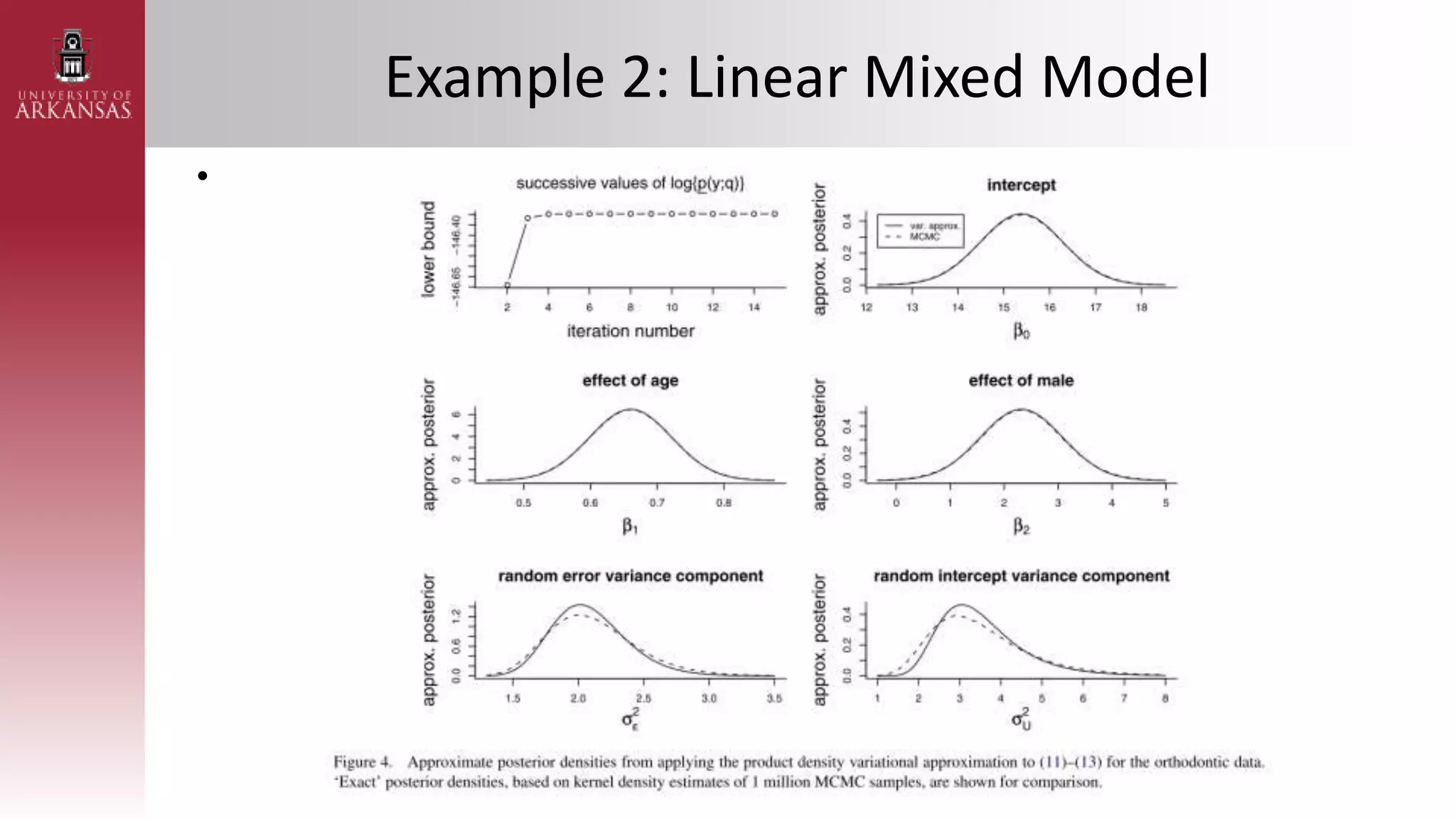
• Longitudinal Orthodontic Measurement (Pinherio and Bates 2000)
• Model
• Comparing with
• Here
Example 2: Linear Mixed Model
•
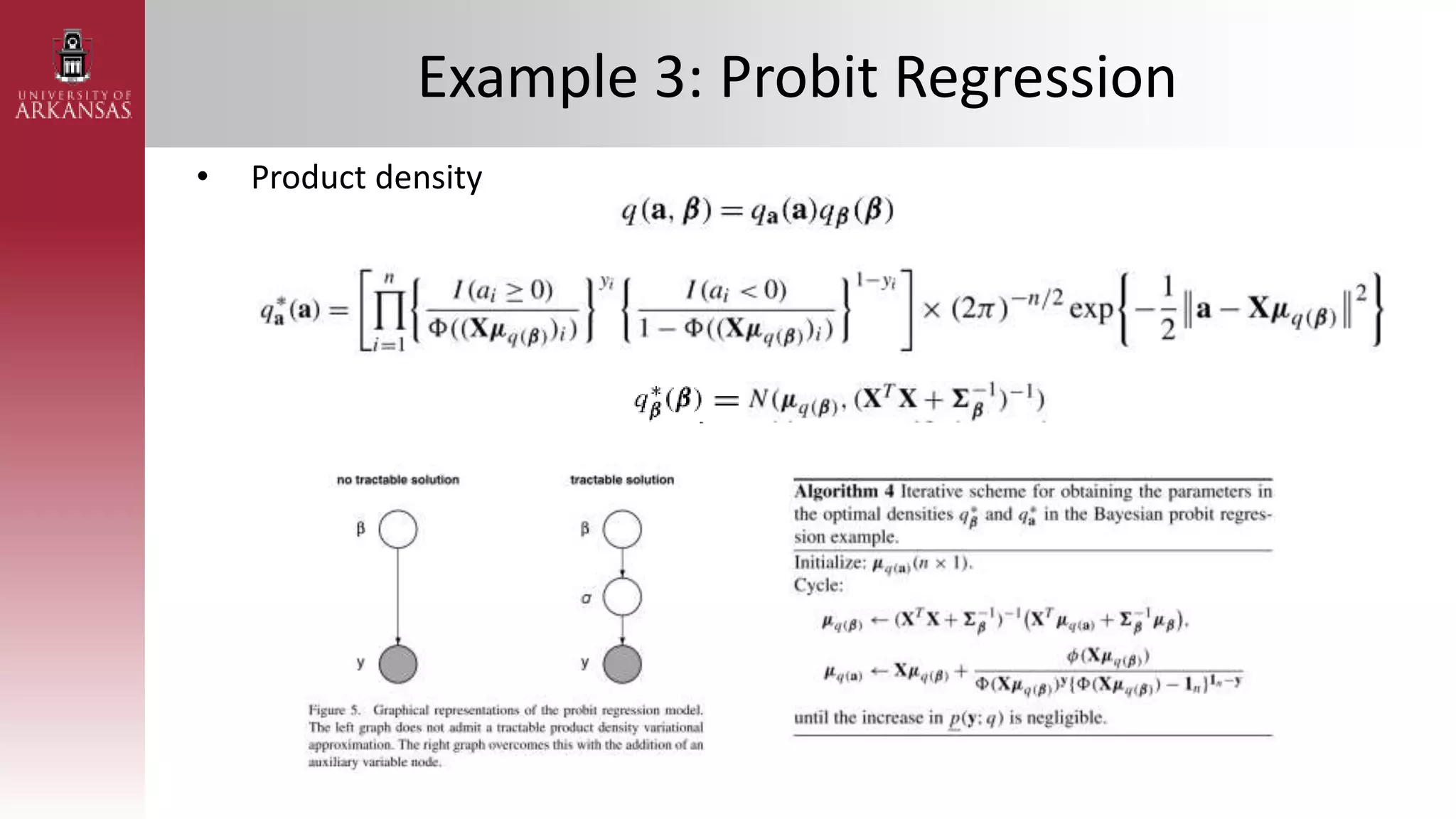
Example 3: Probit Regression
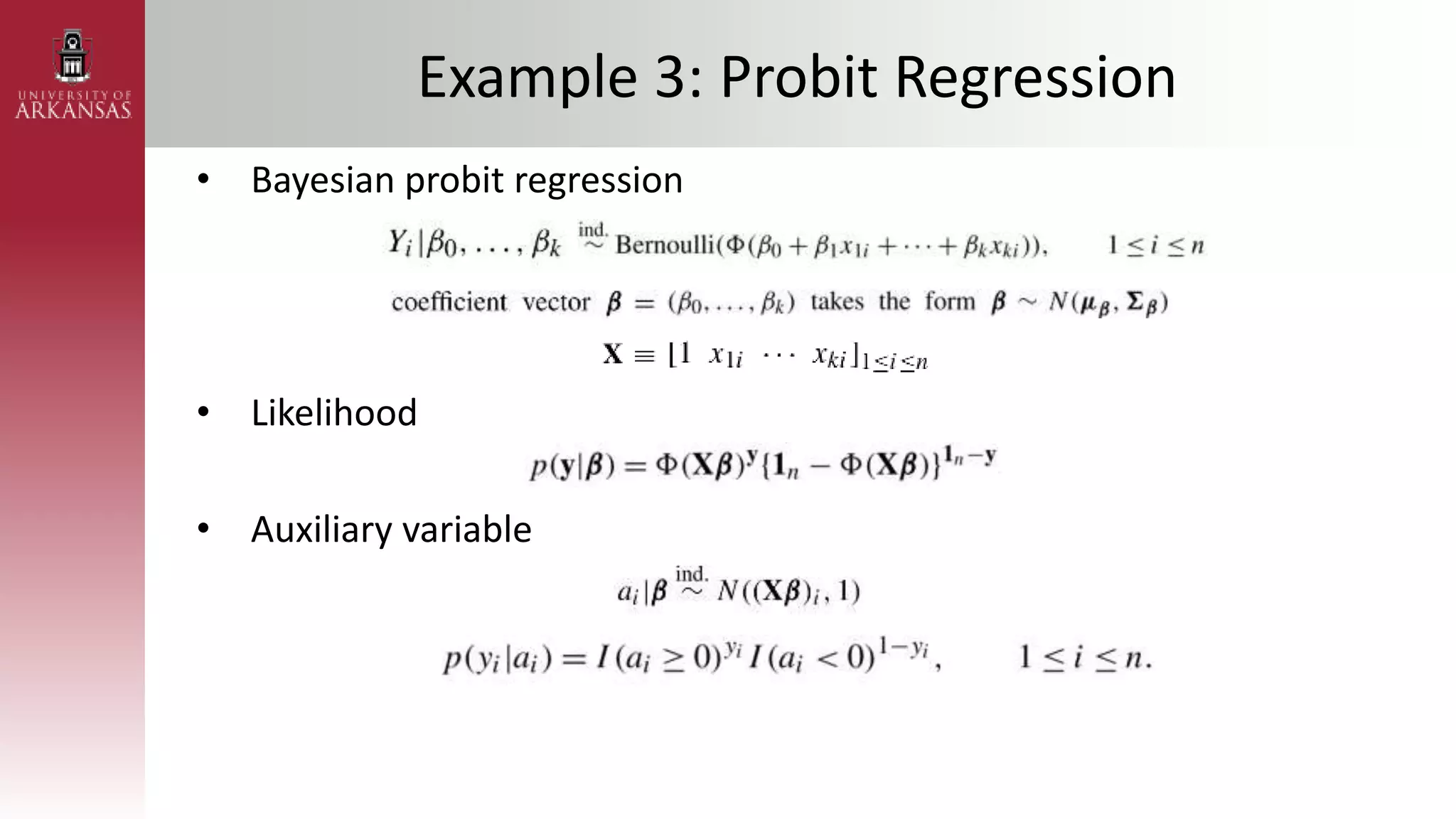
• Bayesian probit regression
• Likelihood
• Auxiliary variable
Example 3: Probit Regression
• Product density
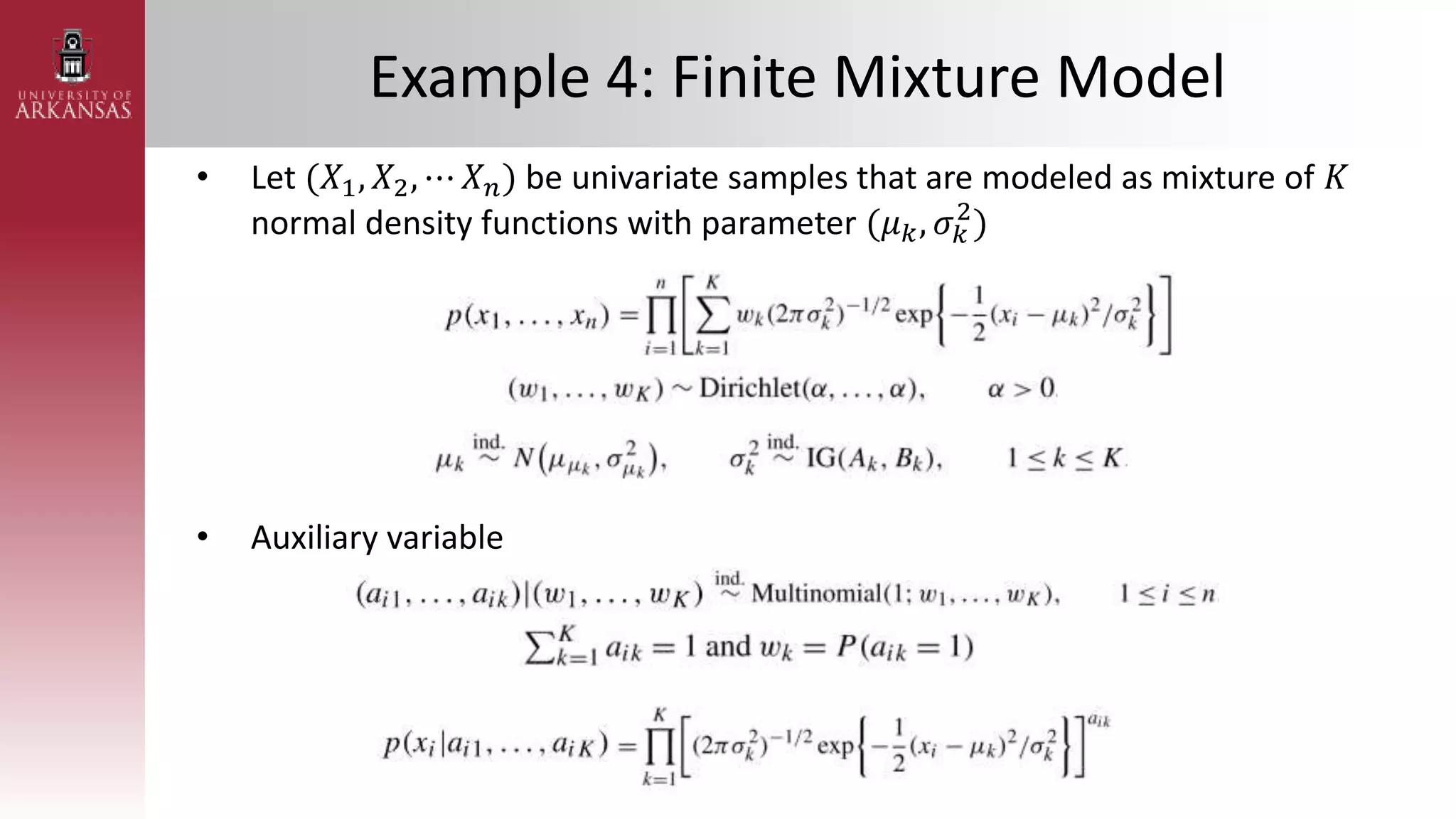
Example 4: Finite Mixture Model
• Let (𝑋1, 𝑋2, ⋯ 𝑋𝑛) be univariate samples that are modeled as mixture of 𝐾
normal density functions with parameter (𝜇𝑘, 𝜎𝑘
2
)
• Auxiliary variable
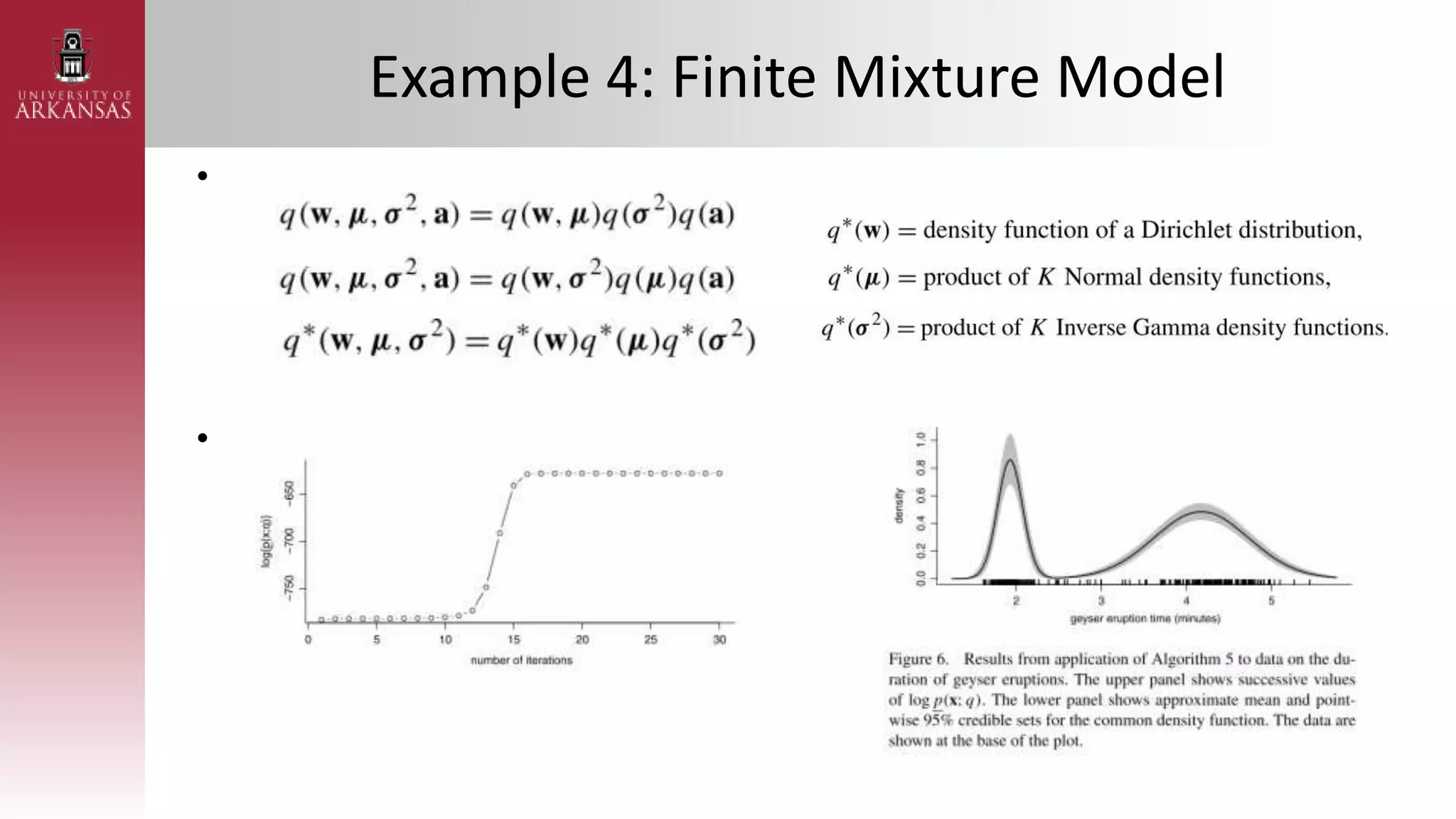
Example 4: Finite Mixture Model
•
•
Parametric Density Transform
• Poisson Regression with Gaussian Transform
– Assuming 𝜷 ∼ (𝝁𝜷, 𝚺𝜷) and 𝑿 = [1 𝑥1𝑖 ⋯ 𝑥𝑘𝑖]
• Likelihood
• Marginal likelihood
• Take the 𝑞 𝛽 = 𝑁(𝝁𝑞 𝛽 , 𝚺𝑞(𝛽)) density
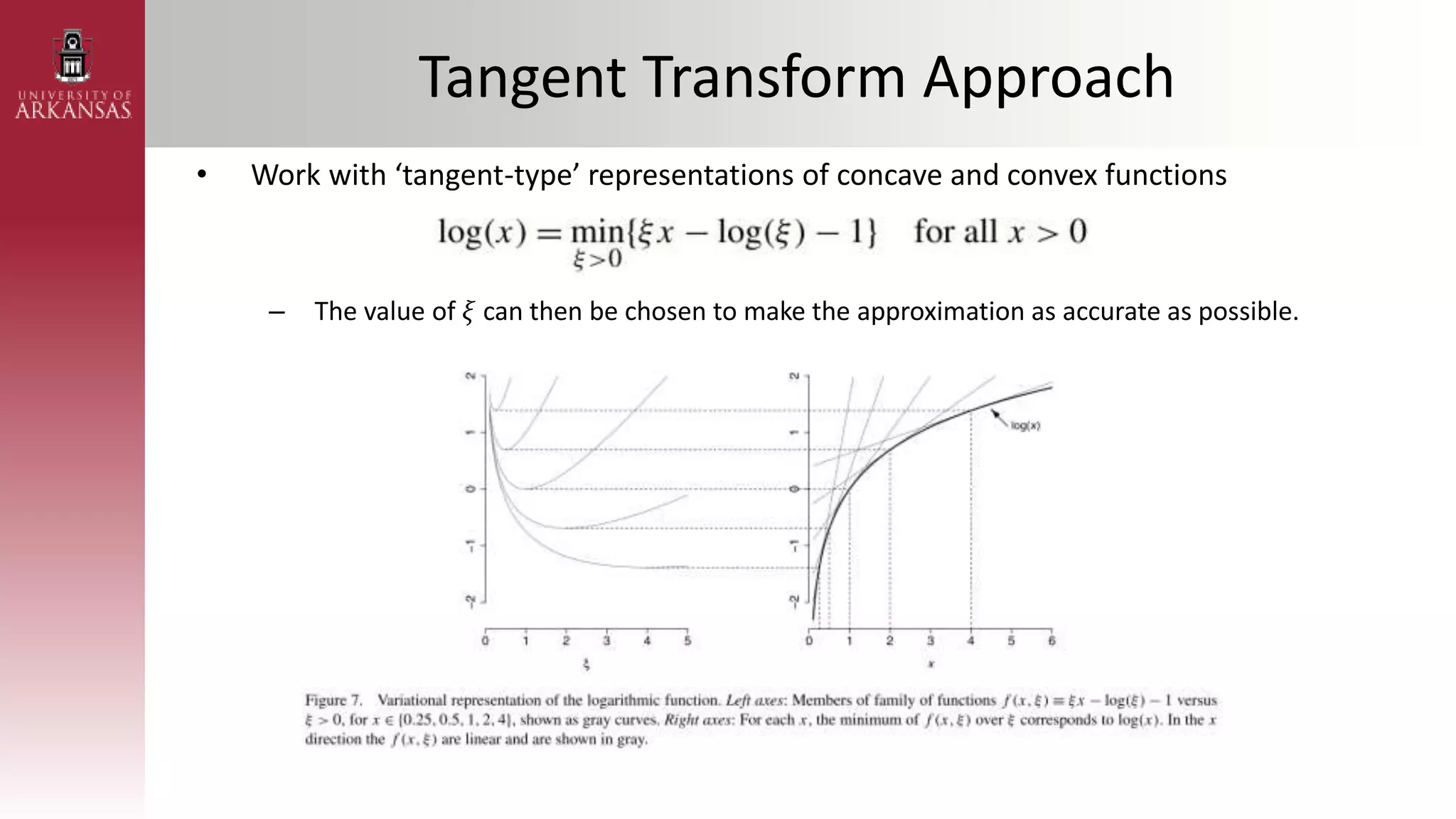
Tangent Transform Approach
• Work with ‘tangent-type’ representations of concave and convex functions
– The value of 𝜉 can then be chosen to make the approximation as accurate as possible.
Bayesian Logistic Regression
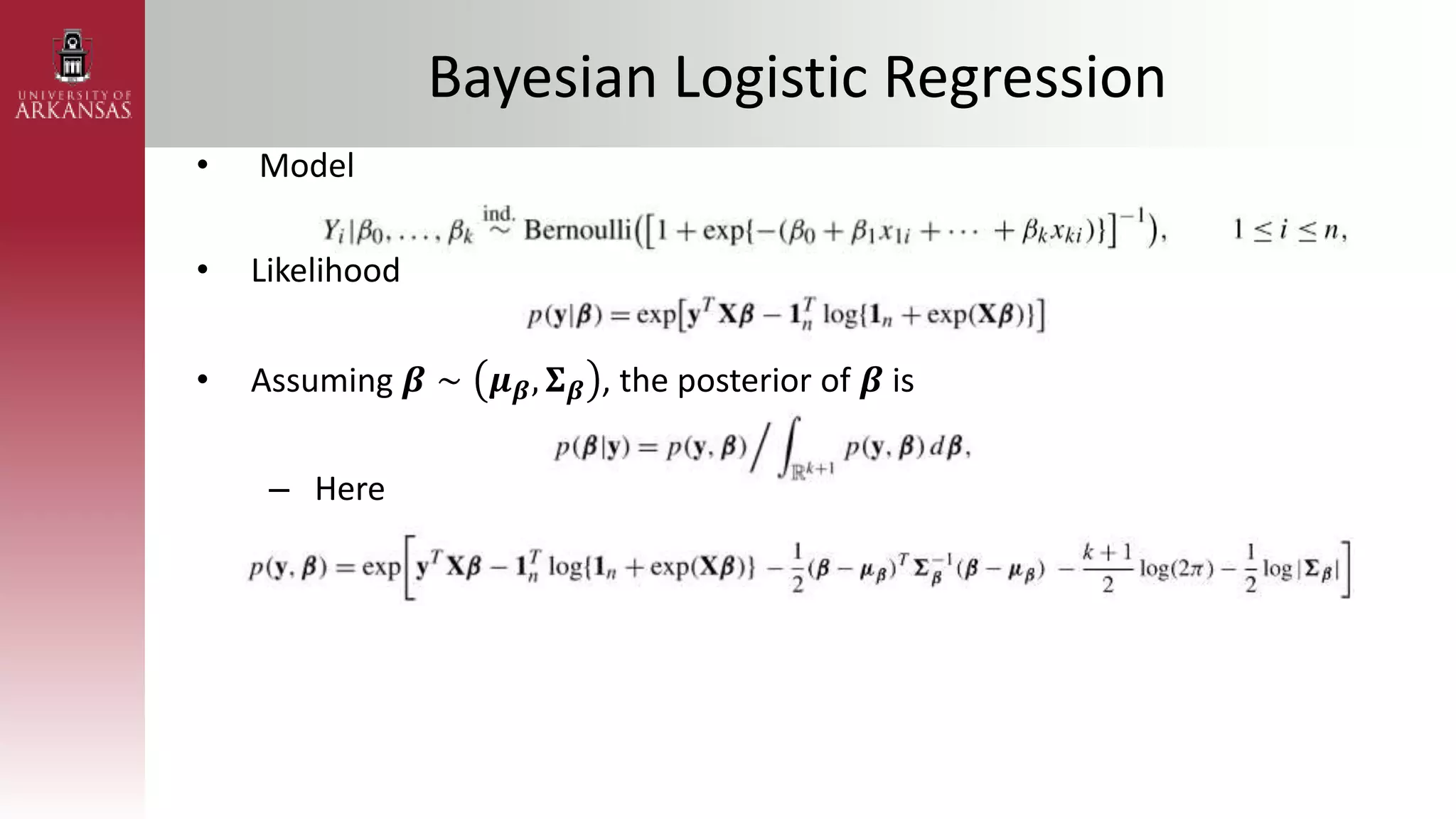
• Model
• Likelihood
• Assuming 𝜷 ∼ 𝝁𝜷, 𝚺𝜷 , the posterior of 𝜷 is
– Here
Bayesian Logistic Regression
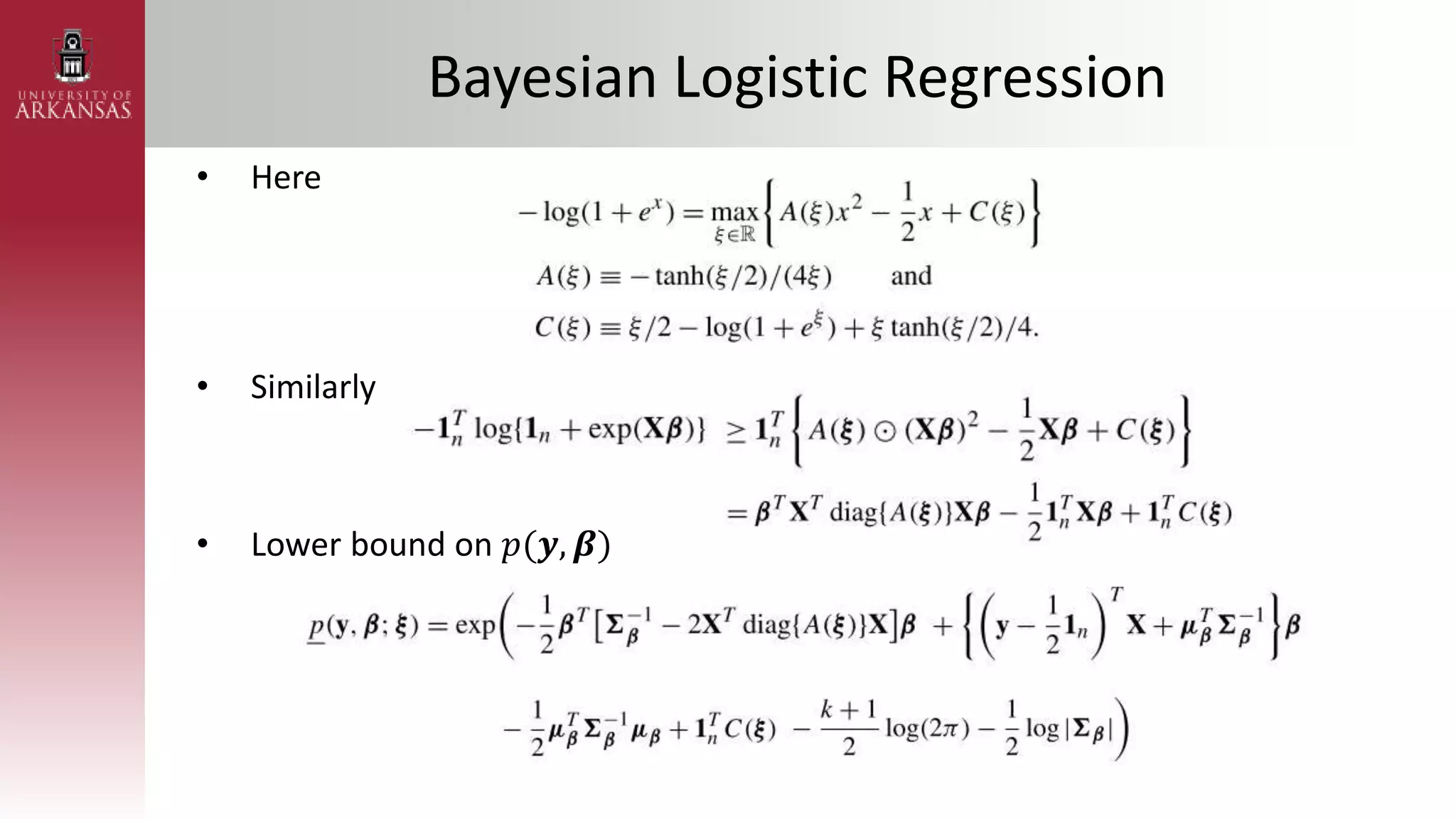
• Here
• Similarly
• Lower bound on 𝑝(𝒚, 𝜷)
Bayesian Logistic Regression
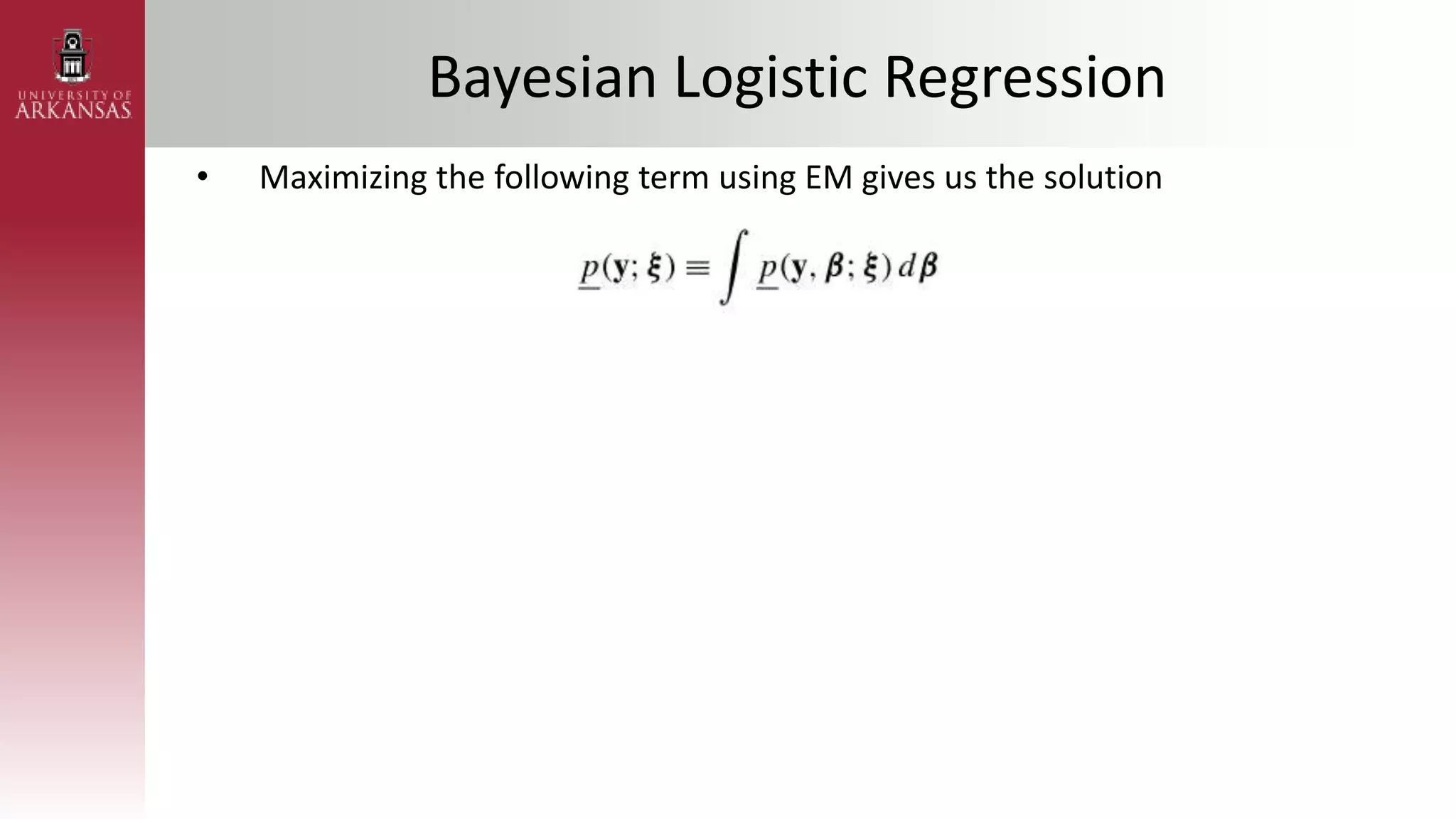
• Maximizing the following term using EM gives us the solution
Questions?
Thanks for listening :D

STAN_MS_PPT.pptx

  • 1.
    Comprehensive Examination Master’s inStatistics and Analytics Md Abul Hayat Graduate Assistant Electrical Engineering April 26, 2021
  • 2.
    Contents • An Introductionto Locally Linear Embedding – Objective – Idea – Algorithm – Results • Explaining Variational Approximations – Idea – Algorithm – Examples • Q&A
  • 3.
    An Introduction toLocally Linear Embedding Lawrence K. Saul, Sam T. Roweis Unpublished (2000) Available at https://cs.nyu.edu/~roweis/lle/publications.html
  • 4.
    Locally Linear Embedding(LLE) • Unsupervised dimension reduction technique • Eigenvector method for nonlinear dimensionality reduction – Both PCA and MDS are eigenvector methods – designed to model linear variabilities in high dimensional data – optimizations do not involve local minima • LLE maps high dimensional data into a system of lower dimensionality
  • 5.
    LLE Algorithm • Datacontains 𝑁 real valued vectors 𝑋𝑖 of dimension 𝐷 • We want to minimize • The number of neighbors 𝐾 to look for is predefined • Assuming the data lie on or near a smooth nonlinear manifold of dimensionality 𝑑 ≪ 𝐷 • LLE is done by choosing 𝑑 dimensional coordinates 𝑌𝑖 that minimize
  • 6.
  • 7.
    Constrained Least SquaresProblem • Step 1: s.t. • Notations • Cost Function
  • 8.
    Constrained Least SquaresProblem • Cost Function • Assuming, • The cost function becomes • Optimization
  • 9.
    Eigenvector Problem • Step-2 •Notation – 𝑊𝑖 is i-th column of 𝑛 𝑥 𝑛 weight matrix 𝑊 – 𝐼𝑖 is i-th column of 𝑛 𝑥 𝑛 identity matrix 𝐼 • Using this notation
  • 10.
    Eigenvector Problem • Thisgives • Replacing 𝑀 • The solution 𝑌 consists of 𝑑 eigenvectors of 𝑀 corresponding to 2 to 𝑑 + 1 minimum eigenvalues
  • 11.
  • 12.
  • 13.
    Explaining Variational Approximations JohnT. Ormerod, Matt P. Wand The American Statistician (2010)
  • 14.
    Introduction • Variational approximationsfacilitate approximate inference for the parameters in complex statistical models and provide fast, deterministic alternatives to Monte Carlo methods • Variational approximations are limited in their approximation accuracy – opposed to MCMC that can be very accurate • This paper does not discuss the quality of variational approximations • Variational approximations can be useful for both likelihood-based and Bayesian inference • Topics – Section 2: Density transform approach – Section 3: Tangent transform approach – Section 4: Same idea on frequentist context
  • 15.
    Density Transform Approach •Consider a generic Bayesian model with parameter vector 𝜃 ∈ Θ and observed data vector 𝒚 • Posterior density function • The denominator 𝑝(𝒚) is known as the marginal likelihood – model evidence in the Computer Science literature • Assuming q to be an arbitrary density function and q ∈ Θ
  • 16.
    Density Transform Approach equalityif and only if 𝑞(𝜽) = 𝑝(𝜽|𝒚)
  • 17.
    Density Transform Approach •Exponential of Evidence Lower-bound (ELBO) The key idea of density transform bases variationals approach is • Approximation of the posterior density 𝑝(𝜽|𝒚) by a 𝑞(𝜽) for which 𝑝(𝒚; 𝑞) is more tractable than 𝑝(𝒚) • Tractability is achieved by restricting 𝑞 to a more manageable class of densities and then maximizing 𝑝(𝒚; 𝑞) over that class • Maximization of 𝑝(𝒚; 𝑞) is equivalent to minimization of the Kullback–Leibler divergence between 𝑞 and 𝑝(· |𝒚)
  • 18.
    Density Transform Approach •The most common restrictions for the q density are: – 𝑞(𝜽) factorizes into Π𝑖=1 𝑀 𝑞𝑖(𝜽𝑖) for some partition {𝜽1, … , 𝜽𝑀} of 𝜽 • Product density transform • Mean Field Approximation (Variational Bayes) • Nonparametric restriction – 𝑞 is a member of a parametric family of density functions • Depending on the Bayesian model at hand, both restrictions can have minor or major impacts on the resulting inference
  • 19.
    Product Density Transforms •ELBO under product density transform • We also define
  • 20.
    Product Density Transforms •ELBO under product density transform becomes • From Result 1 • The optimal 𝑞1 is then
  • 21.
    Product Density Transforms •Repeating the same argument for maximizing • where E−𝜃𝑖 denotes expectation with respect to density Π𝑗≠𝑖𝑞𝑗(𝜃𝑗) • The key thing to note is the expectation is on distribution 𝒒𝒊 • A valid alternative expression with full conditionals
  • 22.
  • 23.
    Example 1: NormalRandom Sample • Random independent sample 𝑋𝑖 from normal distribution with 𝜃 = {𝜇, 𝜎2 } • The product density transform approximation to 𝑝(𝜇, 𝜎2 |𝒙) is • The optimal densities take the form
  • 24.
    Example 1: NormalRandom Sample • Standard manipulations lead to • Here, where 𝒙 = 𝑋1, … , 𝑋𝑛 𝑇 and 𝑋 = (𝑋1 + 𝑋2 + ⋯ + 𝑋𝑛)/𝑛
  • 25.
    Example 1: NormalRandom Sample • Optimal densities • Also • ELBO
  • 26.
    Example 1: NormalRandom Sample • Algorithm and result
  • 27.
    Example 2: LinearMixed Model • Bayesian Gaussian Linear Mixed Model – 𝒀 and 𝜷 are a 𝑛𝑥1 and 𝑝𝑥1 vector respectively – Variance component model – Conjugate priors
  • 28.
    Example 2: LinearMixed Model • Tractable solution arises for two component model • Let 𝝁𝑞 𝜷, 𝒖 and Σ𝑞(𝜷, 𝒖) be the mean and covariance of 𝑞∗ 𝜷, 𝒖 • Set 𝑪 = 𝑿 𝒁 • Markov blanket
  • 29.
    Example 2: LinearMixed Model • • Upon convergence the approximate posteriors are:
  • 30.
    Example 2: LinearMixed Model • Longitudinal Orthodontic Measurement (Pinherio and Bates 2000) • Model • Comparing with • Here
  • 31.
    Example 2: LinearMixed Model •
  • 32.
    Example 3: ProbitRegression • Bayesian probit regression • Likelihood • Auxiliary variable
  • 33.
    Example 3: ProbitRegression • Product density
  • 34.
    Example 4: FiniteMixture Model • Let (𝑋1, 𝑋2, ⋯ 𝑋𝑛) be univariate samples that are modeled as mixture of 𝐾 normal density functions with parameter (𝜇𝑘, 𝜎𝑘 2 ) • Auxiliary variable
  • 35.
    Example 4: FiniteMixture Model • •
  • 36.
    Parametric Density Transform •Poisson Regression with Gaussian Transform – Assuming 𝜷 ∼ (𝝁𝜷, 𝚺𝜷) and 𝑿 = [1 𝑥1𝑖 ⋯ 𝑥𝑘𝑖] • Likelihood • Marginal likelihood • Take the 𝑞 𝛽 = 𝑁(𝝁𝑞 𝛽 , 𝚺𝑞(𝛽)) density
  • 37.
    Tangent Transform Approach •Work with ‘tangent-type’ representations of concave and convex functions – The value of 𝜉 can then be chosen to make the approximation as accurate as possible.
  • 38.
    Bayesian Logistic Regression •Model • Likelihood • Assuming 𝜷 ∼ 𝝁𝜷, 𝚺𝜷 , the posterior of 𝜷 is – Here
  • 39.
    Bayesian Logistic Regression •Here • Similarly • Lower bound on 𝑝(𝒚, 𝜷)
  • 40.
    Bayesian Logistic Regression •Maximizing the following term using EM gives us the solution
  • 41.
  • 42.