Motion & Forces
. Force & Acceleration
 Newton’s Second Law
 Gravity
 Air Resistance
 Calculations
A. Newton’s Second Law
 Newton’s Second Law of Motion
 The acceleration of an object is
directly proportional to the net force
acting on it and inversely
proportional to its mass.
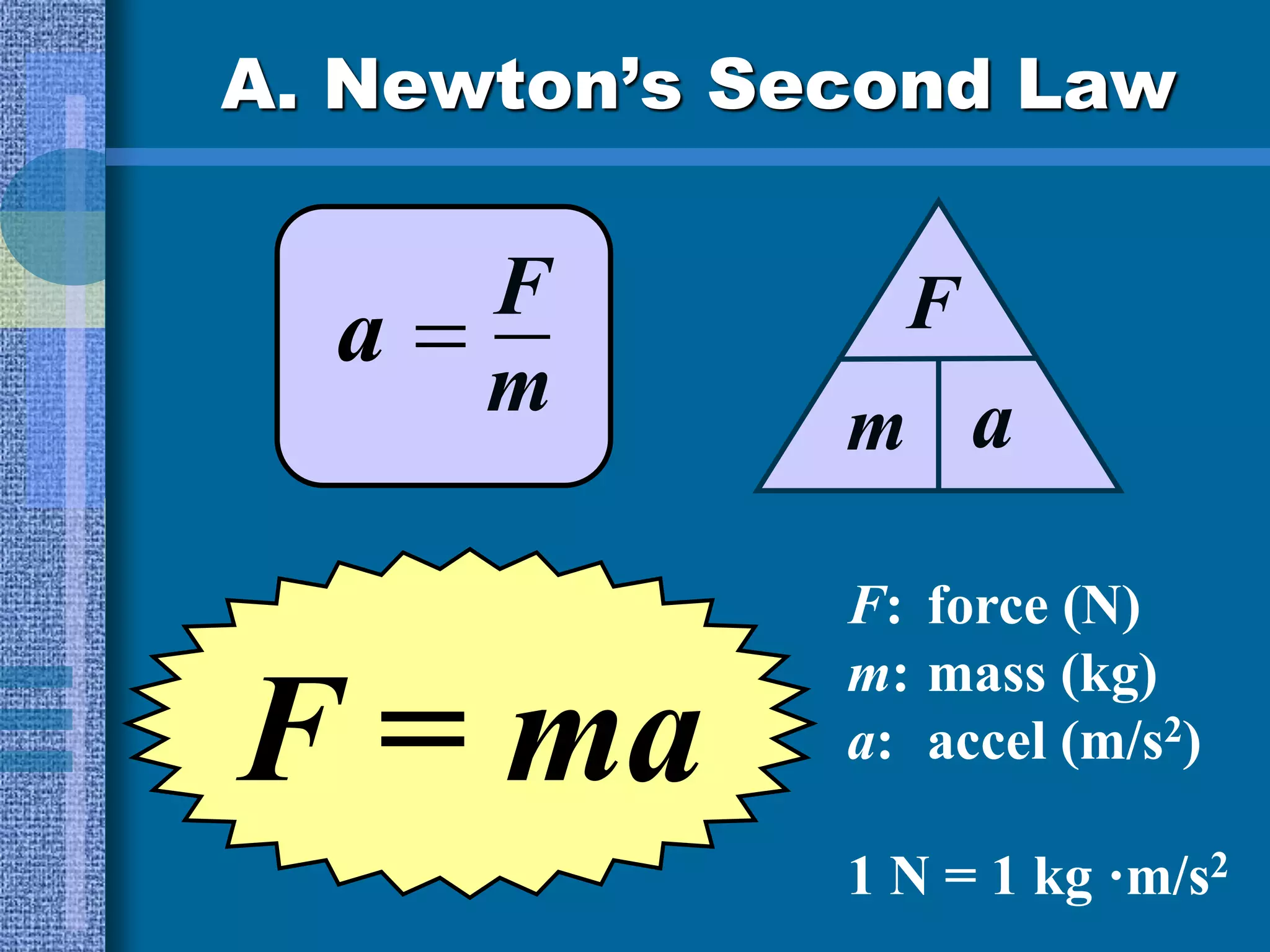
F = ma
A. Newton’s Second Law
F = ma
F: force (N)
m: mass (kg)
a: accel (m/s2)
1 N = 1 kg ·m/s2
a
m
F
a
F
m
B. Gravity
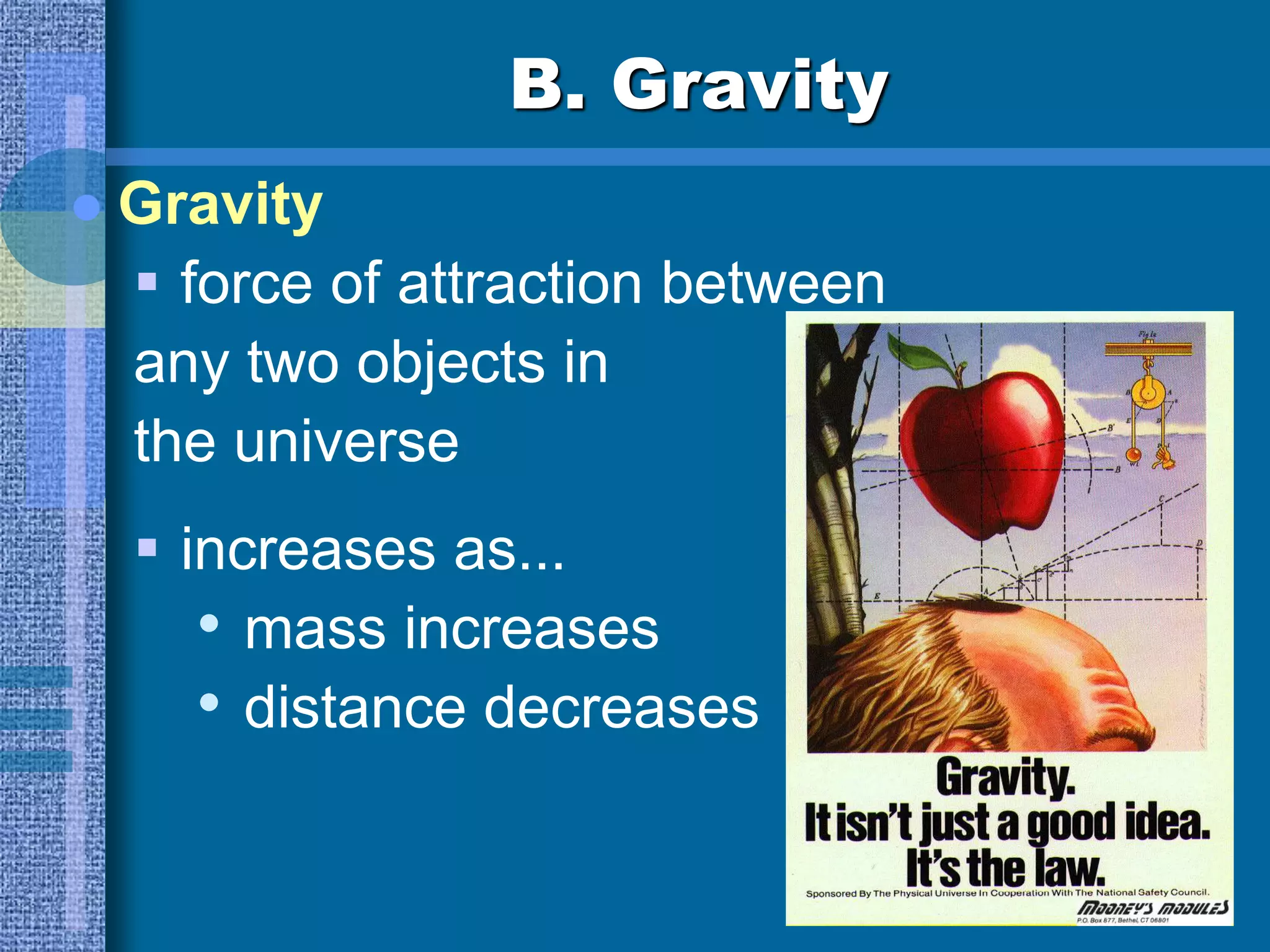
 Gravity
 force of attraction between
any two objects in
the universe
 increases as...
• mass increases
• distance decreases
B. Gravity
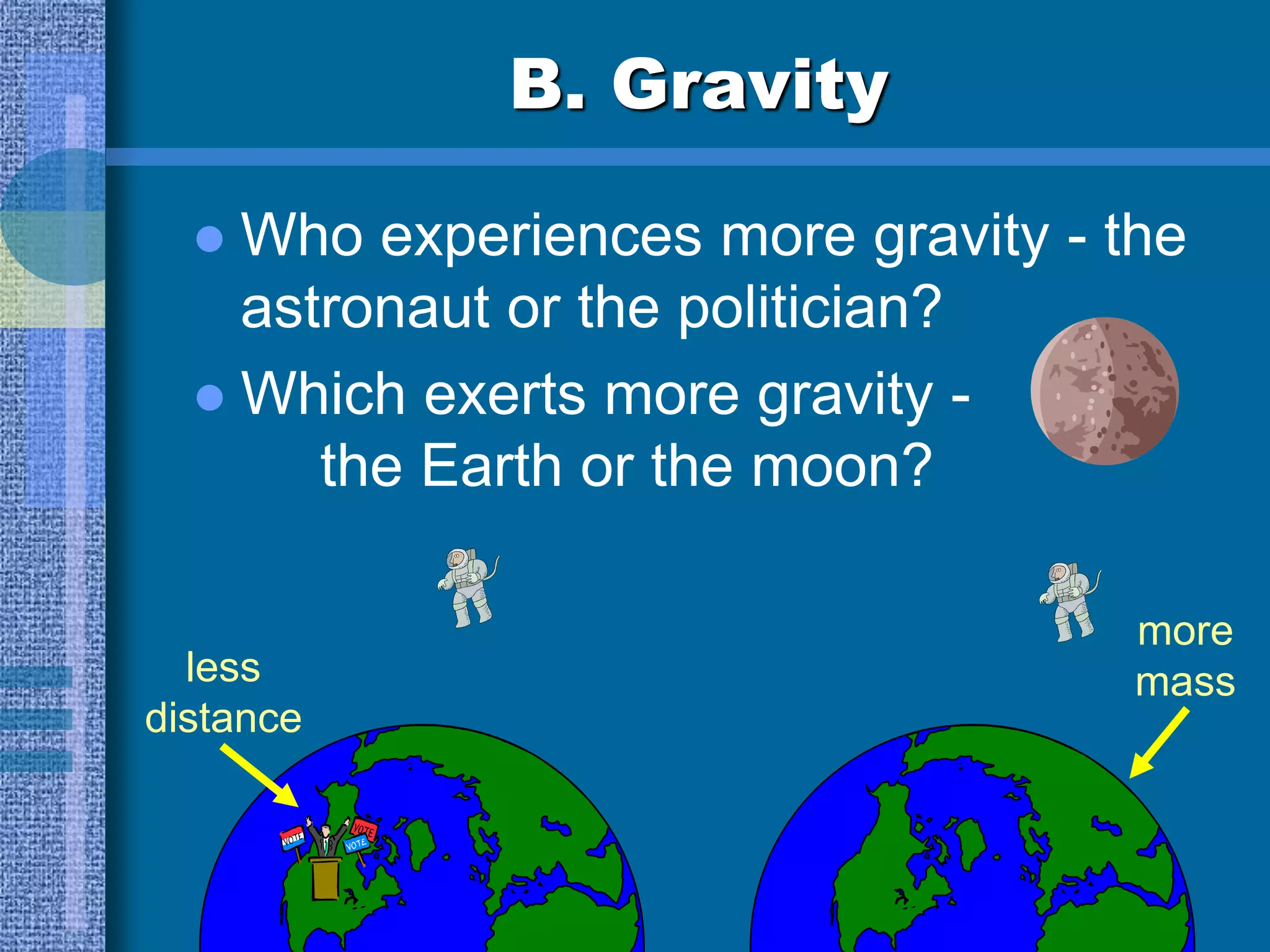
 Who experiences more gravity - the
astronaut or the politician?
less
distance
more
mass
 Which exerts more gravity -
the Earth or the moon?
B. Gravity
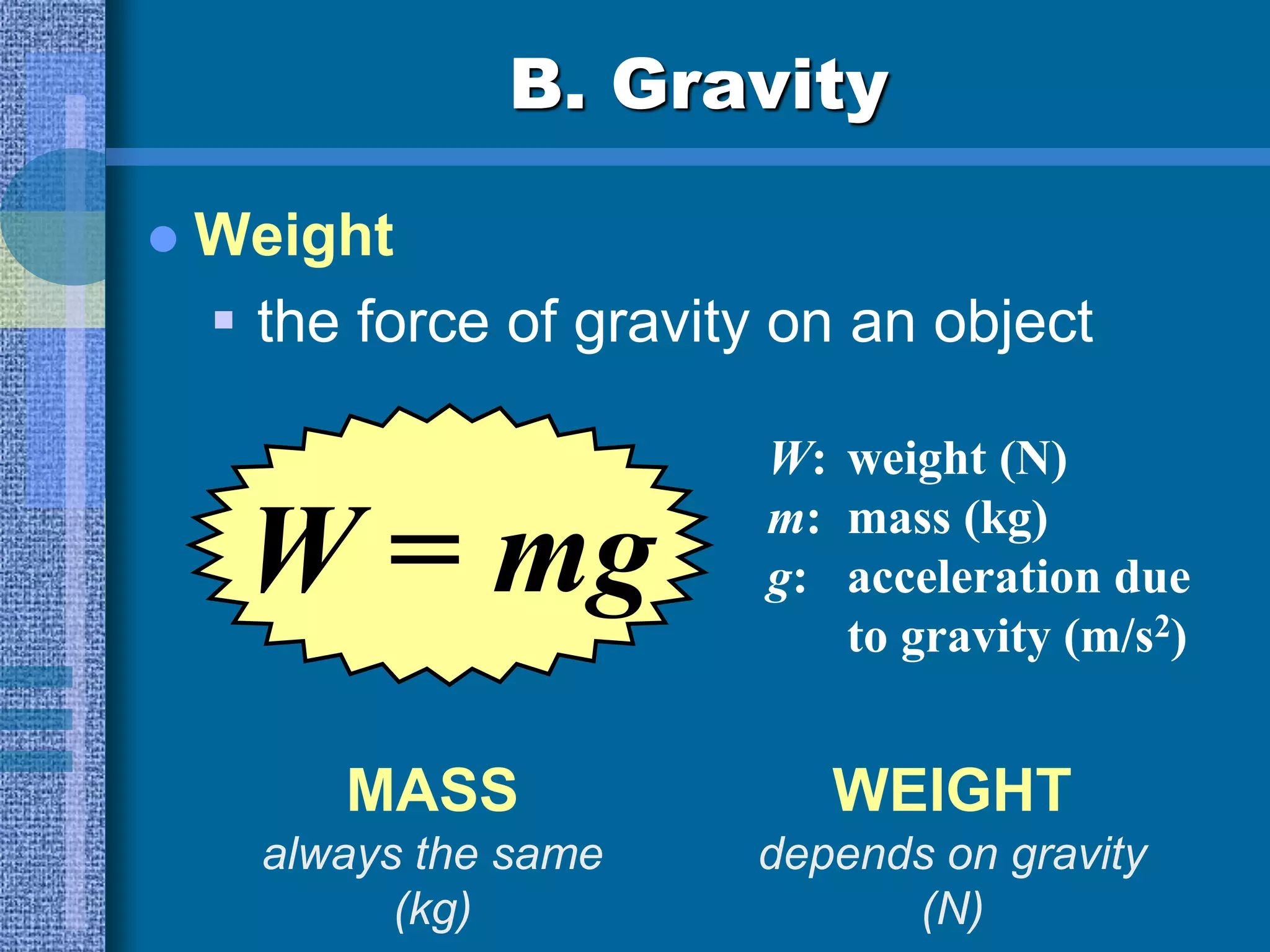
 Weight
 the force of gravity on an object
MASS
always the same
(kg)
WEIGHT
depends on gravity
(N)
W = mg
W: weight (N)
m: mass (kg)
g: acceleration due
to gravity (m/s2)
B. Gravity
 Would you weigh more on Earth
or Jupiter?
greater gravity
greater weight
greater mass
 Jupiter because...
B. Gravity
 Accel. due to gravity (g)
 In the absence of air
resistance, all falling objects
have the same acceleration!
 On Earth: g = 9.8 m/s2
m
Wg 
elephant
m
W
g 
feather
Animation from “Multimedia Physics Studios.”
C. Air Resistance
 Air Resistance
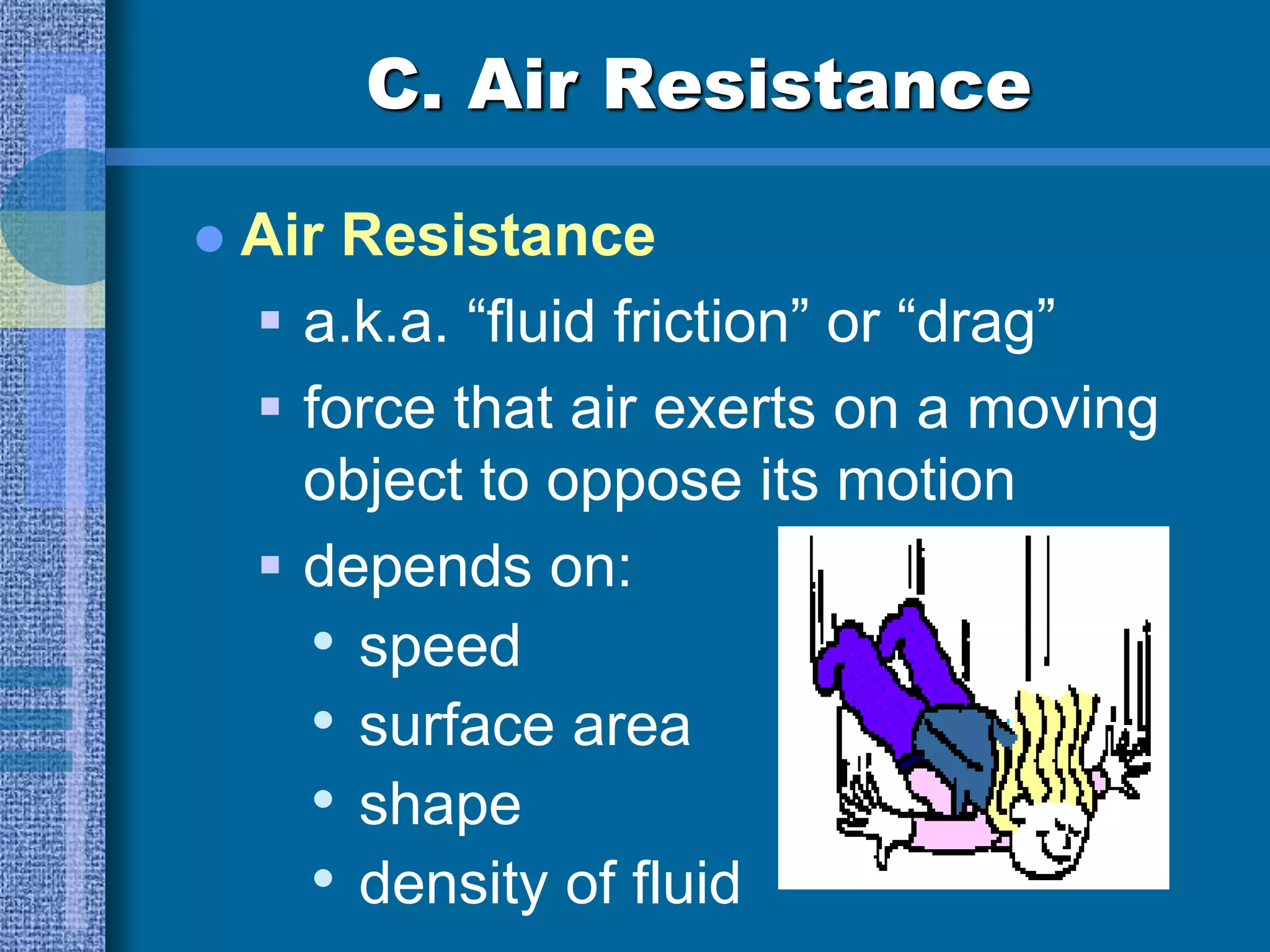
 a.k.a. “fluid friction” or “drag”
 force that air exerts on a moving
object to oppose its motion
 depends on:
• speed
• surface area
• shape
• density of fluid
C. Air Resistance
 Terminal Velocity
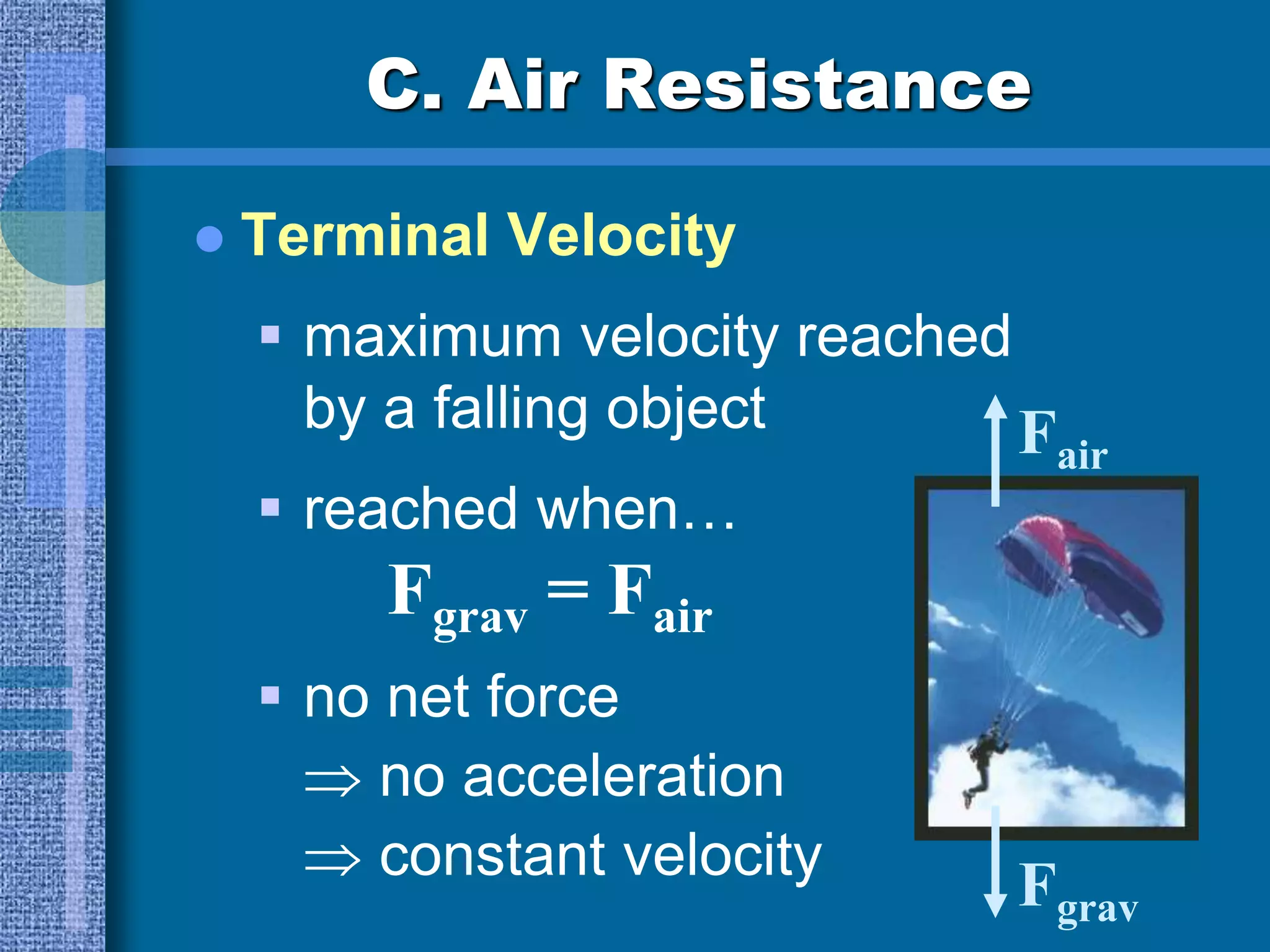
 maximum velocity reached
by a falling object
 reached when…
Fgrav = Fair
Fair
Fgrav
 no net force
 no acceleration
 constant velocity
C. Air Resistance
 Terminal Velocity
 increasing speed  increasing air
resistance until…
Fair = Fgravity
Animation from “Multimedia Physics Studios.”
C. Air Resistance
 Falling with air resistance
Fgrav = Fair
Animation from “Multimedia Physics Studios.”
 heavier objects fall faster
because they accelerate
to higher speeds before
reaching terminal
velocity
 larger Fgrav
 need larger Fair
 need higher speed
D. Calculations
 What force would be required to
accelerate a 40 kg mass by 4 m/s2?
GIVEN:
F = ?
m = 40 kg
a = 4 m/s2
WORK:
F = ma
F = (40 kg)(4 m/s2)
F = 160 N
m
F
a
D. Calculations
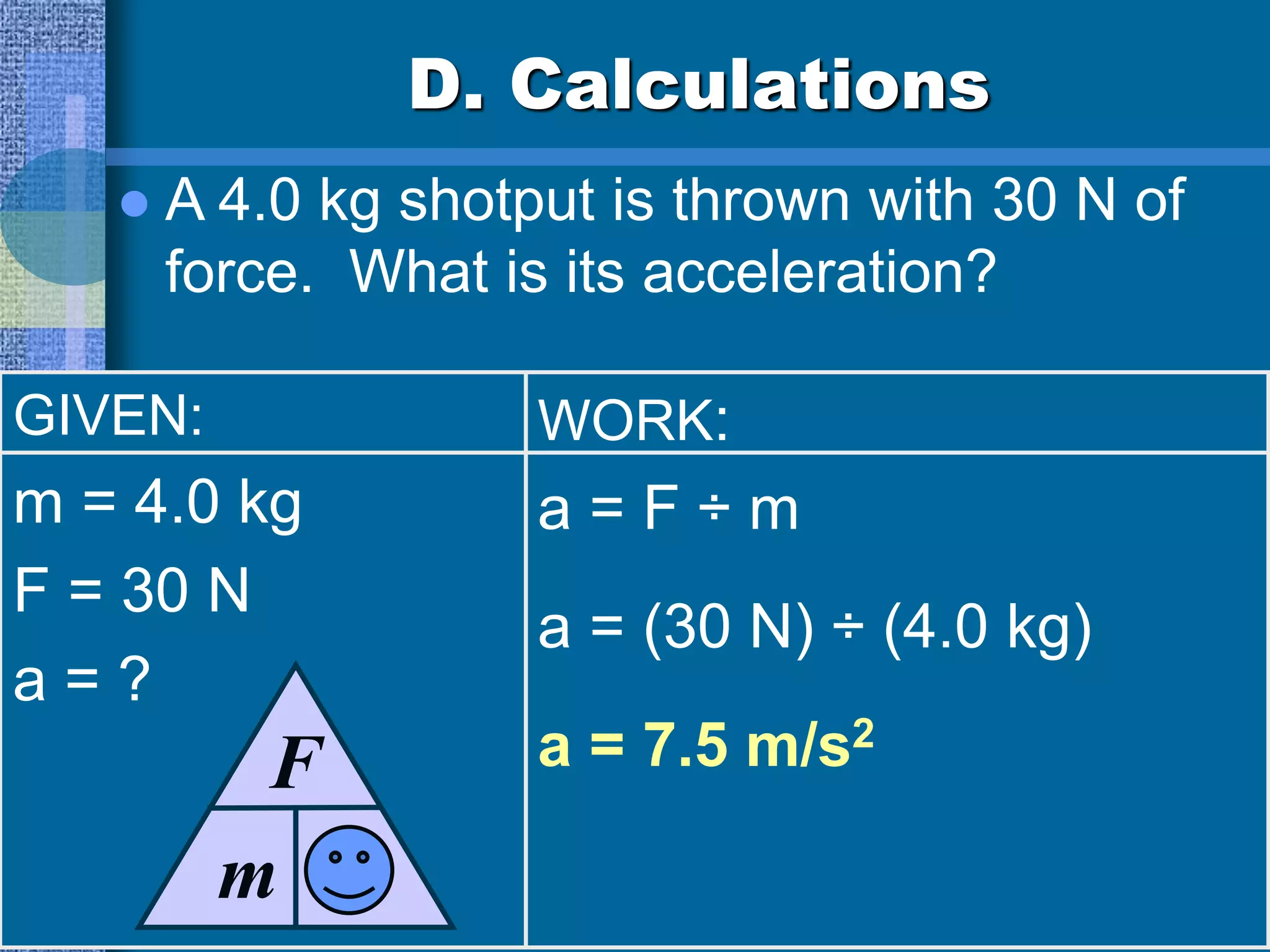
 A 4.0 kg shotput is thrown with 30 N of
force. What is its acceleration?
GIVEN:
m = 4.0 kg
F = 30 N
a = ?
WORK:
a = F ÷ m
a = (30 N) ÷ (4.0 kg)
a = 7.5 m/s2
m
F
a
ConcepTest
 TRUE or FALSE
Does mass depend on gravity?
 False! Mass does not depend on
gravity, weight does. The astronaut has
less weight on the moon.
D. Calculations
 Mrs. J. weighs 557 N. What is her
mass?
GIVEN:
F(W) = 557 N
m = ?
a(g) = 9.8 m/s2
WORK:
m = F ÷ a
m = (557 N) ÷ (9.8 m/s2)
m = 56.8 kg
m
F
a

Newton's 2nd law

  • 1.
    Motion & Forces .Force & Acceleration  Newton’s Second Law  Gravity  Air Resistance  Calculations
  • 2.
    A. Newton’s SecondLaw  Newton’s Second Law of Motion  The acceleration of an object is directly proportional to the net force acting on it and inversely proportional to its mass. F = ma
  • 3.
    A. Newton’s SecondLaw F = ma F: force (N) m: mass (kg) a: accel (m/s2) 1 N = 1 kg ·m/s2 a m F a F m
  • 4.
    B. Gravity  Gravity force of attraction between any two objects in the universe  increases as... • mass increases • distance decreases
  • 5.
    B. Gravity  Whoexperiences more gravity - the astronaut or the politician? less distance more mass  Which exerts more gravity - the Earth or the moon?
  • 6.
    B. Gravity  Weight the force of gravity on an object MASS always the same (kg) WEIGHT depends on gravity (N) W = mg W: weight (N) m: mass (kg) g: acceleration due to gravity (m/s2)
  • 7.
    B. Gravity  Wouldyou weigh more on Earth or Jupiter? greater gravity greater weight greater mass  Jupiter because...
  • 8.
    B. Gravity  Accel.due to gravity (g)  In the absence of air resistance, all falling objects have the same acceleration!  On Earth: g = 9.8 m/s2 m Wg  elephant m W g  feather Animation from “Multimedia Physics Studios.”
  • 9.
    C. Air Resistance Air Resistance  a.k.a. “fluid friction” or “drag”  force that air exerts on a moving object to oppose its motion  depends on: • speed • surface area • shape • density of fluid
  • 10.
    C. Air Resistance Terminal Velocity  maximum velocity reached by a falling object  reached when… Fgrav = Fair Fair Fgrav  no net force  no acceleration  constant velocity
  • 11.
    C. Air Resistance Terminal Velocity  increasing speed  increasing air resistance until… Fair = Fgravity Animation from “Multimedia Physics Studios.”
  • 12.
    C. Air Resistance Falling with air resistance Fgrav = Fair Animation from “Multimedia Physics Studios.”  heavier objects fall faster because they accelerate to higher speeds before reaching terminal velocity  larger Fgrav  need larger Fair  need higher speed
  • 13.
    D. Calculations  Whatforce would be required to accelerate a 40 kg mass by 4 m/s2? GIVEN: F = ? m = 40 kg a = 4 m/s2 WORK: F = ma F = (40 kg)(4 m/s2) F = 160 N m F a
  • 14.
    D. Calculations  A4.0 kg shotput is thrown with 30 N of force. What is its acceleration? GIVEN: m = 4.0 kg F = 30 N a = ? WORK: a = F ÷ m a = (30 N) ÷ (4.0 kg) a = 7.5 m/s2 m F a
  • 15.
    ConcepTest  TRUE orFALSE Does mass depend on gravity?  False! Mass does not depend on gravity, weight does. The astronaut has less weight on the moon.
  • 16.
    D. Calculations  Mrs.J. weighs 557 N. What is her mass? GIVEN: F(W) = 557 N m = ? a(g) = 9.8 m/s2 WORK: m = F ÷ a m = (557 N) ÷ (9.8 m/s2) m = 56.8 kg m F a