Cmns 130
New Media ( Chapter 8 in
Text)
 Definition & the Information Revolution
 Changing economics
 Changing regulation
 Social Issues
 Social Challenges:
 The Knowledge Gap
 Surveillance and loss of privacy
 Sharing and Market “Hacktivism”
Cmns 130
History of New Media
 Since 1970s, but especially 1990s, nations concerned with the “
information highway”
 Treated the Internet like an 1840s challenge of the telegraph
 Concern that to remain competitive in a global trading economy,
nations needed to “wire up”
 Provide businesses, workers and consumers access to the
Internet for education, retail, entertainment
 Frontier metaphors often used
 Essential for economic transformation away from industrial to service/
information economies: the so-called “innovation agenda”
 In Canada, wired telco/cable providers dominated agenda: wireless
only now emerging
Cmns 130
Building the Internet
 Nations regulate telecommunications internationally:
agree on bandwidth of electronic transmission, spacing
of satellites, sharing of costs/ interconnection
 Also develop technical standards for interconnection (
IP protocols such as MP3)
 This is the international standards role of nations,
businesses and technical experts in creating a market
for technology, and ensuring consumers don’t buy
technology which will not work
 Business play a bigger and bigger role influencing this
shadow world of standards: citizens underrepresented
 But: companies still need states to rule on standards
Cmns 130
Definition of New Media
 Digital communication
 Used in the production, distribution and
reception of communication
 Involves use of new communication
networks: Internet as mass medium
Cmns 130
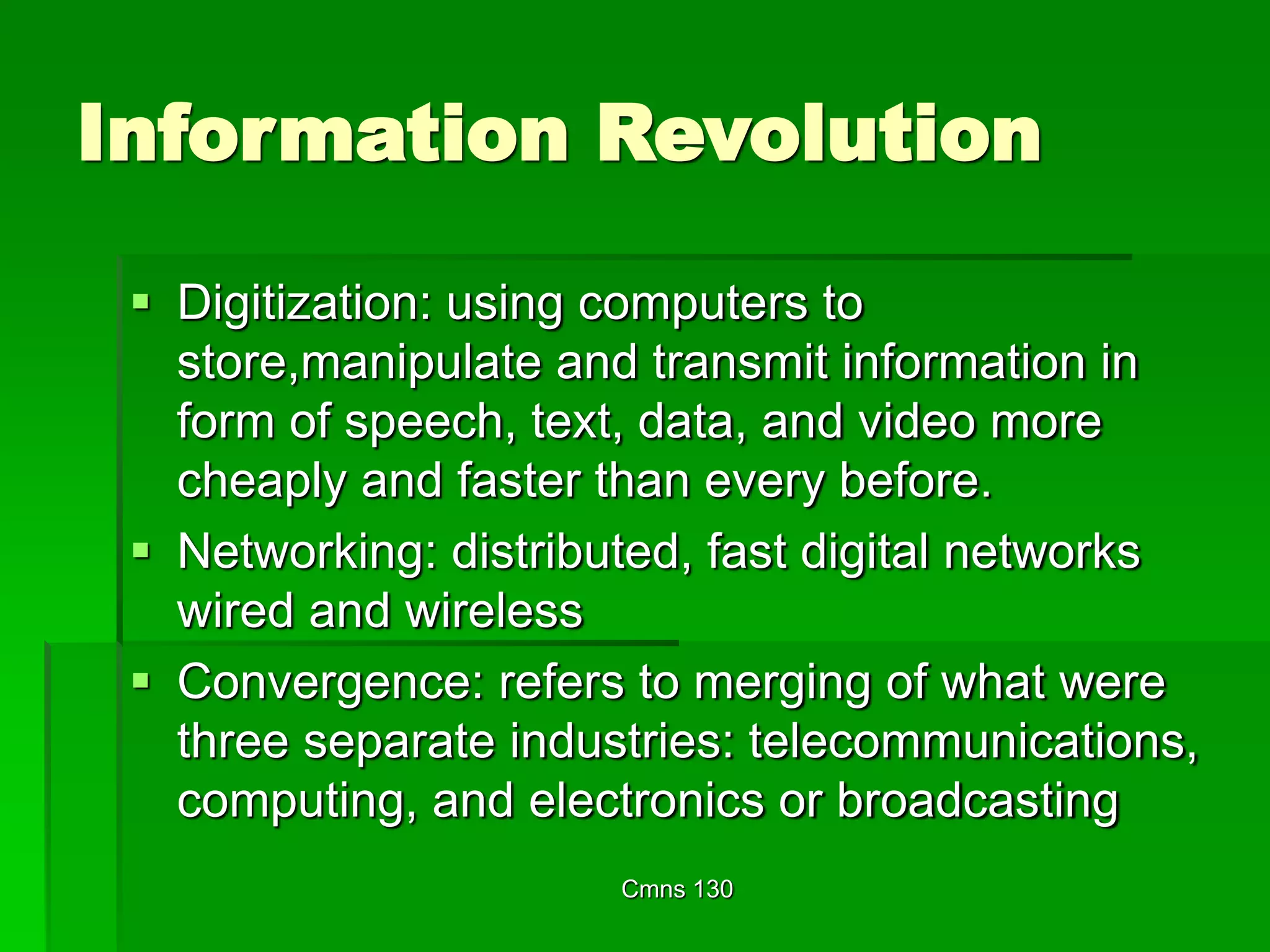
Information Revolution
 Digitization: using computers to
store,manipulate and transmit information in
form of speech, text, data, and video more
cheaply and faster than every before.
 Networking: distributed, fast digital networks
wired and wireless
 Convergence: refers to merging of what were
three separate industries: telecommunications,
computing, and electronics or broadcasting
Cmns 130
Characteristics of New
Media
 Convergence of telecommunications
and entertainment/broadcast media
industries
 Wire or wireless communication
 Point to point or addressable
 Interactive ( two way) ( now multiple
conferencing)
Cmns 130
Characteristics Continued
 Interpersonal: ie. The terrain of telephony treats
telephone calls ( discretionary contact between two
consenting persons) as PRIVATE not PUBLIC
communication ( where telco distributors are not
responsible for content of message)
 Multiple: can be Mass/Broadcast which is PUBLIC
communication ( broadcasters are responsible for
message in exchange for spectrum monopoly: hybrid
character)
 Now a grey area of semi public/private communication
( can monitor cell phones, amass, monitor and store
unprecedented personal communication)
Cmns 130
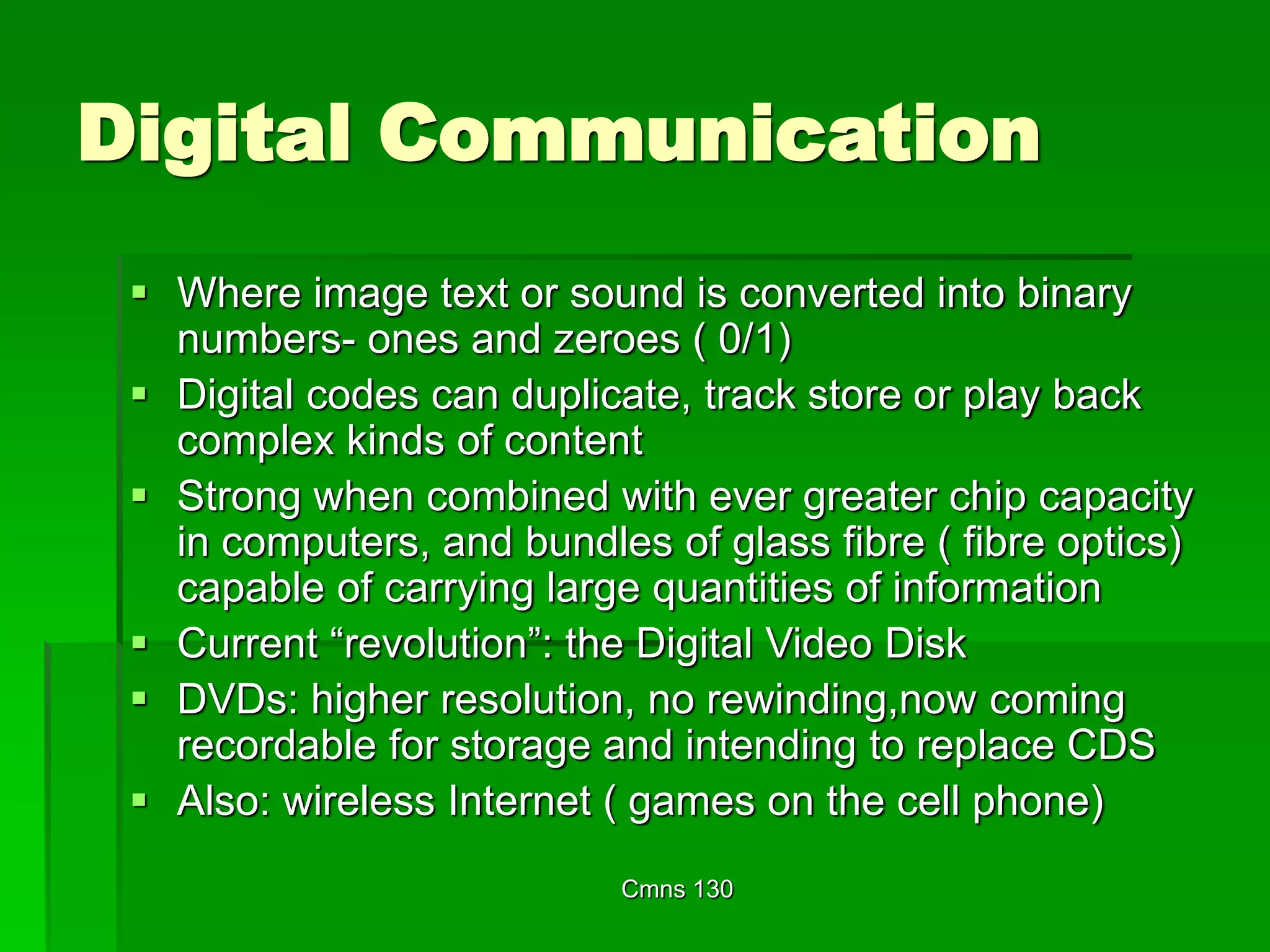
Digital Communication
 Where image text or sound is converted into binary
numbers- ones and zeroes ( 0/1)
 Digital codes can duplicate, track store or play back
complex kinds of content
 Strong when combined with ever greater chip capacity
in computers, and bundles of glass fibre ( fibre optics)
capable of carrying large quantities of information
 Current “revolution”: the Digital Video Disk
 DVDs: higher resolution, no rewinding,now coming
recordable for storage and intending to replace CDS
 Also: wireless Internet ( games on the cell phone)
Cmns 130
Implication of Digitization
 Drive to animation and special effects
 Actors worried about cyber simulators
replacing them
 Domination of nature: totally simulated
worlds?
 Question of authenticity of image
Cmns 130
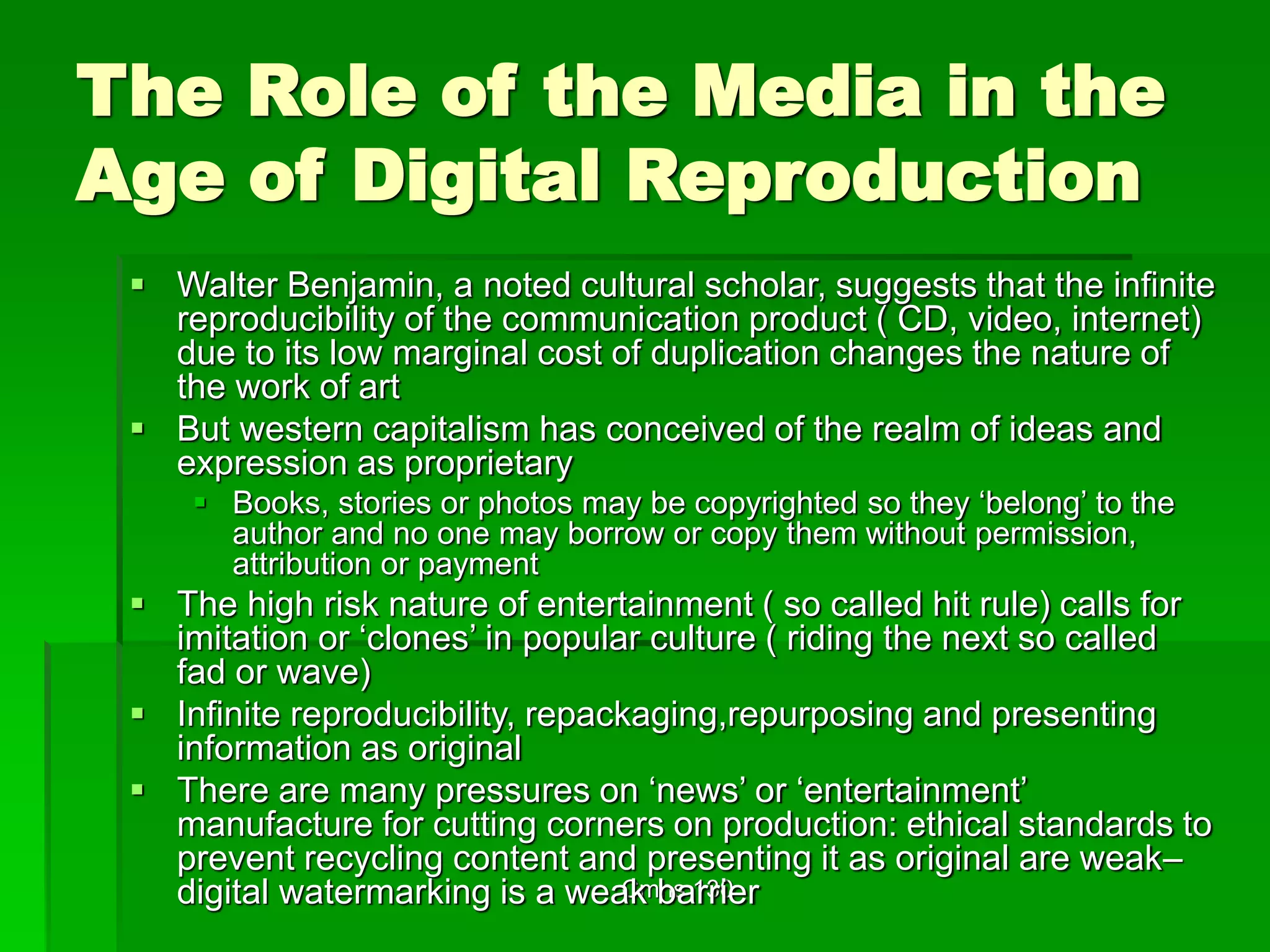
The Role of the Media in the
Age of Digital Reproduction
 Walter Benjamin, a noted cultural scholar, suggests that the infinite
reproducibility of the communication product ( CD, video, internet)
due to its low marginal cost of duplication changes the nature of
the work of art
 But western capitalism has conceived of the realm of ideas and
expression as proprietary
 Books, stories or photos may be copyrighted so they ‘belong’ to the
author and no one may borrow or copy them without permission,
attribution or payment
 The high risk nature of entertainment ( so called hit rule) calls for
imitation or ‘clones’ in popular culture ( riding the next so called
fad or wave)
 Infinite reproducibility, repackaging,repurposing and presenting
information as original
 There are many pressures on ‘news’ or ‘entertainment’
manufacture for cutting corners on production: ethical standards to
prevent recycling content and presenting it as original are weak–
digital watermarking is a weak barrier
Cmns 130
Technical Potentials of
the New Media
 Costs of production dropping: makes
media creation more accessible ( digital
camera and access to the net)
 Costs of distribution down
 Interactive// less hierarchical
 Faster…more global
Cmns 130
The Internet
 What: a vast network of high speed wires and
satellite relays linking computers worldwide
 No central hub: thousands of computer nodes (
it is highly distributed)
 Uses a type of switching that is hard to trace:
designed after WW2 in the RAND corporation
to avoid worldwide military attack
 Now used for: email, commerce, chat lines,file
sharing etc.
 Sometimes synonmous with on line world
Cmns 130
Components of the
Internet
 World Wide Web
 Internet Service Providers (AOL Time
Warner; Sympatico,Telus, Shaw@Home,
AT&T)
 Portals ( MSN)
 Browsers: Explorer, Netscape
 Search Engines and directories ( Google,
etc)
Cmns 130
Rate of Diffusion
 Each generation of technology ( telegraph,
telephone,radio, satellite to cable TV, VCRs) had an
increasingly rapid rate of diffusion
 Key is where it reaches ‘mass’ or majority ( 60% or
more) of consumers.
 Internet has done so within one decade: only other
technology to do so, but not quite as fast were the VCR
and cell phones
 Now well over 75% of Canadians have access: that
number rises to 100% under 25
 The Internet the fastest techology in rate of social
adaption
Cmns 130
Impacts
 Changed the way we work
 Accellerated space time compression:
globalization processes
 Convergence of computers and distribution
allows greater efficiency of control and
communication
 Much cheaper to sell via Internet than in person (
1/100th cost per transaction for banks, airlines)
 Average person is now estimated to spend 187
hours a year on line ( source: Penguin Media and
Information 2003)
Cmns 130
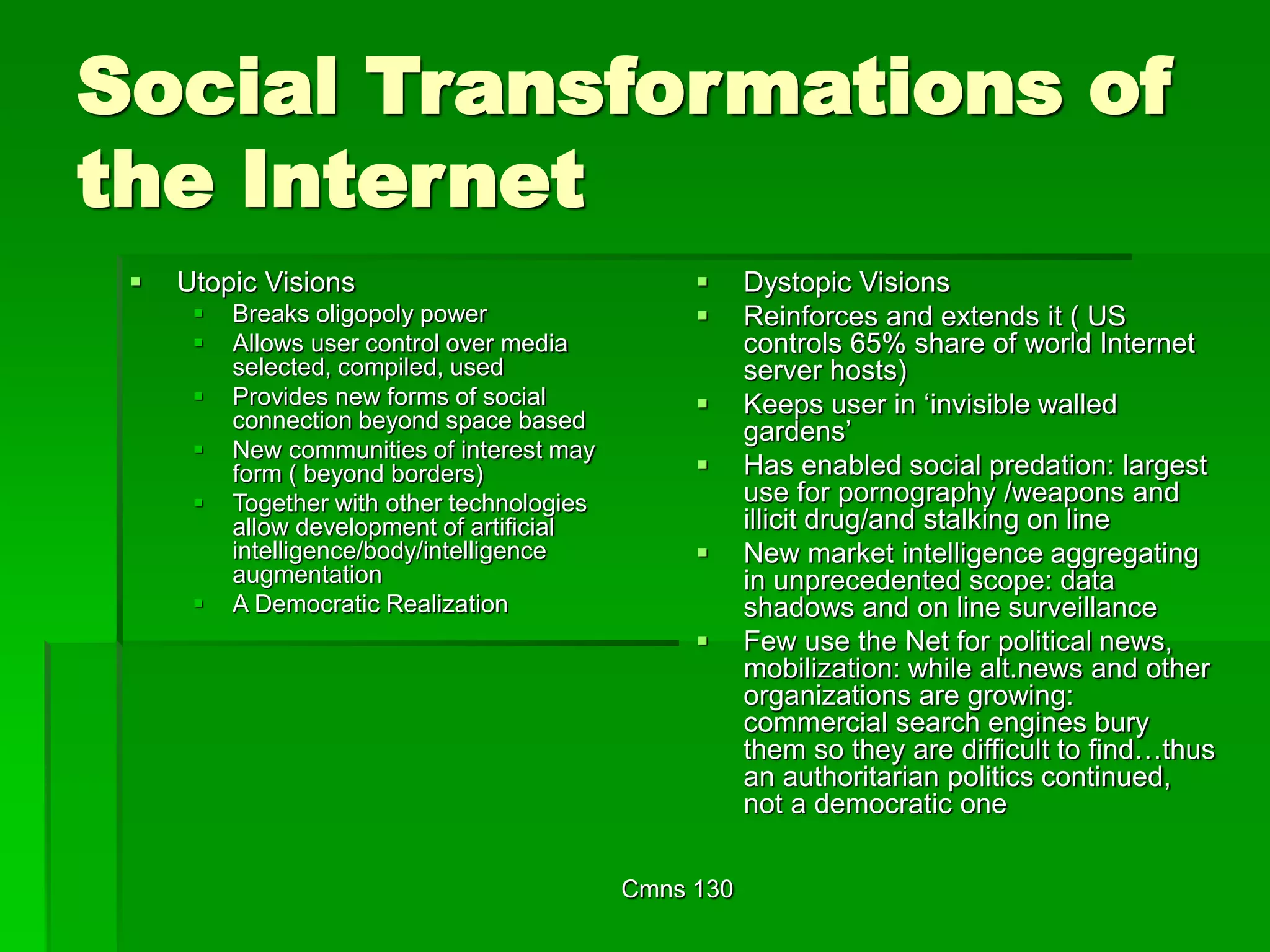
Social Transformations of
the Internet
 Utopic Visions
 Breaks oligopoly power
 Allows user control over media
selected, compiled, used
 Provides new forms of social
connection beyond space based
 New communities of interest may
form ( beyond borders)
 Together with other technologies
allow development of artificial
intelligence/body/intelligence
augmentation
 A Democratic Realization
 Dystopic Visions
 Reinforces and extends it ( US
controls 65% share of world Internet
server hosts)
 Keeps user in ‘invisible walled
gardens’
 Has enabled social predation: largest
use for pornography /weapons and
illicit drug/and stalking on line
 New market intelligence aggregating
in unprecedented scope: data
shadows and on line surveillance
 Few use the Net for political news,
mobilization: while alt.news and other
organizations are growing:
commercial search engines bury
them so they are difficult to find…thus
an authoritarian politics continued,
not a democratic one
Cmns 130
World Wide Web
 Between 22 and 800 million sites– less than
half indexed
 Main search engines:
 Google (500 m page estimate)
 Alta Vista294)
 Yahoo
 Iwon,
 Northern Light
 Fast
Cmns 130
Industry Structure
 No one owner of Internet
 ISP providers route through a tangled web of other providers
 One dominant PC software manufacturer: Microsoft ( Internet
Explorer)
 Decade long anti trust suit settled out of court
 Like AT&T, US Department of Justice concerned about dominant
market power, and predatory competition
 Until 1990s, little competition between telephones and cable
companies: now starting
 Late 1990s a wave of Stock Speculation and large scale mergers
for dot com sector just before its crash
 AOL ( which owns Netscape) tookover Time Warner: sign of new
technology surpassing old
 Emergence of little known Netscapes of Power
Cmns 130
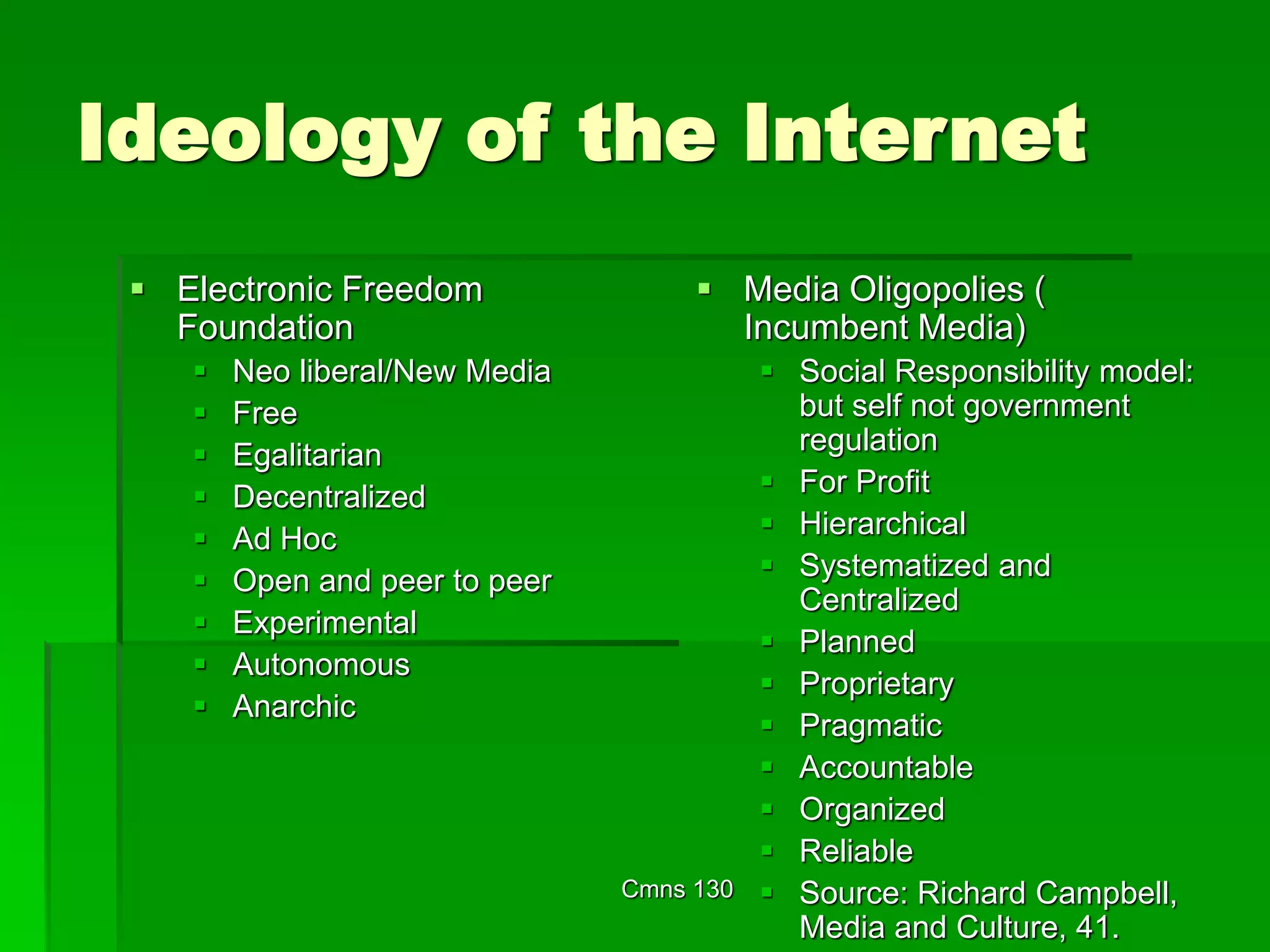
Ideology of the Internet
 Electronic Freedom
Foundation
 Neo liberal/New Media
 Free
 Egalitarian
 Decentralized
 Ad Hoc
 Open and peer to peer
 Experimental
 Autonomous
 Anarchic
 Media Oligopolies (
Incumbent Media)
 Social Responsibility model:
but self not government
regulation
 For Profit
 Hierarchical
 Systematized and
Centralized
 Planned
 Proprietary
 Pragmatic
 Accountable
 Organized
 Reliable
 Source: Richard Campbell,
Media and Culture, 41.
Cmns 130
The Business Case for On
line Start Ups
 Sector characterised by rapidly falling costs
 Transistorization etc.
 Costs for average computer falling 30% per year ( just 0.01% of costs
in 1970)
 E commerce applications growing, but still less than 5% of retail(
slower than supposed)
 Personal messaging ( email) very high
 Use for Information /Research high: but rise of subscription media
( eg. Newspaper on line, growing only among global travel
segment)
 Drive to get video downloadable for entertainment (video cell
phones banned in washrooms)
 Still largest volume of business is porn worldwide
Cmns 130
Globalization of the
Internet
 US has privatized domain names but retained control
over their allocation
 This is a sore point for Europe and other powerful
economic regions
 Internet content providers are estimated to be 98%
English, 87% commercial, and dominantly US in origin
 Other foreign governments now trying to:
 Invest in promotion of infrastructure
 Offer government services on line
 Promote the development of indigenous services
 ( eg. Canada: New Media Content Fund at Telefilm and the
Canadian Television Fund)
Cmns 130
Canadian Shape of
Convergence
 Links telecom and broadcast and news
 No computer sector
 Does link portals and so on
 First impacts of convergence have been
to de-localize news and media production
 Consolidation of media production
 Centralization in a few cities
Cmns 130
Regulation of the Internet
 Canada ‘s CRTC decided in 1999 not to regulate the Internet : to
leave it to open competition
 Australia and Europe are taking very different directions
 1996 US Telecommunications Act ( calling for deregulation) is
opposed world wide:
 It is essentially impossible for one country to act as a content
gatekeeper for a world community– Michael Epstein, quoted in
Campbell, 57.
 Hate and offensive contents are of growing social concern (
especially sexual predation on the Net)
 1996 US Communications Decency Act made it a felony to transmit
obscene, indecent, or harassing material on the Internet where
children might see it: struck down n grounds Internet no different from
a book store: not like broadcast ACLU v. Janet Reno, 1998)23
 Rise of ‘filters’/ ratings? On line entertainment
Cmns 130
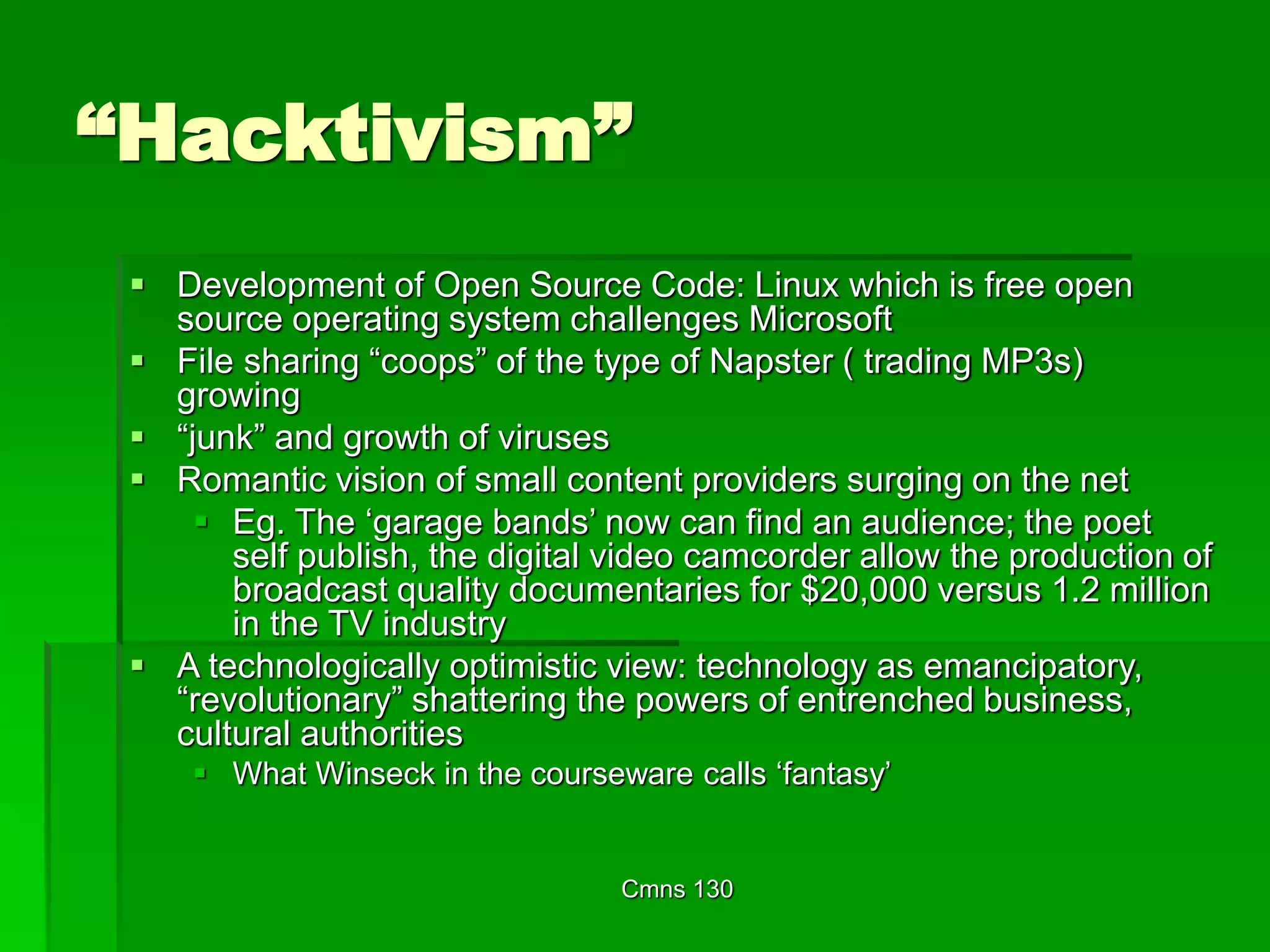
“Hacktivism”
 Development of Open Source Code: Linux which is free open
source operating system challenges Microsoft
 File sharing “coops” of the type of Napster ( trading MP3s)
growing
 “junk” and growth of viruses
 Romantic vision of small content providers surging on the net
 Eg. The ‘garage bands’ now can find an audience; the poet
self publish, the digital video camcorder allow the production of
broadcast quality documentaries for $20,000 versus 1.2 million
in the TV industry
 A technologically optimistic view: technology as emancipatory,
“revolutionary” shattering the powers of entrenched business,
cultural authorities
 What Winseck in the courseware calls ‘fantasy’
Cmns 130
Intellectual Property Law
 Part of Intellectual Property Law
 Governs the realm of inventions ( Patent
Law) and brands or names ( Trade Mark
Law), Trade Secrets ( Commercial Law)
and Copyright
Cmns 130
The Canadian Copyright
Act
 “protection”
 For the life of the author plus 50 years
 Where the creator has the sole right to perform the creative act,
grant permission or a “license” to reproduce it, or copy it.
 What is not copyrightable:
 Facts– but the compilation of them ( i.e how they are interpreted, is)
 Ideas- unless they are manifest in a drawing, paper, or written form (
see Vivian and Maurin, page 365)
 Copyright: important in book publishing, sound tracks to films,
films, music
 All TV and radio based on copyright payment to the performers
they use
 Increasingly important in international trade, all forms of academic
expression
Cmns 130
Canadian Copyright
Agencies
 CANCOPY: 130 courseware
 SOCAN
Cmns 130
US Digital Millenium
Copyright Act ( 1998)
 Computer users who copy or distribute
the digital expression of others without
their permission are liable to prosecution
 ISP’s may avoid liability if they police and
remove offenders
 Arose because of spread of MP3 ( a
digital compression technology)
Cmns 130
Napster
 Before 1999, just 5 companies, court
cases on price fixing underway
 Developer launches Website wi 2 mi per day
 Called P to P networking
 Allowed visitors to search for files on other MP3 users’
hard drive and download to burn their own CDs: control
over compilation shifts to consumers
 ‘freeware’: since Napster’s server did not house or
archive the music, the owners thought they were
exempt from copyright law and reasoned that
prosecution should happen at the individual level: since
so dispersed and large ( estimated in the millions a
month) it was believed it was not possible to enforce
the law
Cmns 130
The Napster Case (see
Fleras: 262)
 Musical Recording Industry argued Napster
infringed copyright– even Metallica!
 Damages estimated in the millions
 Refused to admit free sampling in fact
increased exposure to music: eventual
purchase
 Lined up a number of musicians to argue that
the financial damage was to artists ( not the the
multinationals)
Cmns 130
Napster defense
 An information source
 Not ‘housing’ or copying
 Intention to move to a subscription
service
 Struggled to settle out of court
 Agreed to charge a monthly fee
 Purchased by Bertelsmann
 Lost Case
Cmns 130
Effects of Napster
 Now usurped in the market ( Morpheus , Kazaa and others) but
trying a comeback
 Victor? : to large companies:
 BUT– they introduced 2 tier pricing to allow new artists to break in
 They reduced price of CDs
 More services experimenting with subscription and transaction fees
 Major transformation in Music Happening
 Victor? To consumers
 Forcing a major rethink of copyright
 Hierarchy of value: new versus brand artists merit more protection
 Should IP be free? It takes a community to raise an artist.
Cmns 130
Cmns 130
The Argument
 Fleras: intrusion of commercial interests
and government regulation has
compromised the regulatory potential of
the Internet
 McLuhan: the inception of a new media
casts into sharper relief the premises,
priorities and power relations of existing
media ( page 249).
Cmns 130
Crucial Questions
 Should those who control the medium
also control the message?
 Cases: GayTV and Shaw Cable
 BCE /CTV and Independent Film
 Sympatico(Bell) and Oliver Hate Site
 Issue is: will gatekeeper show
preference/discriminate against
competitors, or evade responsibility?
Cmns 130
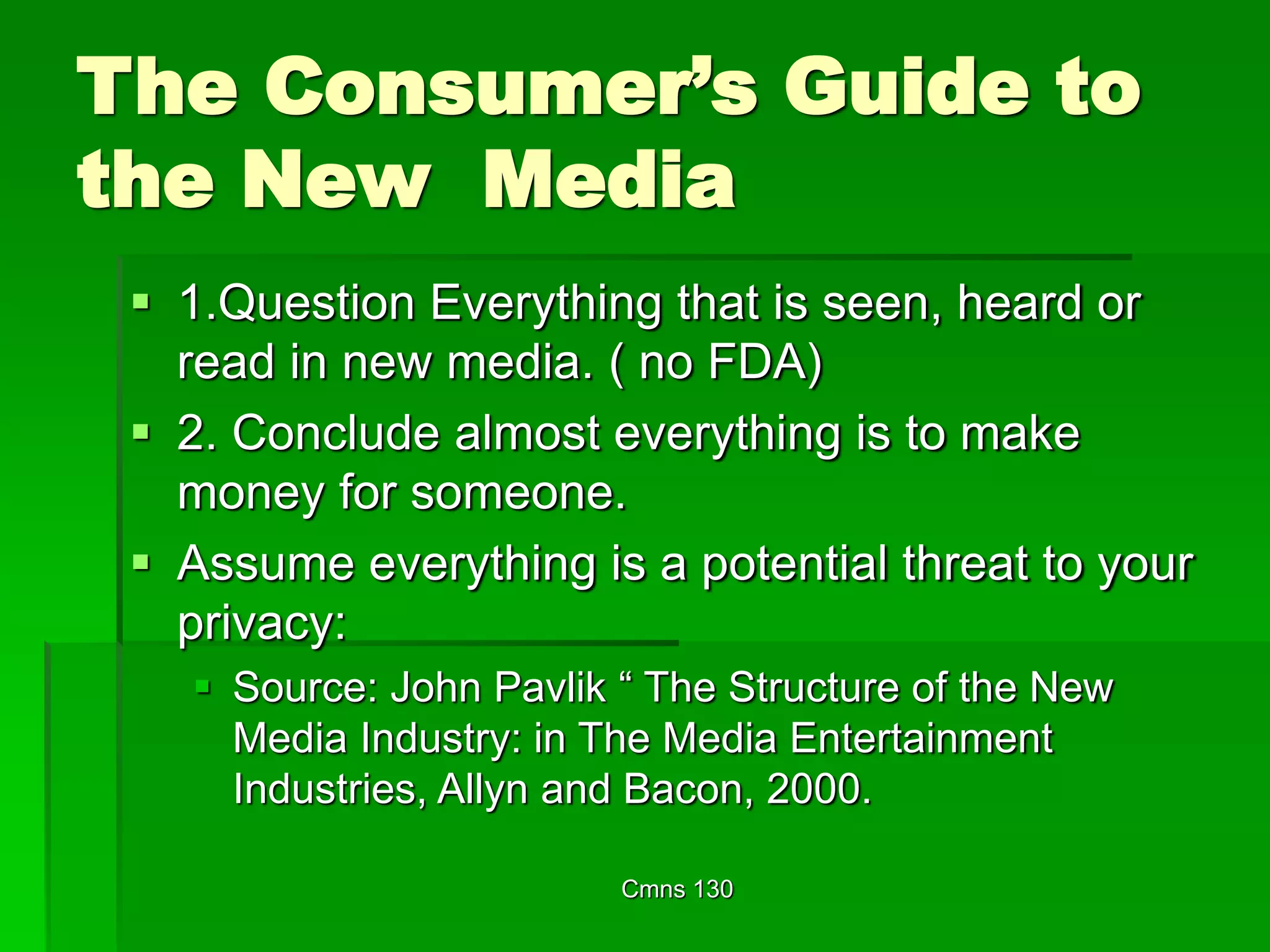
The Consumer’s Guide to
the New Media
 1.Question Everything that is seen, heard or
read in new media. ( no FDA)
 2. Conclude almost everything is to make
money for someone.
 Assume everything is a potential threat to your
privacy:
 Source: John Pavlik “ The Structure of the New
Media Industry: in The Media Entertainment
Industries, Allyn and Bacon, 2000.
Cmns 130
The Myth of Convergence
 Not new
 Since 19th century
 Telegraph and global news agencies born
together ( Winseck)
 AT&T ran RCA/Films until State department
busted it
 In Canada today, we have one of the most
consolidated media systems in the world, with
a high degree of cross-media ownership
Cmns 130
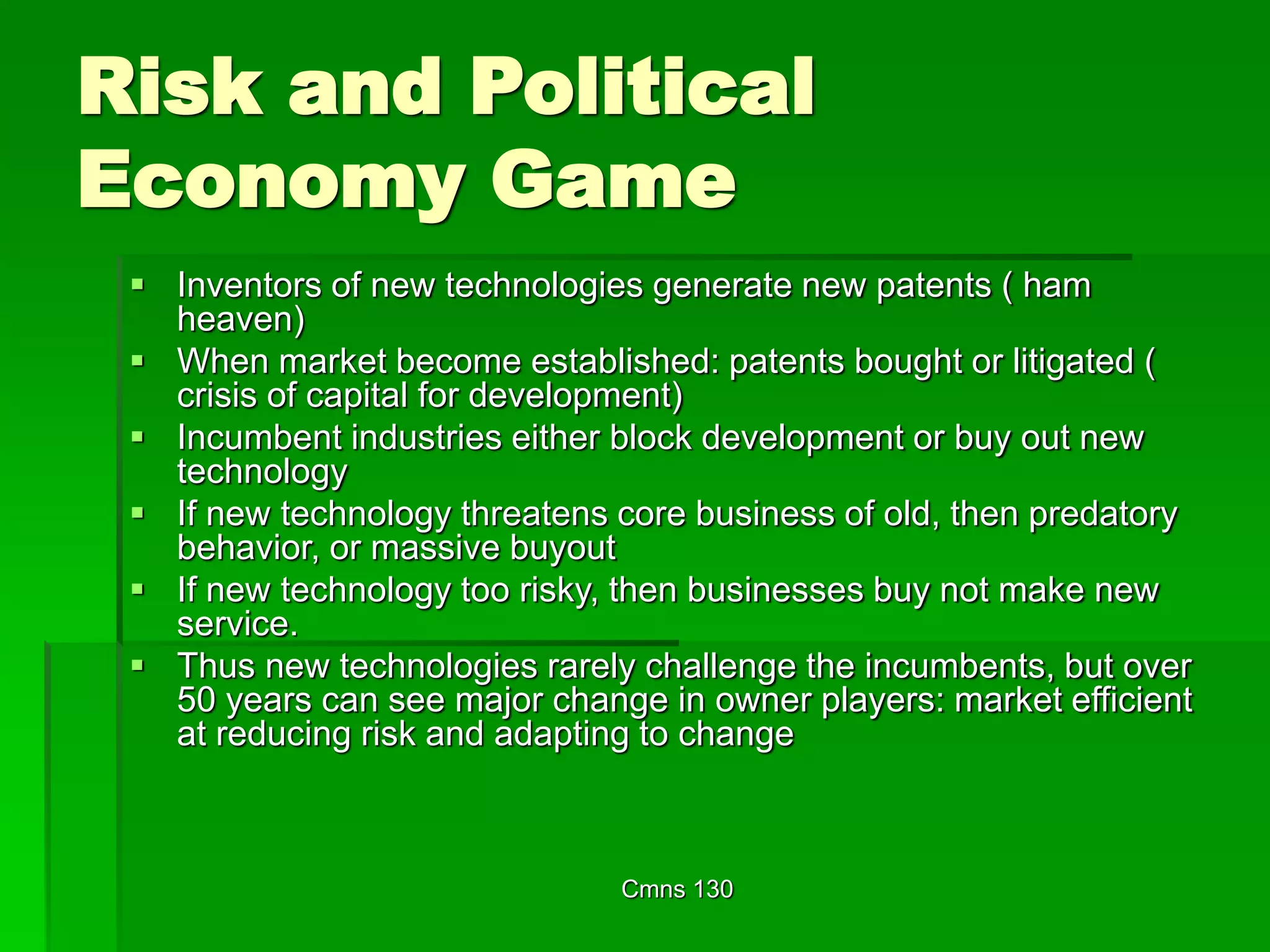
Risk and Political
Economy Game
 Inventors of new technologies generate new patents ( ham
heaven)
 When market become established: patents bought or litigated (
crisis of capital for development)
 Incumbent industries either block development or buy out new
technology
 If new technology threatens core business of old, then predatory
behavior, or massive buyout
 If new technology too risky, then businesses buy not make new
service.
 Thus new technologies rarely challenge the incumbents, but over
50 years can see major change in owner players: market efficient
at reducing risk and adapting to change
Cmns 130
The Critical Political Economy View: Lost
in Cyberspace by Dwayne Winseck
 Sees Intellectual Property Disputes as masking the
larger problem: oligopoly of power and control
 Internet now dominated by big players, not an ideal
perfect competition
 Convergence not new: 19th and 20th century waves and
predicted in Canada since 1971
 In Canada:
 Rogers allied with Microsoft and AT&T
 CanWest: news and TV and radio
 Bell Globemedia, CTV,Expressvue, Globe and Mail and
Sympatico, largest ISP
Cmns 130
Impacts of Cross Media
Ownership
 Now vertically and horizontal
companies can control all
aspects of message
 Should those who control the
medium also control the
message?
 Yes: allows economies of
scale, more money reinvested
in content, better assumption
of risk, more choice and
convenience for consumers
 No: debt means less
investment in content, loss of
jobs, avoidance of risk, less
choice and higher prices for
consumers ( Winseck, 326)
Cmns 130
Canadian Argument
 Canada does have more choice among services
 Highest level of cable, cell, Internet penetration in G-8
 Chronic shortage/ market failure in high cost production
 Shrinking public investment in non commercial or community media
 Indicators News
 More news services, fewer private foreign news bureaus, more reliance on
wire services; diminishing number of jobs
 Indicator Entertainment
 Digital channels not allied with big Canadian companies on verge of
bankruptcy
 Can’t get carried by cable companies, or carried at too high a wholesale rate
 Services high level of repetition( estimated more than 66% reruns)
 Lag of asymmetry: late on video file swapping, speed of video downloads
Cmns 130
Winseck’s conclusion
 In short, there is a resilience in the “old media”
that will not yield
 Incumbents battle new entrants and either buy
them up or forge partnerships, or force them
out of business
 People still mostly rely on TV for their political
information
 Internet works to extend and conserve existing
market dominance in cyberspace
Cmns 130
Netscapes of Power
 Must watch “netscapes of power”: rise of
gatekeepers and “walled gardens”
 Trend to bundling services for convenience
 Styling information services for personal
preferences– and not challenging these ( narrower
and narrower homogenous taste communities)
 Technologies of discrimination: owner preference in
placing subsidiaries at front of retail shelf and
burying competitive service providers
Cmns 130
Fleras: Rhetoric and
Reality ( p.269)
Cmns 130
Rhetoric & Reality
 Subversive/Freewheel
 Egalitarian
 Anarchic Power to the
People
 Globalizing
 Free
 Empowering and
Enlightening
 Diversity
 Corporatized/Control
 Ehaves/Ehavenots
 Authoritarian power to
the dollar
 Americanizing
 Marketing and
Advertising
 Make Money
 Conformity
Cmns 130
Social Issues:
Surveillance
 Network architecture is now “smart”
 Before, telcos did not know the content of messages
 Now, they do. Bits are monitored, stored in charting
flow and effective service
 Nortel and Cisco can establish network architectures
which:
 Identify each traffic type-Web, email, voice, video…and isolate
the type of application even down to specific brands, by the
interface used, by the user typeand individual user
identification or by the site address (winseck:331)
Cmns 130
Surveillance 2
 Rise of “cookies” ( spies on content, personal
information and preferences jeapordizing privacy)
 Technological potential of building a complete ‘data
shadow’ of the consumer, to better market to them
 Emerging self regulation of services
 Eg restrictive private contracts for use, limiting video
downloads, for example, in absence of regulation permitting it.
 Or: @Home…wide open powers to remove offensive matter
which is too prone to authoritarian censorship
 Still major fights: first over spam ( reaccessing your
email accounts, and next data shadowing/market
surveillance)
Cmns 130
The Walled Garden
 AOL Time Warner term
 Disney too
 Keep users within designated zones for as long as
possible ( Winseck, 335)
 How?
 By creation of content and service menus, organization of
hyperlinks, bias of search engings, network architecture,
promotion, content synergies,elimination of bypasses
 Creation of walled gardens: safe, predictable, branded
 Eg: Disney assumes role of immigration officer in AOL’s world:
if people enter their site, and then leave AOL, contract can be
cancelled ( Winseck, 336)
Cmns 130
The Information Gap
 Rest of the World is less than one-tenth on the
way to cyberspace
 Vast continents ( Africa) left out of “global
information highway”
 Rich consumers and those educated elites the
first to embrace computers and the Internet
 Poor, uneducated slow: many countries do not
have policies to help individuals(eg. Computers
in the home), although do help schools
Cmns 130
The Knowledge Gap
 Information and Knowledge gap is widening:
despite mass penetration of the Internet in
Canada, still high levels of illiteracy, ( under
25%) relatively low levels of university
education ( several points below Europe), and
growing child poverty: estimates place one in
four to one in three kids below poverty level
 Structurally higher levels of unemployment,
precarious jobs
 Gendered landscape of technological control

NewMedia (1).ppt

  • 1.
    Cmns 130 New Media( Chapter 8 in Text)  Definition & the Information Revolution  Changing economics  Changing regulation  Social Issues  Social Challenges:  The Knowledge Gap  Surveillance and loss of privacy  Sharing and Market “Hacktivism”
  • 2.
    Cmns 130 History ofNew Media  Since 1970s, but especially 1990s, nations concerned with the “ information highway”  Treated the Internet like an 1840s challenge of the telegraph  Concern that to remain competitive in a global trading economy, nations needed to “wire up”  Provide businesses, workers and consumers access to the Internet for education, retail, entertainment  Frontier metaphors often used  Essential for economic transformation away from industrial to service/ information economies: the so-called “innovation agenda”  In Canada, wired telco/cable providers dominated agenda: wireless only now emerging
  • 3.
    Cmns 130 Building theInternet  Nations regulate telecommunications internationally: agree on bandwidth of electronic transmission, spacing of satellites, sharing of costs/ interconnection  Also develop technical standards for interconnection ( IP protocols such as MP3)  This is the international standards role of nations, businesses and technical experts in creating a market for technology, and ensuring consumers don’t buy technology which will not work  Business play a bigger and bigger role influencing this shadow world of standards: citizens underrepresented  But: companies still need states to rule on standards
  • 4.
    Cmns 130 Definition ofNew Media  Digital communication  Used in the production, distribution and reception of communication  Involves use of new communication networks: Internet as mass medium
  • 5.
    Cmns 130 Information Revolution Digitization: using computers to store,manipulate and transmit information in form of speech, text, data, and video more cheaply and faster than every before.  Networking: distributed, fast digital networks wired and wireless  Convergence: refers to merging of what were three separate industries: telecommunications, computing, and electronics or broadcasting
  • 6.
    Cmns 130 Characteristics ofNew Media  Convergence of telecommunications and entertainment/broadcast media industries  Wire or wireless communication  Point to point or addressable  Interactive ( two way) ( now multiple conferencing)
  • 7.
    Cmns 130 Characteristics Continued Interpersonal: ie. The terrain of telephony treats telephone calls ( discretionary contact between two consenting persons) as PRIVATE not PUBLIC communication ( where telco distributors are not responsible for content of message)  Multiple: can be Mass/Broadcast which is PUBLIC communication ( broadcasters are responsible for message in exchange for spectrum monopoly: hybrid character)  Now a grey area of semi public/private communication ( can monitor cell phones, amass, monitor and store unprecedented personal communication)
  • 8.
    Cmns 130 Digital Communication Where image text or sound is converted into binary numbers- ones and zeroes ( 0/1)  Digital codes can duplicate, track store or play back complex kinds of content  Strong when combined with ever greater chip capacity in computers, and bundles of glass fibre ( fibre optics) capable of carrying large quantities of information  Current “revolution”: the Digital Video Disk  DVDs: higher resolution, no rewinding,now coming recordable for storage and intending to replace CDS  Also: wireless Internet ( games on the cell phone)
  • 9.
    Cmns 130 Implication ofDigitization  Drive to animation and special effects  Actors worried about cyber simulators replacing them  Domination of nature: totally simulated worlds?  Question of authenticity of image
  • 10.
    Cmns 130 The Roleof the Media in the Age of Digital Reproduction  Walter Benjamin, a noted cultural scholar, suggests that the infinite reproducibility of the communication product ( CD, video, internet) due to its low marginal cost of duplication changes the nature of the work of art  But western capitalism has conceived of the realm of ideas and expression as proprietary  Books, stories or photos may be copyrighted so they ‘belong’ to the author and no one may borrow or copy them without permission, attribution or payment  The high risk nature of entertainment ( so called hit rule) calls for imitation or ‘clones’ in popular culture ( riding the next so called fad or wave)  Infinite reproducibility, repackaging,repurposing and presenting information as original  There are many pressures on ‘news’ or ‘entertainment’ manufacture for cutting corners on production: ethical standards to prevent recycling content and presenting it as original are weak– digital watermarking is a weak barrier
  • 11.
    Cmns 130 Technical Potentialsof the New Media  Costs of production dropping: makes media creation more accessible ( digital camera and access to the net)  Costs of distribution down  Interactive// less hierarchical  Faster…more global
  • 12.
    Cmns 130 The Internet What: a vast network of high speed wires and satellite relays linking computers worldwide  No central hub: thousands of computer nodes ( it is highly distributed)  Uses a type of switching that is hard to trace: designed after WW2 in the RAND corporation to avoid worldwide military attack  Now used for: email, commerce, chat lines,file sharing etc.  Sometimes synonmous with on line world
  • 13.
    Cmns 130 Components ofthe Internet  World Wide Web  Internet Service Providers (AOL Time Warner; Sympatico,Telus, Shaw@Home, AT&T)  Portals ( MSN)  Browsers: Explorer, Netscape  Search Engines and directories ( Google, etc)
  • 14.
    Cmns 130 Rate ofDiffusion  Each generation of technology ( telegraph, telephone,radio, satellite to cable TV, VCRs) had an increasingly rapid rate of diffusion  Key is where it reaches ‘mass’ or majority ( 60% or more) of consumers.  Internet has done so within one decade: only other technology to do so, but not quite as fast were the VCR and cell phones  Now well over 75% of Canadians have access: that number rises to 100% under 25  The Internet the fastest techology in rate of social adaption
  • 15.
    Cmns 130 Impacts  Changedthe way we work  Accellerated space time compression: globalization processes  Convergence of computers and distribution allows greater efficiency of control and communication  Much cheaper to sell via Internet than in person ( 1/100th cost per transaction for banks, airlines)  Average person is now estimated to spend 187 hours a year on line ( source: Penguin Media and Information 2003)
  • 16.
    Cmns 130 Social Transformationsof the Internet  Utopic Visions  Breaks oligopoly power  Allows user control over media selected, compiled, used  Provides new forms of social connection beyond space based  New communities of interest may form ( beyond borders)  Together with other technologies allow development of artificial intelligence/body/intelligence augmentation  A Democratic Realization  Dystopic Visions  Reinforces and extends it ( US controls 65% share of world Internet server hosts)  Keeps user in ‘invisible walled gardens’  Has enabled social predation: largest use for pornography /weapons and illicit drug/and stalking on line  New market intelligence aggregating in unprecedented scope: data shadows and on line surveillance  Few use the Net for political news, mobilization: while alt.news and other organizations are growing: commercial search engines bury them so they are difficult to find…thus an authoritarian politics continued, not a democratic one
  • 17.
    Cmns 130 World WideWeb  Between 22 and 800 million sites– less than half indexed  Main search engines:  Google (500 m page estimate)  Alta Vista294)  Yahoo  Iwon,  Northern Light  Fast
  • 18.
    Cmns 130 Industry Structure No one owner of Internet  ISP providers route through a tangled web of other providers  One dominant PC software manufacturer: Microsoft ( Internet Explorer)  Decade long anti trust suit settled out of court  Like AT&T, US Department of Justice concerned about dominant market power, and predatory competition  Until 1990s, little competition between telephones and cable companies: now starting  Late 1990s a wave of Stock Speculation and large scale mergers for dot com sector just before its crash  AOL ( which owns Netscape) tookover Time Warner: sign of new technology surpassing old  Emergence of little known Netscapes of Power
  • 19.
    Cmns 130 Ideology ofthe Internet  Electronic Freedom Foundation  Neo liberal/New Media  Free  Egalitarian  Decentralized  Ad Hoc  Open and peer to peer  Experimental  Autonomous  Anarchic  Media Oligopolies ( Incumbent Media)  Social Responsibility model: but self not government regulation  For Profit  Hierarchical  Systematized and Centralized  Planned  Proprietary  Pragmatic  Accountable  Organized  Reliable  Source: Richard Campbell, Media and Culture, 41.
  • 20.
    Cmns 130 The BusinessCase for On line Start Ups  Sector characterised by rapidly falling costs  Transistorization etc.  Costs for average computer falling 30% per year ( just 0.01% of costs in 1970)  E commerce applications growing, but still less than 5% of retail( slower than supposed)  Personal messaging ( email) very high  Use for Information /Research high: but rise of subscription media ( eg. Newspaper on line, growing only among global travel segment)  Drive to get video downloadable for entertainment (video cell phones banned in washrooms)  Still largest volume of business is porn worldwide
  • 21.
    Cmns 130 Globalization ofthe Internet  US has privatized domain names but retained control over their allocation  This is a sore point for Europe and other powerful economic regions  Internet content providers are estimated to be 98% English, 87% commercial, and dominantly US in origin  Other foreign governments now trying to:  Invest in promotion of infrastructure  Offer government services on line  Promote the development of indigenous services  ( eg. Canada: New Media Content Fund at Telefilm and the Canadian Television Fund)
  • 22.
    Cmns 130 Canadian Shapeof Convergence  Links telecom and broadcast and news  No computer sector  Does link portals and so on  First impacts of convergence have been to de-localize news and media production  Consolidation of media production  Centralization in a few cities
  • 23.
    Cmns 130 Regulation ofthe Internet  Canada ‘s CRTC decided in 1999 not to regulate the Internet : to leave it to open competition  Australia and Europe are taking very different directions  1996 US Telecommunications Act ( calling for deregulation) is opposed world wide:  It is essentially impossible for one country to act as a content gatekeeper for a world community– Michael Epstein, quoted in Campbell, 57.  Hate and offensive contents are of growing social concern ( especially sexual predation on the Net)  1996 US Communications Decency Act made it a felony to transmit obscene, indecent, or harassing material on the Internet where children might see it: struck down n grounds Internet no different from a book store: not like broadcast ACLU v. Janet Reno, 1998)23  Rise of ‘filters’/ ratings? On line entertainment
  • 24.
    Cmns 130 “Hacktivism”  Developmentof Open Source Code: Linux which is free open source operating system challenges Microsoft  File sharing “coops” of the type of Napster ( trading MP3s) growing  “junk” and growth of viruses  Romantic vision of small content providers surging on the net  Eg. The ‘garage bands’ now can find an audience; the poet self publish, the digital video camcorder allow the production of broadcast quality documentaries for $20,000 versus 1.2 million in the TV industry  A technologically optimistic view: technology as emancipatory, “revolutionary” shattering the powers of entrenched business, cultural authorities  What Winseck in the courseware calls ‘fantasy’
  • 25.
    Cmns 130 Intellectual PropertyLaw  Part of Intellectual Property Law  Governs the realm of inventions ( Patent Law) and brands or names ( Trade Mark Law), Trade Secrets ( Commercial Law) and Copyright
  • 26.
    Cmns 130 The CanadianCopyright Act  “protection”  For the life of the author plus 50 years  Where the creator has the sole right to perform the creative act, grant permission or a “license” to reproduce it, or copy it.  What is not copyrightable:  Facts– but the compilation of them ( i.e how they are interpreted, is)  Ideas- unless they are manifest in a drawing, paper, or written form ( see Vivian and Maurin, page 365)  Copyright: important in book publishing, sound tracks to films, films, music  All TV and radio based on copyright payment to the performers they use  Increasingly important in international trade, all forms of academic expression
  • 27.
    Cmns 130 Canadian Copyright Agencies CANCOPY: 130 courseware  SOCAN
  • 28.
    Cmns 130 US DigitalMillenium Copyright Act ( 1998)  Computer users who copy or distribute the digital expression of others without their permission are liable to prosecution  ISP’s may avoid liability if they police and remove offenders  Arose because of spread of MP3 ( a digital compression technology)
  • 29.
    Cmns 130 Napster  Before1999, just 5 companies, court cases on price fixing underway  Developer launches Website wi 2 mi per day  Called P to P networking  Allowed visitors to search for files on other MP3 users’ hard drive and download to burn their own CDs: control over compilation shifts to consumers  ‘freeware’: since Napster’s server did not house or archive the music, the owners thought they were exempt from copyright law and reasoned that prosecution should happen at the individual level: since so dispersed and large ( estimated in the millions a month) it was believed it was not possible to enforce the law
  • 30.
    Cmns 130 The NapsterCase (see Fleras: 262)  Musical Recording Industry argued Napster infringed copyright– even Metallica!  Damages estimated in the millions  Refused to admit free sampling in fact increased exposure to music: eventual purchase  Lined up a number of musicians to argue that the financial damage was to artists ( not the the multinationals)
  • 31.
    Cmns 130 Napster defense An information source  Not ‘housing’ or copying  Intention to move to a subscription service  Struggled to settle out of court  Agreed to charge a monthly fee  Purchased by Bertelsmann  Lost Case
  • 32.
    Cmns 130 Effects ofNapster  Now usurped in the market ( Morpheus , Kazaa and others) but trying a comeback  Victor? : to large companies:  BUT– they introduced 2 tier pricing to allow new artists to break in  They reduced price of CDs  More services experimenting with subscription and transaction fees  Major transformation in Music Happening  Victor? To consumers  Forcing a major rethink of copyright  Hierarchy of value: new versus brand artists merit more protection  Should IP be free? It takes a community to raise an artist.
  • 33.
  • 34.
    Cmns 130 The Argument Fleras: intrusion of commercial interests and government regulation has compromised the regulatory potential of the Internet  McLuhan: the inception of a new media casts into sharper relief the premises, priorities and power relations of existing media ( page 249).
  • 35.
    Cmns 130 Crucial Questions Should those who control the medium also control the message?  Cases: GayTV and Shaw Cable  BCE /CTV and Independent Film  Sympatico(Bell) and Oliver Hate Site  Issue is: will gatekeeper show preference/discriminate against competitors, or evade responsibility?
  • 36.
    Cmns 130 The Consumer’sGuide to the New Media  1.Question Everything that is seen, heard or read in new media. ( no FDA)  2. Conclude almost everything is to make money for someone.  Assume everything is a potential threat to your privacy:  Source: John Pavlik “ The Structure of the New Media Industry: in The Media Entertainment Industries, Allyn and Bacon, 2000.
  • 37.
    Cmns 130 The Mythof Convergence  Not new  Since 19th century  Telegraph and global news agencies born together ( Winseck)  AT&T ran RCA/Films until State department busted it  In Canada today, we have one of the most consolidated media systems in the world, with a high degree of cross-media ownership
  • 38.
    Cmns 130 Risk andPolitical Economy Game  Inventors of new technologies generate new patents ( ham heaven)  When market become established: patents bought or litigated ( crisis of capital for development)  Incumbent industries either block development or buy out new technology  If new technology threatens core business of old, then predatory behavior, or massive buyout  If new technology too risky, then businesses buy not make new service.  Thus new technologies rarely challenge the incumbents, but over 50 years can see major change in owner players: market efficient at reducing risk and adapting to change
  • 39.
    Cmns 130 The CriticalPolitical Economy View: Lost in Cyberspace by Dwayne Winseck  Sees Intellectual Property Disputes as masking the larger problem: oligopoly of power and control  Internet now dominated by big players, not an ideal perfect competition  Convergence not new: 19th and 20th century waves and predicted in Canada since 1971  In Canada:  Rogers allied with Microsoft and AT&T  CanWest: news and TV and radio  Bell Globemedia, CTV,Expressvue, Globe and Mail and Sympatico, largest ISP
  • 40.
    Cmns 130 Impacts ofCross Media Ownership  Now vertically and horizontal companies can control all aspects of message  Should those who control the medium also control the message?  Yes: allows economies of scale, more money reinvested in content, better assumption of risk, more choice and convenience for consumers  No: debt means less investment in content, loss of jobs, avoidance of risk, less choice and higher prices for consumers ( Winseck, 326)
  • 41.
    Cmns 130 Canadian Argument Canada does have more choice among services  Highest level of cable, cell, Internet penetration in G-8  Chronic shortage/ market failure in high cost production  Shrinking public investment in non commercial or community media  Indicators News  More news services, fewer private foreign news bureaus, more reliance on wire services; diminishing number of jobs  Indicator Entertainment  Digital channels not allied with big Canadian companies on verge of bankruptcy  Can’t get carried by cable companies, or carried at too high a wholesale rate  Services high level of repetition( estimated more than 66% reruns)  Lag of asymmetry: late on video file swapping, speed of video downloads
  • 42.
    Cmns 130 Winseck’s conclusion In short, there is a resilience in the “old media” that will not yield  Incumbents battle new entrants and either buy them up or forge partnerships, or force them out of business  People still mostly rely on TV for their political information  Internet works to extend and conserve existing market dominance in cyberspace
  • 43.
    Cmns 130 Netscapes ofPower  Must watch “netscapes of power”: rise of gatekeepers and “walled gardens”  Trend to bundling services for convenience  Styling information services for personal preferences– and not challenging these ( narrower and narrower homogenous taste communities)  Technologies of discrimination: owner preference in placing subsidiaries at front of retail shelf and burying competitive service providers
  • 44.
    Cmns 130 Fleras: Rhetoricand Reality ( p.269)
  • 45.
    Cmns 130 Rhetoric &Reality  Subversive/Freewheel  Egalitarian  Anarchic Power to the People  Globalizing  Free  Empowering and Enlightening  Diversity  Corporatized/Control  Ehaves/Ehavenots  Authoritarian power to the dollar  Americanizing  Marketing and Advertising  Make Money  Conformity
  • 46.
    Cmns 130 Social Issues: Surveillance Network architecture is now “smart”  Before, telcos did not know the content of messages  Now, they do. Bits are monitored, stored in charting flow and effective service  Nortel and Cisco can establish network architectures which:  Identify each traffic type-Web, email, voice, video…and isolate the type of application even down to specific brands, by the interface used, by the user typeand individual user identification or by the site address (winseck:331)
  • 47.
    Cmns 130 Surveillance 2 Rise of “cookies” ( spies on content, personal information and preferences jeapordizing privacy)  Technological potential of building a complete ‘data shadow’ of the consumer, to better market to them  Emerging self regulation of services  Eg restrictive private contracts for use, limiting video downloads, for example, in absence of regulation permitting it.  Or: @Home…wide open powers to remove offensive matter which is too prone to authoritarian censorship  Still major fights: first over spam ( reaccessing your email accounts, and next data shadowing/market surveillance)
  • 48.
    Cmns 130 The WalledGarden  AOL Time Warner term  Disney too  Keep users within designated zones for as long as possible ( Winseck, 335)  How?  By creation of content and service menus, organization of hyperlinks, bias of search engings, network architecture, promotion, content synergies,elimination of bypasses  Creation of walled gardens: safe, predictable, branded  Eg: Disney assumes role of immigration officer in AOL’s world: if people enter their site, and then leave AOL, contract can be cancelled ( Winseck, 336)
  • 49.
    Cmns 130 The InformationGap  Rest of the World is less than one-tenth on the way to cyberspace  Vast continents ( Africa) left out of “global information highway”  Rich consumers and those educated elites the first to embrace computers and the Internet  Poor, uneducated slow: many countries do not have policies to help individuals(eg. Computers in the home), although do help schools
  • 50.
    Cmns 130 The KnowledgeGap  Information and Knowledge gap is widening: despite mass penetration of the Internet in Canada, still high levels of illiteracy, ( under 25%) relatively low levels of university education ( several points below Europe), and growing child poverty: estimates place one in four to one in three kids below poverty level  Structurally higher levels of unemployment, precarious jobs  Gendered landscape of technological control