ā€œ All the World’s a Stageā€ Ian Miles  –   Manchester Institute of Innovation Research MBS - University of Manchester Ian.Miles@mbs.ac.uk  Knowledge Economy and  Information Society 2 – Information Society Evolution
Course material should be available on webct – but in the meantime go to http:// www.freewebs.com/mioir/keisintro.htm
This seminar: Sociotechnical approach to Information Society Technological Revolutions Stages of Information Society? Information Systems Evolution – stages and strategies?
Understanding Information Society All economic sectors (and all human activities) involve producing and processing information; and many also require sharing and storing it. Knowledge about information production and processing has accumulated and evolved.  Historically there have been major new methods  (e.g. writing and arithmetic; abacus and printing; telegraphy and telephony, analogue photography and phonography; radio and TV…)   with significant implications for socioeconomic organisation. New IT -  electricity    electronics    microelectronics , new devices and ideas like software, dataware (e-content), interactivity, etc.
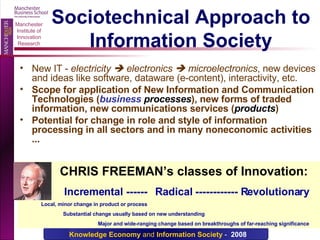
Sociotechnical Approach to Information Society New IT -  electricity    electronics    microelectronics , new devices and ideas like software, dataware (e-content), interactivity, etc. Scope for application of New Information and Communication Technologies ( business  processes ), new forms of traded information, new communications services ( products ) Potential for change in role and style of information processing in all sectors and in many noneconomic activities ...   CHRIS FREEMAN’s classes of Innovation: Incremental ------  Radical ------------ Revolutionary Local, minor change in product or process   Substantial change usually based on new understanding   Major and wide-ranging change based on breakthroughs of far-reaching significance
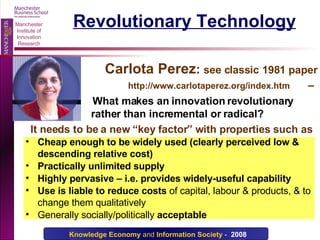
Revolutionary Technology Carlota Perez :  see classic   1981 paper  http://www.carlotaperez.org/index.htm   –    What makes an innovation revolutionary  rather than incremental or radical? It needs to be a new ā€œkey factorā€ with properties such as Cheap enough to be widely used (clearly perceived low & descending relative cost) Practically unlimited supply Highly pervasive – i.e. provides widely-useful capability Use is liable to reduce costs  of capital, labour & products, & to change them qualitatively Generally socially/politically  acceptable
An IT  Revolution? Dramatic & continuing:  power increases (new capabilities), cost decreases Widespread applicability   (information & or information processing power)  as factor of production Effectively no   resource limits  (skills??) Little social resistance  (around generics - may be contention about specific uses) ACTORS’  PERCEPTIONS   - opportunities seized to produce new products and processes, new practices, calculus and ā€œcommon senseā€
A Sociotechnical Approach – Eras as related to Technological revolutions: New  knowledge  of effecting useful transformations    new practices a new  heartland technology  – when new knowledge produces major improvement in capacity to effect pervasive transformations This promotes dramatic change in availability of a core element of production Meaning the use of new production equipment  Organised in new production processes changed logic of production With  new products for industrial and consumer use (and often in a leading role – military and other public sector use)
Opportunities are grasped … Innovation in and around new IT New processes of production, new products  Labour, Capital, Knowledge inputs Changed use of factors of production  Changes in organisational structure Changed linkages between organisations Changed consumption … leading to widespread change Not IMPACTS – strategies, counterstrategies, partial knowledge and visions
Technological revolutions - social phenomena, involving: New Sociotechnical Constituencies   (Molina)   Government Action on Innovation and Diffusion  New processes, products: proliferating choice New Firms, Industries, Linkages between industries New skills, Management approaches Rhetoric precedes systematic analysis of policy, ethical issues, & wider implications   Hype and mythology; Heroes and villains Novel risks; Uncertainties about long-term performance Lengthy learning processes Platforms, standards, dominant designs: Closure of some choices
Sociotechnical Approach: Revolutionary technology: new capabilities – but actors have uneven access to knowledge and resources; they have cognitive constraints; and learning  processes  are important There are real (but evolving) limits to functionality of artefacts and applicability of knowledge Constituencies need to be mobilised to develop and apply knowledge (sometimes against opposition) – it is not costless Materiality of technology -> constrained ability to effect transformations in material world, constrained ability to invent effective technologies Constraints in part cognitive, and learning processes important: but real limits to functionality of artefacts and applicability of knowledge Interplay of actors and their strategies generates development and application of knowledge Unanticipated consequences; n ew actors, alliances, ways of acting
Is Information Society evolving? Earlier phases of industrial capitalism have differed considerably over time and space - reflecting differences in culture, politics, technology Information societies - a genre of industrial capitalism - are currently diverse We can anticipate variation among information societies – despite globalisation, etc.  ( But how much and on   what dimensions? )
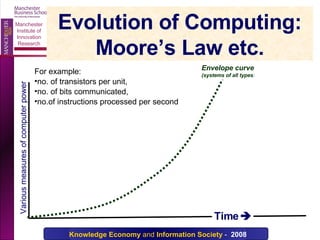
Evolution of Computing: Moore’s Law etc. For example:  no. of transistors per unit,  no. of bits communicated,  no.of instructions processed per second Various measures of computer power Time    Envelope curve  (systems of all types )
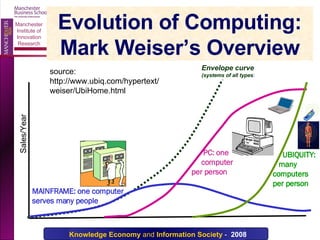
Evolution of Computing: Mark Weiser’s Overview source: http://www.ubiq.com/hypertext/weiser/UbiHome.html Sales/Year Envelope curve  (systems of all types ) MAINFRAME: one computer serves many people  PC: one  ----- computer per person  UBIQUITY:  --- many  --------- computers per person
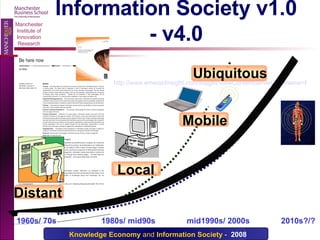
Information Society   v1.0 - v4.0 http://www.emeraldinsight.com/Insight/ViewContentServlet?Filename=Published/EmeraldFullTextArticle/Pdf/2720070203.pdf   Distant Local Mobile Ubiquitous 1960s/ 70s  1980s/ mid90s  mid1990s/ 2000s  2010s?/?
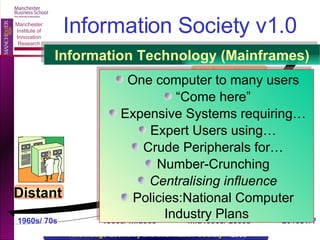
Information Society v1.0 One computer to many users ā€œ Come hereā€ Expensive Systems requiring… Expert Users using… Crude Peripherals for… Number-Crunching Centralising influence Policies:National Computer Industry Plans Information Technology (Mainframes) Distant Local Mobile Ubiquitous 1960s/ 70s  1980s/ mid90s  mid1990s/ 2000s  2010s?/?
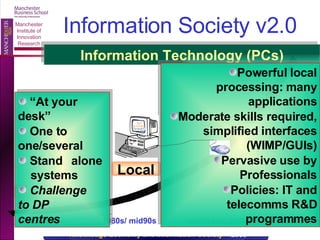
Information Society v2.0 Information Technology (PCs) Distant Local Mobile Ubiquitous 1960s/ 70s  1980s/ mid90s  mid1990s/ 2000s  2010s?/?  ā€œ At your  deskā€ One to  one/several Stand  alone  systems Challenge  to DP  centres Powerful local processing: many applications Moderate skills required, simplified interfaces (WIMP/GUIs) Pervasive use by Professionals Policies: IT and telecomms R&D programmes
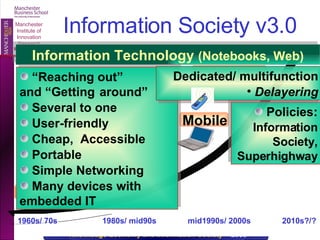
Information Society v3.0 Information Technology  (Notebooks, Web) Distant Local Mobile Ubiquitous 1960s/ 70s  1980s/ mid90s  mid1990s/ 2000s  2010s?/?  ā€œ Reaching outā€  and ā€œGetting  aroundā€ Several to one User-friendly Cheap,  Accessible Portable Simple Networking Many devices with  embedded IT Policies: Information Society, Superhighway Dedicated/ multifunction Delayering
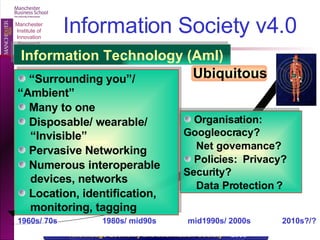
Information Society v4.0 Information Technology (AmI) Distant Local Mobile Ubiquitous 1960s/ 70s  1980s/ mid90s  mid1990s/ 2000s  2010s?/?  ā€œ Surrounding youā€/  ā€œAmbientā€ Many to one Disposable/ wearable/  ā€œInvisibleā€ Pervasive Networking Numerous interoperable  devices, networks Location, identification,  monitoring, tagging Organisation:  Googleocracy? Net governance? Policies:  Privacy?  Security?  Data Protection ?
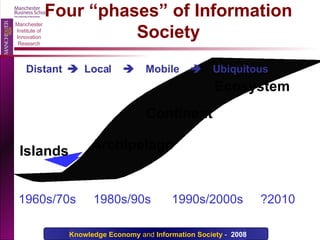
Four ā€œphasesā€ of Information Society Islands Archipelago Continent Ecosystem 1960s/70s  1980s/90s  1990s/2000s  ?2010  Distant     Local     Mobile     Ubiquitous
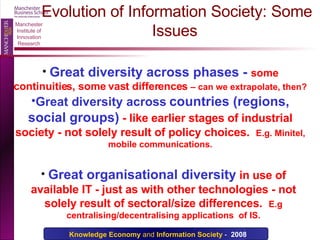
Evolution of Information Society: Some Issues Great diversity across phases -  some continuities, some vast differences  – can we extrapolate, then? Great diversity across   countries (regions, social groups)   - like earlier stages of industrial society - not solely result of policy choices.  E.g. Minitel, mobile communications. Great organisational diversity   in use of available IT - just as with other technologies - not solely result of sectoral/size differences.  E.g centralising/decentralising applications  of IS.
Additional Powerpoints More detail on Moore’s Law etc. Check out KEIS for background readings for next week, on IT and IS statistics.
End of Presentation (if there is not time for the remaining slides!)
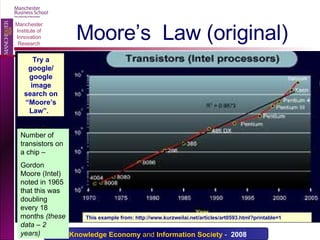
Moore’s  Law (original) Number of transistors on a chip – Gordon Moore (Intel) noted in 1965 that this was doubling every 18 months  (these data – 2 years) This example from: http://www.kurzweilai.net/articles/art0593.html?printable=1 Try a google/ google image search on ā€œMoore’s Lawā€.
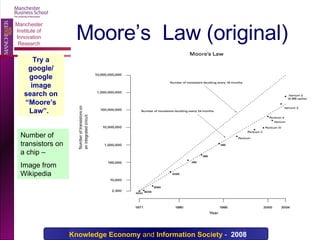
Moore’s  Law (original) Number of transistors on a chip – Image from Wikipedia Try a google/ google image search on ā€œMoore’s Lawā€.
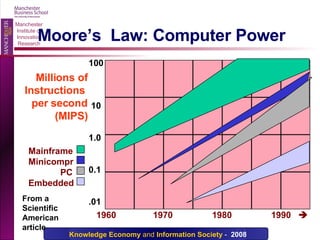
Moore’s  Law:  Computer Power From a Scientific American article 1960  1970  1980  1990   Millions of Instructions  per second (MIPS) 100 10 1.0 0.1 .01 Mainframe Minicompr PC Embedded
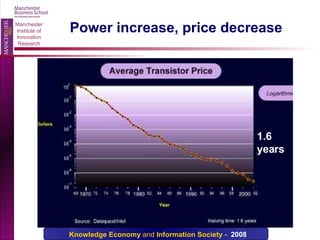
Moore’s  Law (extended) Estimate of PROCESSING POWER (and cost)  Kurzweil Image from Wikipedia ā€œ Moore's Law of Integrated Circuits was not the first, but the fifth paradigm to provide accelerating price-performance. Computing devices have been consistently multiplying in power (per unit of time) from the mechanical calculating devices used in the 1890 U.S. Census, to Turing's relay-based "Robinson" machine that cracked the Nazi enigma code, to the CBS vacuum tube computer that predicted the election of Eisenhower, to the transistor-based machines used in the first space launches, to the integrated-circuit-based personal [computers]. ā€œ
Power increase, price decrease 1.6 years
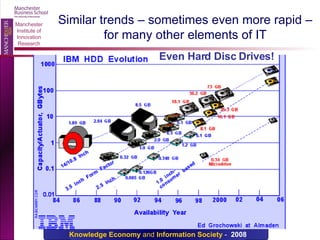
Similar trends – sometimes even more rapid – for many other elements of IT Even Hard Disc Drives!
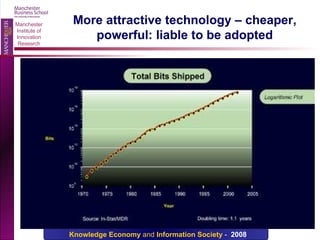
More attractive technology – cheaper, powerful: liable to be adopted
But is it a ā€œLawā€? People like to search for regularities – maybe they’re imputing trends where they don’t exist? If the trends exist, even if not as rigid and predictable as commentators suggest, how can we understand them? Giovanni Dosi ’s notion of technological trajectory (and paradigm) is useful here… Expectations forged in communities of practice, used as benchmarks which competing firms/ researchers pursue.  Expectations need to be realistic in terms of tools, techniques, costs, transformative potentials.
Law and Order Many other ā€œlawsā€ People like to search for regularities – maybe they’re imputing trends where they don’t exist? Look on the Web for the debates between Ray Kurzweil and Ilkka Tuomi: cf.  Tuomi’s original paper ā€œLife and Death of Moore’s Lawā€ at  http://www.jrc.es/~tuomiil/articles/TheLivesAndTheDeathOfMoore.pdf
Tuomi’s Analysis Moore changed his formulation (doubling time  from 12 to 18 months , and specific parameters  from optimal to maximum complexity ) People citing Moore continued to modify the formulation ( per square inch, ā€œprocessing powerā€ ) Data bearing out the argument are often used in misleading ways (e.g. real doubling time?) …  doesn’t really diminish the case that there has been a remarkable accelerating long-run technological evolution, though… There are many arguments suggesting that at some time soon the applicability of the Law will be reduced – difficulties of working with increasingly small scale.  (But so far slow-down / halt has been resisted). There are bottlenecks where progress has been slow (e.g. laptop batteries)

Keis0s2 Is Stages 2008

  • 1.
    ā€œ All theWorld’s a Stageā€ Ian Miles – Manchester Institute of Innovation Research MBS - University of Manchester Ian.Miles@mbs.ac.uk Knowledge Economy and Information Society 2 – Information Society Evolution
  • 2.
    Course material shouldbe available on webct – but in the meantime go to http:// www.freewebs.com/mioir/keisintro.htm
  • 3.
    This seminar: Sociotechnicalapproach to Information Society Technological Revolutions Stages of Information Society? Information Systems Evolution – stages and strategies?
  • 4.
    Understanding Information SocietyAll economic sectors (and all human activities) involve producing and processing information; and many also require sharing and storing it. Knowledge about information production and processing has accumulated and evolved. Historically there have been major new methods (e.g. writing and arithmetic; abacus and printing; telegraphy and telephony, analogue photography and phonography; radio and TV…) with significant implications for socioeconomic organisation. New IT - electricity  electronics  microelectronics , new devices and ideas like software, dataware (e-content), interactivity, etc.
  • 5.
    Sociotechnical Approach toInformation Society New IT - electricity  electronics  microelectronics , new devices and ideas like software, dataware (e-content), interactivity, etc. Scope for application of New Information and Communication Technologies ( business processes ), new forms of traded information, new communications services ( products ) Potential for change in role and style of information processing in all sectors and in many noneconomic activities ... CHRIS FREEMAN’s classes of Innovation: Incremental ------ Radical ------------ Revolutionary Local, minor change in product or process Substantial change usually based on new understanding Major and wide-ranging change based on breakthroughs of far-reaching significance
  • 6.
    Revolutionary Technology CarlotaPerez : see classic 1981 paper http://www.carlotaperez.org/index.htm – What makes an innovation revolutionary rather than incremental or radical? It needs to be a new ā€œkey factorā€ with properties such as Cheap enough to be widely used (clearly perceived low & descending relative cost) Practically unlimited supply Highly pervasive – i.e. provides widely-useful capability Use is liable to reduce costs of capital, labour & products, & to change them qualitatively Generally socially/politically acceptable
  • 7.
    An IT Revolution? Dramatic & continuing: power increases (new capabilities), cost decreases Widespread applicability (information & or information processing power) as factor of production Effectively no resource limits (skills??) Little social resistance (around generics - may be contention about specific uses) ACTORS’ PERCEPTIONS - opportunities seized to produce new products and processes, new practices, calculus and ā€œcommon senseā€
  • 8.
    A Sociotechnical Approach– Eras as related to Technological revolutions: New knowledge of effecting useful transformations  new practices a new heartland technology – when new knowledge produces major improvement in capacity to effect pervasive transformations This promotes dramatic change in availability of a core element of production Meaning the use of new production equipment Organised in new production processes changed logic of production With new products for industrial and consumer use (and often in a leading role – military and other public sector use)
  • 9.
    Opportunities are grasped… Innovation in and around new IT New processes of production, new products Labour, Capital, Knowledge inputs Changed use of factors of production Changes in organisational structure Changed linkages between organisations Changed consumption … leading to widespread change Not IMPACTS – strategies, counterstrategies, partial knowledge and visions
  • 10.
    Technological revolutions -social phenomena, involving: New Sociotechnical Constituencies (Molina) Government Action on Innovation and Diffusion New processes, products: proliferating choice New Firms, Industries, Linkages between industries New skills, Management approaches Rhetoric precedes systematic analysis of policy, ethical issues, & wider implications Hype and mythology; Heroes and villains Novel risks; Uncertainties about long-term performance Lengthy learning processes Platforms, standards, dominant designs: Closure of some choices
  • 11.
    Sociotechnical Approach: Revolutionarytechnology: new capabilities – but actors have uneven access to knowledge and resources; they have cognitive constraints; and learning processes are important There are real (but evolving) limits to functionality of artefacts and applicability of knowledge Constituencies need to be mobilised to develop and apply knowledge (sometimes against opposition) – it is not costless Materiality of technology -> constrained ability to effect transformations in material world, constrained ability to invent effective technologies Constraints in part cognitive, and learning processes important: but real limits to functionality of artefacts and applicability of knowledge Interplay of actors and their strategies generates development and application of knowledge Unanticipated consequences; n ew actors, alliances, ways of acting
  • 12.
    Is Information Societyevolving? Earlier phases of industrial capitalism have differed considerably over time and space - reflecting differences in culture, politics, technology Information societies - a genre of industrial capitalism - are currently diverse We can anticipate variation among information societies – despite globalisation, etc. ( But how much and on what dimensions? )
  • 13.
    Evolution of Computing:Moore’s Law etc. For example: no. of transistors per unit, no. of bits communicated, no.of instructions processed per second Various measures of computer power Time  Envelope curve (systems of all types )
  • 14.
    Evolution of Computing:Mark Weiser’s Overview source: http://www.ubiq.com/hypertext/weiser/UbiHome.html Sales/Year Envelope curve (systems of all types ) MAINFRAME: one computer serves many people PC: one ----- computer per person UBIQUITY: --- many --------- computers per person
  • 15.
    Information Society v1.0 - v4.0 http://www.emeraldinsight.com/Insight/ViewContentServlet?Filename=Published/EmeraldFullTextArticle/Pdf/2720070203.pdf Distant Local Mobile Ubiquitous 1960s/ 70s 1980s/ mid90s mid1990s/ 2000s 2010s?/?
  • 16.
    Information Society v1.0One computer to many users ā€œ Come hereā€ Expensive Systems requiring… Expert Users using… Crude Peripherals for… Number-Crunching Centralising influence Policies:National Computer Industry Plans Information Technology (Mainframes) Distant Local Mobile Ubiquitous 1960s/ 70s 1980s/ mid90s mid1990s/ 2000s 2010s?/?
  • 17.
    Information Society v2.0Information Technology (PCs) Distant Local Mobile Ubiquitous 1960s/ 70s 1980s/ mid90s mid1990s/ 2000s 2010s?/? ā€œ At your deskā€ One to one/several Stand alone systems Challenge to DP centres Powerful local processing: many applications Moderate skills required, simplified interfaces (WIMP/GUIs) Pervasive use by Professionals Policies: IT and telecomms R&D programmes
  • 18.
    Information Society v3.0Information Technology (Notebooks, Web) Distant Local Mobile Ubiquitous 1960s/ 70s 1980s/ mid90s mid1990s/ 2000s 2010s?/? ā€œ Reaching outā€ and ā€œGetting aroundā€ Several to one User-friendly Cheap, Accessible Portable Simple Networking Many devices with embedded IT Policies: Information Society, Superhighway Dedicated/ multifunction Delayering
  • 19.
    Information Society v4.0Information Technology (AmI) Distant Local Mobile Ubiquitous 1960s/ 70s 1980s/ mid90s mid1990s/ 2000s 2010s?/? ā€œ Surrounding youā€/ ā€œAmbientā€ Many to one Disposable/ wearable/ ā€œInvisibleā€ Pervasive Networking Numerous interoperable devices, networks Location, identification, monitoring, tagging Organisation: Googleocracy? Net governance? Policies: Privacy? Security? Data Protection ?
  • 20.
    Four ā€œphasesā€ ofInformation Society Islands Archipelago Continent Ecosystem 1960s/70s 1980s/90s 1990s/2000s ?2010 Distant  Local  Mobile  Ubiquitous
  • 21.
    Evolution of InformationSociety: Some Issues Great diversity across phases - some continuities, some vast differences – can we extrapolate, then? Great diversity across countries (regions, social groups) - like earlier stages of industrial society - not solely result of policy choices. E.g. Minitel, mobile communications. Great organisational diversity in use of available IT - just as with other technologies - not solely result of sectoral/size differences. E.g centralising/decentralising applications of IS.
  • 22.
    Additional Powerpoints Moredetail on Moore’s Law etc. Check out KEIS for background readings for next week, on IT and IS statistics.
  • 23.
    End of Presentation(if there is not time for the remaining slides!)
  • 24.
    Moore’s Law(original) Number of transistors on a chip – Gordon Moore (Intel) noted in 1965 that this was doubling every 18 months (these data – 2 years) This example from: http://www.kurzweilai.net/articles/art0593.html?printable=1 Try a google/ google image search on ā€œMoore’s Lawā€.
  • 25.
    Moore’s Law(original) Number of transistors on a chip – Image from Wikipedia Try a google/ google image search on ā€œMoore’s Lawā€.
  • 26.
    Moore’s Law: Computer Power From a Scientific American article 1960 1970 1980 1990  Millions of Instructions per second (MIPS) 100 10 1.0 0.1 .01 Mainframe Minicompr PC Embedded
  • 27.
    Moore’s Law(extended) Estimate of PROCESSING POWER (and cost) Kurzweil Image from Wikipedia ā€œ Moore's Law of Integrated Circuits was not the first, but the fifth paradigm to provide accelerating price-performance. Computing devices have been consistently multiplying in power (per unit of time) from the mechanical calculating devices used in the 1890 U.S. Census, to Turing's relay-based "Robinson" machine that cracked the Nazi enigma code, to the CBS vacuum tube computer that predicted the election of Eisenhower, to the transistor-based machines used in the first space launches, to the integrated-circuit-based personal [computers]. ā€œ
  • 28.
    Power increase, pricedecrease 1.6 years
  • 29.
    Similar trends –sometimes even more rapid – for many other elements of IT Even Hard Disc Drives!
  • 30.
    More attractive technology– cheaper, powerful: liable to be adopted
  • 31.
    But is ita ā€œLawā€? People like to search for regularities – maybe they’re imputing trends where they don’t exist? If the trends exist, even if not as rigid and predictable as commentators suggest, how can we understand them? Giovanni Dosi ’s notion of technological trajectory (and paradigm) is useful here… Expectations forged in communities of practice, used as benchmarks which competing firms/ researchers pursue. Expectations need to be realistic in terms of tools, techniques, costs, transformative potentials.
  • 32.
    Law and OrderMany other ā€œlawsā€ People like to search for regularities – maybe they’re imputing trends where they don’t exist? Look on the Web for the debates between Ray Kurzweil and Ilkka Tuomi: cf. Tuomi’s original paper ā€œLife and Death of Moore’s Lawā€ at http://www.jrc.es/~tuomiil/articles/TheLivesAndTheDeathOfMoore.pdf
  • 33.
    Tuomi’s Analysis Moorechanged his formulation (doubling time from 12 to 18 months , and specific parameters from optimal to maximum complexity ) People citing Moore continued to modify the formulation ( per square inch, ā€œprocessing powerā€ ) Data bearing out the argument are often used in misleading ways (e.g. real doubling time?) … doesn’t really diminish the case that there has been a remarkable accelerating long-run technological evolution, though… There are many arguments suggesting that at some time soon the applicability of the Law will be reduced – difficulties of working with increasingly small scale. (But so far slow-down / halt has been resisted). There are bottlenecks where progress has been slow (e.g. laptop batteries)