MEDIAAND INFORMATION
LITERACY (MIL)
Mass Media
Media Effects
Mr. Arniel Ping
St. Stephen’s High School
Manila, Philippines MIL PPT 7, Revised: June 11, 2017
Types of Media (Part 2)
LEARNING COMPETENCIES
Learners will be able to…
■ define mass media and media effects (SSHS);
■ discuss and evaluate the different theories on media
effects (SSHS);
■ discuss in class how a particular individual or society is
portrayed in public using different types of media
(MIL11/12TYM-IIId-12).
■ analyze and evaluate the effects of new media to the
youth (SSHS); and
■ editorialize the effects of new media to the Filipino
youth (SSHS).
TOPIC OUTLINE
I- Mass Media
A. Definition
B. Media Effects
C. Importance of Understanding the Effects of
Media
D. How Media Depicts People in Public
E. PerformanceTask: WrittenWork
1. EssayWriting
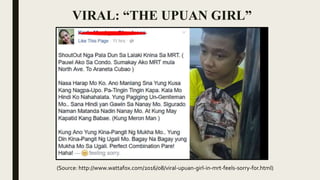
VIRAL: “THE UPUAN GIRL”
(Source: http://www.wattafox.com/2016/08/viral-upuan-girl-in-mrt-feels-sorry-for.html)
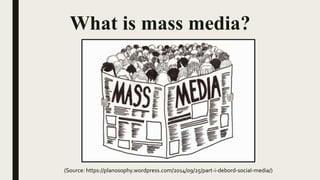
What is mass media?
(Source: https://planosophy.wordpress.com/2014/09/25/part-i-debord-social-media/)
Mass Media
refer to channels of communication
that involve transmitting
information in some way, shape or
form to large numbers of people
MASS MEDIAAND MEDIA EFFECTS
Media Effects
are the intended or unintended
consequences of what the mass
media does
(Denis McQuail, 2010)
MEDIA EFFECTS
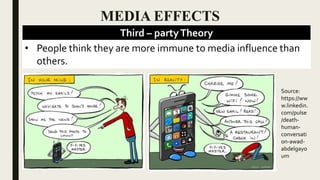
Third – partyTheory
• People think they are more immune to media influence than
others.
Source:
https://ww
w.linkedin.
com/pulse
/death-
human-
conversati
on-awad-
abdelgayo
um
MEDIA EFFECTS
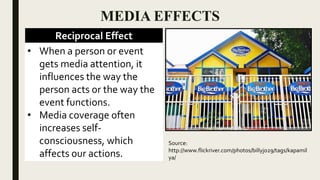
Reciprocal Effect
• When a person or event
gets media attention, it
influences the way the
person acts or the way the
event functions.
• Media coverage often
increases self-
consciousness, which
affects our actions.
Source:
http://www.flickriver.com/photos/billyjo29/tags/kapamil
ya/
MEDIA EFFECTS
Boomerang Effect
• refers to media-induced
change that is counter
to the desired change
(Source: http://uppiddee.com/blog/smiley-
faces-and-the-boomerang-effect/)
MEDIA EFFECT
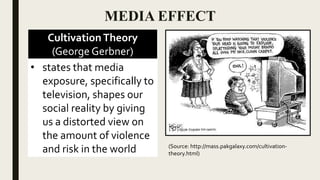
Cultivation Theory
(George Gerbner)
• states that media
exposure, specifically to
television, shapes our
social reality by giving
us a distorted view on
the amount of violence
and risk in the world (Source: http://mass.pakgalaxy.com/cultivation-
theory.html)
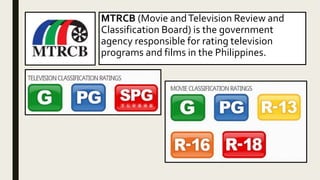
MTRCB (Movie andTelevision Review and
Classification Board) is the government
agency responsible for rating television
programs and films in the Philippines.
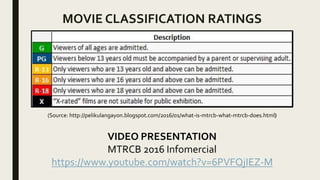
(Source: http://pelikulangayon.blogspot.com/2016/01/what-is-mtrcb-what-mtrcb-does.html)
MOVIE CLASSIFICATION RATINGS
VIDEO PRESENTATION
MTRCB 2016 Infomercial
https://www.youtube.com/watch?v=6PVFQjIEZ-M
MEDIA EFFECTS
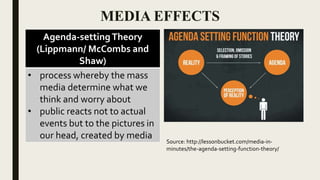
Agenda-settingTheory
(Lippmann/ McCombs and
Shaw)
• process whereby the mass
media determine what we
think and worry about
• public reacts not to actual
events but to the pictures in
our head, created by media
Source: http://lessonbucket.com/media-in-
minutes/the-agenda-setting-function-theory/
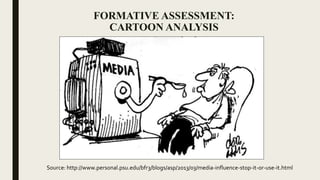
FORMATIVE ASSESSMENT:
CARTOON ANALYSIS
Source: http://www.personal.psu.edu/bfr3/blogs/asp/2013/03/media-influence-stop-it-or-use-it.html
MEDIA EFFECTS
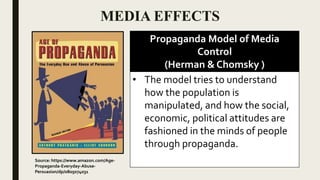
Propaganda Model of Media
Control
(Herman & Chomsky )
• The model tries to understand
how the population is
manipulated, and how the social,
economic, political attitudes are
fashioned in the minds of people
through propaganda.
Source: https://www.amazon.com/Age-
Propaganda-Everyday-Abuse-
Persuasion/dp/0805074031
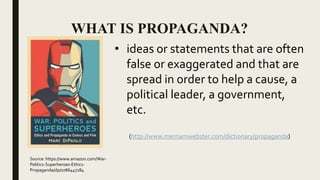
WHAT IS PROPAGANDA?
• ideas or statements that are often
false or exaggerated and that are
spread in order to help a cause, a
political leader, a government,
etc.
(http://www.merriamwebster.com/dictionary/propaganda)
Source: https://www.amazon.com/War-
Politics-Superheroes-Ethics-
Propaganda/dp/0786447184
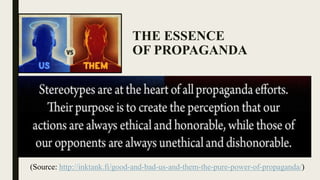
(Source: http://inktank.fi/good-and-bad-us-and-them-the-pure-power-of-propaganda/)
THE ESSENCE
OF PROPAGANDA
(Source: http://vote-revolt.com/2016/03/14/americas-mainstream-media-weapons-of-
mass-deception/)
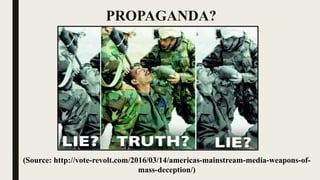
PROPAGANDA?
FORMATIVE ASSESSMENT:
RECITATION
Questions
1. How do you know when what is posted in
social media is a propaganda? How do you
react on it?
2. How can you protect yourself from being
influenced by propaganda messages in social
media?
VIDEO PRESENTATION
Media Effects (2010)
YouTube Channel: Public Sphere
Retrieved October 27, 2016 from
https://www.youtube.com/watch?v=qvgURfZMGoQ
Why is it important to understand how media
effects work?
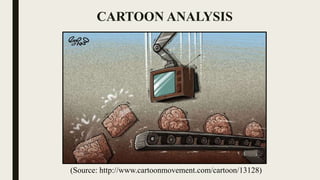
CARTOON ANALYSIS
(Source: http://www.cartoonmovement.com/cartoon/13128)
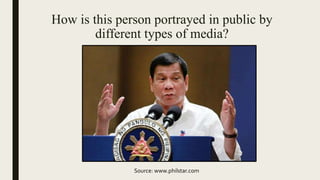
How is this person portrayed in public by
different types of media?
Source: www.philstar.com
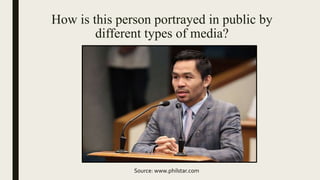
How is this person portrayed in public by
different types of media?
Source: www.philstar.com
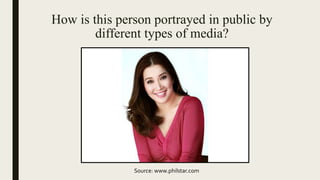
How is this person portrayed in public by
different types of media?
Source: www.philstar.com
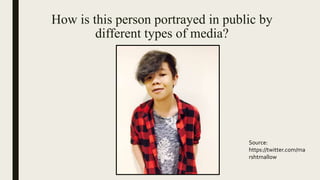
How is this person portrayed in public by
different types of media?
Source:
https://twitter.com/ma
rshtmallow
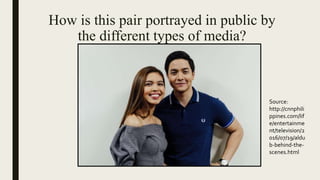
How is this pair portrayed in public by
different types of media?
Source:
http://cnnphili
ppines.com/lif
e/entertainme
nt/television/2
016/07/19/aldu
b-behind-the-
scenes.html
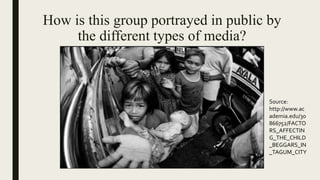
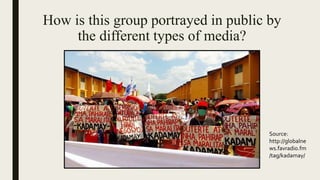
How is this group portrayed in public by
different types of media?
Source:
http://www.ac
ademia.edu/30
866752/FACTO
RS_AFFECTIN
G_THE_CHILD
_BEGGARS_IN
_TAGUM_CITY
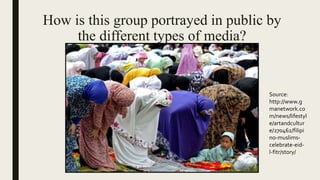
How is this group portrayed in public by
different types of media?
Source:
http://www.g
manetwork.co
m/news/lifestyl
e/artandcultur
e/270462/filipi
no-muslims-
celebrate-eid-
l-fitr/story/
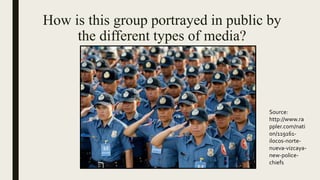
How is this group portrayed in public by
different types of media?
Source:
http://www.ra
ppler.com/nati
on/119161-
ilocos-norte-
nueva-vizcaya-
new-police-
chiefs
How is this group portrayed in public by
different types of media?
Source:
http://globalne
ws.favradio.fm
/tag/kadamay/
How is this person portrayed in public by
different types of media?
Source:
http://www.soccerallia
nce.ca/Default.aspx?ta
bid=523520
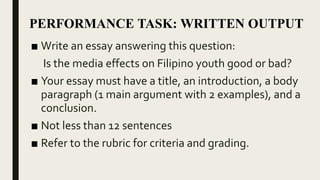
PERFORMANCE TASK: WRITTEN WORK
■ Write an essay about your analysis and evaluation of
the effects of media to the Filipino youth.
■ Your essay must have a title, an introduction, a body
paragraph (1 main argument with 2 examples), and a
conclusion.
■ Not less than 12 sentences
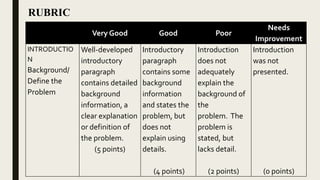
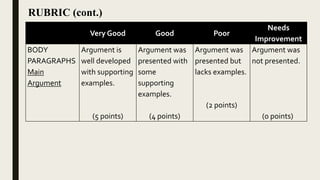
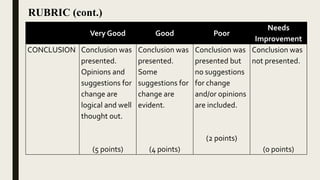
■ Refer to the rubric for criteria and grading.
PERFORMANCE TASK: WRITTEN OUTPUT
Very Good Good Poor
Needs
Improvement
INTRODUCTIO
N
Background/
Define the
Problem
Well-developed
introductory
paragraph
contains detailed
background
information, a
clear explanation
or definition of
the problem.
(5 points)
Introductory
paragraph
contains some
background
information
and states the
problem, but
does not
explain using
details.
(4 points)
Introduction
does not
adequately
explain the
background of
the
problem. The
problem is
stated, but
lacks detail.
(2 points)
Introduction
was not
presented.
(0 points)
RUBRIC
Very Good Good Poor
Needs
Improvement
BODY
PARAGRAPHS
Main
Argument
Argument is
well developed
with supporting
examples.
(5 points)
Argument was
presented with
some
supporting
examples.
(4 points)
Argument was
presented but
lacks examples.
(2 points)
Argument was
not presented.
(0 points)
RUBRIC (cont.)
Very Good Good Poor
Needs
Improvement
CONCLUSION Conclusion was
presented.
Opinions and
suggestions for
change are
logical and well
thought out.
(5 points)
Conclusion was
presented.
Some
suggestions for
change are
evident.
(4 points)
Conclusion was
presented but
no suggestions
for change
and/or opinions
are included.
(2 points)
Conclusion was
not presented.
(0 points)
RUBRIC (cont.)
REFERENCES
• MIL Curriculum Guide by DepEd
• Media and Information Literacy by Boots C.
Liquigan, Diwa Learning Systems Inc.
• http://2012books.lardbucket.org/books/a-primer-
on-communication-studies/s15-02-functions-and-
theories-of-mass.html
• http://www.sociology.org.uk/media_defined.pdf
REFERENCES
• http://zimmer.csufresno.edu/~johnca/spch100/7-4-
agenda.htm
• http://communicationtheory.org/propaganda-
model/
• http://www.mtrcb.gov.ph/

Media and Information Literacy (MIL) Types of Media (Part 2)- Mass Media and Media Effects

  • 1.
    MEDIAAND INFORMATION LITERACY (MIL) MassMedia Media Effects Mr. Arniel Ping St. Stephen’s High School Manila, Philippines MIL PPT 7, Revised: June 11, 2017 Types of Media (Part 2)
  • 2.
    LEARNING COMPETENCIES Learners willbe able to… ■ define mass media and media effects (SSHS); ■ discuss and evaluate the different theories on media effects (SSHS); ■ discuss in class how a particular individual or society is portrayed in public using different types of media (MIL11/12TYM-IIId-12). ■ analyze and evaluate the effects of new media to the youth (SSHS); and ■ editorialize the effects of new media to the Filipino youth (SSHS).
  • 3.
    TOPIC OUTLINE I- MassMedia A. Definition B. Media Effects C. Importance of Understanding the Effects of Media D. How Media Depicts People in Public E. PerformanceTask: WrittenWork 1. EssayWriting
  • 4.
    VIRAL: “THE UPUANGIRL” (Source: http://www.wattafox.com/2016/08/viral-upuan-girl-in-mrt-feels-sorry-for.html)
  • 5.
    What is massmedia? (Source: https://planosophy.wordpress.com/2014/09/25/part-i-debord-social-media/)
  • 6.
    Mass Media refer tochannels of communication that involve transmitting information in some way, shape or form to large numbers of people MASS MEDIAAND MEDIA EFFECTS Media Effects are the intended or unintended consequences of what the mass media does (Denis McQuail, 2010)
  • 7.
    MEDIA EFFECTS Third –partyTheory • People think they are more immune to media influence than others. Source: https://ww w.linkedin. com/pulse /death- human- conversati on-awad- abdelgayo um
  • 8.
    MEDIA EFFECTS Reciprocal Effect •When a person or event gets media attention, it influences the way the person acts or the way the event functions. • Media coverage often increases self- consciousness, which affects our actions. Source: http://www.flickriver.com/photos/billyjo29/tags/kapamil ya/
  • 9.
    MEDIA EFFECTS Boomerang Effect •refers to media-induced change that is counter to the desired change (Source: http://uppiddee.com/blog/smiley- faces-and-the-boomerang-effect/)
  • 10.
    MEDIA EFFECT Cultivation Theory (GeorgeGerbner) • states that media exposure, specifically to television, shapes our social reality by giving us a distorted view on the amount of violence and risk in the world (Source: http://mass.pakgalaxy.com/cultivation- theory.html)
  • 11.
    MTRCB (Movie andTelevisionReview and Classification Board) is the government agency responsible for rating television programs and films in the Philippines.
  • 12.
    (Source: http://pelikulangayon.blogspot.com/2016/01/what-is-mtrcb-what-mtrcb-does.html) MOVIE CLASSIFICATIONRATINGS VIDEO PRESENTATION MTRCB 2016 Infomercial https://www.youtube.com/watch?v=6PVFQjIEZ-M
  • 13.
    MEDIA EFFECTS Agenda-settingTheory (Lippmann/ McCombsand Shaw) • process whereby the mass media determine what we think and worry about • public reacts not to actual events but to the pictures in our head, created by media Source: http://lessonbucket.com/media-in- minutes/the-agenda-setting-function-theory/
  • 14.
    FORMATIVE ASSESSMENT: CARTOON ANALYSIS Source:http://www.personal.psu.edu/bfr3/blogs/asp/2013/03/media-influence-stop-it-or-use-it.html
  • 15.
    MEDIA EFFECTS Propaganda Modelof Media Control (Herman & Chomsky ) • The model tries to understand how the population is manipulated, and how the social, economic, political attitudes are fashioned in the minds of people through propaganda. Source: https://www.amazon.com/Age- Propaganda-Everyday-Abuse- Persuasion/dp/0805074031
  • 16.
    WHAT IS PROPAGANDA? •ideas or statements that are often false or exaggerated and that are spread in order to help a cause, a political leader, a government, etc. (http://www.merriamwebster.com/dictionary/propaganda) Source: https://www.amazon.com/War- Politics-Superheroes-Ethics- Propaganda/dp/0786447184
  • 17.
  • 18.
  • 19.
    FORMATIVE ASSESSMENT: RECITATION Questions 1. Howdo you know when what is posted in social media is a propaganda? How do you react on it? 2. How can you protect yourself from being influenced by propaganda messages in social media?
  • 20.
    VIDEO PRESENTATION Media Effects(2010) YouTube Channel: Public Sphere Retrieved October 27, 2016 from https://www.youtube.com/watch?v=qvgURfZMGoQ Why is it important to understand how media effects work?
  • 21.
  • 22.
    How is thisperson portrayed in public by different types of media? Source: www.philstar.com
  • 23.
    How is thisperson portrayed in public by different types of media? Source: www.philstar.com
  • 24.
    How is thisperson portrayed in public by different types of media? Source: www.philstar.com
  • 25.
    How is thisperson portrayed in public by different types of media? Source: https://twitter.com/ma rshtmallow
  • 26.
    How is thispair portrayed in public by different types of media? Source: http://cnnphili ppines.com/lif e/entertainme nt/television/2 016/07/19/aldu b-behind-the- scenes.html
  • 27.
    How is thisgroup portrayed in public by different types of media? Source: http://www.ac ademia.edu/30 866752/FACTO RS_AFFECTIN G_THE_CHILD _BEGGARS_IN _TAGUM_CITY
  • 28.
    How is thisgroup portrayed in public by different types of media? Source: http://www.g manetwork.co m/news/lifestyl e/artandcultur e/270462/filipi no-muslims- celebrate-eid- l-fitr/story/
  • 29.
    How is thisgroup portrayed in public by different types of media? Source: http://www.ra ppler.com/nati on/119161- ilocos-norte- nueva-vizcaya- new-police- chiefs
  • 30.
    How is thisgroup portrayed in public by different types of media? Source: http://globalne ws.favradio.fm /tag/kadamay/
  • 31.
    How is thisperson portrayed in public by different types of media? Source: http://www.soccerallia nce.ca/Default.aspx?ta bid=523520
  • 32.
  • 33.
    ■ Write anessay about your analysis and evaluation of the effects of media to the Filipino youth. ■ Your essay must have a title, an introduction, a body paragraph (1 main argument with 2 examples), and a conclusion. ■ Not less than 12 sentences ■ Refer to the rubric for criteria and grading. PERFORMANCE TASK: WRITTEN OUTPUT
  • 34.
    Very Good GoodPoor Needs Improvement INTRODUCTIO N Background/ Define the Problem Well-developed introductory paragraph contains detailed background information, a clear explanation or definition of the problem. (5 points) Introductory paragraph contains some background information and states the problem, but does not explain using details. (4 points) Introduction does not adequately explain the background of the problem. The problem is stated, but lacks detail. (2 points) Introduction was not presented. (0 points) RUBRIC
  • 35.
    Very Good GoodPoor Needs Improvement BODY PARAGRAPHS Main Argument Argument is well developed with supporting examples. (5 points) Argument was presented with some supporting examples. (4 points) Argument was presented but lacks examples. (2 points) Argument was not presented. (0 points) RUBRIC (cont.)
  • 36.
    Very Good GoodPoor Needs Improvement CONCLUSION Conclusion was presented. Opinions and suggestions for change are logical and well thought out. (5 points) Conclusion was presented. Some suggestions for change are evident. (4 points) Conclusion was presented but no suggestions for change and/or opinions are included. (2 points) Conclusion was not presented. (0 points) RUBRIC (cont.)
  • 37.
    REFERENCES • MIL CurriculumGuide by DepEd • Media and Information Literacy by Boots C. Liquigan, Diwa Learning Systems Inc. • http://2012books.lardbucket.org/books/a-primer- on-communication-studies/s15-02-functions-and- theories-of-mass.html • http://www.sociology.org.uk/media_defined.pdf
  • 38.

Editor's Notes

  • #5 Guide Questions Did you hear about the viral “upuan girl”? What is the story all about? Why do you think the woman posted this on Facebook? How did the netizen reacted on this post? Why? How did the man on the picture reacted to this post about him? Is it justifiable in the part of the girl to post this picture? Is it justifiable for the netizens to bash the woman who posted this picture? How was the two persons depicted in social media?
  • #6 What is mass media?
  • #7 What is mass media? What are examples of mass media? What is media effects? Are you affected by media? In what ways do you think you are affected by media? For example, we change our clothes and our plans because we watch the forecast on the Weather Channel, look up information about a band and sample their music after we see them perform on a television show, or stop eating melons after we hear about a salmonella outbreak. Other effects are more difficult to study and more difficult for people to accept because they are long term and/or more personal. For example, media may influence our personal sense of style, views on sex, perceptions of other races, or values just as our own free will, parents, or friends do.
  • #8 What is the message of the picture (in your mind, in reality)? Do you agree? Why or why not? Third-party Effect- If this were true, though, would advertisers and public relations professionals spend billions of dollars a year carefully crafting messages aimed at influencing viewers?
  • #9 Reciprocal Effect- It’s similar to the way that we change behavior when we know certain people are around and may be watching us.
  • #10 Why is the “upuan girl” an example of boomerang effect?
  • #11 Cultivation Theory-also states that viewers identify with certain values and identities that are presented as mainstream on television even though they do not actually share those values or identities in their real lives.
  • #12 Movie Classification “G” stands General Audience “PG” stands for Parental Guidance “SPG” stands for Strict Parental Guidance/ Striktong Patnubay at Gabay “R” stands for Restricted “X” stands for Not for Public Exhibition
  • #13 Movie Classification “G” stands General Audience “PG” stands for Parental Guidance “SPG” stands for Strict Parental Guidance/ Striktong Patnubay at Gabay “R” stands for Restricted “X” stands for Not for Public Exhibition
  • #14 Agenda-setting Theory- the process whereby the mass media determine what we think and worry about. Walter Lippmann, a journalist first observed this function, in the 1920’s. Lippmann then pointed out that the media dominates over the creation of pictures in our head, he believed that the public reacts not to actual events but to the pictures in our head. Therefore the agenda setting process is used to remodel all the events occurring in our environment, into a simpler model before we deal with it. Researchers Maxwell McCombs and Donald Shaw have then followed this concept.
  • #15 What is the message of this cartoon? What symbolisms are used in this picture? Do you agree with the message? Why or why not?
  • #16 The Propaganda model of media control was introduced by Edward. S. Herman and Noam Chomsky in their book ‘Manufacturing Consent – The Political Economy of the Mass Media’. This theory states how propaganda works in a mass media. The model tries to understand how the population is manipulated, and how the social, economic, political attitudes are fashioned in the minds of people through propaganda. Herman and Chomsky mostly concentrated on American population and media for their research but this theory is universally applicable.
  • #22 What is the message of this cartoon? What symbolisms are used in this pictues? Do you agree with the message? Why or why not?
  • #32 How do you think people will see you when they see your social media accounts, your pictures or videos , post, or comments on the internet?
  • #33 Optional: You may ask your students to upload their essays on a blog.
  • #34 Optional: You may ask your students to upload their essays on a blog.