Introduction to Information
and Communications
Technology (ICT)
Evolution of Technology
• Personal computing: In the 1970s, personal
computers were introduced, which enabled
individuals to have computing power at their
fingertips
• Internet and World Wide Web: The development of
the internet and the World Wide Web in the 1990s
revolutionized the way we communicate and share
information, making it easier than ever to access and
share data globally
• Mobile technology: The rise of mobile technology in
the 2000s, with the advent of smartphones and
tablets, gave individuals even greater access to
digital resources and communication tools
• Social media: Social media platforms emerged in the
late 2000s, providing new ways to connect and share
information with others
• Cloud computing: Cloud computing, which
allows individuals and organizations to access
computing resources over the internet, has
become increasingly popular in recent years,
providing greater flexibility and scalability for
digital operations
• Artificial intelligence: Advances in artificial
intelligence and machine learning have led to
the development of intelligent systems that can
learn from data, automate tasks, and make
predictions
Evolution of Technology
Central Processing Unit : The
CPU is the "brain" of the
computer, responsible for
performing most of the
calculations and processing
tasks
Random Access Memory :
RAM is a type of memory that
provides temporary storage for
data and program instructions
that are being used by the
CPU
Hard Disk Drive or Solid
State Drive : The hard disk or
solid-state drive is responsible
for storing data, programs, and
other files on the computer
Motherboard: The
motherboard is the main circuit
board that connects all the
other components of the
computer
Power Supply Unit : The
power supply unit provides
power to the computer's
components
Graphics Processing Unit :
The GPU is responsible for
rendering images and graphics
on the computer screen
Components of a Computer
Input devices: These include
devices such as the
keyboard, mouse, and
touchpad, which allow users
to input information into the
computer
Output devices: These
include devices such as the
monitor, printer, and
speakers, which allow users
to receive information from
the computer
Optical Drive: The optical
drive is responsible for
reading and writing data to
CDs, DVDs, and Blu-ray
discs
Cooling system: The cooling
system, which may include
fans and heat sinks, helps to
regulate the temperature of
the computer's components
and prevent overheating
Components of a Computer
Speed: Computers are capable
of processing vast amounts of
data and performing complex
calculations at incredible
speeds, making them much
faster and more efficient than
human beings
Storage: Modern computers are
capable of storing vast amounts
of data, ranging from terabytes
to petabytes, which allows for
the creation of complex
databases and the processing of
large data sets
Automation: Computers can
perform repetitive tasks and
automate processes, saving
time and reducing errors in
many industries
Connectivity: Computers can
connect with other computers
and devices around the world,
allowing for rapid sharing of
information and collaboration
Why Computers are Powerful?
Scalability: Computers are highly
scalable, meaning that they can be
easily upgraded or expanded with
additional hardware and software to
meet growing demands
Flexibility: Computers are highly
flexible, with the ability to run a wide
range of software applications and
perform different types of tasks
Why Computers are Powerful?
The Computer Age refers to the period from the 1940s to the
present day, during which electronic computers were developed and
became increasingly widespread
The Information Age refers to the period from the 1970s to the
present day, during which digital technologies became central to
the creation, processing, storage, and dissemination of information
The Digital Age refers to the period from the 1990s to the present
day, during which digital technologies have become increasingly
integrated into all aspects of society, including communication,
entertainment, business, and government
Convergence: Digital technologies have brought
about the convergence of different types of media,
such as text, audio, and video, and enabled new
forms of multimedia content
Distribution: Digital technologies have made it
easier and more efficient to distribute media
content across different platforms and devices,
from social media to streaming services
Interactivity: Digital technologies have enabled
greater interactivity between media producers and
consumers, allowing for user-generated content
and more personalized media experiences
Media in the Digital Age
Disintermediation: Digital technologies
have enabled the disintermediation of
traditional media gatekeepers, such as
publishers and broadcasters, by allowing
direct communication and engagement
between media producers and consumers
Data-driven content: Digital technologies
have enabled the collection and analysis
of vast amounts of data about media
consumption, allowing for more targeted
and personalized content
Media in the Digital Age
Mass media: The 20th century saw the
emergence of mass media, including
radio, television, and cinema, which
enabled the widespread dissemination of
news, entertainment, and advertising
Digital media: The development of digital
technologies in the late 20th century and
beyond has transformed media production,
distribution, and consumption, allowing for
new forms of multimedia content, online
communication and social media, and
personalized advertising and marketing
Artificial Intelligence : AI is rapidly
becoming an essential part of many
businesses, from chatbots and virtual
assistants to complex machine learning
algorithms that can analyze data and make
predictions
Evolution of Media
Cloud Computing: Cloud computing is the
delivery of computing services over the
internet, enabling businesses to access and
use scalable computing resources without
investing in on-premises infrastructure
Internet of Things : IoT refers to the network
of physical devices, vehicles, home
appliances, and other items embedded with
sensors, software, and connectivity, allowing
for the collection and exchange of data
Cybersecurity: With the increasing
threat of cyberattacks, businesses are
investing in cybersecurity solutions to
protect against data breaches, identity
theft, and other types of cybercrime
Overview of Current Trends
Edge Computing: Edge computing involves the
processing and analysis of data at or near the
source of data generation, rather than in a
centralized data center, enabling real-time
processing and response
5G Networks: The fifth generation of cellular
networks, or 5G, promises faster data transfer
speeds, greater capacity, and lower latency,
enabling new applications such as augmented
and virtual reality, and smart cities
Remote Work: With the rise of remote work and
hybrid work models, businesses are relying on
technologies such as video conferencing,
collaboration tools, and cloud-based services to
enable seamless communication and
collaboration
Overview of Current Trends
Individuals: ICT has changed the
way individuals access and use
information, communicate with
others, and manage their daily lives
Organizations: ICT has
transformed the way businesses
operate, enabling greater efficiency,
productivity, and innovation
Society: ICT has had a profound
impact on society, enabling greater
connectivity, democratization of
information, and social activism
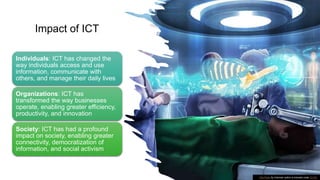
This Photo by Unknown author is licensed under CC BY.
Impact of ICT
Privacy: The collection, storage, and use of personal data in
the digital age raises important questions about privacy and
the right to control one's personal information
Security: With the increasing threat of cyberattacks,
businesses and individuals need to be vigilant about the
security of their data and systems
Intellectual Property: The digital age has raised new
questions about intellectual property, including copyright,
patents, and trademarks, and how to protect creative works
in the digital realm
Accessibility: The digital divide, which refers to the gap
between those who have access to technology and those
who do not, raises questions about social equity and the
need for universal access to technology
Ethical Issues in ICT
Transparency and
Accountability: The use of
algorithms and artificial
intelligence in decision-making
raises questions about
transparency and accountability,
and the need for ethical
standards and oversight
Cyberbullying and online
harassment: The digital age has
given rise to new forms of
bullying and harassment, which
can have a profound impact on
the well-being and mental health
of individuals
This Photo by Unknown author is licensed under CC BY.
Ethical Issues in ICT

module1.pptx

  • 1.
    Introduction to Information andCommunications Technology (ICT)
  • 2.
    Evolution of Technology •Personal computing: In the 1970s, personal computers were introduced, which enabled individuals to have computing power at their fingertips • Internet and World Wide Web: The development of the internet and the World Wide Web in the 1990s revolutionized the way we communicate and share information, making it easier than ever to access and share data globally • Mobile technology: The rise of mobile technology in the 2000s, with the advent of smartphones and tablets, gave individuals even greater access to digital resources and communication tools • Social media: Social media platforms emerged in the late 2000s, providing new ways to connect and share information with others
  • 3.
    • Cloud computing:Cloud computing, which allows individuals and organizations to access computing resources over the internet, has become increasingly popular in recent years, providing greater flexibility and scalability for digital operations • Artificial intelligence: Advances in artificial intelligence and machine learning have led to the development of intelligent systems that can learn from data, automate tasks, and make predictions Evolution of Technology
  • 4.
    Central Processing Unit: The CPU is the "brain" of the computer, responsible for performing most of the calculations and processing tasks Random Access Memory : RAM is a type of memory that provides temporary storage for data and program instructions that are being used by the CPU Hard Disk Drive or Solid State Drive : The hard disk or solid-state drive is responsible for storing data, programs, and other files on the computer Motherboard: The motherboard is the main circuit board that connects all the other components of the computer Power Supply Unit : The power supply unit provides power to the computer's components Graphics Processing Unit : The GPU is responsible for rendering images and graphics on the computer screen Components of a Computer
  • 5.
    Input devices: Theseinclude devices such as the keyboard, mouse, and touchpad, which allow users to input information into the computer Output devices: These include devices such as the monitor, printer, and speakers, which allow users to receive information from the computer Optical Drive: The optical drive is responsible for reading and writing data to CDs, DVDs, and Blu-ray discs Cooling system: The cooling system, which may include fans and heat sinks, helps to regulate the temperature of the computer's components and prevent overheating Components of a Computer
  • 6.
    Speed: Computers arecapable of processing vast amounts of data and performing complex calculations at incredible speeds, making them much faster and more efficient than human beings Storage: Modern computers are capable of storing vast amounts of data, ranging from terabytes to petabytes, which allows for the creation of complex databases and the processing of large data sets Automation: Computers can perform repetitive tasks and automate processes, saving time and reducing errors in many industries Connectivity: Computers can connect with other computers and devices around the world, allowing for rapid sharing of information and collaboration Why Computers are Powerful?
  • 7.
    Scalability: Computers arehighly scalable, meaning that they can be easily upgraded or expanded with additional hardware and software to meet growing demands Flexibility: Computers are highly flexible, with the ability to run a wide range of software applications and perform different types of tasks Why Computers are Powerful?
  • 8.
    The Computer Agerefers to the period from the 1940s to the present day, during which electronic computers were developed and became increasingly widespread The Information Age refers to the period from the 1970s to the present day, during which digital technologies became central to the creation, processing, storage, and dissemination of information The Digital Age refers to the period from the 1990s to the present day, during which digital technologies have become increasingly integrated into all aspects of society, including communication, entertainment, business, and government
  • 9.
    Convergence: Digital technologieshave brought about the convergence of different types of media, such as text, audio, and video, and enabled new forms of multimedia content Distribution: Digital technologies have made it easier and more efficient to distribute media content across different platforms and devices, from social media to streaming services Interactivity: Digital technologies have enabled greater interactivity between media producers and consumers, allowing for user-generated content and more personalized media experiences Media in the Digital Age
  • 10.
    Disintermediation: Digital technologies haveenabled the disintermediation of traditional media gatekeepers, such as publishers and broadcasters, by allowing direct communication and engagement between media producers and consumers Data-driven content: Digital technologies have enabled the collection and analysis of vast amounts of data about media consumption, allowing for more targeted and personalized content Media in the Digital Age
  • 11.
    Mass media: The20th century saw the emergence of mass media, including radio, television, and cinema, which enabled the widespread dissemination of news, entertainment, and advertising Digital media: The development of digital technologies in the late 20th century and beyond has transformed media production, distribution, and consumption, allowing for new forms of multimedia content, online communication and social media, and personalized advertising and marketing Artificial Intelligence : AI is rapidly becoming an essential part of many businesses, from chatbots and virtual assistants to complex machine learning algorithms that can analyze data and make predictions Evolution of Media
  • 12.
    Cloud Computing: Cloudcomputing is the delivery of computing services over the internet, enabling businesses to access and use scalable computing resources without investing in on-premises infrastructure Internet of Things : IoT refers to the network of physical devices, vehicles, home appliances, and other items embedded with sensors, software, and connectivity, allowing for the collection and exchange of data Cybersecurity: With the increasing threat of cyberattacks, businesses are investing in cybersecurity solutions to protect against data breaches, identity theft, and other types of cybercrime Overview of Current Trends
  • 13.
    Edge Computing: Edgecomputing involves the processing and analysis of data at or near the source of data generation, rather than in a centralized data center, enabling real-time processing and response 5G Networks: The fifth generation of cellular networks, or 5G, promises faster data transfer speeds, greater capacity, and lower latency, enabling new applications such as augmented and virtual reality, and smart cities Remote Work: With the rise of remote work and hybrid work models, businesses are relying on technologies such as video conferencing, collaboration tools, and cloud-based services to enable seamless communication and collaboration Overview of Current Trends
  • 14.
    Individuals: ICT haschanged the way individuals access and use information, communicate with others, and manage their daily lives Organizations: ICT has transformed the way businesses operate, enabling greater efficiency, productivity, and innovation Society: ICT has had a profound impact on society, enabling greater connectivity, democratization of information, and social activism This Photo by Unknown author is licensed under CC BY. Impact of ICT
  • 15.
    Privacy: The collection,storage, and use of personal data in the digital age raises important questions about privacy and the right to control one's personal information Security: With the increasing threat of cyberattacks, businesses and individuals need to be vigilant about the security of their data and systems Intellectual Property: The digital age has raised new questions about intellectual property, including copyright, patents, and trademarks, and how to protect creative works in the digital realm Accessibility: The digital divide, which refers to the gap between those who have access to technology and those who do not, raises questions about social equity and the need for universal access to technology Ethical Issues in ICT
  • 16.
    Transparency and Accountability: Theuse of algorithms and artificial intelligence in decision-making raises questions about transparency and accountability, and the need for ethical standards and oversight Cyberbullying and online harassment: The digital age has given rise to new forms of bullying and harassment, which can have a profound impact on the well-being and mental health of individuals This Photo by Unknown author is licensed under CC BY. Ethical Issues in ICT