Module: Understanding Brand
Anatomy
Module : Understanding Brand
Anatomy
• Concept of category and product
• Concept of Brand & Evolution of Brand
• Understanding Strong Brand & Brand
Equity
• Building Strong Brands:Brand Identity
,Brand Positioning & Image,
Brand Manager: The Idea
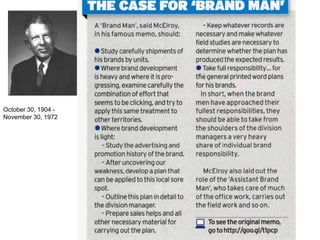
• 13 May, 1931,Neil McElroy wrote a memo to his
boss, RF Rogan
• His memo lasts for three pages, not one.
• In it (displaying the sexism of his times), he lays
out the case for 'Brand Man’
• His memo features a prescient phrase: Brand
Man should take 'a very heavy share of individual
brand responsibility’
• Soon, brand managers commanded a pivotal role
within companies such as McElroy's, Procter &
Gamble, as they restructured around their brands
and 'brand management'.
October 30, 1904 -
November 30, 1972
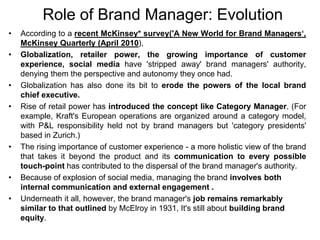
Role of Brand Manager: Evolution
• According to a recent McKinsey* survey('A New World for Brand Managers‘,
McKinsey Quarterly (April 2010),
• Globalization, retailer power, the growing importance of customer
experience, social media have 'stripped away' brand managers' authority,
denying them the perspective and autonomy they once had.
• Globalization has also done its bit to erode the powers of the local brand
chief executive.
• Rise of retail power has introduced the concept like Category Manager. (For
example, Kraft's European operations are organized around a category model,
with P&L responsibility held not by brand managers but 'category presidents'
based in Zurich.)
• The rising importance of customer experience - a more holistic view of the brand
that takes it beyond the product and its communication to every possible
touch-point has contributed to the dispersal of the brand manager's authority.
• Because of explosion of social media, managing the brand involves both
internal communication and external engagement .
• Underneath it all, however, the brand manager's job remains remarkably
similar to that outlined by McElroy in 1931, It's still about building brand
equity.
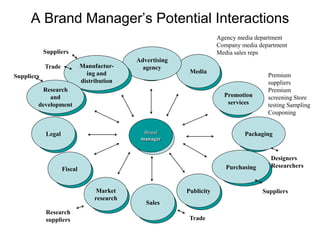
A Brand Manager’s Potential Interactions
Sales
Designers
Researchers
Premium
suppliers
Premium
screening Store
testing Sampling
Couponing
Media
Advertising
agency
Packaging
Promotion
services
Purchasing
Publicity
Legal
Fiscal
Market
research
Manufactur-
ing and
distribution
Research
and
development
Brand
manager
Suppliers
Trade
Suppliers
Trade
Research
suppliers
Suppliers
Agency media department
Company media department
Media sales reps
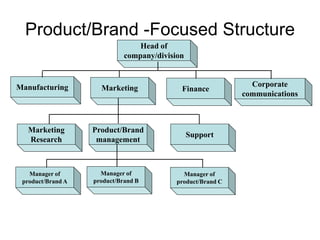
Product/Brand -Focused Structure
Head of
company/division
Corporate
communications
FinanceMarketingManufacturing
Manager of
product/Brand A
Manager of
product/Brand C
Manager of
product/Brand B
Marketing
Research
Support
Product/Brand
management
Defining the Competitive Set
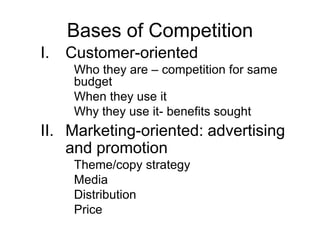
Bases of Competition
I. Customer-oriented
Who they are – competition for same
budget
When they use it
Why they use it- benefits sought
II. Marketing-oriented: advertising
and promotion
Theme/copy strategy
Media
Distribution
Price
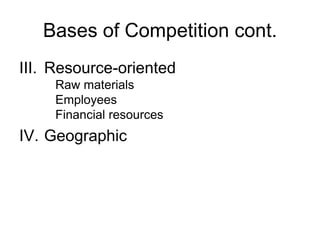
Bases of Competition cont.
III. Resource-oriented
Raw materials
Employees
Financial resources
IV. Geographic
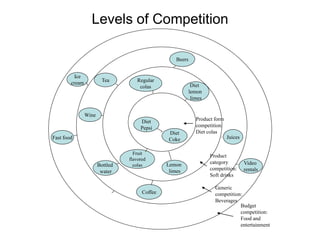
Levels of Competition
Diet
lemon
limes
Fruit
flavored
colas
Coffee
Diet
Coke
Diet
Pepsi
Bottled
water
Lemon
limes
Regular
colas
Beers
Juices
Wine
Fast food
Tea
Video
rentals
Ice
cream
Product form
competition:
Diet colas
Product
category
competition:
Soft drinks
Generic
competition:
Beverages
Budget
competition:
Food and
entertainment
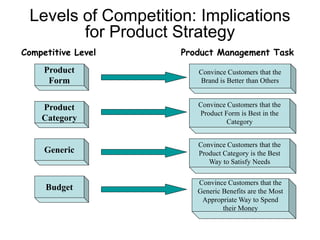
Levels of Competition: Implications
for Product Strategy
Budget
Generic
Product
Category
Product
Form
Competitive Level
Convince Customers that the
Brand is Better than Others
Convince Customers that the
Product Form is Best in the
Category
Convince Customers that the
Product Category is the Best
Way to Satisfy Needs
Convince Customers that the
Generic Benefits are the Most
Appropriate Way to Spend
their Money
Product Management Task
Category Attractiveness Analysis
Aggregate Category Factors
• Category size
• Category growth
• Sales cyclicity
• Seasonality
• Profits
• Stage in product life cycle
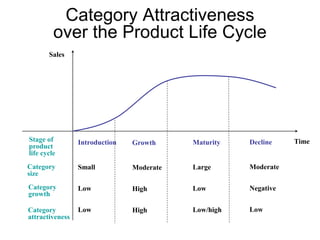
Category Attractiveness
over the Product Life Cycle
Stage of
product
life cycle
Category
size
Category
growth
Category
attractiveness
Introduction
Small
Low
Low
Growth
Moderate
High
High
Maturity
Large
Low
Low/high
Decline
Moderate
Negative
Low
Sales
Time
Customer Analysis: What We Need to Know
about Current and Potential Customers
• Who buys and uses the product
• What customers buy and how they use it
• Where customers buy
• When customers buy
• How customers choose
• Why they prefer a product
• How they respond to marketing programs
• Will they buy it (again)?
Basic Customer Strategies
1. Customer acquisition
2. Customer retention
3. Customer expansion
4. Customer deletion
From Product to Brand
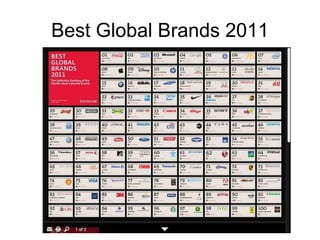
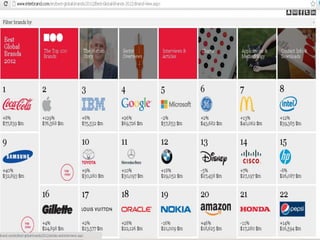
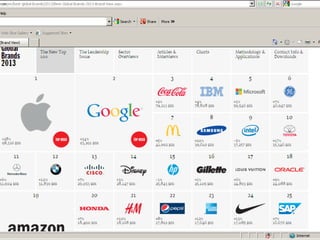
Best Global Brands 2011
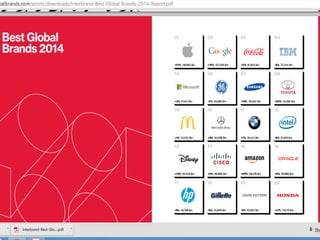
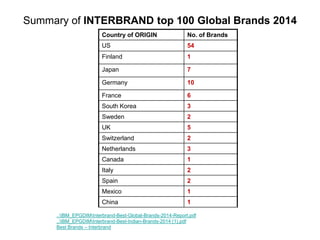
Summary of INTERBRAND top 100 Global Brands 2014
Country of ORIGIN No. of Brands
US 54
Finland 1
Japan 7
Germany 10
France 6
South Korea 3
Sweden 2
UK 5
Switzerland 2
Netherlands 3
Canada 1
Italy 2
Spain 2
Mexico 1
China 1
..IBM_EPGDIMInterbrand-Best-Global-Brands-2014-Report.pdf
..IBM_EPGDIMInterbrand-Best-Indian-Brands-2014 (1).pdf
Best Brands – Interbrand
What is a BRAND?
What is a brand?
A brand is a name, term, sign, symbol, or design,
or a combination of them,
intended to identity the goods or services
of one seller or group of sellers
and to differentiate them from those of competitors
- American Marketing Association
Anything more?
“A product is an object or service that’s available.
A brand is a complex set of satisfactions delivered.”
Jeremy Bullmore, WPP
“Branding is a natural, instinctive human creation. A
way of making a complicated world simpler. With a
brand, you get a symbol, a cue - you know what you’re
getting, you know what to expect.”
Niall Fitzgerald, Unilever
How others define a brand
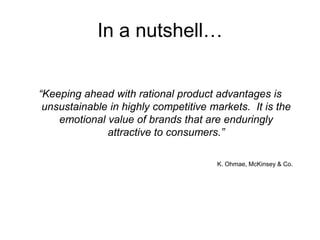
In a nutshell…
“Keeping ahead with rational product advantages is
unsustainable in highly competitive markets. It is the
emotional value of brands that are enduringly
attractive to consumers.”
K. Ohmae, McKinsey & Co.
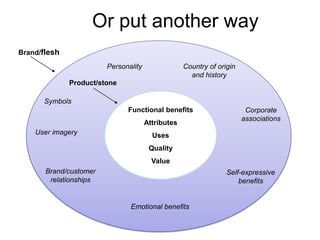
Or put another way
Personality
User imagery
Symbols
Brand/customer
relationships
Emotional benefits
Self-expressive
benefits
Corporate
associations
Country of origin
and history
Functional benefits
Attributes
Uses
Quality
Value
Brand/flesh
Product/stone
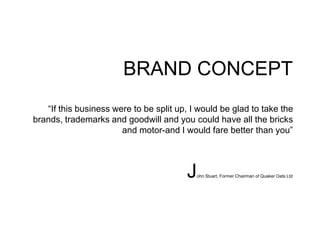
BRAND CONCEPT
“If this business were to be split up, I would be glad to take the
brands, trademarks and goodwill and you could have all the bricks
and motor-and I would fare better than you”
John Stuart, Former Chairman of Quaker Oats Ltd
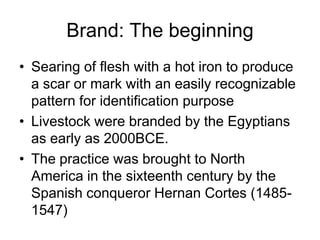
Brand: The beginning
• Searing of flesh with a hot iron to produce
a scar or mark with an easily recognizable
pattern for identification purpose
• Livestock were branded by the Egyptians
as early as 2000BCE.
• The practice was brought to North
America in the sixteenth century by the
Spanish conqueror Hernan Cortes (1485-
1547)
Brand: The evolution
• 1882: Harley Procter named his generically named
‘white soap’ as ‘Ivory Soap’: an idea that apparently
came to him while reading a psalm in church
• In December of that year, ‘Ivory’ got a slogan ‘’99
and 44/100% pure’
• 1888, in Janesville, Wisconsin, George Safford
Parker named each pen produced by his company
a ‘Parker Pen’
• In Europe, food industry provided the first brand
names such as Nestle, Cadbury, Kellogg
Brands can reduce risk in product decisions. There are
many different types of risks that consumers may
perceive in buying and consuming a product:
1. Functional Risk
2. Physical Risk
3. Financial Risk
4. Social Risk
5. Psychological Risk
6. Time Risk
SO,
For Consumers
• Functional:
– Identification of
Product Source
– Reduces search costs
• Experiential:
– Risk reducer
– Signal of Quality
• Symbolic:
– ‘fit’ with self image
– Representing a ‘group’
For Manufacturers
• Identification to simplify
handling or tracing
• Legal Protection
• Signal of Quality Level
• Competitive Advantage
• Financial Returns
Contracting with a Brand
• A Brand is a contract, carved in stone
and long (ever ?) lasting contrat
with the final consumer
with her own environment
• This is a two ways contract (return
contract ?)
Historical / Memory Future / Project
Brand Identity Plan
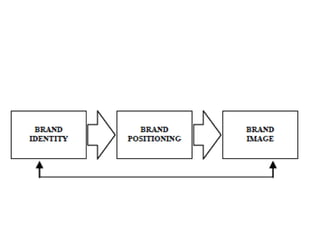
What is Brand Identity?
•Brand Identity is the unique set of brand
associations that the brand strategist aspires
to create or maintain.
•These associations represent what the
brand stands for and imply a promise to
customers for the organization members.
•Identity includes moral image, aim and
values that together constitute the essence
of individuality while differentiating the brand
(de Chernatony, 2002).
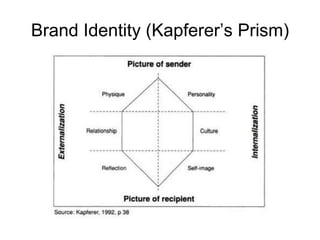
Brand Identity (Kapferer’s Prism)
Brand Identity
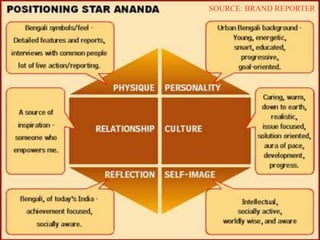
Characteristics of Physical
Representation:
• objective characteristics of the brand
• quick and easy visual recognition thanks to star
products
Characteristics of Personality:
• this is the brand’s main intrinsic parameter,
«what kind of person» it is
• no personality = weakness
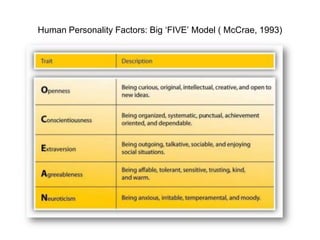
Human Personality Factors: Big ‘FIVE’ Model ( McCrae, 1993)
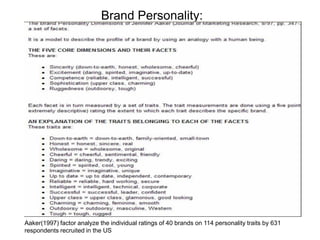
Brand Personality:
Aaker(1997) factor analyze the individual ratings of 40 brands on 114 personality traits by 631
respondents recruited in the US
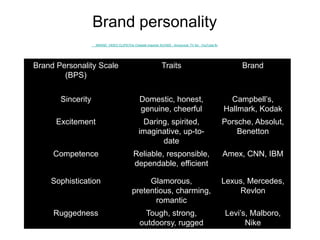
Brand personality
BRAND_VIDEO CLIPSThe Cheetah-inspired XUV500 - Announcer TV Ad - YouTube.flv
Brand Personality Scale
(BPS)
Traits Brand
Sincerity Domestic, honest,
genuine, cheerful
Campbell’s,
Hallmark, Kodak
Excitement Daring, spirited,
imaginative, up-to-
date
Porsche, Absolut,
Benetton
Competence Reliable, responsible,
dependable, efficient
Amex, CNN, IBM
Sophistication Glamorous,
pretentious, charming,
romantic
Lexus, Mercedes,
Revlon
Ruggedness Tough, strong,
outdoorsy, rugged
Levi’s, Malboro,
Nike
Creation of Brand Personality: A
Roadmap for the Marketer
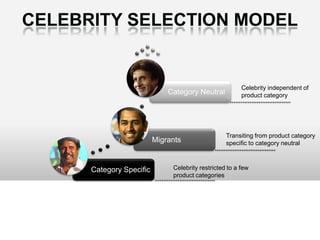
Celebrity Endorsement
Category Specific
Migrants
Category Neutral
Celebrity independent of
product category
Transiting from product category
specific to category neutral
Celebrity restricted to a few
product categories
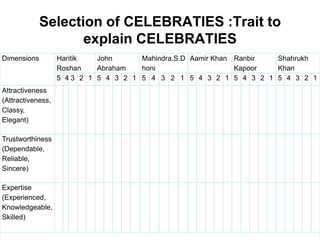
Selection of CELEBRATIES :Trait to
explain CELEBRATIES
Dimensions Haritik
Roshan
John
Abraham
Mahindra.S.D
honi
Aamir Khan Ranbir
Kapoor
Shahrukh
Khan
5 4 3 2 1 5 4 3 2 1 5 4 3 2 1 5 4 3 2 1 5 4 3 2 1 5 4 3 2 1
Attractiveness
(Attractiveness,
Classy,
Elegant)
Trustworthiness
(Dependable,
Reliable,
Sincere)
Expertise
(Experienced,
Knowledgeable,
Skilled)
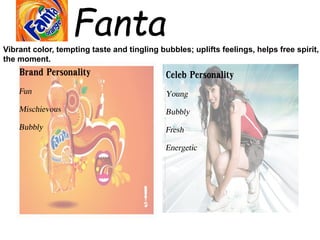
Fanta
Brand Personality
Fun
Mischievous
Bubbly
Celeb Personality
Young
Bubbly
Fresh
Energetic
Vibrant color, tempting taste and tingling bubbles; uplifts feelings, helps free spirit,
the moment.
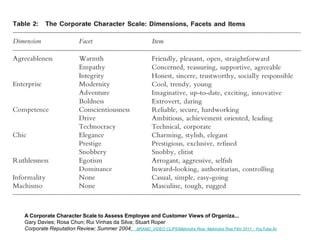
A Corporate Character Scale to Assess Employee and Customer Views of Organiza...
Gary Davies; Rosa Chun; Rui Vinhas da Silva; Stuart Roper
Corporate Reputation Review; Summer 2004; BRAND_VIDEO CLIPSMahindra Rise- Mahindra Rise Film 2011 - YouTube.flv
Brand Identity
Characteristics of Culture:
• a brand is a systemic values task force full of cultural
power and heritage
• a product’s legitimacy is embodied in the name of the
brand and the culture it represents
• (i.e. consumers behave a certain way thanks to
the brand; the brand has created/encouraged a new
form of behaviour/ «culture»)
Characteristics of Self-image:
• brand as an internal mirror of its consumer i.e what
the consumer think of himself.
Brand Identity
Characteristics of Reflection:
• value that is bought by the consumer
• this targets the consumers’ external image
• Identification Model: shows consumers what
they desire to be or own
Characteristics of Relationship:
• our consumption sustains a certain type of
relationship with the organisation?
SOURCE: BRAND REPORTER
Brand Identity
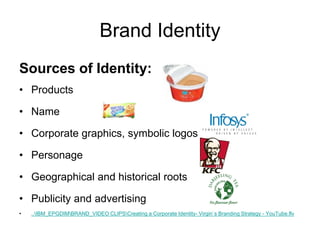
Sources of Identity:
• Products
• Name
• Corporate graphics, symbolic logos
• Personage
• Geographical and historical roots
• Publicity and advertising
• ..IBM_EPGDIMBRAND_VIDEO CLIPSCreating a Corporate Identity- Virgin`s Branding Strategy - YouTube.flv
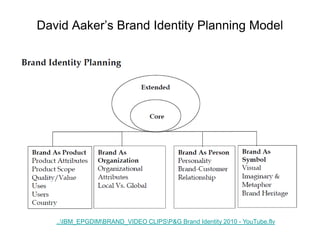
David Aaker’s Brand Identity Planning Model
..IBM_EPGDIMBRAND_VIDEO CLIPSP&G Brand Identity 2010 - YouTube.flv
Creating Identity for a Commodity
• ..IBM_EPGDIMBRAND_VIDEO CLIPSBranding a commodity- Renova Black Toilet Paper- -
introductory video - YouTube.flv
• ..IBM_EPGDIMBRAND_VIDEO CLIPS510-077-1.pdf
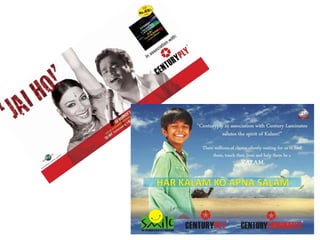
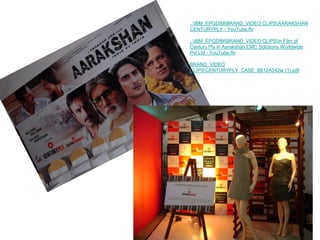
Case of CENTURYPLY
..IBM_EPGDIMBRAND_VIDEO CLIPSAARAKSHAN
CENTURYPLY - YouTube.flv
..IBM_EPGDIMBRAND_VIDEO CLIPSIn Film of
Century Ply in Aarakshan EMC Solutions Worldwide
Pvt Ltd - YouTube.flv
BRAND_VIDEO
CLIPSCENTURYPLY_CASE_8B12A042w (1).pdf
Case of CENTURYPLY
• Are CPIL’s branding initiatives strategically matched with the
branding practices of the plywood industry?
• Is there harmony between the brand identity created by CPIL and its
existing brand image in the market?
• Are CPIL’s branding initiatives rightfully integrated with other
marketing mixes of the company?
• Is the branding model sustainable enough considering the financial
condition of the company?
• Should CPIL now focus on the creation of a separate brand identity
for plywood, laminates and veneers in place of the current
Centuryply corporate branding as a whole? What are the possible
ways?
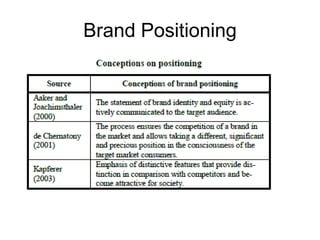
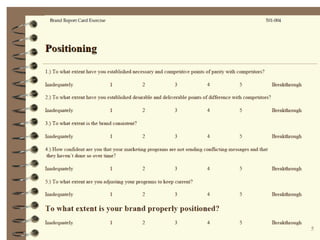
BRAND POSITIONING
Brand Positioning
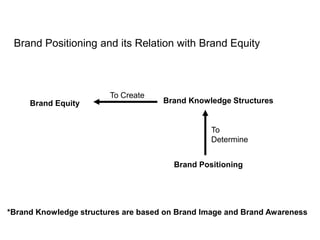
Brand Knowledge StructuresBrand Equity
To Create
Brand Positioning
To
Determine
Brand Positioning and its Relation with Brand Equity
*Brand Knowledge structures are based on Brand Image and Brand Awareness
Positioning Guidelines
• Get the key consumer Insight: Find the GAP
to occupy
• Main unique proposition/promise that the
brand is going to offer/fulfill
• Make it specific, short and tangible
• Keep the positioning up-to-date
Brand Positioning
• Define competitive frame of reference
– Target market
– Nature of competition
• Define desired brand knowledge
structures
– Points-of-parity
– Points-of-difference
POP & POD
• Points-of-Parity-Shared brand
values
–Necessary
–Competitive
Identifying & Choosing POD
• Desirable ( Customer Perspectives)
– Personality Relevant
– Distinctive & Superior
– Believable & Credible
• Deliverable ( Firm Perspectives)
– Feasible
– Profitable
– Pre-emptive, defensive & Difficult to attack
• Differentiating ( Competitive Perspectives)
– Unique
Positioning in B2B Market
• Product differentiation
– Feature, Conformance, Performance, Durability,
Reliability, Style, Design ad clipOzone Safe.jpg
• Service differentiation
– Delivery, Installation, Customer Training, Consulting
services, Repair, Replacement ..IBM_EPGDIMBRAND_VIDEO CLIPSHCL.jpg
• Personnel differentiation
– Empathy, Competency, Credibility, Reliability,
Responsiveness, Communication ..IBM_EPGDIMBRAND_VIDEO CLIPSFEDEX.jpg
• Image differentiation
– Symbol, People, Events, Media, Community
..IBM_EPGDIMBRAND_VIDEO CLIPSdell.jpg
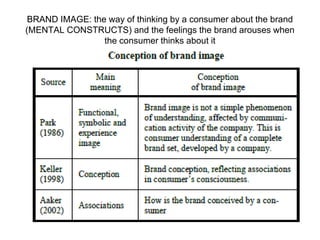
BRAND IMAGE: the way of thinking by a consumer about the brand
(MENTAL CONSTRUCTS) and the feelings the brand arouses when
the consumer thinks about it
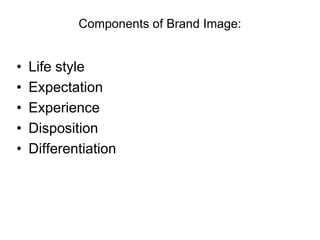
Components of Brand Image:
• Life style
• Expectation
• Experience
• Disposition
• Differentiation
Brainstorming: Brand Image
TIMES OF INDIA vs. HINDUSTAN TIMES
Indigo vs. Spicejet
GAP IDENTIFICATION: BRAND
IDENTITY-BRAND IMAGE
GAP IDENTIFICATION: BRAND
IDENTITY-BRAND IMAGE
• Identity: Image: S:E: JACKPOT
• Identity: Image: S:P: BLIND HORSE
• Identity: Image: W:E: DARK HORSE
• Identity: Image: W:P: LAME HORSE
MANAGING GAP: BRAND
IDENTITY-BRAND IMAGE
• Identity: Image: S:E: PORTFOLIO
EXPANSION
• Identity: Image: S:P: CREDIBILITY
BUILDING
• Identity: Image: W:E: RELATIONSHIP
BUILDING
• Identity: Image: W:P: ALTERATION
Your Brand’s Genetic Code: BRAND DNA
•Every great brand has substance. a brand’s
DNA is timeless. a brand’s blue print is a
unique set of values that originally
defined them. Great brands can
remain relevant through creativity.
•A brand’s DNA is not strictly about the
product, service, the past or even about
research -- its about tapping in to an
essence or story that defines who you are
to the people that matter most, your core
customers.
•What Do You Stand For? BRAND_VIDEO CLIPSHostage_WMP.wmv
•..IBM_EPGDIMBRAND_VIDEO CLIPSAudi Brand Film_vcd0.mpg
DNA consists of:
• Mission: What change does the brand want to bring in
people lives? what would the users be missing if the
brand did not exit?
• Standpoint: From where does the brand speak? History
and the parent values
• Values: What are the brand's core values? What is the
main philosophy?
• Territory: Where is the brand legitimate in achieving its
mission? In what categories?
• Style and Language: What elements of style and
language are typical for the brand?
• ..IBM_EPGDIMBRAND_VIDEO CLIPSford brand DNA.pdf
THANK YOU

83442349

  • 1.
  • 2.
    Module : UnderstandingBrand Anatomy • Concept of category and product • Concept of Brand & Evolution of Brand • Understanding Strong Brand & Brand Equity • Building Strong Brands:Brand Identity ,Brand Positioning & Image,
  • 3.
    Brand Manager: TheIdea • 13 May, 1931,Neil McElroy wrote a memo to his boss, RF Rogan • His memo lasts for three pages, not one. • In it (displaying the sexism of his times), he lays out the case for 'Brand Man’ • His memo features a prescient phrase: Brand Man should take 'a very heavy share of individual brand responsibility’ • Soon, brand managers commanded a pivotal role within companies such as McElroy's, Procter & Gamble, as they restructured around their brands and 'brand management'.
  • 4.
    October 30, 1904- November 30, 1972
  • 5.
    Role of BrandManager: Evolution • According to a recent McKinsey* survey('A New World for Brand Managers‘, McKinsey Quarterly (April 2010), • Globalization, retailer power, the growing importance of customer experience, social media have 'stripped away' brand managers' authority, denying them the perspective and autonomy they once had. • Globalization has also done its bit to erode the powers of the local brand chief executive. • Rise of retail power has introduced the concept like Category Manager. (For example, Kraft's European operations are organized around a category model, with P&L responsibility held not by brand managers but 'category presidents' based in Zurich.) • The rising importance of customer experience - a more holistic view of the brand that takes it beyond the product and its communication to every possible touch-point has contributed to the dispersal of the brand manager's authority. • Because of explosion of social media, managing the brand involves both internal communication and external engagement . • Underneath it all, however, the brand manager's job remains remarkably similar to that outlined by McElroy in 1931, It's still about building brand equity.
  • 6.
    A Brand Manager’sPotential Interactions Sales Designers Researchers Premium suppliers Premium screening Store testing Sampling Couponing Media Advertising agency Packaging Promotion services Purchasing Publicity Legal Fiscal Market research Manufactur- ing and distribution Research and development Brand manager Suppliers Trade Suppliers Trade Research suppliers Suppliers Agency media department Company media department Media sales reps
  • 7.
    Product/Brand -Focused Structure Headof company/division Corporate communications FinanceMarketingManufacturing Manager of product/Brand A Manager of product/Brand C Manager of product/Brand B Marketing Research Support Product/Brand management
  • 8.
  • 9.
    Bases of Competition I.Customer-oriented Who they are – competition for same budget When they use it Why they use it- benefits sought II. Marketing-oriented: advertising and promotion Theme/copy strategy Media Distribution Price
  • 10.
    Bases of Competitioncont. III. Resource-oriented Raw materials Employees Financial resources IV. Geographic
  • 11.
    Levels of Competition Diet lemon limes Fruit flavored colas Coffee Diet Coke Diet Pepsi Bottled water Lemon limes Regular colas Beers Juices Wine Fastfood Tea Video rentals Ice cream Product form competition: Diet colas Product category competition: Soft drinks Generic competition: Beverages Budget competition: Food and entertainment
  • 12.
    Levels of Competition:Implications for Product Strategy Budget Generic Product Category Product Form Competitive Level Convince Customers that the Brand is Better than Others Convince Customers that the Product Form is Best in the Category Convince Customers that the Product Category is the Best Way to Satisfy Needs Convince Customers that the Generic Benefits are the Most Appropriate Way to Spend their Money Product Management Task
  • 13.
  • 14.
    Aggregate Category Factors •Category size • Category growth • Sales cyclicity • Seasonality • Profits • Stage in product life cycle
  • 16.
    Category Attractiveness over theProduct Life Cycle Stage of product life cycle Category size Category growth Category attractiveness Introduction Small Low Low Growth Moderate High High Maturity Large Low Low/high Decline Moderate Negative Low Sales Time
  • 17.
    Customer Analysis: WhatWe Need to Know about Current and Potential Customers • Who buys and uses the product • What customers buy and how they use it • Where customers buy • When customers buy • How customers choose • Why they prefer a product • How they respond to marketing programs • Will they buy it (again)?
  • 18.
    Basic Customer Strategies 1.Customer acquisition 2. Customer retention 3. Customer expansion 4. Customer deletion
  • 19.
  • 20.
  • 24.
    Summary of INTERBRANDtop 100 Global Brands 2014 Country of ORIGIN No. of Brands US 54 Finland 1 Japan 7 Germany 10 France 6 South Korea 3 Sweden 2 UK 5 Switzerland 2 Netherlands 3 Canada 1 Italy 2 Spain 2 Mexico 1 China 1 ..IBM_EPGDIMInterbrand-Best-Global-Brands-2014-Report.pdf ..IBM_EPGDIMInterbrand-Best-Indian-Brands-2014 (1).pdf Best Brands – Interbrand
  • 25.
    What is aBRAND?
  • 26.
    What is abrand? A brand is a name, term, sign, symbol, or design, or a combination of them, intended to identity the goods or services of one seller or group of sellers and to differentiate them from those of competitors - American Marketing Association
  • 27.
  • 28.
    “A product isan object or service that’s available. A brand is a complex set of satisfactions delivered.” Jeremy Bullmore, WPP “Branding is a natural, instinctive human creation. A way of making a complicated world simpler. With a brand, you get a symbol, a cue - you know what you’re getting, you know what to expect.” Niall Fitzgerald, Unilever How others define a brand
  • 29.
    In a nutshell… “Keepingahead with rational product advantages is unsustainable in highly competitive markets. It is the emotional value of brands that are enduringly attractive to consumers.” K. Ohmae, McKinsey & Co.
  • 30.
    Or put anotherway Personality User imagery Symbols Brand/customer relationships Emotional benefits Self-expressive benefits Corporate associations Country of origin and history Functional benefits Attributes Uses Quality Value Brand/flesh Product/stone
  • 31.
    BRAND CONCEPT “If thisbusiness were to be split up, I would be glad to take the brands, trademarks and goodwill and you could have all the bricks and motor-and I would fare better than you” John Stuart, Former Chairman of Quaker Oats Ltd
  • 32.
    Brand: The beginning •Searing of flesh with a hot iron to produce a scar or mark with an easily recognizable pattern for identification purpose • Livestock were branded by the Egyptians as early as 2000BCE. • The practice was brought to North America in the sixteenth century by the Spanish conqueror Hernan Cortes (1485- 1547)
  • 33.
    Brand: The evolution •1882: Harley Procter named his generically named ‘white soap’ as ‘Ivory Soap’: an idea that apparently came to him while reading a psalm in church • In December of that year, ‘Ivory’ got a slogan ‘’99 and 44/100% pure’ • 1888, in Janesville, Wisconsin, George Safford Parker named each pen produced by his company a ‘Parker Pen’ • In Europe, food industry provided the first brand names such as Nestle, Cadbury, Kellogg
  • 34.
    Brands can reducerisk in product decisions. There are many different types of risks that consumers may perceive in buying and consuming a product: 1. Functional Risk 2. Physical Risk 3. Financial Risk 4. Social Risk 5. Psychological Risk 6. Time Risk SO,
  • 35.
    For Consumers • Functional: –Identification of Product Source – Reduces search costs • Experiential: – Risk reducer – Signal of Quality • Symbolic: – ‘fit’ with self image – Representing a ‘group’
  • 36.
    For Manufacturers • Identificationto simplify handling or tracing • Legal Protection • Signal of Quality Level • Competitive Advantage • Financial Returns
  • 37.
    Contracting with aBrand • A Brand is a contract, carved in stone and long (ever ?) lasting contrat with the final consumer with her own environment • This is a two ways contract (return contract ?) Historical / Memory Future / Project
  • 38.
  • 40.
    What is BrandIdentity? •Brand Identity is the unique set of brand associations that the brand strategist aspires to create or maintain. •These associations represent what the brand stands for and imply a promise to customers for the organization members. •Identity includes moral image, aim and values that together constitute the essence of individuality while differentiating the brand (de Chernatony, 2002).
  • 41.
  • 42.
    Brand Identity Characteristics ofPhysical Representation: • objective characteristics of the brand • quick and easy visual recognition thanks to star products Characteristics of Personality: • this is the brand’s main intrinsic parameter, «what kind of person» it is • no personality = weakness
  • 43.
    Human Personality Factors:Big ‘FIVE’ Model ( McCrae, 1993)
  • 44.
    Brand Personality: Aaker(1997) factoranalyze the individual ratings of 40 brands on 114 personality traits by 631 respondents recruited in the US
  • 45.
    Brand personality BRAND_VIDEO CLIPSTheCheetah-inspired XUV500 - Announcer TV Ad - YouTube.flv Brand Personality Scale (BPS) Traits Brand Sincerity Domestic, honest, genuine, cheerful Campbell’s, Hallmark, Kodak Excitement Daring, spirited, imaginative, up-to- date Porsche, Absolut, Benetton Competence Reliable, responsible, dependable, efficient Amex, CNN, IBM Sophistication Glamorous, pretentious, charming, romantic Lexus, Mercedes, Revlon Ruggedness Tough, strong, outdoorsy, rugged Levi’s, Malboro, Nike
  • 46.
    Creation of BrandPersonality: A Roadmap for the Marketer Celebrity Endorsement
  • 47.
    Category Specific Migrants Category Neutral Celebrityindependent of product category Transiting from product category specific to category neutral Celebrity restricted to a few product categories
  • 48.
    Selection of CELEBRATIES:Trait to explain CELEBRATIES Dimensions Haritik Roshan John Abraham Mahindra.S.D honi Aamir Khan Ranbir Kapoor Shahrukh Khan 5 4 3 2 1 5 4 3 2 1 5 4 3 2 1 5 4 3 2 1 5 4 3 2 1 5 4 3 2 1 Attractiveness (Attractiveness, Classy, Elegant) Trustworthiness (Dependable, Reliable, Sincere) Expertise (Experienced, Knowledgeable, Skilled)
  • 49.
    Fanta Brand Personality Fun Mischievous Bubbly Celeb Personality Young Bubbly Fresh Energetic Vibrantcolor, tempting taste and tingling bubbles; uplifts feelings, helps free spirit, the moment.
  • 50.
    A Corporate CharacterScale to Assess Employee and Customer Views of Organiza... Gary Davies; Rosa Chun; Rui Vinhas da Silva; Stuart Roper Corporate Reputation Review; Summer 2004; BRAND_VIDEO CLIPSMahindra Rise- Mahindra Rise Film 2011 - YouTube.flv
  • 51.
    Brand Identity Characteristics ofCulture: • a brand is a systemic values task force full of cultural power and heritage • a product’s legitimacy is embodied in the name of the brand and the culture it represents • (i.e. consumers behave a certain way thanks to the brand; the brand has created/encouraged a new form of behaviour/ «culture») Characteristics of Self-image: • brand as an internal mirror of its consumer i.e what the consumer think of himself.
  • 52.
    Brand Identity Characteristics ofReflection: • value that is bought by the consumer • this targets the consumers’ external image • Identification Model: shows consumers what they desire to be or own Characteristics of Relationship: • our consumption sustains a certain type of relationship with the organisation?
  • 53.
  • 54.
    Brand Identity Sources ofIdentity: • Products • Name • Corporate graphics, symbolic logos • Personage • Geographical and historical roots • Publicity and advertising • ..IBM_EPGDIMBRAND_VIDEO CLIPSCreating a Corporate Identity- Virgin`s Branding Strategy - YouTube.flv
  • 55.
    David Aaker’s BrandIdentity Planning Model ..IBM_EPGDIMBRAND_VIDEO CLIPSP&G Brand Identity 2010 - YouTube.flv
  • 56.
    Creating Identity fora Commodity • ..IBM_EPGDIMBRAND_VIDEO CLIPSBranding a commodity- Renova Black Toilet Paper- - introductory video - YouTube.flv • ..IBM_EPGDIMBRAND_VIDEO CLIPS510-077-1.pdf
  • 57.
  • 60.
    ..IBM_EPGDIMBRAND_VIDEO CLIPSAARAKSHAN CENTURYPLY -YouTube.flv ..IBM_EPGDIMBRAND_VIDEO CLIPSIn Film of Century Ply in Aarakshan EMC Solutions Worldwide Pvt Ltd - YouTube.flv BRAND_VIDEO CLIPSCENTURYPLY_CASE_8B12A042w (1).pdf
  • 61.
    Case of CENTURYPLY •Are CPIL’s branding initiatives strategically matched with the branding practices of the plywood industry? • Is there harmony between the brand identity created by CPIL and its existing brand image in the market? • Are CPIL’s branding initiatives rightfully integrated with other marketing mixes of the company? • Is the branding model sustainable enough considering the financial condition of the company? • Should CPIL now focus on the creation of a separate brand identity for plywood, laminates and veneers in place of the current Centuryply corporate branding as a whole? What are the possible ways?
  • 62.
  • 63.
  • 64.
    Brand Knowledge StructuresBrandEquity To Create Brand Positioning To Determine Brand Positioning and its Relation with Brand Equity *Brand Knowledge structures are based on Brand Image and Brand Awareness
  • 65.
    Positioning Guidelines • Getthe key consumer Insight: Find the GAP to occupy • Main unique proposition/promise that the brand is going to offer/fulfill • Make it specific, short and tangible • Keep the positioning up-to-date
  • 66.
    Brand Positioning • Definecompetitive frame of reference – Target market – Nature of competition • Define desired brand knowledge structures – Points-of-parity – Points-of-difference
  • 67.
    POP & POD •Points-of-Parity-Shared brand values –Necessary –Competitive
  • 68.
    Identifying & ChoosingPOD • Desirable ( Customer Perspectives) – Personality Relevant – Distinctive & Superior – Believable & Credible • Deliverable ( Firm Perspectives) – Feasible – Profitable – Pre-emptive, defensive & Difficult to attack • Differentiating ( Competitive Perspectives) – Unique
  • 69.
    Positioning in B2BMarket • Product differentiation – Feature, Conformance, Performance, Durability, Reliability, Style, Design ad clipOzone Safe.jpg • Service differentiation – Delivery, Installation, Customer Training, Consulting services, Repair, Replacement ..IBM_EPGDIMBRAND_VIDEO CLIPSHCL.jpg • Personnel differentiation – Empathy, Competency, Credibility, Reliability, Responsiveness, Communication ..IBM_EPGDIMBRAND_VIDEO CLIPSFEDEX.jpg • Image differentiation – Symbol, People, Events, Media, Community ..IBM_EPGDIMBRAND_VIDEO CLIPSdell.jpg
  • 71.
    BRAND IMAGE: theway of thinking by a consumer about the brand (MENTAL CONSTRUCTS) and the feelings the brand arouses when the consumer thinks about it
  • 72.
    Components of BrandImage: • Life style • Expectation • Experience • Disposition • Differentiation
  • 73.
    Brainstorming: Brand Image TIMESOF INDIA vs. HINDUSTAN TIMES Indigo vs. Spicejet
  • 74.
  • 75.
    GAP IDENTIFICATION: BRAND IDENTITY-BRANDIMAGE • Identity: Image: S:E: JACKPOT • Identity: Image: S:P: BLIND HORSE • Identity: Image: W:E: DARK HORSE • Identity: Image: W:P: LAME HORSE
  • 76.
    MANAGING GAP: BRAND IDENTITY-BRANDIMAGE • Identity: Image: S:E: PORTFOLIO EXPANSION • Identity: Image: S:P: CREDIBILITY BUILDING • Identity: Image: W:E: RELATIONSHIP BUILDING • Identity: Image: W:P: ALTERATION
  • 77.
    Your Brand’s GeneticCode: BRAND DNA •Every great brand has substance. a brand’s DNA is timeless. a brand’s blue print is a unique set of values that originally defined them. Great brands can remain relevant through creativity. •A brand’s DNA is not strictly about the product, service, the past or even about research -- its about tapping in to an essence or story that defines who you are to the people that matter most, your core customers. •What Do You Stand For? BRAND_VIDEO CLIPSHostage_WMP.wmv •..IBM_EPGDIMBRAND_VIDEO CLIPSAudi Brand Film_vcd0.mpg
  • 78.
    DNA consists of: •Mission: What change does the brand want to bring in people lives? what would the users be missing if the brand did not exit? • Standpoint: From where does the brand speak? History and the parent values • Values: What are the brand's core values? What is the main philosophy? • Territory: Where is the brand legitimate in achieving its mission? In what categories? • Style and Language: What elements of style and language are typical for the brand? • ..IBM_EPGDIMBRAND_VIDEO CLIPSford brand DNA.pdf
  • 79.