NEW PRODUCT
DEVELOPMENT PROCESS.
1
NEW PRODUCT.
 A product is anything that can be offered to a market to satisfy needs and
wants.
 A New product is any product which is perceived by the customer as
being new.
New product Categories…….
1:New to the world.
2:New to the product lines.
3:Additions to the existing product line.
4:Improvements & revisions of existing products.
5:Repositioning.
6:Cost reductions.
2
NEW PRODUCT DEVELOPMENT PROCESS
 New Product Development is the development of original products, product
improvements, product modifications, and new brands through the firm’s
own R & D efforts. This process consist of following steps.
1. Idea Generation.
2. Idea Screening.
3. Concept Development & Testing.
4. Marketing Strategy Development.
5. Business Analysis.
6. Product Development.
7. Market Testing.
8. Commercialization. 3
1.IDEA GENERATION .
 Idea generation is continuous, systematic search for new product
opportunities.
 Ideas form using creativity generating techniques and generated through
firm’s Internal Sources & external Sources.
4
2.IDEA SCREENING.
 Filtering the ideas to pick out good ones & dropping the poor ones.
 It involves a preliminary elimination process in which a large number of product
ideas are screened in terms of the organization’s objectives, policies, technical
feasibility, and financial viability.
 Total ideas are categories into three group. They are, promising ideas, marginal
ideas and rejected ideas.
 In screening ideas, the companies normally face 2 serious errors & they must
try to avoid these mistakes.
1. DROP ERROR 2. GO ERROR
5
3. CONCEPT DEVELOPMENT & TESTING.
 Here, the Product Idea is converted into product concept.
 Product Ideas means Possible product that company may offer to the market.
 A product concept is a detailed version of the idea stated in meaningful consumer terms
 When developing product concept following criteria should be consider.
Who will use the product.
What primary benefit should this product provide.
When will this product be consumed.
 Concept Testing means presenting the product concept to target consumers,
physically or symbolically, and getting their reactions.
6
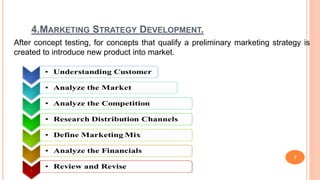
4.MARKETING STRATEGY DEVELOPMENT.
7
After concept testing, for concepts that qualify a preliminary marketing strategy is
created to introduce new product into market.
5.BUSINESS ANALYSIS.
 This stage will decide whether from financial as well as marketing point of view,
the project is beneficial or not.
In Business Analysis ,
 Estimate likely selling price based upon competition and customer feedback.
 Estimate sales volume based upon size of market.
 Estimate profitability and break-even point.
 If above are match with the company's objectives, then the new product concept
moves to product development stage.
8
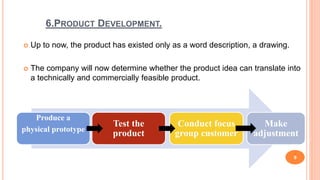
6.PRODUCT DEVELOPMENT.
 Up to now, the product has existed only as a word description, a drawing.
 The company will now determine whether the product idea can translate into
a technically and commercially feasible product.
9
Produce a
physical prototype
Test the
product
Conduct focus
group customer
Make
adjustment
7. MARKET TESTING.
 Now the product is ready to be branded with a name, logo, and packaging
and go into a preliminary market testing.
 Marketing Testing involves placing a product for sale in one or more selected
areas and observing its actual performance under the proposed marketing
plan.
 Methods for market testing:
1. Sales wave research.
2. Simulated test marketing.
3. Controlled testing marketing.
4. Test markets.
10
8.COMMERCIALIZATION.
 After successful market testing, new product comes to commercialisation stage.
 During this stage, production of new product on a commercial basis is rapidly
built up and implementing a total marketing plan.
 For formally launching a New Product, the following decisions to be taken:
A) When to launch (Timing)
B) Where to launch (Geographic Strategy)
C) To Whom (Target-Market Prospects)
D) How to launch (Introductory Market Strategy)
11
CONCLUSION.
 Every year millions of rupees are being spent on R&D for new products
development. Such huge investment is necessary as new products are the only
means of survival of a firm.
 Product development process include ; Idea Generation, Idea Screening,
Concept Development & Testing, Marketing Strategy Development, Business
Analysis, Product Development, Market Testing, Commercialization.
 New product development provides a number of advantages to the
enterprise.
 To produce goods & services with best quality.
 It helps in providing maximum customer satisfaction.
 To replace declining product and take advantage of new technology.
 To maintain/increase market share with competitive advantages.
 To fill gap in the market.
12
REFERENCES
www.innovationexcellence.com
www.awinwinsolutions.com
www.wordpress.com
www.wikipedia.org
13
THANK YOU
14

NEW PRODUCT DEVELOPMENT PROCESS.

  • 1.
  • 2.
    NEW PRODUCT.  Aproduct is anything that can be offered to a market to satisfy needs and wants.  A New product is any product which is perceived by the customer as being new. New product Categories……. 1:New to the world. 2:New to the product lines. 3:Additions to the existing product line. 4:Improvements & revisions of existing products. 5:Repositioning. 6:Cost reductions. 2
  • 3.
    NEW PRODUCT DEVELOPMENTPROCESS  New Product Development is the development of original products, product improvements, product modifications, and new brands through the firm’s own R & D efforts. This process consist of following steps. 1. Idea Generation. 2. Idea Screening. 3. Concept Development & Testing. 4. Marketing Strategy Development. 5. Business Analysis. 6. Product Development. 7. Market Testing. 8. Commercialization. 3
  • 4.
    1.IDEA GENERATION . Idea generation is continuous, systematic search for new product opportunities.  Ideas form using creativity generating techniques and generated through firm’s Internal Sources & external Sources. 4
  • 5.
    2.IDEA SCREENING.  Filteringthe ideas to pick out good ones & dropping the poor ones.  It involves a preliminary elimination process in which a large number of product ideas are screened in terms of the organization’s objectives, policies, technical feasibility, and financial viability.  Total ideas are categories into three group. They are, promising ideas, marginal ideas and rejected ideas.  In screening ideas, the companies normally face 2 serious errors & they must try to avoid these mistakes. 1. DROP ERROR 2. GO ERROR 5
  • 6.
    3. CONCEPT DEVELOPMENT& TESTING.  Here, the Product Idea is converted into product concept.  Product Ideas means Possible product that company may offer to the market.  A product concept is a detailed version of the idea stated in meaningful consumer terms  When developing product concept following criteria should be consider. Who will use the product. What primary benefit should this product provide. When will this product be consumed.  Concept Testing means presenting the product concept to target consumers, physically or symbolically, and getting their reactions. 6
  • 7.
    4.MARKETING STRATEGY DEVELOPMENT. 7 Afterconcept testing, for concepts that qualify a preliminary marketing strategy is created to introduce new product into market.
  • 8.
    5.BUSINESS ANALYSIS.  Thisstage will decide whether from financial as well as marketing point of view, the project is beneficial or not. In Business Analysis ,  Estimate likely selling price based upon competition and customer feedback.  Estimate sales volume based upon size of market.  Estimate profitability and break-even point.  If above are match with the company's objectives, then the new product concept moves to product development stage. 8
  • 9.
    6.PRODUCT DEVELOPMENT.  Upto now, the product has existed only as a word description, a drawing.  The company will now determine whether the product idea can translate into a technically and commercially feasible product. 9 Produce a physical prototype Test the product Conduct focus group customer Make adjustment
  • 10.
    7. MARKET TESTING. Now the product is ready to be branded with a name, logo, and packaging and go into a preliminary market testing.  Marketing Testing involves placing a product for sale in one or more selected areas and observing its actual performance under the proposed marketing plan.  Methods for market testing: 1. Sales wave research. 2. Simulated test marketing. 3. Controlled testing marketing. 4. Test markets. 10
  • 11.
    8.COMMERCIALIZATION.  After successfulmarket testing, new product comes to commercialisation stage.  During this stage, production of new product on a commercial basis is rapidly built up and implementing a total marketing plan.  For formally launching a New Product, the following decisions to be taken: A) When to launch (Timing) B) Where to launch (Geographic Strategy) C) To Whom (Target-Market Prospects) D) How to launch (Introductory Market Strategy) 11
  • 12.
    CONCLUSION.  Every yearmillions of rupees are being spent on R&D for new products development. Such huge investment is necessary as new products are the only means of survival of a firm.  Product development process include ; Idea Generation, Idea Screening, Concept Development & Testing, Marketing Strategy Development, Business Analysis, Product Development, Market Testing, Commercialization.  New product development provides a number of advantages to the enterprise.  To produce goods & services with best quality.  It helps in providing maximum customer satisfaction.  To replace declining product and take advantage of new technology.  To maintain/increase market share with competitive advantages.  To fill gap in the market. 12
  • 13.
  • 14.