Integrated Marketing
   Communication
       Branding
      Promotion
          &
      ReBranding
Business


   The business of Business is BUSINESS
Marketing

    ‘Marketing is the management
  process that identifies, anticipates
         and satisfies customer
        requirements profitably’
                  <*>
‘The right product, in the right place,
   at the right time, and at the right
                  price’
Implications of marketing
 Who are our existing / potential
  customers?
 What are their current / future needs?
 How can we satisfy these needs?
         Can we offer a product/ service that the customer
          would value?
         Can we communicate with our customers?
         Can we deliver a competitive product of service?
   Why should customers buy from us?
The Marketing Environment and
Competitor Analysis


 SWOT   analysis
 PEST analysis
 Five forces analysis
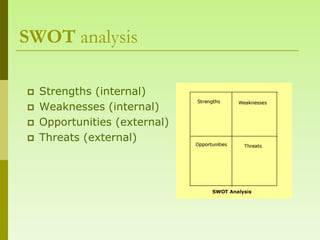
SWOT analysis

   Strengths (internal)
   Weaknesses (internal)
   Opportunities (external)
   Threats (external)
PEST analysis

 Political
          factors
 Economic factors
 Socio-cultural factors
 Technological factors
Sociocultural factors
 Demographics
 Distribution of income
 Social mobility
 Lifestyle changes
 Consumerism (HSE)
 Levels of education
 Others?
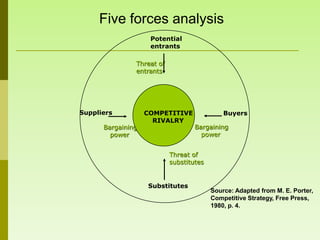
Five forces analysis
                    Potential
                    entrants

               Threat of
               entrants


Suppliers          COMPETITIVE               Buyers
                     RIVALRY
      Bargaining                   Bargaining
        power                        power


                           Threat of
                           substitutes


                   Substitutes
                                         Source: Adapted from M. E. Porter,
                                         Competitive Strategy, Free Press,
                                         1980, p. 4.
Five Forces Analysis: Key
      Questions and Implications
•   What are the key forces at work in the competitive environment?
•   Are there underlying forces driving competitive forces?
•   Will competitive forces change?
•   What are the strengths and weaknesses of competitors in relation to
    the competitive forces?
•   Can competitive strategy influence competitive forces (eg by building
    barriers to entry or reducing competitive rivalry)?
Integrating Marketing
Communication to Build Brand
Market Communication
   Marketing Communication: Inform Remind and
    Persuade Customers, directly or indirectly, about their
    brands [Wimbledon, DLF-IPL, Nike-Women]
   Marketing Communication contributes to brand:
       Creating Awareness [BSRM-Highway notifications, EBL]
       Linking strong favorable unique brand associating
        with memory [Meril beauty soap]
       Eliciting Positive Brand Judgment or feelings
        [AB Bank – Family Friend, Allianz-Security, Femicon]
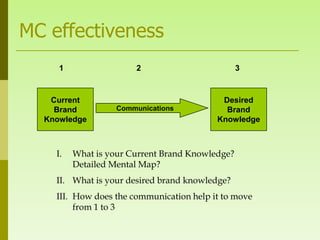
MC effectiveness
     1                 2                         3


   Current                                 Desired
    Brand          Communications           Brand
  Knowledge                               Knowledge


    I.   What is your Current Brand Knowledge?
         Detailed Mental Map?
    II. What is your desired brand knowledge?
    III. How does the communication help it to move
         from 1 to 3
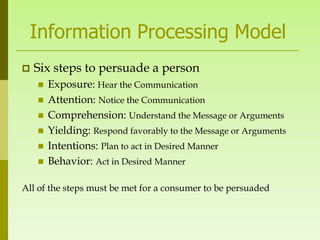
Information Processing Model
   Six steps to persuade a person
       Exposure: Hear the Communication
       Attention: Notice the Communication
       Comprehension: Understand the Message or Arguments
       Yielding: Respond favorably to the Message or Arguments
       Intentions: Plan to act in Desired Manner
       Behavior: Act in Desired Manner

All of the steps must be met for a consumer to be persuaded
Brand by
  sajid
   Brand
Brand Positioning and Values
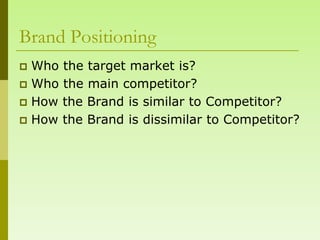
Brand Positioning
 Who   the   target market is?
 Who   the   main competitor?
 How   the   Brand is similar to Competitor?
 How   the   Brand is dissimilar to Competitor?
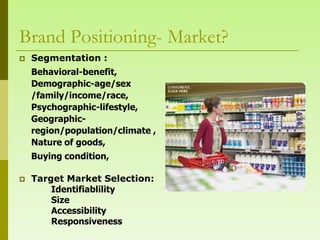
Brand Positioning- Market?
   Segmentation :
    Behavioral-benefit,
    Demographic-age/sex
    /family/income/race,
    Psychographic-lifestyle,
    Geographic-
    region/population/climate ,
    Nature of goods,
    Buying condition,

   Target Market Selection:
        Identifiablility
        Size
        Accessibility
        Responsiveness
Brand Positioning- Competition?
   Competitive Analysis:
      Resource
     (Blackberry vs. Apple) 2
      Capability
     (Technology vs. Labor, Intel
       vs. Walmart)
      Future possible Action
     (Buyout vs. Promotion, MS vs.
       Coke)
      Nature of Competition
       (Oligopoly vs. Mkt., Chevron
       vs. Sony)
Defining and Establishing Brand
Values


 Core Brand Values & Core Brand Proposition
 Brand Mantra
Core Brand Values
   Set of abstract concepts or phrases that
    characterize 5-10 most important dimensions of the
    mental map of a brand.
     Perceptual Mapping Coverage


   Perceptual Map  Core Brand Values  Brand
    Mantra
Brand Mantras
   A brand mantra is an articulation of the “heart
    and soul” of the brand.
       Brand mantras are short three to five word phrases
        that capture the irrefutable essence or spirit of the
        brand positioning and brand values.
   Nike
       Authentic Athletic Performance /Just do it
   Disney
       Fun Family Entertainment
Brand Mantras
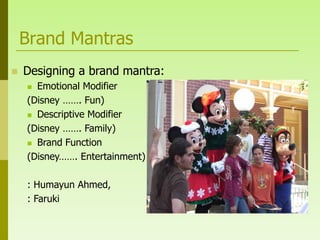
   Designing a brand mantra:
     Emotional Modifier
    (Disney ……. Fun)
     Descriptive Modifier

    (Disney ……. Family)
     Brand Function

    (Disney……. Entertainment)

    : Humayun Ahmed,
    : Faruki
Brand Mantras
   Communicate brand mantra:
       Communicate (setting boundaries …… De Beers)
       Simplify (crisp, lively, retainable…… Just do it !!!!)
       Inspire (patriotic, rebellious …… GP, Birla)
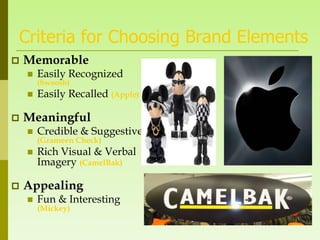
Criteria for Choosing Brand Elements
   Memorable
       Easily Recognized
        (Swoosh)
       Easily Recalled (Apple)

   Meaningful
       Credible & Suggestive
        (Grameen Check)
       Rich Visual & Verbal
        Imagery (CamelBak)

   Appealing
       Fun & Interesting
        (Mickey)
Criteria for Choosing Brand Elements
                 • Adaptable
                   – Flexible & Updateable
                     (Singapore Airlines)

                 • Protectable
                   – Legally (MS Vista)
                   – Competitively (Coke Formula)
                 • Transferrable
                   – Within & Across Product
                     Categories (Sony)
                   – Across Geographical
                     Boundaries & Cultures
                     (HSBC)
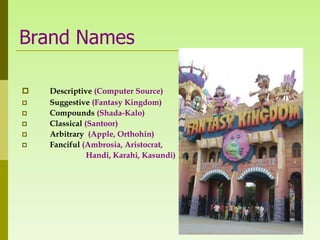
Brand Names

   Descriptive (Computer Source)
   Suggestive (Fantasy Kingdom)
   Compounds (Shada-Kalo)
   Classical (Santoor)
   Arbitrary (Apple, Orthohin)
   Fanciful (Ambrosia, Aristocrat,
               Handi, Karahi, Kasundi)
Brand Names
 Awareness
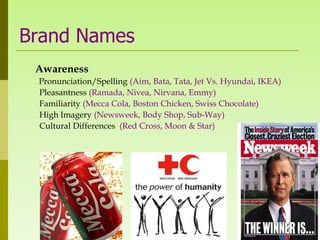
 Pronunciation/Spelling (Aim, Bata, Tata, Jet Vs. Hyundai, IKEA)
 Pleasantness (Ramada, Nivea, Nirvana, Emmy)
 Familiarity (Mecca Cola, Boston Chicken, Swiss Chocolate)
 High Imagery (Newsweek, Body Shop, Sub-Way)
 Cultural Differences (Red Cross, Moon & Star)
New Products and Brand Extensions
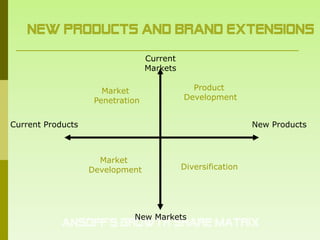
                                  Current
                                  Markets

                      Market                  Product
                    Penetration             Development


Current Products                                              New Products


                     Market
                   Development              Diversification


                             New Markets
            Ansoff’s Growth Share Matrix
New Product – Branding Decisions
When a Firm introduces a New Product, it has three
main choices as to how to Brand it

  A New Brand – individually chosen for the
   New Product
  An existing Brand Name applied in some
   way
  A combination of a New Brand with an
   Existing Brand
Brand Extensions
   An established brand name to introduce a new product
    [Ispahani Pure Snax]

   An existing brand that gives birth to a brand extension
    is referred to as the Parent Brand [Bata Apparels, Pocha Sandal]
   If a parent brand is associated with multiple products
    through brand extensions then it is called a Family
    Brand [Pran Juice, Milk, Chanachur, Mineral Water]
Types of Brand
    Extensions
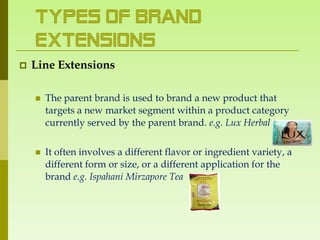
   Line Extensions

       The parent brand is used to brand a new product that
        targets a new market segment within a product category
        currently served by the parent brand. e.g. Lux Herbal


       It often involves a different flavor or ingredient variety, a
        different form or size, or a different application for the
        brand e.g. Ispahani Mirzapore Tea
Types of Brand
Extensions
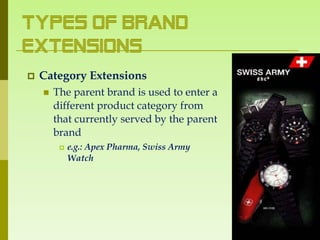
   Category Extensions
       The parent brand is used to enter a
        different product category from
        that currently served by the parent
        brand
            e.g.: Apex Pharma, Swiss Army
             Watch
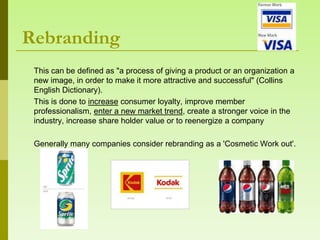
Rebranding
 This can be defined as "a process of giving a product or an organization a
 new image, in order to make it more attractive and successful" (Collins
 English Dictionary).
 This is done to increase consumer loyalty, improve member
 professionalism, enter a new market trend, create a stronger voice in the
 industry, increase share holder value or to reenergize a company

 Generally many companies consider rebranding as a 'Cosmetic Work out'.
Rebranding
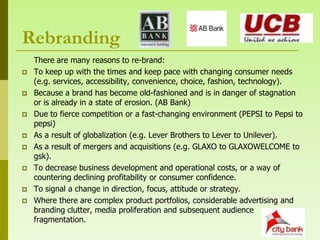
    There are many reasons to re-brand:
   To keep up with the times and keep pace with changing consumer needs
    (e.g. services, accessibility, convenience, choice, fashion, technology).
   Because a brand has become old-fashioned and is in danger of stagnation
    or is already in a state of erosion. (AB Bank)
   Due to fierce competition or a fast-changing environment (PEPSI to Pepsi to
    pepsi)
   As a result of globalization (e.g. Lever Brothers to Lever to Unilever).
   As a result of mergers and acquisitions (e.g. GLAXO to GLAXOWELCOME to
    gsk).
   To decrease business development and operational costs, or a way of
    countering declining profitability or consumer confidence.
   To signal a change in direction, focus, attitude or strategy.
   Where there are complex product portfolios, considerable advertising and
    branding clutter, media proliferation and subsequent audience
    fragmentation.
Sajid

product branding.

  • 1.
    Integrated Marketing Communication Branding Promotion & ReBranding
  • 2.
    Business The business of Business is BUSINESS
  • 3.
    Marketing ‘Marketing is the management process that identifies, anticipates and satisfies customer requirements profitably’ <*> ‘The right product, in the right place, at the right time, and at the right price’
  • 4.
    Implications of marketing Who are our existing / potential customers?  What are their current / future needs?  How can we satisfy these needs?  Can we offer a product/ service that the customer would value?  Can we communicate with our customers?  Can we deliver a competitive product of service?  Why should customers buy from us?
  • 5.
    The Marketing Environmentand Competitor Analysis SWOT analysis PEST analysis Five forces analysis
  • 6.
    SWOT analysis  Strengths (internal)  Weaknesses (internal)  Opportunities (external)  Threats (external)
  • 7.
    PEST analysis Political factors Economic factors Socio-cultural factors Technological factors
  • 8.
    Sociocultural factors  Demographics Distribution of income  Social mobility  Lifestyle changes  Consumerism (HSE)  Levels of education  Others?
  • 9.
    Five forces analysis Potential entrants Threat of entrants Suppliers COMPETITIVE Buyers RIVALRY Bargaining Bargaining power power Threat of substitutes Substitutes Source: Adapted from M. E. Porter, Competitive Strategy, Free Press, 1980, p. 4.
  • 10.
    Five Forces Analysis:Key Questions and Implications • What are the key forces at work in the competitive environment? • Are there underlying forces driving competitive forces? • Will competitive forces change? • What are the strengths and weaknesses of competitors in relation to the competitive forces? • Can competitive strategy influence competitive forces (eg by building barriers to entry or reducing competitive rivalry)?
  • 11.
  • 12.
    Market Communication  Marketing Communication: Inform Remind and Persuade Customers, directly or indirectly, about their brands [Wimbledon, DLF-IPL, Nike-Women]  Marketing Communication contributes to brand:  Creating Awareness [BSRM-Highway notifications, EBL]  Linking strong favorable unique brand associating with memory [Meril beauty soap]  Eliciting Positive Brand Judgment or feelings [AB Bank – Family Friend, Allianz-Security, Femicon]
  • 13.
    MC effectiveness 1 2 3 Current Desired Brand Communications Brand Knowledge Knowledge I. What is your Current Brand Knowledge? Detailed Mental Map? II. What is your desired brand knowledge? III. How does the communication help it to move from 1 to 3
  • 14.
    Information Processing Model  Six steps to persuade a person  Exposure: Hear the Communication  Attention: Notice the Communication  Comprehension: Understand the Message or Arguments  Yielding: Respond favorably to the Message or Arguments  Intentions: Plan to act in Desired Manner  Behavior: Act in Desired Manner All of the steps must be met for a consumer to be persuaded
  • 15.
    Brand by sajid Brand
  • 16.
  • 17.
    Brand Positioning  Who the target market is?  Who the main competitor?  How the Brand is similar to Competitor?  How the Brand is dissimilar to Competitor?
  • 18.
    Brand Positioning- Market?  Segmentation : Behavioral-benefit, Demographic-age/sex /family/income/race, Psychographic-lifestyle, Geographic- region/population/climate , Nature of goods, Buying condition,  Target Market Selection: Identifiablility Size Accessibility Responsiveness
  • 19.
    Brand Positioning- Competition?  Competitive Analysis:  Resource (Blackberry vs. Apple) 2  Capability (Technology vs. Labor, Intel vs. Walmart)  Future possible Action (Buyout vs. Promotion, MS vs. Coke)  Nature of Competition (Oligopoly vs. Mkt., Chevron vs. Sony)
  • 20.
    Defining and EstablishingBrand Values  Core Brand Values & Core Brand Proposition  Brand Mantra
  • 21.
    Core Brand Values  Set of abstract concepts or phrases that characterize 5-10 most important dimensions of the mental map of a brand. Perceptual Mapping Coverage  Perceptual Map  Core Brand Values  Brand Mantra
  • 22.
    Brand Mantras  A brand mantra is an articulation of the “heart and soul” of the brand.  Brand mantras are short three to five word phrases that capture the irrefutable essence or spirit of the brand positioning and brand values.  Nike  Authentic Athletic Performance /Just do it  Disney  Fun Family Entertainment
  • 23.
    Brand Mantras  Designing a brand mantra:  Emotional Modifier (Disney ……. Fun)  Descriptive Modifier (Disney ……. Family)  Brand Function (Disney……. Entertainment) : Humayun Ahmed, : Faruki
  • 24.
    Brand Mantras  Communicate brand mantra:  Communicate (setting boundaries …… De Beers)  Simplify (crisp, lively, retainable…… Just do it !!!!)  Inspire (patriotic, rebellious …… GP, Birla)
  • 25.
    Criteria for ChoosingBrand Elements  Memorable  Easily Recognized (Swoosh)  Easily Recalled (Apple)  Meaningful  Credible & Suggestive (Grameen Check)  Rich Visual & Verbal Imagery (CamelBak)  Appealing  Fun & Interesting (Mickey)
  • 26.
    Criteria for ChoosingBrand Elements • Adaptable – Flexible & Updateable (Singapore Airlines) • Protectable – Legally (MS Vista) – Competitively (Coke Formula) • Transferrable – Within & Across Product Categories (Sony) – Across Geographical Boundaries & Cultures (HSBC)
  • 27.
    Brand Names  Descriptive (Computer Source)  Suggestive (Fantasy Kingdom)  Compounds (Shada-Kalo)  Classical (Santoor)  Arbitrary (Apple, Orthohin)  Fanciful (Ambrosia, Aristocrat, Handi, Karahi, Kasundi)
  • 28.
    Brand Names Awareness Pronunciation/Spelling (Aim, Bata, Tata, Jet Vs. Hyundai, IKEA) Pleasantness (Ramada, Nivea, Nirvana, Emmy) Familiarity (Mecca Cola, Boston Chicken, Swiss Chocolate) High Imagery (Newsweek, Body Shop, Sub-Way) Cultural Differences (Red Cross, Moon & Star)
  • 29.
    New Products andBrand Extensions Current Markets Market Product Penetration Development Current Products New Products Market Development Diversification New Markets Ansoff’s Growth Share Matrix
  • 30.
    New Product –Branding Decisions When a Firm introduces a New Product, it has three main choices as to how to Brand it  A New Brand – individually chosen for the New Product  An existing Brand Name applied in some way  A combination of a New Brand with an Existing Brand
  • 31.
    Brand Extensions  An established brand name to introduce a new product [Ispahani Pure Snax]  An existing brand that gives birth to a brand extension is referred to as the Parent Brand [Bata Apparels, Pocha Sandal]  If a parent brand is associated with multiple products through brand extensions then it is called a Family Brand [Pran Juice, Milk, Chanachur, Mineral Water]
  • 32.
    Types of Brand Extensions  Line Extensions  The parent brand is used to brand a new product that targets a new market segment within a product category currently served by the parent brand. e.g. Lux Herbal  It often involves a different flavor or ingredient variety, a different form or size, or a different application for the brand e.g. Ispahani Mirzapore Tea
  • 33.
    Types of Brand Extensions  Category Extensions  The parent brand is used to enter a different product category from that currently served by the parent brand  e.g.: Apex Pharma, Swiss Army Watch
  • 34.
    Rebranding This canbe defined as "a process of giving a product or an organization a new image, in order to make it more attractive and successful" (Collins English Dictionary). This is done to increase consumer loyalty, improve member professionalism, enter a new market trend, create a stronger voice in the industry, increase share holder value or to reenergize a company Generally many companies consider rebranding as a 'Cosmetic Work out'.
  • 35.
    Rebranding There are many reasons to re-brand:  To keep up with the times and keep pace with changing consumer needs (e.g. services, accessibility, convenience, choice, fashion, technology).  Because a brand has become old-fashioned and is in danger of stagnation or is already in a state of erosion. (AB Bank)  Due to fierce competition or a fast-changing environment (PEPSI to Pepsi to pepsi)  As a result of globalization (e.g. Lever Brothers to Lever to Unilever).  As a result of mergers and acquisitions (e.g. GLAXO to GLAXOWELCOME to gsk).  To decrease business development and operational costs, or a way of countering declining profitability or consumer confidence.  To signal a change in direction, focus, attitude or strategy.  Where there are complex product portfolios, considerable advertising and branding clutter, media proliferation and subsequent audience fragmentation.
  • 36.