NEW PRODUCT AND NEW
PRODUCT DEVELOPMENT
PROCESS
What is a new product ?
• A product that opens an entirely new
market
• A product that adopts or replaces an
existing product
• A product that significantly broadens
the market for an existing product
• An old product introduced in a new
market
• An old product packaged in a different
way
• An old product marketed in a
different way
Types of new product
• Innovative products
• New product lines – to allow the firm
to enter an existing market
• Addition to product line – to
supplement the firm’s existing product
line
• Improvements and revisions of
existing product
• Repositioned products – existing
products targets at new market
• Cost reduction new product that
provide similar performance at lower
cost
Examples of new products
• New to the world – high definition
TV, ipod, flat screen TV, Probiotic
Ice Cream
• Product improvement &
replacement :SPEED by BPCL
• Cost reduction new product: Moser
Baer.
New product can be used to
• Increase/defend market share by
offering more choice or updating older
products
• Appeal to new segments
• Diversify into new markets
• Improve relationship with distributors
• Maintain the firm’s reputation a leading
edge company
• Even out peaks and troughs in demand
• Make better use of the organization's
resources
Why develop New Product ?
• To create stars and cash cows for
the future
• To replace declining product
• To take advantage of new
technology
• To defeat rivals
• To maintain/increase market share
• To keep up with rivals
• To maintain competitive advantage
• To fill gap in the market
New product planning
• This is the strategic stage
• The firm assesses
• It current product
portfolio
• Opportunities and threats
• The firm then determines the
type of product which would
best fit in with the corporate
strategy
New product development
• New product development is
a process which is designed
to develop, test and consider
the viability of products
which are new to the market
in order to ensure the
Growth or survival of the
organisation.
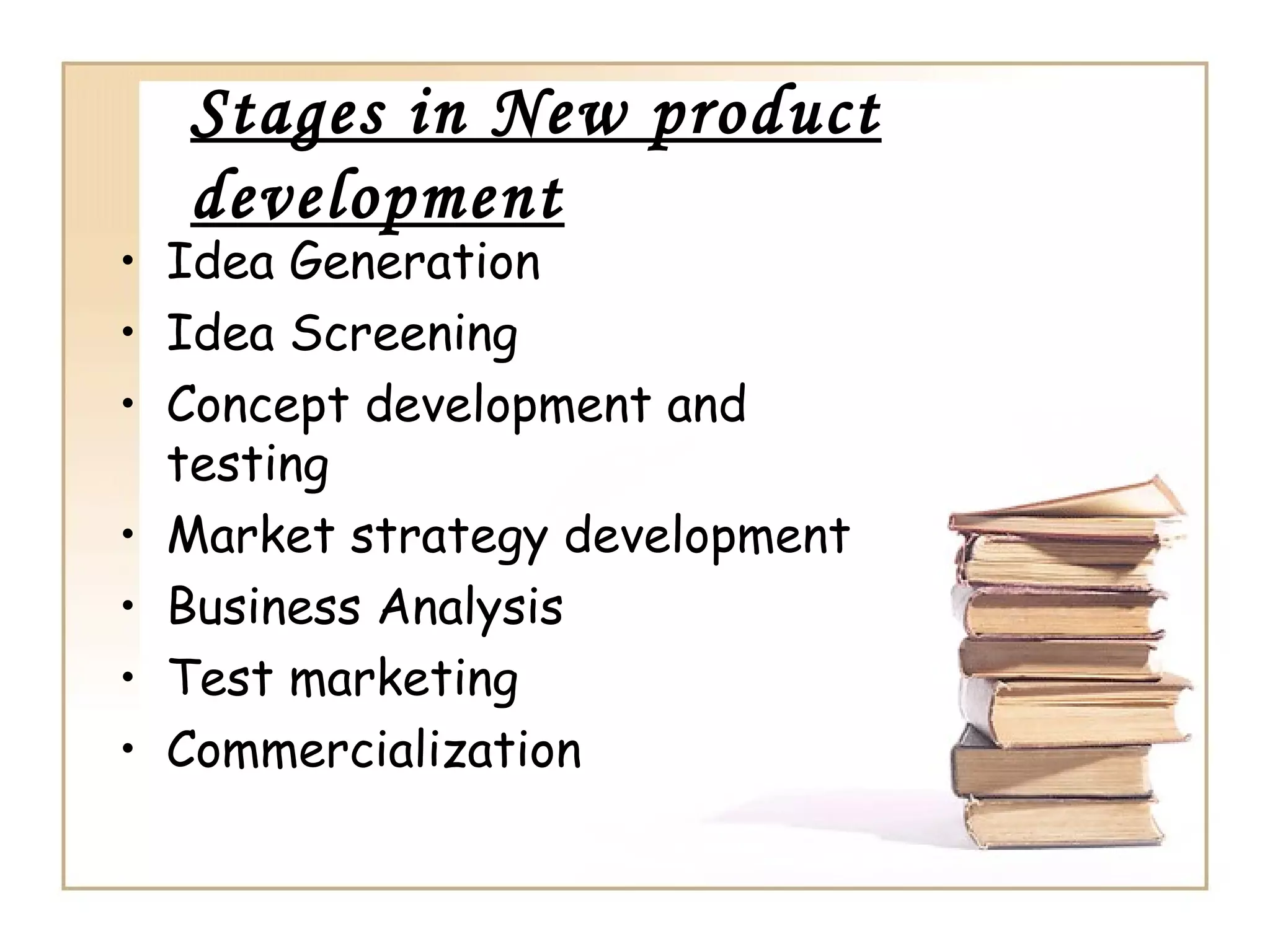
Stages in New product
development
• Idea Generation
• Idea Screening
• Concept development and
testing
• Market strategy development
• Business Analysis
• Test marketing
• Commercialization
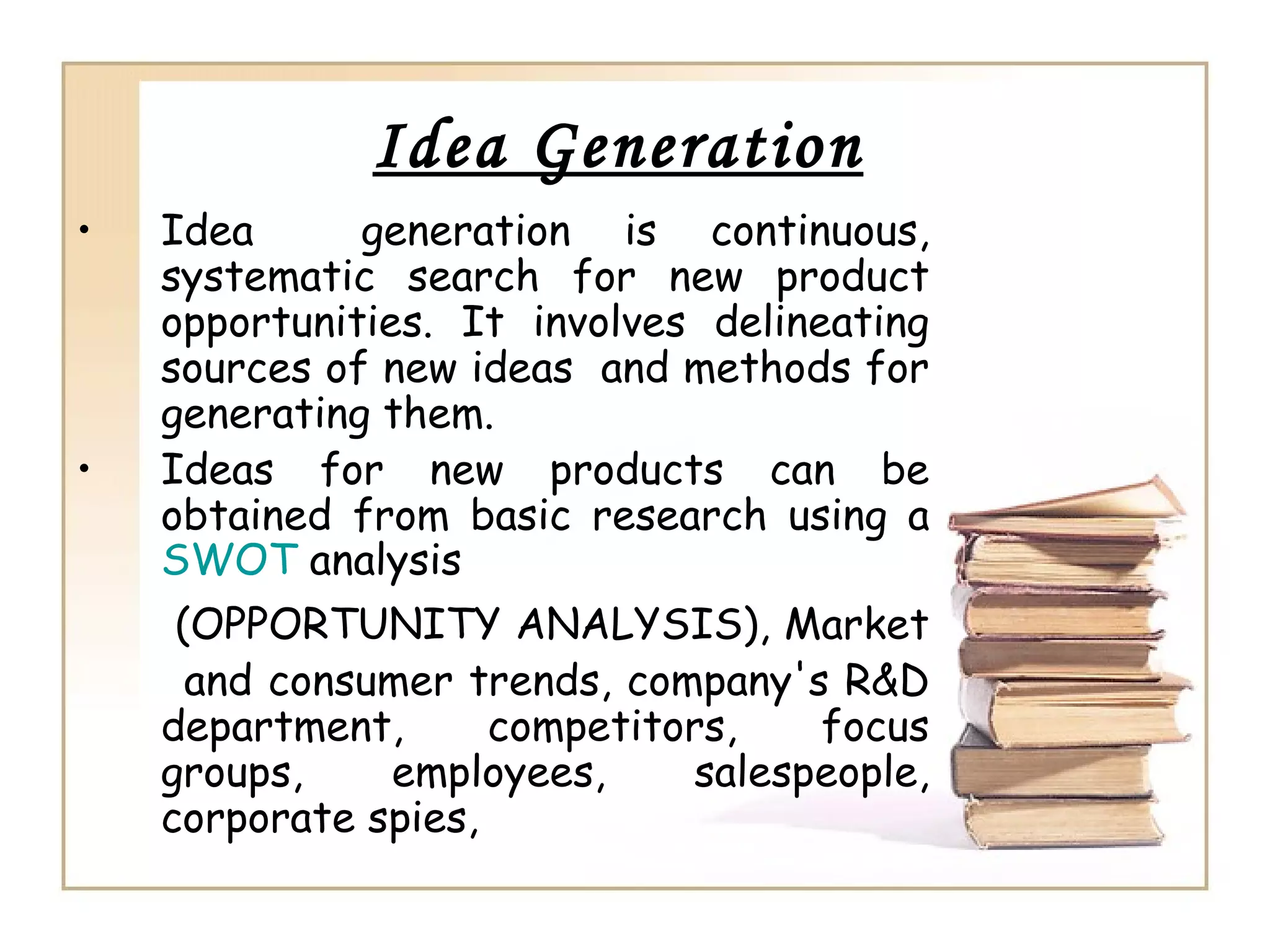
Idea Generation
• Idea generation is continuous,
systematic search for new product
opportunities. It involves delineating
sources of new ideas and methods for
generating them.
• Ideas for new products can be
obtained from basic research using a
SWOT analysis
(OPPORTUNITY ANALYSIS), Market
and consumer trends, company's R&D
department, competitors, focus
groups, employees, salespeople,
corporate spies,
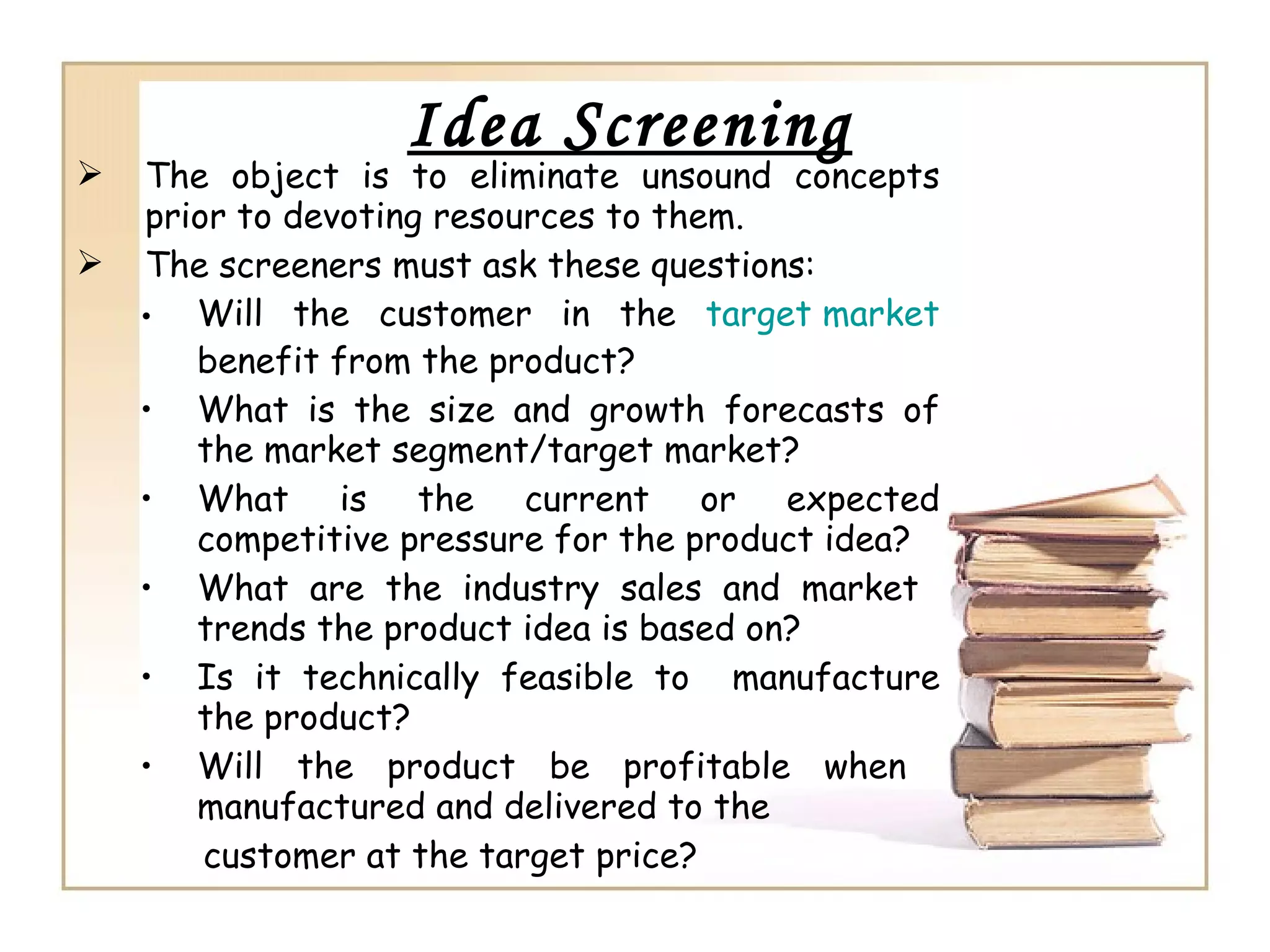
Idea Screening
 The object is to eliminate unsound concepts
prior to devoting resources to them.
 The screeners must ask these questions:
• Will the customer in the target market
benefit from the product?
• What is the size and growth forecasts of
the market segment/target market?
• What is the current or expected
competitive pressure for the product idea?
• What are the industry sales and market
trends the product idea is based on?
• Is it technically feasible to manufacture
the product?
• Will the product be profitable when
manufactured and delivered to the
customer at the target price?
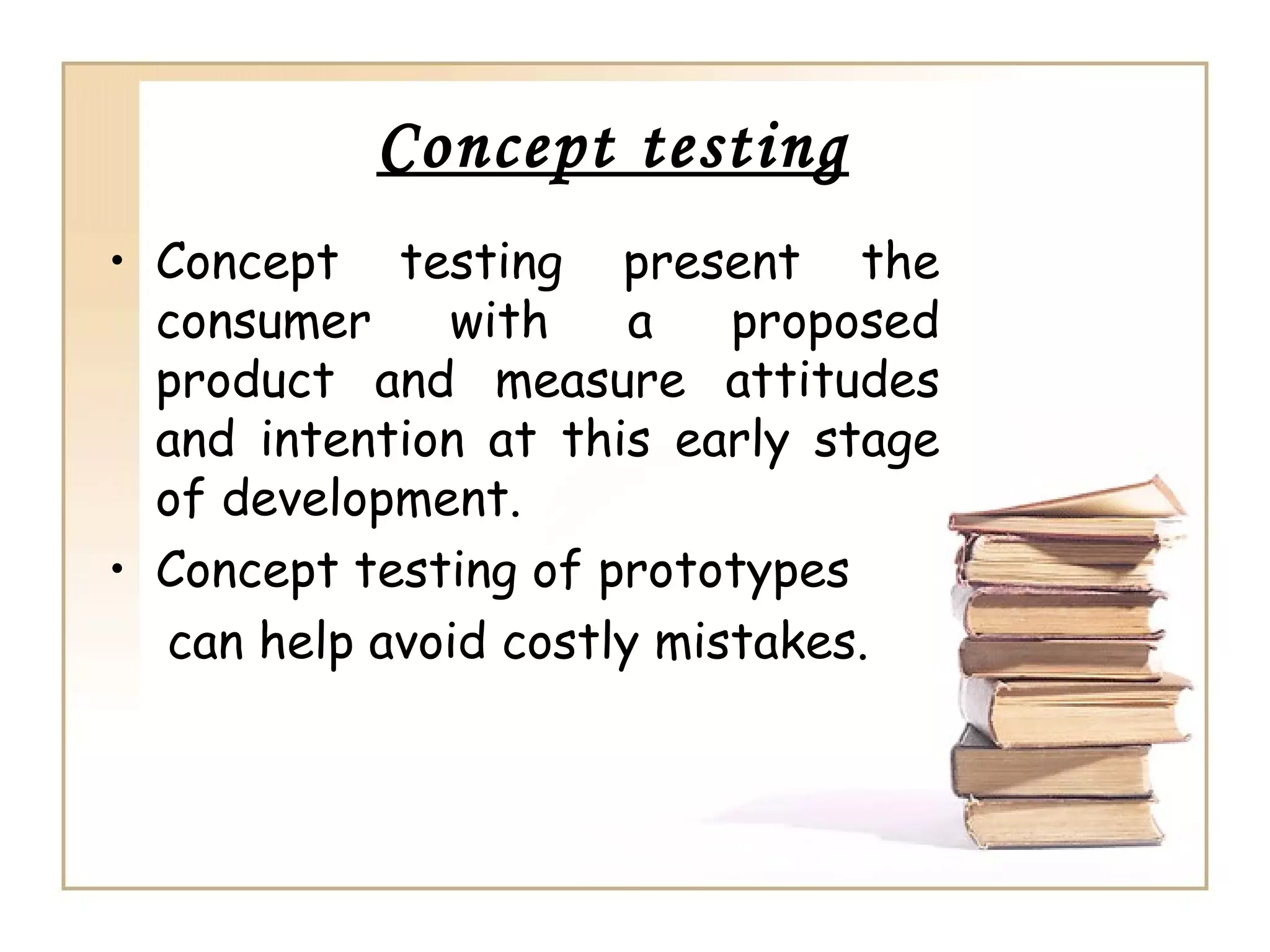
Concept testing
• Concept testing present the
consumer with a proposed
product and measure attitudes
and intention at this early stage
of development.
• Concept testing of prototypes
can help avoid costly mistakes.
Market Strategy Development
• Outlines the planned price,
distribution strategy, and marketing
budget for the first year.
• Describes thelong-run sales and
profit goals and marketing-mix
strategy over time.
1. Describe the market’s size, structure,
and behaviour, the planned product
positioning, and the sales, market
share, and profit goals for first few
years.
Includes development of three part
strategy plan
Business & financial Analysis
• Estimate likely selling price
based upon competition and
customer feedback
• Estimate sales volume based
upon size of market
• Estimate profitability and
breakeven point
Test Marketing
• Test marketing involves placing
a product for sale in one or
more selected areas and
observing its actual
performance under the
proposed marketing plan
Commercialization
• Commercialization involves implementing
a total marketing plan and full
production
 Launch the product
 Produce and place advertisements
and other promotions
 Fill the distribution pipeline with
product
 Critical path analysis is most useful
at this stage
Key success factors in New
Product Development
• Operating Philosophy
• Organization Structure
• The Experience Effect
• Management Style
18981370 new-product-development-process-120614123155-phpapp02

18981370 new-product-development-process-120614123155-phpapp02

  • 1.
    NEW PRODUCT ANDNEW PRODUCT DEVELOPMENT PROCESS
  • 2.
    What is anew product ? • A product that opens an entirely new market • A product that adopts or replaces an existing product • A product that significantly broadens the market for an existing product • An old product introduced in a new market • An old product packaged in a different way • An old product marketed in a different way
  • 3.
    Types of newproduct • Innovative products • New product lines – to allow the firm to enter an existing market • Addition to product line – to supplement the firm’s existing product line • Improvements and revisions of existing product • Repositioned products – existing products targets at new market • Cost reduction new product that provide similar performance at lower cost
  • 4.
    Examples of newproducts • New to the world – high definition TV, ipod, flat screen TV, Probiotic Ice Cream • Product improvement & replacement :SPEED by BPCL • Cost reduction new product: Moser Baer.
  • 5.
    New product canbe used to • Increase/defend market share by offering more choice or updating older products • Appeal to new segments • Diversify into new markets • Improve relationship with distributors • Maintain the firm’s reputation a leading edge company • Even out peaks and troughs in demand • Make better use of the organization's resources
  • 6.
    Why develop NewProduct ? • To create stars and cash cows for the future • To replace declining product • To take advantage of new technology • To defeat rivals • To maintain/increase market share • To keep up with rivals • To maintain competitive advantage • To fill gap in the market
  • 7.
    New product planning •This is the strategic stage • The firm assesses • It current product portfolio • Opportunities and threats • The firm then determines the type of product which would best fit in with the corporate strategy
  • 8.
    New product development •New product development is a process which is designed to develop, test and consider the viability of products which are new to the market in order to ensure the Growth or survival of the organisation.
  • 9.
    Stages in Newproduct development • Idea Generation • Idea Screening • Concept development and testing • Market strategy development • Business Analysis • Test marketing • Commercialization
  • 10.
    Idea Generation • Ideageneration is continuous, systematic search for new product opportunities. It involves delineating sources of new ideas and methods for generating them. • Ideas for new products can be obtained from basic research using a SWOT analysis (OPPORTUNITY ANALYSIS), Market and consumer trends, company's R&D department, competitors, focus groups, employees, salespeople, corporate spies,
  • 11.
    Idea Screening  Theobject is to eliminate unsound concepts prior to devoting resources to them.  The screeners must ask these questions: • Will the customer in the target market benefit from the product? • What is the size and growth forecasts of the market segment/target market? • What is the current or expected competitive pressure for the product idea? • What are the industry sales and market trends the product idea is based on? • Is it technically feasible to manufacture the product? • Will the product be profitable when manufactured and delivered to the customer at the target price?
  • 12.
    Concept testing • Concepttesting present the consumer with a proposed product and measure attitudes and intention at this early stage of development. • Concept testing of prototypes can help avoid costly mistakes.
  • 13.
    Market Strategy Development •Outlines the planned price, distribution strategy, and marketing budget for the first year. • Describes thelong-run sales and profit goals and marketing-mix strategy over time. 1. Describe the market’s size, structure, and behaviour, the planned product positioning, and the sales, market share, and profit goals for first few years. Includes development of three part strategy plan
  • 14.
    Business & financialAnalysis • Estimate likely selling price based upon competition and customer feedback • Estimate sales volume based upon size of market • Estimate profitability and breakeven point
  • 15.
    Test Marketing • Testmarketing involves placing a product for sale in one or more selected areas and observing its actual performance under the proposed marketing plan
  • 16.
    Commercialization • Commercialization involvesimplementing a total marketing plan and full production  Launch the product  Produce and place advertisements and other promotions  Fill the distribution pipeline with product  Critical path analysis is most useful at this stage
  • 17.
    Key success factorsin New Product Development • Operating Philosophy • Organization Structure • The Experience Effect • Management Style