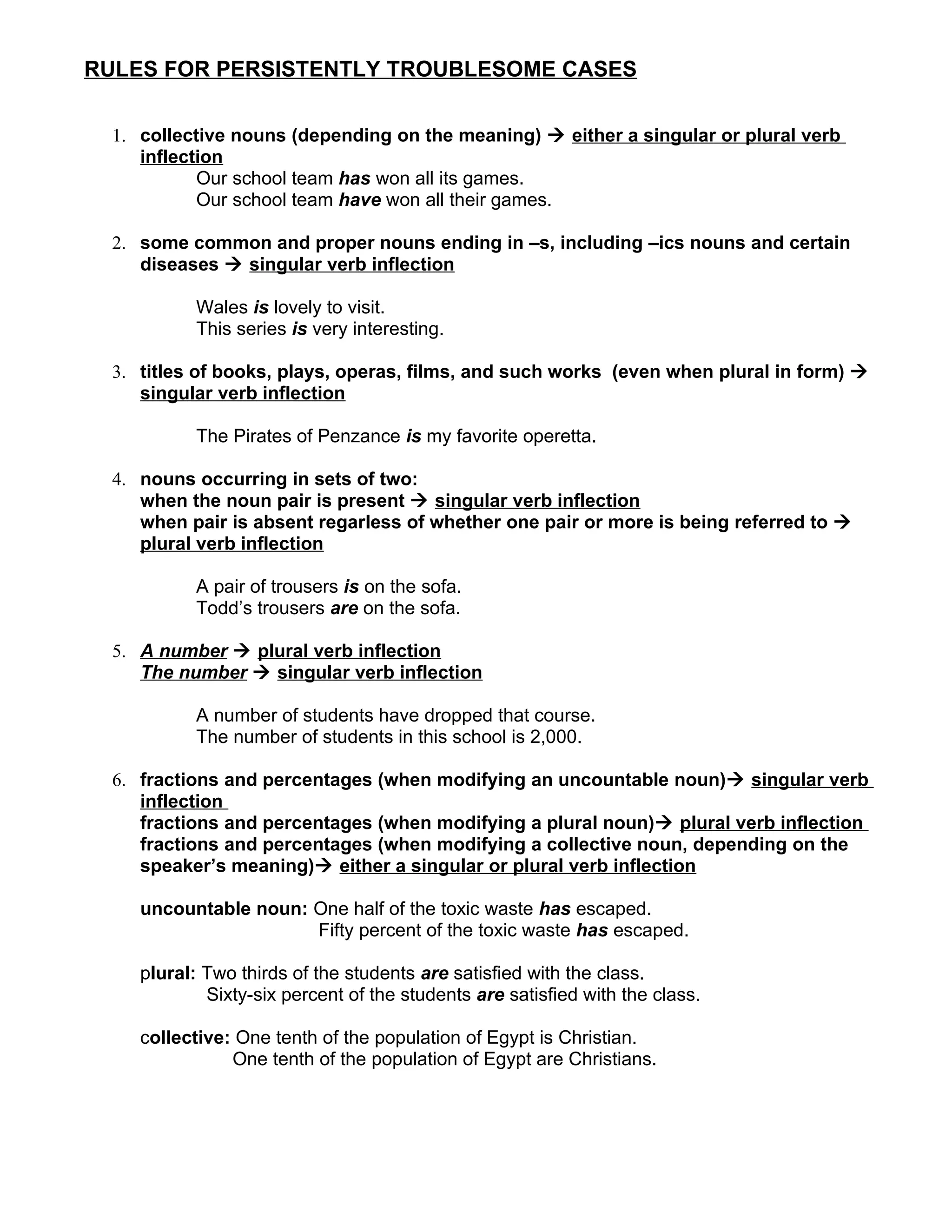
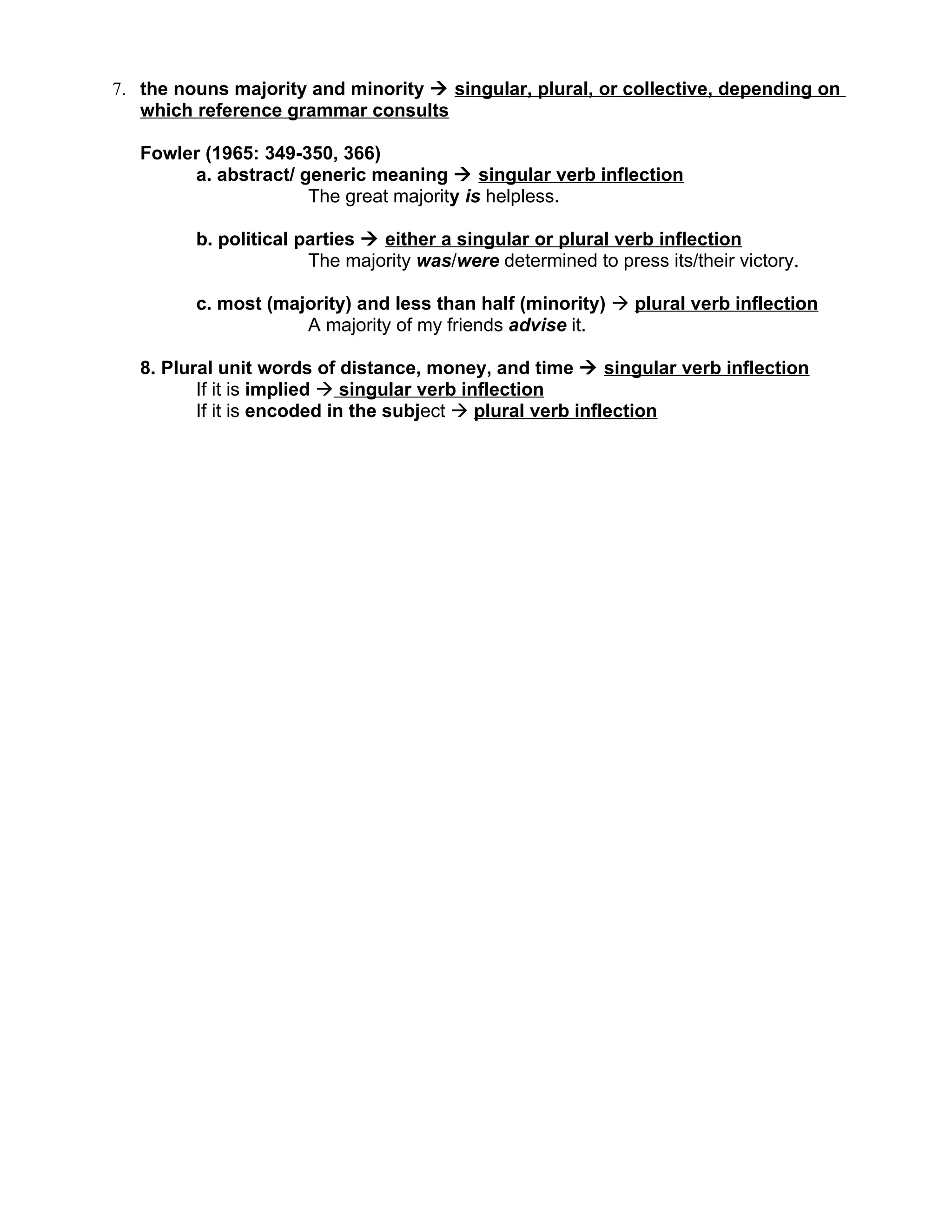
RULES FOR PERSISTENTLY TROUBLESOME CASES

  1. collective nouns (depending on the meaning)  either a singular or plural verb
     inflection
            Our school team has won all its games.
            Our school team have won all their games.

  2. some common and proper nouns ending in –s, including –ics nouns and certain
     diseases  singular verb inflection

            Wales is lovely to visit.
            This series is very interesting.

  3. titles of books, plays, operas, films, and such works (even when plural in form) 
     singular verb inflection

            The Pirates of Penzance is my favorite operetta.

  4. nouns occurring in sets of two:
     when the noun pair is present  singular verb inflection
     when pair is absent regarless of whether one pair or more is being referred to 
     plural verb inflection

            A pair of trousers is on the sofa.
            Todd’s trousers are on the sofa.

  5. A number  plural verb inflection
     The number  singular verb inflection

            A number of students have dropped that course.
            The number of students in this school is 2,000.

  6. fractions and percentages (when modifying an uncountable noun) singular verb
     inflection
     fractions and percentages (when modifying a plural noun) plural verb inflection
     fractions and percentages (when modifying a collective noun, depending on the
     speaker’s meaning) either a singular or plural verb inflection

     uncountable noun: One half of the toxic waste has escaped.
                       Fifty percent of the toxic waste has escaped.

     plural: Two thirds of the students are satisfied with the class.
             Sixty-six percent of the students are satisfied with the class.

     collective: One tenth of the population of Egypt is Christian.
                One tenth of the population of Egypt are Christians.
7. the nouns majority and minority  singular, plural, or collective, depending on
   which reference grammar consults

   Fowler (1965: 349-350, 366)
        a. abstract/ generic meaning  singular verb inflection
                      The great majority is helpless.

         b. political parties  either a singular or plural verb inflection
                       The majority was/were determined to press its/their victory.

         c. most (majority) and less than half (minority)  plural verb inflection
                     A majority of my friends advise it.

   8. Plural unit words of distance, money, and time  singular verb inflection
          If it is implied  singular verb inflection
          If it is encoded in the subject  plural verb inflection

Rules For Persistently Troublesome Cases

  • 1.
    RULES FOR PERSISTENTLYTROUBLESOME CASES 1. collective nouns (depending on the meaning)  either a singular or plural verb inflection Our school team has won all its games. Our school team have won all their games. 2. some common and proper nouns ending in –s, including –ics nouns and certain diseases  singular verb inflection Wales is lovely to visit. This series is very interesting. 3. titles of books, plays, operas, films, and such works (even when plural in form)  singular verb inflection The Pirates of Penzance is my favorite operetta. 4. nouns occurring in sets of two: when the noun pair is present  singular verb inflection when pair is absent regarless of whether one pair or more is being referred to  plural verb inflection A pair of trousers is on the sofa. Todd’s trousers are on the sofa. 5. A number  plural verb inflection The number  singular verb inflection A number of students have dropped that course. The number of students in this school is 2,000. 6. fractions and percentages (when modifying an uncountable noun) singular verb inflection fractions and percentages (when modifying a plural noun) plural verb inflection fractions and percentages (when modifying a collective noun, depending on the speaker’s meaning) either a singular or plural verb inflection uncountable noun: One half of the toxic waste has escaped. Fifty percent of the toxic waste has escaped. plural: Two thirds of the students are satisfied with the class. Sixty-six percent of the students are satisfied with the class. collective: One tenth of the population of Egypt is Christian. One tenth of the population of Egypt are Christians.
  • 2.
    7. the nounsmajority and minority  singular, plural, or collective, depending on which reference grammar consults Fowler (1965: 349-350, 366) a. abstract/ generic meaning  singular verb inflection The great majority is helpless. b. political parties  either a singular or plural verb inflection The majority was/were determined to press its/their victory. c. most (majority) and less than half (minority)  plural verb inflection A majority of my friends advise it. 8. Plural unit words of distance, money, and time  singular verb inflection If it is implied  singular verb inflection If it is encoded in the subject  plural verb inflection