


6th International Summer SchoolNational University of Technology of the UkraineKiev, Ukraine,  August 8-20, 2011New Insights and Applications                                                           of Eco-Finance Networksand Collaborative GamesGerhard-Wilhelm Weber 1*SırmaZeynepAlparslanGök2,  Erik Kropat3,  ÖzlemDefterli4,                                         Fatma Yelikaya-Özkurt1,Armin Fügenschuh51     Institute of Applied Mathematics, Middle East Technical University, Ankara, Turkey   2     Department of Mathematics, SüleymanDemirel University, Isparta, Turkey 3     Department of Computer Science, Universität der Bundeswehr München, Munich, Germany  4      Department of Mathematics and Computer Science, Cankaya University, Ankara, Turkey  5      Optimierung, Zuse Institut Berlin, Germany*   Faculty of Economics, Management and Law, University of Siegen, GermanyCenter for Research on Optimization and Control, University of Aveiro, PortugalUniversiti Teknologi Malaysia, Skudai, Malaysia
OutlineBio- and Financial SystemsGenetic ,Gene-Environment and Eco-Finance Networks Time-Continuous and Time-Discrete ModelsOptimization ProblemsNumerical Example and ResultsNetworks under UncertaintyEllipsoidal ModelOptimization of the Ellipsoidal ModelKyoto GameEllipsoidal Game TheoryRelated Aspects from FinanceHybrid Stochastic ControlConclusion
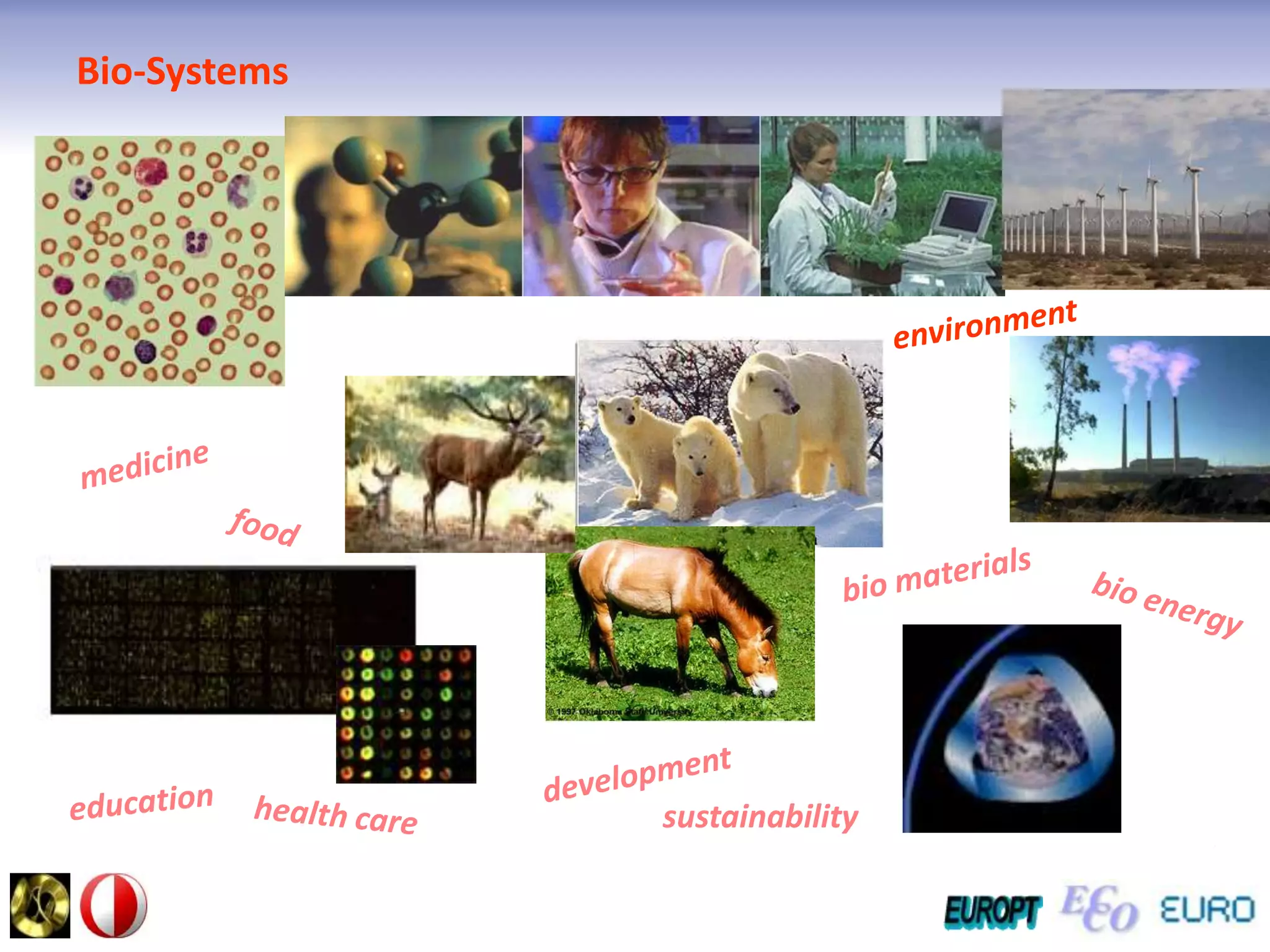
Bio-Systems environmentmedicinefoodbio materialsbio energydevelopmenteducationhealth caresustainability
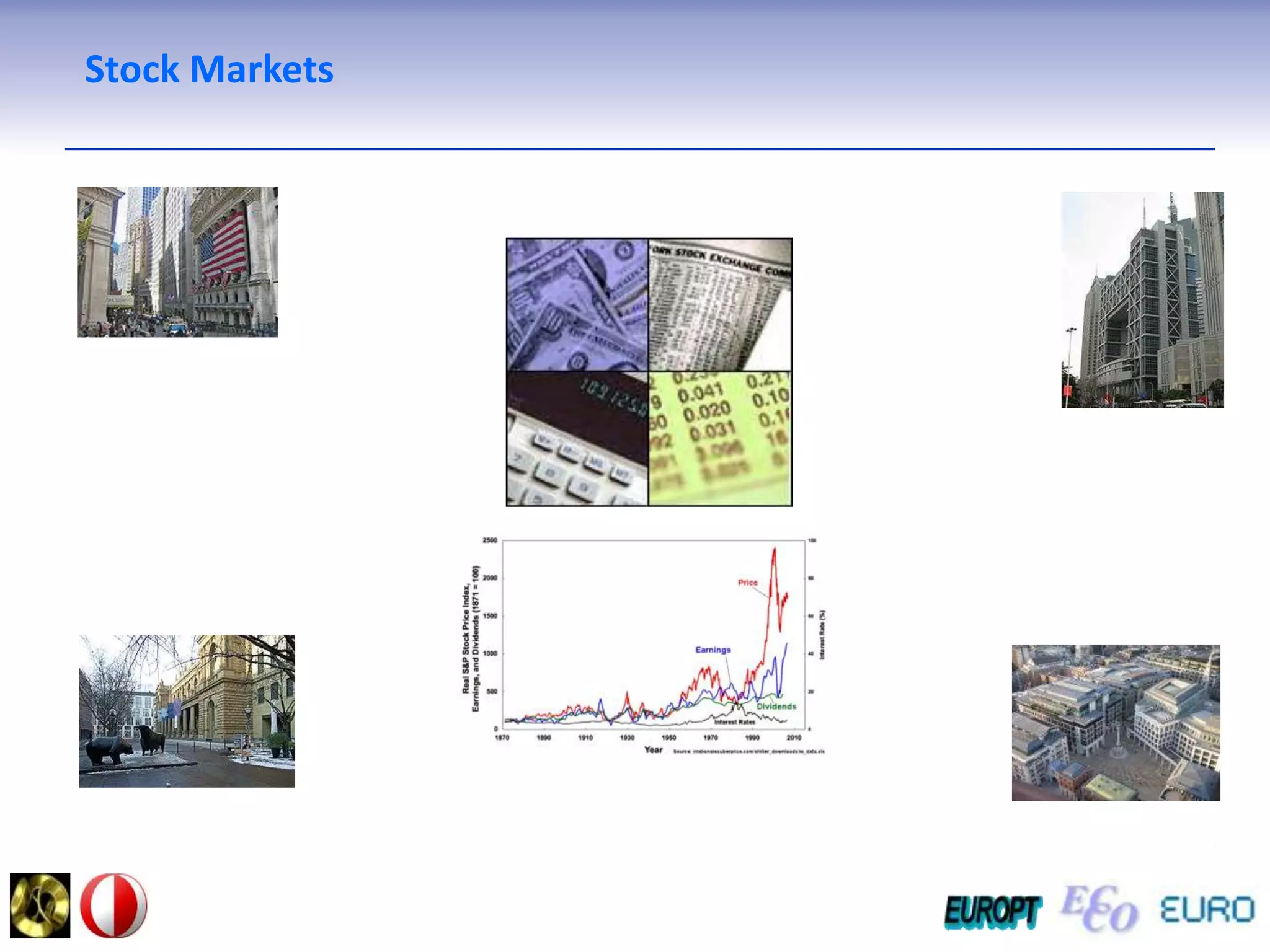
Stock Markets
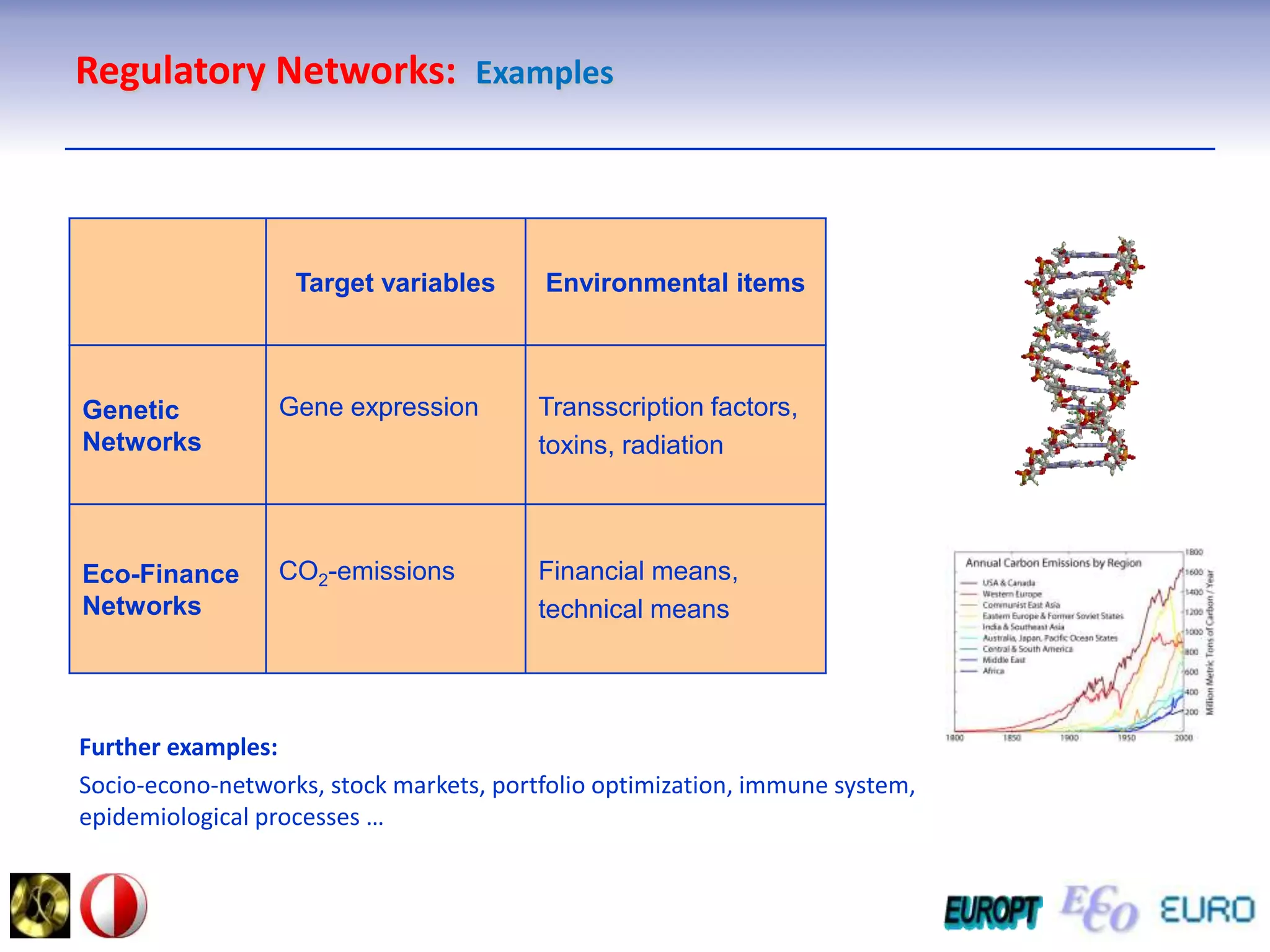
Regulatory Networks:  ExamplesFurther examples:Socio-econo-networks, stock markets, portfolio optimization, immune system, epidemiological processes …
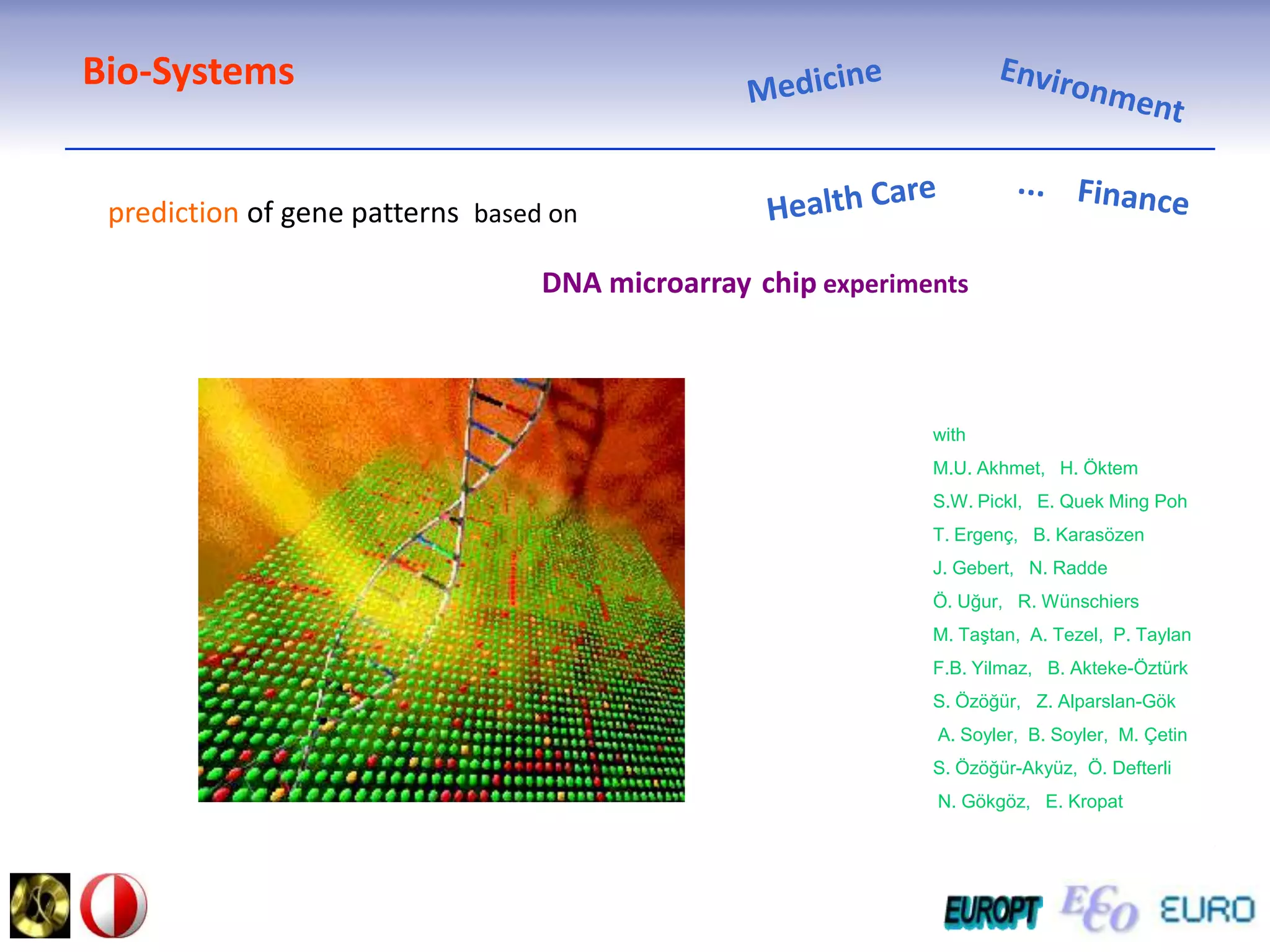
Bio-Systems  MedicineEnvironment...    Finance Health Careprediction of gene patterns  based onDNA microarraychip experimentswithM.U. Akhmet,   H. Öktem  S.W. Pickl,   E. Quek Ming PohT. Ergenç,   B. Karasözen    J. Gebert,   N. Radde   Ö. Uğur,   R. WünschiersM. Taştan,  A. Tezel,  P. Taylan                                    F.B. Yilmaz,   B. Akteke-ÖztürkS. Özöğür,   Z. Alparslan-Gök   A. Soyler,  B. Soyler,  M. ÇetinS. Özöğür-Akyüz,  Ö. Defterli N. Gökgöz,   E. Kropat
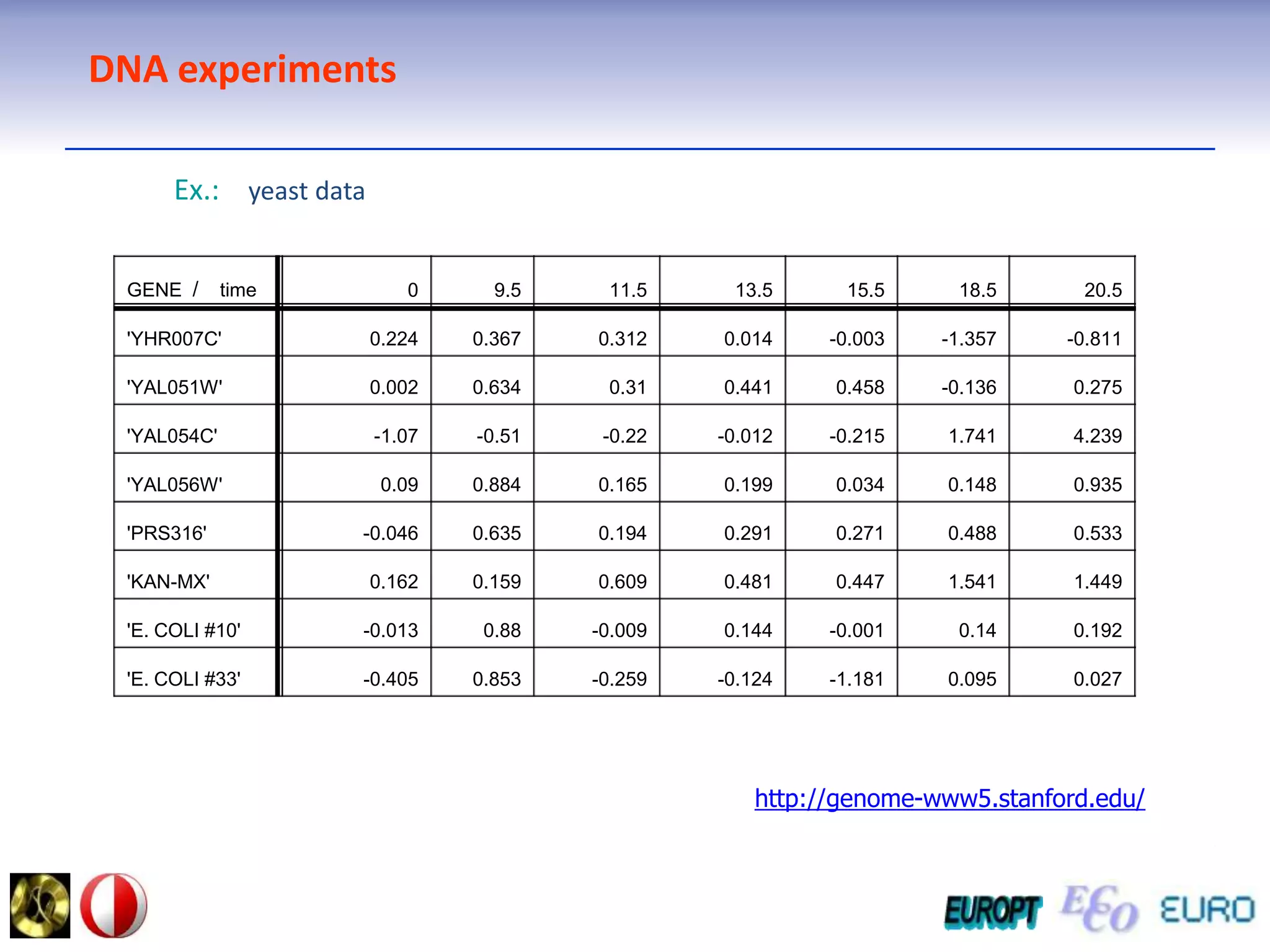
DNA experimentsEx.:yeastdatahttp://genome-www5.stanford.edu/
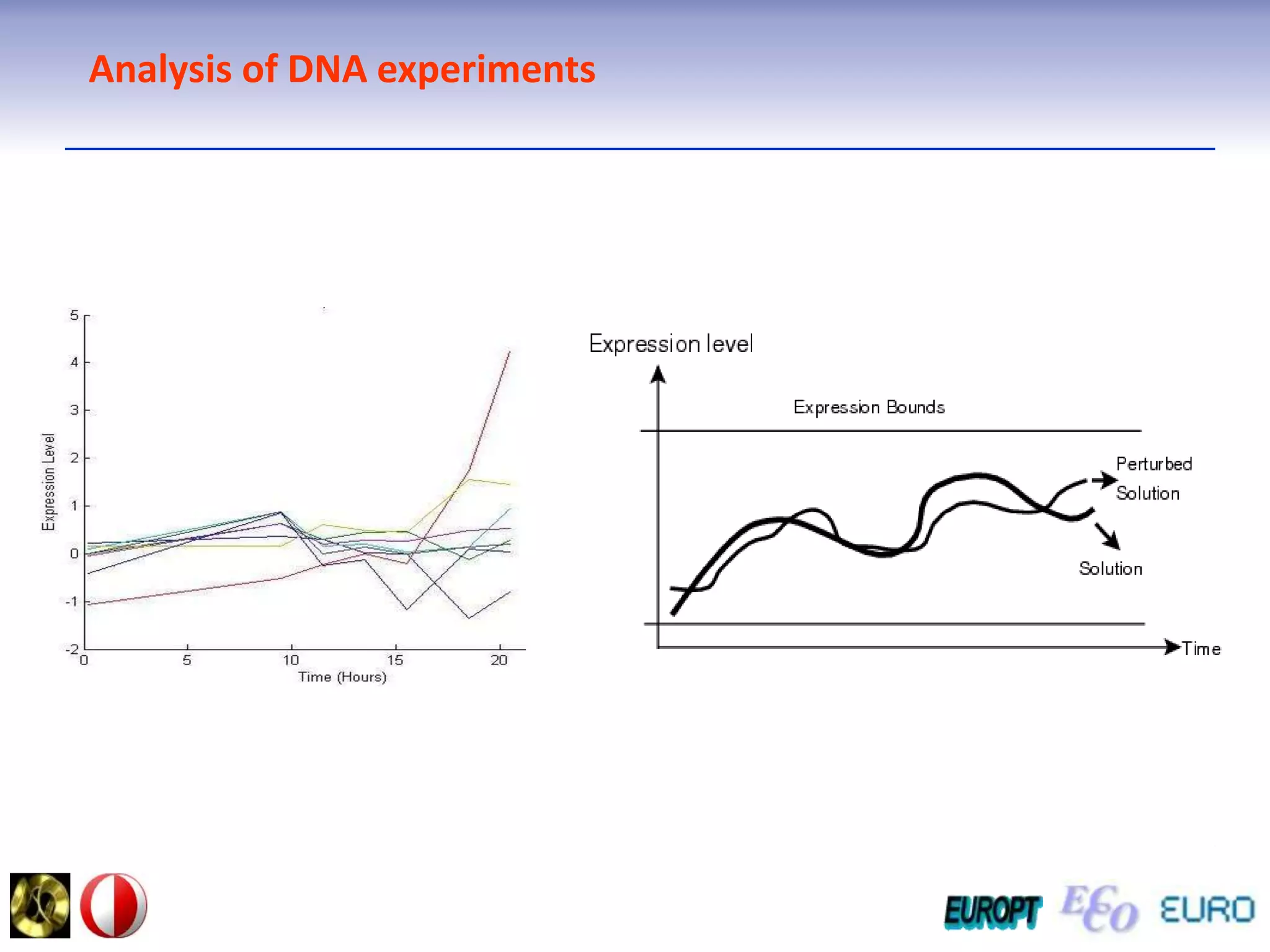
Analysis of DNA experiments
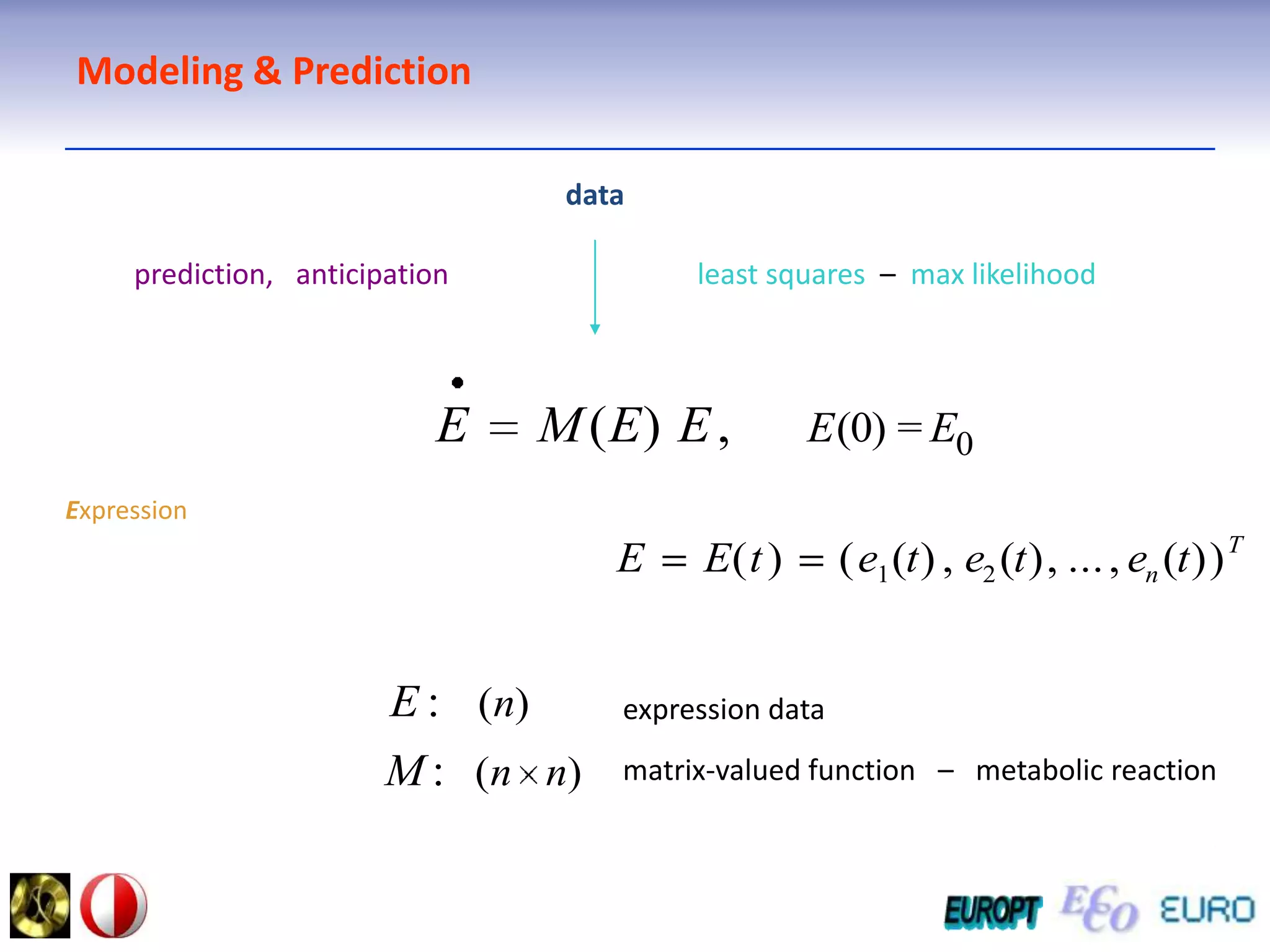
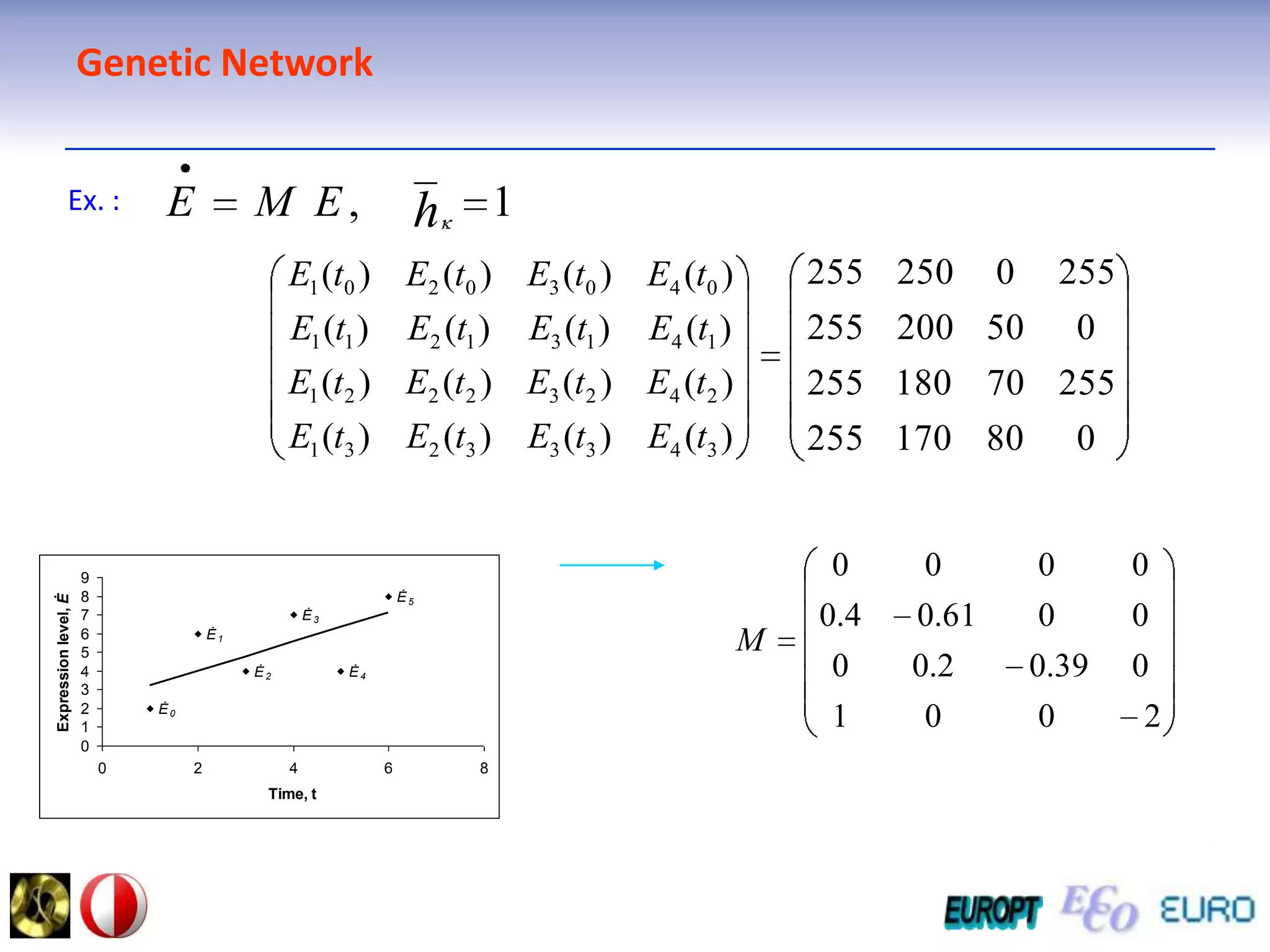
E0 : metabolic state of a cell at t0 (:=gene expression pattern),ith element of the vector E0 :=expression level of gene i,Mk := I + hkM(Ek) , Ek (k є IN0) is recursively defined as Ek+1 := MkEk.Metabolic ShiftGebert et al. (2006)
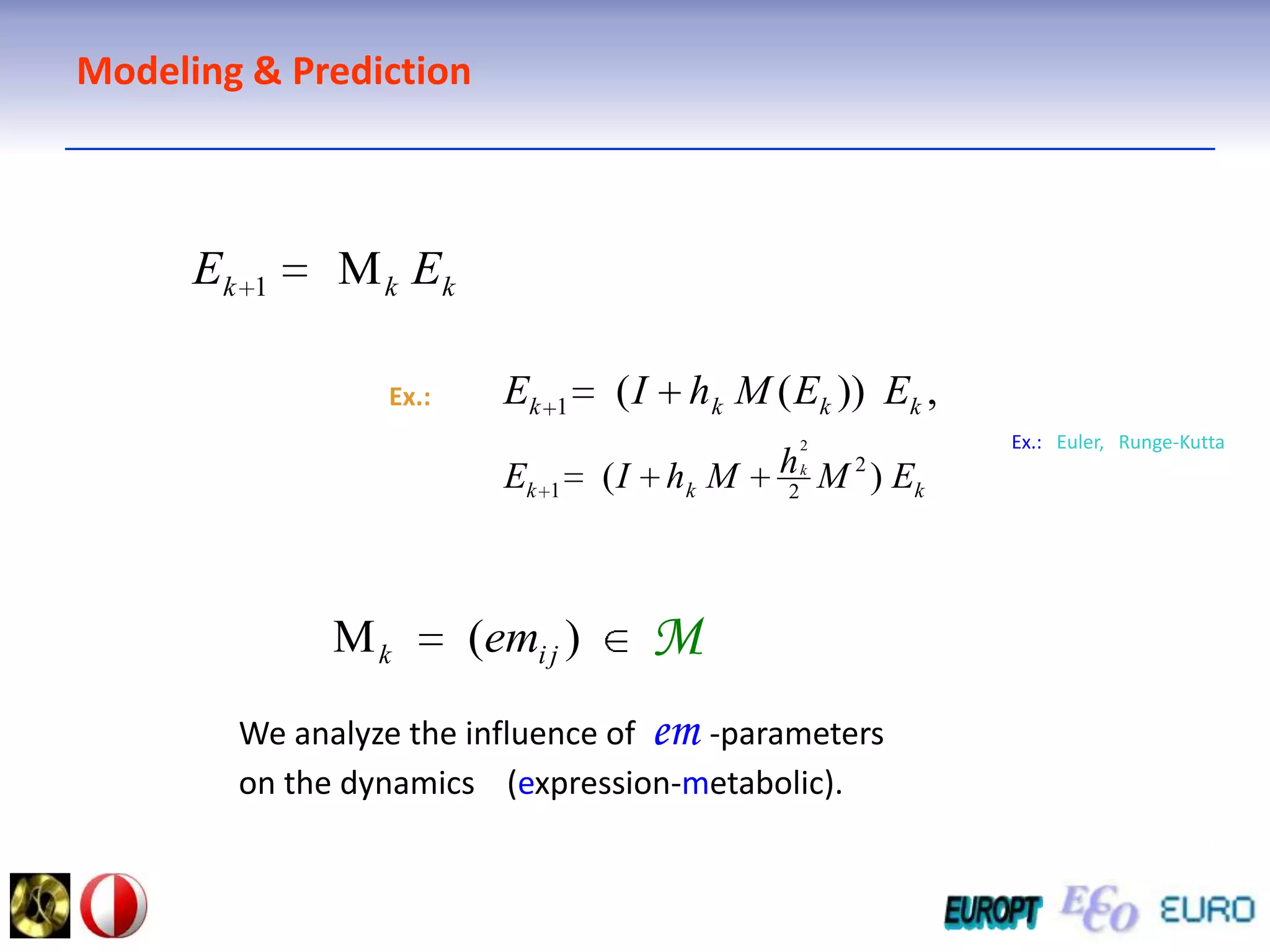
Modeling & Predictiondataprediction,   anticipation      least squares  –  max likelihoodExpressionexpression datamatrix-valued function  –  metabolic reaction
Modeling & PredictionEx.:Ex.:   Euler,   Runge-KuttaMWe analyze the influence of em-parameters  on the dynamics    (expression-metabolic).
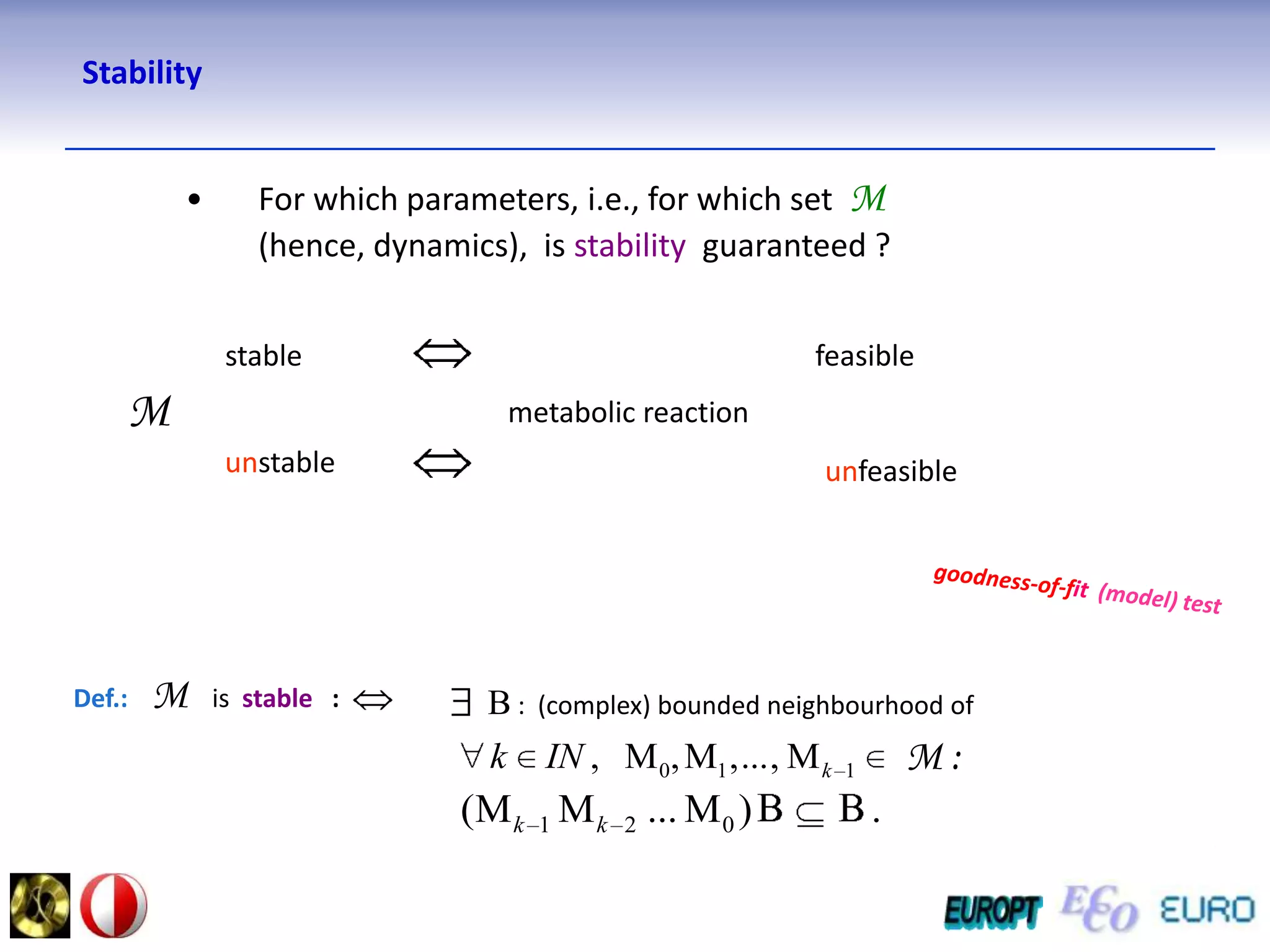
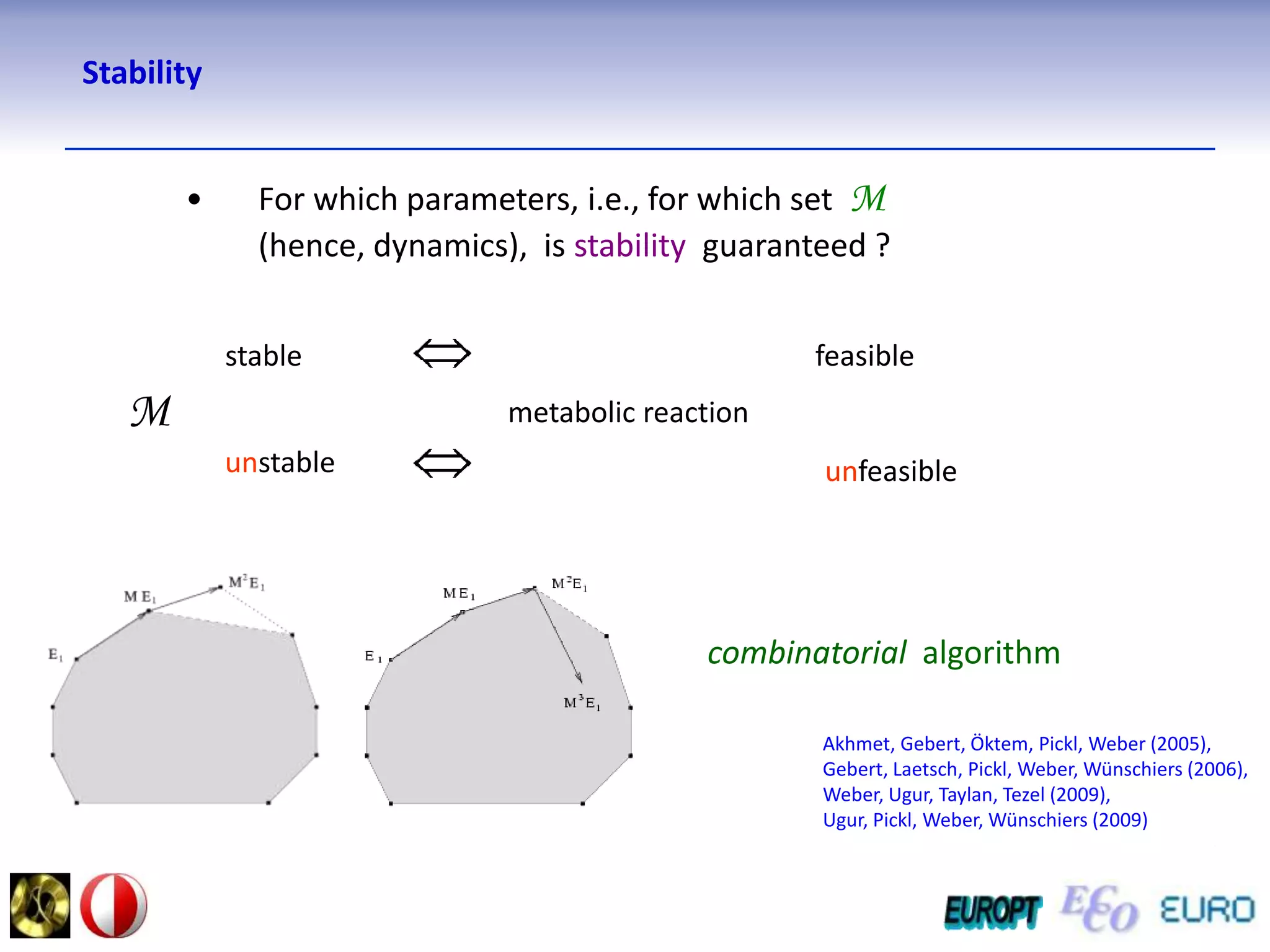
StabilityFor which parameters, i.e., for which setM(hence,dynamics),  isstabilityguaranteed ?stablefeasibleMmetabolic reactionunstable unfeasiblegoodness-of-fit  (model) testDef.:Mis stable   :B :  (complex) bounded neighbourhood ofM :
Stabilitycombinatorial  algorithmFor which parameters, i.e., for which setM(hence,dynamics),  isstabilityguaranteed ?stablefeasibleMmetabolic reactionunstable unfeasible  Akhmet, Gebert, Öktem, Pickl, Weber (2005),  Gebert, Laetsch, Pickl, Weber, Wünschiers (2006),  Weber, Ugur, Taylan, Tezel (2009),  Ugur, Pickl, Weber, Wünschiers (2009)
Genetic NetworkEx. :
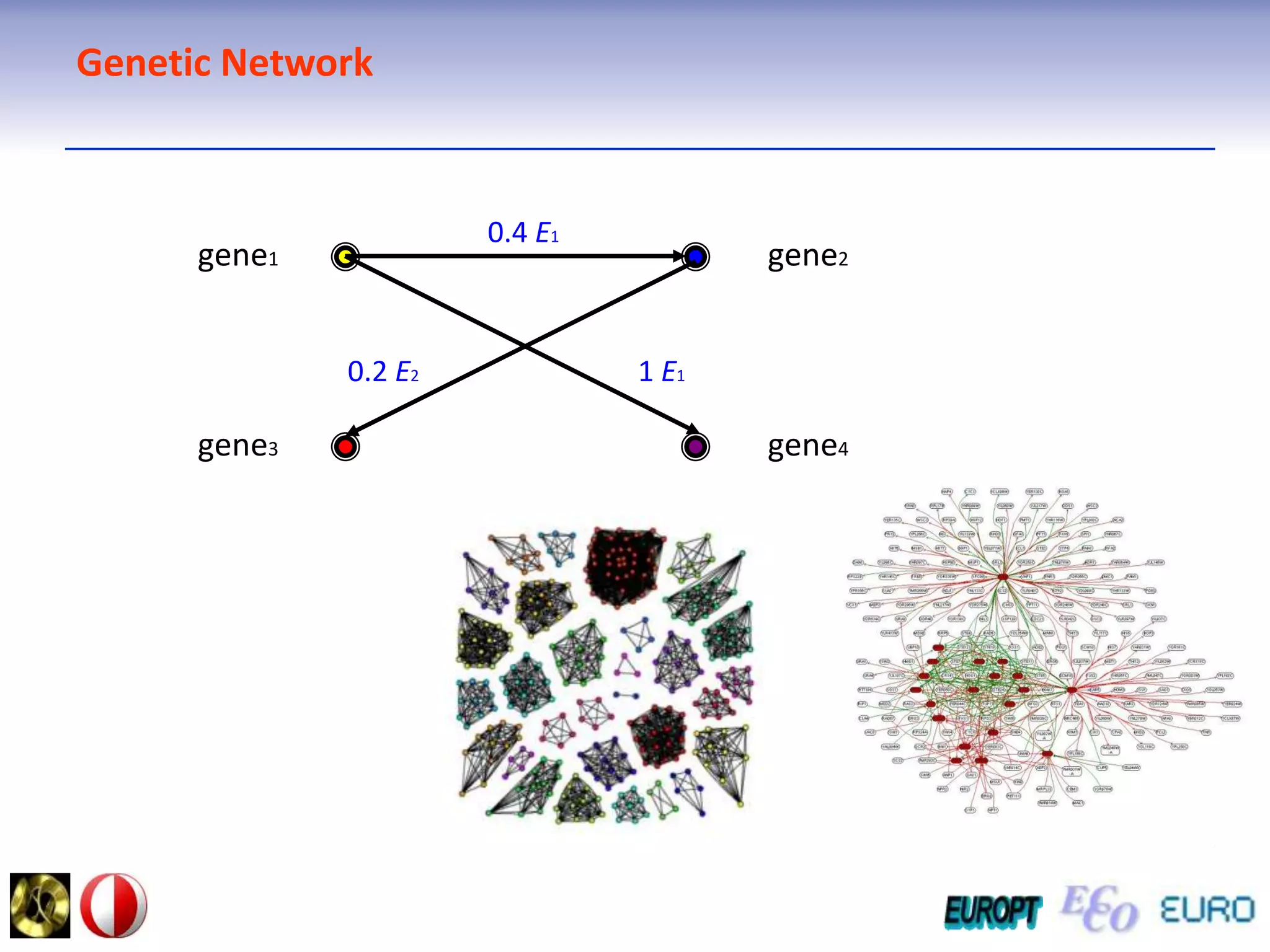
Genetic Network0.4E1gene2gene10.2 E21 E1gene3gene4
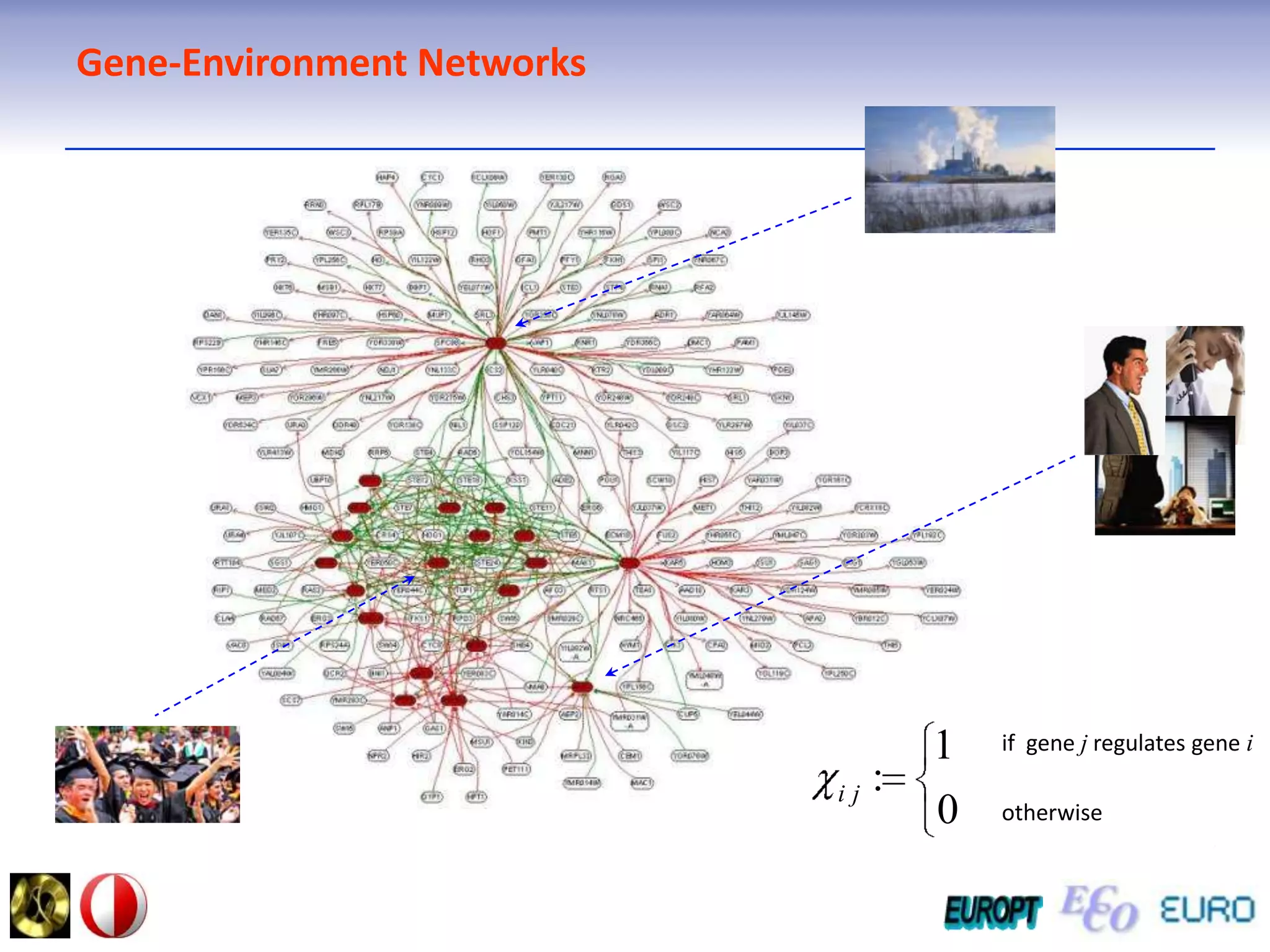
Gene-Environment Networks             if  gene j regulates gene i             otherwise
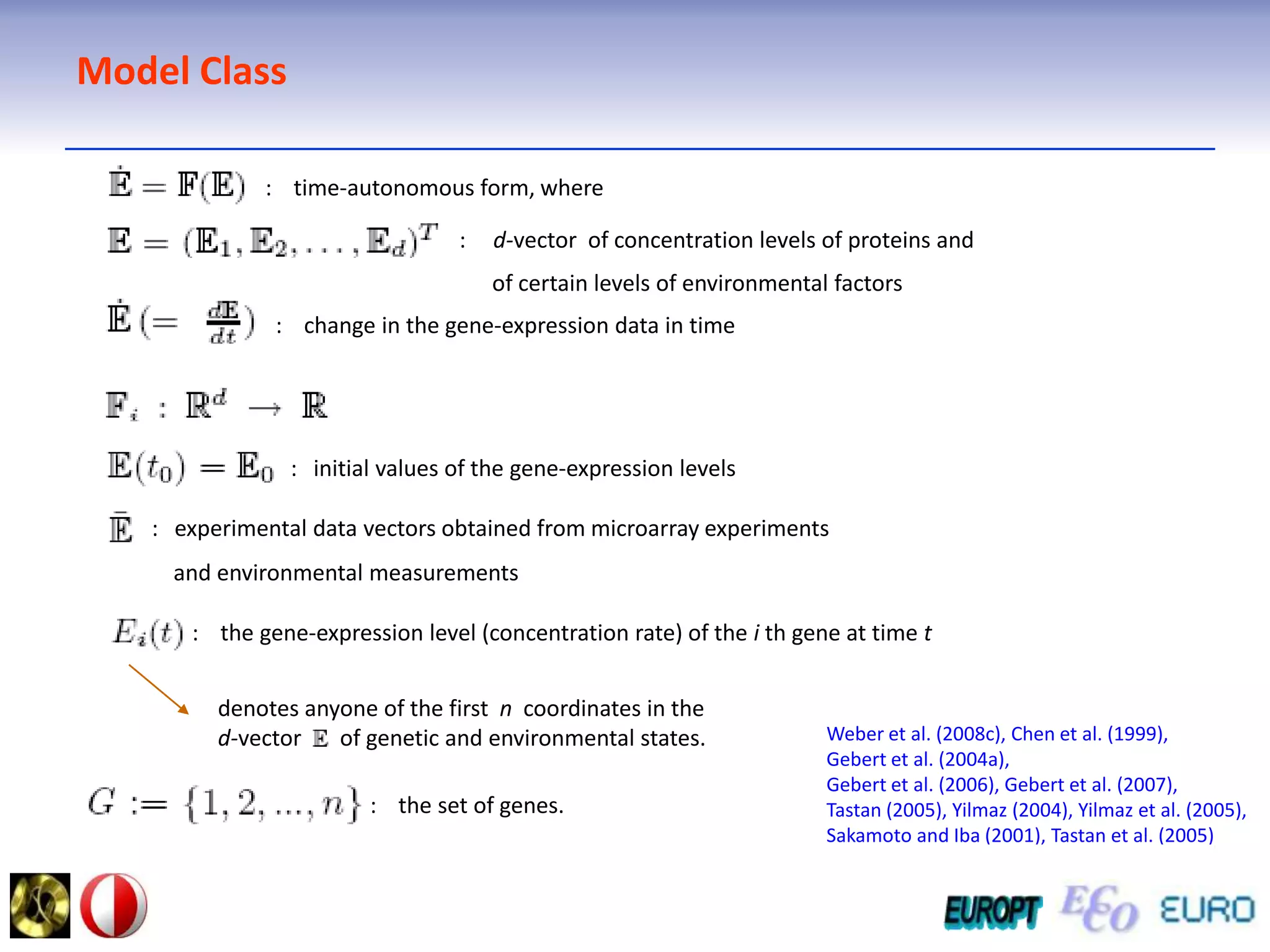
Model Class:    time-autonomous form, where:     d-vector  of concentration levels of proteins and      of certain levels of environmental factors :    change in the gene-expression data in time:   initial values of the gene-expression levels: experimental data vectors obtained from microarray experiments                                                                                 and environmental measurements                :    the gene-expression level (concentration rate) of the i th gene at time tdenotes anyone of the first  n  coordinates in thed-vector       of genetic and environmental states.Weber et al. (2008c), Chen et al. (1999), Gebert et al. (2004a),Gebert et al. (2006), Gebert et al. (2007), Tastan (2005), Yilmaz (2004), Yilmaz et al. (2005),Sakamoto and Iba (2001), Tastan et al. (2005):    the set of genes.
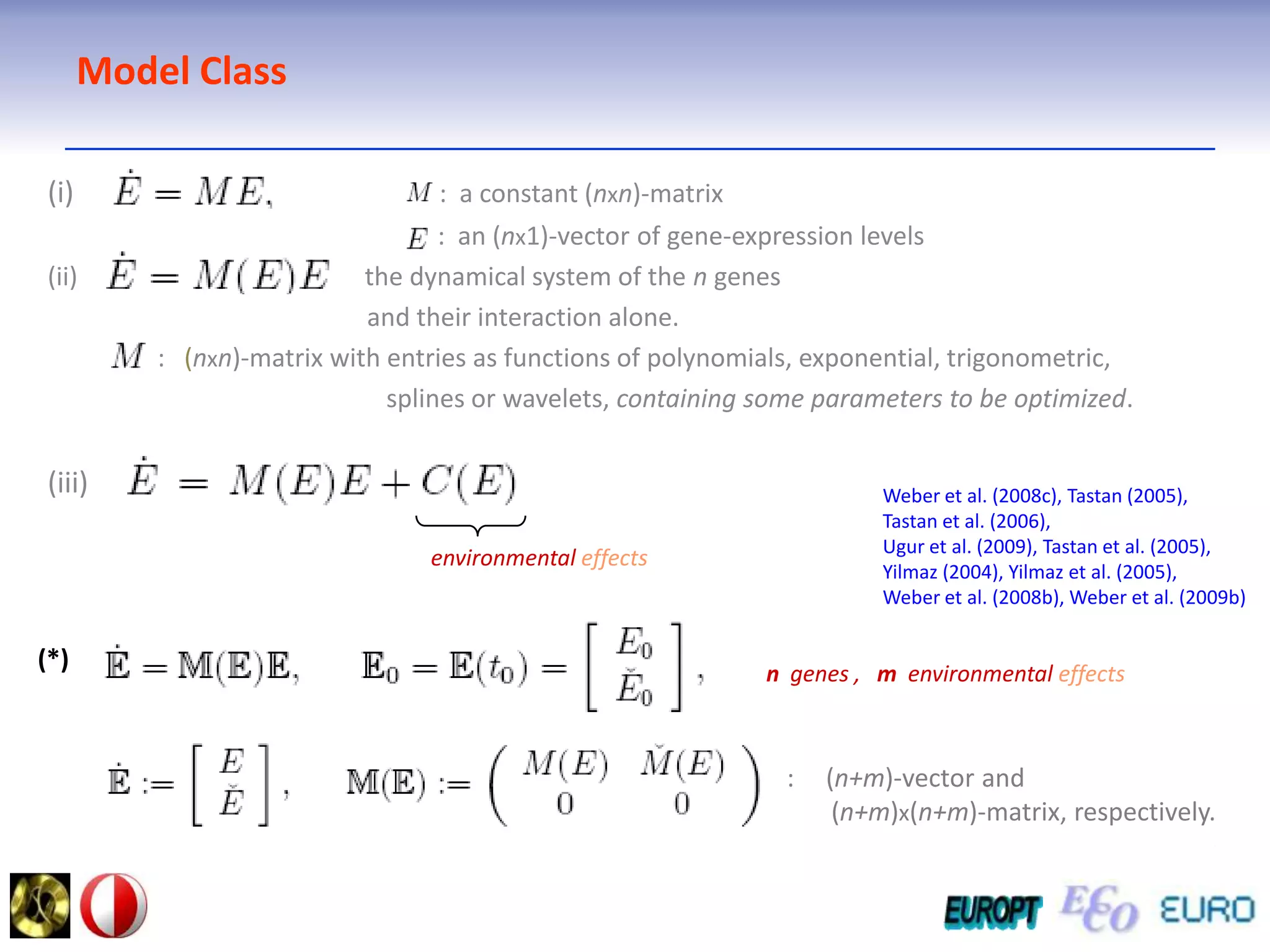
Model Class(i):  a constant (nxn)-matrix                                                             :  an (nx1)-vector of gene-expression levelsrepresents and t      the dynamical system of the n genes                                                                                      and their interaction alone.             :   :   (nxn)-matrix with entries as functions of polynomials, exponential, trigonometric,                                                         splines or wavelets, containing some parameters to be optimized.(iii)Weber et al. (2008c), Tastan (2005), Tastan et al. (2006),Ugur et al. (2009), Tastan et al. (2005), Yilmaz (2004), Yilmaz et al. (2005),Weber et al. (2008b), Weber et al. (2009b)environmental effects(*)n  genes ,   m  environmental effects:     (n+m)-vector and                                  (n+m)x(n+m)-matrix, respectively.
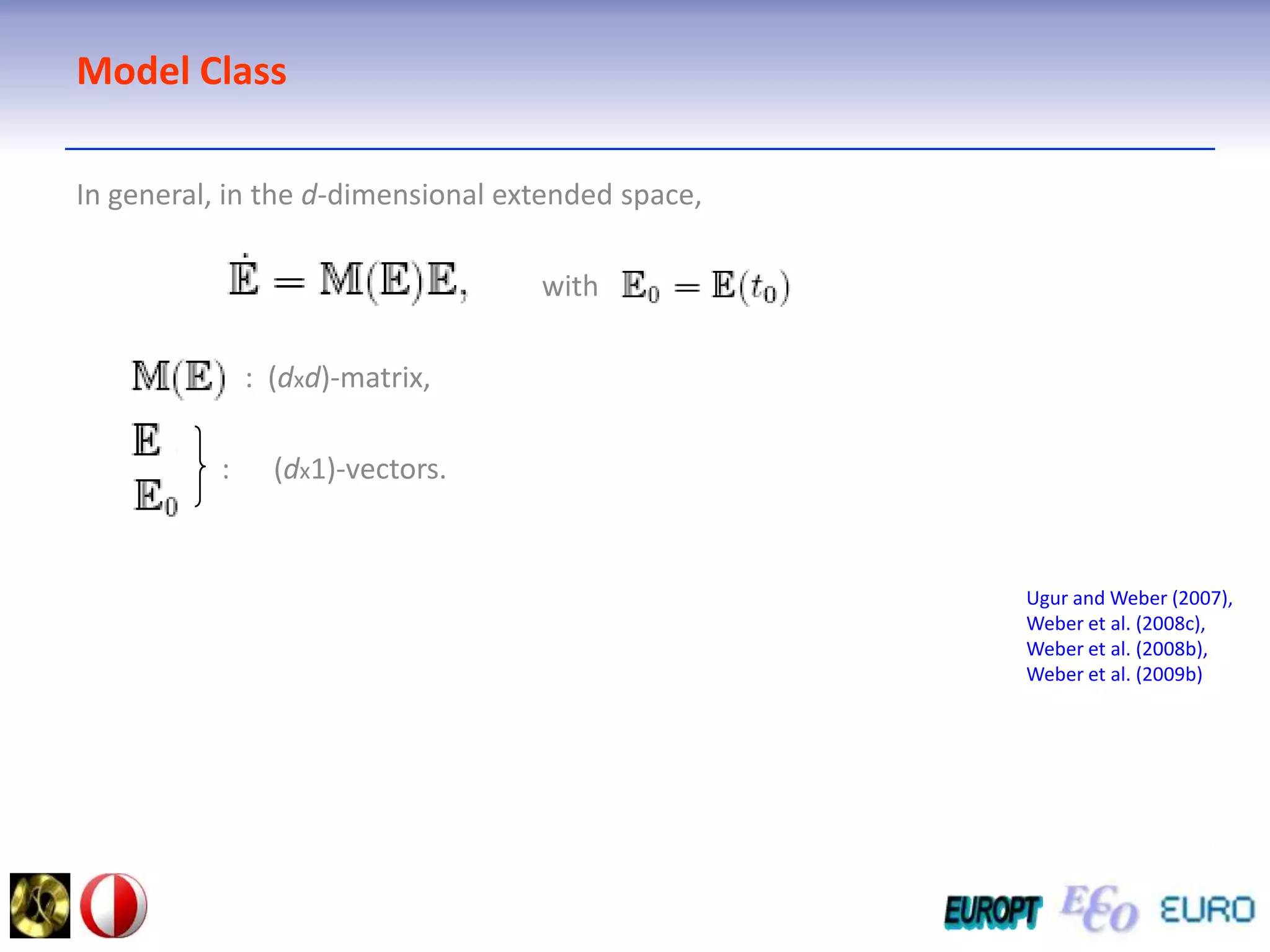
Model ClassIn general, in the d-dimensional extended space,                                                                with                     :   :  (dxd)-matrix,                    :      (dx1)-vectors.Ugur and Weber (2007), Weber et al. (2008c),Weber et al. (2008b), Weber et al. (2009b)
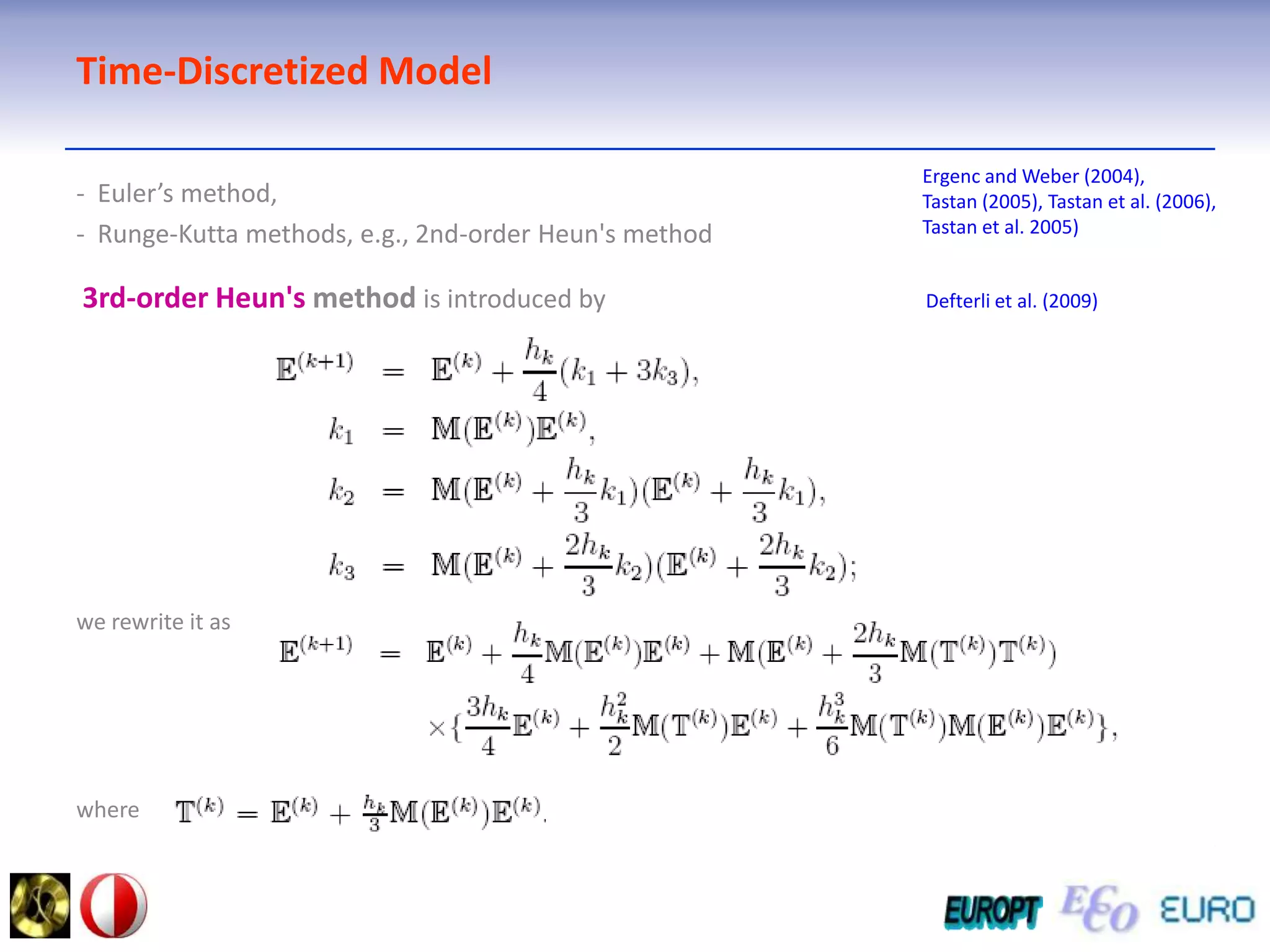
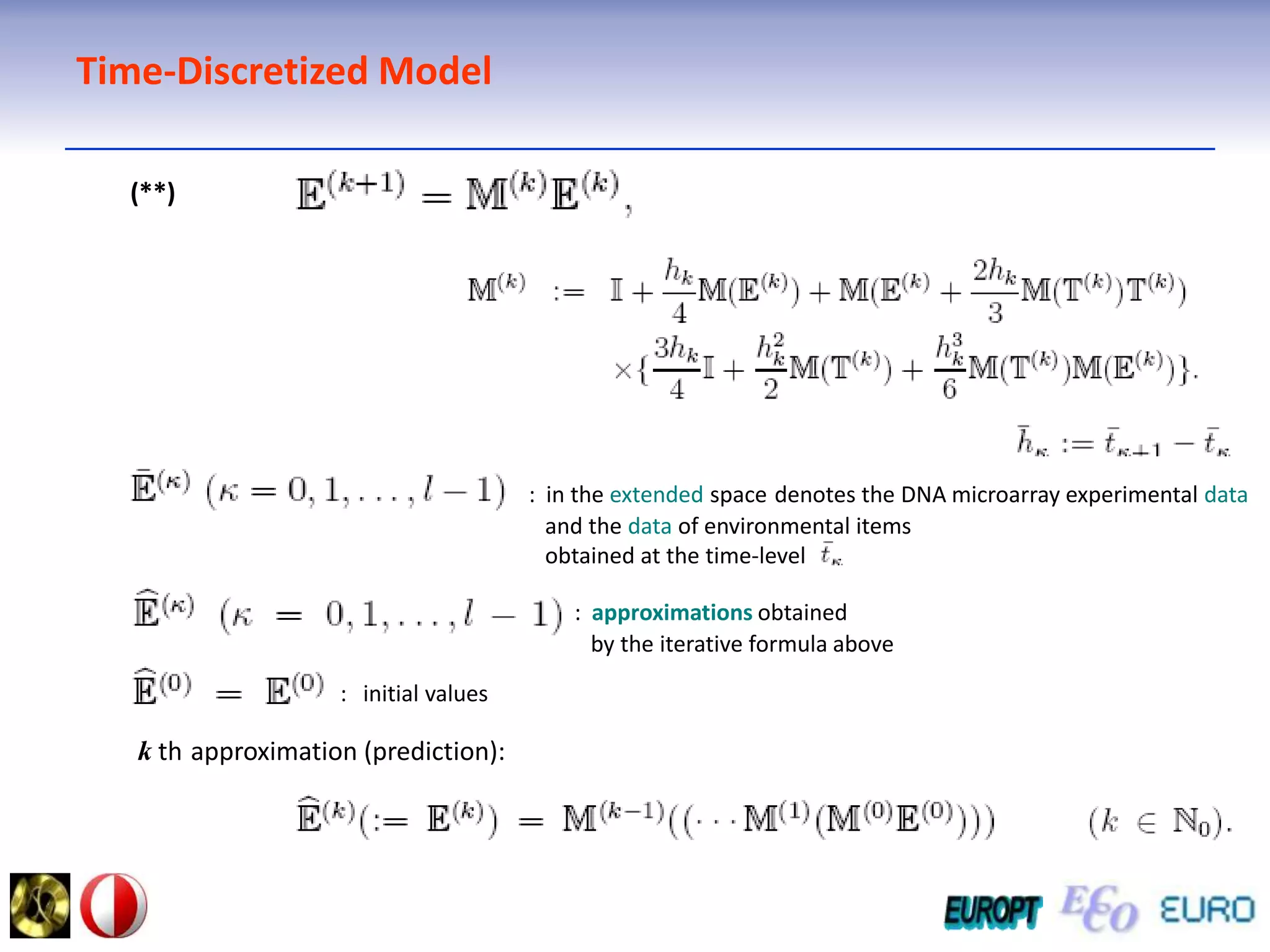
Time-Discretized Model-  Euler’s method, -  Runge-Kutta methods, e.g., 2nd-order Heun's method3rd-order Heun's method is introduced byDefterli et al. (2009)we rewrite it as whereErgenc and Weber (2004), Tastan (2005), Tastan et al. (2006),              Tastan et al. 2005)
Time-Discretized Model  (**):  in the extended spacedenotes the DNA microarray experimental dataand the data of environmental items    obtained at the time-level:  approximationsobtained   by the iterative formula above:   initial valueskthapproximation (prediction):
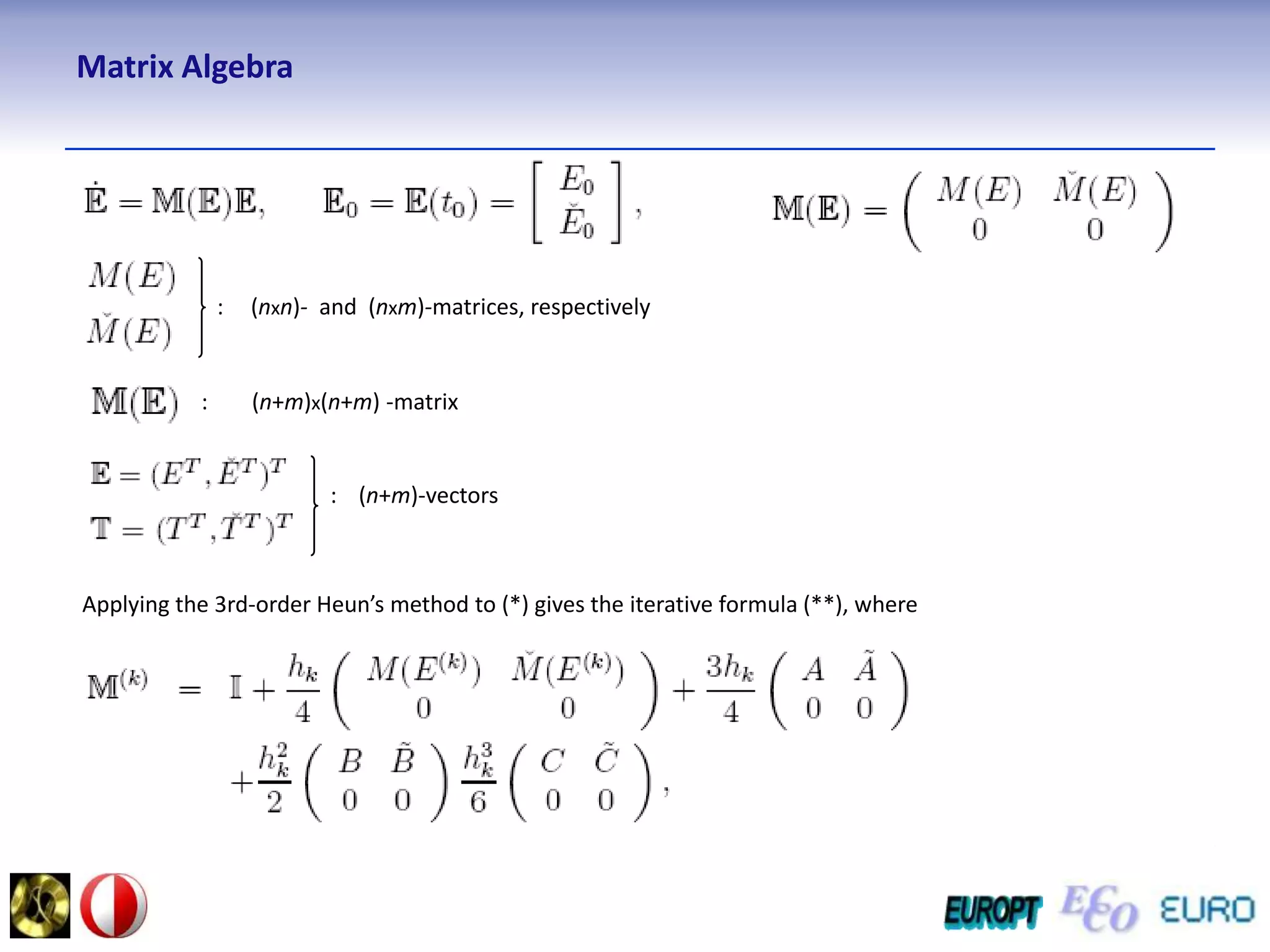
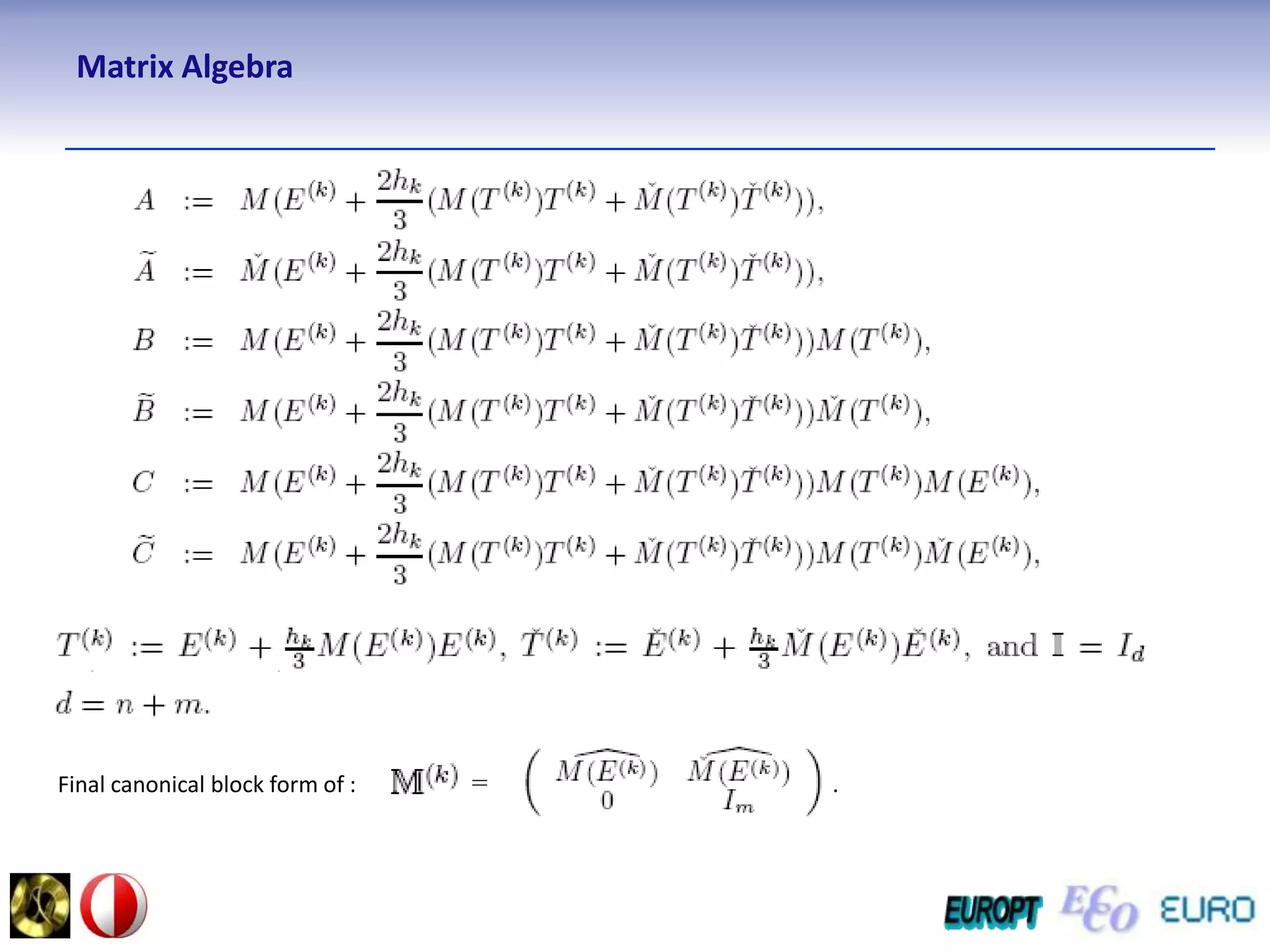
Matrix Algebra:     (nxn)- and  (nxm)-matrices, respectively:        (n+m)x(n+m) -matrix:    (n+m)-vectorsApplying the 3rd-order Heun’s method to (*) gives the iterative formula (**), where
Matrix AlgebraFinal canonical block form of :                     =  .
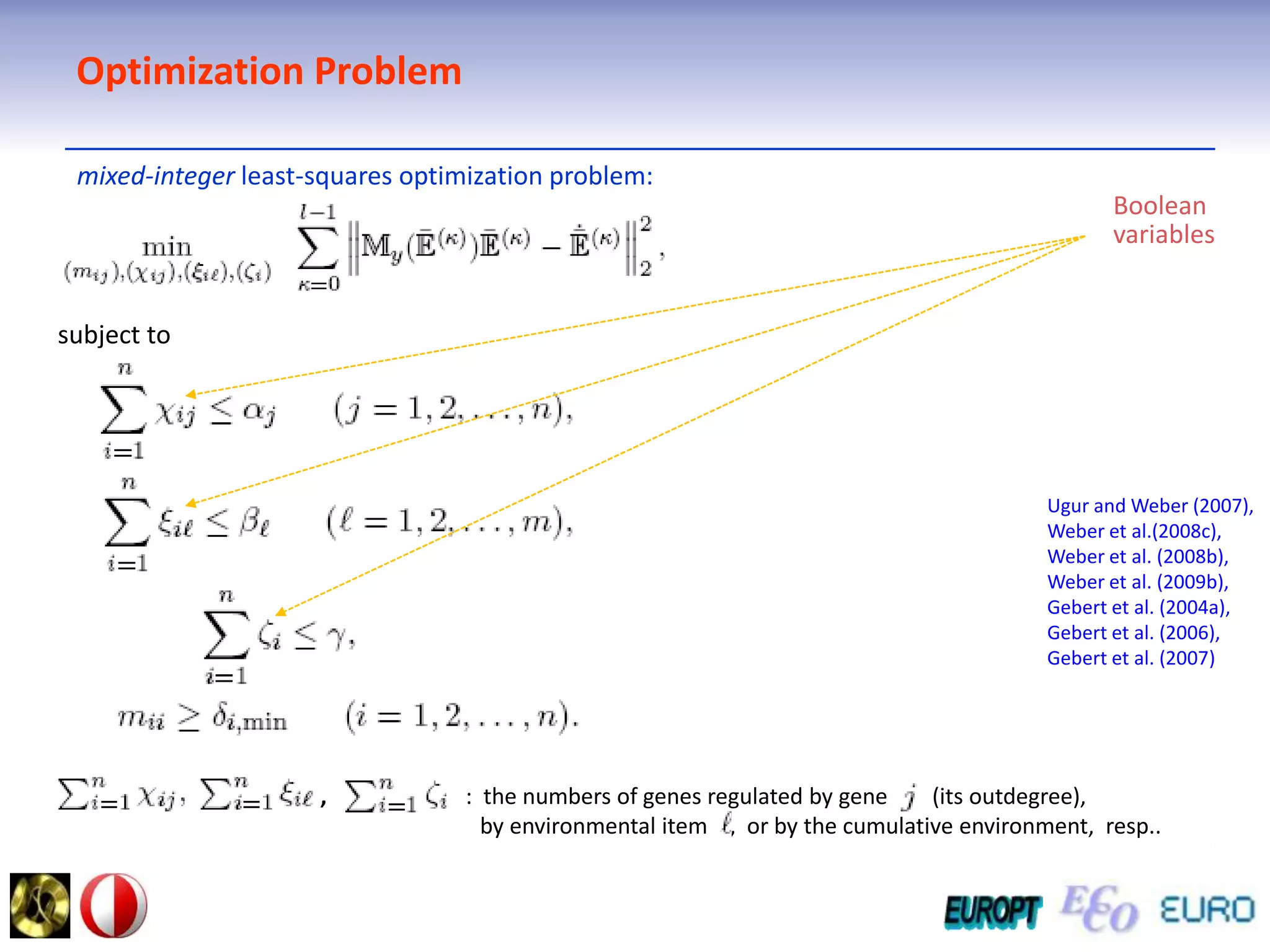
Optimization Problemmixed-integer least-squares optimization problem:Boolean variablessubject toUgur and Weber (2007),Weber et al.(2008c),Weber et al. (2008b),Weber et al. (2009b), Gebert et al. (2004a), Gebert et al. (2006), Gebert et al. (2007),   , : th              :  the numbers of genes regulated by gene        (its outdegree),                                                     by environmental item    ,  or by the cumulative environment,  resp..
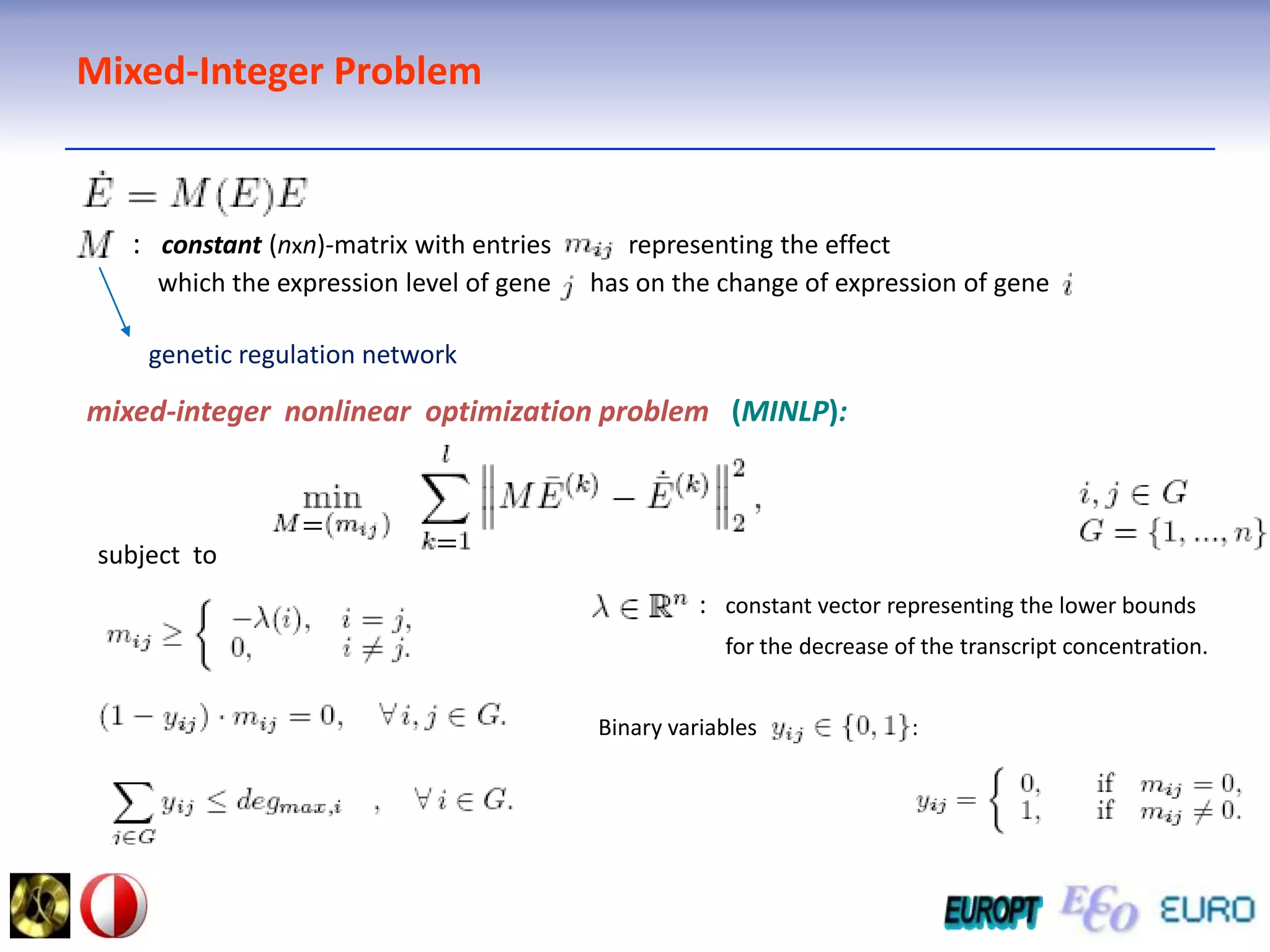
Mixed-Integer Problem:  constant (nxn)-matrix with entries            representing the effect    which the expression level of gene      has on the change of expression of genegenetic regulation network  mixed-integer  nonlinear  optimization problem   (MINLP):subject  to   :   constant vectorrepresenting the lower bounds        for the decrease of the transcript concentration.Binary variables                            :
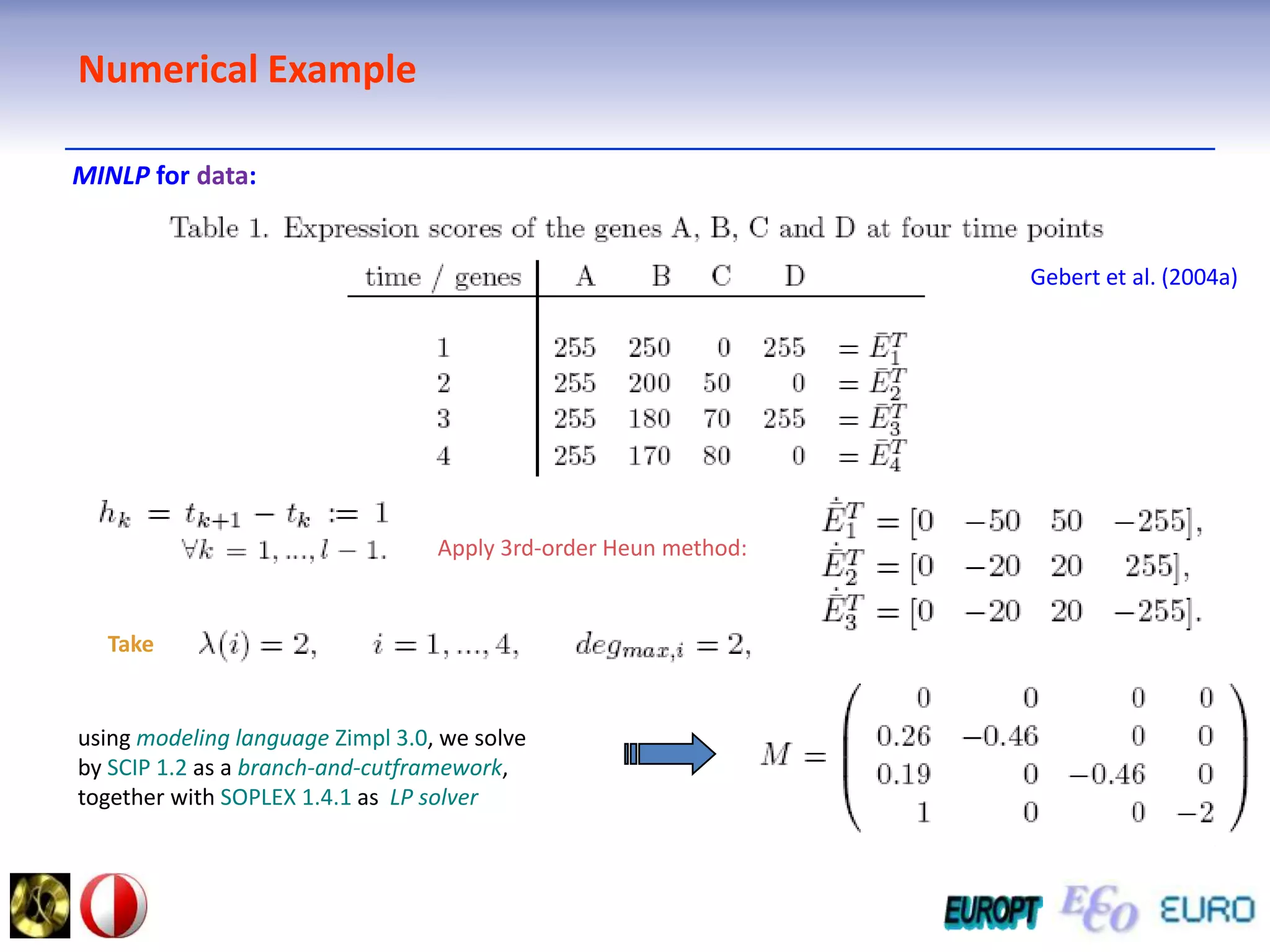
Numerical ExampleMINLP for data: Gebert et al. (2004a)Apply 3rd-order Heun method:Takeusing modeling language Zimpl 3.0, we solveby SCIP 1.2 as a branch-and-cutframework,                       together with SOPLEX 1.4.1 as LP solver
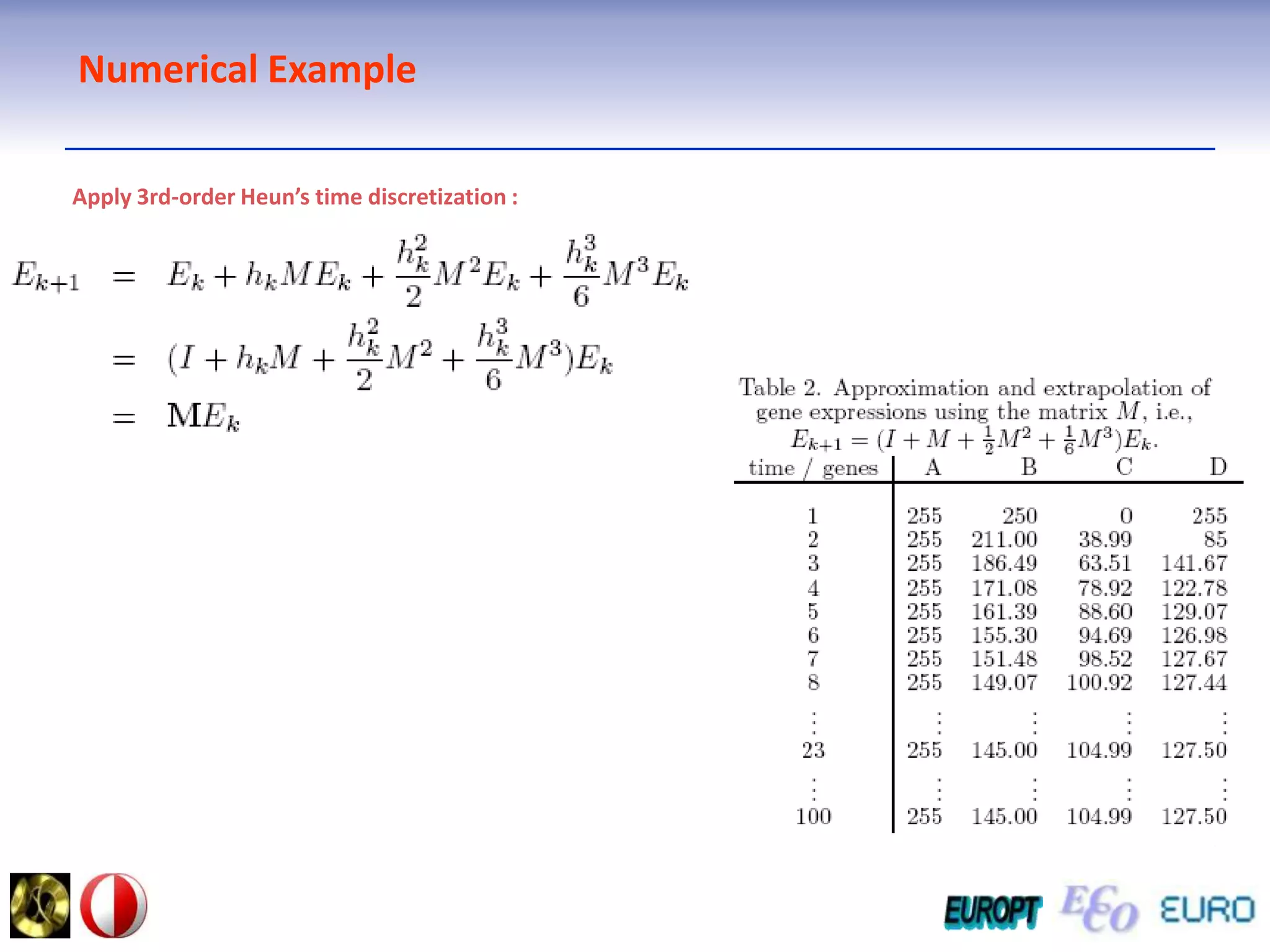
Numerical ExampleApply 3rd-order Heun’s time discretization :
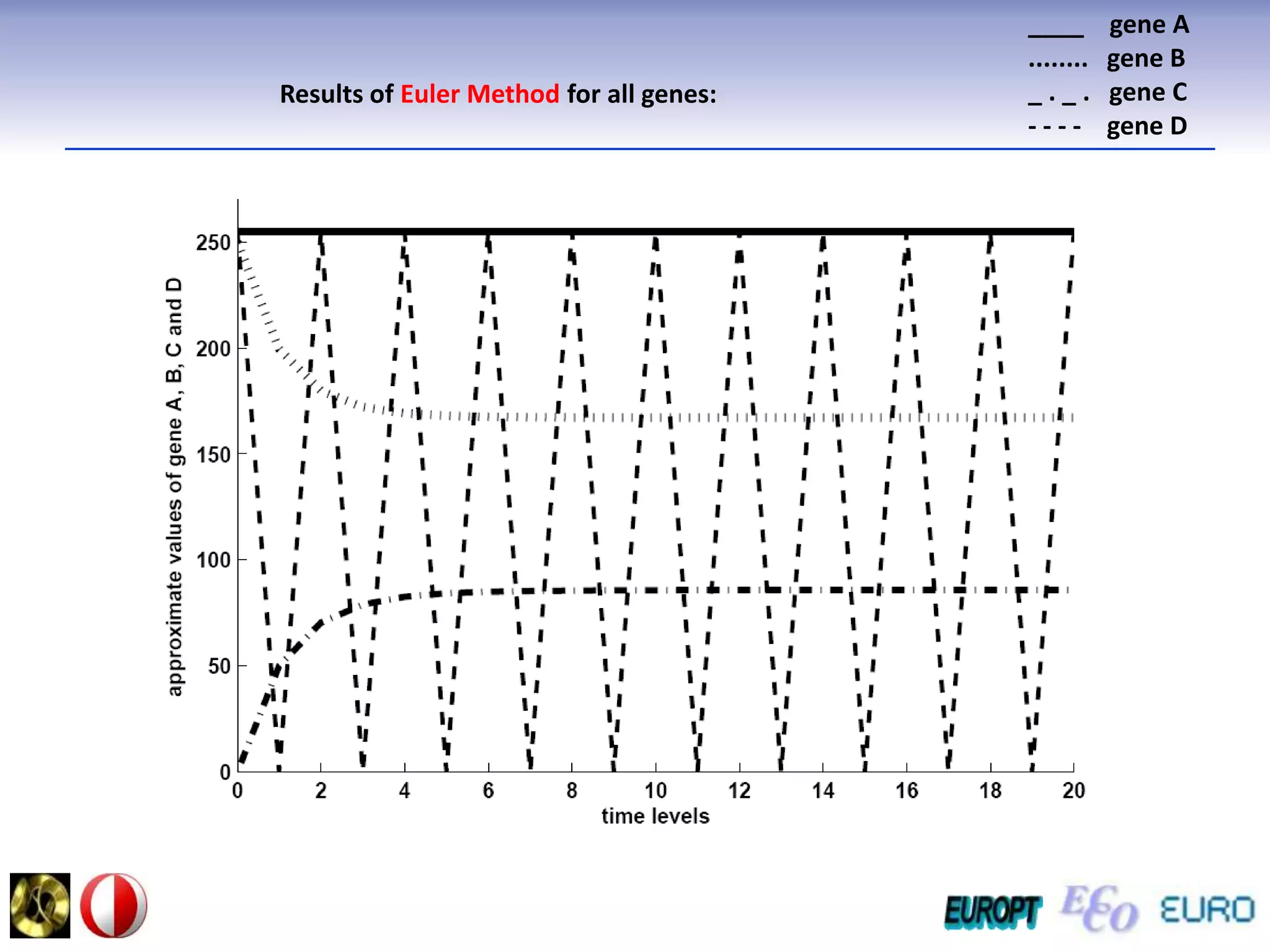
____    gene A........   gene B_ . _ .   gene C- - - -    gene DResults of Euler Method for all genes:
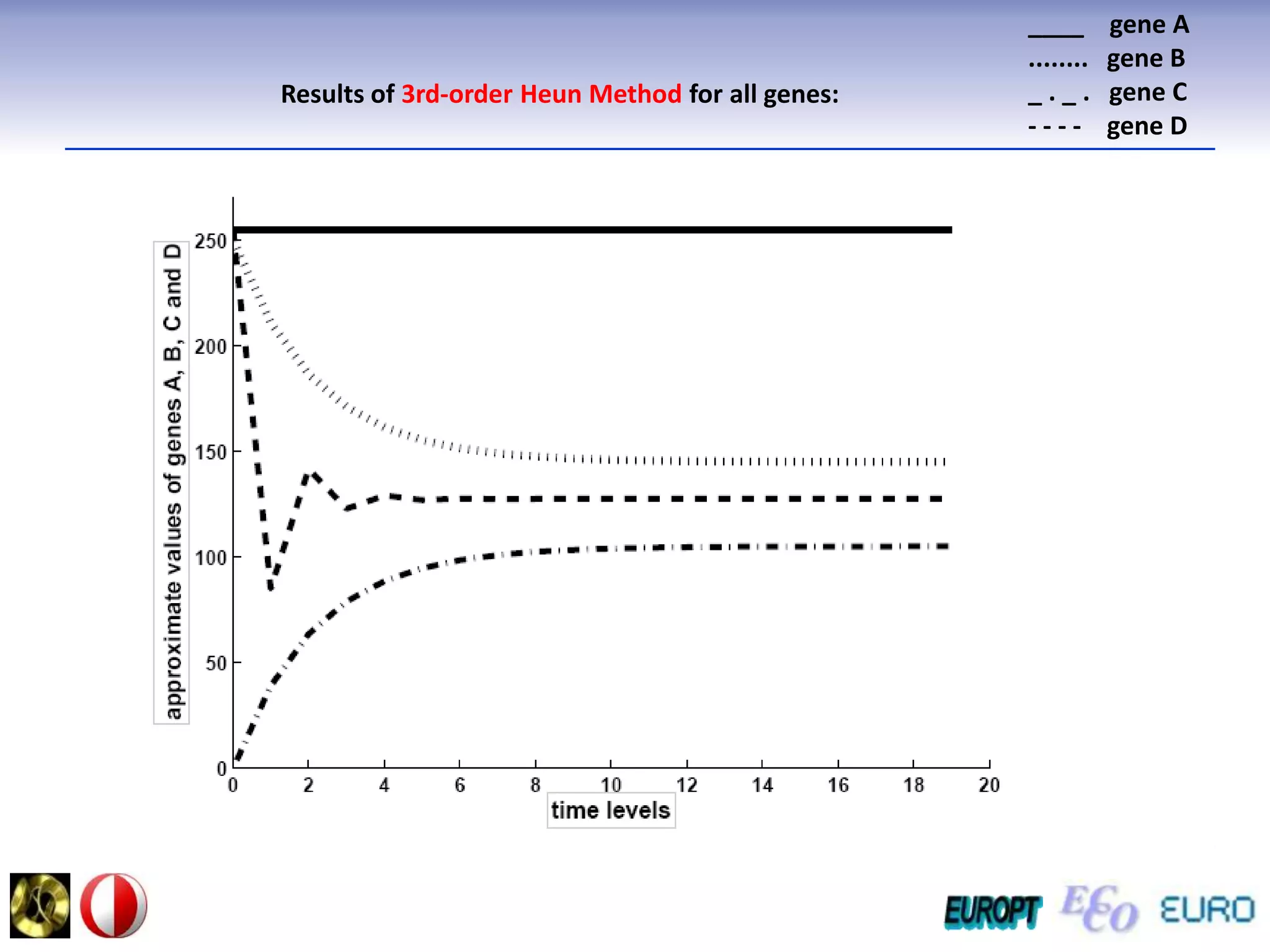
____    gene A........   gene B_ . _ .   gene C- - - -    gene DResults of 3rd-order Heun Method for all genes:
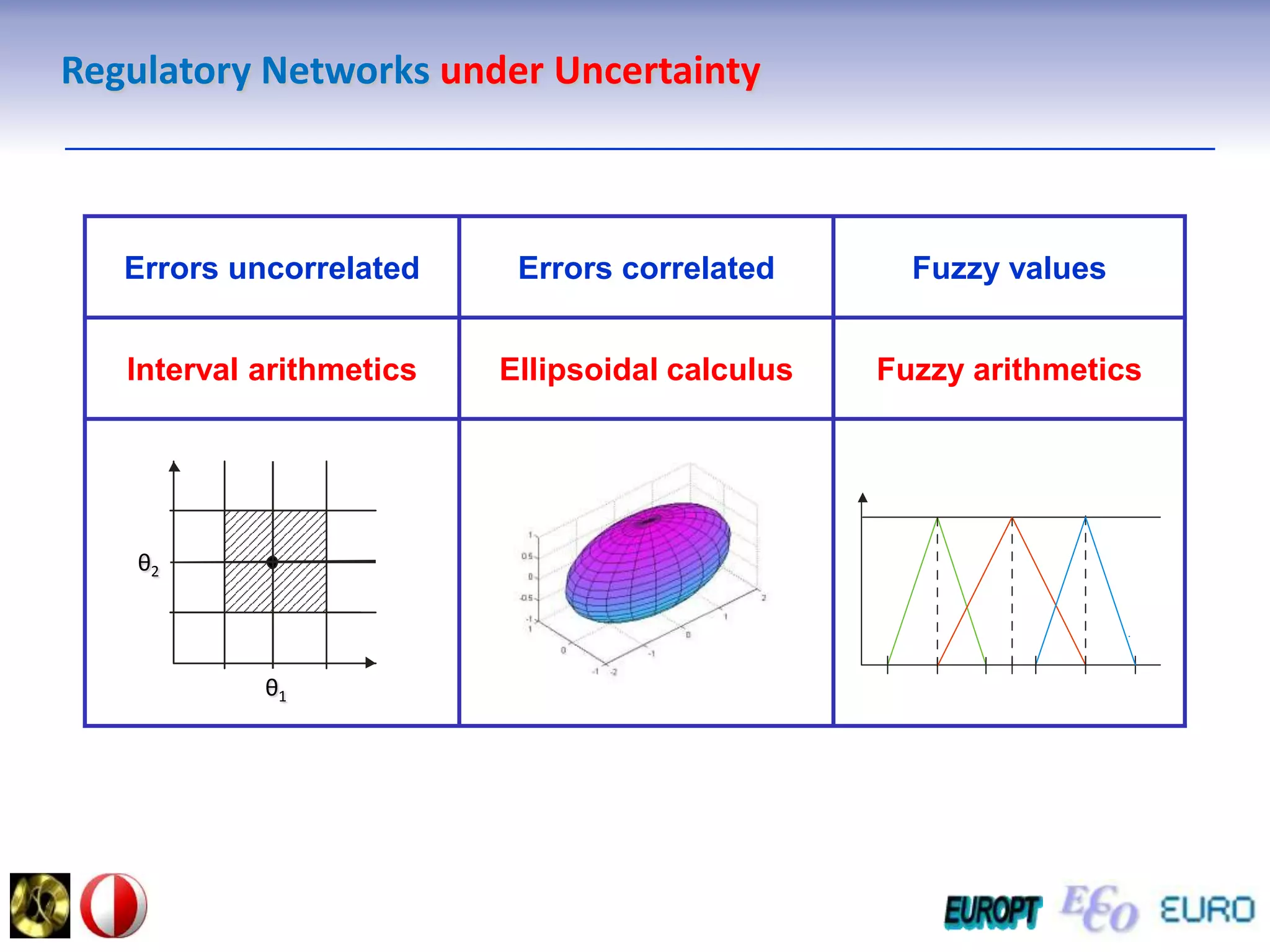
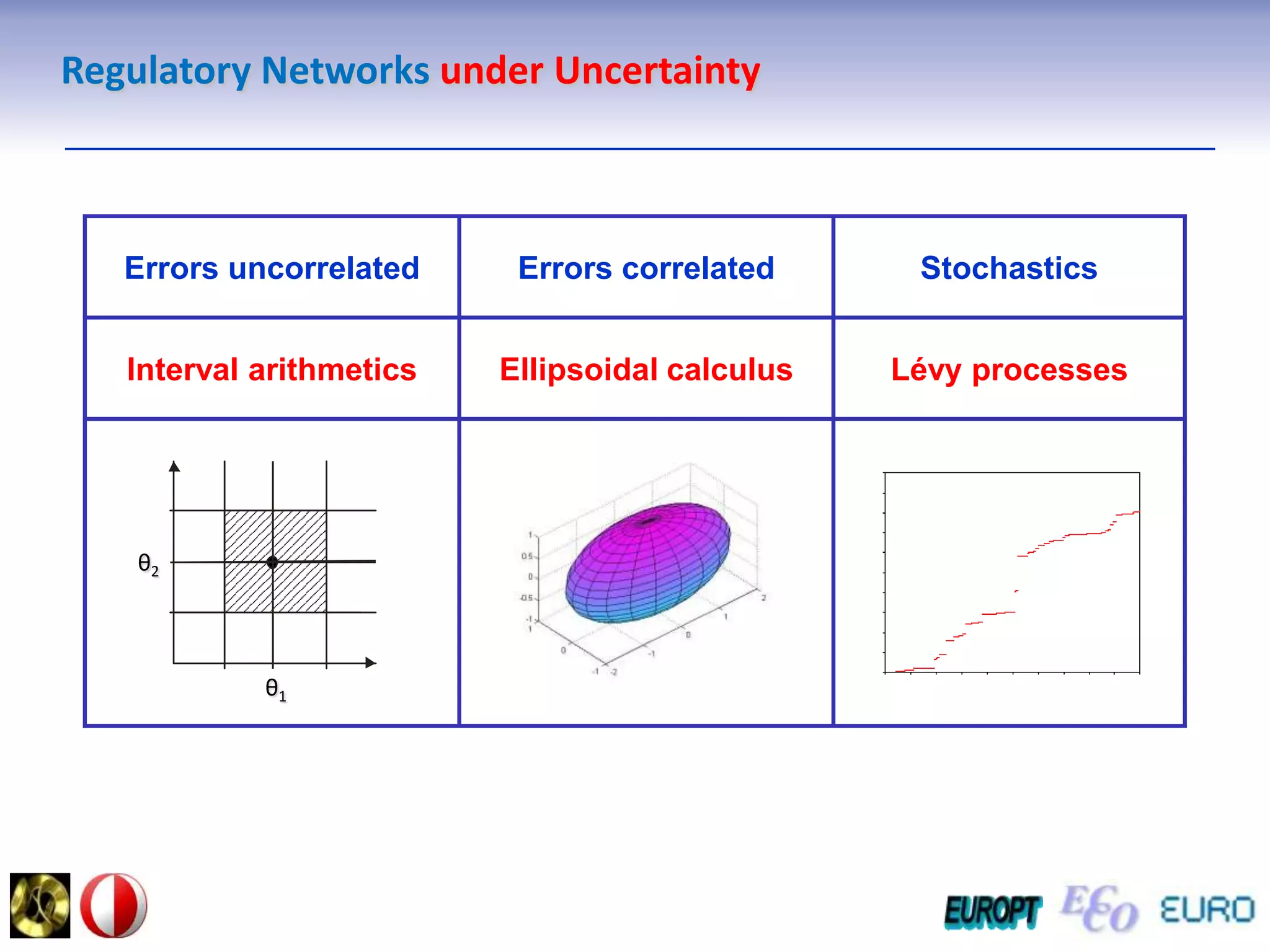
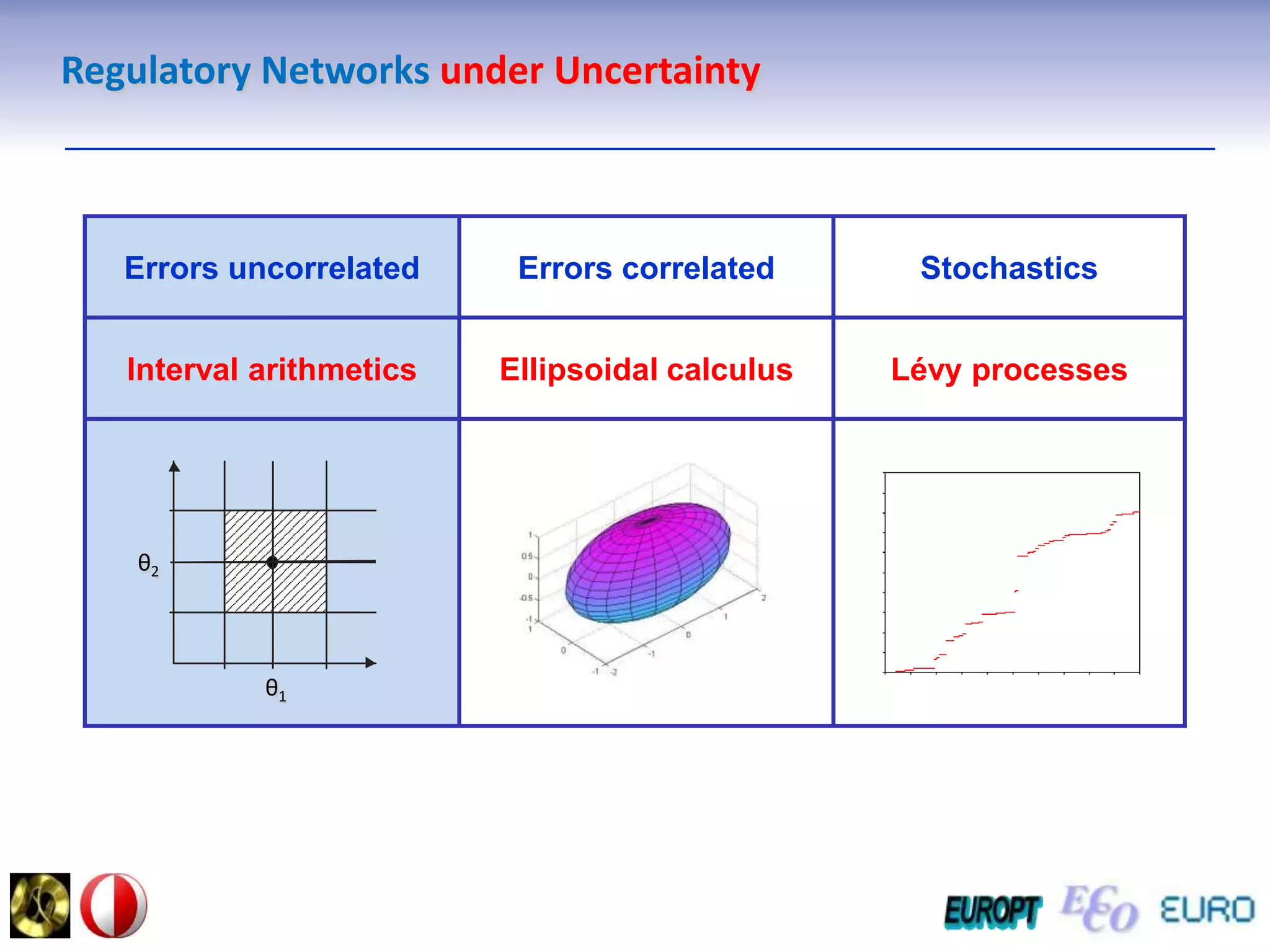
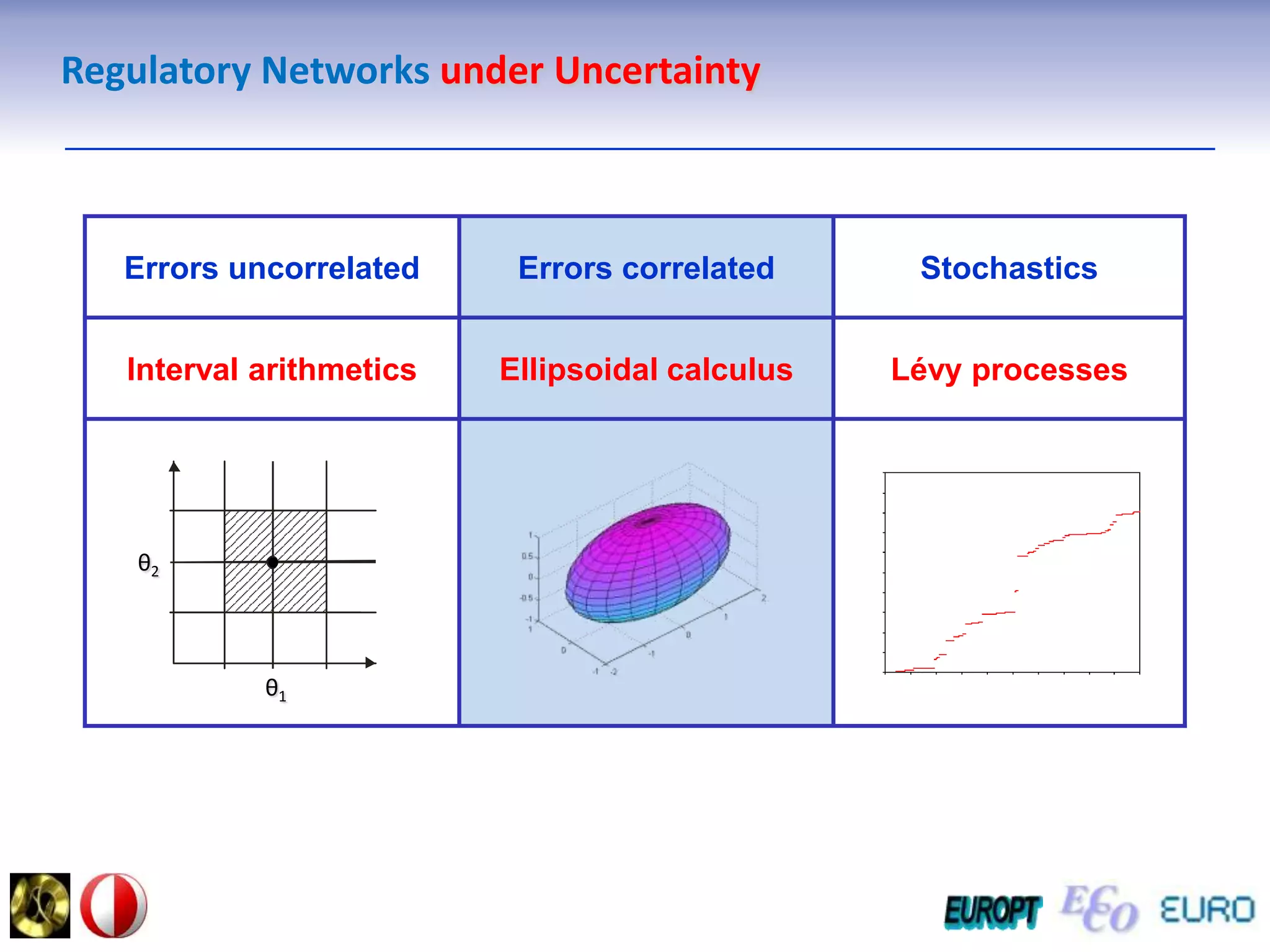
Regulatory NetworksunderUncertaintyθ2θ1
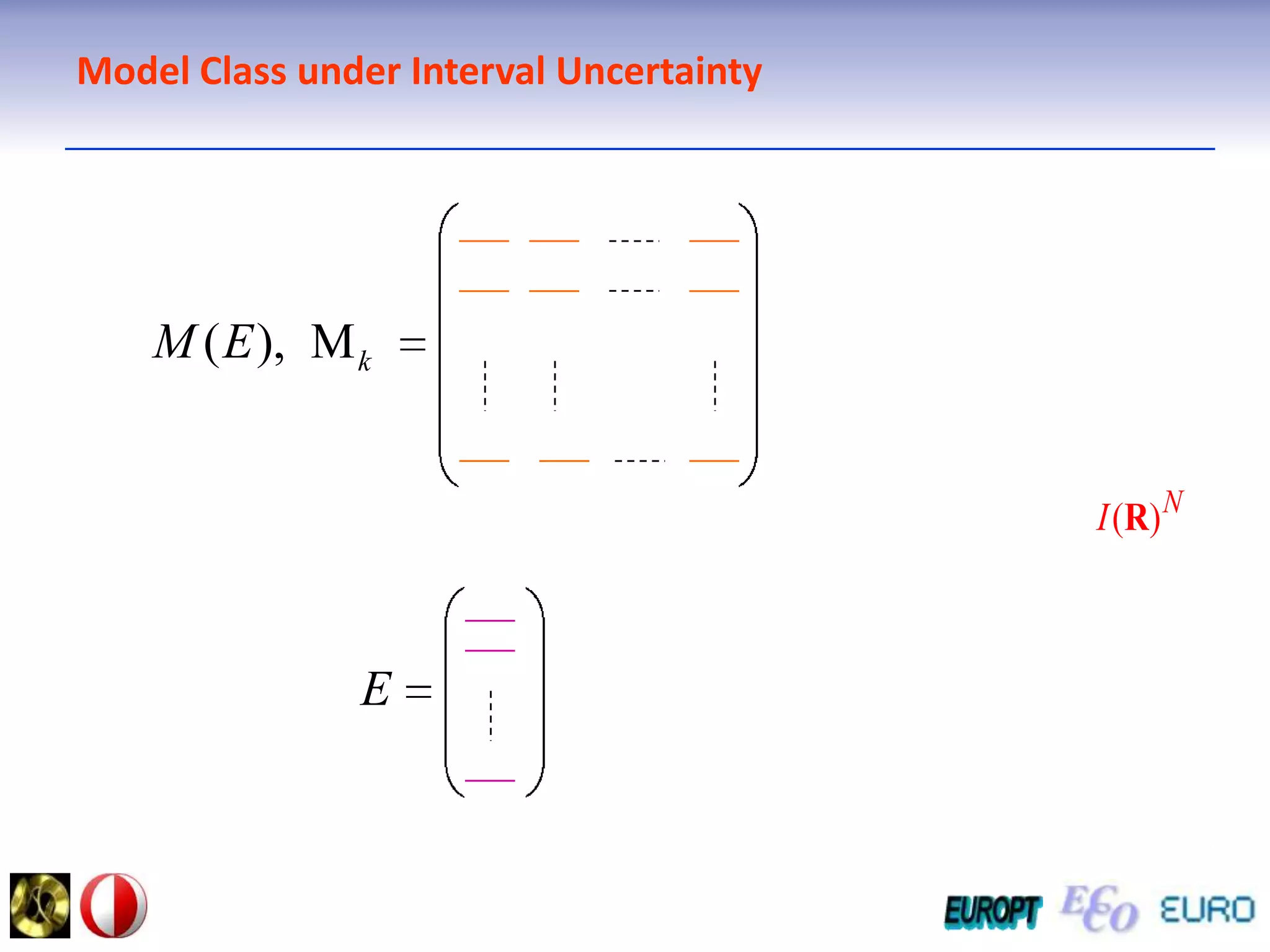
Model Class under Interval Uncertainty
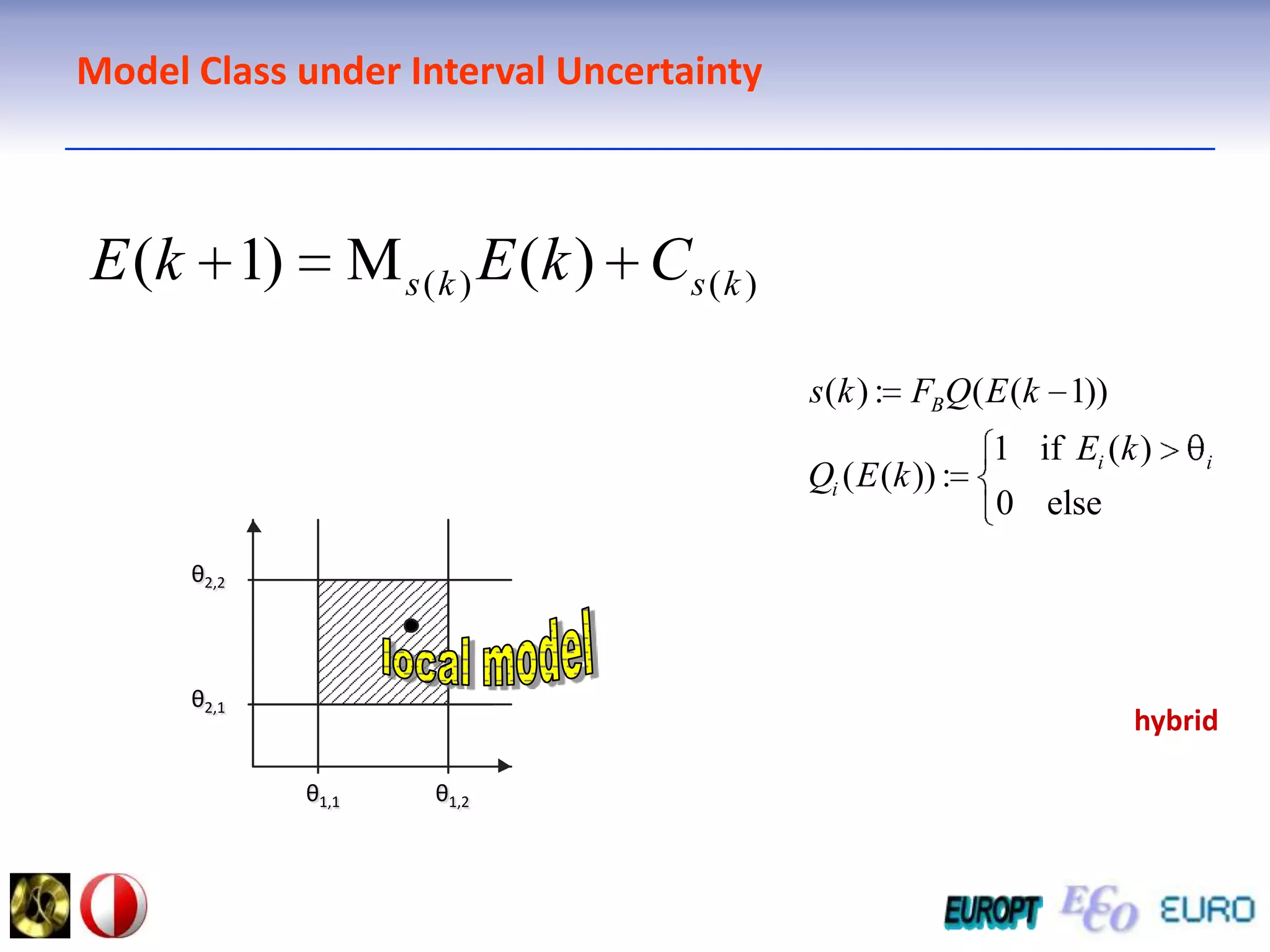
Model Class under Interval Uncertaintyθ2,2hybridlocal modelθ2,1θ1,1θ1,2
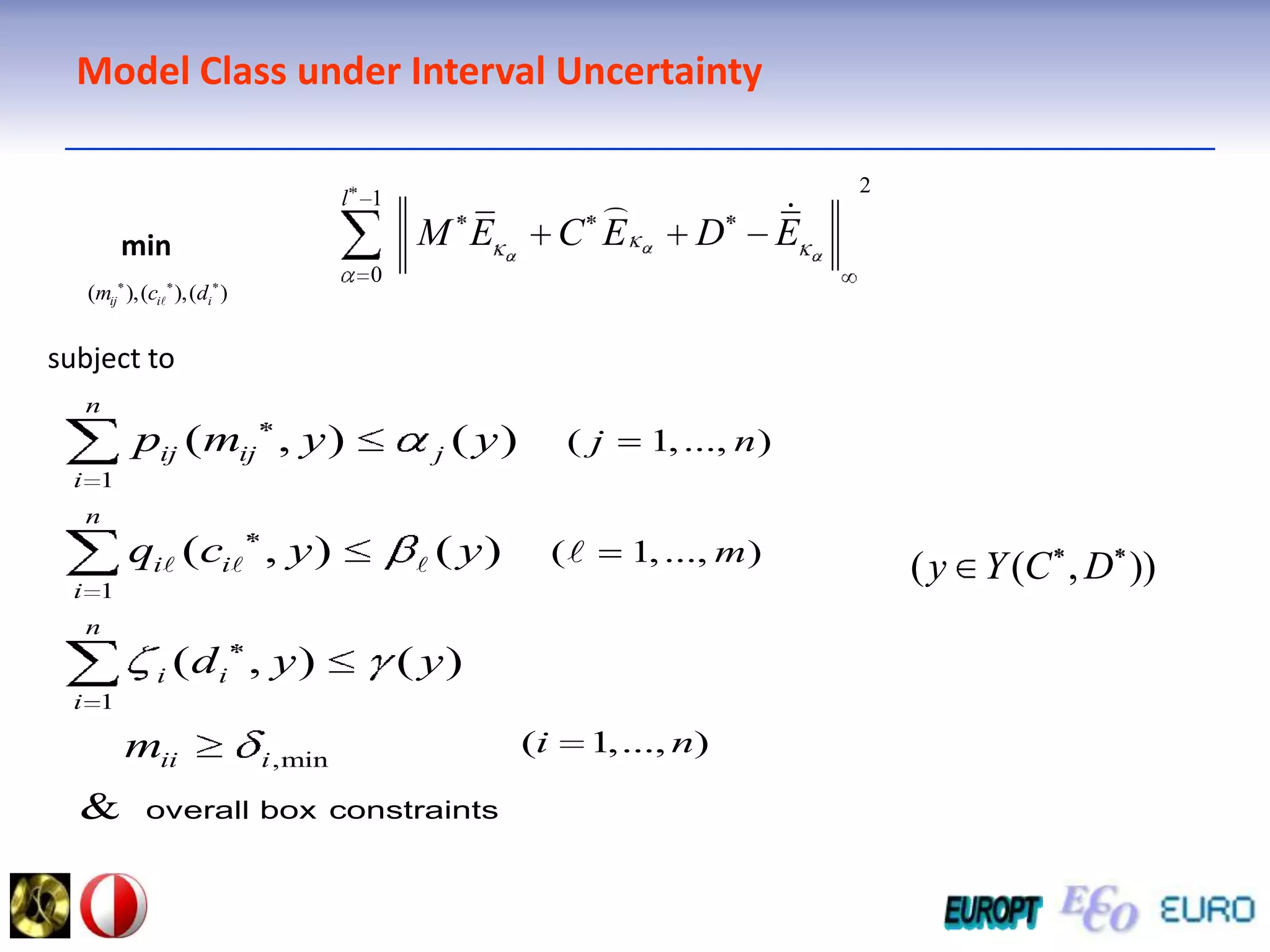
Model Class under Interval Uncertaintyminsubject to
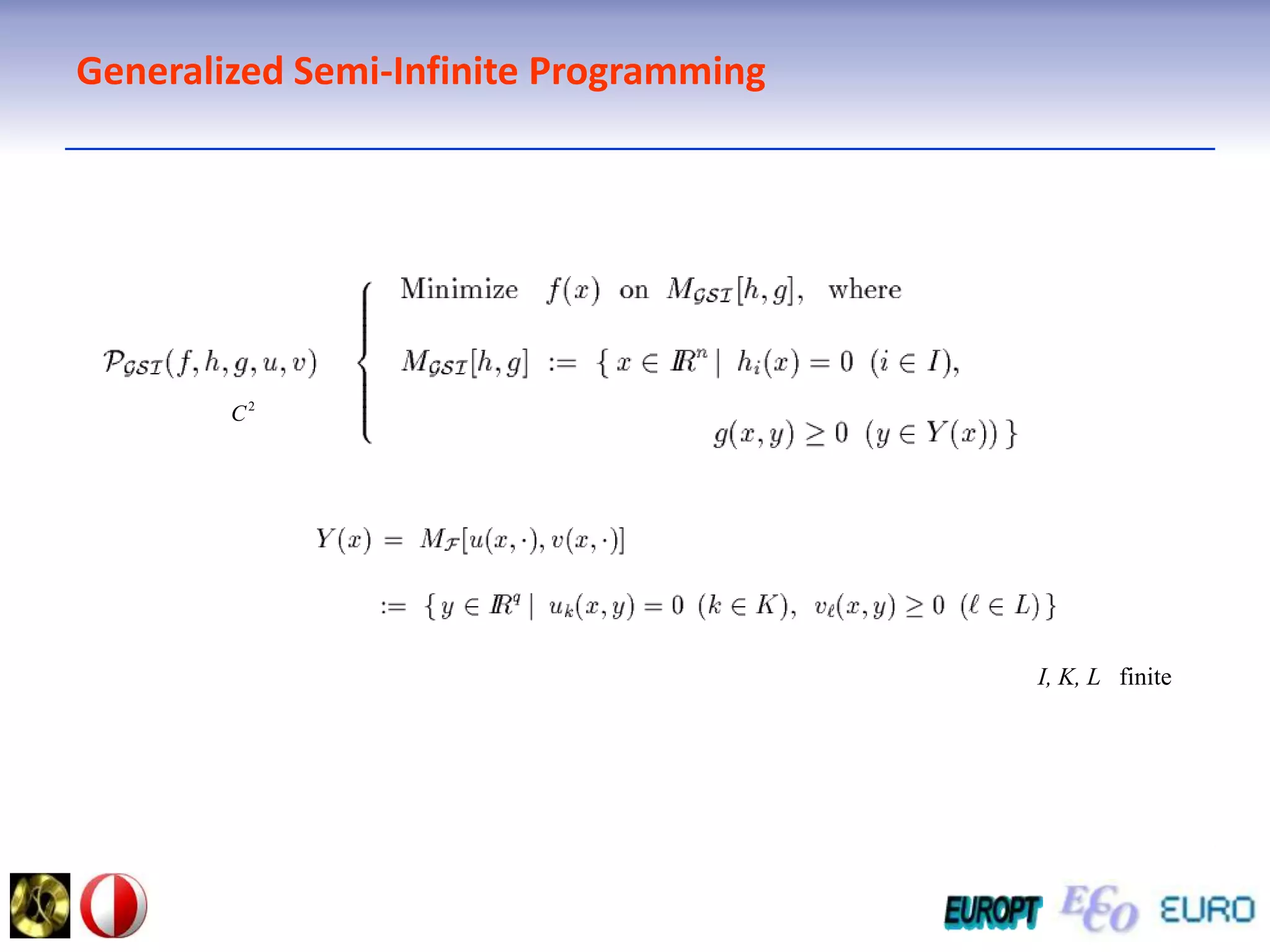
Generalized Semi-Infinite ProgrammingI, K, L   finite
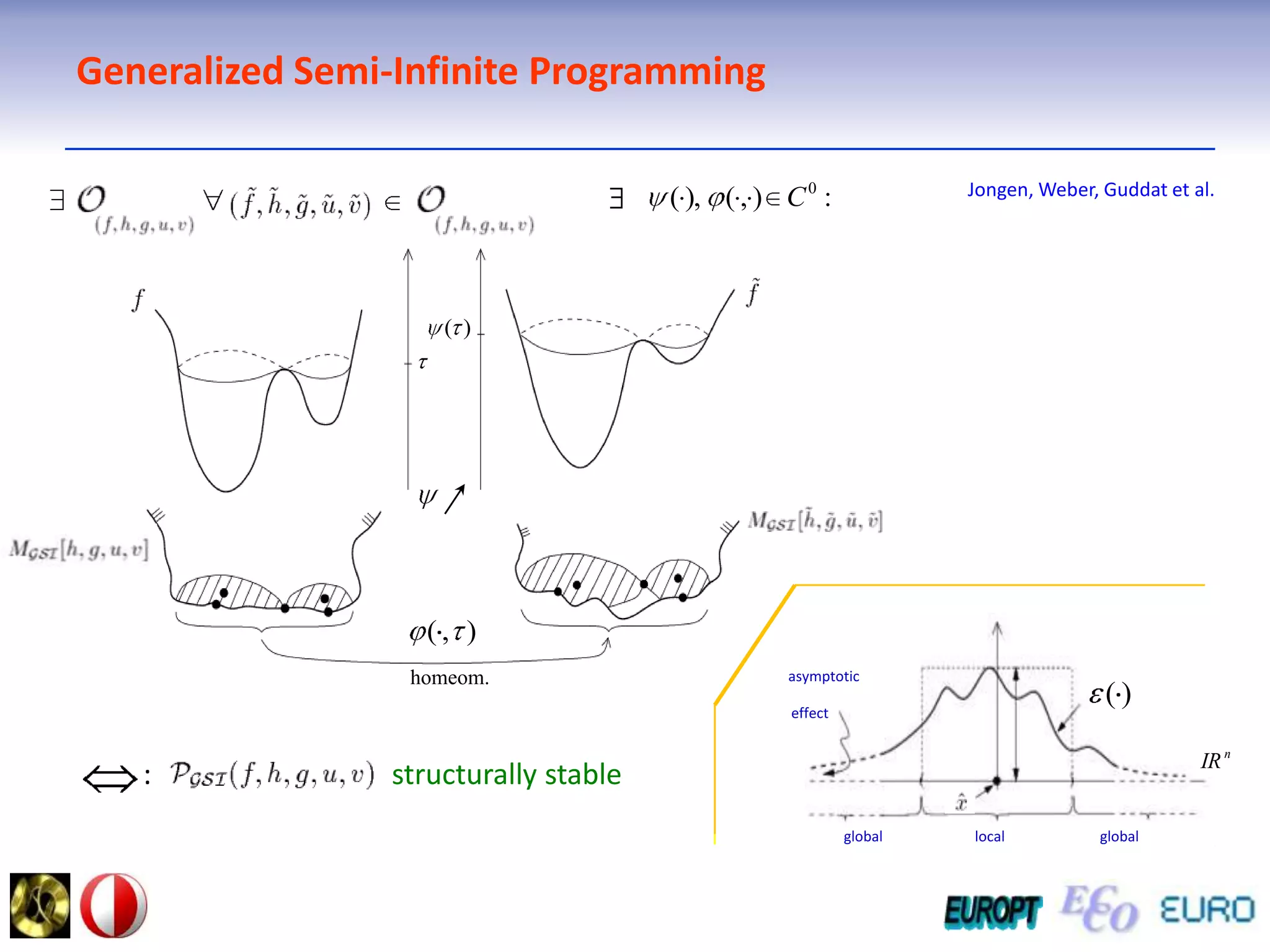
Generalized Semi-Infinite ProgrammingJongen, Weber, Guddat et al.homeom.        asymptoticeffect:        structurally stableglobal                          local                           global
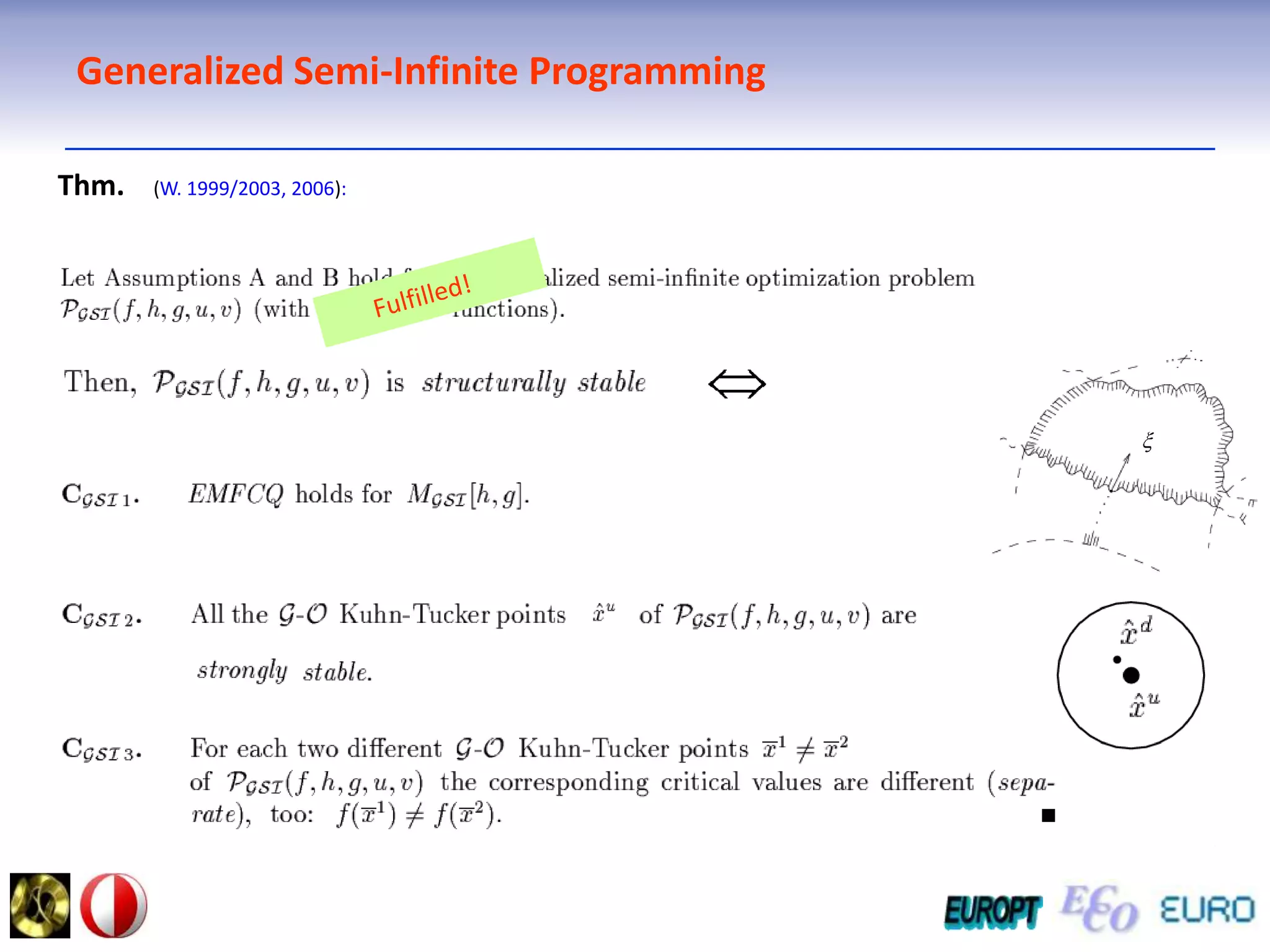
Generalized Semi-Infinite ProgrammingThm.    (W. 1999/2003, 2006):Fulfilled!
Regulatory NetworksunderUncertaintyθ2θ1
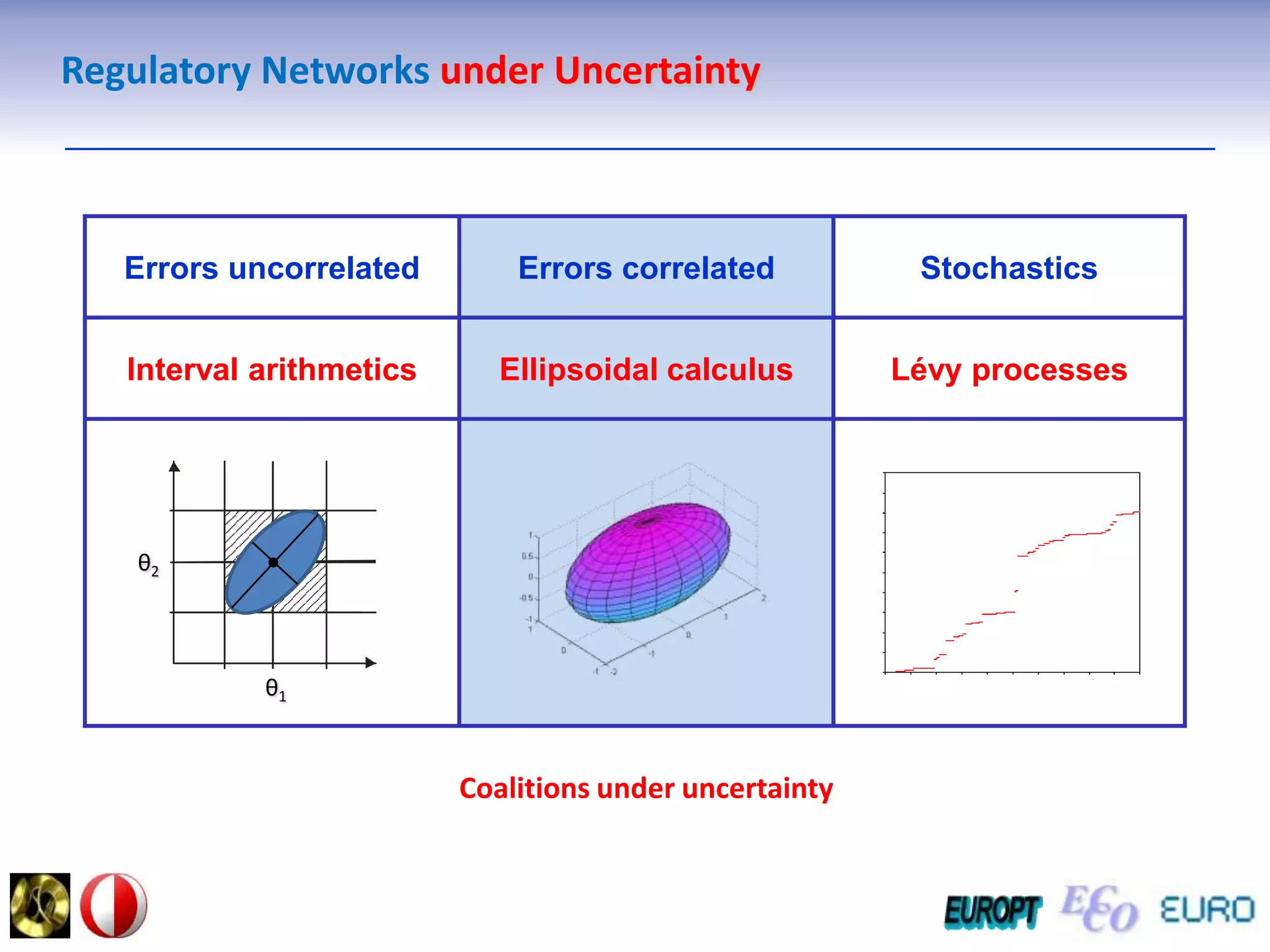
Regulatory NetworksunderUncertaintyθ2θ1Coalitions under uncertainty
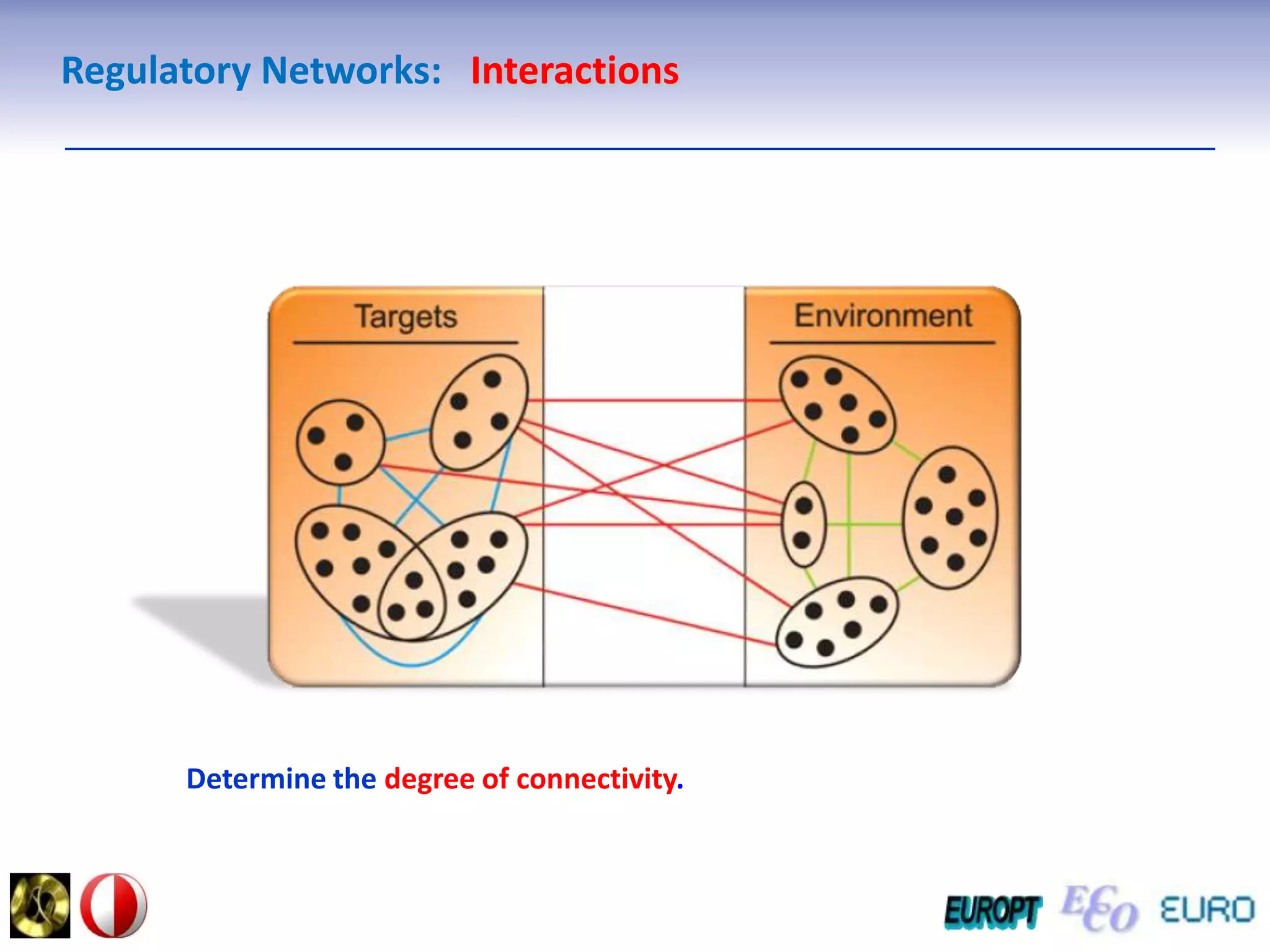
Regulatory Networks:   InteractionsDetermine the degree of connectivity.
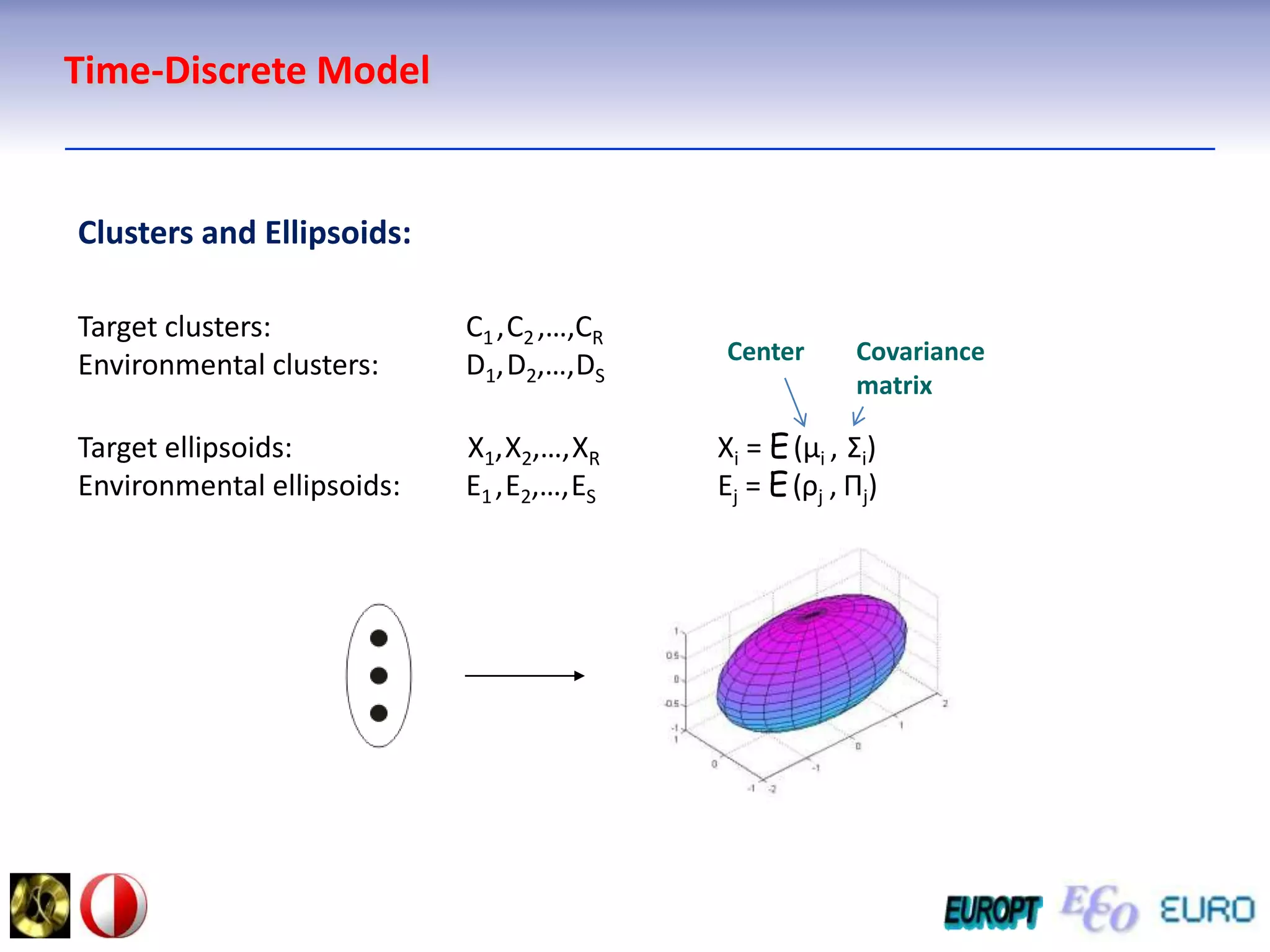
Time-Discrete ModelClusters and Ellipsoids:Target clusters: 	             C1,C2,…,CREnvironmental clusters:	 D1,D2,…,DSTarget ellipsoids:                   X1,X2,…,XRXi = E(μi , Σi) Environmental ellipsoids:	 E1,E2,…,ES	 Ej = E(ρj ,Πj) CenterCovariance matrix
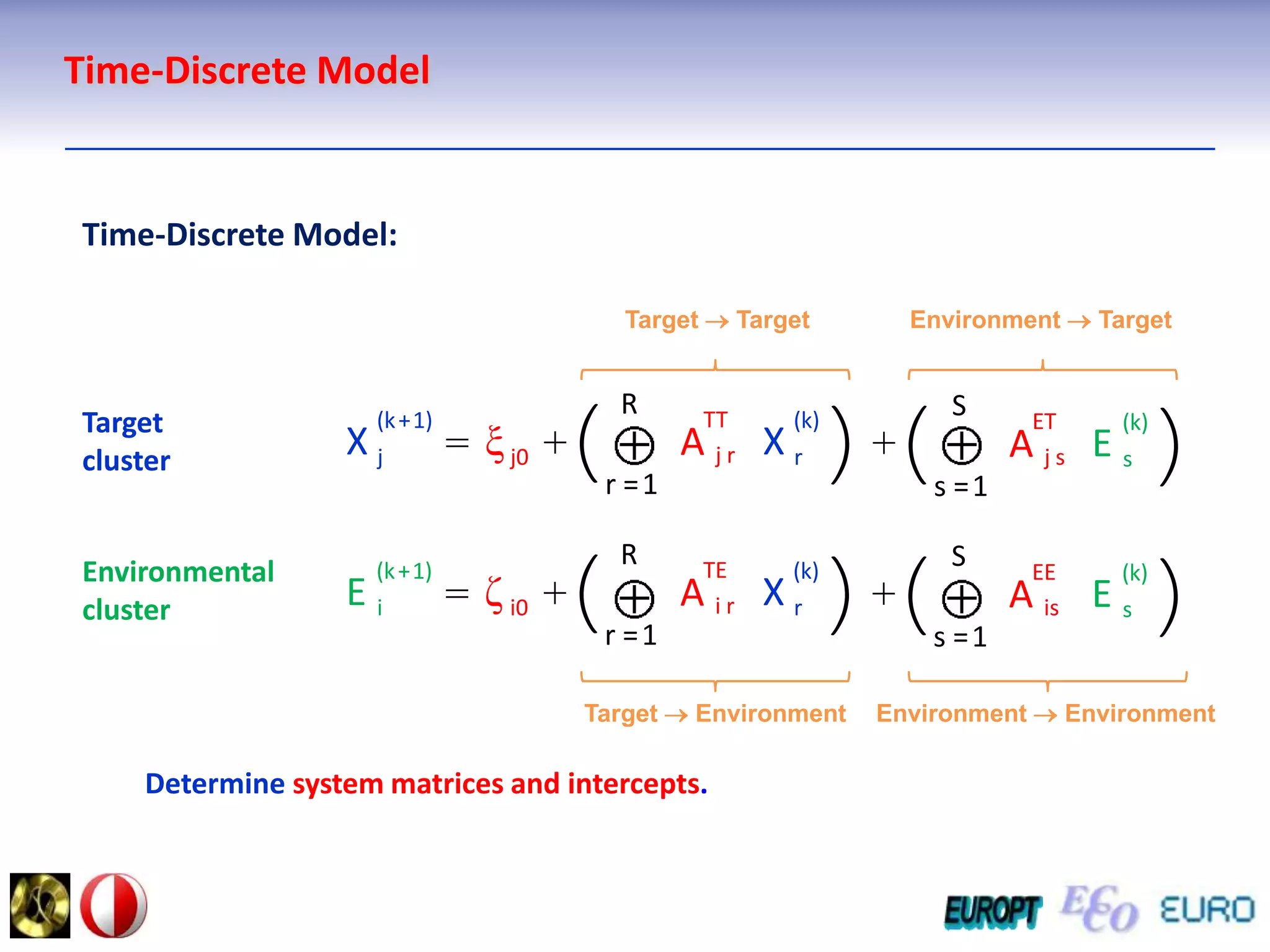
Time-Discrete ModelTime-Discrete Model:Target  TargetEnvironment  Target(R)(S)TargetclusterTT(k)(k+1)ET(k)XξXA++=EAj r r j0j s j sr =1s =1(R)(S)Environmental clusterTE(k)(k+1)EE(k)XζEA++=EAi r r i0is i sr =1s =1Target  EnvironmentEnvironment  Environment  Determine system matrices and intercepts.
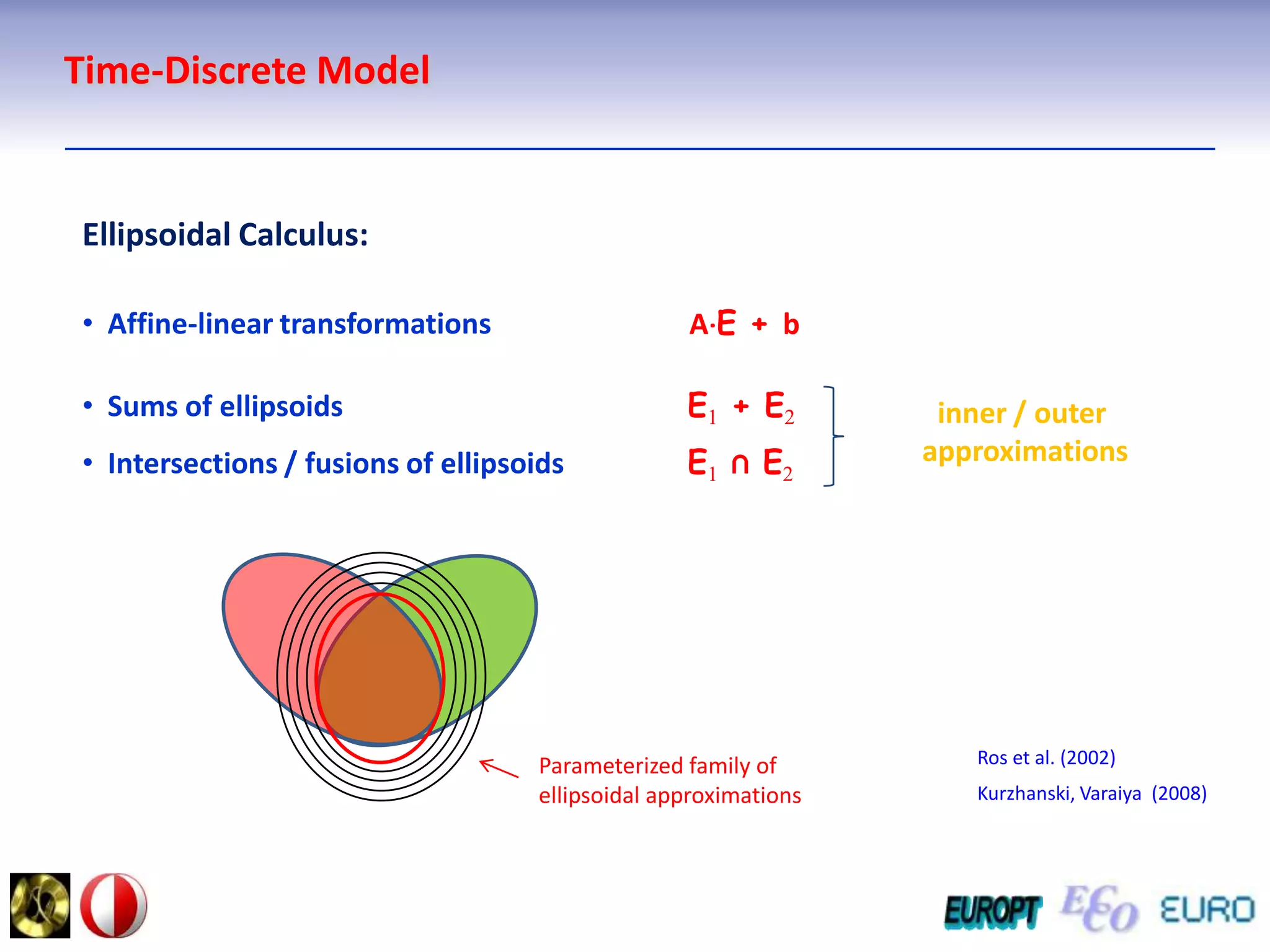
Time-Discrete ModelEllipsoidal Calculus:  Affine-linear transformations
  Sums of ellipsoids
  Intersections / fusions of ellipsoidsAE + bE1 + E2inner / outer approximationsE1∩ E2Ros et al. (2002)Parameterized family of ellipsoidal approximationsKurzhanski, Varaiya  (2008)
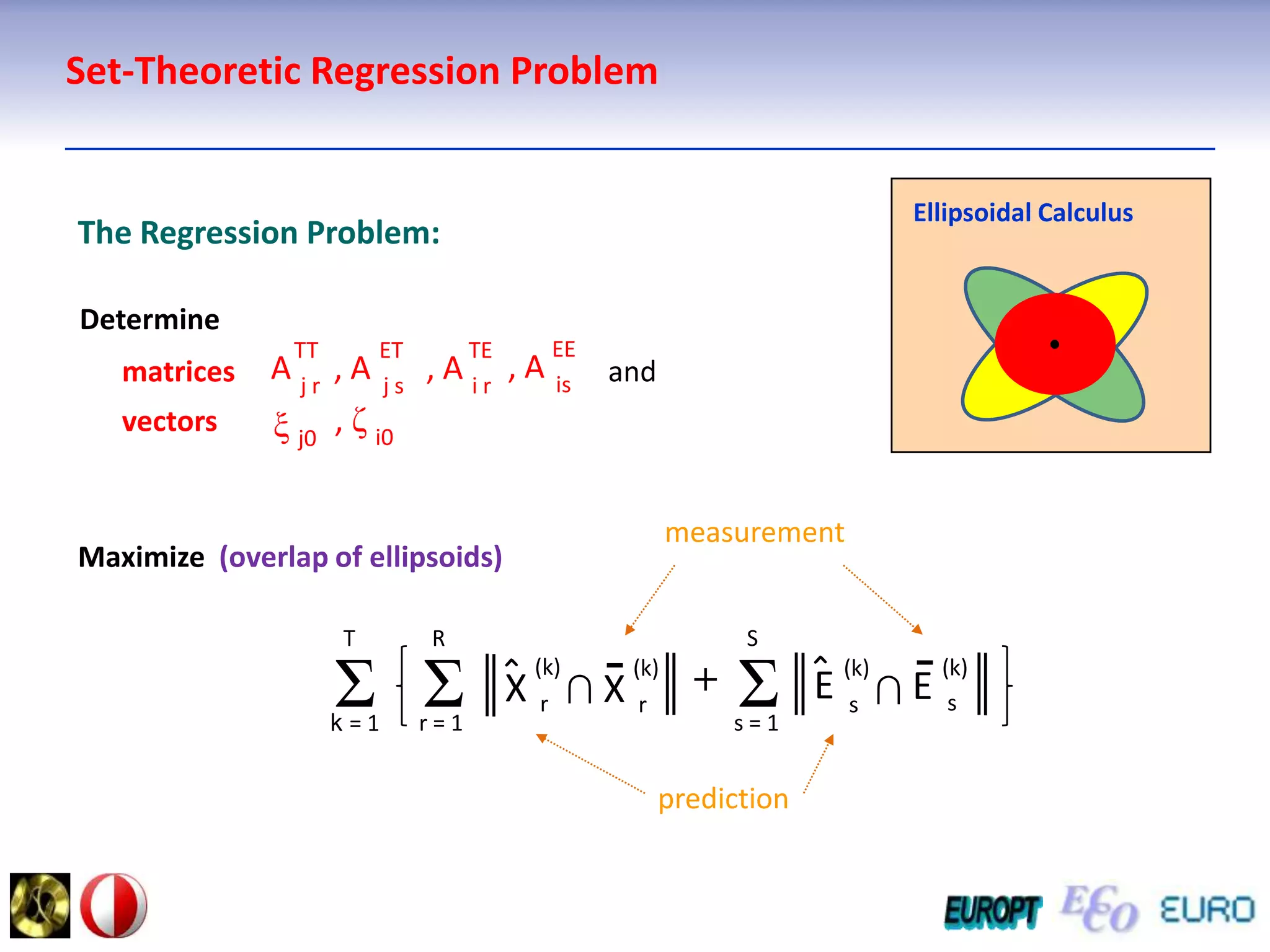
Set-Theoretic Regression ProblemEllipsoidal CalculusThe Regression Problem:Maximize(overlap of ellipsoids)    DetermineEETTETTE, AA, A, Amatricesand isj rj si r,ζvectorsξ i0 j0measurementRSTΣΣΣ−−^(k)(k)(k)(k)+^EEXX∩∩ s r r sr = 1s = 1k= 1prediction
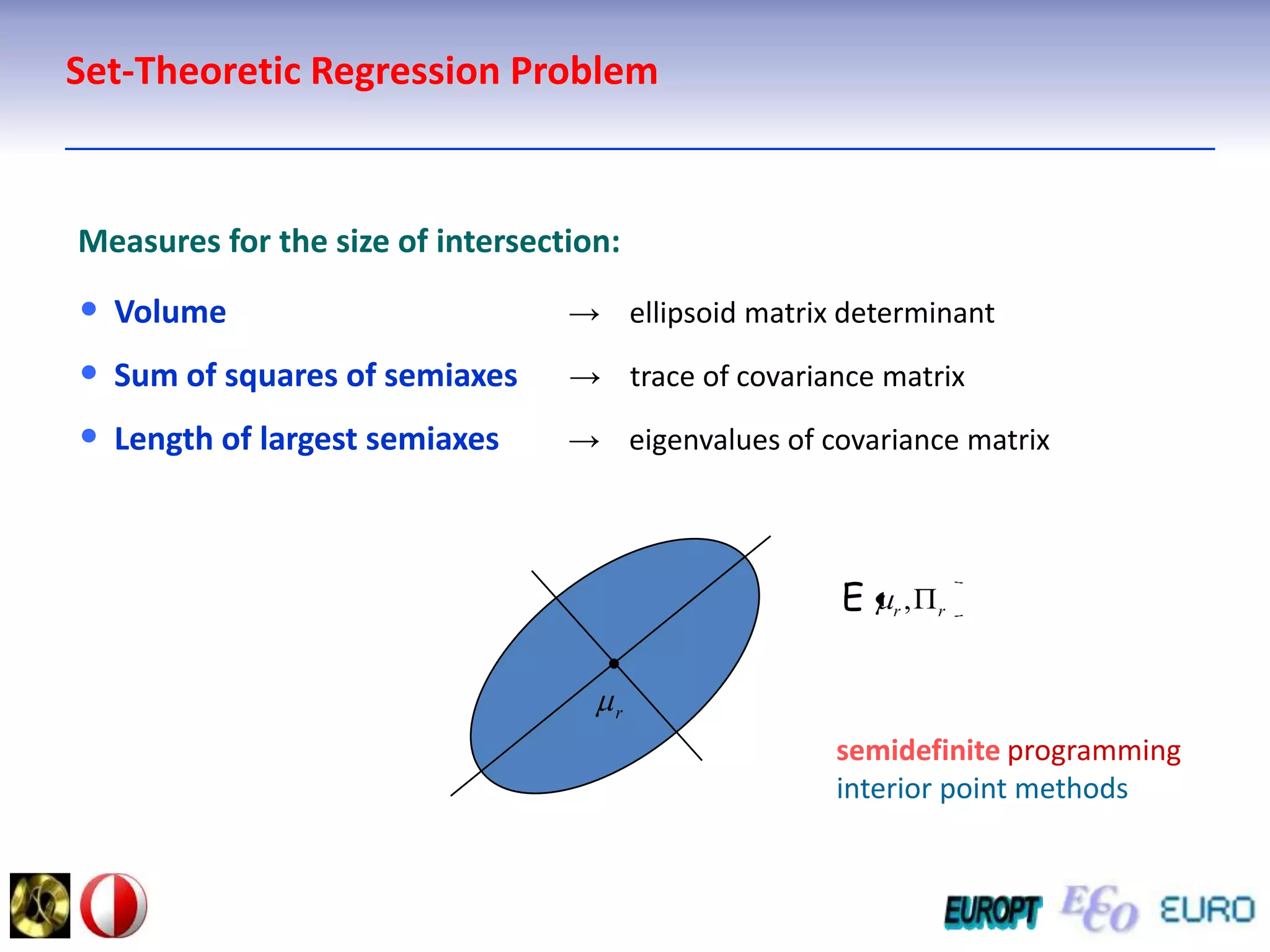
Set-Theoretic Regression ProblemMeasures for the size of intersection:Volume->ellipsoid matrix determinant
Sum of squares of semiaxes->  trace of covariance matrix
Length of largest semiaxes->  eigenvalues of covariance matrixEsemidefinite programming                                                                                                        interior point methods
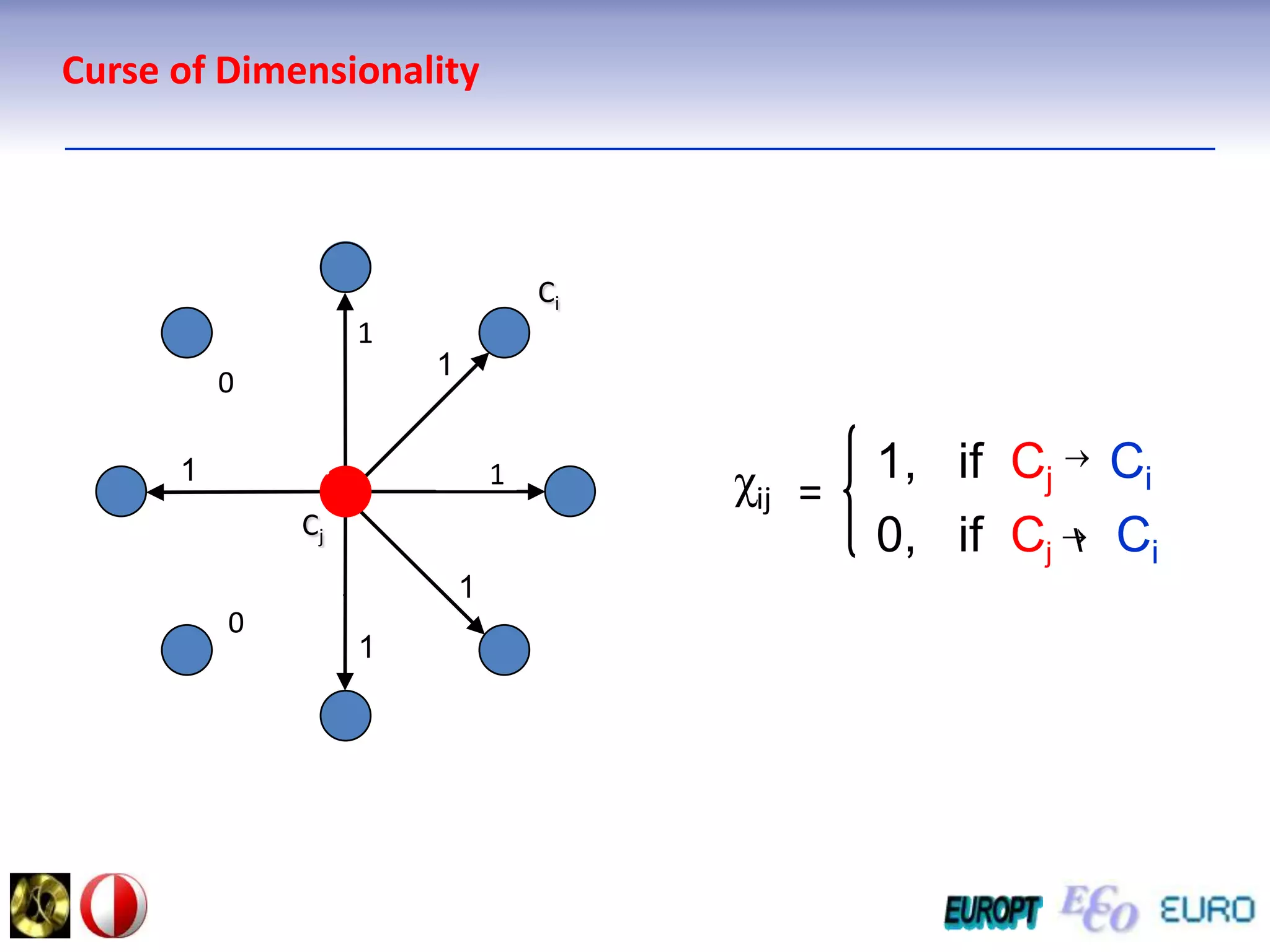
Curse of DimensionalityCi110χij 1=CjTj0
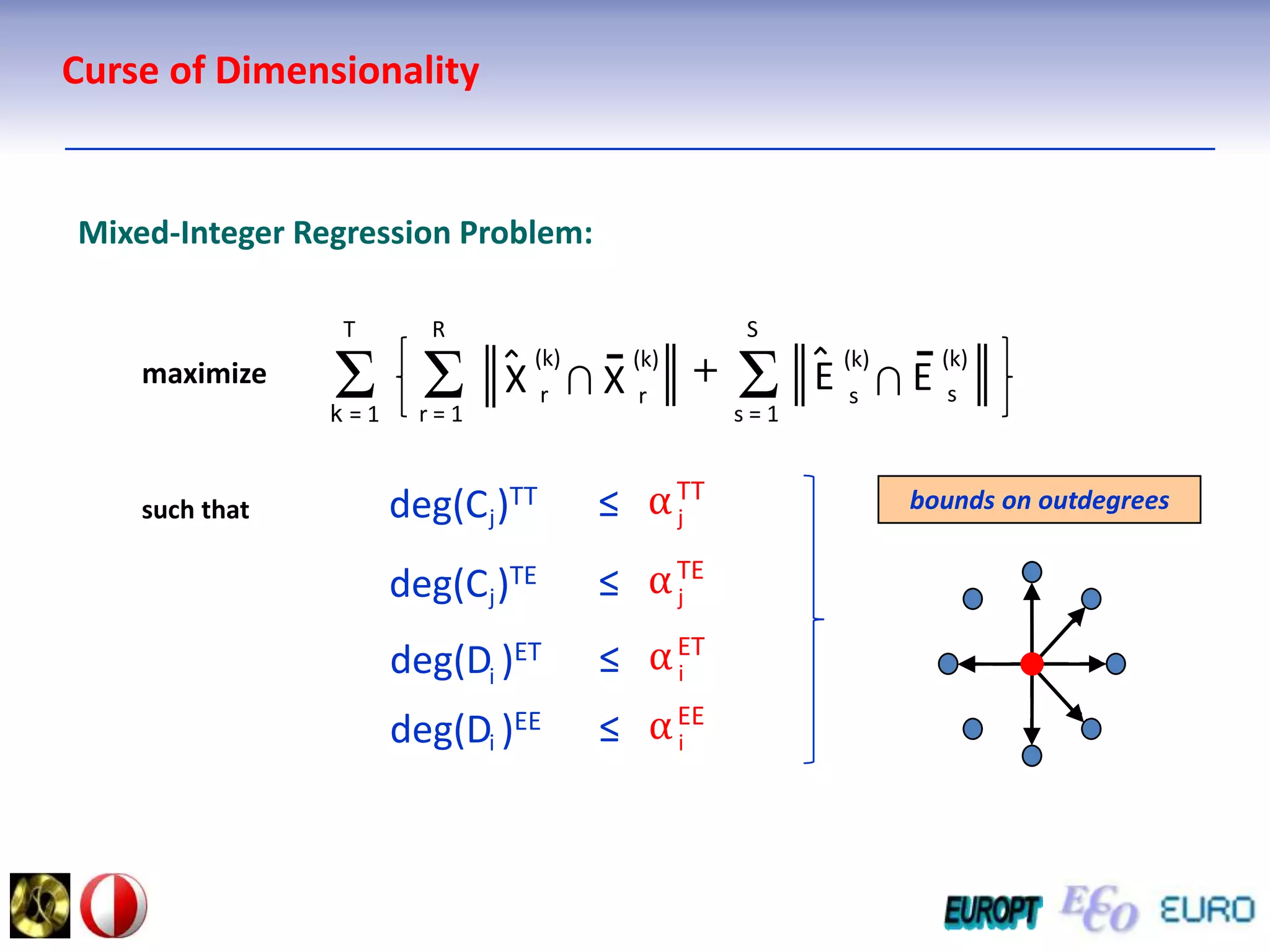
Curse of DimensionalityMixed-Integer Regression Problem:RSTΣΣΣ−−^(k)(k)(k)(k)+^EEXmaximizeX∩∩ s r r sr = 1s = 1k= 1αTT≤deg(C )TT bounds on outdegreessuch thatjjαTE≤deg(C )TE jjαET≤deg(D )ET iiαEE≤deg(D )EE ii
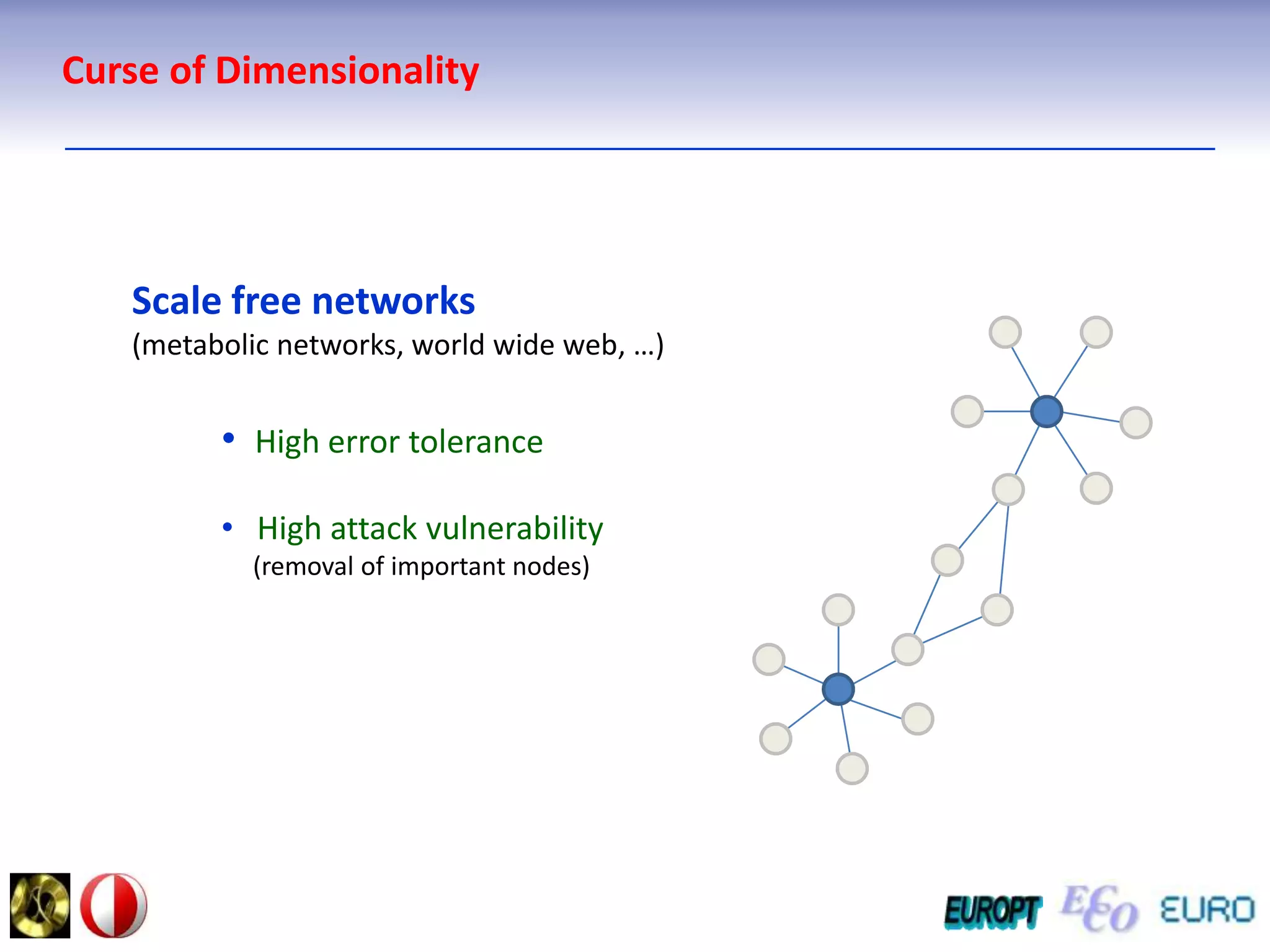
Curse of DimensionalityScale free networks(metabolic networks, world wide web,…)High error tolerance
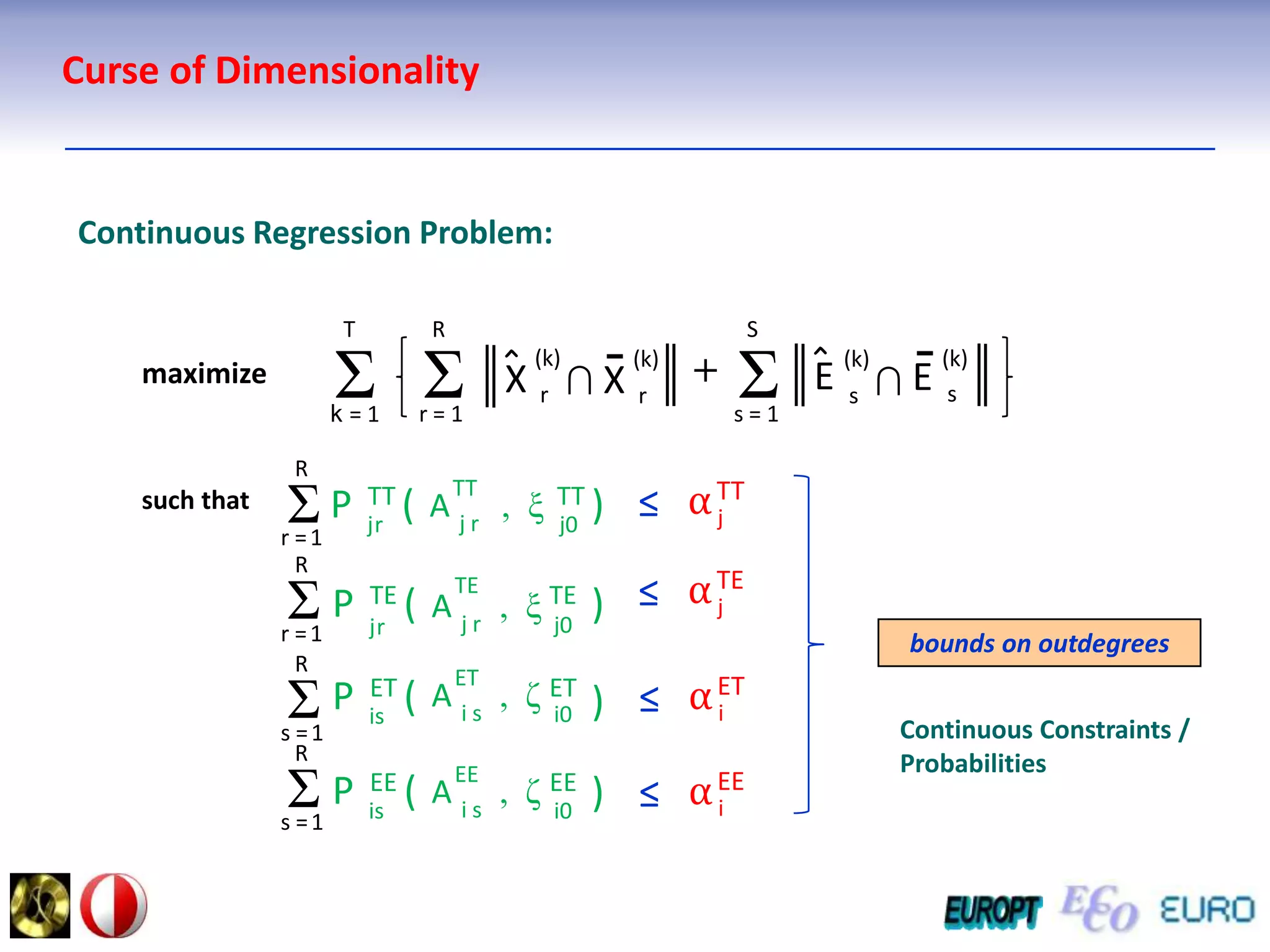
High attack vulnerability(removal of important nodes)Curse of DimensionalityContinuous Regression Problem:RSTΣΣΣ−−^(k)(k)(k)(k)+^EEXX∩maximize∩ s r r sr = 1s = 1k= 1RΣαTTTT≤PTT (           TT )such that, ξAjj rjrj0r =1RαTEΣ≤TEPTE (           TE ),ξAjj r j0jrr =1bounds on outdegreesRETΣαETPET (            ET ≤,  ζA)ii s i0isContinuous Constraints /Probabilities s =1RΣEEαEEPEE (            EE )≤,  ζAii s i0iss =1
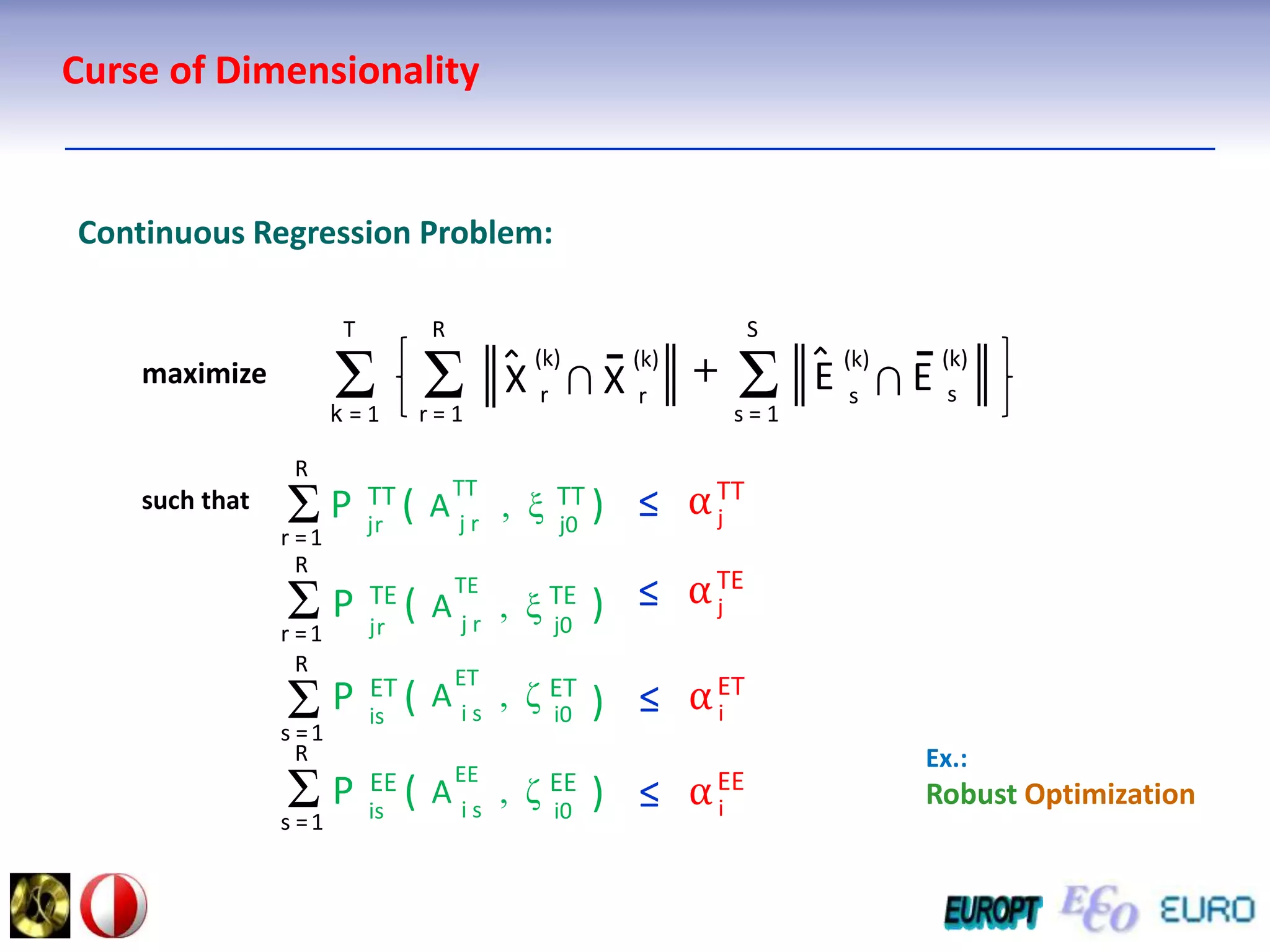
Curse of DimensionalityContinuous Regression Problem:RSTΣΣΣ−−^(k)(k)(k)(k)+^EEXX∩maximize∩ s r r sr = 1s = 1k= 1RΣαTTTT≤PTT (           TT )such that, ξAjj rjrj0r =1RαTEΣ≤TEPTE (           TE ),ξAjj r j0jrr =1RETΣαETPET (            ET ≤,  ζA)ii s i0iss =1REx.:Robust OptimizationΣEEαEEPEE (            EE )≤,  ζAii s i0iss =1
Cost GamesCost games are very important in the practice of OR.Ex.:   airport game,
  unanimity game,
  production economy with landowners and peasants,
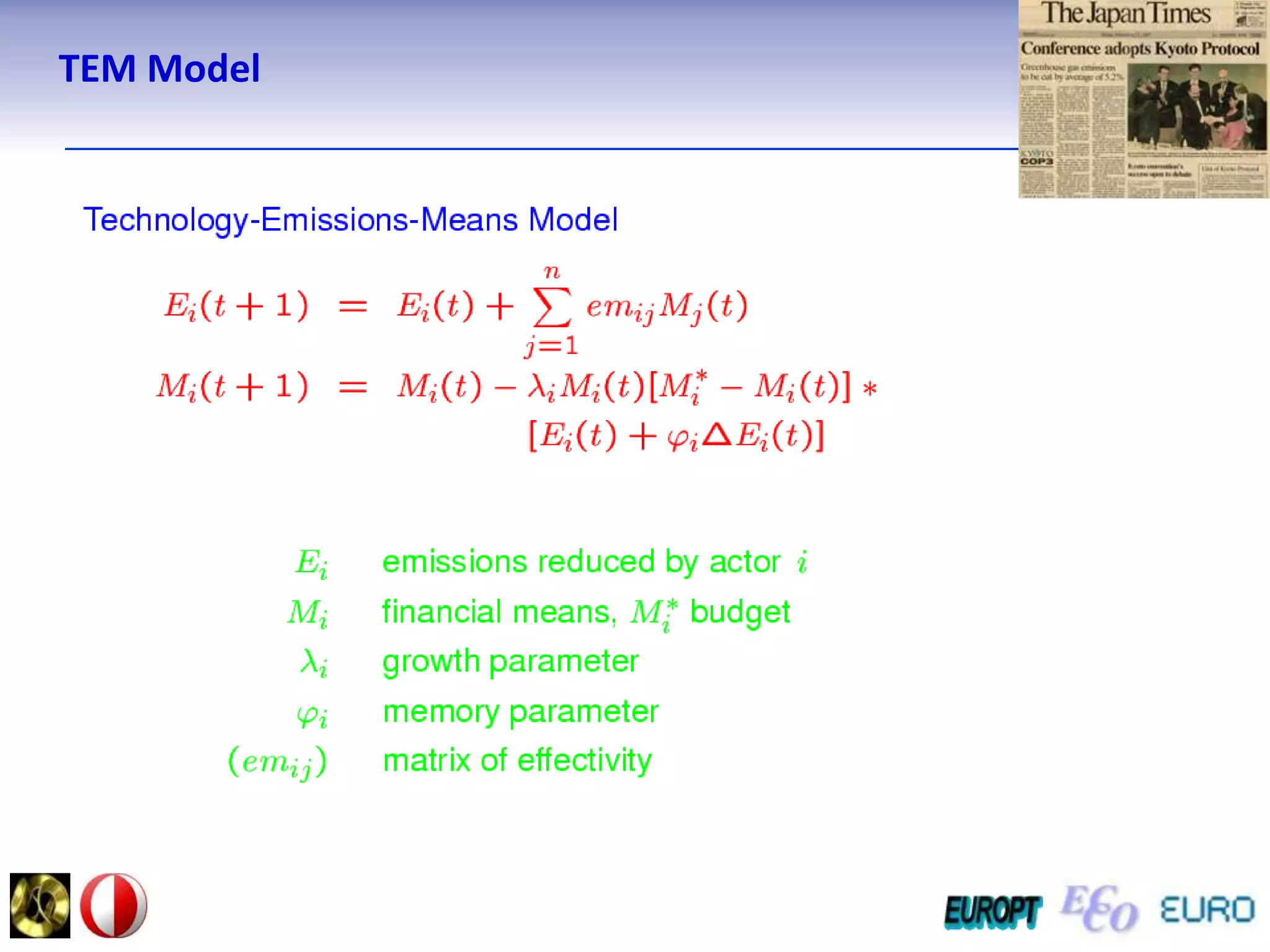
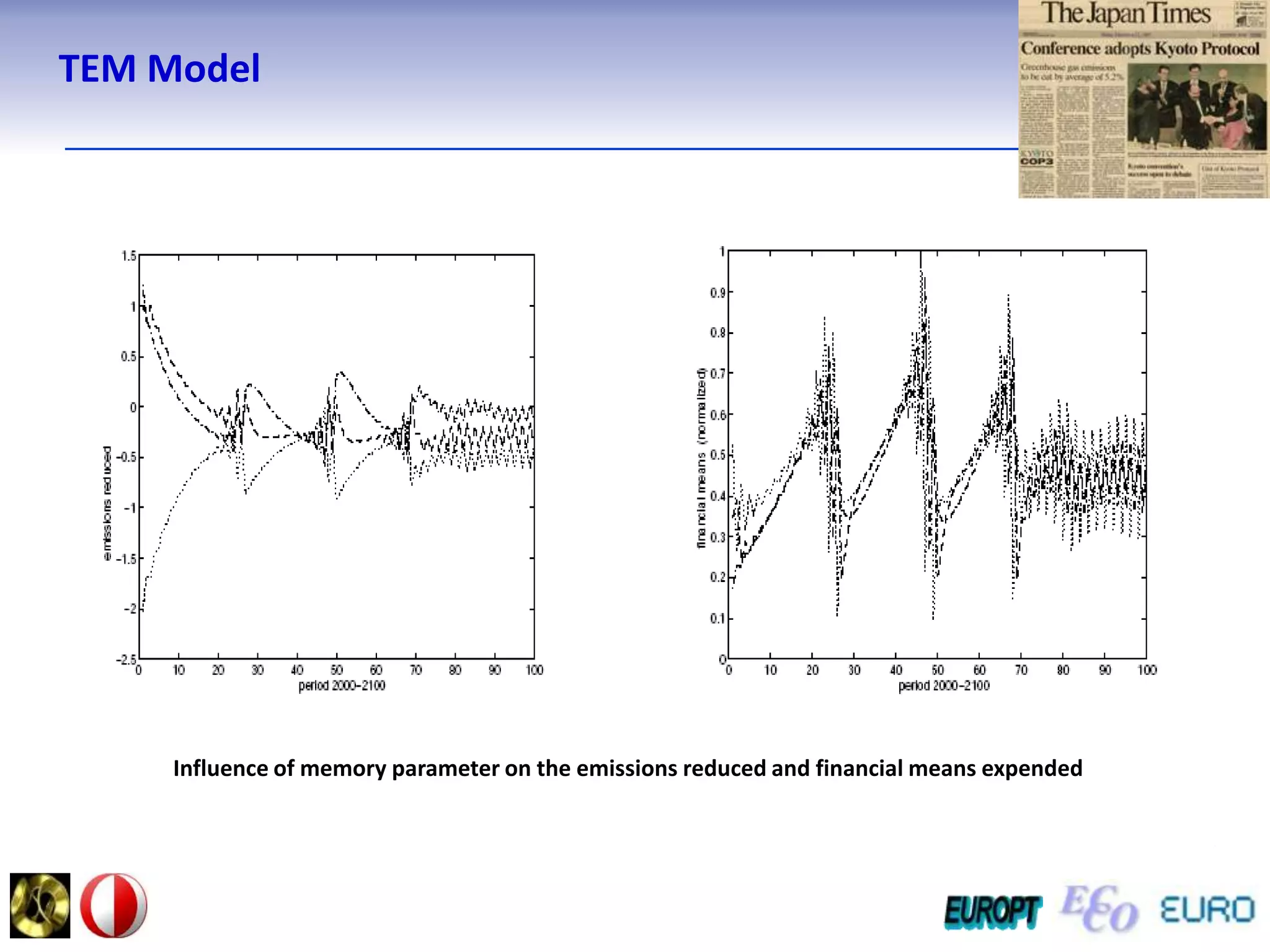
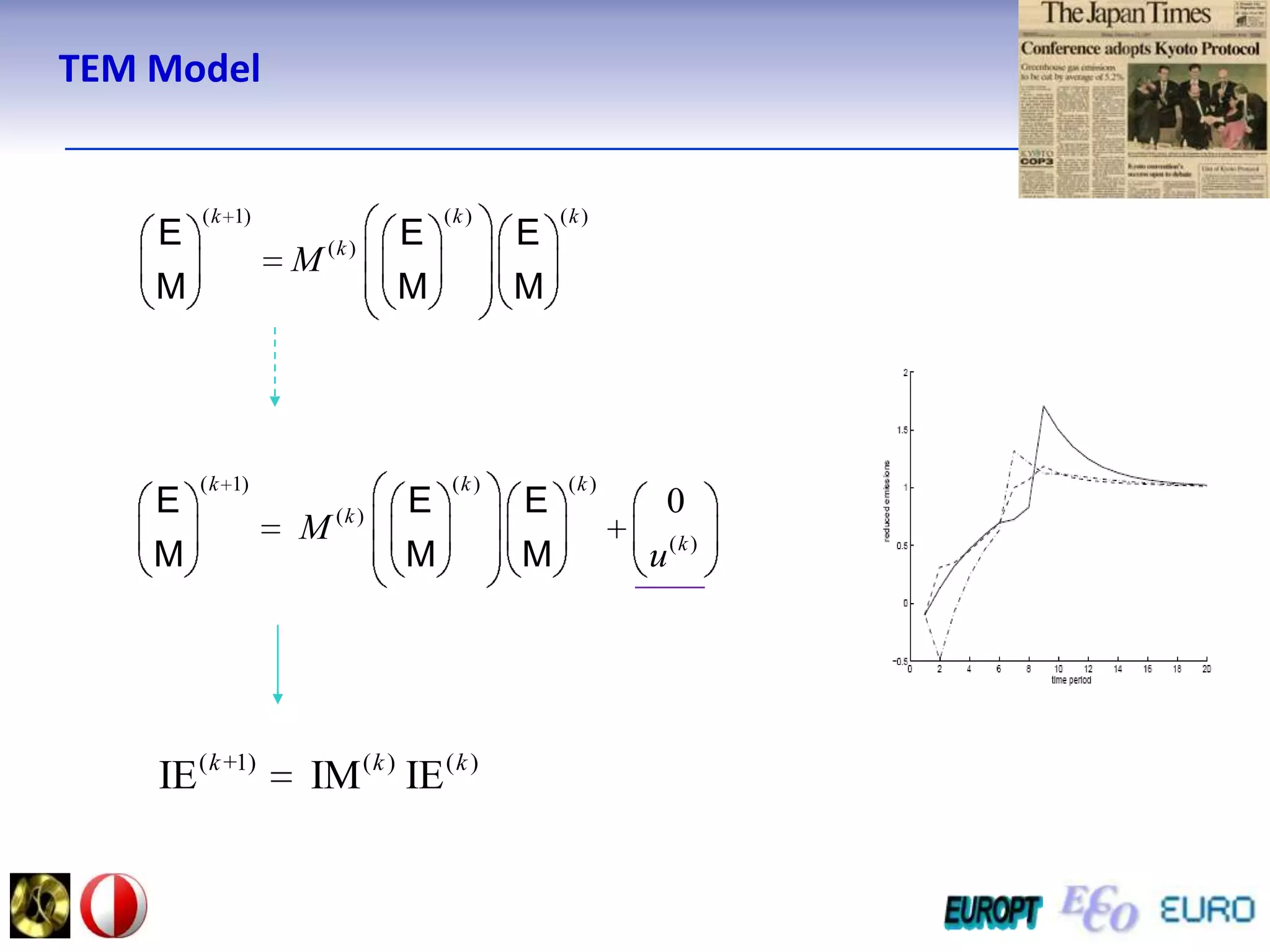
  bankrupcy game, etc..There is also a cost game in environmental protection (TEM model):The aim is to reach a state which is mentioned in Kyoto Protocol                        by choosing control parameters such that                                                                the emissions of each player become minimized.For example, the       value  is taken as a control parameter.
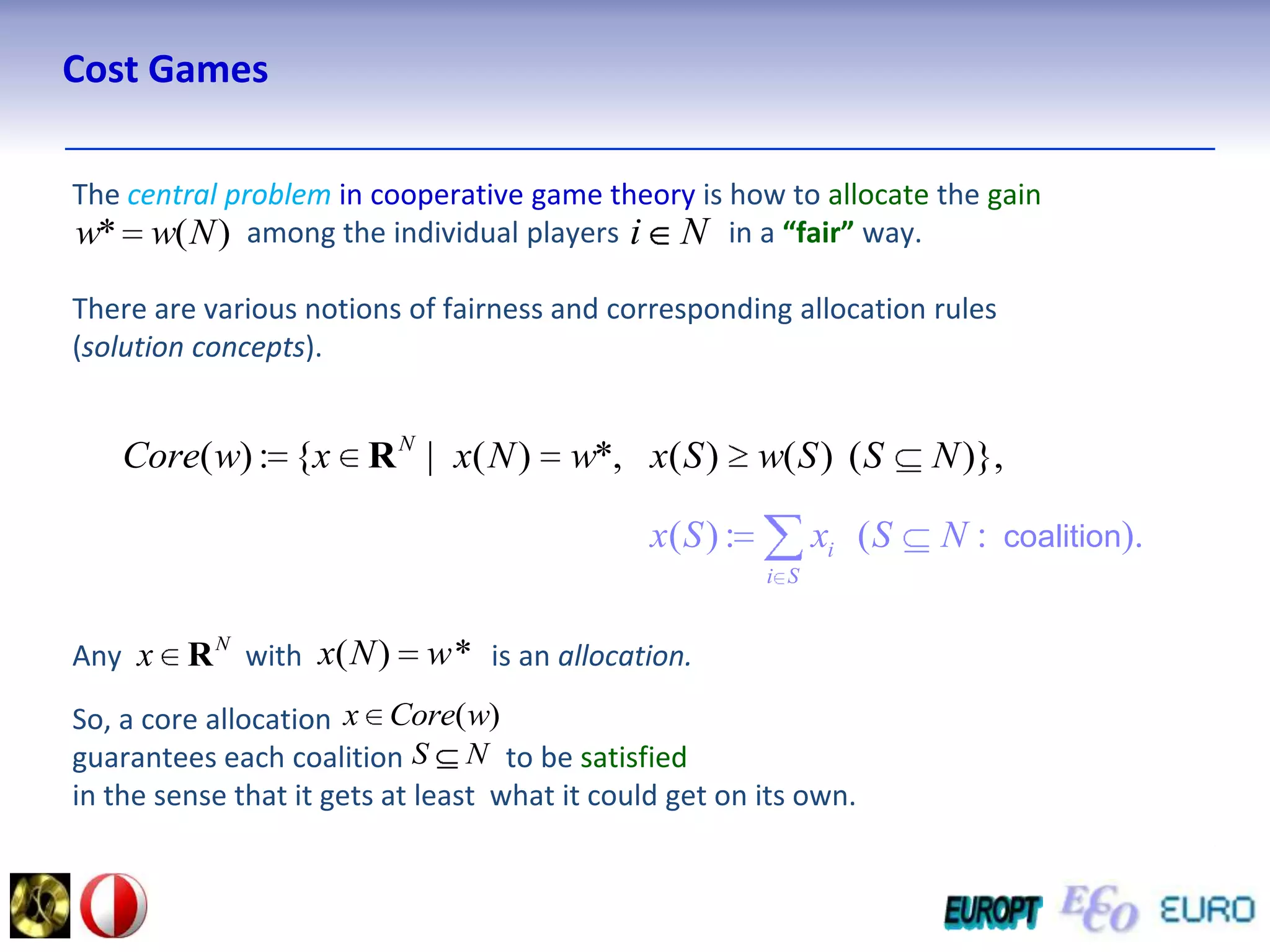
Cost GamesThe central problem in cooperative game theory is how to allocate the gain    among the individual players               in a “fair” way. There are various notions of fairness and corresponding allocation rules              (solution concepts).Any                 with                          is an allocation.So, a core allocation guarantees each coalition              to be satisfied in the sense that it gets at least  what it could get on its own.
TEM Model
TEM Model      Influence of memory parameter on the emissions reduced and financial means expended
TEM Model
Gamescooperative
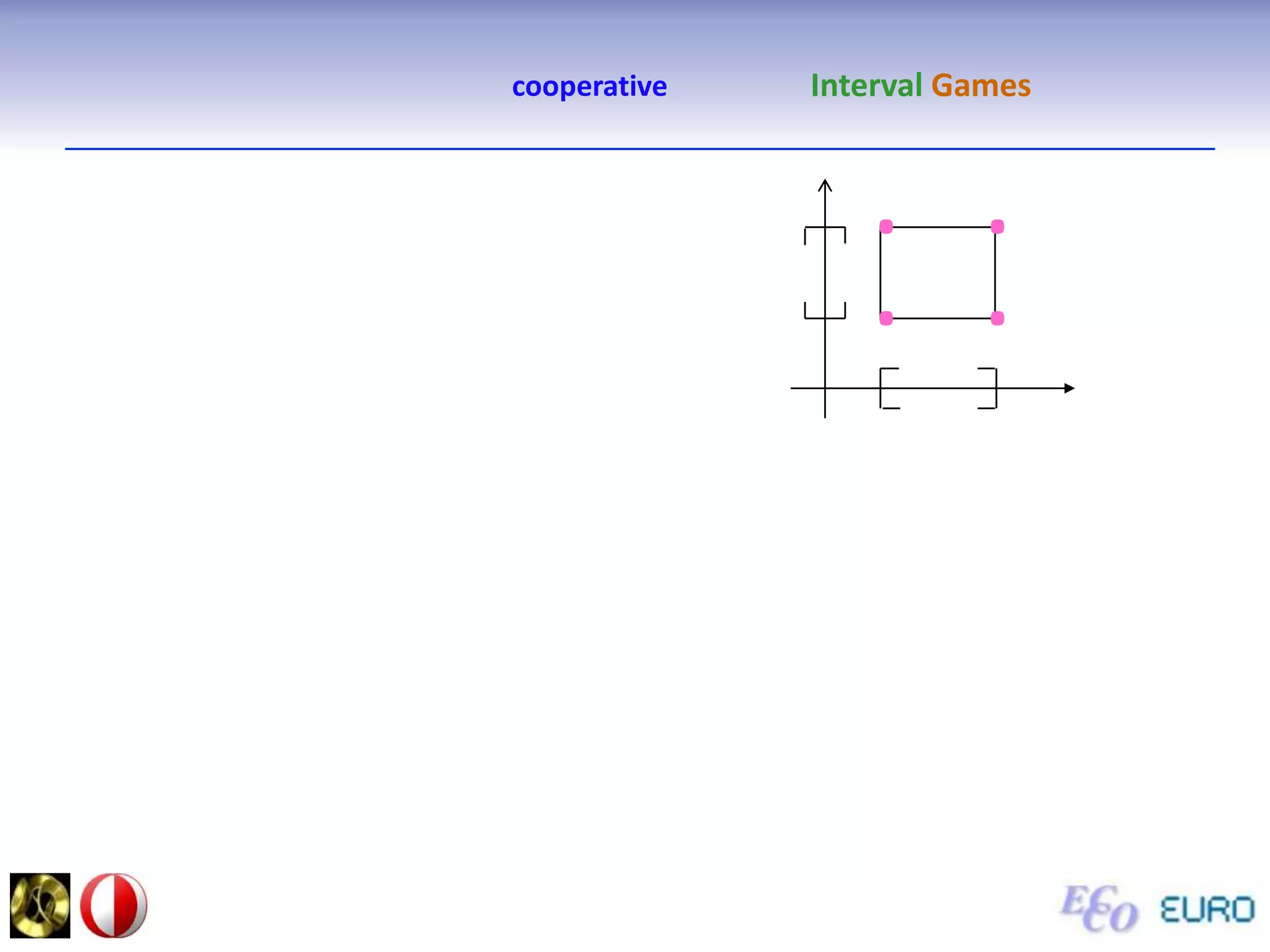
IntervalGamescooperative....
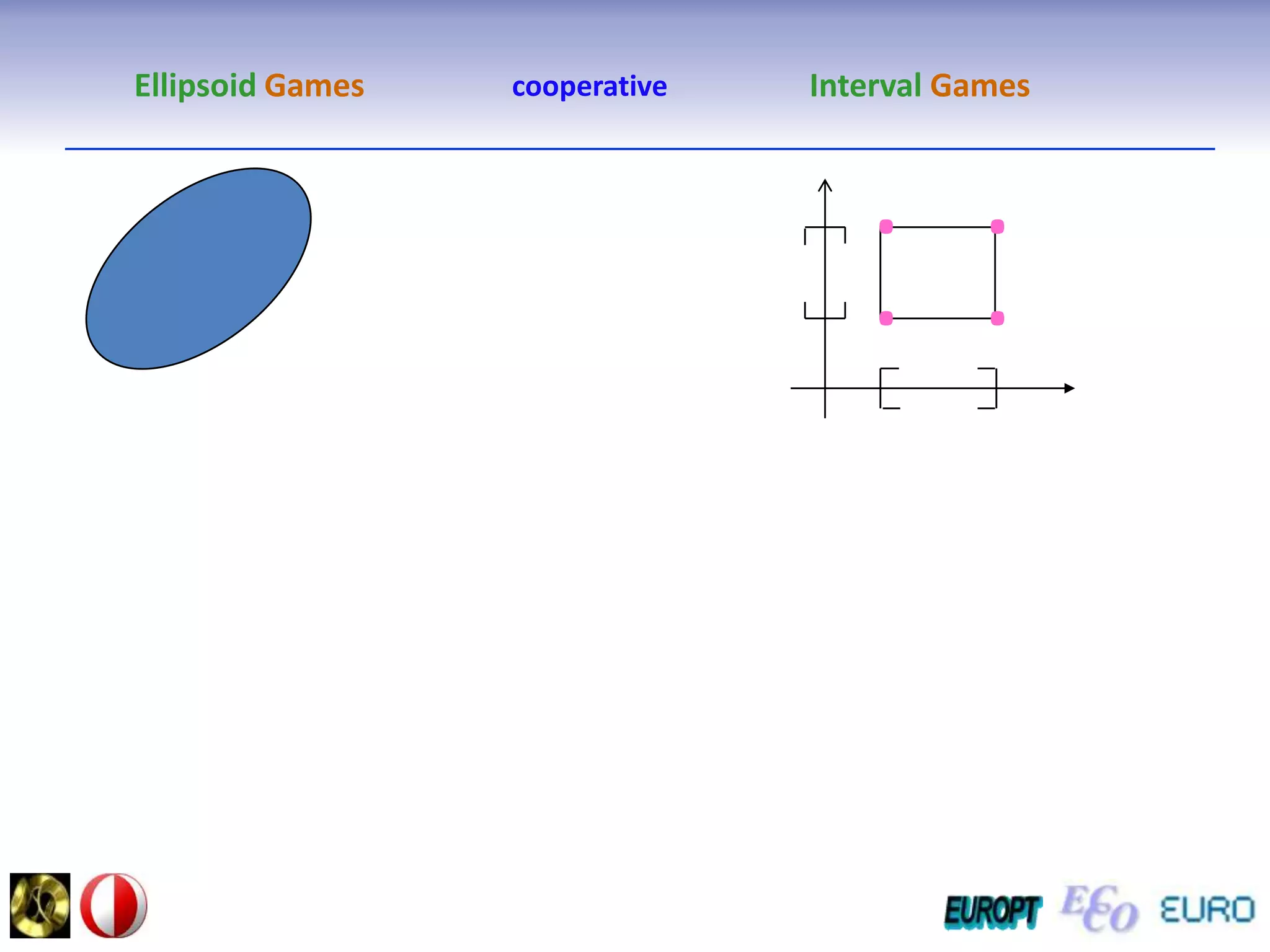
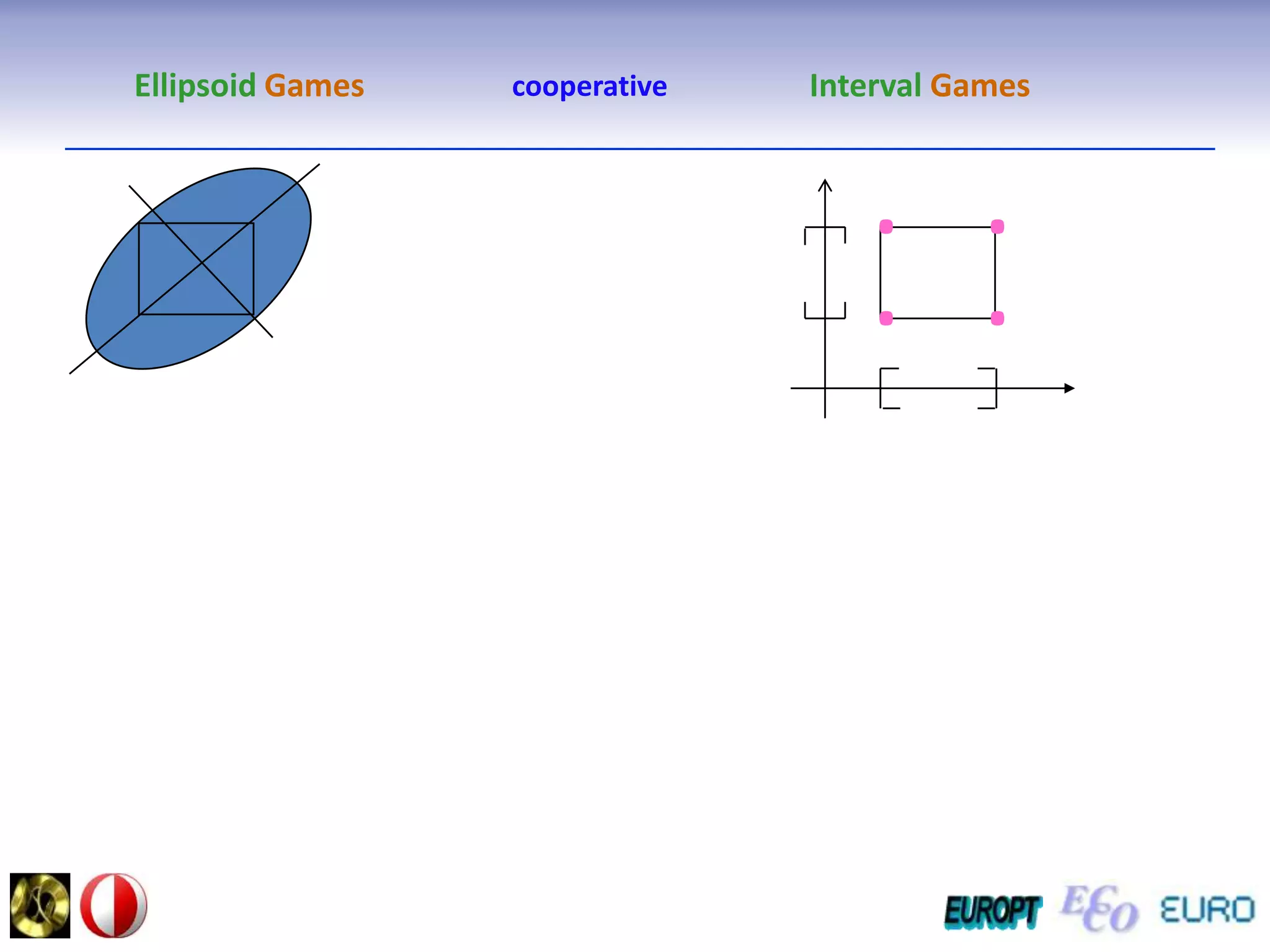
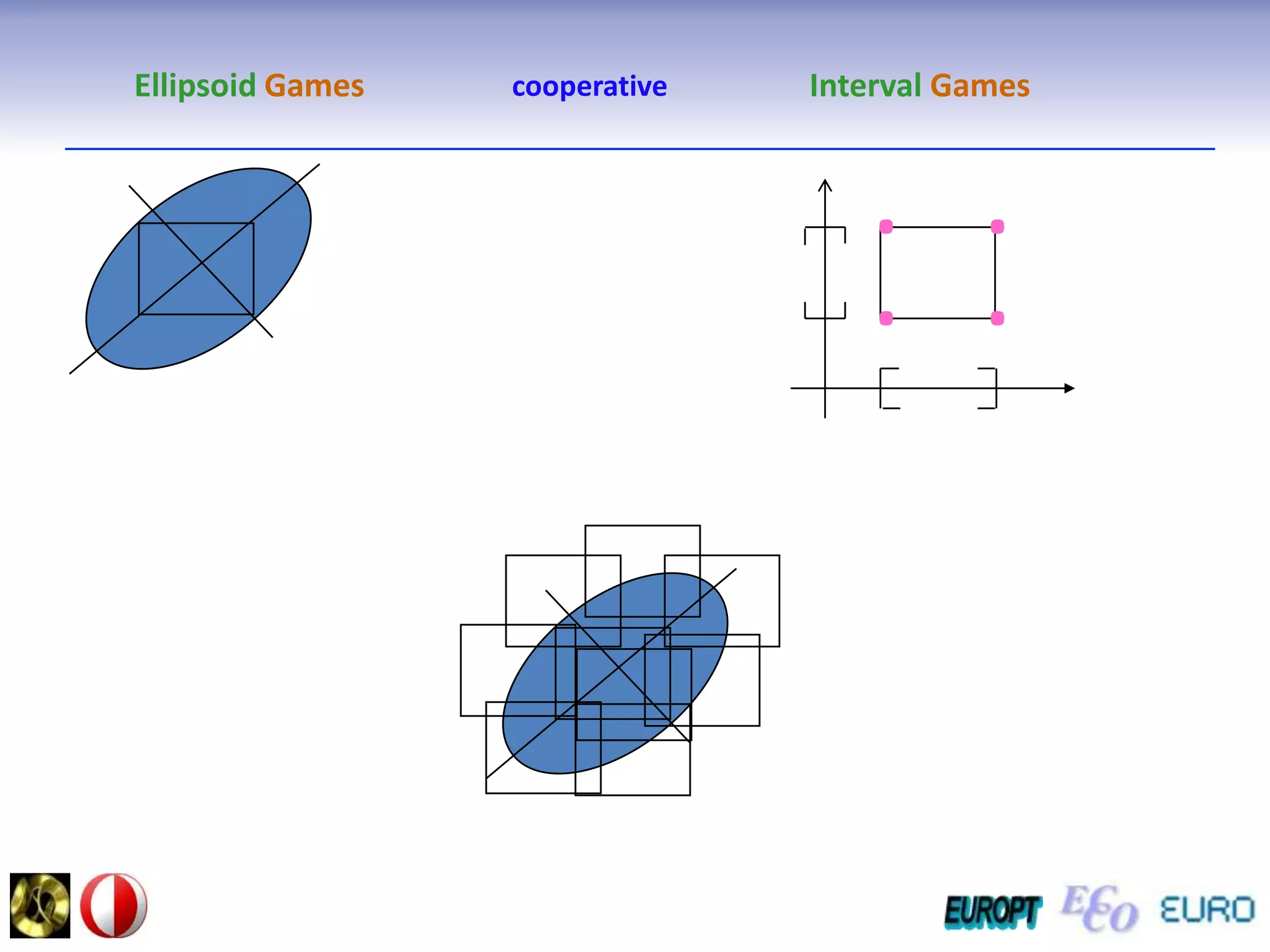
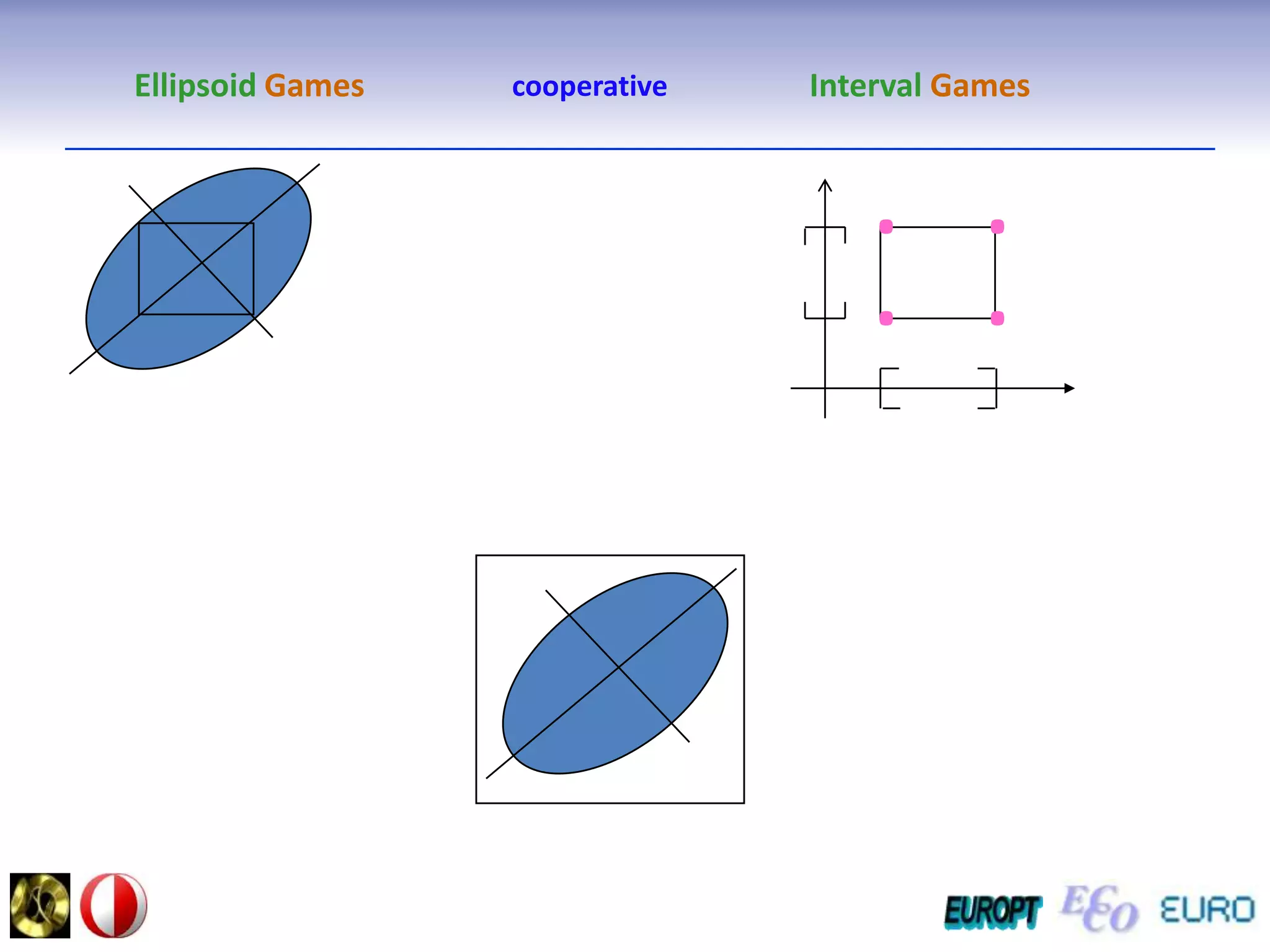
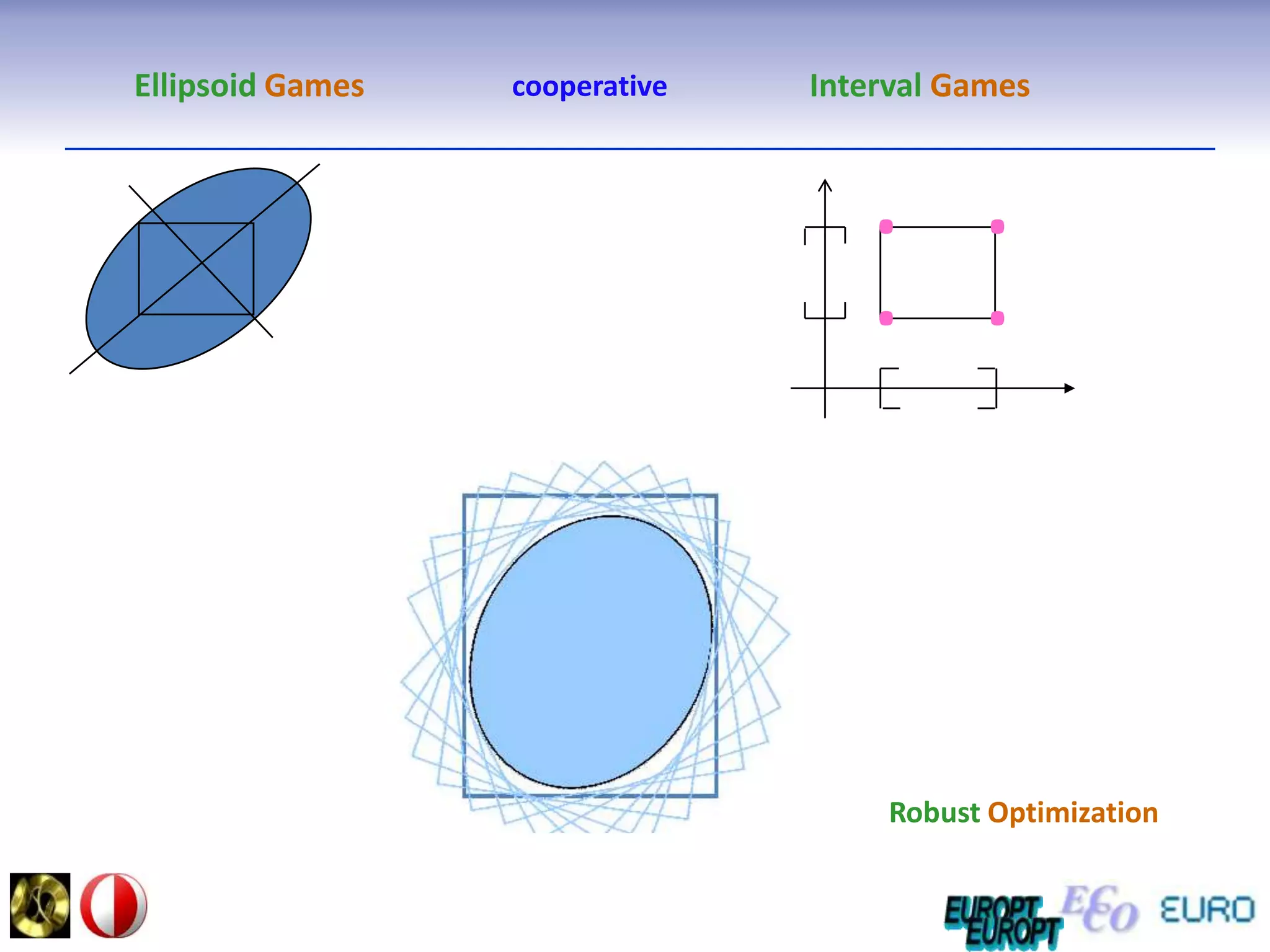
Ellipsoid Games                                                        Interval Gamescooperative....
Ellipsoid Games                                                        Interval Gamescooperative....Robust Optimization
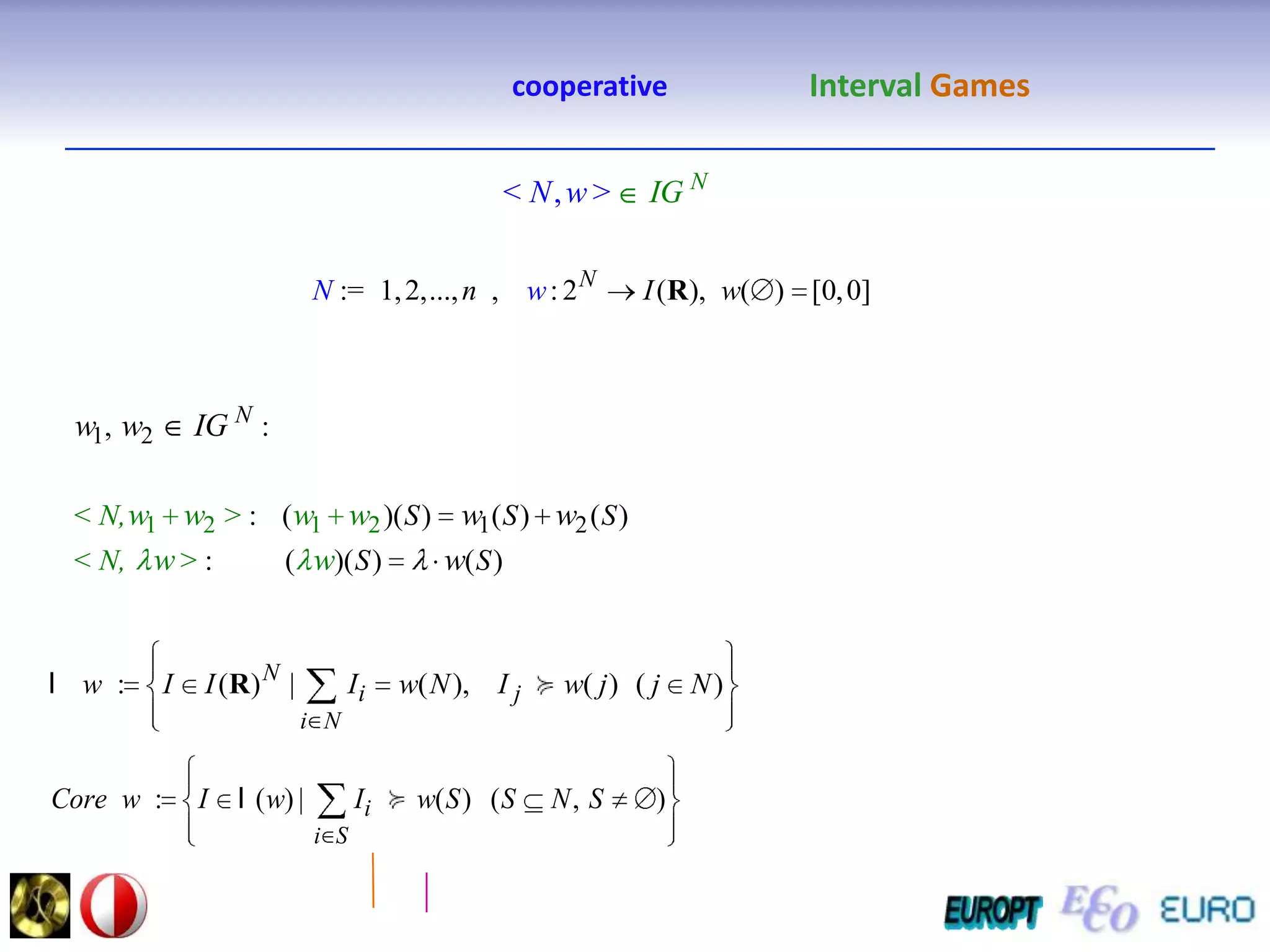
IntervalGamescooperative
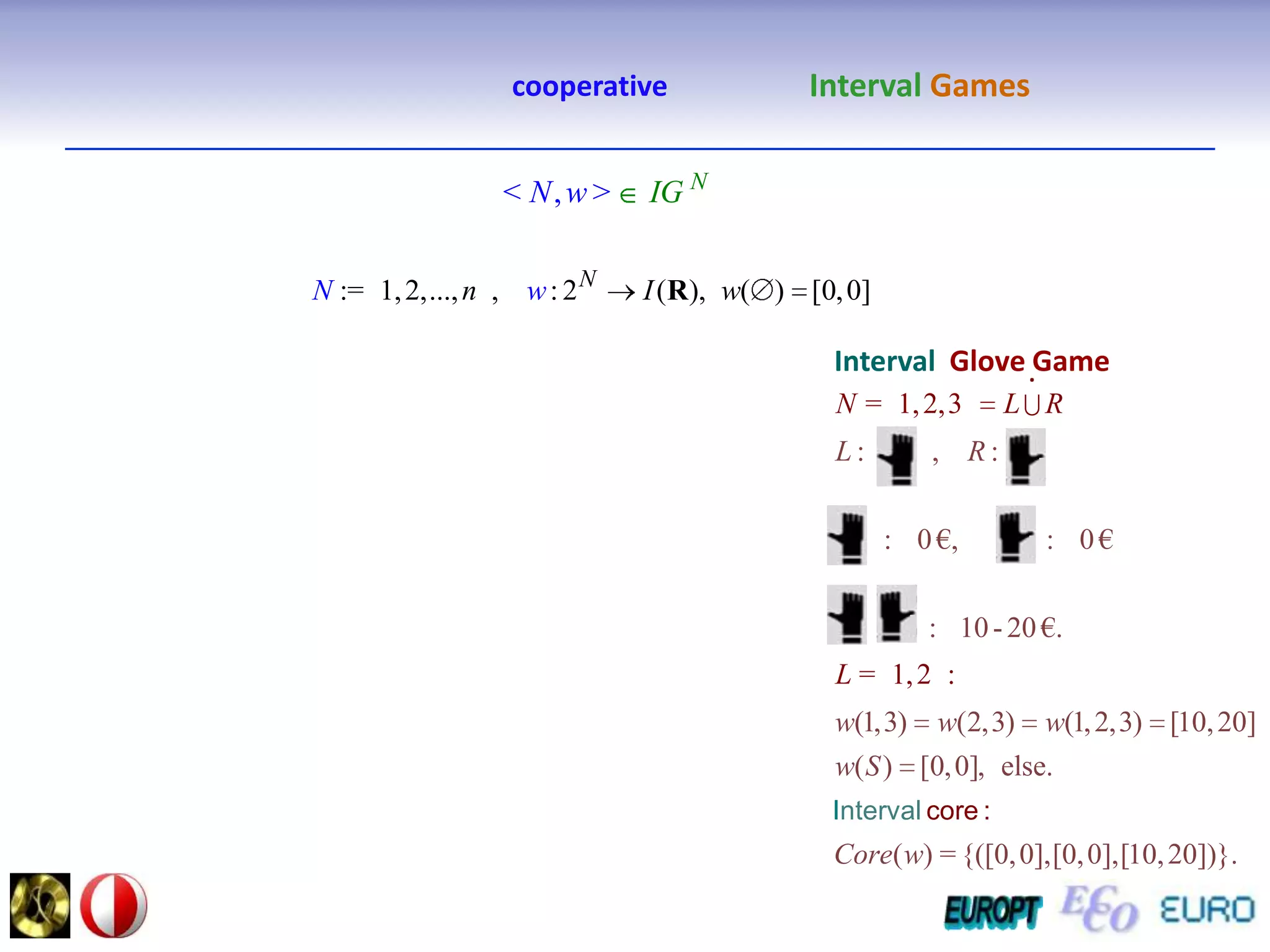
IntervalGamescooperativeInterval Glove Game
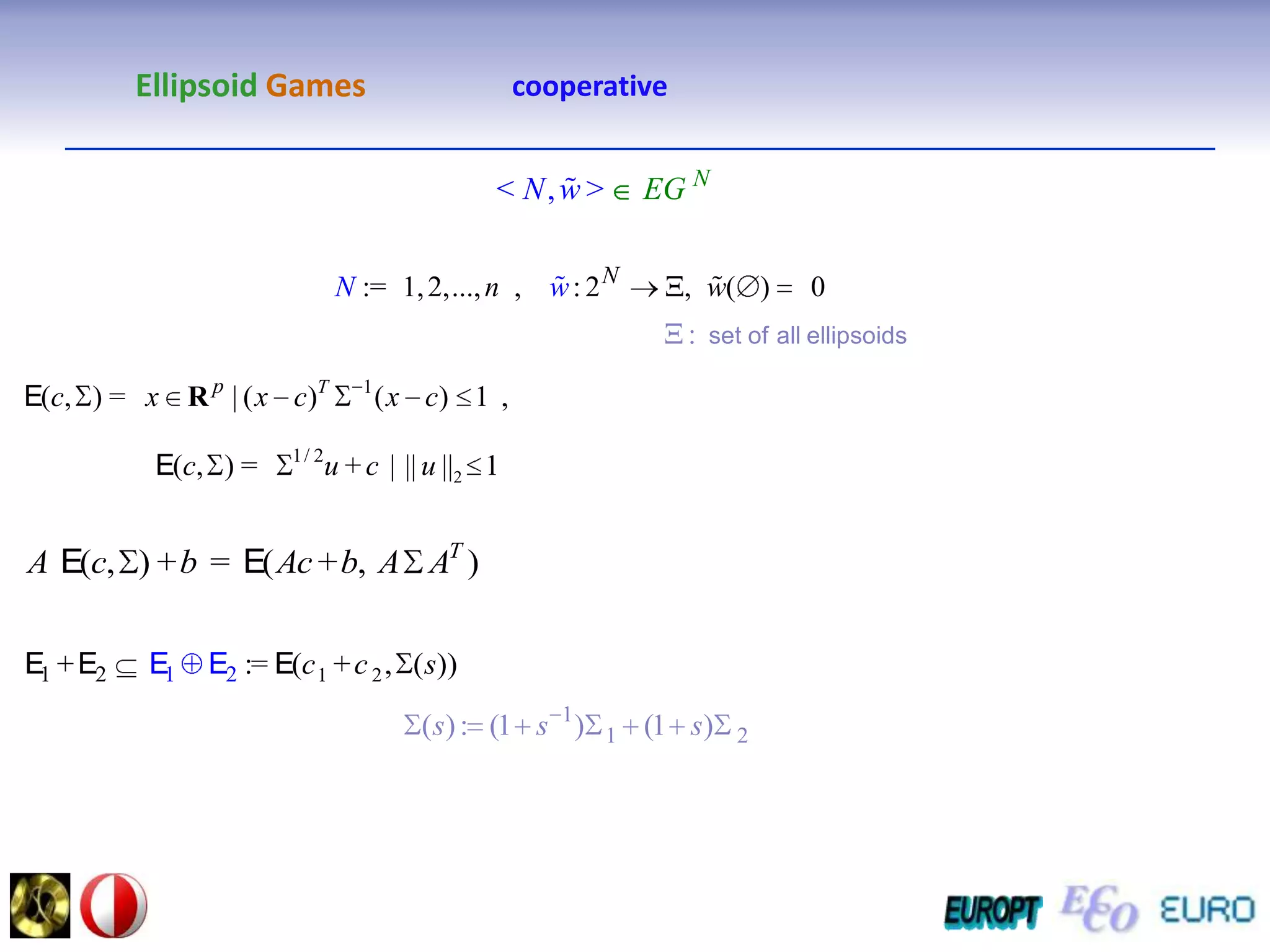
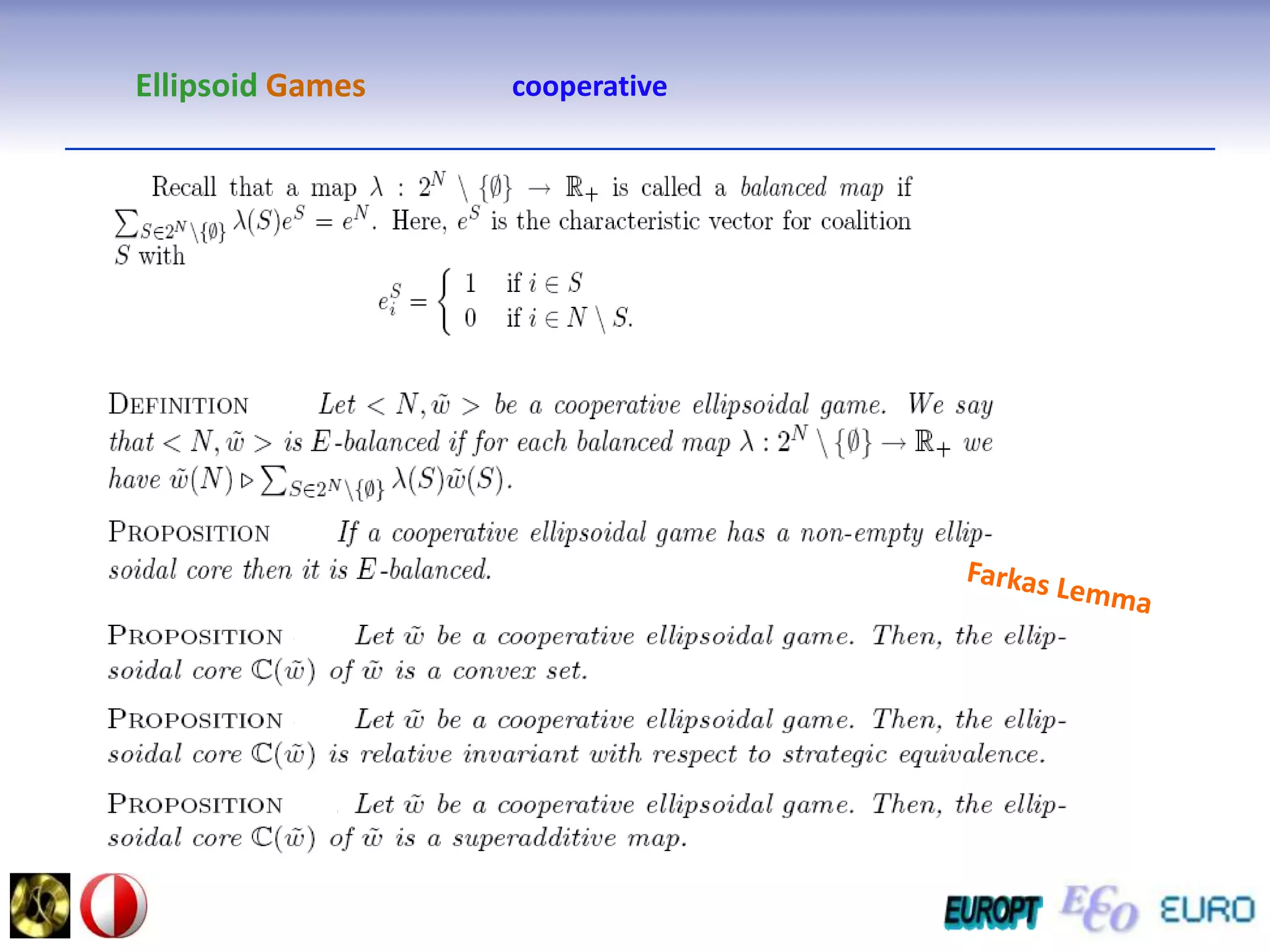
               Ellipsoid Games                                                        cooperative
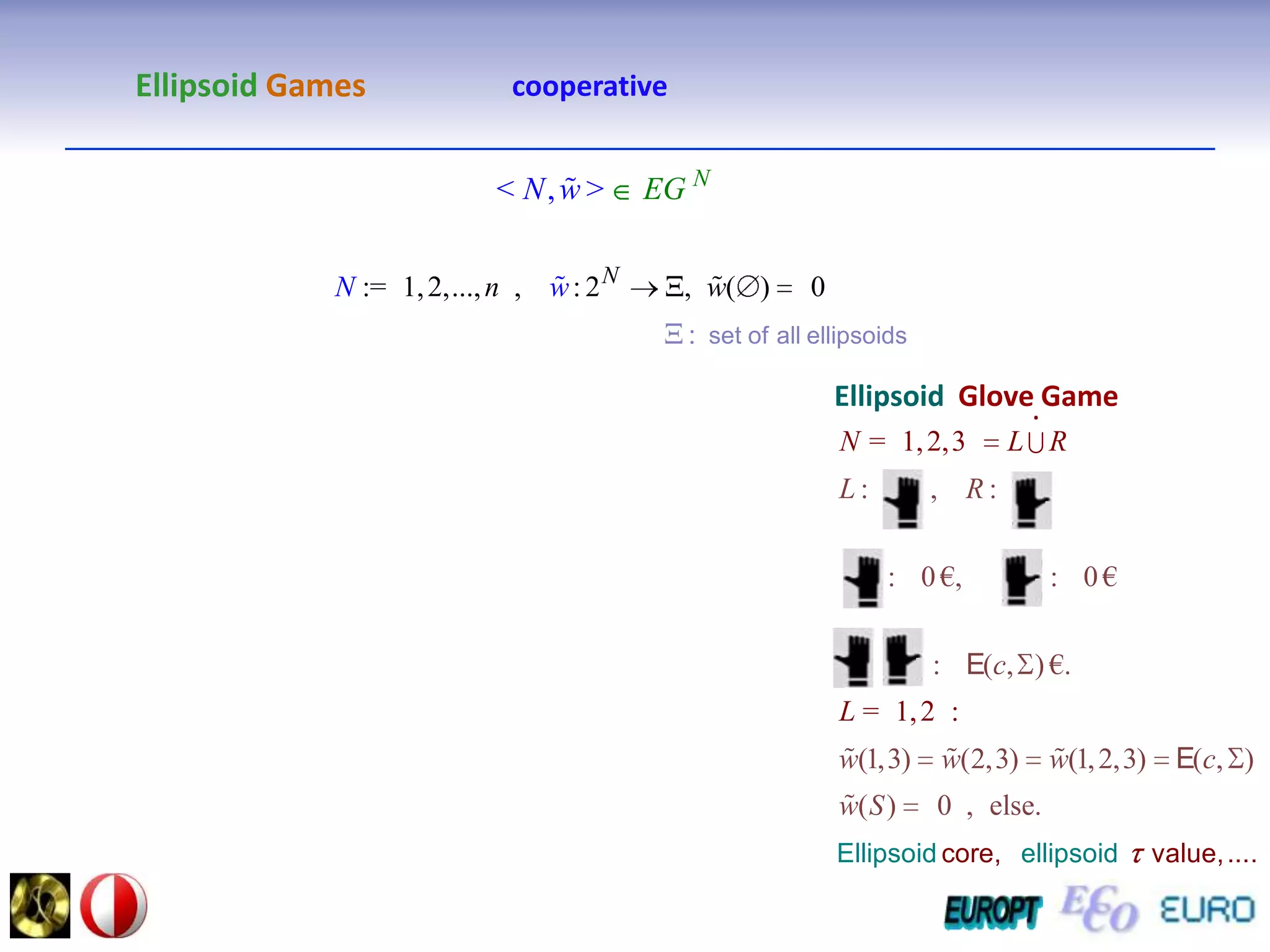
               Ellipsoid Games                                                        cooperativeEllipsoid  Glove Game
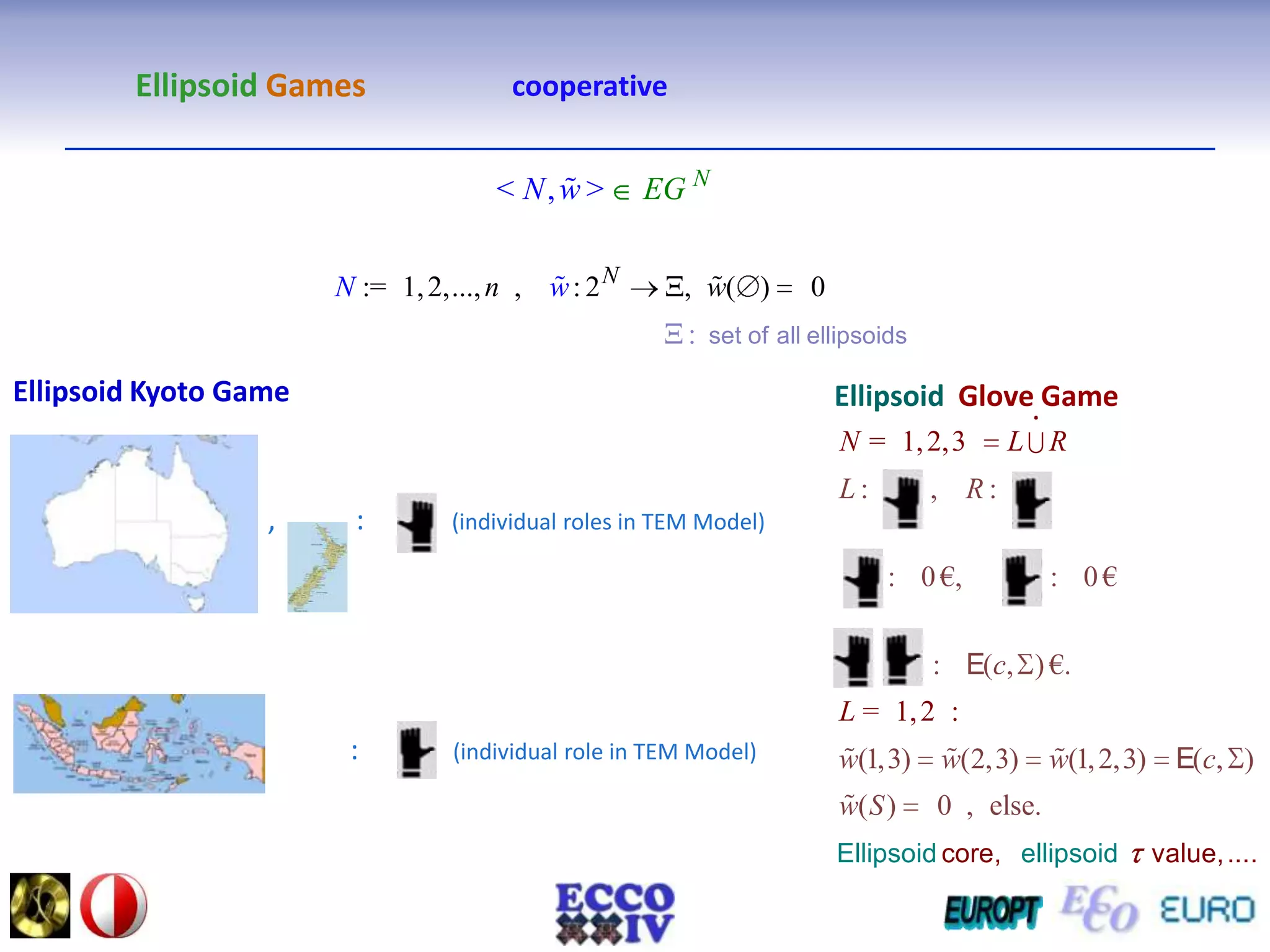
               Ellipsoid Games                                                        cooperativeEllipsoid Kyoto GameEllipsoid  Glove Game , :            (individual roles in TEM Model):             (individual role in TEM Model)
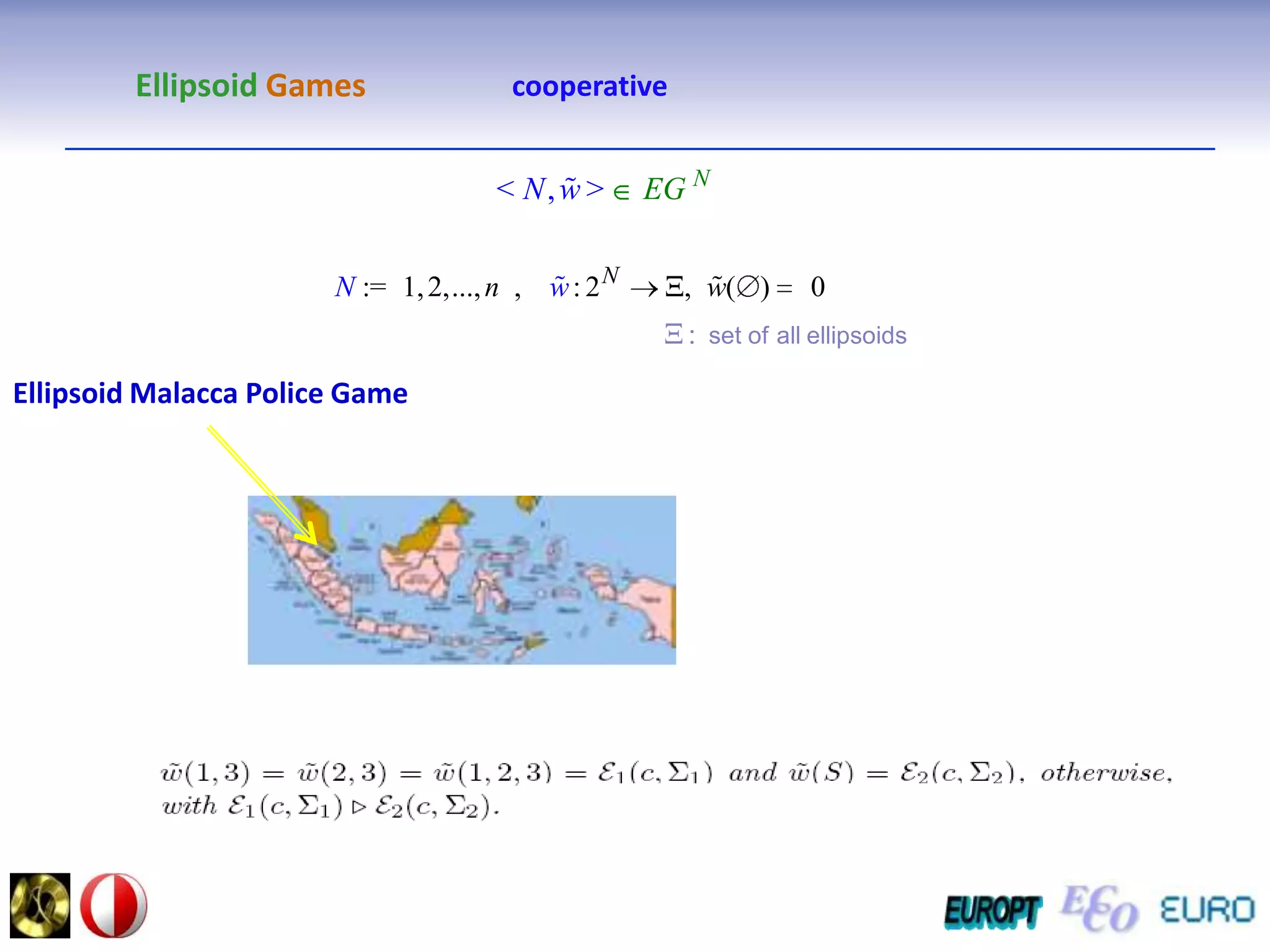
               Ellipsoid Games                                                        cooperativeEllipsoid Malacca Police GameR
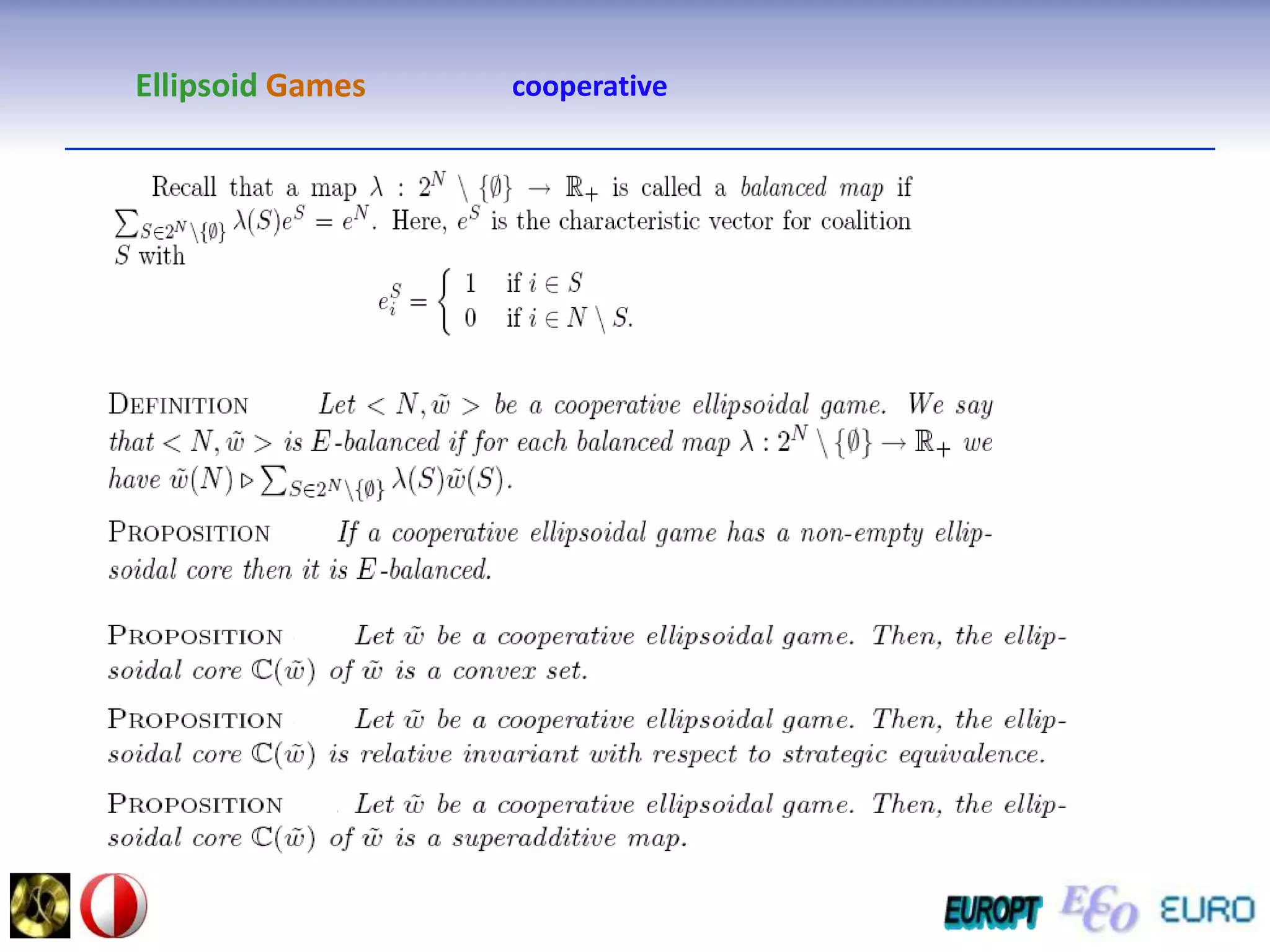
               Ellipsoid Games                                                        cooperativererrrr
               Ellipsoid Games                                                        cooperativererFarkas Lemmarrr
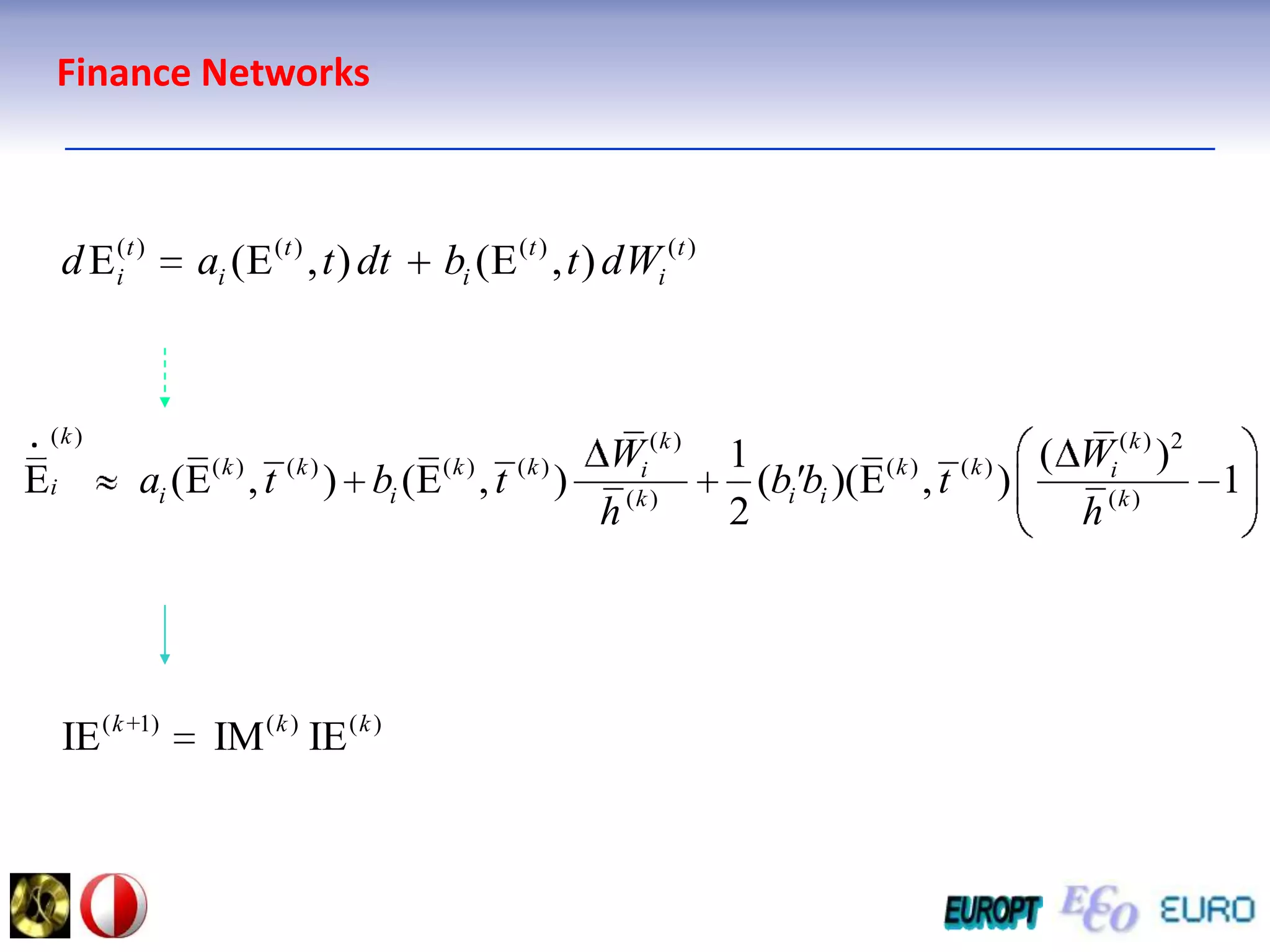
Finance Networks.
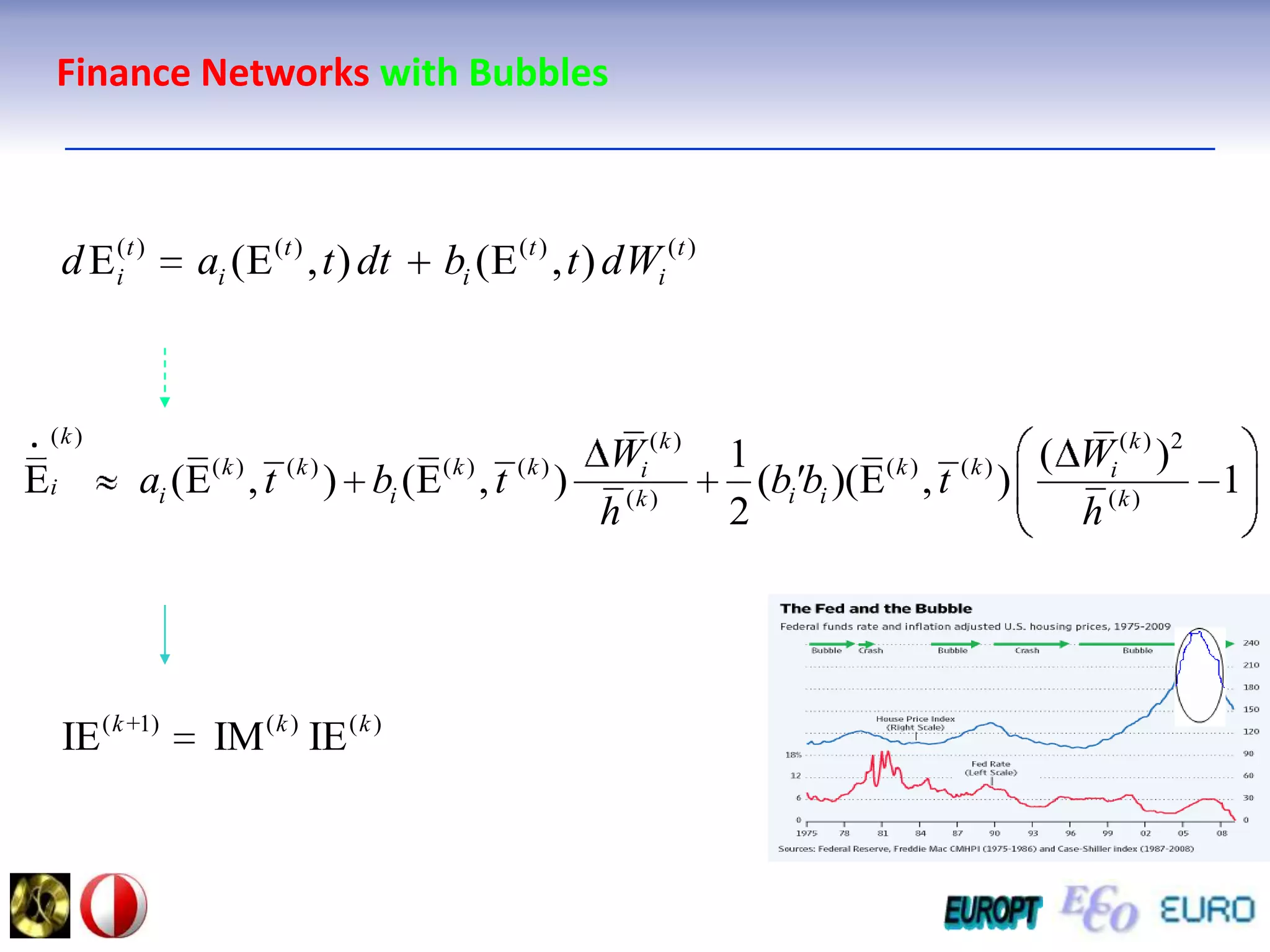
Finance Networks with Bubbles.
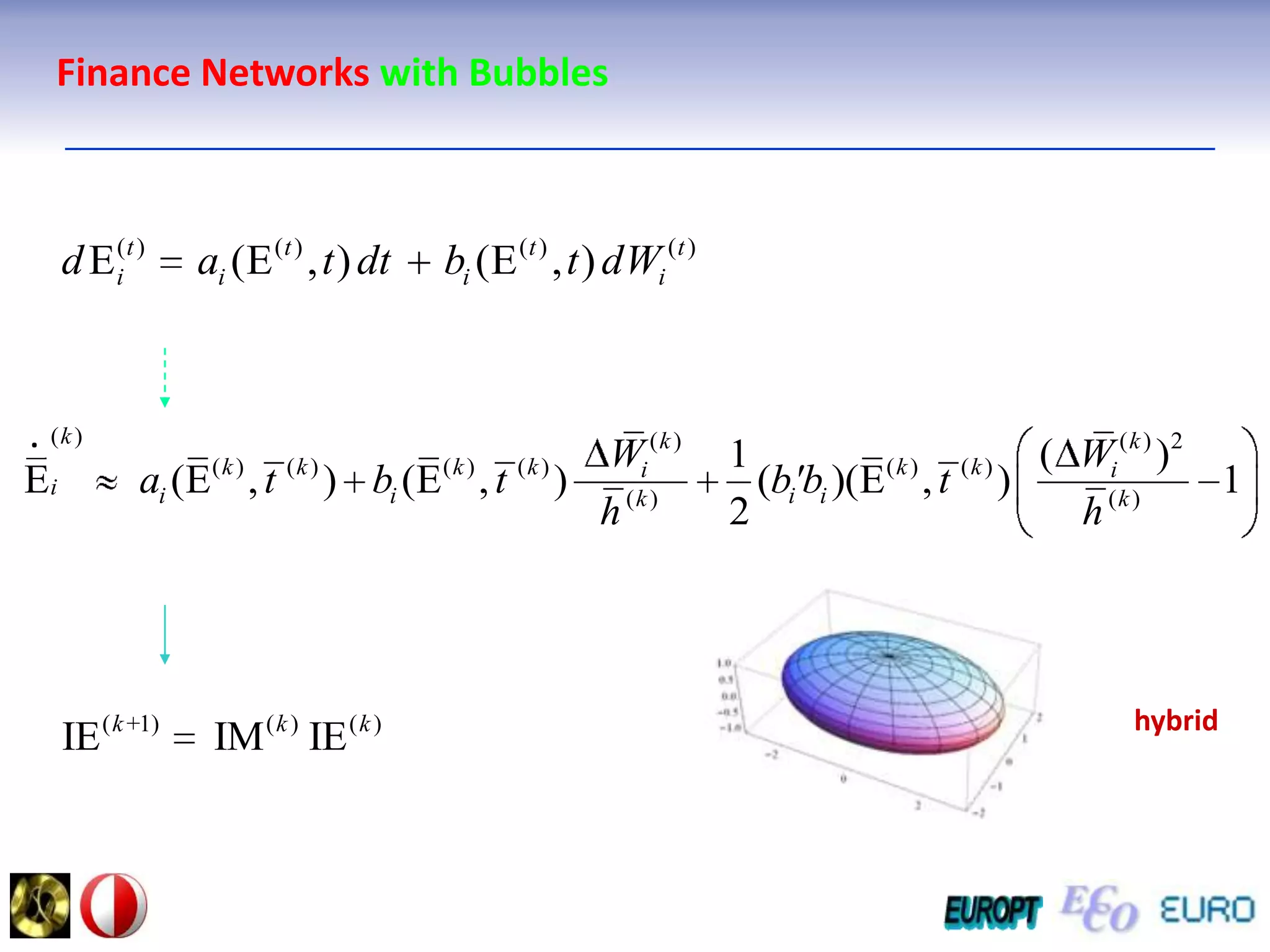
Finance Networks with Bubbles.hybrid
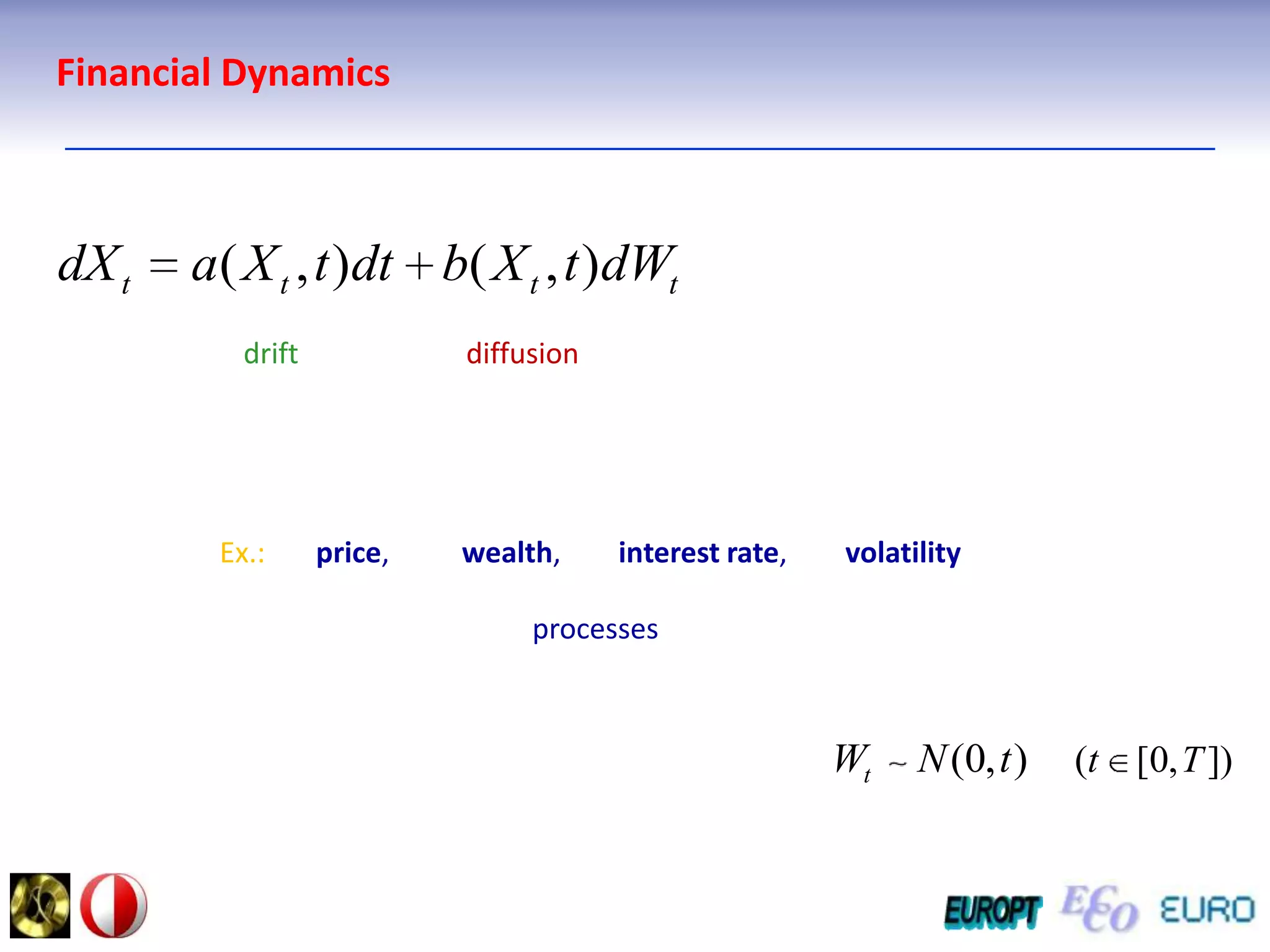
Financial Dynamicsdrift    diffusion       Ex.:       price,          wealth,        interest rate,        volatility      processes
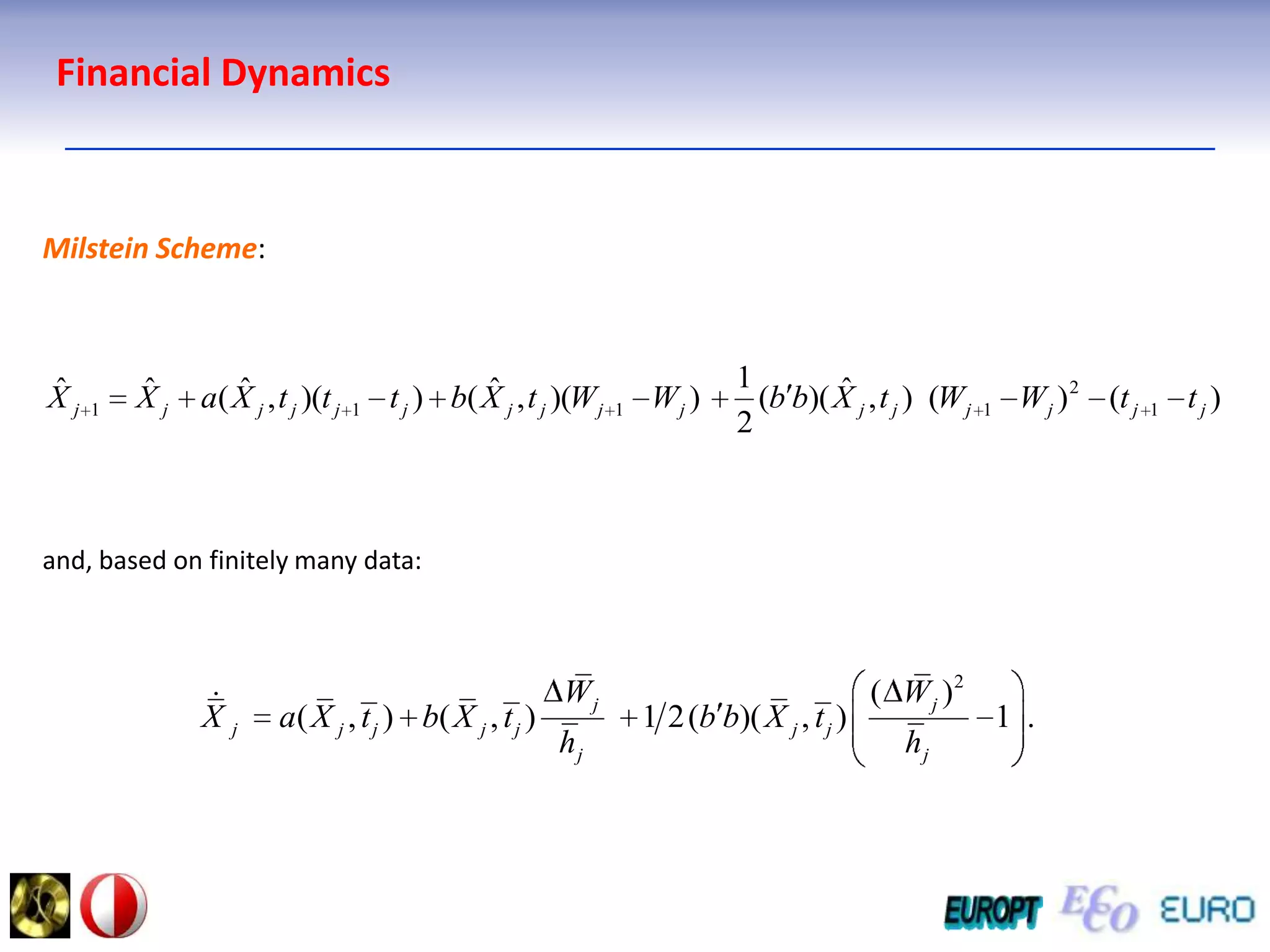
Financial DynamicsMilstein Scheme:and, based on finitely many data:
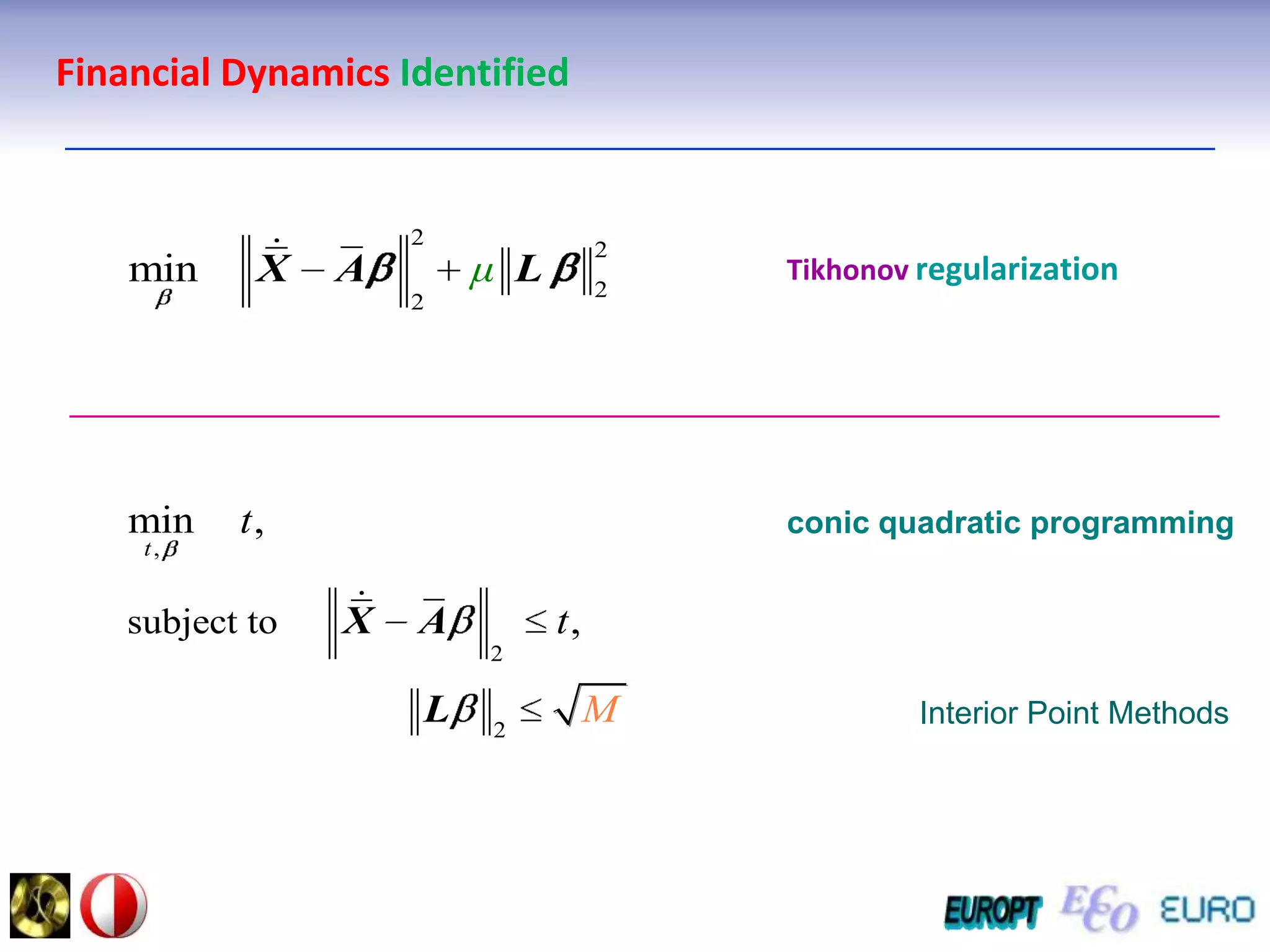
Financial Dynamics IdentifiedTikhonovregularizationconic quadratic programmingInterior Point Methods
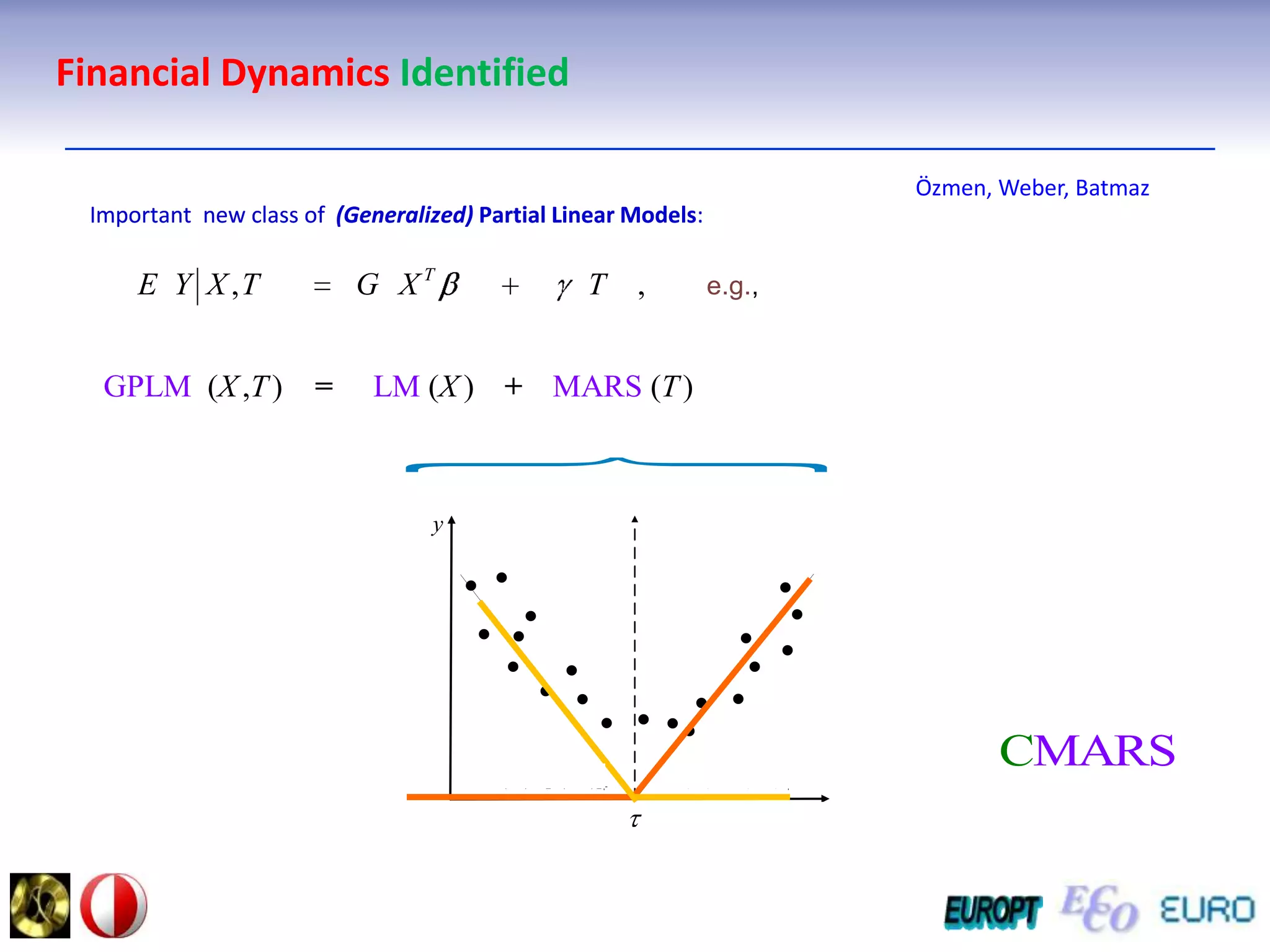
Financial Dynamics IdentifiedÖzmen, Weber, BatmazImportant  new class of (Generalized) Partial Linear Models:              Important  new class of (Generalized) Partial Linear Models:
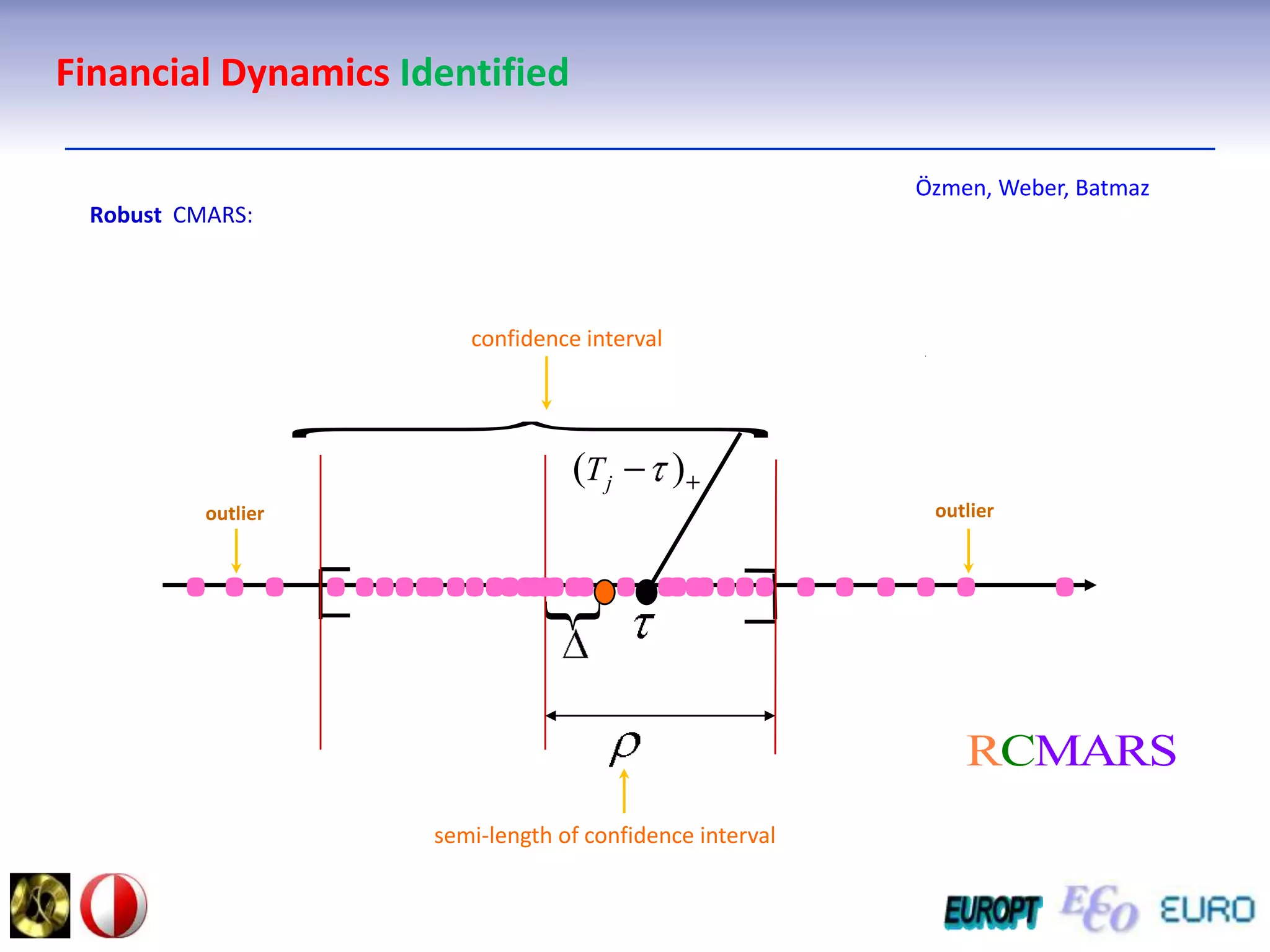
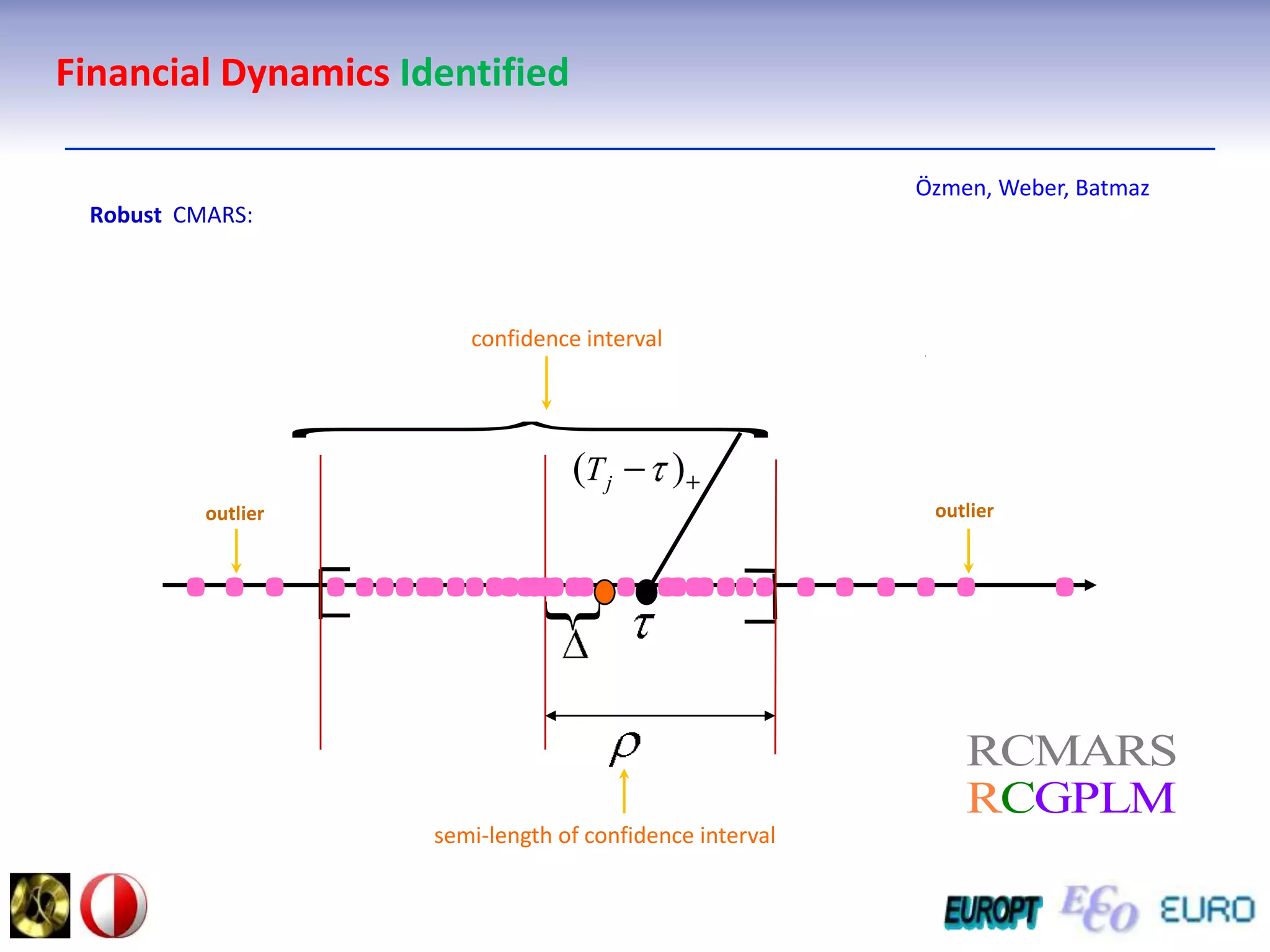
Financial Dynamics IdentifiedÖzmen, Weber, BatmazRobust  CMARS:              confidence interval..... ....................... . . . ..outlieroutliersemi-length of confidence interval
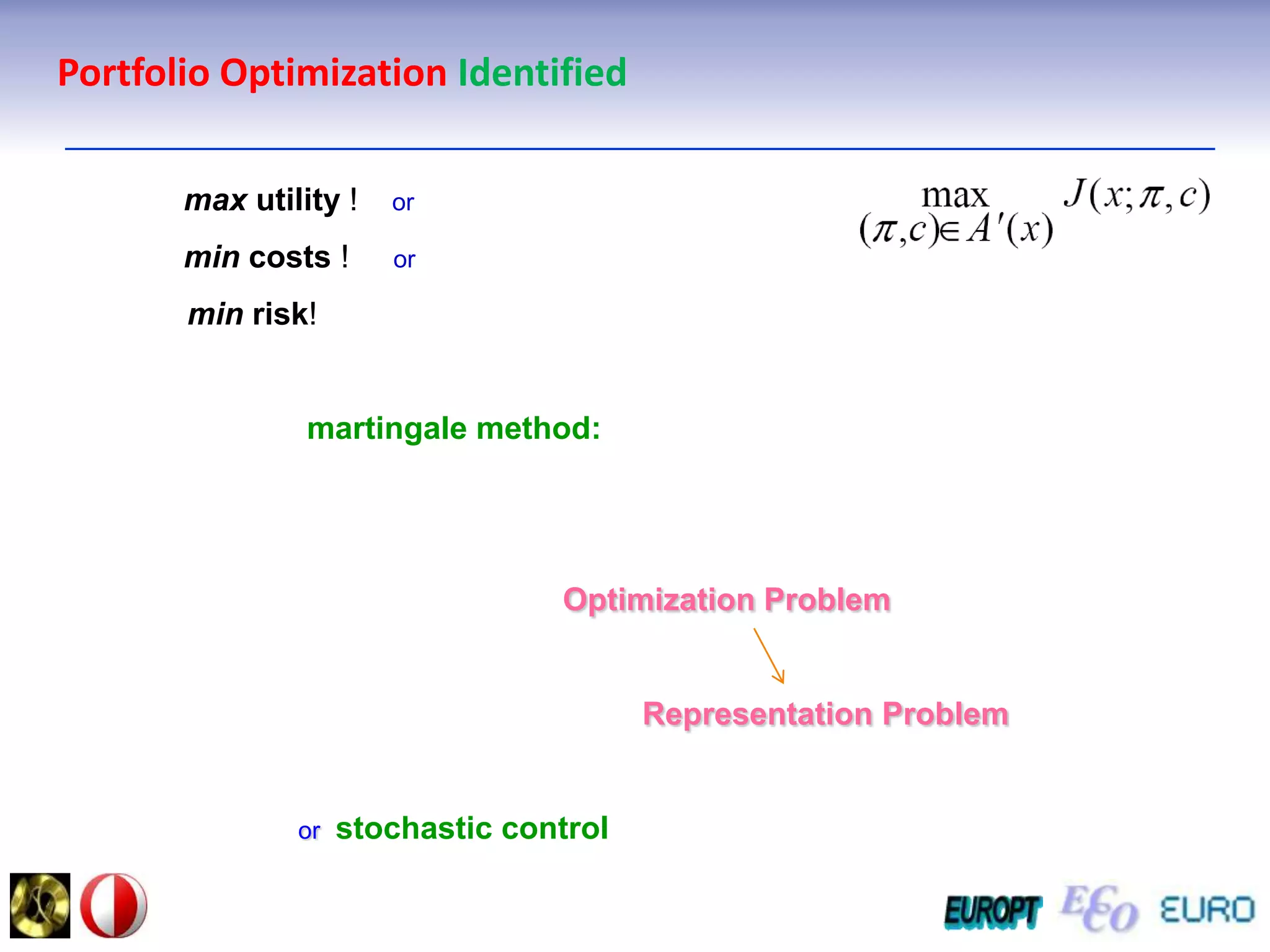
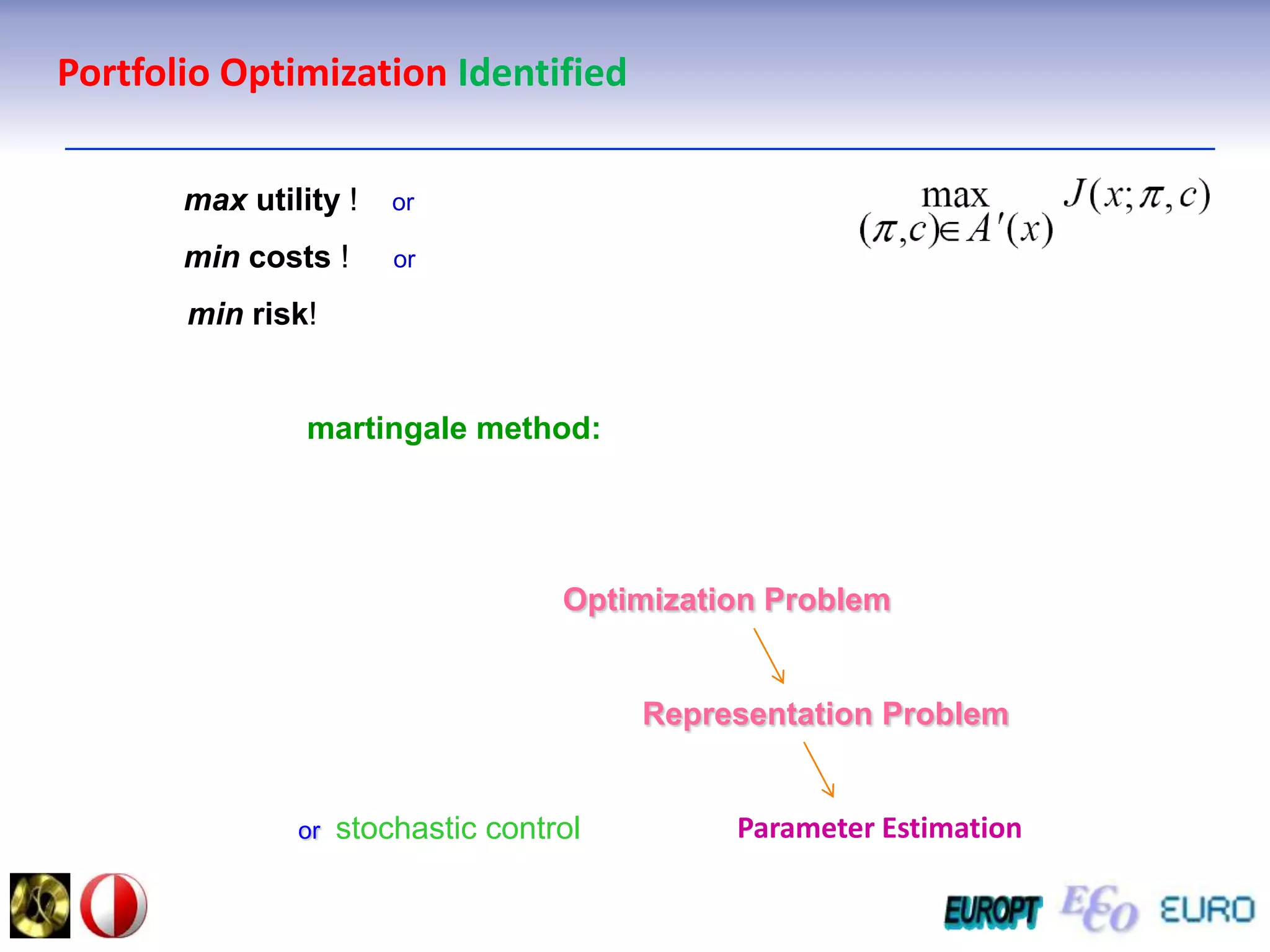
Portfolio Optimization Identified            max utility !     ormincosts!ormin risk!martingale method:                                                                                                         Optimization Problem                                                                Representation Problemor stochastic control
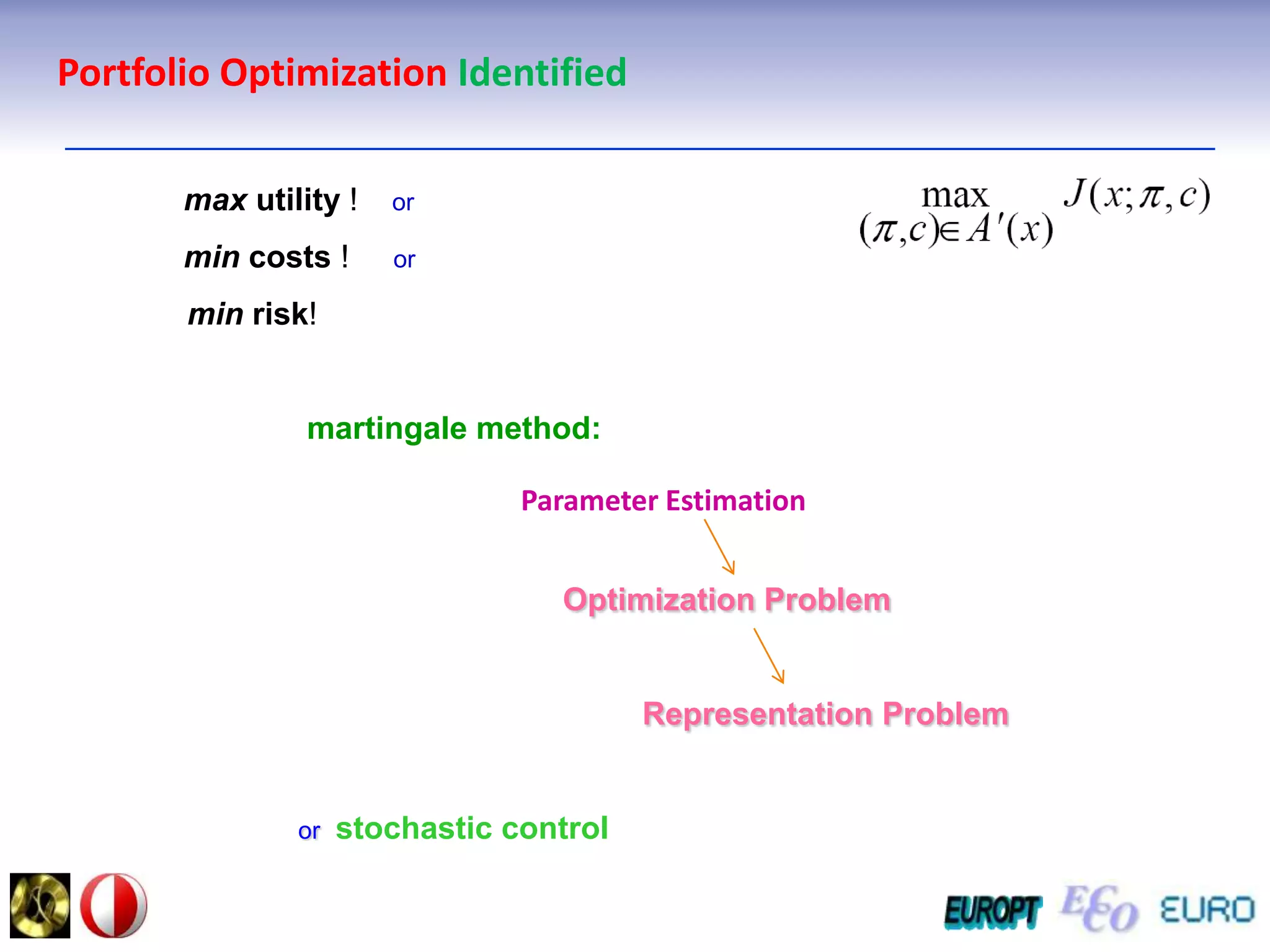
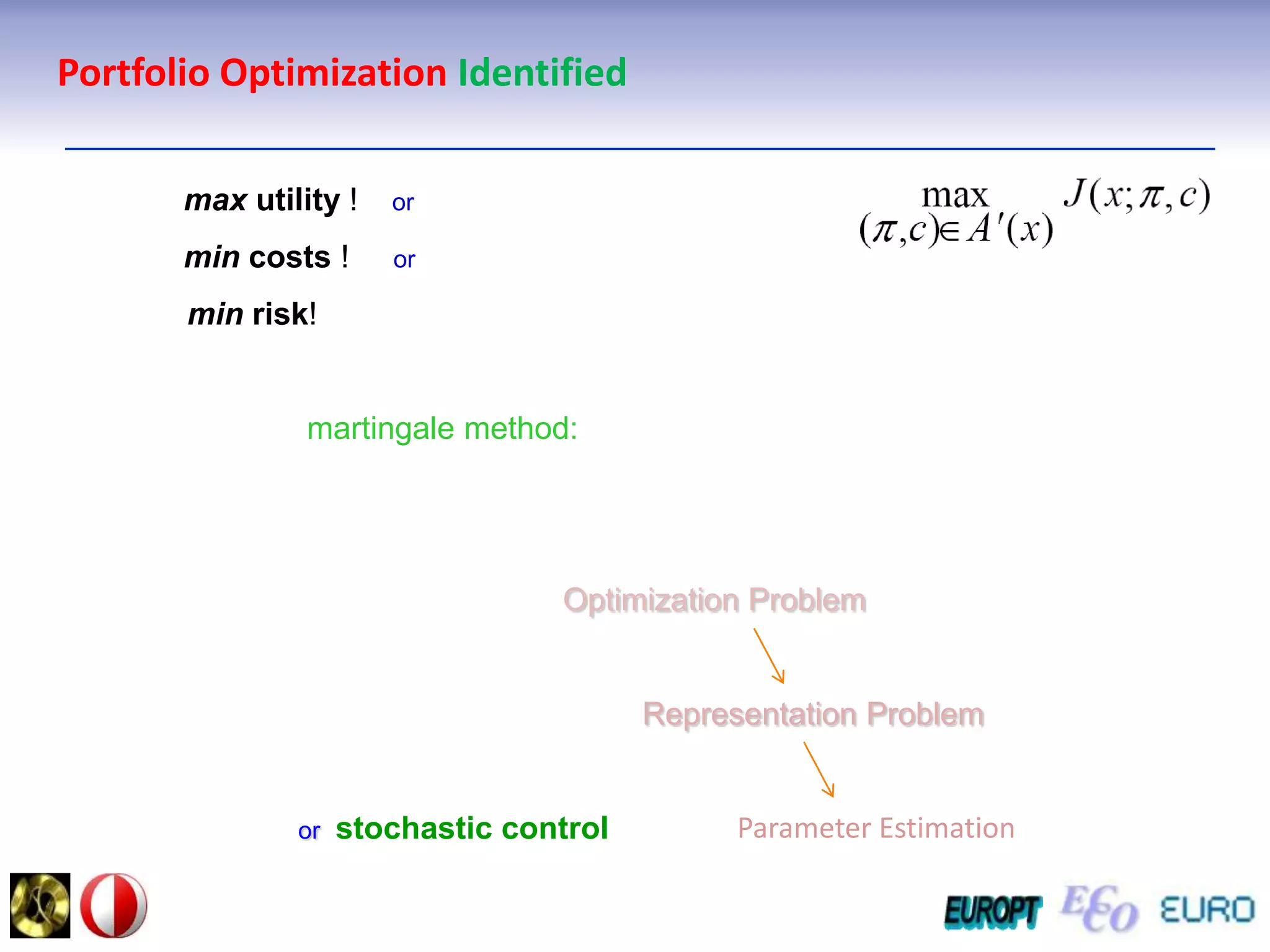
Portfolio Optimization Identified            max utility !     ormincosts!ormin risk!martingale method:                                                  Optimization ProblemRepresentation Problemor stochastic controlParameter Estimation
Portfolio Optimization Identified            max utility !     ormincosts!ormin risk! martingale method:                                                                                                         Optimization Problem                                                                Representation Problemor stochastic controlParameter Estimation
Portfolio Optimization Identified            max utility !     ormincosts!ormin risk! martingale method:                                                  Optimization ProblemRepresentation Problemor stochastic controlParameter Estimation
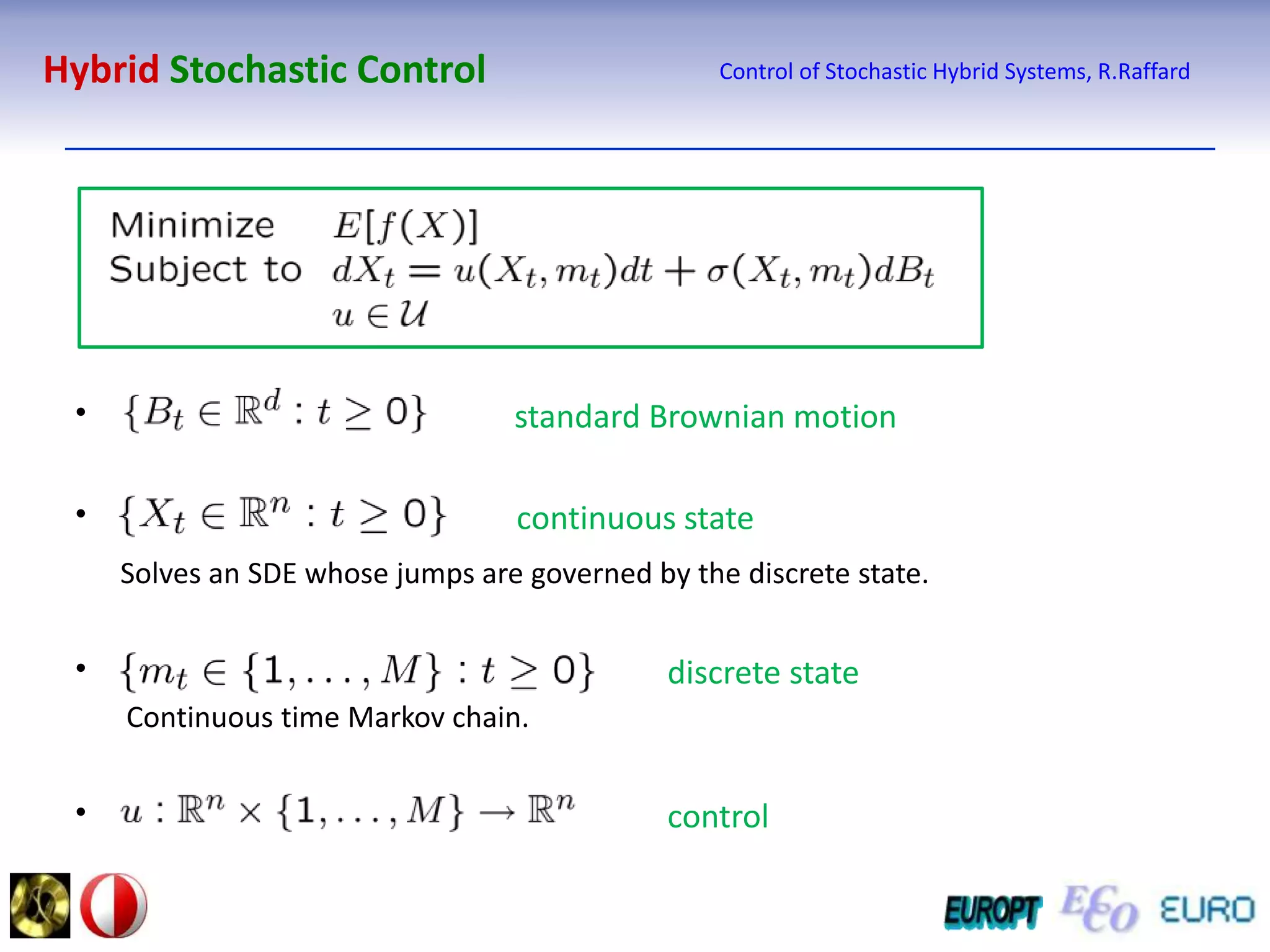
HybridStochastic ControlControl of Stochastic Hybrid Systems, R.Raffardstandard Brownian motion
continuous stateSolves an SDE whose jumps are governed by the discrete state.
discrete stateContinuous time Markov chain.
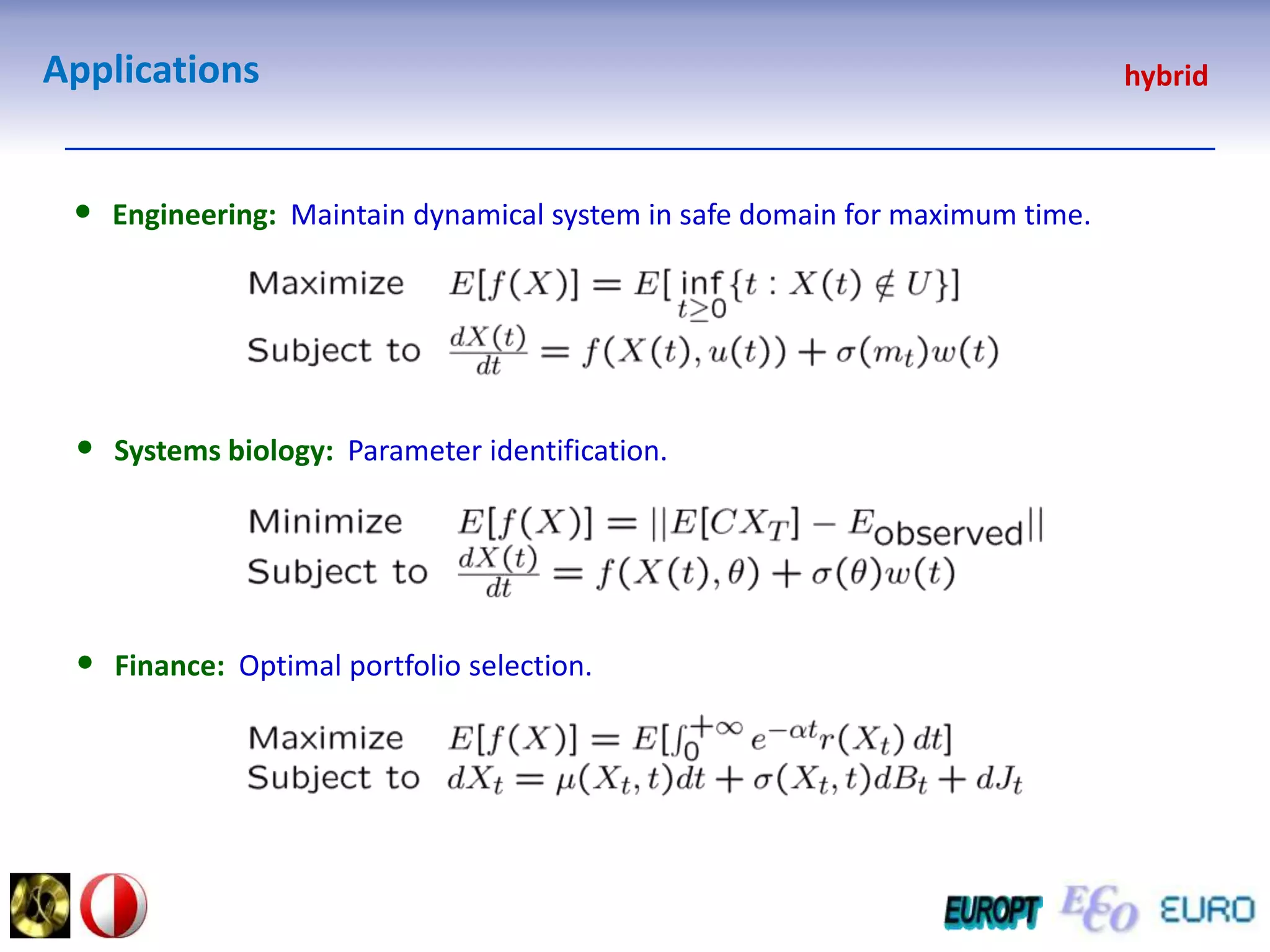
controlApplicationshybridEngineering:Maintain dynamical system in safe domain for maximum time.

New Insights and Applications of Eco-Finance Networks and Collaborative Games

  • 1.
    6th International SummerSchoolNational University of Technology of the UkraineKiev, Ukraine, August 8-20, 2011New Insights and Applications of Eco-Finance Networksand Collaborative GamesGerhard-Wilhelm Weber 1*SırmaZeynepAlparslanGök2, Erik Kropat3, ÖzlemDefterli4, Fatma Yelikaya-Özkurt1,Armin Fügenschuh51 Institute of Applied Mathematics, Middle East Technical University, Ankara, Turkey 2 Department of Mathematics, SüleymanDemirel University, Isparta, Turkey 3 Department of Computer Science, Universität der Bundeswehr München, Munich, Germany 4 Department of Mathematics and Computer Science, Cankaya University, Ankara, Turkey 5 Optimierung, Zuse Institut Berlin, Germany* Faculty of Economics, Management and Law, University of Siegen, GermanyCenter for Research on Optimization and Control, University of Aveiro, PortugalUniversiti Teknologi Malaysia, Skudai, Malaysia
  • 2.
    OutlineBio- and FinancialSystemsGenetic ,Gene-Environment and Eco-Finance Networks Time-Continuous and Time-Discrete ModelsOptimization ProblemsNumerical Example and ResultsNetworks under UncertaintyEllipsoidal ModelOptimization of the Ellipsoidal ModelKyoto GameEllipsoidal Game TheoryRelated Aspects from FinanceHybrid Stochastic ControlConclusion
  • 3.
    Bio-Systems environmentmedicinefoodbio materialsbioenergydevelopmenteducationhealth caresustainability
  • 4.
  • 5.
    Regulatory Networks: ExamplesFurther examples:Socio-econo-networks, stock markets, portfolio optimization, immune system, epidemiological processes …
  • 6.
    Bio-Systems MedicineEnvironment... Finance Health Careprediction of gene patterns based onDNA microarraychip experimentswithM.U. Akhmet, H. Öktem S.W. Pickl, E. Quek Ming PohT. Ergenç, B. Karasözen J. Gebert, N. Radde Ö. Uğur, R. WünschiersM. Taştan, A. Tezel, P. Taylan F.B. Yilmaz, B. Akteke-ÖztürkS. Özöğür, Z. Alparslan-Gök A. Soyler, B. Soyler, M. ÇetinS. Özöğür-Akyüz, Ö. Defterli N. Gökgöz, E. Kropat
  • 7.
  • 8.
    Analysis of DNAexperiments
  • 9.
    E0 : metabolicstate of a cell at t0 (:=gene expression pattern),ith element of the vector E0 :=expression level of gene i,Mk := I + hkM(Ek) , Ek (k є IN0) is recursively defined as Ek+1 := MkEk.Metabolic ShiftGebert et al. (2006)
  • 10.
    Modeling & Predictiondataprediction, anticipation least squares – max likelihoodExpressionexpression datamatrix-valued function – metabolic reaction
  • 11.
    Modeling & PredictionEx.:Ex.: Euler, Runge-KuttaMWe analyze the influence of em-parameters on the dynamics (expression-metabolic).
  • 12.
    StabilityFor which parameters,i.e., for which setM(hence,dynamics), isstabilityguaranteed ?stablefeasibleMmetabolic reactionunstable unfeasiblegoodness-of-fit (model) testDef.:Mis stable :B : (complex) bounded neighbourhood ofM :
  • 13.
    Stabilitycombinatorial algorithmForwhich parameters, i.e., for which setM(hence,dynamics), isstabilityguaranteed ?stablefeasibleMmetabolic reactionunstable unfeasible Akhmet, Gebert, Öktem, Pickl, Weber (2005), Gebert, Laetsch, Pickl, Weber, Wünschiers (2006), Weber, Ugur, Taylan, Tezel (2009), Ugur, Pickl, Weber, Wünschiers (2009)
  • 14.
  • 15.
  • 16.
    Gene-Environment Networks if gene j regulates gene i otherwise
  • 17.
    Model Class: time-autonomous form, where: d-vector of concentration levels of proteins and of certain levels of environmental factors : change in the gene-expression data in time: initial values of the gene-expression levels: experimental data vectors obtained from microarray experiments and environmental measurements : the gene-expression level (concentration rate) of the i th gene at time tdenotes anyone of the first n coordinates in thed-vector of genetic and environmental states.Weber et al. (2008c), Chen et al. (1999), Gebert et al. (2004a),Gebert et al. (2006), Gebert et al. (2007), Tastan (2005), Yilmaz (2004), Yilmaz et al. (2005),Sakamoto and Iba (2001), Tastan et al. (2005): the set of genes.
  • 18.
    Model Class(i): a constant (nxn)-matrix : an (nx1)-vector of gene-expression levelsrepresents and t the dynamical system of the n genes and their interaction alone. : : (nxn)-matrix with entries as functions of polynomials, exponential, trigonometric, splines or wavelets, containing some parameters to be optimized.(iii)Weber et al. (2008c), Tastan (2005), Tastan et al. (2006),Ugur et al. (2009), Tastan et al. (2005), Yilmaz (2004), Yilmaz et al. (2005),Weber et al. (2008b), Weber et al. (2009b)environmental effects(*)n genes , m environmental effects: (n+m)-vector and (n+m)x(n+m)-matrix, respectively.
  • 19.
    Model ClassIn general,in the d-dimensional extended space, with : : (dxd)-matrix, : (dx1)-vectors.Ugur and Weber (2007), Weber et al. (2008c),Weber et al. (2008b), Weber et al. (2009b)
  • 20.
    Time-Discretized Model- Euler’s method, - Runge-Kutta methods, e.g., 2nd-order Heun's method3rd-order Heun's method is introduced byDefterli et al. (2009)we rewrite it as whereErgenc and Weber (2004), Tastan (2005), Tastan et al. (2006), Tastan et al. 2005)
  • 21.
    Time-Discretized Model (**): in the extended spacedenotes the DNA microarray experimental dataand the data of environmental items obtained at the time-level: approximationsobtained by the iterative formula above: initial valueskthapproximation (prediction):
  • 22.
    Matrix Algebra: (nxn)- and (nxm)-matrices, respectively: (n+m)x(n+m) -matrix: (n+m)-vectorsApplying the 3rd-order Heun’s method to (*) gives the iterative formula (**), where
  • 23.
  • 24.
    Optimization Problemmixed-integer least-squaresoptimization problem:Boolean variablessubject toUgur and Weber (2007),Weber et al.(2008c),Weber et al. (2008b),Weber et al. (2009b), Gebert et al. (2004a), Gebert et al. (2006), Gebert et al. (2007), , : th : the numbers of genes regulated by gene (its outdegree), by environmental item , or by the cumulative environment, resp..
  • 25.
    Mixed-Integer Problem: constant (nxn)-matrix with entries representing the effect which the expression level of gene has on the change of expression of genegenetic regulation network mixed-integer nonlinear optimization problem (MINLP):subject to : constant vectorrepresenting the lower bounds for the decrease of the transcript concentration.Binary variables :
  • 26.
    Numerical ExampleMINLP fordata: Gebert et al. (2004a)Apply 3rd-order Heun method:Takeusing modeling language Zimpl 3.0, we solveby SCIP 1.2 as a branch-and-cutframework, together with SOPLEX 1.4.1 as LP solver
  • 27.
    Numerical ExampleApply 3rd-orderHeun’s time discretization :
  • 28.
    ____ gene A........ gene B_ . _ . gene C- - - - gene DResults of Euler Method for all genes:
  • 29.
    ____ gene A........ gene B_ . _ . gene C- - - - gene DResults of 3rd-order Heun Method for all genes:
  • 30.
  • 31.
  • 32.
  • 33.
    Model Class underInterval Uncertainty
  • 34.
    Model Class underInterval Uncertaintyθ2,2hybridlocal modelθ2,1θ1,1θ1,2
  • 35.
    Model Class underInterval Uncertaintyminsubject to
  • 36.
  • 37.
    Generalized Semi-Infinite ProgrammingJongen,Weber, Guddat et al.homeom. asymptoticeffect: structurally stableglobal local global
  • 38.
    Generalized Semi-Infinite ProgrammingThm. (W. 1999/2003, 2006):Fulfilled!
  • 39.
  • 40.
  • 41.
    Regulatory Networks: InteractionsDetermine the degree of connectivity.
  • 42.
    Time-Discrete ModelClusters andEllipsoids:Target clusters: C1,C2,…,CREnvironmental clusters: D1,D2,…,DSTarget ellipsoids: X1,X2,…,XRXi = E(μi , Σi) Environmental ellipsoids: E1,E2,…,ES Ej = E(ρj ,Πj) CenterCovariance matrix
  • 43.
    Time-Discrete ModelTime-Discrete Model:Target TargetEnvironment  Target(R)(S)TargetclusterTT(k)(k+1)ET(k)XξXA++=EAj r r j0j s j sr =1s =1(R)(S)Environmental clusterTE(k)(k+1)EE(k)XζEA++=EAi r r i0is i sr =1s =1Target  EnvironmentEnvironment  Environment Determine system matrices and intercepts.
  • 44.
    Time-Discrete ModelEllipsoidal Calculus: Affine-linear transformations
  • 45.
    Sumsof ellipsoids
  • 46.
    Intersections/ fusions of ellipsoidsAE + bE1 + E2inner / outer approximationsE1∩ E2Ros et al. (2002)Parameterized family of ellipsoidal approximationsKurzhanski, Varaiya (2008)
  • 47.
    Set-Theoretic Regression ProblemEllipsoidalCalculusThe Regression Problem:Maximize(overlap of ellipsoids) DetermineEETTETTE, AA, A, Amatricesand isj rj si r,ζvectorsξ i0 j0measurementRSTΣΣΣ−−^(k)(k)(k)(k)+^EEXX∩∩ s r r sr = 1s = 1k= 1prediction
  • 48.
    Set-Theoretic Regression ProblemMeasuresfor the size of intersection:Volume->ellipsoid matrix determinant
  • 49.
    Sum of squaresof semiaxes-> trace of covariance matrix
  • 50.
    Length of largestsemiaxes-> eigenvalues of covariance matrixEsemidefinite programming interior point methods
  • 51.
  • 52.
    Curse of DimensionalityMixed-IntegerRegression Problem:RSTΣΣΣ−−^(k)(k)(k)(k)+^EEXmaximizeX∩∩ s r r sr = 1s = 1k= 1αTT≤deg(C )TT bounds on outdegreessuch thatjjαTE≤deg(C )TE jjαET≤deg(D )ET iiαEE≤deg(D )EE ii
  • 53.
    Curse of DimensionalityScalefree networks(metabolic networks, world wide web,…)High error tolerance
  • 54.
    High attack vulnerability(removalof important nodes)Curse of DimensionalityContinuous Regression Problem:RSTΣΣΣ−−^(k)(k)(k)(k)+^EEXX∩maximize∩ s r r sr = 1s = 1k= 1RΣαTTTT≤PTT ( TT )such that, ξAjj rjrj0r =1RαTEΣ≤TEPTE ( TE ),ξAjj r j0jrr =1bounds on outdegreesRETΣαETPET ( ET ≤, ζA)ii s i0isContinuous Constraints /Probabilities s =1RΣEEαEEPEE ( EE )≤, ζAii s i0iss =1
  • 55.
    Curse of DimensionalityContinuousRegression Problem:RSTΣΣΣ−−^(k)(k)(k)(k)+^EEXX∩maximize∩ s r r sr = 1s = 1k= 1RΣαTTTT≤PTT ( TT )such that, ξAjj rjrj0r =1RαTEΣ≤TEPTE ( TE ),ξAjj r j0jrr =1RETΣαETPET ( ET ≤, ζA)ii s i0iss =1REx.:Robust OptimizationΣEEαEEPEE ( EE )≤, ζAii s i0iss =1
  • 56.
    Cost GamesCost gamesare very important in the practice of OR.Ex.: airport game,
  • 57.
  • 58.
    productioneconomy with landowners and peasants,
  • 59.
    bankrupcygame, etc..There is also a cost game in environmental protection (TEM model):The aim is to reach a state which is mentioned in Kyoto Protocol by choosing control parameters such that the emissions of each player become minimized.For example, the value is taken as a control parameter.
  • 60.
    Cost GamesThe centralproblem in cooperative game theory is how to allocate the gain among the individual players in a “fair” way. There are various notions of fairness and corresponding allocation rules (solution concepts).Any with is an allocation.So, a core allocation guarantees each coalition to be satisfied in the sense that it gets at least what it could get on its own.
  • 61.
  • 62.
    TEM Model Influence of memory parameter on the emissions reduced and financial means expended
  • 63.
  • 64.
  • 65.
  • 66.
    Ellipsoid Games Interval Gamescooperative....
  • 67.
    Ellipsoid Games Interval Gamescooperative....
  • 68.
    Ellipsoid Games Interval Gamescooperative....
  • 69.
    Ellipsoid Games Interval Gamescooperative....
  • 70.
    Ellipsoid Games Interval Gamescooperative....Robust Optimization
  • 71.
  • 72.
  • 73.
    Ellipsoid Games cooperative
  • 74.
    Ellipsoid Games cooperativeEllipsoid Glove Game
  • 75.
    Ellipsoid Games cooperativeEllipsoid Kyoto GameEllipsoid Glove Game , : (individual roles in TEM Model): (individual role in TEM Model)
  • 76.
    Ellipsoid Games cooperativeEllipsoid Malacca Police GameR
  • 77.
    Ellipsoid Games cooperativererrrr
  • 78.
    Ellipsoid Games cooperativererFarkas Lemmarrr
  • 79.
  • 80.
  • 81.
    Finance Networks withBubbles.hybrid
  • 82.
    Financial Dynamicsdrift diffusion Ex.: price, wealth, interest rate, volatility processes
  • 83.
    Financial DynamicsMilstein Scheme:and,based on finitely many data:
  • 84.
    Financial Dynamics IdentifiedTikhonovregularizationconicquadratic programmingInterior Point Methods
  • 85.
    Financial Dynamics IdentifiedÖzmen,Weber, BatmazImportant new class of (Generalized) Partial Linear Models: Important new class of (Generalized) Partial Linear Models:
  • 86.
    Financial Dynamics IdentifiedÖzmen,Weber, BatmazRobust CMARS: confidence interval..... ....................... . . . ..outlieroutliersemi-length of confidence interval
  • 87.
    Financial Dynamics IdentifiedÖzmen,Weber, BatmazRobust CMARS: confidence interval..... ....................... . . . ..outlieroutliersemi-length of confidence interval
  • 88.
    Portfolio Optimization Identified max utility ! ormincosts!ormin risk!martingale method: Optimization Problem Representation Problemor stochastic control
  • 89.
    Portfolio Optimization Identified max utility ! ormincosts!ormin risk!martingale method: Optimization ProblemRepresentation Problemor stochastic controlParameter Estimation
  • 90.
    Portfolio Optimization Identified max utility ! ormincosts!ormin risk! martingale method: Optimization Problem Representation Problemor stochastic controlParameter Estimation
  • 91.
    Portfolio Optimization Identified max utility ! ormincosts!ormin risk! martingale method: Optimization ProblemRepresentation Problemor stochastic controlParameter Estimation
  • 92.
    HybridStochastic ControlControl ofStochastic Hybrid Systems, R.Raffardstandard Brownian motion
  • 93.
    continuous stateSolves anSDE whose jumps are governed by the discrete state.
  • 94.
  • 95.
  • 96.
  • 97.
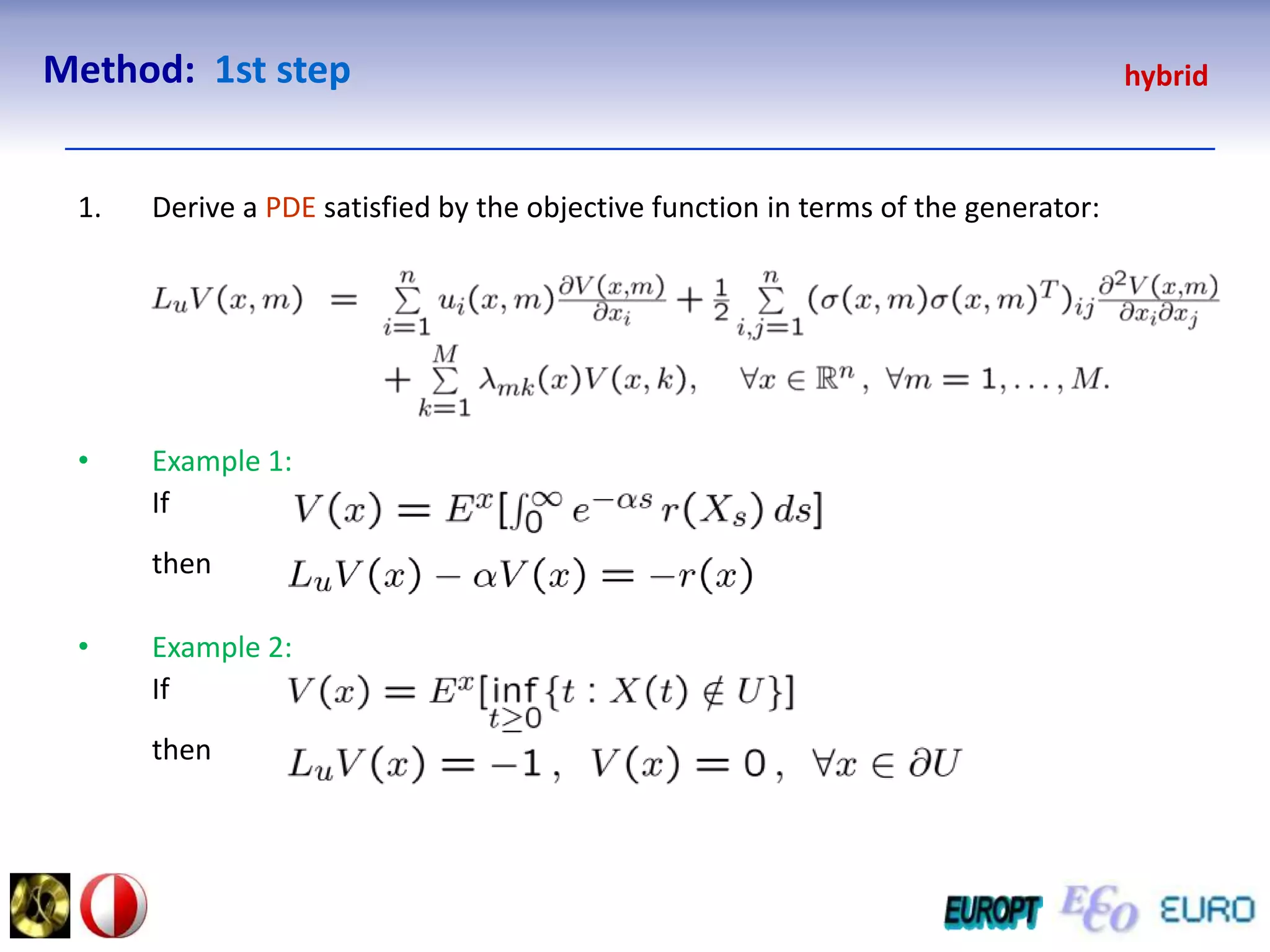
    Finance: Optimal portfolioselection.Method:1st stephybridDerive a PDE satisfied by the objective function in terms of the generator:Example 1: If thenExample 2: If then
  • 98.
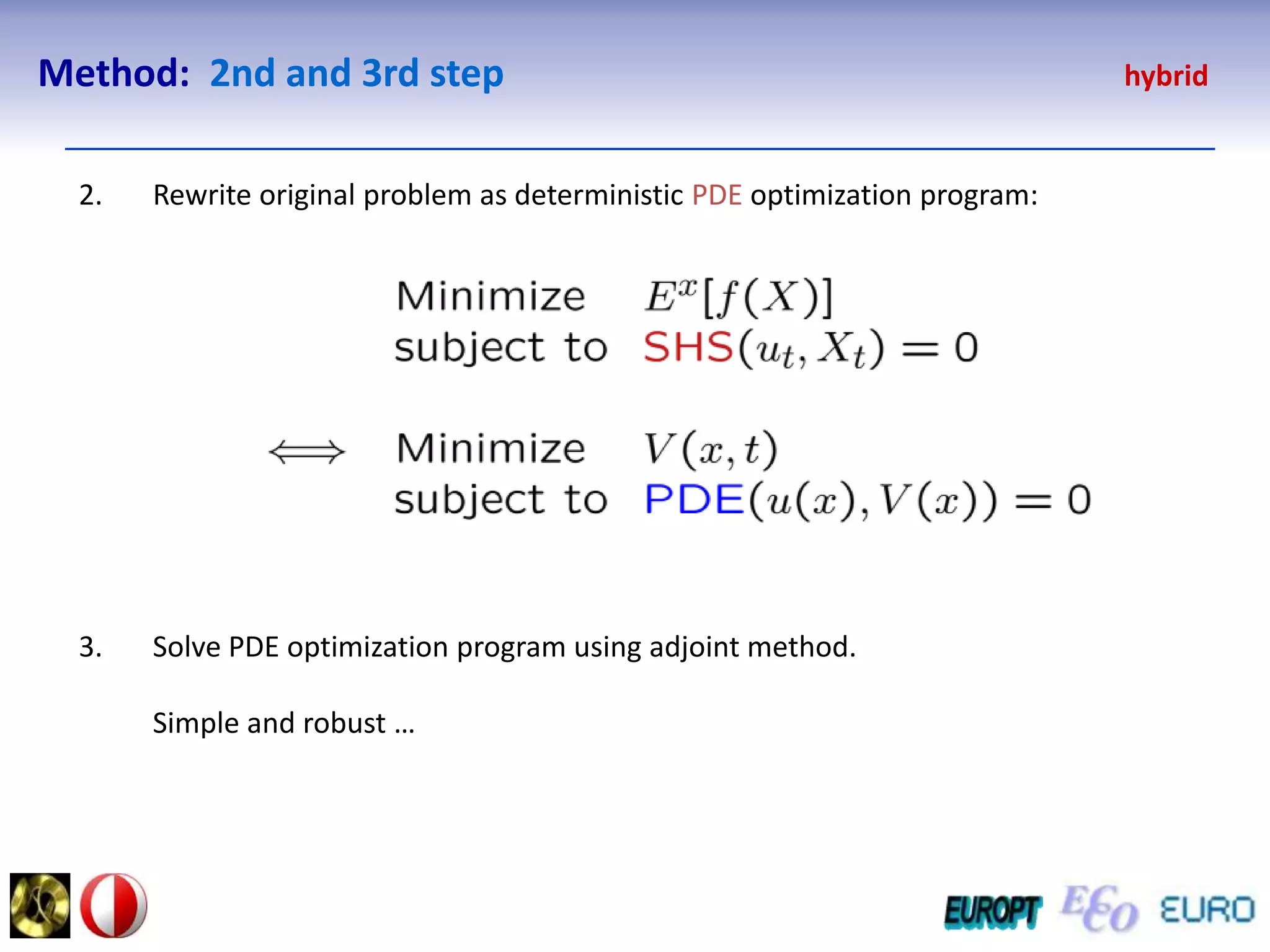
    Method:2ndand 3rd stephybridRewriteoriginal problem as deterministic PDE optimization program:Solve PDE optimization program using adjoint method. Simple and robust…
  • 99.
  • 100.
    References Part 1Achterberg, T., Constraint integer programming, PhD. Thesis, Technische Universitat Berlin, Berlin, 2007.Aster, A., Borchers, B., and Thurber, C., Parameter Estimation and Inverse Problems. Academic Press, San Diego; 2004.Chen, T., He, H.L., and Church, G.M., Modeling gene expression with differential equations, Proceedings of Pacific Symposium on Biocomputing 1999, 29-40.Ergenc, T,. and Weber, G.-W., Modeling and prediction of gene-expression patterns reconsidered with Runge-Kutta discretization, Journal of Computational Technologies 9, 6 (2004) 40-48.Gebert, J., Laetsch, M., Pickl, S.W., Weber, G.-W., and Wünschiers ,R., Genetic networks and anticipation of gene expression patterns, Computing Anticipatory Systems: CASYS(92)03 - Sixth International Conference,AIP Conference Proceedings 718 (2004) 474-485.Hoon, M.D., Imoto, S., Kobayashi, K., Ogasawara, N ., andMiyano, S., Inferring gene regulatory networks from time-ordered gene expression data of Bacillus subtilis using dierential equations, Proceedings of Pacific Symposium on Biocomputing (2003) 17-28.Pickl, S.W., and Weber, G.-W., Optimization of a time-discrete nonlinear dynamical system from a problem of ecology - an analytical and numerical approach, Journal of Computational Technologies 6, 1 (2001) 43-52.Sakamoto, E., and Iba, H., Inferring a system of differential equations for a gene regulatory network by using genetic programming, Proc. Congress on Evolutionary Computation 2001, 720-726.Tastan, M., Analysis and Prediction of Gene Expression Patterns by Dynamical Systems, and by a Combinatorial Algorithm, MSc Thesis, Institute of Applied Mathematics, METU, Turkey, 2005.
  • 101.
    References Part 1Tastan , M., Pickl, S.W., and Weber, G.-W., Mathematical modeling and stability analysis of gene-expression patterns in an extended space and with Runge-Kutta discretization, Proceedings of Operations Research, Bremen, 2006, 443-450.Wunderling, R., Paralleler und objektorientierter Simplex Algorithmus, PhD Thesis. Technical Report ZIB-TR 96-09. Technische Universitat Berlin, Berlin, 1996.Weber, G.-W., Alparslan -Gök, S.Z ., and Dikmen, N.. Environmental and life sciences: Gene-environment networks-optimization, games and control - a survey on recent achievements, deTombe, D. (guest ed.), special issue of Journal of Organizational Transformation and Social Change 5, 3 (2008) 197-233.Weber, G.-W., Taylan, P., Alparslan-Gök, S.Z., Özögur, S., and Akteke-Öztürk, B., Optimization of gene-environment networks in the presence of errors and uncertainty with Chebychev approximation, TOP 16, 2 (2008) 284-318.Weber, G.-W., Alparslan-Gök, S.Z ., and Söyler, B., A new mathematical approach in environmental and life sciences: gene-environment networks and their dynamics,Environmental Modeling & Assessment 14, 2 (2009) 267-288.Weber, G.-W., and Ugur, O., Optimizing gene-environment networks: generalized semi-infinite programming approach with intervals,Proceedings of International Symposium on Health Informatics and Bioinformatics Turkey '07, HIBIT, Antalya, Turkey, April 30 - May 2 (2007).Yılmaz, F.B., A Mathematical Modeling and Approximation of Gene Expression Patterns by Linear and Quadratic Regulatory Relations and Analysis of Gene Networks, MSc Thesis, Institute of Applied Mathematics, METU, Turkey, 2004.
  • 102.
    References Part 2Aster, A., Borchers, B., and Thurber, C., Parameter Estimation and Inverse Problems, Academic Press, 2004.Boyd, S., and Vandenberghe, L., Convex Optimization, Cambridge University Press, 2004.Buja, A., Hastie, T., and Tibshirani, R., Linear smoothers and additive models, The Ann. Stat. 17,2(1989) 453-510.Fox, J., Nonparametric regression, Appendix to an R and S-Plus Companion to Applied Regression, Sage Publications, 2002. Friedman, J.H., Multivariate adaptive regression splines, Annals of Statistics 19, 1 (1991) 1-141.Hastie, T., and Tibshirani, R., Generalized additive models, Statist. Science 1, 3 (1986) 297-310.Hastie, T., and Tibshirani, R., Generalized additive models: some applications, J. Amer. Statist. Assoc. 82, 398 (1987) 371-386.Hastie, T., Tibshirani, R., and Friedman, J.H., The Element of Statistical Learning, Springer, 2001.Hastie, T.J., and Tibshirani, R.J., Generalized Additive Models, New York, Chapman and Hall, 1990.Kloeden, P.E, Platen, E., and Schurz, H., Numerical Solution of SDE ThroughComputer Experiments, Springer, 1994.Korn, R., and Korn, E., Options Pricing and Portfolio Optimization: Modern Methods ofFinancial Mathematics, Oxford University Press, 2001.Nash, G., and Sofer, A., Linear and Nonlinear Programming, McGraw-Hill, New York, 1996. Nemirovski, A., Lectures on modern convex optimization, Israel Institute of Technology (2002).
  • 103.
    References Part 2Nemirovski, A., Modern Convex Optimization, lecture notes, Israel Institute of Technology (2005).Nesterov, Y.E , and Nemirovskii,A.S., Interior Point Methods in Convex Programming, SIAM, 1993.Önalan, Ö., Martingale measures for NIG Lévyprocesses with applications to mathematicalfinance, presentation at Advanced Mathematical Methods for Finance, Side, Antalya, Turkey, April 26-29, 2006.Taylan, P., Weber, G.-W.,and Kropat, E.,Approximation of stochastic differential equationsby additive modelsusing splines and conic programming, International Journal of Computing Anticipatory Systems 21(2008) 341-352.Taylan, P., Weber, G.-W., and Beck, A.,New approaches to regression by generalized additive modelsand continuous optimization for modernapplications in finance, science and techology, Optimization 56, 5-6 (2007) 1-24.Taylan, P., Weber, G.-W.,andYerlikaya, F., A new approach to multivariate adaptive regression splineby using Tikhonov regularization and continuous optimization, TOP 18, 2 (December 2010) 377-395.Seydel, R., Tools for ComputationalFinance, Springer, Universitext, 2004.Weber, G.-W., Taylan, P., Akteke-Öztürk, B., and Uğur, Ö., Mathematical and datamining contributionsdynamics and optimization of gene-environment networks,inthe special issue Organization in MatterfromQuarks to Proteins of Electronic Journalof Theoretical Physics.Weber, G.-W.,Taylan, P., Yıldırak, K.,and Görgülü, Z.K., Financial regression and organization, DCDIS-B (Dynamics of Continuous, Discrete andImpulsive Systems (Series B)) 17, 1b (2010) 149-174.
  • 104.
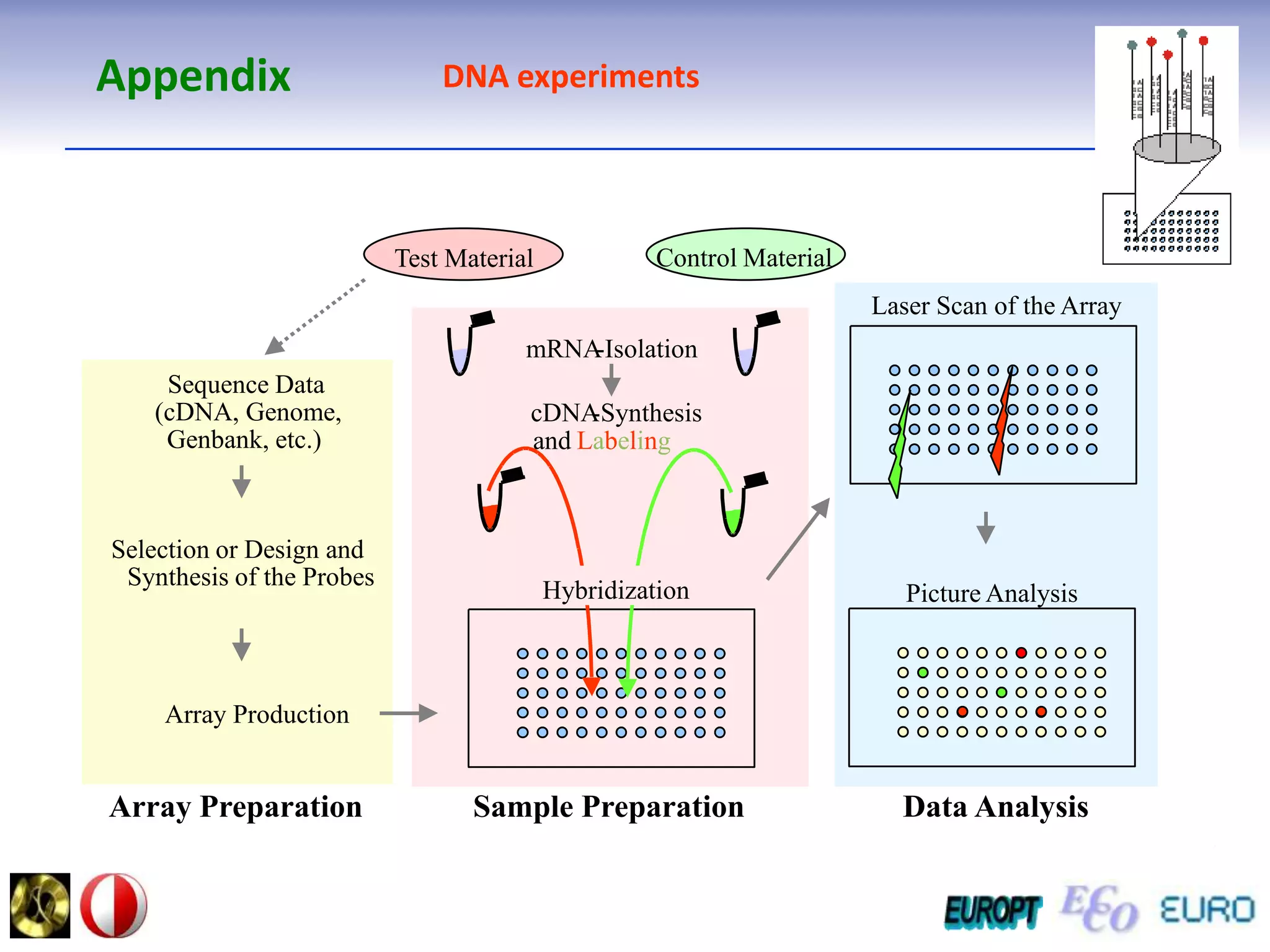
    AppendixDNA experimentsControl MaterialTestMaterialLaser Scan of the ArraymRNA-IsolationSequence Data(cDNA, Genome,cDNA-SynthesisGenbank, etc.)and LabelingSelection or Design andSynthesis of the ProbesHybridizationPicture AnalysisArray ProductionArray PreparationSample PreparationData Analysis
  • 105.
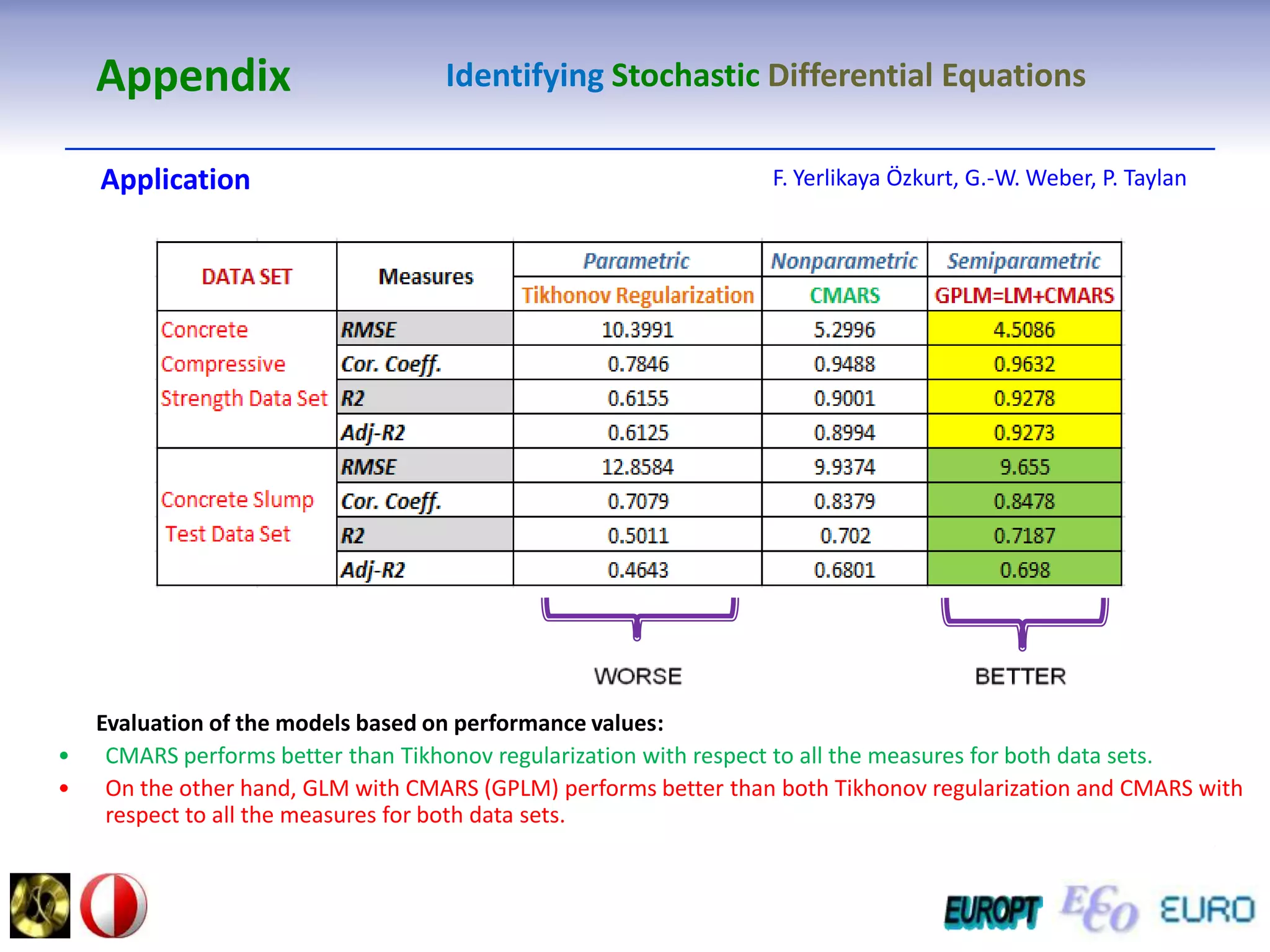
    Identifying Stochastic DifferentialEquationsAppendixApplicationF. Yerlikaya Özkurt, G.-W. Weber, P. Taylan Evaluation of the models based on performance values:CMARS performs better than Tikhonov regularization with respect to all themeasures for both data sets.
  • 106.
    On the otherhand, GLM with CMARS (GPLM) performs better than both Tikhonov regularization and CMARS with respect to all the measures for both data sets.