New Drug Development
Dr Naser Ashraf Tadvi
Associate Professor
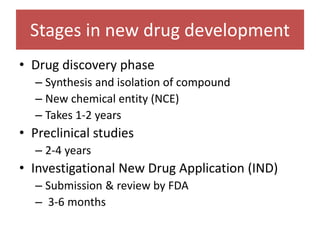
Stages in new drug development
• Drug discovery phase
– Synthesis and isolation of compound
– New chemical entity (NCE)
– Takes 1-2 years
• Preclinical studies
– 2-4 years
• Investigational New Drug Application (IND)
– Submission & review by FDA
– 3-6 months
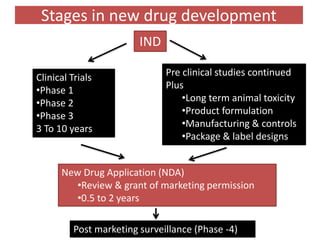
IND
Clinical Trials
•Phase 1
•Phase 2
•Phase 3
3 To 10 years
Pre clinical studies continued
Plus
•Long term animal toxicity
•Product formulation
•Manufacturing & controls
•Package & label designs
New Drug Application (NDA)
•Review & grant of marketing permission
•0.5 to 2 years
Post marketing surveillance (Phase -4)
Stages in new drug development
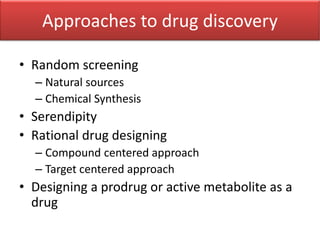
Approaches to drug discovery
• Random screening
– Natural sources
– Chemical Synthesis
• Serendipity
• Rational drug designing
– Compound centered approach
– Target centered approach
• Designing a prodrug or active metabolite as a
drug
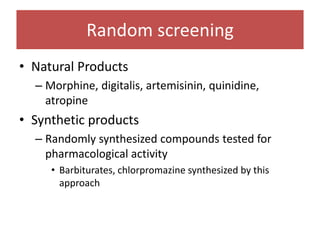
Random screening
• Natural Products
– Morphine, digitalis, artemisinin, quinidine,
atropine
• Synthetic products
– Randomly synthesized compounds tested for
pharmacological activity
• Barbiturates, chlorpromazine synthesized by this
approach
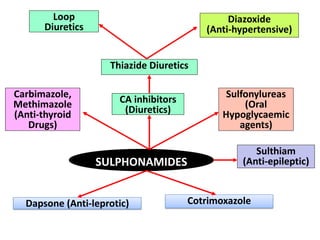
SULPHONAMIDES
CA inhibitors
(Diuretics)
Thiazide Diuretics
Loop
Diuretics
Sulfonylureas
(Oral
Hypoglycaemic
agents)
Carbimazole,
Methimazole
(Anti-thyroid
Drugs)
Diazoxide
(Anti-hypertensive)
Dapsone (Anti-leprotic)
Sulthiam
(Anti-epileptic)
Cotrimoxazole
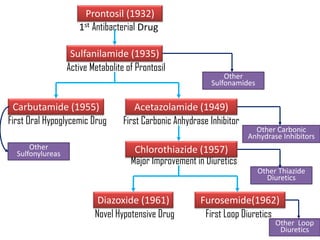
1st Antibacterial Drug
Active Metabolite of Prontosil
First Oral Hypoglycemic Drug First Carbonic Anhydrase Inhibitor
Major Improvement in Diuretics
Novel Hypotensive Drug First Loop Diuretics
Other
Sulfonamides
Other Carbonic
Anhydrase Inhibitors
Other Thiazide
Diuretics
Other Loop
Diuretics
Other
Sulfonylureas
Prontosil (1932)
Sulfanilamide (1935)
Carbutamide (1955) Acetazolamide (1949)
Chlorothiazide (1957)
Diazoxide (1961) Furosemide(1962)
Drug Discovery by Serendipity
• Happy observation by chance
• New use of old drugs or its side effects find
new therapeutic application
– Penicillin
– Methotrexate in psoriaris
– Sildenafil now used in impotence
– Lignocaine as antiarrhythmic
Rational drug designing
• Compound centered approach
– Beta blockers developed by modifying structure of
Propranolol
– Molecular modification/ manipulation
• Receptor based approach ( target oriented)
– Depends on sound knowledge & identification of
specific target for drug action
Target oriented approach
• Receptors
– GPCR, Receptors with intrinsic ion channels,
enzyme linked receptors
• Ion channels
– Na+, K+, Ca++ and Cl–
• Transporters
– Na+/K+ ATPase, H+/K+ ATPase, Na+-K+-2Cl–
• Enzymes
Designing of prodrug or active metabolite
as a drug
• Paracetamol active metabolite of phenacetin
• N acetyl procainamide active metabolite of
procainamide
• Bacampicillin prodrug of ampicillin
• Levodopa prodrug of dopamine
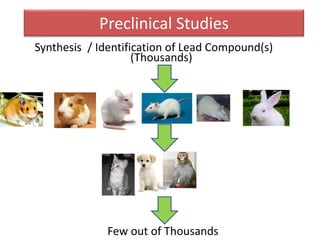
Preclinical Studies
Synthesis / Identification of Lead Compound(s)
(Thousands)
Few out of Thousands
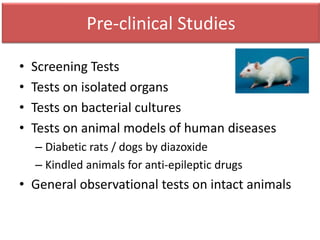
Pre-clinical Studies
• Screening Tests
• Tests on isolated organs
• Tests on bacterial cultures
• Tests on animal models of human diseases
– Diabetic rats / dogs by diazoxide
– Kindled animals for anti-epileptic drugs
• General observational tests on intact animals
Preclinical Studies
• Pharmacodynamic studies
• Toxicity studies
– Acute toxicity studies
– Subacute toxicity studies
– Chronic toxicity studies
– Special toxicity studies
• Reproductive
• Teratogenicity
• Carcinogenicity
• Mutagenicity
• Local Toxicity
• Pharmacokinetic studies
Toxicity Studies
• Acute Toxicity Studies (1 – 3 days)
– LD50
– Organ toxicity
• Sub-acute Toxicity Studies (2 – 12 weeks)
• Chronic Toxicity Studies (6 – 12 months)
• Special Long-term Toxicity Studies
– Reproduction ( including Teratogenicity)
– Mutagenicity
– Carcinogenicity
Good Laboratory Practice (GLP)
• Embodies a set of principles that provides a
framework within which laboratory studies
are planned, performed, monitored, recorded,
reported and archived.
Before Clinical Studies
• Drug is formulated into a suitable dosage form
• The clinical trials are done under the guideline
of Good Clinical Practice (GCP) laid down by
International Conference on Harmonization
(ICH)
Investigational New Drug (IND)
• IND license is obtained after successful
completion of pre-clinical studies from
regulatory authorities.
• Regulatory Authority
– India: Drug Control General of India (DCGI)
– USA: FDA (Food and Drug Administration)
Good Clinical Practice (GCP)
• GCP include
– Protection of human rights as a subject in clinical trial.
– Provides assurance of the safety and efficacy of the
newly developed compounds.
• Good Clinical Practice Guidelines include
standards on
– how clinical trials should be conducted,
– define the roles and responsibilities of clinical
trial sponsors, clinical research investigators, and
monitors.
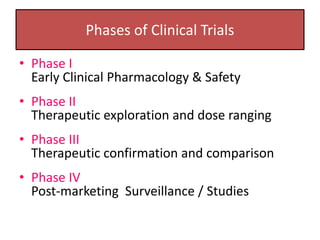
Phases of Clinical Trials
• Phase I
Early Clinical Pharmacology & Safety
• Phase II
Therapeutic exploration and dose ranging
• Phase III
Therapeutic confirmation and comparison
• Phase IV
Post-marketing Surveillance / Studies
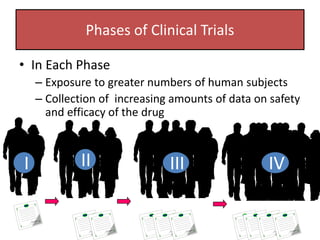
Phases of Clinical Trials
• In Each Phase
– Exposure to greater numbers of human subjects
– Collection of increasing amounts of data on safety
and efficacy of the drug
I II III IV
PHASE I
(Early clinical Pharmacology and safety)
• N = 20 – 80 healthy human volunteers
(sometimes patients)
• Carried out by qualified clinical pharmacologists
or trained physicians
• Carried out in emergency settings
• No blinding, open label
• Approx duration 1 year
PHASE I
• Emphasis : Safety and Tolerability
• Started with lowest estimated dose and stepwise
increased to effective dose.
• Data collection on
– Pharmacokinetics
– Systemic pharmacodynamics
– General adverse effects
• Acceptable dosing level is found
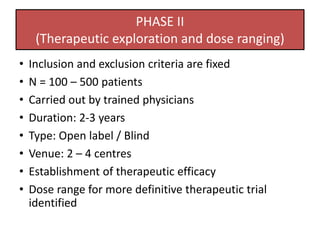
PHASE II
(Therapeutic exploration and dose ranging)
• Inclusion and exclusion criteria are fixed
• N = 100 – 500 patients
• Carried out by trained physicians
• Duration: 2-3 years
• Type: Open label / Blind
• Venue: 2 – 4 centres
• Establishment of therapeutic efficacy
• Dose range for more definitive therapeutic trial
identified
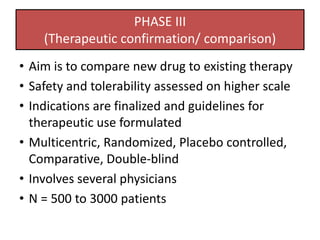
PHASE III
(Therapeutic confirmation/ comparison)
• Aim is to compare new drug to existing therapy
• Safety and tolerability assessed on higher scale
• Indications are finalized and guidelines for
therapeutic use formulated
• Multicentric, Randomized, Placebo controlled,
Comparative, Double-blind
• Involves several physicians
• N = 500 to 3000 patients
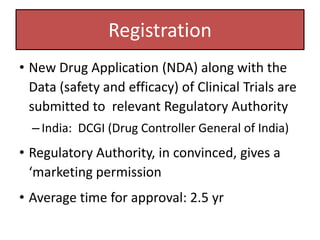
Registration
• New Drug Application (NDA) along with the
Data (safety and efficacy) of Clinical Trials are
submitted to relevant Regulatory Authority
– India: DCGI (Drug Controller General of India)
• Regulatory Authority, in convinced, gives a
‘marketing permission
• Average time for approval: 2.5 yr
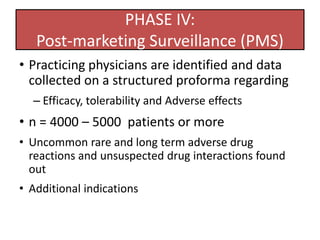
PHASE IV:
Post-marketing Surveillance (PMS)
• Practicing physicians are identified and data
collected on a structured proforma regarding
– Efficacy, tolerability and Adverse effects
• n = 4000 – 5000 patients or more
• Uncommon rare and long term adverse drug
reactions and unsuspected drug interactions found
out
• Additional indications
PHASE IV:
Post-marketing Surveillance (PMS)
• Effect on special groups
– Elderly & Neonates
– Pregnancy & Lactation
– Liver &Renal impairment
• Exploration of possibilities
– Modified release dosage form
– Additional route of administration
– Fixed dose combination
• Even drugs / formulations are withdrawn from
the market if found to be injurious to health
Examples of drug withdrawal
• Antihistamine: Terfenadine, Astemizole
• Selective COX-II inhibitor: Rofecoxib and
Celecoxib - cardiotoxicity
• Nimesulide banned for all in Western
countries & for pediatric group in India
• Aspirin liquid formation: due to possibilities
of producing Reye’s Syndrome in children
Phase 0
(Human Micro-dosing)
• Offers a way of developing drugs in a faster,
more cost effective and ethical way than ever
before.
New drug development

New drug development

  • 1.
    New Drug Development DrNaser Ashraf Tadvi Associate Professor
  • 2.
    Stages in newdrug development • Drug discovery phase – Synthesis and isolation of compound – New chemical entity (NCE) – Takes 1-2 years • Preclinical studies – 2-4 years • Investigational New Drug Application (IND) – Submission & review by FDA – 3-6 months
  • 3.
    IND Clinical Trials •Phase 1 •Phase2 •Phase 3 3 To 10 years Pre clinical studies continued Plus •Long term animal toxicity •Product formulation •Manufacturing & controls •Package & label designs New Drug Application (NDA) •Review & grant of marketing permission •0.5 to 2 years Post marketing surveillance (Phase -4) Stages in new drug development
  • 5.
    Approaches to drugdiscovery • Random screening – Natural sources – Chemical Synthesis • Serendipity • Rational drug designing – Compound centered approach – Target centered approach • Designing a prodrug or active metabolite as a drug
  • 6.
    Random screening • NaturalProducts – Morphine, digitalis, artemisinin, quinidine, atropine • Synthetic products – Randomly synthesized compounds tested for pharmacological activity • Barbiturates, chlorpromazine synthesized by this approach
  • 7.
  • 8.
    1st Antibacterial Drug ActiveMetabolite of Prontosil First Oral Hypoglycemic Drug First Carbonic Anhydrase Inhibitor Major Improvement in Diuretics Novel Hypotensive Drug First Loop Diuretics Other Sulfonamides Other Carbonic Anhydrase Inhibitors Other Thiazide Diuretics Other Loop Diuretics Other Sulfonylureas Prontosil (1932) Sulfanilamide (1935) Carbutamide (1955) Acetazolamide (1949) Chlorothiazide (1957) Diazoxide (1961) Furosemide(1962)
  • 9.
    Drug Discovery bySerendipity • Happy observation by chance • New use of old drugs or its side effects find new therapeutic application – Penicillin – Methotrexate in psoriaris – Sildenafil now used in impotence – Lignocaine as antiarrhythmic
  • 10.
    Rational drug designing •Compound centered approach – Beta blockers developed by modifying structure of Propranolol – Molecular modification/ manipulation • Receptor based approach ( target oriented) – Depends on sound knowledge & identification of specific target for drug action
  • 11.
    Target oriented approach •Receptors – GPCR, Receptors with intrinsic ion channels, enzyme linked receptors • Ion channels – Na+, K+, Ca++ and Cl– • Transporters – Na+/K+ ATPase, H+/K+ ATPase, Na+-K+-2Cl– • Enzymes
  • 12.
    Designing of prodrugor active metabolite as a drug • Paracetamol active metabolite of phenacetin • N acetyl procainamide active metabolite of procainamide • Bacampicillin prodrug of ampicillin • Levodopa prodrug of dopamine
  • 13.
    Preclinical Studies Synthesis /Identification of Lead Compound(s) (Thousands) Few out of Thousands
  • 14.
    Pre-clinical Studies • ScreeningTests • Tests on isolated organs • Tests on bacterial cultures • Tests on animal models of human diseases – Diabetic rats / dogs by diazoxide – Kindled animals for anti-epileptic drugs • General observational tests on intact animals
  • 15.
    Preclinical Studies • Pharmacodynamicstudies • Toxicity studies – Acute toxicity studies – Subacute toxicity studies – Chronic toxicity studies – Special toxicity studies • Reproductive • Teratogenicity • Carcinogenicity • Mutagenicity • Local Toxicity • Pharmacokinetic studies
  • 16.
    Toxicity Studies • AcuteToxicity Studies (1 – 3 days) – LD50 – Organ toxicity • Sub-acute Toxicity Studies (2 – 12 weeks) • Chronic Toxicity Studies (6 – 12 months) • Special Long-term Toxicity Studies – Reproduction ( including Teratogenicity) – Mutagenicity – Carcinogenicity
  • 17.
    Good Laboratory Practice(GLP) • Embodies a set of principles that provides a framework within which laboratory studies are planned, performed, monitored, recorded, reported and archived.
  • 18.
    Before Clinical Studies •Drug is formulated into a suitable dosage form • The clinical trials are done under the guideline of Good Clinical Practice (GCP) laid down by International Conference on Harmonization (ICH)
  • 19.
    Investigational New Drug(IND) • IND license is obtained after successful completion of pre-clinical studies from regulatory authorities. • Regulatory Authority – India: Drug Control General of India (DCGI) – USA: FDA (Food and Drug Administration)
  • 20.
    Good Clinical Practice(GCP) • GCP include – Protection of human rights as a subject in clinical trial. – Provides assurance of the safety and efficacy of the newly developed compounds. • Good Clinical Practice Guidelines include standards on – how clinical trials should be conducted, – define the roles and responsibilities of clinical trial sponsors, clinical research investigators, and monitors.
  • 21.
    Phases of ClinicalTrials • Phase I Early Clinical Pharmacology & Safety • Phase II Therapeutic exploration and dose ranging • Phase III Therapeutic confirmation and comparison • Phase IV Post-marketing Surveillance / Studies
  • 22.
    Phases of ClinicalTrials • In Each Phase – Exposure to greater numbers of human subjects – Collection of increasing amounts of data on safety and efficacy of the drug I II III IV
  • 23.
    PHASE I (Early clinicalPharmacology and safety) • N = 20 – 80 healthy human volunteers (sometimes patients) • Carried out by qualified clinical pharmacologists or trained physicians • Carried out in emergency settings • No blinding, open label • Approx duration 1 year
  • 24.
    PHASE I • Emphasis: Safety and Tolerability • Started with lowest estimated dose and stepwise increased to effective dose. • Data collection on – Pharmacokinetics – Systemic pharmacodynamics – General adverse effects • Acceptable dosing level is found
  • 25.
    PHASE II (Therapeutic explorationand dose ranging) • Inclusion and exclusion criteria are fixed • N = 100 – 500 patients • Carried out by trained physicians • Duration: 2-3 years • Type: Open label / Blind • Venue: 2 – 4 centres • Establishment of therapeutic efficacy • Dose range for more definitive therapeutic trial identified
  • 26.
    PHASE III (Therapeutic confirmation/comparison) • Aim is to compare new drug to existing therapy • Safety and tolerability assessed on higher scale • Indications are finalized and guidelines for therapeutic use formulated • Multicentric, Randomized, Placebo controlled, Comparative, Double-blind • Involves several physicians • N = 500 to 3000 patients
  • 27.
    Registration • New DrugApplication (NDA) along with the Data (safety and efficacy) of Clinical Trials are submitted to relevant Regulatory Authority – India: DCGI (Drug Controller General of India) • Regulatory Authority, in convinced, gives a ‘marketing permission • Average time for approval: 2.5 yr
  • 28.
    PHASE IV: Post-marketing Surveillance(PMS) • Practicing physicians are identified and data collected on a structured proforma regarding – Efficacy, tolerability and Adverse effects • n = 4000 – 5000 patients or more • Uncommon rare and long term adverse drug reactions and unsuspected drug interactions found out • Additional indications
  • 29.
    PHASE IV: Post-marketing Surveillance(PMS) • Effect on special groups – Elderly & Neonates – Pregnancy & Lactation – Liver &Renal impairment • Exploration of possibilities – Modified release dosage form – Additional route of administration – Fixed dose combination • Even drugs / formulations are withdrawn from the market if found to be injurious to health
  • 30.
    Examples of drugwithdrawal • Antihistamine: Terfenadine, Astemizole • Selective COX-II inhibitor: Rofecoxib and Celecoxib - cardiotoxicity • Nimesulide banned for all in Western countries & for pediatric group in India • Aspirin liquid formation: due to possibilities of producing Reye’s Syndrome in children
  • 31.
    Phase 0 (Human Micro-dosing) •Offers a way of developing drugs in a faster, more cost effective and ethical way than ever before.