NEW DRUG
DEVELOPMENT
PROCESS
PRESENTED BY- POOJA PANDYA
M.PHARM
PHARMACOLOGY
INTRODUCTION
 Drug development now is a highly
complex, tedious, competitive,
costly and commercially risky
process.
 From the synthesis/ identification
of the molecule to marketing, a
new drug takes at least 10 years
and cost 500-1000 million US$.
AIMS OF NEW DRUG
DEVELOPMENT PROCESS
 To develop clinically acceptable
and safer drug.
 Economically viable.
 Discover entirely new class of
drug or discover newer clinical
user of older drugs.
 Explore mechanism and
pharmaco- dynamic properties of
investigational drug.
STAGES IN NEW DRUG
DEVELOPMENT
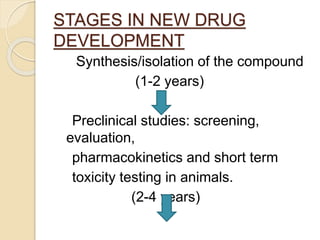
Synthesis/isolation of the compound
(1-2 years)
Preclinical studies: screening,
evaluation,
pharmacokinetics and short term
toxicity testing in animals.
(2-4 years)
Scrutiny and grant permission for
clinical
trials (3-6 months)
Pharmaceutical formulation,
standardization of chemical /biological
/ immuno-assay of the compound
(0.5- 1 year)
Clinical studies: phase I, phase II,
phase III
trials; long term animal toxicity testing
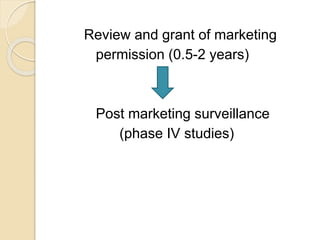
Review and grant of marketing
permission (0.5-2 years)
Post marketing surveillance
(phase IV studies)
Approaches to drug
discovery
A. Natural sources-
 Plants are oldest source of
medicines. Clues about these
have been obtained from
traditional system of medicine
prevalent in various part of
world.
For eg: Opium (morphine),
Cinchona (quinine), curare
(tubocurarine), belladona
(atropine), Ephedra (ephedrine)
are the best eg. to quote.
Animals- insulin, liver extracts,
antisera,
thyroxin, adrenaline, etc.
Search for new plants, animal and
microbial products as drug is still a
productive approach, especially to
serve as lead compounds.
B. Chemical synthesis
 Now largest source of medicines.
 Randomly synthesized compounds
can be tested for a variety of
pharmacological activities. Though
some useful drug (barbiturates,
chlorpromazine) have been produced
serendipitously by this approach.
C. Molecular modelling
 Advances in protein chemistry and
computer aided elucidation of three
dimensional structure of key
receptors, enzymes, etc. has
permitted designing of targeted
compounds, e.g. designing of
selective COX-2 inhibitors was
prompted by the comparative
configuration of COX-I and COX-2
enzyme molecules.
D. Combinatorial chemisrty
 Chemical groups are combined in a
random manner to yield innumerable
compounds and subjected to high-
throughput screening on cells,
genetically engineered microbes,
receptors, enzymes, etc. in robotically
controlled automated assay systems.
E. Biotechnology
 Several drugs are now being produced
by
recombinant DNA technology, e.g.
human growth hormone, human insulin,
interferon, etc. Some monoclonal and
chimera antibodies have been
PRECLINICAL STUDIES
• After synthesizing/ identifying a
prospective compound/ series of
compounds, it is tested on animals to
expose the whole pharmacological
profile.
 Experiments are generally performed
on a rodent (mouse, rat, guinea pig,
hamster, rabbit) and then on a larger
animal (cat, dog, monkey).
The following types of tests are performed-
1. Screening tests
These are simple and rapidly
performed tests to indicate presence or
absence of a particular
pharmacodynamic activity that is
sought for, e.g. analgesic or
hypoglycaemic activity.
2. Tests on isolated organs. bacterial
cultures, etc
These also are preliminary tests to
detect specific activity, such as
antihistaminic, antisecretory, vasodilator,
3. Tests on animal models of human
disease Such as kindled seizures in
rats, spontaneously (genetically)
hypertensive rats, experimental
tuberculosis in mouse, alloxan
induced diabetes in rat or dog, etc.
4. General observational test
Performed either in the beginning (in
case of totally novel compounds) or
after detecting useful activity in
screening test, drug is administered in
tripling doses.
5. Confirmatory tests and analogous
activity:
Compounds found active are taken up
for detailed study by more elaborate
tests which confirm and characterize
the activity.
6. Mechanism of action
Attempts are made to find out the
mechanism of action, e.g. whether ar
antihypertensive is an a β
blocker/calcium channel blocker /ACE
inhibitor / centrally acting, etc
7. Systemic pharmacology
Irrespective of the primary action of
the drug, its effects on major organ
system; such as nervous,
cardiovascular, respiratory, renal, g.i.t.
worked out.
8 . Quantitative tests
The dose-response relationship
maximal
effect and comparative efficacy with
existing drug is ascertain.
9. Pharmacokinetics
The absorption, tissue distribution,
metabolism, excretion, volume of
distribution and half-life of the drug are
quantified.
10. Toxicity tests
The aim is to determine safety of the
compound in atleast 2 animal species,
mostly mouse/rat and dog by oral and
parenteral routes.
CLINICAL TRIALS
 When a compound deserving trial
in man is identified by animal
studies, the regulatory authorities
are approached who on
satisfaction issue an
'investigational new drug' (IND)
license.
 The drug is formulated into a
suitable dosage form and clinical
trials are conducted in a logical
phased manner.
 Standards for the design, ethics,
conduct, monitoring, auditing,
recording and analyzing data and
reporting of clinical trials have
been laid down in the form of
Good Clinical Practice' (GCP)
guidelines by an International
Conference on Harmonization
(ICH).
The clinical studies are conventionally
divided into 4 phases-
Phase1-Human pharmacology and
safety
 The first human administration of
the drug is carried out by qualified
clinical pharmacologists/ trained
physicians in a setting where all
vital functions are monitored and
emergency facilities are available.
 Subjects healthy volunteers,
sometimes patients) are exposed to
the drug one by one (total 20-40
subjects) starting with the lowest
estimated dose increasing stepwise to
achieve the effective.
 The emphasis is on safety and
tolerability,
the purpose is to observe the
pharmaco-
dynamic effects in man, and to
characterize absorption, distribution,
Phase 11: Therapeutic exploration and
dose
ranging
 This is conducted by physicians who
are trained as clinical investigators on
100-400 patients selected according
to specific inclusion and exclusion
criteria.
 The primary aim is establishment of
therapeutic efficacy, dose range and
ceiling effect in a controlled setting.
Tolerability and pharmacokinetic are
studied as extension of phase 1.The
study may be blinded or open label
Phase 111: Therapeutic confirmation/
comparison
 Generally these are randomized
double blind comparative trials
conducted on a larger patient
population (500-3000) by several
physicians at many centers.
 The aim is to establish the value of the
drug in relation to existing therapy.
Safety,
tolerability and possible drug
interactions are assessed on a wider
 Indications are finalized and
guidelines for therapeutic use are
formulated. A 'new drug
application' (NDA) is submitted to
the licensing authority, who if
convinced give marketing
permission.
Phase 1V: Postmarketing
surveillance/
studies
 After the drug has been marketed for
general use, practicing physicians are
identified through whom data are
collected on a structured performa
about the efficacy, acceptability and
adverse effects of the drug (similar to
prescription event monitoring).
 Uncommon/idiosyncratic adverse
effects, or those that occur only after
long-term use and unsuspected drug
interactions are detected at this stage.
 Further therapeutic trials involving
groups like children, elderly,
pregnant/lactating women, patients
with renal/hepatic disease, etc .(which
are generally excluded during clinical
trials) may be undertaken at this
stage.
 Modified release dosage forms,
additional routes of
administration, fixed dose drug
combinations, etc.may be
explored.
 As such, many drugs continue
their development even after
marketing.
Thank you

NEW DRUG

  • 1.
    NEW DRUG DEVELOPMENT PROCESS PRESENTED BY-POOJA PANDYA M.PHARM PHARMACOLOGY
  • 2.
    INTRODUCTION  Drug developmentnow is a highly complex, tedious, competitive, costly and commercially risky process.  From the synthesis/ identification of the molecule to marketing, a new drug takes at least 10 years and cost 500-1000 million US$.
  • 3.
    AIMS OF NEWDRUG DEVELOPMENT PROCESS  To develop clinically acceptable and safer drug.  Economically viable.  Discover entirely new class of drug or discover newer clinical user of older drugs.  Explore mechanism and pharmaco- dynamic properties of investigational drug.
  • 4.
    STAGES IN NEWDRUG DEVELOPMENT Synthesis/isolation of the compound (1-2 years) Preclinical studies: screening, evaluation, pharmacokinetics and short term toxicity testing in animals. (2-4 years)
  • 5.
    Scrutiny and grantpermission for clinical trials (3-6 months) Pharmaceutical formulation, standardization of chemical /biological / immuno-assay of the compound (0.5- 1 year) Clinical studies: phase I, phase II, phase III trials; long term animal toxicity testing
  • 6.
    Review and grantof marketing permission (0.5-2 years) Post marketing surveillance (phase IV studies)
  • 7.
    Approaches to drug discovery A.Natural sources-  Plants are oldest source of medicines. Clues about these have been obtained from traditional system of medicine prevalent in various part of world. For eg: Opium (morphine), Cinchona (quinine), curare (tubocurarine), belladona (atropine), Ephedra (ephedrine) are the best eg. to quote.
  • 8.
    Animals- insulin, liverextracts, antisera, thyroxin, adrenaline, etc. Search for new plants, animal and microbial products as drug is still a productive approach, especially to serve as lead compounds.
  • 9.
    B. Chemical synthesis Now largest source of medicines.  Randomly synthesized compounds can be tested for a variety of pharmacological activities. Though some useful drug (barbiturates, chlorpromazine) have been produced serendipitously by this approach.
  • 10.
    C. Molecular modelling Advances in protein chemistry and computer aided elucidation of three dimensional structure of key receptors, enzymes, etc. has permitted designing of targeted compounds, e.g. designing of selective COX-2 inhibitors was prompted by the comparative configuration of COX-I and COX-2 enzyme molecules.
  • 11.
    D. Combinatorial chemisrty Chemical groups are combined in a random manner to yield innumerable compounds and subjected to high- throughput screening on cells, genetically engineered microbes, receptors, enzymes, etc. in robotically controlled automated assay systems. E. Biotechnology  Several drugs are now being produced by recombinant DNA technology, e.g. human growth hormone, human insulin, interferon, etc. Some monoclonal and chimera antibodies have been
  • 12.
    PRECLINICAL STUDIES • Aftersynthesizing/ identifying a prospective compound/ series of compounds, it is tested on animals to expose the whole pharmacological profile.  Experiments are generally performed on a rodent (mouse, rat, guinea pig, hamster, rabbit) and then on a larger animal (cat, dog, monkey).
  • 13.
    The following typesof tests are performed- 1. Screening tests These are simple and rapidly performed tests to indicate presence or absence of a particular pharmacodynamic activity that is sought for, e.g. analgesic or hypoglycaemic activity. 2. Tests on isolated organs. bacterial cultures, etc These also are preliminary tests to detect specific activity, such as antihistaminic, antisecretory, vasodilator,
  • 14.
    3. Tests onanimal models of human disease Such as kindled seizures in rats, spontaneously (genetically) hypertensive rats, experimental tuberculosis in mouse, alloxan induced diabetes in rat or dog, etc. 4. General observational test Performed either in the beginning (in case of totally novel compounds) or after detecting useful activity in screening test, drug is administered in tripling doses.
  • 15.
    5. Confirmatory testsand analogous activity: Compounds found active are taken up for detailed study by more elaborate tests which confirm and characterize the activity. 6. Mechanism of action Attempts are made to find out the mechanism of action, e.g. whether ar antihypertensive is an a β blocker/calcium channel blocker /ACE inhibitor / centrally acting, etc
  • 16.
    7. Systemic pharmacology Irrespectiveof the primary action of the drug, its effects on major organ system; such as nervous, cardiovascular, respiratory, renal, g.i.t. worked out. 8 . Quantitative tests The dose-response relationship maximal effect and comparative efficacy with existing drug is ascertain.
  • 17.
    9. Pharmacokinetics The absorption,tissue distribution, metabolism, excretion, volume of distribution and half-life of the drug are quantified. 10. Toxicity tests The aim is to determine safety of the compound in atleast 2 animal species, mostly mouse/rat and dog by oral and parenteral routes.
  • 18.
    CLINICAL TRIALS  Whena compound deserving trial in man is identified by animal studies, the regulatory authorities are approached who on satisfaction issue an 'investigational new drug' (IND) license.  The drug is formulated into a suitable dosage form and clinical trials are conducted in a logical phased manner.
  • 19.
     Standards forthe design, ethics, conduct, monitoring, auditing, recording and analyzing data and reporting of clinical trials have been laid down in the form of Good Clinical Practice' (GCP) guidelines by an International Conference on Harmonization (ICH).
  • 20.
    The clinical studiesare conventionally divided into 4 phases- Phase1-Human pharmacology and safety  The first human administration of the drug is carried out by qualified clinical pharmacologists/ trained physicians in a setting where all vital functions are monitored and emergency facilities are available.
  • 21.
     Subjects healthyvolunteers, sometimes patients) are exposed to the drug one by one (total 20-40 subjects) starting with the lowest estimated dose increasing stepwise to achieve the effective.  The emphasis is on safety and tolerability, the purpose is to observe the pharmaco- dynamic effects in man, and to characterize absorption, distribution,
  • 22.
    Phase 11: Therapeuticexploration and dose ranging  This is conducted by physicians who are trained as clinical investigators on 100-400 patients selected according to specific inclusion and exclusion criteria.  The primary aim is establishment of therapeutic efficacy, dose range and ceiling effect in a controlled setting. Tolerability and pharmacokinetic are studied as extension of phase 1.The study may be blinded or open label
  • 23.
    Phase 111: Therapeuticconfirmation/ comparison  Generally these are randomized double blind comparative trials conducted on a larger patient population (500-3000) by several physicians at many centers.  The aim is to establish the value of the drug in relation to existing therapy. Safety, tolerability and possible drug interactions are assessed on a wider
  • 24.
     Indications arefinalized and guidelines for therapeutic use are formulated. A 'new drug application' (NDA) is submitted to the licensing authority, who if convinced give marketing permission.
  • 25.
    Phase 1V: Postmarketing surveillance/ studies After the drug has been marketed for general use, practicing physicians are identified through whom data are collected on a structured performa about the efficacy, acceptability and adverse effects of the drug (similar to prescription event monitoring).
  • 26.
     Uncommon/idiosyncratic adverse effects,or those that occur only after long-term use and unsuspected drug interactions are detected at this stage.  Further therapeutic trials involving groups like children, elderly, pregnant/lactating women, patients with renal/hepatic disease, etc .(which are generally excluded during clinical trials) may be undertaken at this stage.
  • 27.
     Modified releasedosage forms, additional routes of administration, fixed dose drug combinations, etc.may be explored.  As such, many drugs continue their development even after marketing.
  • 28.