PRESENTED BY: ROHAN SINGH
SNEHASHIS SARKAr
B. PHARM
CONTENTS
INTRODUCTION
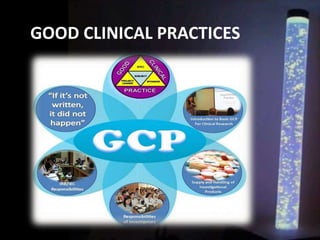
GOOD CLINICAL PRACTICES
ASSESSMENT OF SAFETY AND EFFICACY
DESIRED CRITERIAS
DESCRIPTION OF PHASES INVOLVED
REGULATORY AUTHORITIES – IND & NDA
APPLICATION IN PHARMACEUTICAL INDUSTRY
ROLE OF PHARMACISTS IN CLINICAL TRIALS
CONCLUSION
REFERENCE
INTRODUCTION
• A systematic path of pharmaceutical
products on human subjects .
• It discovers or verify the clinical,
pharmacological adverse effects.
• Biomedical and interventions of NEW
CHEMICAL ENTITY(NCE) can be known.
• Safety ,efficacy and effectiveness of the
drug can be evaluated by monitoring
their effects on large group of people.
INTRODUCTION
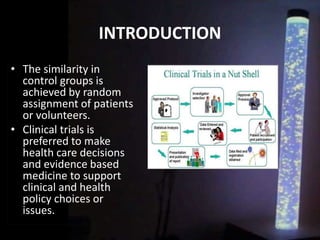
• The similarity in
control groups is
achieved by random
assignment of patients
or volunteers.
• Clinical trials is
preferred to make
health care decisions
and evidence based
medicine to support
clinical and health
policy choices or
issues.
GOOD CLINICAL PRACTICES-
PRINCIPLES
• A standard for designing,
conducting , recording and
reporting of studies
involving human subjects.
• Statistical designs of the
protocols ,use of placebo is
required.
• Cross-over study and the
statistical analysis of
clinical data should be
generated.
GOOD CLINICAL PRACTICE -
GUIDELINES
• Trials be conducted in accordance with the
ethical principles defined in the declaration
of Helsinki.
• A trial should be conducted and continued
if the anticipated benefits justify the risks.
• Trials should be describes in a clear,
detailed protocol.
• The decisions made in the protocol are the
responsibility of a qualified physician or
dentist(as appropriate)
GOOD CLINICAL PRACTICES
MEDICAL REASONS FOR DRUG
DISCONTINUATION
• Lack of efficacy of drug.
• Intolerable adverse
interactions.
• Subject’s condition
deteriorates with time.
• Abnormal laboratory value.
• Didn’t meet the original entry
criteria.
ASSESSMENTS OF SAFETY
• Specifications of safety
parameters.
• Methods and periodicity
for assuring and
recording safety
parameters.
• Procedures for eliciting
reports of adverse drug
interactions.
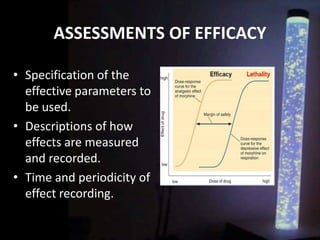
ASSESSMENTS OF EFFICACY
• Specification of the
effective parameters to
be used.
• Descriptions of how
effects are measured
and recorded.
• Time and periodicity of
effect recording.
CRITERIAS TO PERFORM
• Inclusion and Exclusion criteria are a very
important aspects of clinical research.
• The inclusion and exclusion criteria are
predominantly outlined in protocol to yield the
best results for the research participants.
• It helps the researcher to take the precise decisions
while including the subjects, thereby eventually
impacting the analysis and interpretation of results
in clinical research.
INCLUSION CRITERIA
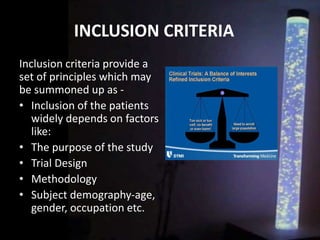
Inclusion criteria provide a
set of principles which may
be summoned up as -
• Inclusion of the patients
widely depends on factors
like:
• The purpose of the study
• Trial Design
• Methodology
• Subject demography-age,
gender, occupation etc.
EXCLUSION CRITERIA
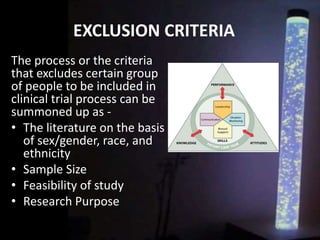
The process or the criteria
that excludes certain group
of people to be included in
clinical trial process can be
summoned up as -
• The literature on the basis
of sex/gender, race, and
ethnicity
• Sample Size
• Feasibility of study
• Research Purpose
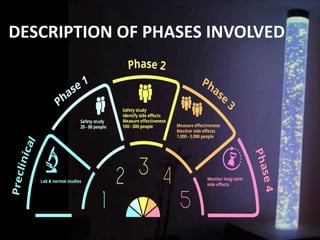
DESCRIPTION OF PHASES INVOLVED
ELABORATING PHASES
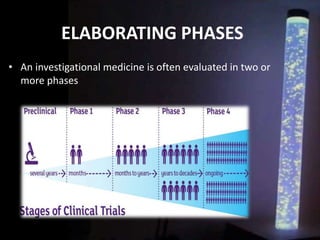
• An investigational medicine is often evaluated in two or
more phases
PHASE- 0/PRE CLINICAL PHASE
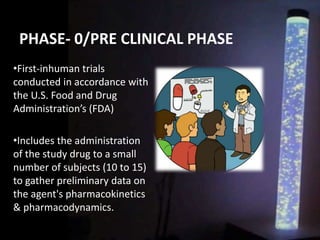
•First-inhuman trials
conducted in accordance with
the U.S. Food and Drug
Administration’s (FDA)
•Includes the administration
of the study drug to a small
number of subjects (10 to 15)
to gather preliminary data on
the agent's pharmacokinetics
& pharmacodynamics.
PHASE- 1 (up to several months)
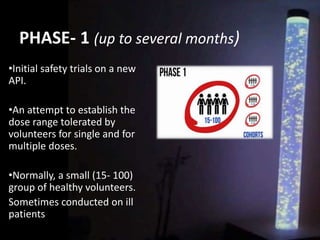
•Initial safety trials on a new
API.
•An attempt to establish the
dose range tolerated by
volunteers for single and for
multiple doses.
•Normally, a small (15- 100)
group of healthy volunteers.
Sometimes conducted on ill
patients
PHASE- 2 (up to 2 years)
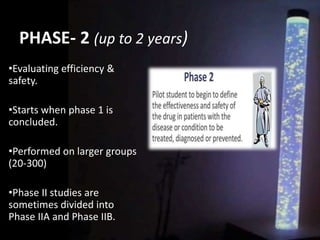
•Evaluating efficiency &
safety.
•Starts when phase 1 is
concluded.
•Performed on larger groups
(20-300)
•Phase II studies are
sometimes divided into
Phase IIA and Phase IIB.
PHASE- 2A & B
2A-
•Objectives focus on dose-
response, type of patient,
frequency of dosing, or
numerous other
characteristics of safety and
efficacy.
2B-
•Represents the most
rigorous demonstration of
a medicine's efficacy.
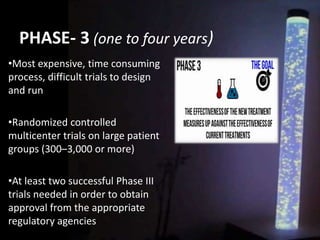
PHASE- 3 (one to four years)
•Most expensive, time consuming
process, difficult trials to design
and run
•Randomized controlled
multicenter trials on large patient
groups (300–3,000 or more)
•At least two successful Phase III
trials needed in order to obtain
approval from the appropriate
regulatory agencies
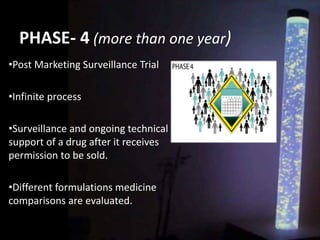
PHASE- 4 (more than one year)
•Post Marketing Surveillance Trial
•Infinite process
•Surveillance and ongoing technical
support of a drug after it receives
permission to be sold.
•Different formulations medicine
comparisons are evaluated.
REGULATORY AUTHORITIES-
IND & NDA
•The role of these authorities is to provide the legal
framework for clinical trials.
•AN IMPORTANT DISTINCTION:-
1. Role of Regulating Authorities
2. Role of Government
Role of Regulatory Authorities
•Ensuring the quality of the
investigational product
• Ensuring subject rights and
safety during a study
• Educating the parties who
conduct or oversee the study
•Receiving and acting on
complaints about a clinical study
Role of Government
Establish a legal framework for GCP
• Protect rights and safety of subjects
• Ensure quality of data, quality of
regulatory decisions and implementation
of quality systems
• Sanctions/ penalties for violators
•Licensure of medical professionals
•Qualifications of clinical investigators/
staff
•Provide mandates to the regulatory
authority
Aim of regulatory body
(i) To protect the safety and
rights of the subjects
participating in a trial
(ii) To ensure that trials are
adequately designed to meet
scientifically sound
objectives.
APPLICATION IN-
PHARMACEUTICAL INDUSTRY
•The pharmaceutical industry plays an active
role in policy surrounding the research,
discovery and development of new NCE.
Relation between clinical trial &
pharmaceutical industry
Phase Occurring
I Clinical pharmacology: pharmacokinetics
And Pharmacodynamics Measured In
Healthy volunteers
II Exploratory Therapeutic Trials In Small
numbers of closely monitored patients
III Extensive clinical trials on large
numbers of patients
IV Post marketing surveillance-long-term
studies of morbidity/mortality,
multicentre studies to monitor usage
of the drug.
ROLE OF PHARMACISTS IN
CLINICAL TRIALS
• We provide the necessary facilities required for proper
storage of IMPs.
• We ensure there is constant supply of IMPs at all times.
• We provide the necessary information to patient regarding
the drug administration.
• We document the review of the patient.
• We often run research projects to improve the outcomes.
• We conduct observational surveys that are aimed at
investigating patients’ or physicians’ perspectives and
attitudes towards medications.
CONCLUSION
• Clinical trial study should be clarified with
well defined objectives.
• Statistical analysis of the data should be
generated.
• Clinical Findings of the new drug should
have significant advantage over the
existing therapy
• Their should be a good planning,
organizing skills and appropriate resource
allocation.
REFERENCE
• The Pharmacological Basis Of Therapeutics
– Goodman and Gilman,11th edition 2006-
TATA McGRAW HILL, New Delhi, India
• Principles of Clinical Research- Dr. R.B.
Ghool, 2nd edition 2016- NIRALI
PRAKASHAN, Pune, India
• Regulation of Clinical Trials – Rakesh Kumar
Rishi, 1st edition 2007- KONGPOSH
PUBLICATION PVT. LTD. New Delhi, India
• Basic Pharmacology and
Pharmacotherapeutics - Dr. Suresh R.Naik,
1st edition 2017- NIRALI PRAKASHAN, Pune,
India
Clinical trials

Clinical trials

  • 1.
    PRESENTED BY: ROHANSINGH SNEHASHIS SARKAr B. PHARM
  • 3.
    CONTENTS INTRODUCTION GOOD CLINICAL PRACTICES ASSESSMENTOF SAFETY AND EFFICACY DESIRED CRITERIAS DESCRIPTION OF PHASES INVOLVED REGULATORY AUTHORITIES – IND & NDA APPLICATION IN PHARMACEUTICAL INDUSTRY ROLE OF PHARMACISTS IN CLINICAL TRIALS CONCLUSION REFERENCE
  • 4.
    INTRODUCTION • A systematicpath of pharmaceutical products on human subjects . • It discovers or verify the clinical, pharmacological adverse effects. • Biomedical and interventions of NEW CHEMICAL ENTITY(NCE) can be known. • Safety ,efficacy and effectiveness of the drug can be evaluated by monitoring their effects on large group of people.
  • 5.
    INTRODUCTION • The similarityin control groups is achieved by random assignment of patients or volunteers. • Clinical trials is preferred to make health care decisions and evidence based medicine to support clinical and health policy choices or issues.
  • 6.
    GOOD CLINICAL PRACTICES- PRINCIPLES •A standard for designing, conducting , recording and reporting of studies involving human subjects. • Statistical designs of the protocols ,use of placebo is required. • Cross-over study and the statistical analysis of clinical data should be generated.
  • 7.
    GOOD CLINICAL PRACTICE- GUIDELINES • Trials be conducted in accordance with the ethical principles defined in the declaration of Helsinki. • A trial should be conducted and continued if the anticipated benefits justify the risks. • Trials should be describes in a clear, detailed protocol. • The decisions made in the protocol are the responsibility of a qualified physician or dentist(as appropriate)
  • 8.
  • 9.
    MEDICAL REASONS FORDRUG DISCONTINUATION • Lack of efficacy of drug. • Intolerable adverse interactions. • Subject’s condition deteriorates with time. • Abnormal laboratory value. • Didn’t meet the original entry criteria.
  • 10.
    ASSESSMENTS OF SAFETY •Specifications of safety parameters. • Methods and periodicity for assuring and recording safety parameters. • Procedures for eliciting reports of adverse drug interactions.
  • 11.
    ASSESSMENTS OF EFFICACY •Specification of the effective parameters to be used. • Descriptions of how effects are measured and recorded. • Time and periodicity of effect recording.
  • 12.
    CRITERIAS TO PERFORM •Inclusion and Exclusion criteria are a very important aspects of clinical research. • The inclusion and exclusion criteria are predominantly outlined in protocol to yield the best results for the research participants. • It helps the researcher to take the precise decisions while including the subjects, thereby eventually impacting the analysis and interpretation of results in clinical research.
  • 13.
    INCLUSION CRITERIA Inclusion criteriaprovide a set of principles which may be summoned up as - • Inclusion of the patients widely depends on factors like: • The purpose of the study • Trial Design • Methodology • Subject demography-age, gender, occupation etc.
  • 14.
    EXCLUSION CRITERIA The processor the criteria that excludes certain group of people to be included in clinical trial process can be summoned up as - • The literature on the basis of sex/gender, race, and ethnicity • Sample Size • Feasibility of study • Research Purpose
  • 15.
  • 16.
    ELABORATING PHASES • Aninvestigational medicine is often evaluated in two or more phases
  • 17.
    PHASE- 0/PRE CLINICALPHASE •First-inhuman trials conducted in accordance with the U.S. Food and Drug Administration’s (FDA) •Includes the administration of the study drug to a small number of subjects (10 to 15) to gather preliminary data on the agent's pharmacokinetics & pharmacodynamics.
  • 18.
    PHASE- 1 (upto several months) •Initial safety trials on a new API. •An attempt to establish the dose range tolerated by volunteers for single and for multiple doses. •Normally, a small (15- 100) group of healthy volunteers. Sometimes conducted on ill patients
  • 19.
    PHASE- 2 (upto 2 years) •Evaluating efficiency & safety. •Starts when phase 1 is concluded. •Performed on larger groups (20-300) •Phase II studies are sometimes divided into Phase IIA and Phase IIB.
  • 20.
    PHASE- 2A &B 2A- •Objectives focus on dose- response, type of patient, frequency of dosing, or numerous other characteristics of safety and efficacy. 2B- •Represents the most rigorous demonstration of a medicine's efficacy.
  • 21.
    PHASE- 3 (oneto four years) •Most expensive, time consuming process, difficult trials to design and run •Randomized controlled multicenter trials on large patient groups (300–3,000 or more) •At least two successful Phase III trials needed in order to obtain approval from the appropriate regulatory agencies
  • 22.
    PHASE- 4 (morethan one year) •Post Marketing Surveillance Trial •Infinite process •Surveillance and ongoing technical support of a drug after it receives permission to be sold. •Different formulations medicine comparisons are evaluated.
  • 23.
    REGULATORY AUTHORITIES- IND &NDA •The role of these authorities is to provide the legal framework for clinical trials. •AN IMPORTANT DISTINCTION:- 1. Role of Regulating Authorities 2. Role of Government
  • 24.
    Role of RegulatoryAuthorities •Ensuring the quality of the investigational product • Ensuring subject rights and safety during a study • Educating the parties who conduct or oversee the study •Receiving and acting on complaints about a clinical study
  • 25.
    Role of Government Establisha legal framework for GCP • Protect rights and safety of subjects • Ensure quality of data, quality of regulatory decisions and implementation of quality systems • Sanctions/ penalties for violators •Licensure of medical professionals •Qualifications of clinical investigators/ staff •Provide mandates to the regulatory authority
  • 26.
    Aim of regulatorybody (i) To protect the safety and rights of the subjects participating in a trial (ii) To ensure that trials are adequately designed to meet scientifically sound objectives.
  • 27.
    APPLICATION IN- PHARMACEUTICAL INDUSTRY •Thepharmaceutical industry plays an active role in policy surrounding the research, discovery and development of new NCE.
  • 28.
    Relation between clinicaltrial & pharmaceutical industry Phase Occurring I Clinical pharmacology: pharmacokinetics And Pharmacodynamics Measured In Healthy volunteers II Exploratory Therapeutic Trials In Small numbers of closely monitored patients III Extensive clinical trials on large numbers of patients IV Post marketing surveillance-long-term studies of morbidity/mortality, multicentre studies to monitor usage of the drug.
  • 29.
    ROLE OF PHARMACISTSIN CLINICAL TRIALS • We provide the necessary facilities required for proper storage of IMPs. • We ensure there is constant supply of IMPs at all times. • We provide the necessary information to patient regarding the drug administration. • We document the review of the patient. • We often run research projects to improve the outcomes. • We conduct observational surveys that are aimed at investigating patients’ or physicians’ perspectives and attitudes towards medications.
  • 30.
    CONCLUSION • Clinical trialstudy should be clarified with well defined objectives. • Statistical analysis of the data should be generated. • Clinical Findings of the new drug should have significant advantage over the existing therapy • Their should be a good planning, organizing skills and appropriate resource allocation.
  • 31.
    REFERENCE • The PharmacologicalBasis Of Therapeutics – Goodman and Gilman,11th edition 2006- TATA McGRAW HILL, New Delhi, India • Principles of Clinical Research- Dr. R.B. Ghool, 2nd edition 2016- NIRALI PRAKASHAN, Pune, India • Regulation of Clinical Trials – Rakesh Kumar Rishi, 1st edition 2007- KONGPOSH PUBLICATION PVT. LTD. New Delhi, India • Basic Pharmacology and Pharmacotherapeutics - Dr. Suresh R.Naik, 1st edition 2017- NIRALI PRAKASHAN, Pune, India