Neuropsychological Development of Children Brooke Schauder, PhD Erie Psychology Consortium
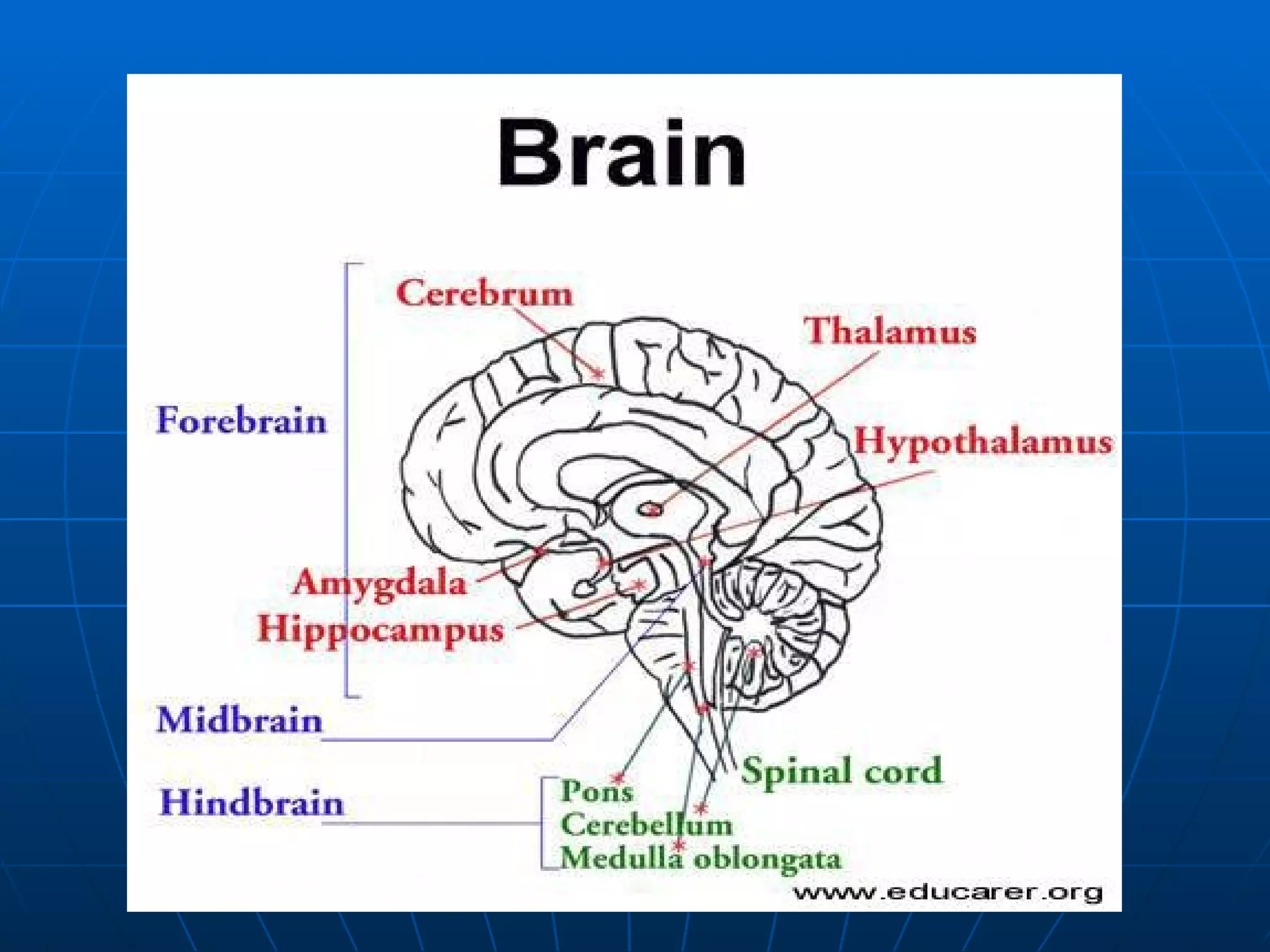
Phases of Development Primitive Brain Structures (Hindbrain/Midbrain) mature within first 3 years of life.  By age 2, brain is 80% as large as an adult brain.  Basic sensory and motor functions are gained in this phase. Frontal lobe functioning doesn’t begin to occur until between 5-7.
 
Piaget’s Stages in Relation to Neurological Development Sensorimotor (0-2) no language, no thought, no objective reality in beginning of this stage Preoperational Thinking:(2-7) Egocentric thought, reason dominated by perception; intuitive rather than logic, inability to conserve.
Concrete Operations (7-11) Ability to conserve; logic of categories and relationships; understanding of numbers; bound to concrete objects and events; development of reversibility. Formal Operations:(12-15) Generality of thought; propositional thinking; ability to deal with the hypothetical.
Myelination and Teen Years MRI Imaging shows that white matter (connection material) continues throughout teen years. EXECUTIVE Functions are the  last  to develop.
Developmental Milestones Age 5: stands on 1 foot for 10 seconds, draws a person with a body, speaks sentence of more than 5 words, talks about future events, counts to 10, names 4 colors, wants to please friends, aware of gender, differentiates obvious fantasy from reality.
Childhood Neurodevelopmental Disorders Learning Disabilities  (5-10%) ADHD (7%) Tourette Syndrome (2%) Autism (<1%) and other PDDs (3%) Turner Syndrome Fragile X Syndrome  Neurofibromatosis Down Syndrome Klinefelter Syndrome Phenylketonuria Rett Syndrome Seizure Disorders Prader-Willi Syndrome Williams Syndrome
Learning Disabilities Most common neurobehavioral disorder. Not a SINGLE entity or cause: Genetic (up to 35%) Environmental Teratogens Brain Trauma Malnutrition Early parent-infant relational problem, lack of sensory stimulation.
Abnormal Brain Structures in Reading Disorder (Dyslexia) Left Parietal Abnormalities Thin Corpus Callosum General Left Sided cell abnormalities  Inferior frontal, superior temporal, parietal regions affected (not occipital or orbitofrontal)
Abnormal Brain Structures in Non-Verbal Learning Disorder (NLD) Mathematics Disorder Learning Disorder, NOS Social Skills problems & disorganization. Right-sided brain abnormalities – parietal lobe (however, left side may be involved as well)
Treatment of Children with Learning Disorders (30-40%)have ADHD type symptoms: impulsivity, distractibility. Conduct Disorder (Parental Intervention – basic behavioral principles) Anxiety disorder/Depression: CBT, relaxation, positive self-talk, desensitization, self-esteem building.  Social Skills Deficits: Identifying and responding to emotions, conversation skills, Social Role Playing.
4 Personality Patterns Found in LD Children (Wirt, Lachar, Klinedinst, & Seat, 1977) 44% displayed Balanced, well-adjusted social emotional functioning. 26% exhibited internalizing psychological disturbances (depression, anxiety, low social skills). 13% displayed normal personality fxn, but somatic concerns. 17% behavioral disturbance, ODD, conduct problems.
Attention Deficit Hyperactivity Disorder (ADHD) A “biopsychosocial” problem; interaction of biological/tempermental traits with environment. It is a “cluster” of deficits, rather than a single disorder with a single etiology.
Genetics and Brain Structure Dopamine transporter and receptor genes. Frontal lobe impairment (executive functions of attention, motor planning, mental flexibility, sustaining mental effort, and abstract reasoning. Reduction in Basal Ganglia: subcortical structure involved in movement and basic sensory regulation.
Treatment Most effective: combination of medical, behavioral, and environmental. Classroom:  Organized and structured environment  Rewards are consistent and immediate Response Cost program should be implemented Constant feedback from instructors Transition times should be monitored closely Consistent Parent- teacher communication
ADHD Parenting Skills Have the parents read “123 Magic” and/or “The Explosive Child” for basic behavior mod. Strategies Parents must distinguish incompetence from noncompliance Parents must give  clear, operational  commands.  Parents should learn to use “start” and not “stop” commands. Must use consistent and frequent reinforcement.
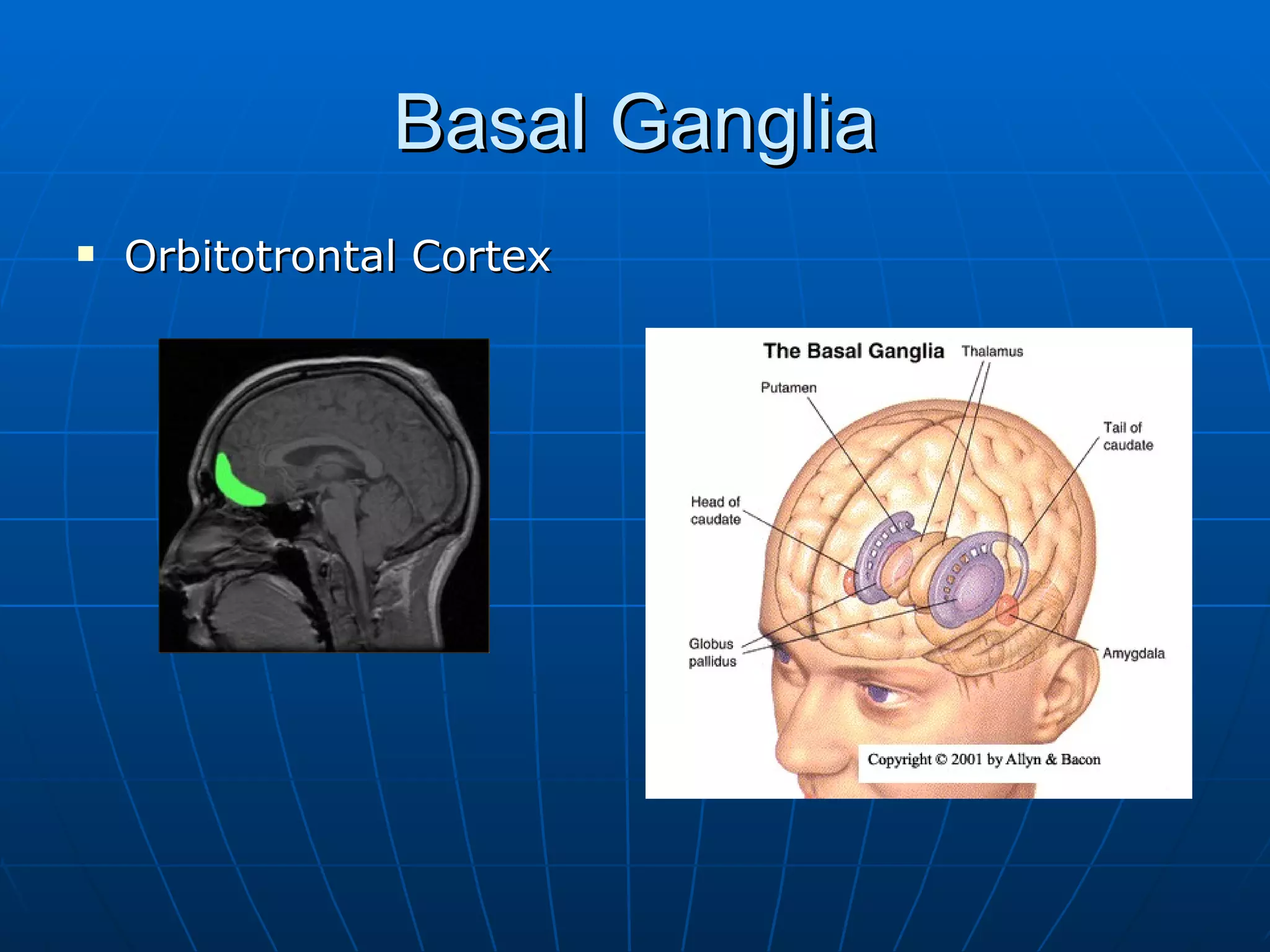
Tourette Syndrome Usually begins at age 7. Motor tics preceed vocal tics. Etiology is genetic AND familial (learned). Abnormalities of basal ganglia (movement) Orbitofrontal Cortex: Decision Making, obsession, compulsion, attention.
Basal Ganglia Orbitotrontal Cortex
Treatment of Tourette Disorder Awareness/Self-Monitoring :  record each incidence of the habit or tic for a specified amount of time each day (30 minutes).  -have the child verbally describe the details of the habit or tic to the therapist.  - Have the child become cognizant of where the tic/habit happens most frequently.
Tourette Treatment  Competing-Response Training:  Have the person engage in a response that is incompatible with the tic.  Must be 1) incompatible 2) capable of being maintained for several minutes 3) able to strengthen the muscles antagonistic to those used when engaging in the tic behavior.
Tourette Treatment Relaxation Training:  Progressive muscle relaxation, deep breathing, visual imagery, self-statements of relaxation. Contingency Management:  Work with parents to set up rewards for decreased tic behavior.
Pervasive Developmental Disorders Characterized by severe deficits in multiple areas, including  social interaction, communication, and behavioral stereotypes. Autistic Disorder Rett’s Disorder Childhood Disintegrative Disorder PDD NOS
Rett’s Disorder Onset of problems AFTER normal 5 months of development. Deceleration of head growth (between 5 and 48 months) Loss of motor skills Loss of social engagement Poorly coordinated trunk movements Severely impaired expressive and receptive language development
Childhood Disintegrative Disorder Normal development for 2 years (verbal and non-verbal, social skills, play, etc.) Loss of previous skills before age 10 in 2 of: Language -social skills Bowel or bladder -play Motor skills AND 2 of: Social interaction problems Communication problems Behavioral stereotypes or restricted interests
Autistic Disorder 6 of: Impairment in social interaction as: Impairment of non-verbal behavior Failure to develop peer relationships Lack of spontaneous seeking to interact Lack of social/emotional reciprocity Impairment of Communication Delay in spoken language Inablity to sustain conversation Stereotyped language Lack of make-believe or imitative play
(DSM Autistic Disorder Continued) Stereotyped behavior or interests: Preoccupation with interests Inflexible adherence to routine Repetitive motor mannerisms Preoccupation with parts of objects Delays in at least 1 area manifest BEFORE age 3.
Asperger’s Disorder Impairment in social interaction (as in autism) Stereotyped behavior or interests (as in Autism) NO clinically significant delay in language. NO impairment of cognitive development.
Neuroanatomical Feature MRI Studies and Total Brain volume (occipital, parietal, and temporal) Temporal is critical region. Limbic Regions. Decreased Purkinje cells.
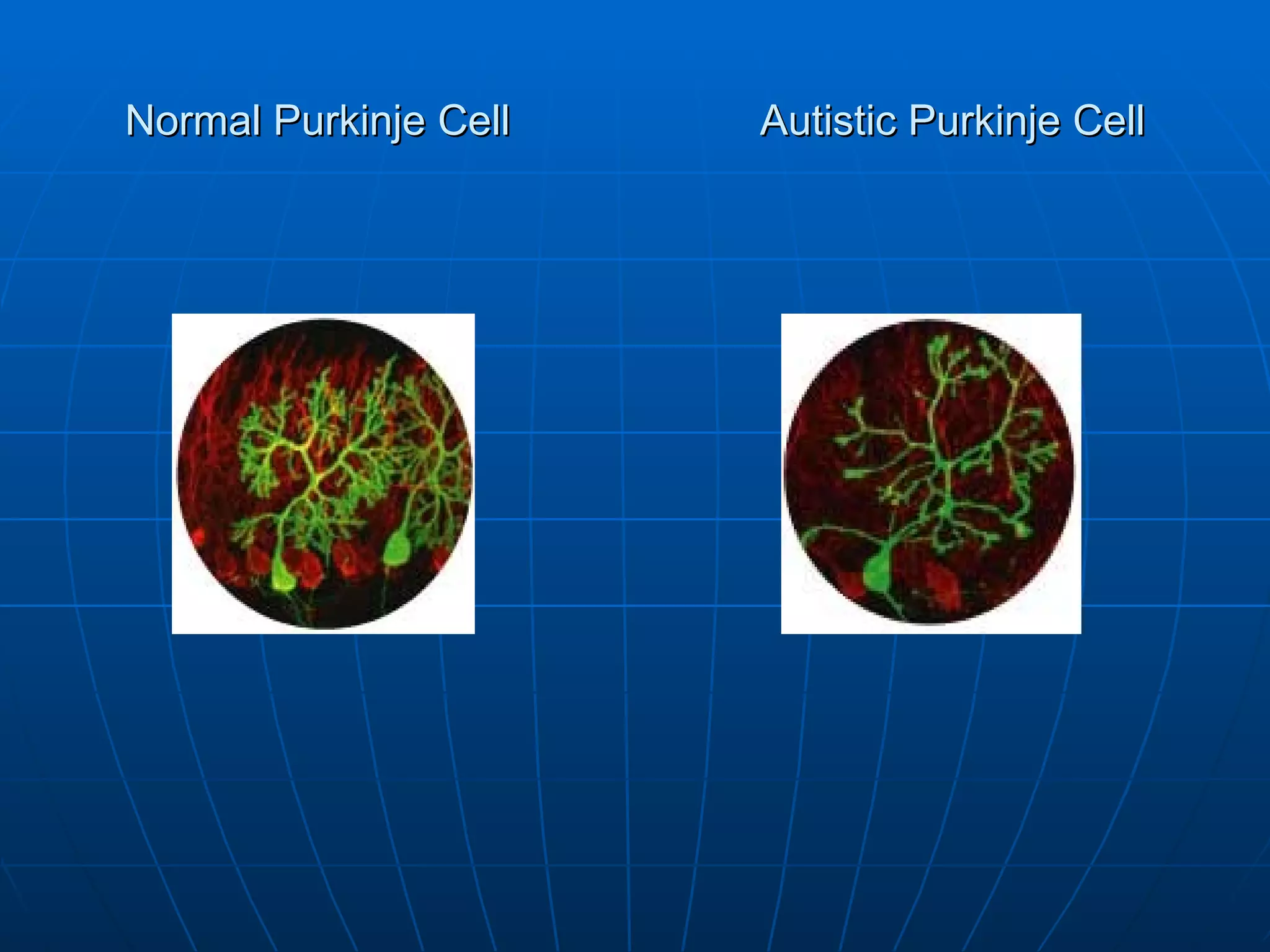
Normal Purkinje Cell Autistic Purkinje Cell
Neurological/Heritable Abnormalities Endocrine Abnormalities Gastrointestinal dysfunction. Gene HOXA1 22 (40%) had one copy of the  variant Underconnectivity Activation and time synchronization between cortical areas was lower in autistic group
Treatment of ASDs BEHAVIORAL TREATMENT Reinforcement is KEY Repetition Shaping Visual Works Best Communication:  initiating spontaneous questions and comments Basic Conversation Skills Organizing thoughts into words
ASD Communication Treatment Eye Contact Non-verbal body language (identifying) Prosody and Intonation of Speech Social Stories
ASD Treatment Play How to pretend  How to initiate play with others Sharing Idendifying Emotions Recognizing own emotions Recognizing and making facial expressions
Treatment of ASDs Use of Schedule Theory of Mind Time out / Quiet Place Decrease Self Injurious Behaviors Teach Me Language (Freeman, PhD) Asperger’s…What does it mean to me?  (Faherty)

Neuropsychological development of children

  • 1.
    Neuropsychological Development ofChildren Brooke Schauder, PhD Erie Psychology Consortium
  • 2.
    Phases of DevelopmentPrimitive Brain Structures (Hindbrain/Midbrain) mature within first 3 years of life. By age 2, brain is 80% as large as an adult brain. Basic sensory and motor functions are gained in this phase. Frontal lobe functioning doesn’t begin to occur until between 5-7.
  • 3.
  • 4.
    Piaget’s Stages inRelation to Neurological Development Sensorimotor (0-2) no language, no thought, no objective reality in beginning of this stage Preoperational Thinking:(2-7) Egocentric thought, reason dominated by perception; intuitive rather than logic, inability to conserve.
  • 5.
    Concrete Operations (7-11)Ability to conserve; logic of categories and relationships; understanding of numbers; bound to concrete objects and events; development of reversibility. Formal Operations:(12-15) Generality of thought; propositional thinking; ability to deal with the hypothetical.
  • 6.
    Myelination and TeenYears MRI Imaging shows that white matter (connection material) continues throughout teen years. EXECUTIVE Functions are the last to develop.
  • 7.
    Developmental Milestones Age5: stands on 1 foot for 10 seconds, draws a person with a body, speaks sentence of more than 5 words, talks about future events, counts to 10, names 4 colors, wants to please friends, aware of gender, differentiates obvious fantasy from reality.
  • 8.
    Childhood Neurodevelopmental DisordersLearning Disabilities (5-10%) ADHD (7%) Tourette Syndrome (2%) Autism (<1%) and other PDDs (3%) Turner Syndrome Fragile X Syndrome Neurofibromatosis Down Syndrome Klinefelter Syndrome Phenylketonuria Rett Syndrome Seizure Disorders Prader-Willi Syndrome Williams Syndrome
  • 9.
    Learning Disabilities Mostcommon neurobehavioral disorder. Not a SINGLE entity or cause: Genetic (up to 35%) Environmental Teratogens Brain Trauma Malnutrition Early parent-infant relational problem, lack of sensory stimulation.
  • 10.
    Abnormal Brain Structuresin Reading Disorder (Dyslexia) Left Parietal Abnormalities Thin Corpus Callosum General Left Sided cell abnormalities Inferior frontal, superior temporal, parietal regions affected (not occipital or orbitofrontal)
  • 11.
    Abnormal Brain Structuresin Non-Verbal Learning Disorder (NLD) Mathematics Disorder Learning Disorder, NOS Social Skills problems & disorganization. Right-sided brain abnormalities – parietal lobe (however, left side may be involved as well)
  • 12.
    Treatment of Childrenwith Learning Disorders (30-40%)have ADHD type symptoms: impulsivity, distractibility. Conduct Disorder (Parental Intervention – basic behavioral principles) Anxiety disorder/Depression: CBT, relaxation, positive self-talk, desensitization, self-esteem building. Social Skills Deficits: Identifying and responding to emotions, conversation skills, Social Role Playing.
  • 13.
    4 Personality PatternsFound in LD Children (Wirt, Lachar, Klinedinst, & Seat, 1977) 44% displayed Balanced, well-adjusted social emotional functioning. 26% exhibited internalizing psychological disturbances (depression, anxiety, low social skills). 13% displayed normal personality fxn, but somatic concerns. 17% behavioral disturbance, ODD, conduct problems.
  • 14.
    Attention Deficit HyperactivityDisorder (ADHD) A “biopsychosocial” problem; interaction of biological/tempermental traits with environment. It is a “cluster” of deficits, rather than a single disorder with a single etiology.
  • 15.
    Genetics and BrainStructure Dopamine transporter and receptor genes. Frontal lobe impairment (executive functions of attention, motor planning, mental flexibility, sustaining mental effort, and abstract reasoning. Reduction in Basal Ganglia: subcortical structure involved in movement and basic sensory regulation.
  • 16.
    Treatment Most effective:combination of medical, behavioral, and environmental. Classroom: Organized and structured environment Rewards are consistent and immediate Response Cost program should be implemented Constant feedback from instructors Transition times should be monitored closely Consistent Parent- teacher communication
  • 17.
    ADHD Parenting SkillsHave the parents read “123 Magic” and/or “The Explosive Child” for basic behavior mod. Strategies Parents must distinguish incompetence from noncompliance Parents must give clear, operational commands. Parents should learn to use “start” and not “stop” commands. Must use consistent and frequent reinforcement.
  • 18.
    Tourette Syndrome Usuallybegins at age 7. Motor tics preceed vocal tics. Etiology is genetic AND familial (learned). Abnormalities of basal ganglia (movement) Orbitofrontal Cortex: Decision Making, obsession, compulsion, attention.
  • 19.
  • 20.
    Treatment of TouretteDisorder Awareness/Self-Monitoring : record each incidence of the habit or tic for a specified amount of time each day (30 minutes). -have the child verbally describe the details of the habit or tic to the therapist. - Have the child become cognizant of where the tic/habit happens most frequently.
  • 21.
    Tourette Treatment Competing-Response Training: Have the person engage in a response that is incompatible with the tic. Must be 1) incompatible 2) capable of being maintained for several minutes 3) able to strengthen the muscles antagonistic to those used when engaging in the tic behavior.
  • 22.
    Tourette Treatment RelaxationTraining: Progressive muscle relaxation, deep breathing, visual imagery, self-statements of relaxation. Contingency Management: Work with parents to set up rewards for decreased tic behavior.
  • 23.
    Pervasive Developmental DisordersCharacterized by severe deficits in multiple areas, including social interaction, communication, and behavioral stereotypes. Autistic Disorder Rett’s Disorder Childhood Disintegrative Disorder PDD NOS
  • 24.
    Rett’s Disorder Onsetof problems AFTER normal 5 months of development. Deceleration of head growth (between 5 and 48 months) Loss of motor skills Loss of social engagement Poorly coordinated trunk movements Severely impaired expressive and receptive language development
  • 25.
    Childhood Disintegrative DisorderNormal development for 2 years (verbal and non-verbal, social skills, play, etc.) Loss of previous skills before age 10 in 2 of: Language -social skills Bowel or bladder -play Motor skills AND 2 of: Social interaction problems Communication problems Behavioral stereotypes or restricted interests
  • 26.
    Autistic Disorder 6of: Impairment in social interaction as: Impairment of non-verbal behavior Failure to develop peer relationships Lack of spontaneous seeking to interact Lack of social/emotional reciprocity Impairment of Communication Delay in spoken language Inablity to sustain conversation Stereotyped language Lack of make-believe or imitative play
  • 27.
    (DSM Autistic DisorderContinued) Stereotyped behavior or interests: Preoccupation with interests Inflexible adherence to routine Repetitive motor mannerisms Preoccupation with parts of objects Delays in at least 1 area manifest BEFORE age 3.
  • 28.
    Asperger’s Disorder Impairmentin social interaction (as in autism) Stereotyped behavior or interests (as in Autism) NO clinically significant delay in language. NO impairment of cognitive development.
  • 29.
    Neuroanatomical Feature MRIStudies and Total Brain volume (occipital, parietal, and temporal) Temporal is critical region. Limbic Regions. Decreased Purkinje cells.
  • 30.
    Normal Purkinje CellAutistic Purkinje Cell
  • 31.
    Neurological/Heritable Abnormalities EndocrineAbnormalities Gastrointestinal dysfunction. Gene HOXA1 22 (40%) had one copy of the variant Underconnectivity Activation and time synchronization between cortical areas was lower in autistic group
  • 32.
    Treatment of ASDsBEHAVIORAL TREATMENT Reinforcement is KEY Repetition Shaping Visual Works Best Communication: initiating spontaneous questions and comments Basic Conversation Skills Organizing thoughts into words
  • 33.
    ASD Communication TreatmentEye Contact Non-verbal body language (identifying) Prosody and Intonation of Speech Social Stories
  • 34.
    ASD Treatment PlayHow to pretend How to initiate play with others Sharing Idendifying Emotions Recognizing own emotions Recognizing and making facial expressions
  • 35.
    Treatment of ASDsUse of Schedule Theory of Mind Time out / Quiet Place Decrease Self Injurious Behaviors Teach Me Language (Freeman, PhD) Asperger’s…What does it mean to me? (Faherty)

Editor's Notes

  • #4 First, spinal cord and hindbrain structures are developed (pons, cerebellum), followed by midbrain (hypothalamus, thalamus, hippocampus) and finally forebrain and cerebral cortex.
  • #5 Everyone’s heard before of Piaget’s stages of development. These are not just abstract theoretical constructs, but are actually supported by research into neurodevelopmental growth. Correlating with these phases are growth spurts in the brain that move from lower structures, the brainstem, forward to the midbrain and cerebrum or outer portions of the brain.
  • #7 Neurodevelopment does NOT stop at puberty. Continues until age 18- later for boys than girls. The last parts of the brain to develop are the executive functions- found into eh frontal lobe. These are what gives kids the ability to plan, reason, think abstractly, and most importantly – foresee consequences. Therefore, when courts are thinking about trying adolescents for crimes, murder in particular in the case of the shooting, psychology really argues that teens brains are not yet developed as are those of the adult.
  • #8 Often parents present with children at between the ages of 4-6, wanting to know if their child is lagging in any cognitive ways. Some of the more basic ones you can assess with patients: If a child is having problems in any of these areas it may be a red flag – may want to think about testing if the child has not been diagnosed with any sort of neurodevelopmental or learning disorder
  • #9 So moving into when something goes wrong. These are a list and approximate frequency rates of the disorders. I included the frequency rates to remind everyone that these are not common and you are not likely to see many of these if ever.
  • #10 This is the most common neurodevelopmental DO affecting children and adults; Like with most of the ND disorders, there is not one single BIO cause, but many different causes. The causes are either genetic or environmental, such as head trauma or the result of substances, possibly neglect as an early infant.
  • #11 neurobiological findings that they’ve found with things like CAT scans and MRI. Starting with Reading disorder, aka dyslexia, the abnormalities are primarily left sided – left side is the language portion of the brain while right is more visual spatial.
  • #12 More variability on the causes and abnormalities – not as clear cut as in verbal LD’s
  • #13 You are not going to treat the child specifically in intellectual or academics of course, but the emotional sequalea
  • #17 Many teachers already are aware, but if you are doing a group for these children, it is important to know strategies for working with groups. Often, ADHD kids will primarily behave well 1-1 because of constant focus and attention. They are less abel to be distracted. In a group is where you will see the ADHD symptoms manifest the most.
  • #21 The 1 st part of treatment is just learing to recognize or become aware of the tic or habit.
  • #22 So, for movements, teach the child to tense the musle that is isometric or opposite the tic movement. For shoulder jerking, isometric contraction of the shoulder depressors (that push the shouler down) For barking, slow rhythmic deep breathing through the nose with mouth shut. For thumb sucking or trichotillomania, clenching of fists.
  • #23 As with all behavioral programs for kids, the more visual the better – use a poster or stickers, etc.
  • #24 If you were to treat any of these other disorders, it would be similar symptoms to those with autism or MR.
  • #25 The key with this disorder is that there is a LOSS of skills after a previously normal development
  • #27 6
  • #31 These are the perkunje cells of the cerebellum – one of the areas of the most consistent findings in autistic brains
  • #34 While Eye contact is very important in our society, some literature suggests that Autistics avoid eye contact and there comprehension is BETTER – this may be because they become overstimulated with too much eyecontact So, it is important for them to recognize and practice eye contact, but maybe prioritize this as a treatment goal – better to be saying and doing the right things than be very akward with great eye-contact
  • #35 How to use inanimate objects Many autistic kids don’t initiate play with others and if they do play with others, it is parallel or non-interactive, rather than socially reciprocal