Adolescent brain development 

& psychological functioning
Leah Somerville
Department of Psychology & Center for Brain Science
Harvard University
Affective	
  
Neuroscience	
  
&	
  
Development	
  
Laboratory
HLS 2015
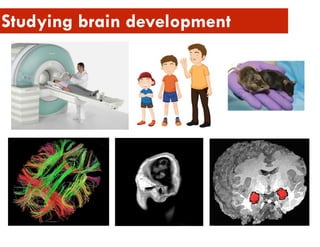
Studying brain development
• The adolescent brain is different from the adult
brain.
Lessons learned about the adolescent brain
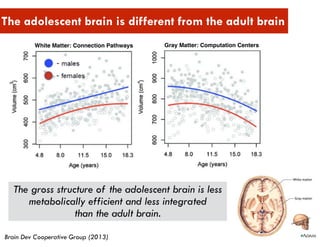
The adolescent brain is different from the adult brain
Gray Matter: Computation CentersWhite Matter: Connection Pathways
Brain Dev Cooperative Group (2013)
The gross structure of the adolescent brain is less
metabolically efficient and less integrated
than the adult brain.
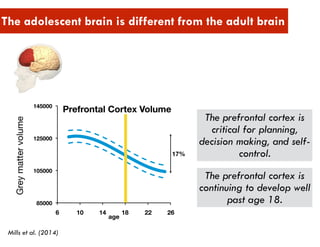
Mills et al. (2014)
The prefrontal cortex is
critical for planning,
decision making, and self-
control.
The prefrontal cortex is
continuing to develop well
past age 18.
The adolescent brain is different from the adult brain
• The adolescent brain is different from the adult
brain.
• The maturational state of the adolescent brain
‘tunes’ it to rewards and learning opportunities.
Lessons learned about the adolescent brain
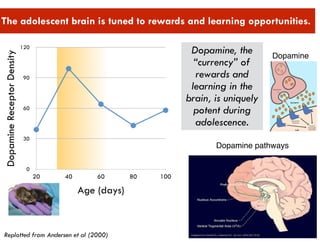
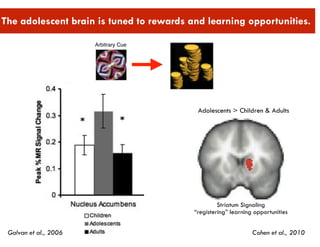
The adolescent brain is tuned to rewards and learning opportunities.
Dopamine
Dopamine pathways
Replotted from Andersen et al (2000)
DopamineReceptorDensity
0
30
60
90
120
Age (days)
20 40 60 80 100
Dopamine, the
“currency” of
rewards and
learning in the
brain, is uniquely
potent during
adolescence.
Galvan et al., 2006
Adolescents > Children & Adults
Striatum Signaling
“registering” learning opportunities
Cohen et al., 2010
Arbitrary Cue
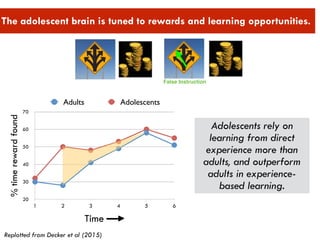
The adolescent brain is tuned to rewards and learning opportunities.
Adolescents rely on
learning from direct
experience more than
adults, and outperform
adults in experience-
based learning.
%timerewardfound
20
30
40
50
60
70
Time —>
1 2 3 4 5 6
Adults Adolescents
Replotted from Decker et al (2015)
False Instruction
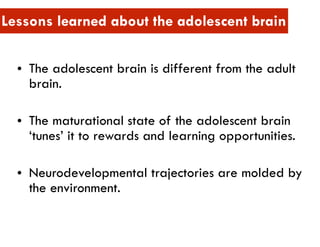
• The adolescent brain is different from the adult
brain.
• The maturational state of the adolescent brain
‘tunes’ it to rewards and learning opportunities.
• Neurodevelopmental trajectories are molded by
the environment.
Lessons learned about the adolescent brain
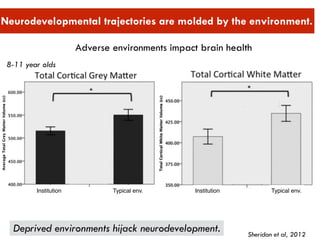
Neurodevelopmental trajectories are molded by the environment.
Sheridan et al, 2012
Institution Typical env. Institution Typical env.
Adverse environments impact brain health
8-11 year olds
Deprived environments hijack neurodevelopment.
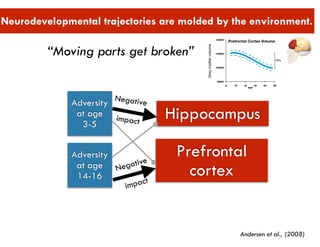
“Moving parts get broken”


Neurodevelopmental trajectories are molded by the environment.
Hippocampus
Prefrontal
cortex
Adversity
at age
3-5
Adversity
at age
14-16
Negative


impact
Negative


impact
Andersen et al., (2008)
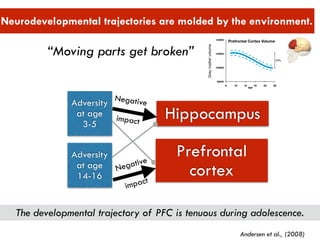
“Moving parts get broken”


Neurodevelopmental trajectories are molded by the environment.
Hippocampus
Prefrontal
cortex
Adversity
at age
3-5
Adversity
at age
14-16
Negative


impact
Negative


impact
Andersen et al., (2008)
The developmental trajectory of PFC is tenuous during adolescence.
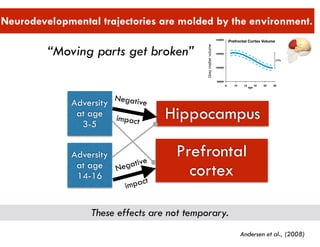
“Moving parts get broken”


Neurodevelopmental trajectories are molded by the environment.
Hippocampus
Prefrontal
cortex
Adversity
at age
3-5
Adversity
at age
14-16
Negative


impact
Negative


impact
Andersen et al., (2008)
These effects are not temporary.
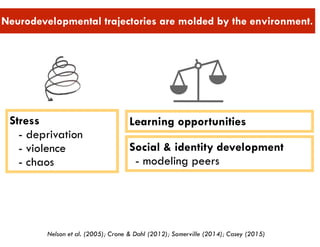
Neurodevelopmental trajectories are molded by the environment.
Social & identity development
- modeling peers
Stress
- deprivation
- violence
- chaos
Learning opportunities
Nelson et al. (2005); Crone & Dahl (2012); Somerville (2014); Casey (2015)
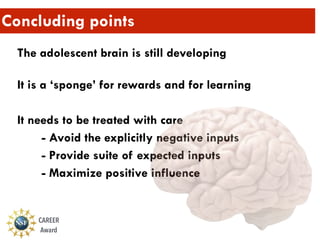
Concluding points
The adolescent brain is still developing

It is a ‘sponge’ for rewards and for learning
It needs to be treated with care
- Avoid the explicitly negative inputs
- Provide suite of expected inputs
- Maximize positive influence
CAREER
Award

Somerville, Adolescent Brain Development and Psychological Functioning

  • 1.
    Adolescent brain development
 & psychological functioning Leah Somerville Department of Psychology & Center for Brain Science Harvard University Affective   Neuroscience   &   Development   Laboratory HLS 2015
  • 2.
  • 3.
    • The adolescentbrain is different from the adult brain. Lessons learned about the adolescent brain
  • 4.
    The adolescent brainis different from the adult brain Gray Matter: Computation CentersWhite Matter: Connection Pathways Brain Dev Cooperative Group (2013) The gross structure of the adolescent brain is less metabolically efficient and less integrated than the adult brain.
  • 5.
    Mills et al.(2014) The prefrontal cortex is critical for planning, decision making, and self- control. The prefrontal cortex is continuing to develop well past age 18. The adolescent brain is different from the adult brain
  • 6.
    • The adolescentbrain is different from the adult brain. • The maturational state of the adolescent brain ‘tunes’ it to rewards and learning opportunities. Lessons learned about the adolescent brain
  • 7.
    The adolescent brainis tuned to rewards and learning opportunities. Dopamine Dopamine pathways Replotted from Andersen et al (2000) DopamineReceptorDensity 0 30 60 90 120 Age (days) 20 40 60 80 100 Dopamine, the “currency” of rewards and learning in the brain, is uniquely potent during adolescence.
  • 8.
    Galvan et al.,2006 Adolescents > Children & Adults Striatum Signaling “registering” learning opportunities Cohen et al., 2010 Arbitrary Cue The adolescent brain is tuned to rewards and learning opportunities.
  • 9.
    The adolescent brainis tuned to rewards and learning opportunities. Adolescents rely on learning from direct experience more than adults, and outperform adults in experience- based learning. %timerewardfound 20 30 40 50 60 70 Time —> 1 2 3 4 5 6 Adults Adolescents Replotted from Decker et al (2015) False Instruction
  • 10.
    • The adolescentbrain is different from the adult brain. • The maturational state of the adolescent brain ‘tunes’ it to rewards and learning opportunities. • Neurodevelopmental trajectories are molded by the environment. Lessons learned about the adolescent brain
  • 11.
    Neurodevelopmental trajectories aremolded by the environment. Sheridan et al, 2012 Institution Typical env. Institution Typical env. Adverse environments impact brain health 8-11 year olds Deprived environments hijack neurodevelopment.
  • 12.
    “Moving parts getbroken” 
 Neurodevelopmental trajectories are molded by the environment. Hippocampus Prefrontal cortex Adversity at age 3-5 Adversity at age 14-16 Negative 
 impact Negative 
 impact Andersen et al., (2008)
  • 13.
    “Moving parts getbroken” 
 Neurodevelopmental trajectories are molded by the environment. Hippocampus Prefrontal cortex Adversity at age 3-5 Adversity at age 14-16 Negative 
 impact Negative 
 impact Andersen et al., (2008) The developmental trajectory of PFC is tenuous during adolescence.
  • 14.
    “Moving parts getbroken” 
 Neurodevelopmental trajectories are molded by the environment. Hippocampus Prefrontal cortex Adversity at age 3-5 Adversity at age 14-16 Negative 
 impact Negative 
 impact Andersen et al., (2008) These effects are not temporary.
  • 15.
    Neurodevelopmental trajectories aremolded by the environment. Social & identity development - modeling peers Stress - deprivation - violence - chaos Learning opportunities Nelson et al. (2005); Crone & Dahl (2012); Somerville (2014); Casey (2015)
  • 16.
    Concluding points The adolescentbrain is still developing
 It is a ‘sponge’ for rewards and for learning It needs to be treated with care - Avoid the explicitly negative inputs - Provide suite of expected inputs - Maximize positive influence CAREER Award