NEUROMUSCULAR ADAPTATION TO
EXERCISE –APPLICATION TO
PRACTISE
Presented by : S.Aparna Selvam
1st MPT
Moderator: Mrs. Renuka Devi
Professor
Dept. Cardiopulmonary Sciences
TABLE OF CONTENTS
• Introduction
• Responses vs Adaptations
• Neuromuscular responses & adaptations
• Neuromuscular adaptation to specific type of exercise
• How is neural adaptation different from neuromuscular adaptations
• Effects of over training
Introduction
Exercise is the systematic, planned performance of bodily movements,
postures, or physical activities intended to provide an individual with
the means to remediate or prevent impairments Improve, restore, or
enhance physical function prevent or reduce health-related risk factors
Optimize overall health status, fitness, or sense of well-being.
Neural adaptations to exercise can be defined as changes within the
nervous system. Neural adaptations may occur at the level of the motor
cortex, spinal cord, and/or neuromuscular junction following training,
Adaptations may also occur at excitation- contraction coupling
pathways located distal to the neuromuscular junction.
To contribute to the body’s need for mobility and stability ,muscle
contraction occurs which is controlled by the central nervous system.
Whenever there is sensory stimulus to initiate muscle contraction
afferent pathway carries signals to the brain (motor cortex) where signal
is processed and descended via pyramidal tract to anterior horn cells
through the motor neuron stimulating NMJ.
Following stimulation of NMJ there is generation and spread of action
potential in muscle fibre via t tubules and release of CA+ from cisternae,
CA+ then binds with troponin and changes its position, pulling away
tropomyosin molecule away from F-actin and exposing of actin sites
occur resulting in binding of actin and myosin (power stroke )
,contraction of muscle
Responses vs adaptations in exercise training
Responses ???
Short term changes
Physiological changes
Changes in function
In short term, the neuromuscular response to exercise are
• Increase in blood supply
Increased demand for oxygen and glucose
Removal of waste products (i.e.) carbon dioxide and lactate production
is greater in proportion during exercise serves the need for increase
blood flow
Vasodilation-more blood supply –more oxygen and glucose to exercise
• Increase in muscle temperature
Breaking up of fat and production of heat (exothermic reaction in the
muscle
• Increased muscle pliability
Increase in flexibity of muscle and reducing the risk of injuries
Greater ROM
Greater power
Greater force
• Production of lactate (by product of anaerobic system
Activation of lactate energy system for energy production
• Micro tears (minuscule )
Post resistance training there is micro trauma to the muscle fibres(
eccentric contractions- DOMS)
Adaptation ????
Long term
Anatomical / structural changes
In long term the neuromuscular adaptation that occurs in the body are:
• Hypertrophy
Increase in muscle size and no. of cells
Stimulation of growth hormone and increase in its production can also
cause hyperplasia (5%)
• Increase in tendon strength
Tendon is contiguous to muscle sheath, it is made up of collagen
Following resistance training there is increase in strength, thickness and
fibre density of tendons
• Increase in myoglobin stores
Myoglobin is a protein similar to haemoglobin, which is found in
muscle and not in blood stream ,It binds with oxygen and iron stores
them for future application on requirement of energy
• Increase in size and no. of mitochondria
Mitochondria is the powerhouse of the cell, it is an organelle for cellular
respiration . Source for energy production. Increase in mitochondria
with no.and size ability to use various compounds in the body such as
oxygen and pyruvate, which helps in, creation of energy & resynthesizes
of ATP .
Therefore greater mitochondria greater the ATP resynthesize, greater
energy ,cellular respiration and greater metabolism
• Increase in storage of glycogen and fat ( fuel for exercise)
Following training there is increase in storage of glycogen and
intramuscular triglycerides, which serves as a fuel for exercise training
• Increase in CA+ stores
Exercise training causes increase in density of bone, and increase in
synovial fluid production
• Increase in muscle strength
Primary gain (6weeks)
True gain follows
Steady gain
Detraining –loss of strength
• Increase tolerance to lactate
Lactate is produced as a result of exercise /anaerobic respiration and if
found in muscle tissue and blood stream
lactate can be converted to pyruvate in presence of oxygen for
production of energy
• Increase in hyaline cartilage thickness
• Increase in ligament flexibility
The magnitude of these adaptations are dependent on:
• The type of exercise
• The intensity of exercise
• The frequency of exercise
• The duration of exercise
• The initial level of fitness
• Genetic influences which determine the body's responsiveness
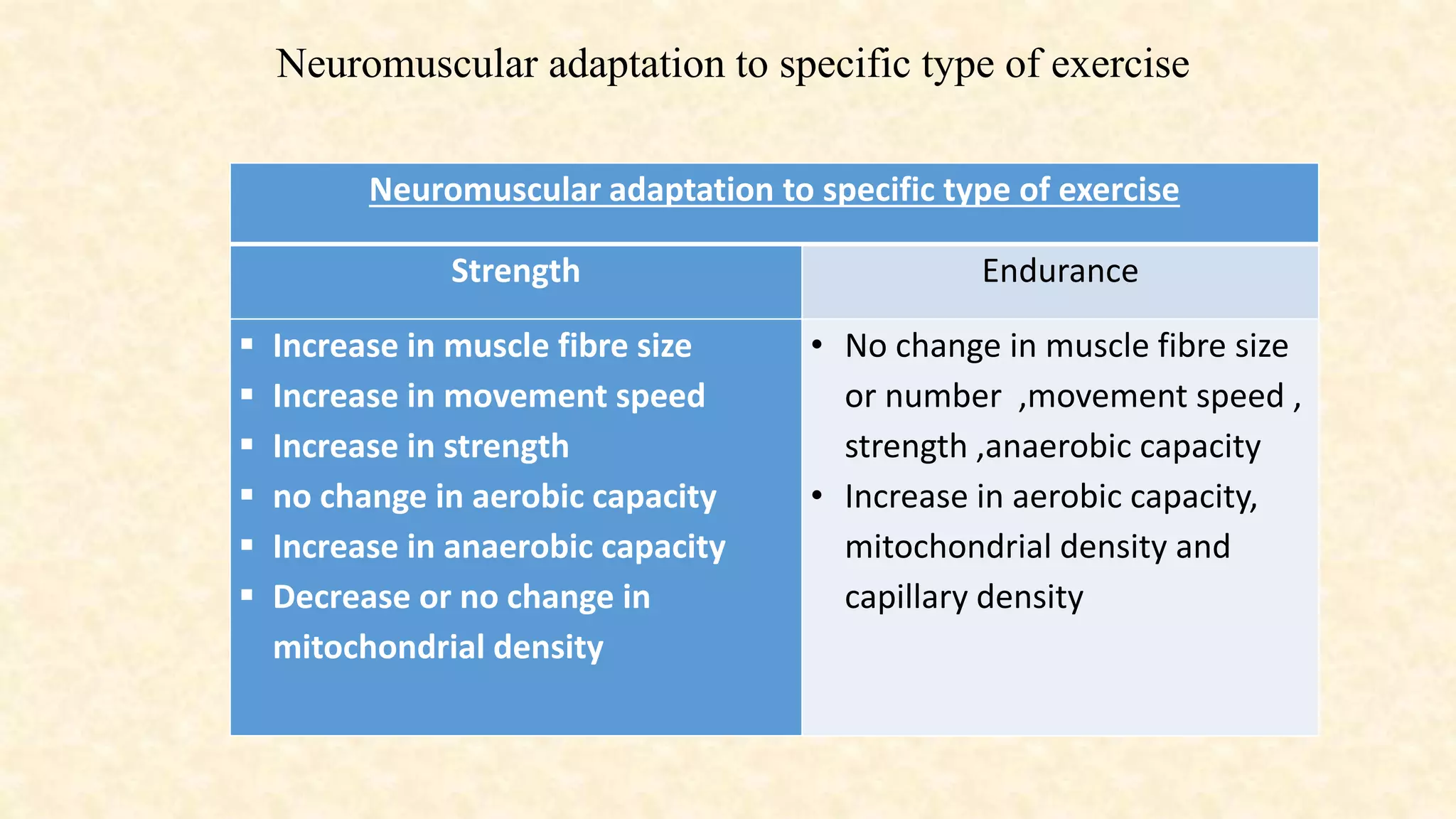
Neuromuscular adaptation to specific type of exercise
Strength Endurance
 Increase in muscle fibre size
 Increase in movement speed
 Increase in strength
 no change in aerobic capacity
 Increase in anaerobic capacity
 Decrease or no change in
mitochondrial density
• No change in muscle fibre size
or number ,movement speed ,
strength ,anaerobic capacity
• Increase in aerobic capacity,
mitochondrial density and
capillary density
Neuromuscular adaptation to specific type of exercise
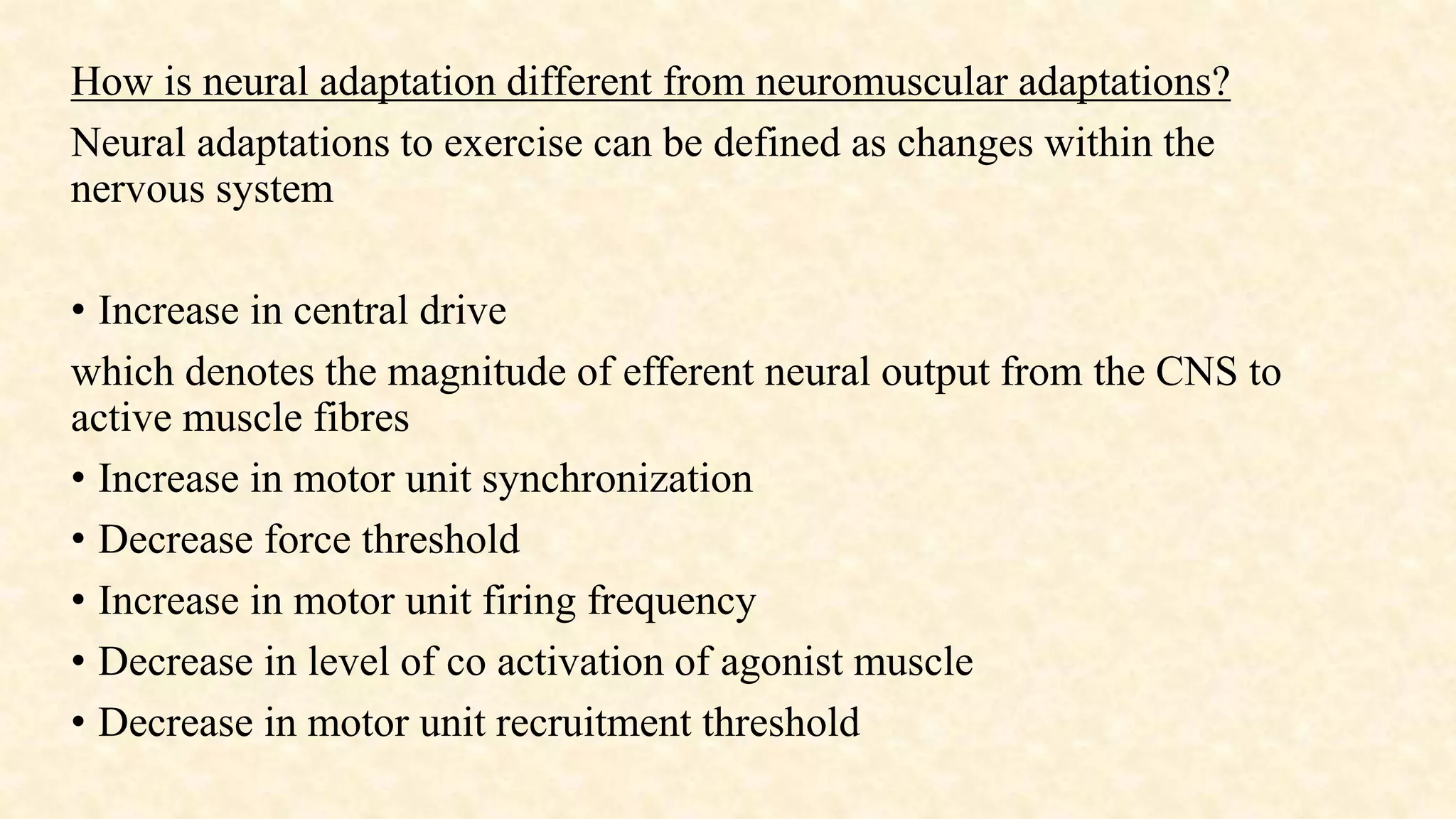
How is neural adaptation different from neuromuscular adaptations?
Neural adaptations to exercise can be defined as changes within the
nervous system
• Increase in central drive
which denotes the magnitude of efferent neural output from the CNS to
active muscle fibres
• Increase in motor unit synchronization
• Decrease force threshold
• Increase in motor unit firing frequency
• Decrease in level of co activation of agonist muscle
• Decrease in motor unit recruitment threshold
• Decrease neuron inhibition ( autogenic inhibition )
Changes in the sensory receptors (i.e. Golgi tendon organs) may lead to
disinhibition and an increased expression of muscular force. Agonist
muscle activity results in limb movement in the desired direction, while
antagonist activity opposes that motion. Both decreases and increases in
co-activation of the antagonist occurs A reduction in antagonist co-
activation would allow increased expression of agonist muscle force, while
an increase in antagonist co-activation is important for maintaining the
integrity of the joint.
• Increase in diameter of the recruited fibres
• Increased recruitment of additional motor units
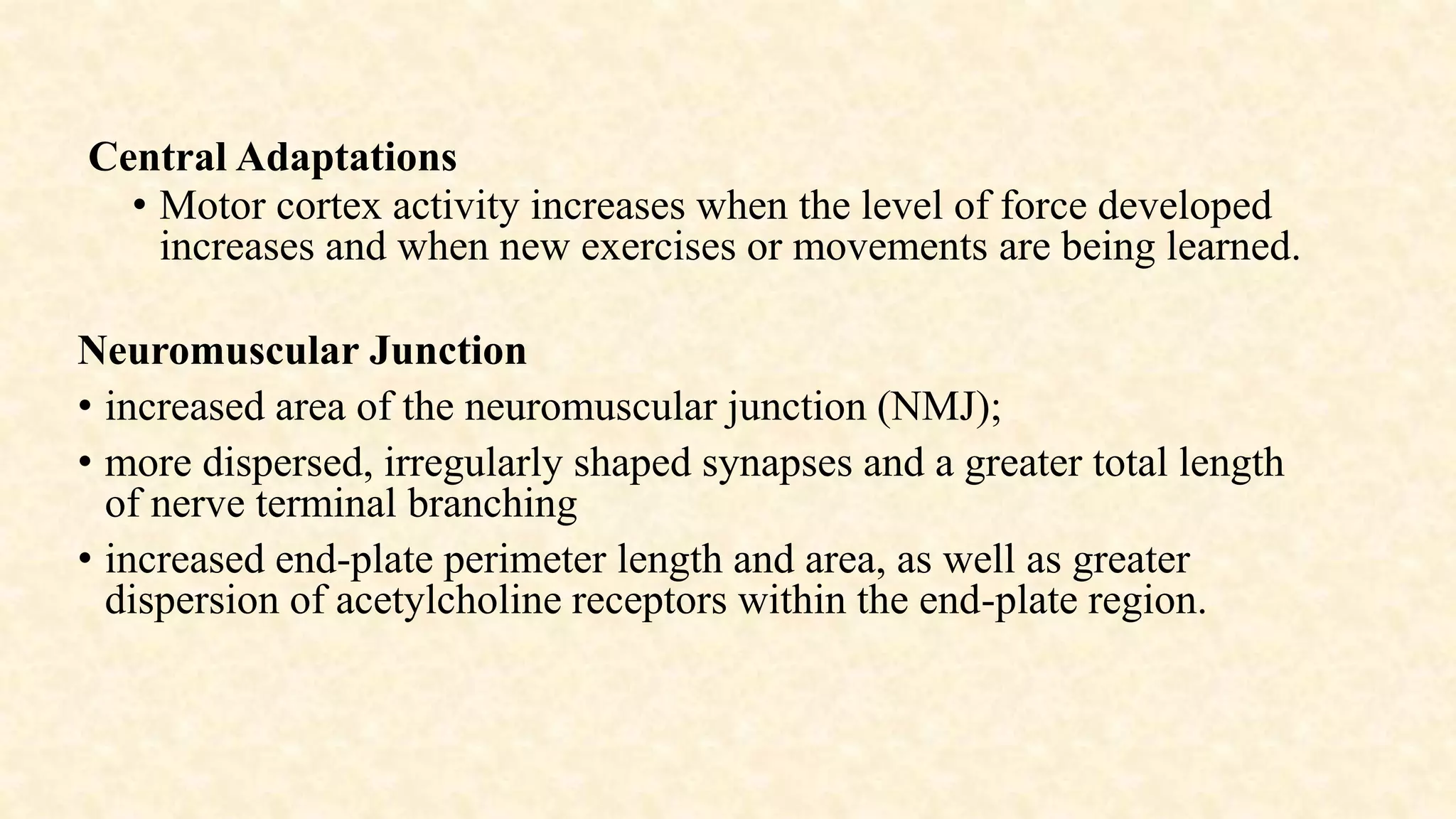
Central Adaptations
• Motor cortex activity increases when the level of force developed
increases and when new exercises or movements are being learned.
Neuromuscular Junction
• increased area of the neuromuscular junction (NMJ);
• more dispersed, irregularly shaped synapses and a greater total length
of nerve terminal branching
• increased end-plate perimeter length and area, as well as greater
dispersion of acetylcholine receptors within the end-plate region.
Adaptations of Motor Units
• Maximal strength and power increases of agonist muscles result from an
increase in recruitment, rate of firing, synchronization of firing, or a
combination of these factors
• motor units that contain Type I (slow-twitch) and Type II (fast-twitch) fibers
are organized based on some “size” factor.
• Low-threshold motor units are recruited first and have lower force
capabilities than higher-threshold motor units.
• Typically, to get to the high-threshold motor units, the body must first
recruit the lower-threshold motor units.
The moto neurons with the lowest thresholds, innervating slow (S) muscle
units, fire at low rates for long periods of time, whereas the neurons with the
highest thresholds innervating fast, fatiguing(FF) units, fire in scarce and
short high-frequency bursts. Intermediate neurons, innervating fast, fatigue-
resistant units, have intermediate everyday firing
During long-lasting maximal performance, such as endurance training,
all units fire at moderate rates, but as soon as the drive is not maximal,
the neurons with the highest thresholds drop out performance, such as
strength training, all units fire in long high-frequency bursts.
Neuromuscular Reflex Potentiation
• Training Enhances the reflex response, thereby enhancing the
magnitude and rate of force development.
Effects of over training
Overtraining is defined as excessive frequency, volume, or intensity of
training that results in extreme fatigue, illness, or injury (which is often
due to a lack of sufficient rest, recovery, and perhaps nutrient intake).
Excessive training on a short-term basis is called overreaching.
References
• Edström, L. and Grimby, L. (1986). Effect of exercise on the motor
unit. Muscle & Nerve, 9(2), pp.104-126.
• Gabriel, D., Kamen, G. and Frost, G. (2006). Neural Adaptations to
Resistive Exercise. Sports Medicine, 36(2), pp.133-149.
• Hall, j. (N.D.). Guyton and hall textbook of medical physiology. [S.L.]:
Elsevier - health science.
• Hedayatpour, N. and Falla, D. (2015). Physiological and Neural
Adaptations to Eccentric Exercise: Mechanisms and Considerations
for Training. BioMed Research International, 2015, pp.1-7.
• Kenney, W., Wilmore, J. and Costill, D. (n.d.). Physiology of sport and
exercise.
• McArdle, W. (n.d.). Exercise Physiology. Philadelphia: Lippincott
Williams and Wilkins.
• A.Plowman, s. And Smith, d. (2014). Exercise physiology. 4th ed.
Wolter kluwer.
• Sembulingam, k. (N.D.). Essential of medical physiology. 6th ed.

Neuromuscular adaptation to exercise –application to practise

  • 1.
    NEUROMUSCULAR ADAPTATION TO EXERCISE–APPLICATION TO PRACTISE Presented by : S.Aparna Selvam 1st MPT Moderator: Mrs. Renuka Devi Professor Dept. Cardiopulmonary Sciences
  • 2.
    TABLE OF CONTENTS •Introduction • Responses vs Adaptations • Neuromuscular responses & adaptations • Neuromuscular adaptation to specific type of exercise • How is neural adaptation different from neuromuscular adaptations • Effects of over training
  • 3.
    Introduction Exercise is thesystematic, planned performance of bodily movements, postures, or physical activities intended to provide an individual with the means to remediate or prevent impairments Improve, restore, or enhance physical function prevent or reduce health-related risk factors Optimize overall health status, fitness, or sense of well-being.
  • 4.
    Neural adaptations toexercise can be defined as changes within the nervous system. Neural adaptations may occur at the level of the motor cortex, spinal cord, and/or neuromuscular junction following training, Adaptations may also occur at excitation- contraction coupling pathways located distal to the neuromuscular junction. To contribute to the body’s need for mobility and stability ,muscle contraction occurs which is controlled by the central nervous system.
  • 6.
    Whenever there issensory stimulus to initiate muscle contraction afferent pathway carries signals to the brain (motor cortex) where signal is processed and descended via pyramidal tract to anterior horn cells through the motor neuron stimulating NMJ. Following stimulation of NMJ there is generation and spread of action potential in muscle fibre via t tubules and release of CA+ from cisternae, CA+ then binds with troponin and changes its position, pulling away tropomyosin molecule away from F-actin and exposing of actin sites occur resulting in binding of actin and myosin (power stroke ) ,contraction of muscle
  • 8.
    Responses vs adaptationsin exercise training Responses ??? Short term changes Physiological changes Changes in function
  • 9.
    In short term,the neuromuscular response to exercise are • Increase in blood supply Increased demand for oxygen and glucose Removal of waste products (i.e.) carbon dioxide and lactate production is greater in proportion during exercise serves the need for increase blood flow Vasodilation-more blood supply –more oxygen and glucose to exercise • Increase in muscle temperature Breaking up of fat and production of heat (exothermic reaction in the muscle
  • 10.
    • Increased musclepliability Increase in flexibity of muscle and reducing the risk of injuries Greater ROM Greater power Greater force • Production of lactate (by product of anaerobic system Activation of lactate energy system for energy production • Micro tears (minuscule ) Post resistance training there is micro trauma to the muscle fibres( eccentric contractions- DOMS)
  • 11.
  • 12.
    In long termthe neuromuscular adaptation that occurs in the body are: • Hypertrophy Increase in muscle size and no. of cells Stimulation of growth hormone and increase in its production can also cause hyperplasia (5%)
  • 13.
    • Increase intendon strength Tendon is contiguous to muscle sheath, it is made up of collagen Following resistance training there is increase in strength, thickness and fibre density of tendons • Increase in myoglobin stores Myoglobin is a protein similar to haemoglobin, which is found in muscle and not in blood stream ,It binds with oxygen and iron stores them for future application on requirement of energy
  • 14.
    • Increase insize and no. of mitochondria Mitochondria is the powerhouse of the cell, it is an organelle for cellular respiration . Source for energy production. Increase in mitochondria with no.and size ability to use various compounds in the body such as oxygen and pyruvate, which helps in, creation of energy & resynthesizes of ATP . Therefore greater mitochondria greater the ATP resynthesize, greater energy ,cellular respiration and greater metabolism • Increase in storage of glycogen and fat ( fuel for exercise) Following training there is increase in storage of glycogen and intramuscular triglycerides, which serves as a fuel for exercise training
  • 15.
    • Increase inCA+ stores Exercise training causes increase in density of bone, and increase in synovial fluid production • Increase in muscle strength Primary gain (6weeks) True gain follows Steady gain Detraining –loss of strength
  • 16.
    • Increase toleranceto lactate Lactate is produced as a result of exercise /anaerobic respiration and if found in muscle tissue and blood stream lactate can be converted to pyruvate in presence of oxygen for production of energy • Increase in hyaline cartilage thickness • Increase in ligament flexibility
  • 18.
    The magnitude ofthese adaptations are dependent on: • The type of exercise • The intensity of exercise • The frequency of exercise • The duration of exercise • The initial level of fitness • Genetic influences which determine the body's responsiveness
  • 19.
    Neuromuscular adaptation tospecific type of exercise Strength Endurance  Increase in muscle fibre size  Increase in movement speed  Increase in strength  no change in aerobic capacity  Increase in anaerobic capacity  Decrease or no change in mitochondrial density • No change in muscle fibre size or number ,movement speed , strength ,anaerobic capacity • Increase in aerobic capacity, mitochondrial density and capillary density Neuromuscular adaptation to specific type of exercise
  • 20.
    How is neuraladaptation different from neuromuscular adaptations? Neural adaptations to exercise can be defined as changes within the nervous system • Increase in central drive which denotes the magnitude of efferent neural output from the CNS to active muscle fibres • Increase in motor unit synchronization • Decrease force threshold • Increase in motor unit firing frequency • Decrease in level of co activation of agonist muscle • Decrease in motor unit recruitment threshold
  • 21.
    • Decrease neuroninhibition ( autogenic inhibition ) Changes in the sensory receptors (i.e. Golgi tendon organs) may lead to disinhibition and an increased expression of muscular force. Agonist muscle activity results in limb movement in the desired direction, while antagonist activity opposes that motion. Both decreases and increases in co-activation of the antagonist occurs A reduction in antagonist co- activation would allow increased expression of agonist muscle force, while an increase in antagonist co-activation is important for maintaining the integrity of the joint. • Increase in diameter of the recruited fibres • Increased recruitment of additional motor units
  • 22.
    Central Adaptations • Motorcortex activity increases when the level of force developed increases and when new exercises or movements are being learned. Neuromuscular Junction • increased area of the neuromuscular junction (NMJ); • more dispersed, irregularly shaped synapses and a greater total length of nerve terminal branching • increased end-plate perimeter length and area, as well as greater dispersion of acetylcholine receptors within the end-plate region.
  • 23.
    Adaptations of MotorUnits • Maximal strength and power increases of agonist muscles result from an increase in recruitment, rate of firing, synchronization of firing, or a combination of these factors • motor units that contain Type I (slow-twitch) and Type II (fast-twitch) fibers are organized based on some “size” factor.
  • 24.
    • Low-threshold motorunits are recruited first and have lower force capabilities than higher-threshold motor units. • Typically, to get to the high-threshold motor units, the body must first recruit the lower-threshold motor units. The moto neurons with the lowest thresholds, innervating slow (S) muscle units, fire at low rates for long periods of time, whereas the neurons with the highest thresholds innervating fast, fatiguing(FF) units, fire in scarce and short high-frequency bursts. Intermediate neurons, innervating fast, fatigue- resistant units, have intermediate everyday firing
  • 25.
    During long-lasting maximalperformance, such as endurance training, all units fire at moderate rates, but as soon as the drive is not maximal, the neurons with the highest thresholds drop out performance, such as strength training, all units fire in long high-frequency bursts. Neuromuscular Reflex Potentiation • Training Enhances the reflex response, thereby enhancing the magnitude and rate of force development.
  • 26.
    Effects of overtraining Overtraining is defined as excessive frequency, volume, or intensity of training that results in extreme fatigue, illness, or injury (which is often due to a lack of sufficient rest, recovery, and perhaps nutrient intake). Excessive training on a short-term basis is called overreaching.
  • 28.
    References • Edström, L.and Grimby, L. (1986). Effect of exercise on the motor unit. Muscle & Nerve, 9(2), pp.104-126. • Gabriel, D., Kamen, G. and Frost, G. (2006). Neural Adaptations to Resistive Exercise. Sports Medicine, 36(2), pp.133-149. • Hall, j. (N.D.). Guyton and hall textbook of medical physiology. [S.L.]: Elsevier - health science. • Hedayatpour, N. and Falla, D. (2015). Physiological and Neural Adaptations to Eccentric Exercise: Mechanisms and Considerations for Training. BioMed Research International, 2015, pp.1-7. • Kenney, W., Wilmore, J. and Costill, D. (n.d.). Physiology of sport and exercise. • McArdle, W. (n.d.). Exercise Physiology. Philadelphia: Lippincott Williams and Wilkins.
  • 29.
    • A.Plowman, s.And Smith, d. (2014). Exercise physiology. 4th ed. Wolter kluwer. • Sembulingam, k. (N.D.). Essential of medical physiology. 6th ed.