• Learners willhave the opportunity to
• Review muscle function
• Learn about muscle metabolism:
• Muscle protein synthesis
• Muscle protein breakdown
• Learn about muscle adaptation:
• Stimulus (training)
• Response (growth/adaptation)
1
Learning Outcomes
Muscle Adaptation
3.
Muscle Function
2
Muscle Adaptation
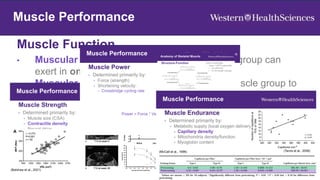
MusclePerformance
• Muscular strength: force a muscle or muscle group can
exert in one maximal effort.
• Muscular power: The ability of a muscle or muscle group to
generate force while shortening.
• Muscular endurance: Ability of muscles or muscle groups to
perform repeated or sustained contractions.
4.
Muscle Function
3
Muscle Adaptation
MusclePerformance
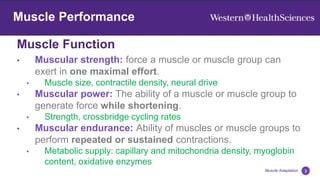
• Muscular strength: force a muscle or muscle group can
exert in one maximal effort.
• Muscle size, contractile density, neural drive
• Muscular power: The ability of a muscle or muscle group to
generate force while shortening.
• Strength, crossbridge cycling rates
• Muscular endurance: Ability of muscles or muscle groups to
perform repeated or sustained contractions.
• Metabolic supply: capillary and mitochondria density, myoglobin
content, oxidative enzymes
5.
4
Muscle Adaptation
Muscle FibreTypes
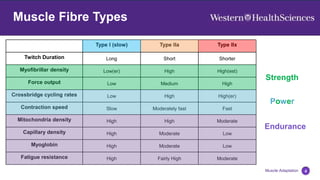
Type I (slow) Type IIa Type IIx
Twitch Duration Long Short Shorter
Myofibrillar density Low(er) High High(est)
Force output Low Medium High
Crossbridge cycling rates Low High High(er)
Contraction speed Slow Moderately fast Fast
Mitochondria density High High Moderate
Capillary density High Moderate Low
Myoglobin High Moderate Low
Fatigue resistance High Fairly High Moderate
Strength
Power
Endurance
6.
5
Muscle Adaptation
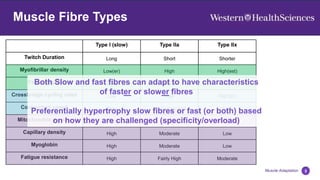
Muscle FibreTypes
Type I (slow) Type IIa Type IIx
Twitch Duration Long Short Shorter
Myofibrillar density Low(er) High High(est)
Force output Low Medium High
Crossbridge cycling rates Low High High(er)
Contraction speed Slow Moderately fast Fast
Mitochondria density High High Moderate
Capillary density High Moderate Low
Myoglobin High Moderate Low
Fatigue resistance High Fairly High Moderate
Both Slow and fast fibres can adapt to have characteristics
of faster or slower fibres
Preferentially hypertrophy slow fibres or fast (or both) based
on how they are challenged (specificity/overload)
Muscle Protein Balance
7
MuscleAdaptation
Muscle Metabolism
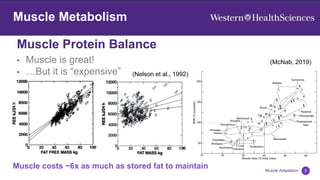
• Muscle is great!
• …But it is “expensive”
(McNab, 2019)
Muscle costs ~6x as much as stored fat to maintain
(Nelson et al., 1992)
9.
Net Muscle ProteinBalance (NBAL)
8
Muscle Adaptation
Muscle Metabolism
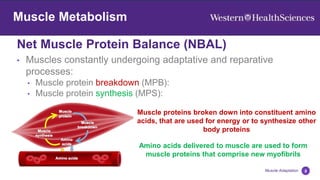
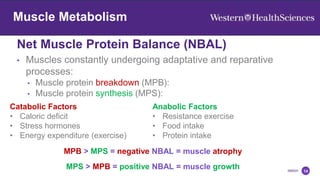
• Muscles constantly undergoing adaptative and reparative
processes:
• Muscle protein breakdown (MPB):
• Muscle protein synthesis (MPS):
Amino acids delivered to muscle are used to form
muscle proteins that comprise new myofibrils
Muscle proteins broken down into constituent amino
acids, that are used for energy or to synthesize other
body proteins
Net Muscle ProteinBalance (NBAL)
10
Muscle Adaptation
Muscle Metabolism
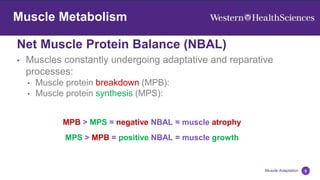
• Muscles constantly undergoing adaptative and reparative
processes:
• Muscle protein breakdown (MPB):
• Muscle protein synthesis (MPS):
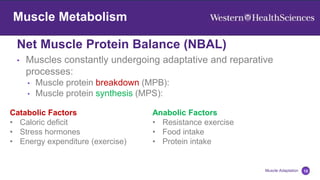
Catabolic Factors
• Caloric deficit
• Stress hormones
• Energy expenditure (exercise)
Anabolic Factors
• Resistance exercise
• Food intake
• Protein intake
12.
Net Muscle ProteinBalance (NBAL)
11
Muscle Adaptation
Muscle Metabolism
• Muscles constantly undergoing adaptative and reparative
processes:
• Muscle protein breakdown (MPB):
• Muscle protein synthesis (MPS):
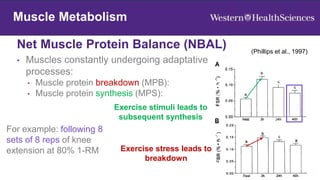
For example: following 8
sets of 8 reps of knee
extension at 80% 1-RM
(Phillips et al., 1997)
Exercise stress leads to
breakdown
Exercise stimuli leads to
subsequent synthesis
13.
Net Muscle ProteinBalance (NBAL)
12
Muscle Adaptation
Muscle Metabolism
• Muscles constantly undergoing adaptative and reparative
processes:
• Muscle protein breakdown (MPB):
• Muscle protein synthesis (MPS):
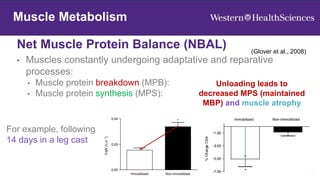
(Glover et al., 2008)
Unloading leads to
decreased MPS (maintained
MBP) and muscle atrophy
For example, following
14 days in a leg cast
14.
Net Muscle ProteinBalance (NBAL)
13
Muscle Adaptation
Muscle Metabolism
• Muscles constantly undergoing adaptative and reparative
processes:
• Muscle protein breakdown (MPB):
• Muscle protein synthesis (MPS):
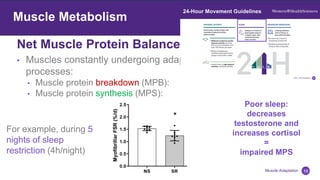
Poor sleep:
decreases
testosterone and
increases cortisol
=
impaired MPS
For example, during 5
nights of sleep
restriction (4h/night)
Muscle Growth
16
Muscle Adaptation
MuscleAdaptation
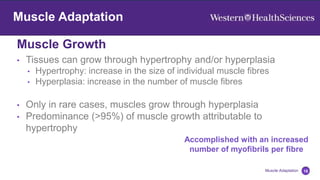
• Tissues can grow through hypertrophy and/or hyperplasia
• Hypertrophy: increase in the size of individual muscle fibres
• Hyperplasia: increase in the number of muscle fibres
• Only in rare cases, muscles grow through hyperplasia
• Predominance (>95%) of muscle growth attributable to
hypertrophy
Accomplished with an increased
number of myofibrils per fibre
18.
Muscle Growth
17
Muscle Adaptation
MuscleAdaptation
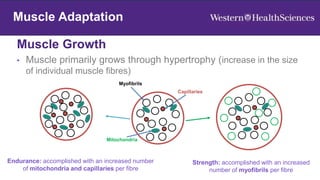
• Muscle primarily grows through hypertrophy (increase in the size
of individual muscle fibres)
Strength: accomplished with an increased
number of myofibrils per fibre
Endurance: accomplished with an increased number
of mitochondria and capillaries per fibre
Myofibrils
Capillaries
Mitochondria
19.
Muscle Growth
18
Muscle Adaptation
MuscleAdaptation
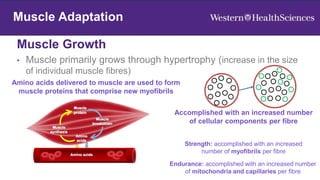
• Muscle primarily grows through hypertrophy (increase in the size
of individual muscle fibres)
Strength: accomplished with an increased
number of myofibrils per fibre
Endurance: accomplished with an increased number
of mitochondria and capillaries per fibre
Accomplished with an increased number
of cellular components per fibre
Amino acids delivered to muscle are used to form
muscle proteins that comprise new myofibrils
20.
Muscle Growth
19
Muscle Adaptation
MuscleAdaptation
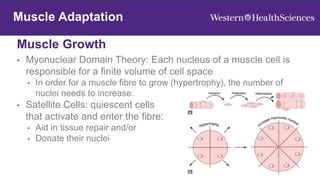
• Myonuclear Domain Theory: Each nucleus of a muscle cell is
responsible for a finite volume of cell space
• In order for a muscle fibre to grow (hypertrophy), the number of
nuclei needs to increase. Analogy Time!
21.
Muscle Growth
20
Muscle Adaptation
MuscleAdaptation
• Myonuclear Domain Theory: Each nucleus of a muscle cell is
responsible for a finite volume of cell space
• In order for a muscle fibre to grow (hypertrophy), the number of
nuclei needs to increase.
• Satellite Cells: quiescent cells
that activate and enter the fibre:
• Aid in tissue repair and/or
• Donate their nuclei
22.
Muscle Growth
21
Muscle Adaptation
MuscleAdaptation
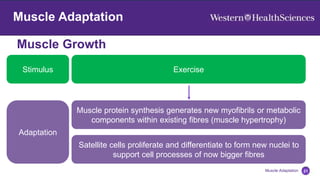
Muscle protein synthesis generates new myofibrils or metabolic
components within existing fibres (muscle hypertrophy)
Satellite cells proliferate and differentiate to form new nuclei to
support cell processes of now bigger fibres
Exercise
Stimulus
Adaptation
23.
Muscle Adaptation
Muscle GrowthStimulus
22
Muscle Adaptation
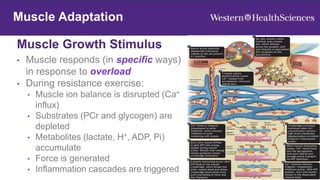
• Muscle responds (in specific ways)
in response to overload
• During resistance exercise:
• Muscle ion balance is disrupted (Ca+
influx)
• Substrates (PCr and glycogen) are
depleted
• Metabolites (lactate, H+, ADP, Pi)
accumulate
• Force is generated
• Inflammation cascades are triggered
24.
Muscle Adaptation
Muscle GrowthStimulus
23
Muscle Adaptation
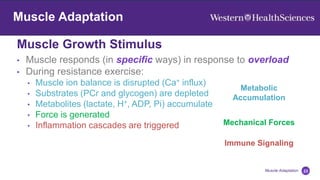
• Muscle responds (in specific ways) in response to overload
• During resistance exercise:
• Muscle ion balance is disrupted (Ca+ influx)
• Substrates (PCr and glycogen) are depleted
• Metabolites (lactate, H+, ADP, Pi) accumulate
• Force is generated
• Inflammation cascades are triggered
Metabolic
Accumulation
Mechanical Forces
Immune Signaling
25.
Muscle Adaptation
Muscle GrowthStimulus
24
Muscle Adaptation
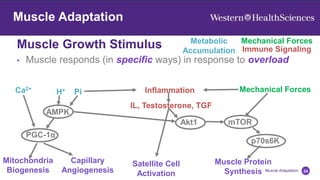
• Muscle responds (in specific ways) in response to overload
Metabolic
Accumulation
Mechanical Forces
Immune Signaling
Ca2+
H+ Pi Inflammation
IL, Testosterone, TGF
Mechanical Forces
AMPK
PGC-1α
Mitochondria
Biogenesis
Capillary
Angiogenesis
mTOR
p70s6K
Akt1
Muscle Protein
Synthesis
Satellite Cell
Activation
26.
Muscle Adaptation
Muscle GrowthStimulus
25
Muscle Adaptation
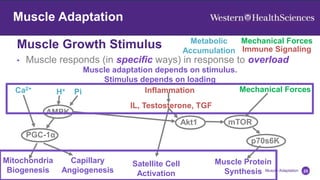
• Muscle responds (in specific ways) in response to overload
Metabolic
Accumulation
Mechanical Forces
Immune Signaling
Ca2+
H+ Pi Inflammation
IL, Testosterone, TGF
Mechanical Forces
AMPK
PGC-1α
Mitochondria
Biogenesis
Capillary
Angiogenesis
mTOR
p70s6K
Akt1
Muscle Protein
Synthesis
Satellite Cell
Activation
Muscle adaptation depends on stimulus.
Stimulus depends on loading
27.
Muscle Adaptation
Muscle GrowthStimulus
26
Muscle Adaptation
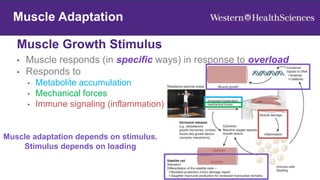
• Muscle responds (in specific ways) in response to overload
• Responds to
• Metabolite accumulation
• Mechanical forces
• Immune signaling (inflammation)
Muscle adaptation depends on stimulus.
Stimulus depends on loading
28.
27
Resistance Training
Muscle Adaptation
FinalThoughts
• Muscle composition and size (CSA) dictates its functional
performance
• Muscle size (growth or atrophy) is dependent on muscle protein
balance (MPS and MPB)
• Muscles adapt to exercise stimuli by generation of myofibril
muscle proteins, and mitochondria and capillaries, and satellite
cell differentiation into nuclei
• Muscle adaptation stimulated by accumulation of metabolites,
detection of mechanical forces, and inflammation